Two earthquakes with magnitudes of 7.7 and 7.6 occurred in Kahramanmaraş, Türkiye, on February 6, 2023, affecting 11 cities and causing severe damage and loss of life. These earthquakes were termed the “Disaster of the Century” by the Presidency of Communications of the Republic of Türkiye.Reference Kocaman 1 Earthquakes have significant negative impacts on both material and spiritual aspects of human life, particularly for survivors who experience numerous adverse effects, including physical and mental health problems.Reference Dokuzoğlu and Ünaldı 2 The psychological devastation from earthquakes is a major traumatic event, often leading to long-term issues such as anxiety, stress, hopelessness, and fear.Reference Kurt and Gülbahçe 3
To address these psychological issues, psycho-social support is crucial. Traumatic events like earthquakes cause profound changes, leading survivors to employ various coping mechanisms. Adaptive strategies include religious, familial, and social support, while less adaptive methods might involve denial, avoidance, and substance use. Religious coping, especially, is a significant strategy among natural disaster survivors.Reference Abu-Raiya, Pargament and Mahoney 4 , Reference Yilmaz, Toksoy and Direk 5 For earthquake survivors with chronic diseases, the challenges are even greater. These individuals face additional difficulties in emergency response and health precautions, exacerbating their traumatic experiences. Disruptions in health care access and treatment plans further hinder their recovery.Reference Karaman 6 Religious coping refers to the use of religious beliefs and practices to manage stress and trauma. In the context of this study, it is important to note that Türkiye’s population is predominantly Muslim (approximately 99%). This religious framework influences the coping mechanisms of individuals, as many survivors turn to prayer, gratitude, and faith-based practices to navigate the aftermath of traumatic events. These strategies align with the principles of positive religious coping, which include seeking comfort and meaning through a connection with a higher power.Reference Abu Raiya, Pargament and Mahoney 7
Religious coping strategies play a vital role in coping with these traumas, offering support and contributing to psychosocial recovery. Assessing the trauma levels and religious coping styles in chronic disease earthquake survivors is crucial for developing effective mental health interventions. This study aims to examine the relationship between post-earthquake trauma and religious coping styles in earthquake survivors with chronic diseases.
Methods
Type
The research was conducted as a cross-sectional study.
Location and Time
The study occurred in Adıyaman between May and August 2023, focusing on earthquake survivors with chronic diseases residing in tent camps.
Population and Sample
Data were collected using the snowball sampling method, used when accessing the population is challenging or information about the population is incomplete. The research was conducted descriptively in Türkiye between May and August 2023. The sample consisted of earthquake victims with chronic diseases who agreed to participate and were selected by snowball sampling. The snowball sampling process began with Nursing Student CK, a member of the research team who was residing in the tent camp during the study period. CK conducted the initial interviews by identifying participants who met the inclusion criteria and invited them to participate in the study. These initial participants then referred others in similar circumstances, allowing the sampling process to expand progressively. 250 people were reached, but 100 did not meet the research criteria, and 28 did not accept participation, resulting in a final sample of 122 people. A post hoc analysis using the G*Power program showed that the sample size was sufficient, with a power of 0.95, significance of 0.05, and effect size of 0.298, indicating the sample is at the desired level.
Inclusion Criteria
-
• 18+ years old
-
• Chronic disease
-
• Earthquake survivor in Adıyaman
-
• No communication problems
-
• Living in tent camps
-
• Internet Access
Data Collection Tools
The study’s data were collected using the “Sociodemographic Form,” “Post-Earthquake Trauma Level Determination Scale,” and “Religious Coping Scale.”
Sociodemographic Form
This form includes questions to obtain information about the descriptive characteristics of earthquake survivors.
Post-earthquake Trauma Level Determination Scale
Developed by Tanhan and KayriReference Tanhan and Kayri 8 (2014), consists of 20 negative items.Reference Tanhan and Kayri 8 PTSD symptoms are measured on a 5-point Likert scale. The scale’s scores range from 20-100. The original Cronbach’s Alpha reliability coefficient is 0.87.Reference Ekşi and Sayın 9 In this study, it was 0.866.
Religious Coping Scale
The Turkish adaptation of the scale by Abu-Raiya et al. (2008)Reference Abu Raiya, Pargament and Mahoney 7 was done by Ekşi and Sayın (2016).Reference Ekşi and Sayın 9 The “Religious Coping Scale,” with 2 subscales and 10 items, measures religious coping styles. The first 7 items measure positive religious coping, and the last 3 measure negative religious coping. The original Cronbach’s Alpha is 0.91 for positive and 0.86 for negative coping.Reference Ekşi and Sayın 9 In this study, they were 0.77 for positive and 0.84 for negative coping.
Data Collection
Researchers collected data from May to December 2023 through face-to-face meetings with earthquake survivors in Adıyaman tent camps. After explaining the study’s purpose and method, participants filled out the “Informed Consent Form.” The data collection process took about 10 minutes.
Data Analysis
Data were analyzed using SPSS (Version 22.0). Cronbach Alpha values assessed scale reliability. Normality was determined using skewness-kurtosis values and histograms, with values between +3 and -3 indicating normal distribution. Sociodemographic characteristics were presented with frequency and percentage distributions. Scale descriptions included means, standard deviations, and min-max values. Pearson Correlation analyzed relationships between scales, with P<0.05 indicating significance.
Ethical Aspects
The Atatürk University Faculty of Nursing Unit Ethics Committee approved the study’s implementation. Participants who agreed to participate also provided informed consent. The study adhered to the Helsinki Declaration.
Results
The demographic characteristics of earthquake survivors revealed: 63.1% female, 42.6% aged 41-50, 50% with primary education, 80.3% married, and 97.5% on prescribed medication. Additionally, 93.4% were not trapped under debris. Post-earthquake, 55.7% didn’t change religious practices, 58.2% occasionally forgot medications, 59% always prayed, 44.3% occasionally fasted, and 59% occasionally read the Quran. Tent living conditions: 73% believed it affected their religious beliefs. Furthermore, 92.6% always prayed, 81.1% didn’t seek support, 71.3% believed earthquakes were fate, and 94.3% believed precautions could reduce impact (Table 1).
Distribution of earthquake survivors’ sociodemographic characteristics

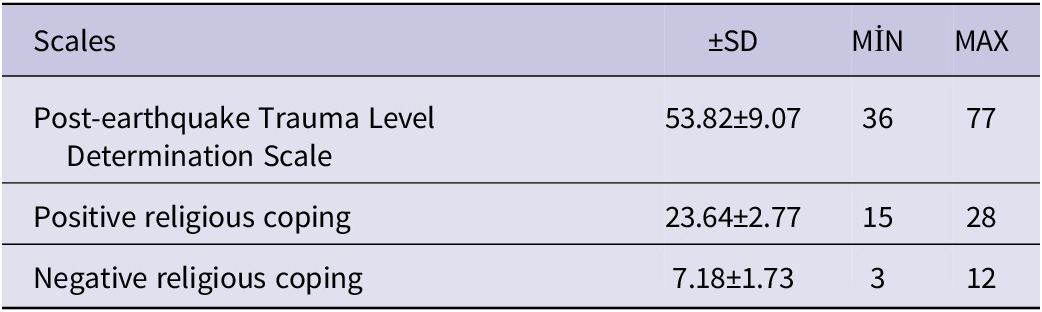
The earthquake survivors were found to have an average score of 53.82±9.07 on the Post-Earthquake Trauma Level Determination Scale, 23.64±2.77 on the Positive Religious Coping Scale, and 7.18±1.73 on the Negative Religious Coping Scale. (Table 2).
Average scores of earthquake survivors on the post-earthquake trauma level determination scale and religious coping scale

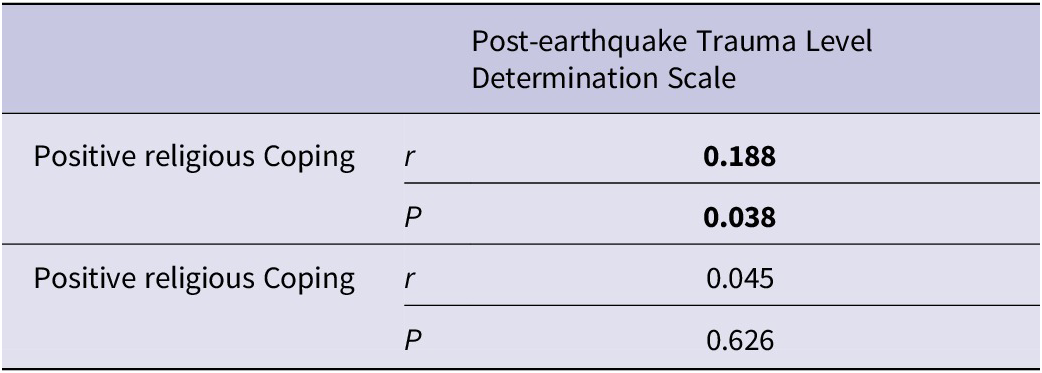
It was determined that there is a statistically significant positive relationship at a moderate level between the post-earthquake trauma levels and positive religious coping levels of earthquake survivors (P<0.05). However, no statistically significant relationship was found between the Post-Earthquake Trauma Level Determination Scale scores and the Negative Religious Coping Scale (P>0.05) (Table 3).
Examining the relationship between the Post-earthquake Trauma Level Determination Scale and Religious Coping Scale average scores of earthquake survivors

Correlation is significant at the 0.05 level (2-tailed).
Discussion
In the study investigating the relationship between post-earthquake trauma levels and religious coping styles among earthquake survivors with chronic diseases, it was found that the trauma levels were high. Kurt&GülbahçeReference Kurt and Gülbahçe 3 (2019) reported moderate traumatic stress levels among high school students after the Van earthquake. Abolhadi et al.Reference Abolhadi, Divsalar and Mosleh-Shirazi 10 (2020) similarly found high levels of post-earthquake stress nearly 20 years after the Bam earthquake. Qi et al.Reference Qi, Yang and Tan 11 (2020) noted high stress and trauma among women after the Jiuzhaigou earthquake in China. Studies involving affected individuals consistently indicate elevated trauma levels in earthquake survivors.
The data for this research were collected following the Kahramanmaraş earthquake, often called the “Disaster of the Century.” Four similar studiesReference Bahar and Çuhadar 12 –Reference Tüccar and Yavuz 15 conducted after the Kahramanmaraş-centered earthquake all found high levels of trauma symptoms. The study’s results align with existing literature, which indicates that earthquakes, unexpected and devastating events, inflict suffering and alter lives. High levels of trauma are anticipated in such circumstances. When reviewing the literature,Reference Kurt and Gülbahçe 3 , Reference Abolhadi, Divsalar and Mosleh-Shirazi 10 it is noted that these studies generally involve university students, women, and the general population. This research is unique as it is the first study with earthquake survivors who have chronic diseases. The higher trauma levels observed here may stem from the inclusion of individuals with chronic diseases in the sample. Limited medication access (32% reported regular medication use post-earthquake) and inadequate emergency support likely worsened the situation. Additionally, postponing essential aspects of chronic disease management, such as preventing complications, maintaining a proper diet, and engaging in physical activity during the earthquake, may have contributed to these trauma levels. Primary earthquake experiences such as losing a relative (56.6%), being trapped under debris (6.6%), and residing in tents (100%) also likely impacted survivors’ trauma. Another significant factor contributing to high trauma levels among earthquake survivors could be the widespread impact of the earthquake, affecting 11 provinces, gaining global attention, causing over 50,000 deaths, and being labeled the “Disaster of the Century.”
Both positive and negative religious coping levels were high among earthquake survivors. During major stressors or traumas, individuals often turn to religion and spirituality for coping. These aspects influence how individuals perceive and cope with traumatic events.Reference Harper and Pargament 16 Positive religious coping includes patience, gratitude, persistent prayer, and a fatalistic approach, while negative coping involves feeling abandoned by or angry with God. Jung and Han’sReference Jung and Han 17 (2023) systematic review found that some earthquake survivors’ religious and spiritual perspectives expanded, drawing them closer to Allah and strengthening their belief in divine intervention. DillReference Dill 18 (2017) showed that positive religious coping mechanisms act as internal resilience resources, crucial for post-traumatic growth.Reference Feder, Ahmad and Lee 19 In Türkiye, where the majority is Muslim, people often rely on Allah for support during crises, perceiving natural disasters as divine acts and performing rituals to prevent their recurrence.Reference Yilmaz, Toksoy and Direk 5 This study observed earthquake survivors using positive religious coping, believing the earthquake was fate (71.3%), increasing religious beliefs afterward (44.3%), and relying on prayer (92.6%). Feder et al.Reference Feder, Ahmad and Lee 19 noted both positive and negative religious coping among participants, including feelings of abandonment, anger toward God, and perceptions of punishment for sins.
As earthquake survivors’ trauma levels rose, their positive religious coping increased, but not their negative religious coping. Keskin and YurtReference Keskin and Yurt 20 (study on health care professionals post-Izmir earthquake) found a strong positive link between religious coping and trauma levels. DoğanReference Doğan 21 (2023) identified significant positive relationships between post-traumatic growth and positive religious coping and significant negative relationships with negative religious coping. With limited existing research on this topic, this study fills a critical gap. It highlights that those using positive religious coping tend to manage trauma more effectively. This underscores challenges like delayed resource access and inadequate response, emphasizing the role of positive religious coping in “Post-Disaster of the Century" recovery. Religion proves beneficial for earthquake survivors, especially in Muslim-majority countries like Türkiye. Most survivors with chronic diseases being Muslim likely heightens their positive religious coping. They may turn to religion for comfort and support (positive religious coping) amid earthquake-induced trauma.
Limitations of the Study
Although 11 provinces were reported for the earthquake region in the study, collecting data only from earthquake survivors in Adıyaman constitutes a limitation. Another limitation of the study is that it includes data only from earthquake survivors staying in tents, which may be insufficient due to future transitions from tents to houses. Focusing solely on Adıyaman, a region with its unique socio-cultural dynamics, and collecting data from participants living in tent camps may have influenced the findings by amplifying the psychological and social challenges faced by survivors. These conditions likely shaped the trauma levels and religious coping mechanisms observed, as the prolonged exposure to temporary living arrangements and limited access to resources could exacerbate the participants’ stress and reliance on coping strategies.
Conclusion and Recommendations
The trauma levels among earthquake survivors with chronic diseases following the earthquake in Kahramanmaraş were found to be high. As the post-earthquake trauma levels increased, so did their positive religious coping, without affecting negative coping. These findings specifically underscore the significant role of positive religious coping in managing trauma among earthquake survivors. By integrating religious coping strategies into psychological and social support services, culturally sensitive interventions can be developed to better address the needs of disaster-affected populations. Considering the cultural and religious framework of Türkiye, implementing support programs that align with survivors’ spiritual beliefs may enhance their effectiveness in managing post-traumatic stress. It is believed that proactive planning and implementation of psychological, social, and spiritual support services can effectively mitigate post-traumatic issues in such survivors following earthquakes and similar disasters. These findings are expected to aid researchers, practitioners, and policymakers in devising effective strategies for the post-earthquake period. This study paves the way for future research to explore how various coping strategies, beyond religious coping, interact with trauma levels in diverse populations, including those with different cultural and socio-economic backgrounds. Examining these dynamics could provide a more comprehensive understanding of trauma management and resilience in disaster-affected communities.
Author contribution
All listed authors meet the authorship criteria and agree with the content of the manuscript. All authors contributed to the study’s conception and design. Study design: B.Ç., M.Ş.Ö, A.A. Data collection: C.K Data analysis: M.Ş.Ö, A.A. Study supervision: B.Ç., A.A. Manuscript writing: B.Ç., M.Ş.Ö, Critical revisions for important intellectual content: B.Ç., M.Ş.Ö, A.A.
Acknowledgements
This research was conducted with earthquake survivors living in tent camps in Adıyaman, Turkey. We thank the earthquake survivors with chronic disease for participating in the study.
Funding statement
The authors declare that no funds, grants, or other forms of support were received during the preparation of this manuscript.
Competing interests
The authors have no relevant financial or non-financial interests to disclose.
Ethical standard
Ethical approval was obtained from the Atatürk University Faculty of Nursing Unit Ethics Committee for the implementation of the study. Informed consent was also obtained from participants who agreed to participate. The study adhered to the Helsinki Declaration.