Introduction
Several previous studies have explored differential employment probability according to linear body mass status, measured using the body mass index (BMI, body weight in kilograms divided by height in metres squared) or overweight/obesity status (Pagan & Davila, Reference Pagan and Davila1997; Baum & Ford, Reference Baum and Ford2004; Conley & Glauber, Reference Conley and Glauber2005; Garcia & Quintana-Domeque, Reference Garcia and Quintana-Domeque2007; Norton & Han, Reference Norton and Han2009). These studies commonly reported a penalty for BMI against employment probability for women. However, the employment area may be more important than employment per se given the heterogeneity in jobs. This study focuses particularly on the division of employment according to the salaried and self-employed categories. Previous studies have argued that self-employed people are a residual labour force, many of whom were unwillingly self-employed (Storey, Reference Storey1991; Alba-Ramirez, Reference Alba-Ramirez1994; Blanchflower, Reference Blanchflower2000). Previous studies have also shown that a transition from unemployment to self-employment is 2–3 times more likely than that from being salaried to self-employed (Evans & Leighton, Reference Evans and Leighton1989; Carrasco, Reference Carrasco1999; Kuhn & Schuetze, Reference Kuhn and Schuetze2001).
The characteristics of the self-employed in Korea mostly exhibit such marginality. Although reports from previous literature on the labour market show that the rate of self-employment generally decreases as the economy grows (Lucas, Reference Lucas1978), this does not apply to the labour market in Korea. Korea has one of the largest populations of self-employed workers among the Organisation for Economic Co-operation and Development (OECD) countries, as approximately one-third of the employed have been reported to be self-employed, whereas other countries with a similar level of national economy have much lower proportions, e.g. Taiwan at 19.5% and New Zealand at 20.8% (Yun, Reference Yun2011). Almost half of the self-employed in Korea are middle-aged, whose proportion increased to 58.4% in 2004 from 45.9% in 1993 (Sohn, Reference Sohn2007). Korea has suffered a major economic crisis multiple times since 1998, yielding a large number of layoffs and early retirements. Those who were laid off or retired early became self-employed rather than entering different salaried job. Furthermore, most of the self-employed jobs in Korea are concentrated in the low-skilled service and sales sector such as in retail shops (25%), small restaurants (66%), lodging (2%), freighting services (5%), or taxis (2%) (Yun, Reference Yun2011). These statistics imply that the self-employed in Korea are not likely to be small entrepreneurs who willingly run their own businesses with available resources such as household assets, inheritances, technology and social networks, which are important for successful businesses (Nisbet, Reference Nisbet1997; Blanchflower & Oswald, Reference Blanchflower and Oswald1998; Moog & Backes-Gellner, Reference Moog and Backes-Gellner2006). In addition, employment insurance or job training programmes are still limited for the self-employed in Korea (Yun, Reference Yun2011).
There is sporadic evidence implying employers’ prejudice against obese applicants or employees (Roehling, Reference Roehling1999; Puhl & Brownell, Reference Puhl and Brownell2001; Andreyeva et al., Reference Andreyeva, Puhl and Brownell2008; Giel et al., Reference Giel, Alizadeh, Schaffeler, Zahn, Wessel and Hesse2012). Employers may have a distaste for obese applicants, assuming that obese persons are less self-constrained or more prone to various health problems, thus affecting their job productivity (Everett, 1990; Cawley, Reference Cawley2000; Carr & Friedman, 2005; Baum & Ford, 2009; Han et al., Reference Han, Norton and Powell2011). Employers may also be concerned about the negative stereotypes that consumers may have against obese workers (Puhl & Brownell, Reference Puhl and Brownell2001; Caliendo & Lee, Reference Caliendo and Lee2013). Other than such preferential basis, employers may shun obese job applicants because they have to make decisions about hiring with asymmetric information about job applicants, and thus, visible information on the applicants, such as education, are important objective criteria that they can rely on. Obesity can be considered as one such visible signal and employers are likely to statistically discriminate against obese applicants based on their knowledge regarding the correlation of obesity with job performances. These mechanisms suggest a potential BMI penalty for being a salaried worker. Given that self-employment is the next best option to being salaried (Kumar, Reference Kumar2012), a higher sorting of obese workers into the self-employment sector can be considered to be a labour market penalty for obesity.
Only a few previous studies have expanded their assessment of the BMI penalty in self-employment, and have reported weak association of BMI status with self-employment (Garcia & Quintana-Domeque, Reference Garcia and Quintana-Domeque2007). Those studies were based on data from European countries whose labour market institutions differ substantially from those in Korea. The relationship between BMI status and labour market outcomes depends not only on labour market characteristics but also on the cultural norms regarding obesity in a given society (Garcia & Quintana-Domeque, Reference Garcia and Quintana-Domeque2007). Korea had the lowest obesity (as BMI≥30) prevalence (4%) among the OECD countries as of 2013. However, the prevalence soars to 30% when the overweight category (BMI≥25) is included, which is considerable given that a BMI of 23 or higher is recommended as being obese for Asians, as prescribed by the World Health Organization (WHO) Regional Office for the Western Pacific (WHO Regional Office, 2000). The prevalence of overweight and obesity status in Korea is higher overall in men than women (Joh et al., Reference Joh, Oh, Lee and Kawachi2013; OECD, 2014), and shows a disparity according to education level, particularly among women (OECD, 2014). At the same time, Korean men of low socioeconomic status have been reported to under-perceive their body weight status and have tried to gain weight even if they were already overweight (Joh et al., Reference Joh, Oh, Lee and Kawachi2013). Other studies have also reported overweight/obesity stigmatization in Asia. For example, Chang et al. (Reference Chang, Chang and Cheah2009) reported that overweight or obese individuals were ashamed of their body size and felt less productive in their work. Another study based in Korea reported a statistically significant positive association of weight control failure with suicidal ideation among obese women (Ju et al., Reference Ju, Han, Lee, Kim, Park and Park2016). Studies have also reported higher overestimation of body size and, accordingly, higher dissatisfaction with their own body size, more specifically among Asian women than men (Cachelin et al., Reference Cachelin, Rebeck, Chung and Pelayo2002). These studies imply possible specificity regarding BMI penalty in labour market outcomes across different cultures. Therefore, the expansion of global evidence is important to advance our understanding of the spill-over effect of BMI status on labour market outcomes.
This study builds on the previous literature and explores differential labour market performances according to BMI status, focusing on three distinct employment statuses: unemployed, self-employed and salaried. The question of whether differential earnings exist, according to BMI status, is also explored within each of the two employment sectors of self-employed and salaried, and the question of whether the differentials vary by occupational classifications within each sector is assessed. Unemployment rate in the Korean economy has soared recently, particularly among young adults (OECD, 2013), and self-employment can be considered less preferable to being salaried (Kumar, Reference Kumar2012). Therefore, if any penalty related to BMI is found in the employment distribution in each sub-sector among the employed, an increase in BMI may need to be considered as an utmost important public issue beyond the health arena.
Methods
Data
The Korean Labor and Income Panel Study (KLIPS) was used, which surveyed every member of 5000 households annually between 1998 and 2009. Multistage probability sampling was used on the KLIPS data to generate nationally representative estimates from the study results. The KLIPS is similar to the Panel Study of Income Dynamics of the US and has collected extensive information regarding the respondents’ performances in the labour market. It also collected additional information regarding the respondents’ health status, including self-reported body weight and height in the years 2005, 2007 and 2008. Therefore, the study pulled data from those three years of the survey. The final sample included 15,180 person-year observations (9645 men and 5535 women) between 20 and 65 years of age with valid information for all covariates.
Variables
The dependent variables were the labour market outcomes. A variable with three employment status categories was generated: unemployed, self-employed and salaried. The self-employed were defined as those who own a small business with less than five employees, or salaried and unpaid family workers (who work 18 h or more per week for family members or relatives without being paid) who are employed in those small businesses (Yun, Reference Yun2011). Anyone who is employed but not self-employed was defined as a salaried worker. Among the employed, monthly wages in 10,000 Korean Won (KW), approximately 10 US dollars, were used as a linear measure of the labour market outcome.
The main independent variable was BMI. In addition, a dummy indicator was generated for a clinical weight classification of overweight or obesity as BMI≥25, which is the cut-off value for defining an overweight status. The WHO recommends defining overweight as BMI between 25 and 30 and obese as BMI≥30 (WHO, 2014), whereas the WHO Regional Office for the Western Pacific recommends BMI≥23 as obesity for Asians (WHO Regional Office, 2000). The Centers for Disease Control and Prevention in Korea has used BMI≥25 to publish obesity prevalence (Centers for Disease Control and Prevention, 2012).
The following individual characteristics of the respondents were controlled for in all estimations: age in years with four splined spans of 19–30, 31–40, 41–50 and 51–65 years of age; residential areas of living in metropolitan areas, medium to small cities, with the reference of living in rural areas; marital status of being married, with the reference of being unmarried; number of children; level of education of college or more, high school graduate, with reference to less than high school; a dummy indicator for whether the respondents have any health-related difficulties in relation to performing their work; two dichotomous variables, each of which represents their current smoking and drinking status; and dummy indicators to denote risk preference of risk-preferred, risk-averse, with reference to risk-neutral. The measurement of risk preference was based on a dichotomous response to a series of questions asking about their preference between a lottery with a higher expected return and a smaller than expected value of the lottery but with a certain amount of earnings. The job sector for the employed was controlled for as a series of dummy indicators in all estimations as follows: service, sales, administration, professional and semi-professional, with reference to blue-collar jobs of manufacturing, machine operating, agriculture, mining, fishing or forestry. The job classification was based on the Korean standard classification index (Korean Standard Industrial & Job Classification, 5th edition, 2000.1.7, Statistics Korea).
Estimation
Self-employment was parsed out from being employed as salaried workers to determine whether a BMI penalty exists differentially in the self-employment sector, which is supposed to be less preferred than being a salaried worker. The BMI wage penalty by self-employment and salaried employment was also separately estimated in order to discern employers’ distaste from consumers’ distaste for obese workers as a potential mechanism for such a penalty. Also, BMI status (either linear BMI or a dummy indicator of an overweight status) was regressed on monthly wages in order to estimate the BMI penalty for labour market outcomes and the extent of heterogeneity of the penalty by the occupational group.
First a multinomial logit model for the labour market participation status on linear BMI was run:
 $$LABOUR _{{it}} \,{\equals}\ \beta _{0} {\plus}\beta ^{{BMI}} BMI_{{it}} {\plus}\beta ^{{JOB}} JOB_{{it}} {\plus}\beta ^{X} X_{{it}} {\plus}{\epsilon}_{{it}} $$
where the subscripts i and t denote the individual and year, respectively. The βs are parameters to be estimated. The variable LABOUR has three categories: unemployed, self-employed and salaried; BMI is a linear measure of BMI as weight in kilograms divided by height in metres squared; JOB is a vector with a series of dummy indicators of the employed respondents’ occupational classifications of service, sales, administration, professional and semi-professional, with reference to blue-collar jobs in year t. X it is a vector of individual characteristics that were controlled in the estimations.
An ordinary least squares model of monthly wages according to the three employment sectors of self-employed, temporary salaried and permanent salaried was then run. The following equation was used for the estimation:
 $$WAGES _{{it}}\ {\equals}\ \beta _{0} {\plus}\beta ^{{BMI}} BMI_{{it}} {\plus}\beta ^{{JOB}} JOB_{{it}} {\plus}\beta ^{X} X_{{it}} {\plus}\mu _{{it}} {\plus}{\epsilon}_{{it}} $$
where WAGES is a linear measure of the monthly income in year t for an individual i; μ is the permanent unobserved individual heterogeneity, which was controlled for only in the longitudinal individual fixed-effects model, whereas the pooled ordinary least squares model does not control for such permanent unobserved portions. Other variables are the same as those in Eqn (1).
Equation (2) was modified by introducing interaction terms of occupational classifications with BMI, as in Eqn (3), in order to determine whether a BMI penalty for monthly wages varies according to the respondents’ occupational group.
 $$WAGES_{it}\,{\equals}\,\beta _{0} {\plus}\beta ^{{BMI}} BMI_{{it}} \plus\beta ^{{BMI \,\cdot\, JOB}} BMI \cdot JOB_{{it}} {\plus}\beta ^{{JOB}} JOB_{{it}} {\plus}\beta ^{X} X_{{it}} {\plus}\mu _{{it}} {\plus}{\epsilon}_{{it}} $$
The marginal effect of a unit increase in BMI on monthly wages was calculated in Eqn (3) as β BMI +β BMI·JOB JOB it . The incremental difference in the BMI monthly wage penalty of each occupational classification compared with blue-collar occupations is β BMI·JOB .
All estimations were replicated for a dummy indicator of overweight status, defined as BMI≥25, instead of a linear BMI. All estimations were run separately by gender.
Results
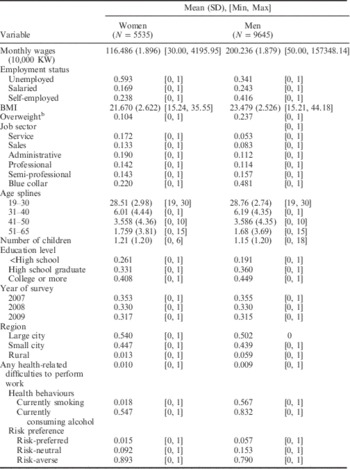
The summary statistics of the final sample used in the analysis are shown in Table 1. The average monthly income was approximately 2,000,000 KW for men and 1,164,000 KW for women. The average BMI was approximately 23.4 for men and 21.6 for women; 23.7% and 10.4% of men and women were classified as overweight and obese, respectively. Among salaried workers, 78% of men and 67% of women had permanent jobs. The proportion of self-employed among the employed was higher for men (0.416) than for women (0.238). Men occupied blue-collar jobs most frequently (48.1%), followed by semi-professional jobs (15.7%), whereas the most frequently occupied jobs for women were in the blue-collar sector (22.0%), followed by administrative (19.0%), semi-professional (14.3%) and professional (14.2%) sectors. Approximately 40% of men and women have college or higher education.
Descriptive statistics of study sample by genderFootnote a
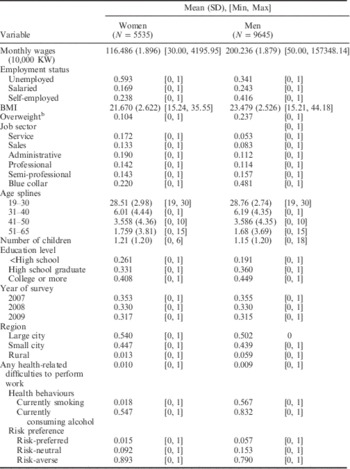
a The final study sample, including unemployed individuals, was 28,234 person-year observations (14,635 men and 13,599 women).
b A dummy indicator for a clinical weight classification of overweight or obesity was generated as BMI≥25, which is the cut-off value for defining an overweight status.
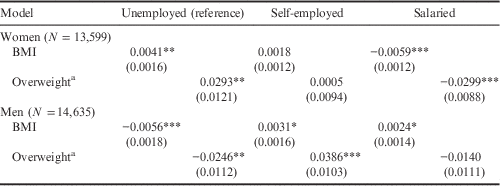
Table 2 shows the association of BMI status with the probability of being unemployed, self-employed and salaried in a multinomial logit model. Results for women show that a higher BMI or an overweight/obese status penalizes the likelihood of employment only in the salaried sector. A unit increase in BMI for women (approximately 2.71 kg increase in weight for 162 cm tall women) was associated with a higher likelihood of unemployment by approximately 0.41 percentage points, whereas it exhibited an association with a lower likelihood of being salaried by 0.59 percentage points. However, no statistically significant employment penalty was found among women for being self-employed. The relative risk ratio of being salaried compared with being unemployed by a unit increase in BMI was 0.9595 (i.e. 4.2% more likely to be unemployed than being salaried workers). For women, the relative risk of being self-employed due to a higher BMI was not statistically significantly different from that of being unemployed. Similarly, overweight/obese women were more likely to be unemployed compared with their normal weight or underweight counterparts by 2.9 percentage points. The likelihood of being a salaried worker was 2.9 percentage points lower for overweight/obese women than their counterparts; the relative risk ratio of being salaried compared with being unemployed was 0.7912 (i.e. 26.4% more likely to be unemployed than being salaried) (see upper panel of Table 2).
Association of BMI with the probability of being employed, self-employed and salaried by gender: multinomial model
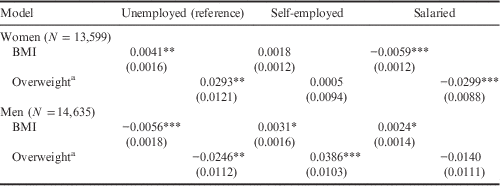
a A dummy indicator for a clinical weight classification of overweight or obesity was generated as BMI≥25, which is the cut-off value for defining an overweight status.
Numbers in parentheses are the estimated robust standard errors.
*p<0.1; **p<0.05%; ***p<0.01%.
All the estimations controlled for the individual demographic and socioeconomic characteristics given in the Methods section.
The direction of the association was the opposite for men, for whom a unit increase in BMI (approximately 3.23 kg increase in weight for 178 cm tall men) was associated with a lower likelihood of being unemployed by 5.6 percentage points. Also, a higher BMI of one unit was associated with a higher likelihood of being both self-employed and salaried for men by 3.1 and 2.4 percentage points, respectively. For men, the relative risk ratios of being self-employed and salaried compared with being unemployed were 3.3% and 2.8% with a unit increase in BMI, respectively. The results were similar when overweight/obesity was substituted for a linear measure of BMI. Overweight/obese men were less likely to be unemployed (by 2.4 percentage points) and more likely to be self-employed (by 3.8 percentage points) than normal weight or underweight men. The relative risk ratio of being self-employed compared with being unemployed was 24% higher among overweight/obese men compared with their non-obese counterparts. However, such a statistically significant reward for obesity was not found for the likelihood of being salaried (see lower panel of Table 2).
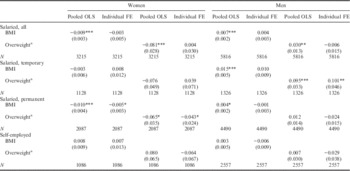
Table 3 shows the relationship of BMI with monthly wages separated by employment status and gender. Salaried women earned 90 KW less per month with each unit increase in BMI. Overweight/obese salaried women also earned 810 KW less monthly than their normal weight or underweight counterparts. However, the wage penalties among salaried women became statistically insignificant when an unobserved time-invariant individual-level heterogeneity was adjusted in a fixed-effects model. Further division of the salaried women into subgroups of being salaried in a permanent job versus being salaried in a temporary job showed a wage penalty only among those who were salaried in a permanent job. Salaried women with a permanent job were penalized in their monthly wages by 100 KW for a unit increase in BMI, and overweight/obese women in a salaried permanent job earned 650 KW less monthly than their counterparts in the same employment sector. Such a wage penalty in the permanent salaried sector was weakened but persisted when the individual-level unobserved time-invariant heterogeneity was controlled; a unit increase in BMI showed an association with a 50 KW lower monthly wage, and overweight/obese women earned 430 KW less than normal weight or underweight women. However, no statistically significant wage penalty was found among women in the self-employment job sector (see left panel in Table 3).
Association of BMI with monthly income by gender
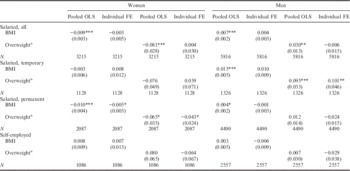
A dummy indicator for a clinical weight classification of overweight or obesity was generated as BMI≥25, which is the cut-off value for defining overweight status.
Numbers in parentheses are the estimated robust standard errors. OLS, ordinary least squares; FE, fixed effect.
*p<0.1; **p<0.05%; ***p<0.01%.
All estimations control for the individual demographic and socioeconomic characteristics as covariates, as given in the Methods section.
All estimations from a fixed-effects model controlled for the same covariates as the cross-sectional model, except that the individual fixed-effects model did not control for any time constant of individual characteristics.
Results for men differed from those for women, given that higher BMI or overweight/obesity showed an association with higher monthly wages. However, no impact of BMI on monthly wages among the self-employed was found for men, similar to that for women. In pooled Ordinary Least Squares (OLS) models, a unit increase in BMI showed an association with 70 KW higher monthly wages for all salaried men, 150 KW for salaried men with temporary jobs and only 40 KW for those with permanent jobs. Overweight/obese salaried men were estimated to earn 300 KW more monthly than non-overweight/obese salaried men. While the extent of the wage reward for overweight/obese men was increased to 950 KW in a subgroup of salaried men with temporary jobs, no statistically significant overweight/obesity wage reward was found in a subgroup of salaried men with permanent jobs. Controlling for the unobserved individual permanent heterogeneity cancelled such BMI or overweight/obesity rewards among men, except for those who were salaried in temporary jobs, where the magnitude of the reward for overweight/obesity was 101 KW (see the right panel in Table 3).
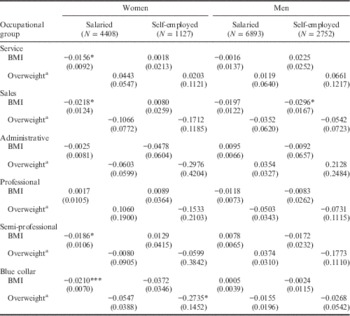
Table 4 shows differential associations of BMI status with monthly wages in an individual-level fixed-effects model by occupation groups within each subgroup of salaried and self-employed. Among salaried women, a BMI wage penalty was found for all job classifications, except for administrative occupations; as BMI increased by one unit, monthly wages for salaried women decreased for service (−156 KW), sales (−218 KW), semi-professional (−186 KW) and blue-collar occupations (−210 KW). However, no such BMI wage penalty across occupational classifications was found for self-employed women. Estimation using a dummy indicator of overweight/obesity, instead of linear BMI, yielded statistically significant results only for self-employed women in blue-collar occupations for whom overweight/obesity showed an association with lower monthly wages by 2735 KW (see left panel in Table 4). No moderations of the relationship of BMI with wages by occupational classifications were found among men, except for sales occupations in the self-employed subgroup. Self-employed men in sales earned 296 KW less monthly, as their BMI increased by one unit (see right panel in Table 4).
Associations of BMI with income by job sector: differences between salaried and self-employed groups, individual-level, fixed-effects model
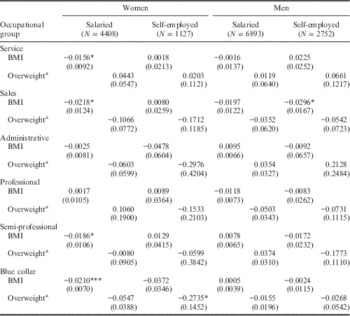
a A dummy indicator for a clinical weight classification of overweight or obesity was generated as BMI≥25, which is the cut-off value for defining an overweight status.
Numbers in parentheses are the estimated robust standard errors.
*p<0.1; **p<0.05%; ***p<0.01%.
All estimations from a fixed-effects model controlled for the same covariates as the cross-sectional model, except that the individual fixed-effects model did not control for any time constant of individual characteristics.
Discussion
This study investigated the impact of BMI on labour market outcomes, particularly focusing on heterogeneity in the relationship between self-employed and salaried subgroups, using a nationally representative panel study in South Korea. To the best of the authors’ knowledge, only a few studies have explored the relationship between self-employment and health-related issues, including obesity. For example, Lewin-Epstein and Yuchtman-Yaar (Reference Lewin-Epstein and Yuchtman-Yaar1991) reported that the self-employed have a greater burden of poorer health, possibly due to higher uncertainty that they encounter from market fluctuations. Garcia and Quintana-Domeque (Reference Garcia and Quintana-Domeque2007) reported that there is weak evidence to support an obesity penalty for self-employment. The present study builds on the previous literature and improves it by accounting for potential heterogeneity in two employment sectors, i.e. self-employment versus salaried, in order to partially distinguish whether employers’ distaste is one of the underlying mechanisms for the BMI penalty in labour market outcomes.
The findings indeed show variations in the impact of BMI status on employment by employment sectors; overweight/obese women were less likely to be employed as employees with salaries, even if they were employed, and salaried overweight/obese women had lower wage earnings than their normal weight or underweight counterparts only when they were in permanent jobs. Such earning penalty according to BMI status was found among neither salaried women with temporary jobs nor self-employed women. Such distinct impacts by employment sectors were not found for men, among whom higher BMI or overweight/obesity status exhibited positive associations with being employed in both salaried and self-employed jobs with a larger magnitude of the impact in the latter sector. The BMI wage rewards among employed men were found only for the salaried with temporary jobs. These statistically significant findings, mainly in the salaried sector, imply that employers’ distaste for workers with a high BMI is a potential mechanism for the BMI wage penalty, particularly among women.
The current study also assessed whether the relationship of BMI with wages for each self-employed and salaried sector varied by occupational groups, based on technical skills or activities. Occupational classifications tend to classify occupations with similar earnings or educational requirements in the same occupational category (Jencks et al., Reference Jencks, Perman and Rainwater1988). A BMI wage penalty was found in service, sales, semi-professional and blue-collar occupations only among salaried women, and a penalty among self-employed men in sales occupations. It is assumed that blue-collar occupations require physical strength in some aspects, and thus, the BMI penalty found in these occupational classifications for salaried women is likely to reflect physical suitability in job performance rather than the distaste of employers. However, it is acknowledged that work characteristics are likely to vary by occupation, even within the same occupational classification (Jencks et al., Reference Jencks, Perman and Rainwater1988).
Employers’ distaste for obese applicants or workers has been consistently reported in previous literature, particularly in small experimental settings, although a mechanism under which such distaste acts is not clearly suggested in those studies. For example, Giel and colleagues (Reference Giel, Alizadeh, Schaffeler, Zahn, Wessel and Hesse2012) reported that human resources personnel underestimated obese individuals’ job prestige and disqualified more obese applicants for hire or nomination for a supervisory position than non-obese applicants. Similar prejudice of employers against obese applicants was reported in other studies based on experimental settings as well (Roehling, Reference Roehling1999; Roehlings et al., Reference Roehling, Roehling and Pichler2007; Rooth, Reference Rooth2009). A few observational studies have elucidated a potential distaste on the employer side for obese workers. According to a recent study by Caliendo and Lee (Reference Caliendo and Lee2013), obese women experience at best similar employment outcomes despite more job applications and engagement in more job training. Butcher and Park (Reference Butcher and Park2008) also reported that there is a lack of evidence to infer the relative importance of employer-side effects in the obesity employment penalty based on data over 20 years between 1984–85 and 2004–05. Therefore, further studies with comparative data and a framework of studies from various labour market institutions would help us to more comprehensively understand the relationship of BMI status with labour market outcomes and the underlying mechanisms explaining such a relationship.
Employment per se would become less meaningful in studying the relationship of obesity with employment as more heterogeneity in employment exists and such heterogeneity decisively affects employment quality, and consequently, preference of job applicants for a given job. Wages can be used as the standard indicator to reflect job quality, assuming that jobs with poor work quality or contents offer higher wages to compensate for such differentials when the market is in competitive equilibrium (Smith, Reference Smith1979; Brown, Reference Brown1980). However, previous studies also imply that other quantitative and/or qualitative job characteristics such as non-financial benefits, job security or autonomy are important factors in defining preferred jobs (Jencks et al., Reference Jencks, Perman and Rainwater1988). A recent study by Kim and Han (Reference Kim and Han2015) measured job quality as a composite measure of labour market success and reported a job quality penalty in the upper quantiles for overweight women. In order to expand our understanding of the impact of BMI status on outcomes beyond the health arena, future studies need to further explore whether the extent to which BMI status impacts job quality in different social and economic contexts. At the same time, the relationship between overweight/obesity and unemployment needs to be delved into in future studies according to the characteristics of unemployment, such as whether it is voluntary or the involuntary, or duration of unemployment.
The increasing prevalence of obesity is a global concern, with its prevalence having doubled since 1980 (Visscher & Seidell, Reference Visscher and Seidell2001; WHO, 2014). It also has a well-known adverse impact on chronic diseases such as diabetes, ischaemic heart disease and cancer (WHO, 2014). Korea has also experienced a significant increase in the prevalence of overweight/obesity in its population: 31.7% of adults were reported to be overweight/obese (BMI ≥ 25 kg/m2) in 2007, whereas the prevalence was 29.2% in 2005 and 26.0% in 1998 (Kim et al., Reference Kim, Lee and Han2014). Parallel to such an increase in the prevalence of obesity, an increasing number of studies have explored the impact of obesity on outcomes beyond the health sector, such as education and job market performances (Hammond & Levine, Reference Hammond and Levine2010). However, only a few studies have been based on Asia, where many countries, including Korea, have much more rapid economic growth with much slower comparable progression in labour market institutions, including collective bargaining or unionization, than US or European countries (Freeman, Reference Freeman2007; Yun, Reference Yun2011). The existence and extent of the relationship of obesity with labour market outcomes is likely to rely on specific local contexts given the heterogeneity in labour market situations and cultural norms regarding BMI status in each society. Therefore, the collection of global evidence is important for a better understanding of the comprehensive impact of BMI. The current study adds important global evidence regarding the BMI penalty for labour market performance, particularly carving out employer-side distaste for workers with a high BMI status.
In conclusion, this study shows variations in the impact of BMI status on labour market outcomes by employment characteristics. First, overweight/obese women were less likely to have salaried jobs than underweight/normal weight women, whereas overweight/obese men were more likely to be employed than underweight/normal weight men in both salaried and self-employed sectors. Second, overweight/obese women had lower wages only in salaried permanent jobs than underweight/normal weight women, whereas overweight/obese men earned higher wages than underweight/normal weight men only in salaried temporary jobs. Third, overweight/obese women earned lower wages than underweight/normal weight women in service, sales, semi-professional, and blue-collar jobs only in the salaried sector, whereas overweight/obese men have lower wages than underweight/normal weight men only in sales jobs only in the self-employed sector. The findings imply that heterogeneous job characteristics across employment sectors and occupational groups within a given employment sector need to be accounted for when assessing the impact of BMI status on labour market outcomes.
Acknowledgments
Research support from the Korea National Research Foundation (2014R1A1A3A04049984) is gratefully acknowledged. The content of this paper is solely the responsibility of the authors and does not necessarily represent the official view of the Korea National Research Foundation. The Korea National Research Foundation had no involvement in the preparation and submission of this manuscript. The authors have no conflicts of interest to disclose.