A talking machine is the prime mover, if not the central character, of Frederic Beecher Perkins's little-known short story “The Man-ufactory” (1877): the human figures merely exist to reveal information about the device.Footnote 1 Perkins's speculative tale tours readers through a factory that produces talking machines made of a jumble of wood, leather, and rubber that collectively imitates human vocal anatomy. The machines are adorned with humanoid dummies and capable of “long, connected discourse” with “fluent clearness” and “natural articulation.”Footnote 2 The remarkable invention was ostensibly created by Professor Faber of Vienna. Faber turns out to be a fictional contrivance of an American entrepreneur named Budlong, who amusingly reveals: “Faber is Latin for Smith; and professor is American for anybody.”Footnote 3 Budlong envisions his invention as a replacement for a variety of vocal vocations—orators, preachers, politicians—and the story slips into a nightmarish vision of the displacement of humanity in favor of cost-efficient and strictly moral speechifying automatons. “The Man-ufactory” hauntingly suggests that when the voice no longer indexes humanity, humanity itself is no longer necessary.
The talking machine seems to be as much an invention of Perkins's creativity as Faber was of Budlong's; however, a similar device appears in contemporaneous fiction. The short story “Economical Love” (1878), written by the pseudonymous “The Major,” features a lovely young woman named Euphonia, an automaton comprised of various parts who talks and sings.Footnote 4 Rather than producing inventions from their own imaginative faculties, both Perkins and “The Major” are indebted to the historical figure of Joseph Faber and his speech simulator known as the Euphonia. The following article resurrects this largely forgotten technology and puts it in dialogue with literary criticism in order to better understand the fictive representation of the voice.
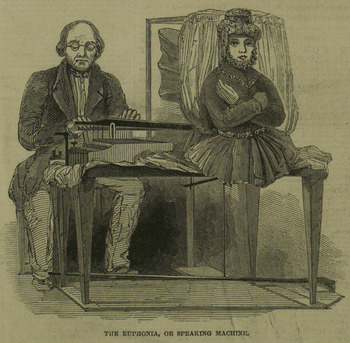
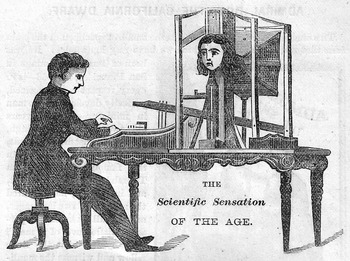
The Euphonia—also known as the Wonderful, Marvelous, or Amazing Talking Machine—simulated rather than reproduced speech, predating the existence of audio-recording technology by decades. Widespread sound recording began with Thomas Edison's 1877 invention of the phonograph, credited with redeeming “sound waves from the curse of transience.”Footnote 5 The story of the Euphonia's exhibition, by contrast, begins in the early 1840s before Edison was born. Rather than record speech, the Euphonia—which consisted of a complex mechanical apparatus, keyboard, and humanoid dummy (fig. 1)—was actively played by Faber, much like a piano, in order to produce its mechanized voice. It was a mixture of machine and maker, of speech simulation and human manipulation. This duality in the Euphonia's operation provides a conceptual model for how nineteenth-century novelists created voices in their texts, an understanding that puts pressure on the critical tendency to align fictional speech with recording rather than simulation.
“The Euphonia,” Illustrated London News, August 8, 1846, 96.

The few accounts of the Euphonia in recent work come from musicologists, historians, and film scholars, with literary critics thus far remaining silent.Footnote 6 Meanwhile, a profusion of research on literary phonography has offered rich accounts of the reciprocal relationship between texts and technologies. Naturally, there is not a consensus among scholars on the relationship between the phonograph and literature: it has been positioned as “dig[ging] the grave of the author,” as a fierce competitor for the “same cultural space as the Victorian novel,” and as an interactive device used by and influential on eminent Victorian writers.Footnote 7 Whether characterized as authorial murderer, competitor, or influencer, the phonograph has been unchallenged as the primary audio-technological interlocutor of fiction until recently.
This fixation has been aptly diagnosed by Paul Saint-Amour as a “gramophone problem,” indicating the now-reflexive tendency of literary scholars to reach for the “phonographic assemblage” when they want to put sound technology in dialogue with literature.Footnote 8 Saint-Amour explains the logic behind this habitual turn to the phonograph: it recorded the voices of several prominent literary figures; it appears as a diegetic object in canonized late-Victorian and modernist fiction from Arthur Conan Doyle to Ralph Ellison; and its very name announces the promise to write sound. Saint-Amour points our attention to the player piano, or pianola, as one way to lift the stylus off the siren song of the phonograph; this is not to supplant one “technological determinism” in favor of another but to help place “literature in the fullest mediatic landscape.”Footnote 9 My goal is in sympathy with Saint-Amour's insights, though it tends in a somewhat different direction. I propose that literary scholars are not only fixated with one sound-recording technology (the phonograph) but with sound recording itself (the inscription of sonic data onto a surface that can be replayed). By turning to voice-simulating technologies that emphasize imitation and not reproduction through the case of the Euphonia, I provide an alternative for unpacking the reciprocally influential relationship between textual and sonic forms of vocalization.
The Euphonia was a rival to the phonograph as an alternative theorizer of the voice and the voice's mechanization, not as a comparable commodity (it was never manufactured and sold). The Euphonia mechanizes the voice in a way that emphasizes the integrality of human anatomy and performativity to the voice's construction, despite its technologically simulated speech. By contrast, these human features are erased or minimized in the phonograph, widely conceived of as a tool of vocal disembodiment.Footnote 10 Ironically, the machinic voice of the Euphonia is more intimately tied to human corporeality than the human voices of phonographic recordings. Despite this inextricability from human embodiment, the Euphonia conjures a type of voice that troubles stratified identity categories like gender, race, nationality, and ability. Both sonically and visually (with its use of shifting humanoid dummies), the machine vocalizes an androgynous and translingual cosmopolitanism through its fluid gender presentation and polyglot utterances. In other words, the Euphonia is fixated on embodiment but eschews identity, crafting a voice from a reconstruction of human corporeality that refuses to slot itself into human-created divisions of difference. It is, in short, the vocal “self before categories.”Footnote 11
The idea of the phonograph and the Euphonia as distinct conceptual approaches to speech replication dates back to an 1878 piece by physicist Alfred M. Mayer. Mayer declares, “All talking-machines may be reduced to two types. That of Prof. Faber . . . is the most perfect example of one type; that of Mr. Edison is the only example of the other . . . Faber solved the problem by reproducing the mechanical causes of the vibrations making voice and speech; Edison solved it by obtaining the mechanical effects of these vibrations.”Footnote 12 The phonograph's invention in the last quarter of the nineteenth century initiates a schism between two forms of speech replication: Faber mimics the physiology of the voice by mechanizing “artificial organ[s] of speech,” whereas Edison captures the effects of the voice by impressing sonic data onto metallic foil, wax, and other materials, thereby mimicking the ear.Footnote 13 Put differently, Faber simulates the human voice, while Edison inscribes/reproduces it. Considering the relation of the former to literature provides a reconceptualization of the aims and operations of depicting human voices in the nineteenth-century novel.
The schism between types of speech replication outlined by Mayer is also apparent in the fictional rewritings of Faber, his machine, and its vocal theorizations with which I began. Perkins's “The Man-ufactory” was published in the same year and country in which Edison invented the phonograph and depicts Budlong commodifying the Euphonia as a marvel of American ingenuity. The shift from simulation to recording is neatly captured in an announcement of a publisher's close call with producing a plagiarized version of Perkins's stories in 1886, a decade after their initial appearance: the plagiarized copy was entitled “Dr. Edison's Conundrums.”Footnote 14 Despite Faber's explicit place in Perkins's story, ten years of phonographic prominence was enough for Edison to eclipse and supplant his predecessor as the vocal-inventor-as-literary-inspiration. Similarly, though “Economical Love” features a device named the Euphonia that shares its external paraphernalia, the story ends by revealing that the machine was “artfully packed” with “phonographs.”Footnote 15 Here, only a year was needed for the Euphonia to be appropriated as a name for the inner workings of Edison's machine, rather than Faber's.Footnote 16
Even in 1878, it seemed likely which invention would win out, but the survival of a technology now does not determine its significance then.Footnote 17 Following Lisa Gitelman, I attend to an invention in the historical “discard pile” as a tool for providing the most detailed account of the relationship between technology and textuality in a period.Footnote 18 The Euphonia can be thought of as a noncanonical technology: its diegetic appearances take place in texts little noticed at their time of publication or today (in contrast with the phonographic Dracula [1897], for instance), and it is relegated to the fringes of accounts of the technologizing of sound, if mentioned at all.Footnote 19 My turn to the Euphonia does not proclaim its overlooked ubiquity, nor satisfy a need for comprehensiveness; rather, I unpack its utility as a model for understanding literary representations of the human voice. The Euphonia helps us understand fictive voices as collaborative simulations, rather than recordings—the latter a durable notion from the nineteenth century until today—and to trouble connections between vocal particularity and human identity.Footnote 20
In what follows, I provide an account of the Euphonia's creator, Joseph Faber, as well as the invention, exhibition, and disappearance of his machine, starting in the 1840s and ending in 1887. This account elucidates how the Euphonia articulated a theory of the voice ostensibly disentangled from identity. Next, I turn to George Du Maurier's best-selling novel Trilby (1894), one of the most famous representations of Victorian voice.Footnote 21 Du Maurier's text presents Trilby, a tone-deaf and charming laundress in 1850s Bohemian Paris, and her transformation into an international opera star through the mesmeric manipulations of the villainous Svengali. Contemporary interpretations aligning Trilby with the phonograph are predicated on a conflation of vocal simulation and vocal recording.Footnote 22 A phonograph records and replays preexisting sound, but it does not generate wholly new sound. There is no preexisting source for Trilby's performances that is recorded and then replayed; rather, her performances are actively generated by Svengali (a figure with striking parallels to Faber) live on stage. She is a product of both Du Maurier's authorship and Svengali's mesmerism. If Trilby's own voice was recorded and replayed, like sound from a phonograph, audiences would be horrified by her tone-deaf ineptitude, but, through the manipulation of another human, she becomes the defining voice of her century. Trilby exemplifies the limitations of the phonographic fixation in literary studies: a habitual turn to the phonograph to illuminate vocal representations obfuscates more apt and otherwise neglected connections between literature and other sonic technologies, like Trilby's closer resemblance to the Euphonia.Footnote 23
The Euphonia facilitates a new investigation of the relationship between voices and novelistic writing. Scholarship that aligns the phonograph with the novel can seem to imply that the latter is a transcribing device that textually records the precise words spoken by real people. The assumption that the novel is doing what the phonograph does dates to Edison himself. Edison insists on the “fidelity” of his phonographic recordings, which allow the machine to assert its dominance as accurate vocal transcriber over the human, wresting the role of preserving utterances from “skillful observers, listeners and realistic novelists” who “cannot reproduce a conversation exactly as it occurred.”Footnote 24 He describes this reproduced exactitude, his phonograph providing an “unimpeachable transcript of . . . conversation . . . with every break and pause, every hesitation or confident affirmation.” Returning to Edison's now-outstripped list of human recorders of speech, we can query whether it was ever the intention or aspiration of “realistic” novelists to put dialogue on the page “exactly” as it happened. In addition, assuming that novelistic dialogues are fictional and not transcripts of utterances that took place “in reality,” we can ask whether novelists in the realist tradition aimed to replicate the forms of speech exactly as they would be said. Neither case seems accurate, as a novel replete with “every break and pause, every hesitation” of actual speech would be a novel very few people would read.Footnote 25
In other words, even the most canonically realist authors cannot be described as recording voices verbatim; instead, novels amplify, echo, or diminish the voices that resound around their writers. Novelists create voices based on reality, but they do not reproduce them. I argue that the novel's method of creating voices is more homologous to that of the Euphonia than that of the phonograph. A novelist cannot hit record and leave the room and return to a neatly inscribed artifact ready for replaying/rereading. Novels do not offer reproductions of previously spoken utterances; rather, they play with the raw material of the voice in order to create new words and sounds that resemble “reality.” With the Euphonia as a guide, I align novels with technologies of vocal simulation, rather than speech reproduction, thereby providing a new vocal ontology for the novel. Along the way, I explore how the Euphonia's mechanical speech simulation troubles the integrity of discrete linguistic and gender categories as reflected in Trilby, my case study to show the Euphonia's use as a model for understanding vocal representation. The paucity of recorded speech prior to the twentieth century means scholars need other ways to explore vocal histories, and I propose the Euphonia as one such conceptual tool. It elucidates the collaborative and power-inflected performances between audiences, writers, and technologies of print that result in the voices of nineteenth-century fiction.
“So far as talking is characteristic of man, he has made a man”: The Euphonia's Exhibition
So what exactly was the Euphonia?Footnote 26 Part automaton, part human-operated musical instrument, part speech simulator, the Euphonia's story is not an easy one to tell, especially as its inventor, Joseph Faber, left behind no writings about the machine.Footnote 27 Recollections about Faber and his Euphonia—scattered through newspapers, memoirs, scientific journals, and speech manuals—provide a varied portrait of inventor, device, and their degree of notoriety throughout the nineteenth century. My motivation is less to stake out the Euphonia's place in history as the first viable mechanical speech simulator than to parse out what sort of potentialities it represented. Whether or not the machine functioned exactly as commentators claimed it did is not as significant, for my purposes, as the fact that it circulated in a variety of discourses as if it did work and, in the process, challenged conceptions of the voice as a sonic index of particularity, as a way of conveying the identity of speakers.
Faber was born in Freiburg in the Grand Duchy of Baden in southwestern Germany around 1800, and later relocated to Vienna where he was attached to an observatory as an astronomer. Failing eyesight ended Faber's ambitions in astronomy and turned him toward anatomy and mechanics.Footnote 28 Nineteenth-century accounts emphasize the amount of time Faber spent developing his sprachmaschine, or speaking machine, before sharing it with the world, with numbers ranging from fourteen to twenty-seven years, while others revel in the “fact” that Faber devoted seven years exclusively toward getting the Euphonia to pronounce the letter e.Footnote 29 While the first accounts of the machine's public exhibition describe Faber's energy and enthusiasm, successive reports note his depressed and disheveled appearance, the change likely attributable to the fact that most reviews of the Euphonia declared it to be mechanically impressive, yet ultimately trivial and useless.Footnote 30
The machine itself consisted of a wooden table supporting a mechanical reconstruction of the human tongue, larynx, glottis, vocal cords, and other speech organs, made of rubber, ivory, and leather; piano-like levers, strings, pedals, and seventeen keys; a set of bellows equivalent to a pair of lungs; all crowned with a humanoid dummy. Faber played a keyboard to facilitate the Euphonia's speech and operated the pedals to control the bellows. Sixteen keys were marked with characters representing elementary sounds, and a seventeenth key was used to open the machine's glottis; strings and levers filled in for tendons and muscles.Footnote 31 Different keys and combinations of keys corresponded to different phonemes, thereby modulating the voice.Footnote 32
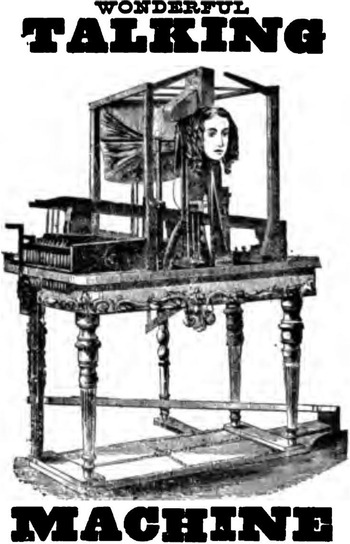
After its debut in front of the king of Bavaria, the machine was exhibited in New York City in 1844 and Philadelphia in 1845, before being purchased by P. T. Barnum.Footnote 33 Barnum is credited with naming the device the Euphonia and subsequently displaying it in London in 1846.Footnote 34 Back in Europe, the Euphonia was “critically examined and highly eulogized” by such luminaries as the emperor of Austria and the duke of Wellington.Footnote 35 Nonetheless, many accounts, likely apocryphal, describe Faber destroying the machine and committing suicide in the 1850s or 1860s due to the Euphonia's poor reception, frequently paralleling the duo to Frankenstein and his monster.Footnote 36 Regardless, the machine survived and Faber did not, and by the 1860s it was being exhibited on both sides of the Atlantic by Faber's niece Maria and her husband, the latter self-stylizing himself as Professor Faber and rechristening the Euphonia as the Amazing Talking Machine. The device was irregularly shown for the next two decades until the mid-1880s, remaining an attraction of Barnum's circuses and museums throughout North America and Europe (fig. 2). Following a heated marital dispute between Maria and her husband over the legal ownership of the machine—including a divorce case brought to the Supreme Court of the United States and a suicide attempt by Maria that made newspapers across America—it disappeared in 1887, after over four decades of exhibition.Footnote 37
Harry Houdini, The Unmasking (1908), 90.

The Euphonia's interactive performances were as fascinating as the dramatic lives of its owners. Audience members would request that the machine pronounce particular words and sentences or answer certain questions; then Faber, and later Maria or her husband as his successors, would mentally divide the word into separate phonemes; and, finally, they would press the appropriate keys to reassemble the word or phrase.Footnote 38 Maria, for one, is noted for getting the machine to pronounce complicated multisyllabic words including “Constantinople” and “Mississippi” and for making the machine hiss, groan, laugh, and murmur.Footnote 39 The process—the rapid-fire atomization of words into phonetic components—was not an easy one and “required the constant attention of the inventor.”Footnote 40 One reporter admits that their own attempt to make the Euphonia speak “sounded rather ludicrous.”Footnote 41 Despite the shock of most writers over the machine, they generally trusted the legitimacy of the Euphonia, not attributing its efficacy to ventriloquism or another form of trickery common in other purported talking machines of the period.Footnote 42
The Euphonia often sang at the climax of its performances, usually “Hail, Columbia” in the United States and “God Save the Queen” in England, to suit the national context of its performance.Footnote 43 Faber would also play a second keyboard to provide musical accompaniment while the Euphonia sang. Accounts of its exhibition repeatedly detail its polyglot nature—the machine's ability to speak “in any language.”Footnote 44 Although they often attribute a slight German accent to its pronunciations, most commentators conclude that it speaks better English than Faber himself.Footnote 45 In this sense, the machine materializes the possibility of a translingual cosmopolitanism while simultaneously marking the failure of that possibility.
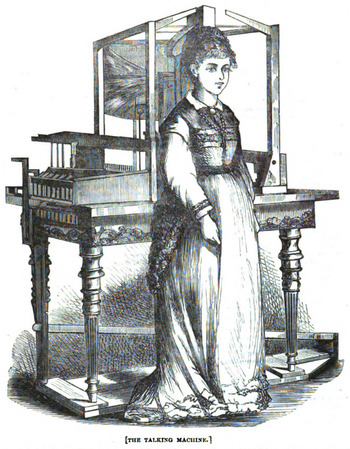
The sonic, national, and linguistic flexibilities of the machine have provocative parallels in its visual component. The initial dummy for the Euphonia was a male “Turk,” elaborately dressed and rather effeminate. Automatons were steeped in the Orientalism of the period and were often dressed as “Turks” throughout the eighteenth and nineteenth centuries (“Why are all automata dressed in turbans?” wonders one journalist).Footnote 46 Later, the “Turk” was replaced by a dummy resembling a white woman (the swap likely made by Maria and her husband), either consisting of a head with hair (fig. 2) or an entire female figure (fig. 3).Footnote 47 Either way, the dummy embodied a departure from the unstated norm of white maleness, whether via race or gender, proffering both the white woman and the Turkish man as the kinds of bodies that can be manipulated by those at the apex of imperial patriarchy. Interestingly, while newspaper reports gender the dummy, they avoid gendering the voice of the Euphonia itself. One reporter describes the listening experience as a reverberating transfer of voice between genders, “as if a lady were echoing the voice and words of the professor.”Footnote 48 While the Euphonia's external dummy can be linked to an identity, the audible voice it produces cannot. Both the need for a visual anthropomorphic element to the machine as well as the changing gender and race of the device are important: they indicate the Euphonia's relation to humanity writ large, while also signaling its refusal to commit to categories of difference.
“The Latest Invention,” London Journal, November 1, 1870, 245.

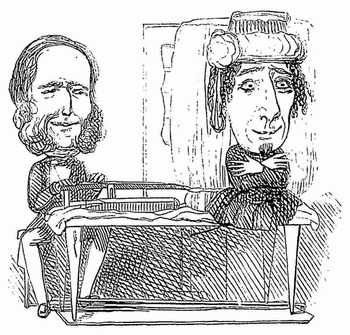
Furthermore, the Euphonia was envisioned as a tool for normalizing speech. Reports declare that the machine, via its de/reconstruction of language, pronounces words “more clearly than the majority of human beings,” speaking with “perfect fluency,” and, as such, would be beneficial for “educational purposes,” particularly “elocutionary instruction.”Footnote 49 It is imagined as a type of speech synthesizer for those with difficulty speaking, one reporter suggesting that “dumb or weak-nerved and feeble-voiced individuals should choose to purchase them and use them as mediums through which to address the public,” a nineteenth-century version of contemporary technologies like text-to-speech software and electrolarynxes.Footnote 50 William Makepeace Thackeray's Punch article about the Euphonia takes this idea a step further, joking that it would be ideal for purifying Parliament of its vocal variety, banishing “a Scotch accent like LORD BROUGHAM's or a high key like MR. SHIEL's, or a conventicle twang like SIR RODGER's” (fig. 4).Footnote 51 Thackeray epitomizes what is implicit in several reports on the machine: the Euphonia approximates human vocalization while simultaneously effacing all the variations (regional accent, pitch, volume, etc.) that particularize and distinguish human voices.
“The Speaking Machine,” Punch, August 22, 1846, 83. The accompanying sketch imagines George Bentinck using Benjamin Disraeli as his Euphonia.

Unsurprisingly, then, the main complaint of the Euphonia's witnesses is the monotony of the machine's voice.Footnote 52 This monotony is symptomatic of how the Euphonia blurs categories of nationality, language, gender, race, and ability; in short, it conjures a voice that refuses to index identity, that is bereft of difference. In this sense, the Euphonia and the concept of speech simulation it represents suggest an alternative trajectory from the archival drive of the phonograph, which seeks to render voices immortal in their individuality.Footnote 53 The Euphonia homogenizes; the phonograph particularizes. Months after Edison announced the invention of the phonograph, George Eliot wrote to a friend: “What do you say to the phonograph, which can report gentlemen's bad speeches with all their stammering?”Footnote 54 Eliot sees the phonograph as emphasizing the human voice's vulnerabilities by making them permanent and repeatable. When a stammer is ephemeral it remains potentially malleable,Footnote 55 but when inscribed into the wax or tinfoil of Edison's phonographic cylinders, it becomes indelible, the machine documenting and replaying moments of spoken diversity. Thackeray imagines the Euphonia erasing vocal difference, while Eliot imagines the phonograph immortalizing it.
The Euphonia's vocality—and its attendant destabilization of identity—finds parallel expression in Du Maurier's Trilby. The eponymous Trilby becomes a mobile exhibit akin to the Euphonia throughout the novel. Like the machine, she performs fantastic vocal feats that, despite their seemingly superhuman quality, are contingent on the manipulation of another person for their execution. Without (one of the) Faber(s) and Svengali, the Euphonia and Trilby fall silent at the end of their exhibition history and narrative, respectively. By reading Trilby, I suggest that the narrative of mechanized speech sketched above is not only overlooked in the history of technologized voices but is also crucial for interpreting the textual representation of voices as more concerned with generation via simulation than reproduction via recording.
La Svengali as Euphonia: Svengali/Joseph/Dummy, Trilby/Maria/Dummy
“[T]he bridge of your nose is like the belly of a Stradivarius—what a sounding-board! and inside your beautiful big chest the lungs are made of leather.” This speech, which could be Faber addressing his Euphonia, instead belongs to another genius of vocal simulation, Du Maurier's Svengali, who directs it at Trilby.Footnote 56 In it, Svengali transforms Trilby into a human instrument, device, and commodity, with the wood and leather construction recalling the materiality of the Euphonia. Furthermore, the wood of the Stradivarius is the main ingredient in paper, whereas the leather of the lungs could be used to create bookbinding. Svengali's mechanical anatomizing of Trilby as an instrument for simulating the voice, then, also likens her materiality to that of a book. Trilby's embodiment suggests both the novel and the vocal simulator or, rather, the novel as vocal simulator. One account of the Euphonia's exhibition ends with a major limitation of the machine: “a singing machine . . . combining words and music as a human singer would do—still remains beyond the skill of any automaton maker.”Footnote 57 The Euphonia was the ultimate speaking machine to date, but its monotonous “singing” left this writer underwhelmed. It would take the immensely popular Trilby—which, like the Euphonia, garnered much attention on both sides of the Atlantic—to offer a detailed imagining of a singing machine that simulates human musicality.
It is difficult to know conclusively whether Du Maurier was aware of Faber's machine, but it was consistently exhibited throughout Britain and France where he alternately resided. Furthermore, as mentioned previously, Thackeray wrote about the Euphonia in the pages of Punch.Footnote 58 As Thackeray was Du Maurier's idol and model for his own career,Footnote 59 his piece may have been a link between Faber's machine and its inheritor in Du Maurier's character, the latter entering popular culture a few years after the former vanishes. References to the Euphonia crop up in subsequent issues of Punch, with an 1869 iteration joking that the Social Science Congress is “wrongly . . . accused of being a mere talking machine.”Footnote 60 Du Maurier was an illustrator for Punch in 1869: this glancing reference to Faber's machine appears at the bottom of page 143 of the issue, and the entirety of the next page consists of a series of illustrations with a telltale “DM” scrawled in the bottom corner.Footnote 61 Earlier in the decade, an ambitious Du Maurier was eager to have his work featured in the Cornhill Magazine, a frequent topic in his letters at the time. In March 1863 he writes to his mother to announce he has achieved his aim and will appear in Cornhill, declaring: “I'm in devilish good company—Leighton and Millais.”Footnote 62 Du Maurier's first Cornhill illustration would appear in April 1863, and the March issue contemporaneous with his letter does indeed feature the work of Leighton and Millais as well as a long paragraph about the Euphonia in the magazine's “Notes on Science.” The piece describes a machine “which so accurately imitates the human mechanism” and “is made to sing any song” invented by “a German, named Faber.”Footnote 63 When the seventh volume of Cornhill (January through June of 1863) was published later that year, both this description of Faber's invention and Du Maurier's first illustration were included: ten or so lines separate “Manufacture of the Voice” from the poem Du Maurier illustrated, W. Frank Smith's “The Cilician Pirates,” in the table of contents. These instances of proximity between journalistic accounts of the Euphonia and Du Maurier's own work, along with the frequent mention of the machine in other publications he worked for, make it probable that he had at the very least heard of it.Footnote 64
Regardless, the striking parallels between the Euphonia and Trilby elucidate their shared vision of an unsustainable form of vocality that transcends human stratification, a joint desire for a voice that does not index identity. Nineteenth-century accounts of the former singing “by means of [Faber's] contrivance, [and] through the mouth of the ever-compliant Euphonia” and thus becoming “indisputably the most popular singer of the day” serve as a fitting summary of the eventual relationship between Svengali and Trilby.Footnote 65 Trilby can be read as a novel that mediates the shift from older models of vocal performance (live, operatic singing) to newer forms of technological vocal performance (a trend Faber's device, and subsequently the phonograph, participated in).Footnote 66 Trilby is preoccupied with the voice, perhaps more than any other nineteenth-century novel, variously exploring the voice in relation to medicine, erotics, cultural hybridity, morality, machines, and more. The sheer frequency of the word “voice” is notable as is the centrality of voice to the character of Trilby: it is her most notable feature.Footnote 67
Du Maurier was often praised for his ability to render speech on the page. Lionel Stevenson, referring to Du Maurier's work in Punch, describes how he would polish the captions for his illustrations “with the care of a poet until it captured exactly the appropriate intonation or dialect or foreign accent.”Footnote 68 He was especially noted for his parodies of Cockney French, which are key to Trilby's nonmesmerized idiolect. Du Maurier's close friend Henry James remarks that he wrote “a style so talked and smoked . . . so whistled and sung, that it never occurs to us even to ask ourselves whether it is written.”Footnote 69 In other words, Du Maurier was skilled at depicting the human voice via print, at representing variations in articulation in such a quotidian, realistic way as to blur their textual medium of transmission with the repurposed sonic material that comprised them. Elsewhere, James remarks that Du Maurier's novels “come as near as possible to reading as if a report of it had been taken down at various times by an emissary behind the door,” again invoking the figure of the novelist as vocal recorder, of hurriedly scribbling down actual utterances to comprise a narrative.Footnote 70 By contrast, I argue that Du Maurier takes his skills in the believable simulation of voices to the world of fiction when he becomes a novelist: not transcribing real speeches, but collaboratively mixing the soundscapes of fin-de-siècle England and midcentury Paris with active invention in Trilby.
Trilby, his second novel, is the story of the eponymous amiable and morally fluid grisette who befriends a trio of British artists and is eventually transformed into an international opera star known as La Svengali through the mesmeric control of the villainous musical genius, Svengali, depicted using a battery of anti-Semitic conventions. Critical commonplaces about the machinic nature of Trilby's transformation are unsettled by recourse to the Euphonia. Contemporary interpretations of Trilby see her mechanization—furthered by Svengali's later mesmeric control over her—as turning the heroine into a human phonograph. This is implicitly suggested in Picker, succinctly captured in Galvan's references to “phonographic Trilby” and “phonographic La Svengali,” and explicitly stated by Gitelman: “Though tone-deaf, Trilby is made to sing in a trance, and the result is perfection, a phonograph.”Footnote 71 Gitelman's reading is predicated on a tenuous alignment between perfection and phonography. The qualitative “perfection” of Trilby's/La Svengali's voice is demonstrated by her captivating audiences all across Europe. However, as suggested by the earlier quotation from Eliot, this type of perfection was often far removed from the voices recorded by the phonograph. Recall that Eliot is intrigued by the phonograph capturing a stammer, an utterance socially distinguished from the renowned performances of an international singing phenomenon. The novel itself builds on this distinction, vocally contrasting Trilby's pleasing talking voice (when under her own volition) and captivating singing voice (when mesmerized) to the habitual stammering of her would-be, and ultimately unsuccessful, suitor, Little Billee.
Therefore, while Trilby is undeniably a vocal machine, she is not a phonograph. Instead, Trilby's mesmerized singing prowess—a mix of performer and instrument—more closely approximates the difference-effacing drive of the Euphonia. Like the machine, both Trilby's embodiment and voice are androgynous: it is remarked she would “have made a singularly handsome boy,” even that “it was a real pity she wasn't a boy,” and that she had a “voice of great volume, and that might have belonged to any sex (even an angel's)” (12–13).Footnote 72 While Trilby's physicality straddles the line between masculine and feminine, her fluid voice does not index a single gender, or even humanity itself.Footnote 73
These same pages describe Trilby speaking “in English, with an accent half Scotch and certain French intonations” (13). The international crowding in Trilby's voice—capable of several languages, but suffused with the accents of particular places—recalls the cosmopolitan character of the Euphonia's speech, which remains shot through with a German accent; furthermore, both Trilby and the Euphonia are polyglots, performing in multiple languages throughout their exhibition and performance histories. Trilby uses “hybrid talk,” possessing a voice of “eccentric variety,” an audible indication of her elusive resistance to conventional designations of class position and national identity.Footnote 74 And this is part of the threatening nature she shares with Faber's device, an unnerving intertwining of languages that challenges homogeneous linguistic cultures.Footnote 75
The particularity of Trilby's idiolect that persists despite this variety—encapsulated in her frequent exclamation of “maïe, aïe!”—is compromised by her transformation into La Svengali. Indeed, many of her performances when mesmerized by Svengali are nonlinguistic in nature or suggest a sort of universal language: the vocalization of musical notes without any attendant lyrics or the evacuation of the national resonances and local contexts of certain songs. Offstage, La Svengali “loses nearly all awareness of cultural difference and, deprived of [Trilby's] distinctive capacity for moving between dialects, conflates all language into a series of monosyllabic responses.”Footnote 76 She remains able to communicate in a range of languages but flattens them all to a machinelike monotone, echoing evaluations of the Euphonia as linguistically diverse but tonally static.
Nonetheless, the androgynous cosmopolitanism inherent in Trilby's robust voice is the raw material that Svengali needs in order to transform her into an instrumentalized opera star.Footnote 77 Svengali's voice similarly indexes a “chaotic amalgam of cultures,” speaking “fluent French with a German accent, and humorous German twists and idioms”; however, despite this linguistic blend, he is “absolutely without voice, beyond the harsh, hoarse, weak raven's croak he used to speak” (11, 42).Footnote 78 In contrast to this vocal decrepitude, Trilby's first utterances in the text are described as a “portentous war-cry” that resonates with the piano, connecting her with an instrument from the beginning. Trilby, then, becomes a prosthetic voice for Svengali, recalling observers of the Euphonia who declared its vocalization of English was superior to Faber's (50).Footnote 79 Svengali and Trilby share linguistic flexibility in vocal content, but she supplies a type of physiological fortitude absent in his vocal form. Once under Svengali's mesmeric control, Trilby's transformation into an instrument is fully realized: “elle a chanté l'Impromptu de Chopin absolument comme si c’était un piano qu'on jouait!” [she sang Chopin's Impromptu exactly like a piano being played] (162). It is as if Trilby has keys that Svengali presses to control her voice, demonstrating that her musical aptitude is not only attributable to her particular voice but is indissociable from Svengali's intervention. In other words, the vocal potential of both the Euphonia and Trilby are harnessed via the manipulations of piano-playing eastern Europeans to produce striking sounds.
The changing dummies of the Euphonia (from male “Turk” to white woman) bring to mind the bodies of both Svengali and Trilby. Near the novel's conclusion, Trilby—lingering on after her “operator's” demise, like the Euphonia—receives a postmortem gift from Svengali, which, much like its sender, hails from “the mysterious East. The poisonous East” (282). In this sense, both Trilby and Svengali can be associated with either inventor or invention. Svengali is both Joseph Faber, xenophobically received in England and America with his German-inflected English, and the xenophobically resonant Turkish dummy, emblem of “the East.” Trilby is both the pliant female dummy deprived of agency and a charismatic, captivating presence in her own right, like Maria Faber. Thinking of Svengali as Joseph/dummy or Trilby as Maria/dummy—of La Svengali as a Euphonia composed of both Trilby and Svengali—complicates, though does not efface, the deep inequalities inherent in Svengali's control of Trilby.Footnote 80 Instead, it emphasizes how their shared voice is the product of fusing racialized and gendered otherness. Notably, both Svengali and Trilby perish before the novel's conclusion, highlighting their narrative precarity against the relative stability of the triad of male Anglo-Western artists who both pre- and postdate their presence in the novel.
However, not all three artists are immune to Trilby's high body count: Little Billee is the third central character who dies before the novel's conclusion. Upon hearing La Svengali sing, Billee is cured of the heartsickness he has been grappling with since the sundering of his engagement to Trilby. In this moment, La Svengali's voice is likened to air blown through “a little India-rubber machine” by a doctor into one's head to alleviate deafness: Trilby is the curative rubber machine, Svengali the doctor, and they use the force of air to impart a dramatic effect on their auditor-patient (213). Billee's intense reaction to La Svengali's singing, remarkable despite the generally intense reactions that attend her performances, can be attributed to his shared mutability of identity with both Svengali and Trilby. He is smaller, more graceful, more sartorially inclined than his friends, and possessed of an “almost girlish purity”; in addition, he has a “remote Jewish ancestor,” a “homeopathic dose” of “good old Oriental blood” (9, 6–7, 157). In contrast to Svengali and Trilby, though, Billee remains consummately English, his skills with French notably weaker than everyone else in his Parisian social sphere: when they speak French slang, he “couldn't understand a word of it” (31). Billee thus embodies elements of the identity-challenging tendencies of the Euphonia comprised of Svengali and Trilby—androgyny, a mix of racialized backgrounds—but in a staunchly anglophone form that is more importable back to England and, in this way, even more threatening.Footnote 81 Billee, as the last corollary of the disruptive energies around human stratification shared by his beloved and his nemesis, dies too.
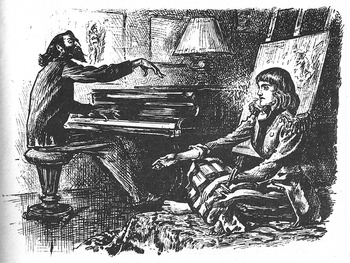
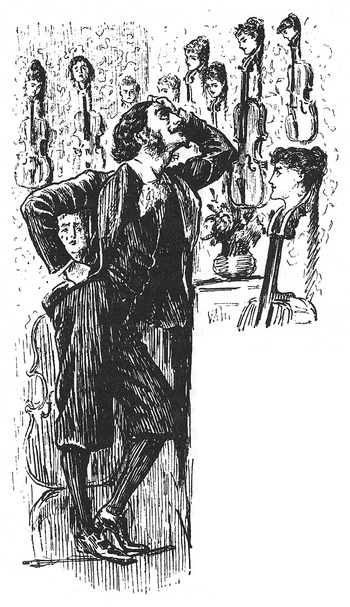
The collaborative vocalization of Svengali and Trilby, with its fraught power dynamic, is further apparent in the visual depictions of both invention and character. Striking resemblances can be observed between a sketch of the machine and its operator and one of Du Maurier's illustrations of Svengali and Trilby (figs. 5–6): the overall composition and the positioning of the two figures relative to each other and the space of the page; the operator's and Svengali's lifted hands at the keyboard; the Euphonia's dummy and Trilby share blank facial expressions and comparable hair lengths; the portrait easel behind Trilby's head is reminiscent of the wooden scaffolding of the Euphonia; and although Trilby has a body and the dummy is merely a head, Trilby's arm is stiff and automaton-like. These visual echoes of the Euphonia also appear in Du Maurier's sketch of disembodied female heads on violins (fig. 7), fusing the instrumental with the corporeal.
“The Marvelous Talking-Machine,” Illustrated History (1874).

George Du Maurier, “The ‘Rosamund’ of Schubert,” Trilby (1894).

George Du Maurier, “Platonic Love,” Trilby (1894).

Near the end of the novel, a now-deceased Trilby is explicitly described as a singing machine by Svengali's former assistant, Gecko: “Trilby was just a singing-machine—an organ to play upon—an instrument of music—a Stradivarius—a flexible flageolet of flesh and blood—a voice, and nothing more—just the unconscious voice that Svengali sang with—for it takes two to sing like la Svengali, monsieur—the one who has got the voice, and the one who knows what to do with it” (199). Like Faber and the Euphonia, Svengali and Trilby are an inseparable dyad for vocal creation. Her human anatomy once again becomes a musical instrument—organ, flute, violin, piano—that must be played by Svengali. This fundamentally collaborative method of vocal creation confirms that Trilby is indeed a singing machine, but, unlike the phonograph, one that cannot simply be started and left to repeat prior utterances. Nor is she a conventional musical instrument, distinguished from the pianos and violins to which the novel likens her to by her linguistic musicality, capable of vocalizing both music and lyrics. Furthermore, she can only be “played” by Svengali, reminiscent of the reporter who declared that the attempt of others apart from Faber to operate the Euphonia were “ludicrous.” Svengali cannot be replaced by another conductor in the same way that various pianists and violinists could provide comparable, though certainly not interchangeable, musical performances. When Svengali dies during Trilby's final public performance, she shocks her audience with her incompetence: Svengali's death is the death of the possibility of simulating the idealized voice, whereas the “flawed” voices inscribed by Edison's phonograph outlive their human sources. These differences—of durability and ephemerality, of replaying and simulating—demonstrate that Edison and Du Maurier presented radically different theories of the mechanized voice, and that Svengali and Trilby's co-authored vocal simulation is elucidated by attention to the Euphonia, rather than the default phonograph.Footnote 82
The voice that Trilby and Svengali create together diffuses its concomitant evacuation of identity to their audience, making their instability contagious. The collective response to La Svengali's performances is at once liberating and perilous to social norms of stratification. The primarily upper-class audience members “adopt the mannerisms and the behavior of the lower classes” in their mania for her concerts, whereas the low-class audiences adopt a “highbrow concern for dictional and musical properties.”Footnote 83 Even when encountered singing in the streets, a mesmerized Trilby's voice compels wealthy passersby to give her “their watches and diamond studs,” divesting themselves of their material markers of social superiority. By divorcing certain tangible possessions and cultural orientations from particular class positions, La Svengali's auditors mimic what she accomplishes with music: she makes the populist “Ben Bolt” resound in renowned opera halls; she makes it so you “couldn't tell ‘God Save the Queen’ from ‘Pop Goes the Weasel’” (171, 214). Like the Euphonia, La Svengali subjects national anthems and nursery rhymes alike to a homogenizing vocalization, captivating diverse audiences in part because these songs are bereft of their usual contexts of performance.
La Svengali's singing “had never failed, whatever the audience, whatever the country, whatever the song” (213)—that is, until she performs in England. Despite her triumph across continental Europe, La Svengali's career comes to an end in London. Du Maurier dismantles his textual Euphonia comprised of Svengali and Trilby and kills its components, thereby muting their gender fluidity, national liminality, and polyglot capacity. Svengali dies first, returning Trilby to her personal accent and tone-deaf singing: when she bewilderedly speaks to her audience, one member responds “Oh ye're Henglish, har yer?” (250). The use of spurious h's—a common typographical shorthand to indicate low-class pronunciation of English in Victorian literature—firmly locates Trilby back in London, whereas the content of this utterance affixes a previously absent and now unambiguous nationality to her. She becomes unmistakably English before her death, a contributor to how “with a loud and seemingly present voice . . . Trilby announces itself as thoroughly English.”Footnote 84 After Trilby and Little Billee die, the novel leaves the narrative reins in the hands of the significantly endogamous British pairing of Taffy and Blanche.
This reading diverges from other critical approaches to Trilby. Fiona Coll describes the novel as Trilby's “gradual erosion into . . . an automaton-like state,” rather than an accelerated transformation due to Svengali's mesmerism. I am in sympathy with her “Trilby-as-automaton” reading, though she historicizes this connection with references to eighteenth-century automatons shaped like ducks and shepherds, perplexingly leaving more relevant nineteenth-century speaking machines out of her discussion, an absence my turn to the Euphonia addresses.Footnote 85 Furthermore, Coll intervenes in debates about the respective power of Trilby and Svengali to argue that the latter is a narrative scapegoat and the responsibility for Trilby's fate is more diffuse. However, the critical debate sketched by Coll about whom to credit with Trilby's transformation is dependent on a dichotomy of responsibility between external and internal factors that either render Trilby an “inert handmaiden” or “an equal” to Svengali; instead, I emphasize the uneven collaboration that is requisite for their vocal productions.Footnote 86
Sarah Gracombe illuminates another tension in interpretations of the novel, turning to the competing conversion narratives that structure the plot. She argues that Trilby is subjected to “English training” by Little Billee in a way that suggests that the adoption of English forms of consumption and habitus can make one English, a narrative strand overlooked in preference for Svengali's hypnotic conversion grounded in intangible mental manipulation rather than tangible cultural behaviors.Footnote 87 I concur with Gracombe that the novel solves its ambivalence about whether England needs to incorporate or eject foreign culture by advocating for a “moderation” of outside influence.Footnote 88 Nonetheless, I view La Svengali as distinct from the before-and-after logic of a conversion via either English commodities or Jewish artistry. Interpreting her as a Euphonia eschews binaristic accounts of responsibility in the narrative (she is either an unwitting pawn or fully agential) and of cultural determinism (she is ultimately a product of English, French, or Jewish culture, or some combination) common in scholarship on the text. Instead, La Svengali's performances create a voice with multiple sources that refutes singular and static subjectivities. In short, typical questions of agency and identification are suspended by this collaborative and mechanized voice.
Conclusion: Collaborative Composition
The backdating of the novel to the 1850s locates it in a period before the advent of sound-recording technology, though it was published several years after the phonograph's invention. La Svengali is an earlier model of technological vocalization, one exhibited during the midcentury: she is not a preexisting voice recorded and replayed by a new machine but a collaborative vocal contrivance that blurs rather than fixes sonic characteristics. Recording, by contrast, can be seen as enforcing cultural distinctions by making them durable. Edison understood the potential of the phonograph as a tool for the audible codification of national identity. His agent George Edward Gourad brought the device to England in the 1880s and recorded the voices of prominent Victorians ranging from William Gladstone to Robert Browning, from politics to poetry. These recordings align the archiving of speech with the preservation of clearly marked anglophone, masculine subjectivities: they are “grooved talisman[s] of identity.”Footnote 89 This identity-laden form of voice is what remains in the soundscape of Trilby at its conclusion. The Laird of Cockpen—otherwise, Sandy—survives the massacre of the novel's ending. He speaks “with a pleasing Scotch accent” and sings “with a capital barytone” songs like “Hie diddle Dee for the Lowlands low”: a Scotchman with a Scotch accent who sings about the lowlands of Scotland, his large physicality according with his baritone voice (5, 115). Sandy represents the voice as a clear index of embodied, stable particularity—a recording of identity.
Trilby, by contrast, shares the Euphonia's tendency to buck the constraints of a concretized identity. She is mutability embodied: destabilizing gender binaries with her androgyny, blurring national boundaries with her linguistic and idiolectic variability, and challenging rigid notions of ability with her oscillation between tone-deafness and mesmerized vocal prowess. In short, Trilby's “power of metamorphosis defines her character” and is most clearly articulated in her voice.Footnote 90 The shared fluidity of the Euphonia and Trilby—both approximations of human bodies crafted through leather and rubber or print and page, respectively—can be read as an eschewal of identity. I am less interested in these identity-less voices as a desired reality (an impossible one, given Trilby's unsustainable mesmerized vocal perfection) than as a strategy for fictional creation and a sounding board literary scholars can use to interpret the fictive. They show that writing a novel is not suggestive of vocal recording but of vocal simulation: that Victorian novels do not inscribe vocal utterances into print with mimetic precision like the phonograph, but reassemble the sonic data of everyday life through representations of the human voice in occasionally unheard-of ways in the spirit of the Euphonia. The Euphonia gives us a theory of the voice that clarifies what it means to represent speech on the page: it is a collaborative process between author, society, and the mechanistic materiality of texts. This form of collaboration does not insist on vocal particularity as a static marker of identity but plays with it, therefore taking the diverse voices of reality and simulating them, attaching them to both predictable and surprising bodies for various ends. By teasing out the tensions between recording and simulation, machine and maker, voice and text, we can craft fuller, more nuanced, and likely competing accounts of sonic modernity that grapple with the inextricability of humans, texts, and technologies.
Trilby itself was born out of the interrelation of these elements. Du Maurier's persistent problems with his eyesight were particularly intense as he began composing the novel. Faced with a period of “near-blindness when he had to stop working,” Du Maurier “dictated the novel to his wife and children.”Footnote 91 This was not a new habit for Du Maurier, who decades earlier intended “to write very hard in the evenings (Emma amanuensis),” while an account of the composition of his first novel states that he used “his daughter as amanuensis.”Footnote 92 Whether aided by Emma (his wife) or one of his children, these accounts reveal the fundamentally collaborative underpinnings of his textual output, a point considered in the period to the extent that some harbored doubt over his authorial claims to his texts. In particular, a rumor arose that his wife and daughters were responsible for “the illustrations of ‘Trilby,’” a rumor others scrambled to refute, declaring: “Only George Du Maurier could have done them, and not any of the trifling assistance which he may have received from his family . . . could deprive him of his responsibility.”Footnote 93 For Du Maurier himself, the art of prose was amenable to interpersonal assistance, whereas his other talent—illustration—was not: “A story can be dictated,” he declares, “but good eyes are needed to make a drawing.”Footnote 94 While he needs his own vision to illustrate, an oral collaboration allows him to narrate through another.
The use of amanuenses for novelistic composition was common in Du Maurier's contemporaries, ranging from Thomas Hardy to Henry James. Certainly, this fin-de-siècle profusion of dictated novels has long literary precedent, suggestive of a blind Milton and his daughters. However, the period witnessed the heightened mechanical mediation of this relationship between “author” and “amanuensis.” James, for one, initially turned to dictation due to a “lame hand,” and soon “the click of the typewriter” became key to his compositional process: he claimed, I “live . . . from day to day and from hour to hour, by the aid of this mechanism.”Footnote 95 Though dictation does not inevitably alter the contents of a piece, James included the word “dictated” in his later letters, marking them out as ontologically different epistolary creations. We can understand these forms of writing as collaborative, though of a different order than those more explicitly conceived of as such in the period, such as the work of Michael Field or Vernon Lee and her associates.
The mechanically mediated collaboration central to this type of writing is a textual parallel to the Euphonia's model of vocal articulation where people dictate a word and a human-operated machine repeats it. The co-authored voice of the Euphonia emphasizes not only mechanical simulation but mechanical composition. The voices of both the Euphonia and Trilby are the amalgamation of many dynamically related elements. Similarly, this form of writing challenges a discrete authorial identity, sharing the interplay of voices and the clicking keys of a human-operated machine that featured in the Euphonia's exhibition. The variant abilities of the human body—Du Maurier's failing eyesight, James's injured hand, Svengali's absent voice—necessitate an interdependence with machines and other people to write or to sing. These instances exemplify a theory of authorship extracted from the Euphonia, one that views the representation of utterances as an active process between voices, bodies, and machines and where a multimodal collaboration is at the root of having a voice or writing a novel. In other words, the Euphonia demands that we do not dismiss the contributions of other people and machines as “trifling assistance” in composition, but as a condition of possibility for the texts they help to produce.
My goal is not to instigate a quest for other literary Euphonias, though potential candidates abound of the technical and gendered manipulation of raw vocal material into captivating forms: Charlotte Brontë's Graham Bretton and his “lesson[s] in recitation” with Paulina Home to give her an idealized wifely voice,Footnote 96 or, of course, Henry James's Verena Tarrant, who undergoes mesmeric manipulation from several figures bent on controlling her impressive vocality. Beyond this interpretive lens, though, reading literature as a form of vocal simulation helps us transcend binaries of phonocentrism and graphocentrism to see the relationship of text to voice as performative, collaborative, and steeped in power. Novels are not a reproduction of preexisting speech acts that glorify a primary and “natural” oralism as their source material, nor is the voice merely rich material to be incorporated into a culturally superior medium, part of the novel's omnivorous absorption of preexisting communicative modes. Rather, simulation—with its connotations of imitation, analogizing, and falsity—characterizes the multidirectional connections between quotidian speech and novelistic utterances. We can use the Euphonia as a model for thinking about the creation of nineteenth-century novels: an audience demands certain words that a mediating author/operator breaks down and creatively reassembles to craft the utterances of a leather-and-wood-bound object—we can turn to the novelistic stage and ascertain a network of listeners, writers, and machines.