Introduction
Depression is common among the elderly, affecting their physical and mental health (Kraaij et al., Reference Kraaij, Arensman and Spinhoven2002). The decline in physical functioning, cognition, and social resources (Adams et al., Reference Adams, Rabin, Da Silva, Katz, Fogel and Lipton2016; Kim and Sok, Reference Kim and Sok2012) makes depressive symptoms more widespread in older adults than in middle-aged individuals (Fiske et al., Reference Fiske, Gatz and Pedersen2003). Depression further deteriorates older adults’ physical health (Alexopoulos, Reference Alexopoulos2005; Zhang et al., Reference Zhang, Chen and Ma2017; Zis et al., Reference Zis, Daskalaki, Bountouni, Sykioti, Varrassi and Paladini2017), seriously threatens their social interactions (Blazer, Reference Blazer1983; Coyne, Reference Coyne1976b) and the quality of life (Adams et al., Reference Adams, Rabin, Da Silva, Katz, Fogel and Lipton2016; Ghubach et al., Reference Ghubach, El-Rufaie, Zoubeidi, Sabri, Yousif and Moselhy2010; Mhaoláin et al., Reference Mhaoláin2012), and even increases their mortality (Collins et al., Reference Collins, Glei and Goldman2009).
Life satisfaction is an important indicator of the quality of life among the elderly; it is also the cognitive dimension used to measure subjective well-being (Andrews and Withey, Reference Andrews and Withey1976), which reflects the elderly’s overall assessment of their lives (Shin and Johnson, Reference Shin and Johnson1978). Multiple factors affect older people’s life satisfaction. Depression, an important psychological factor, has a significant negative predictive effect on older adults’ life satisfaction (Adams et al., Reference Adams, Rabin, Da Silva, Katz, Fogel and Lipton2016; Berg et al., Reference Berg, Hassing, McClearn and Johansson2006; Berg et al., Reference Berg, Hoffman, Hassing, McClearn and Johansson2009; Ghubach et al., Reference Ghubach, El-Rufaie, Zoubeidi, Sabri, Yousif and Moselhy2010; Kim et al., Reference Kim, Harris and Cha2017; Mhaoláin et al., Reference Mhaoláin2012). Moreover, depression is the most common mental health problem among the elderly (Ghubach et al., Reference Ghubach, El-Rufaie, Zoubeidi, Sabri, Yousif and Moselhy2010), significantly affecting their life satisfaction.
Mhaoláin et al. (Reference Mhaoláin2012) found that mental and emotional states were the factors that affected life satisfaction the most among elderly people in Ireland. The strong influence of emotional factors such as depression is more detrimental to life satisfaction than other factors. Compared with elderly people without depression, depressed elderly people are usually more depressed, more irritable, tenser, and worrying more about small things (Girling et al., Reference Girling, Huppert, Brayne, Paykel, Gill and Mathewson1995). In addition, negative self-appraisal and thoughts of worthlessness are common depressive characteristics (Adams et al., Reference Adams, Rabin, Da Silva, Katz, Fogel and Lipton2016) that negatively affect quality of life and life satisfaction among elderly people.
The interpersonal theory of depression (Coyne, Reference Coyne1976b) proposed that depression affects the attitudes and behavioral responses of the people who are around depressed individuals. In a study, normal subjects were asked to converse on the telephone with either a depressed patient, a non-depressed patient, or a normal control; they found subjects who had spoken to depressed patients were significantly more depressed, anxious, hostile, and rejecting (Coyne, Reference Coyne1976a). This might be because depressed individuals seek more frequent and extreme reassurance from others, inducing more negative affect in them and potential rejection (Coyne, Reference Coyne1976b).
The experience of being ignored or excluded by individuals or groups is called ostracism (Williams, Reference Williams2007). Although a large number of studies have confirmed that certain characteristics of depressed individuals do increase disregard and rejection from others (Coyne, Reference Coyne1976b; Hames et al., Reference Hames, Hagan and Joiner2013; Joiner and Metalsky, Reference Joiner and Metalsky1995; Starr and Davila, Reference Starr and Davila2008), most of these studies focused on mildly depressed people (Coyne, Reference Coyne1976b) and undergraduates (Starr and Davila, Reference Starr and Davila2008). For the elderly, on the one hand, they receive less support from their social networks compared to other age groups, and depression would further deteriorate their social interactions (Blazer, Reference Blazer1983). On the other hand, depressed older people are more likely to feel isolated subjectively; even if their social connections are strong, they will perceive themselves as more isolated and excluded than those without depression (Evans et al., Reference Evans, Llewellyn, Matthews, Woods, Brayne and Clare2019). Therefore, depression is likely to damage interpersonal relationships and increase ostracism among elderly people.
According to Williams’s (Reference Williams2009) temporal need-threat model, ostracism severely threatens belonging, control, self-esteem, and meaningful existence, increasing negative emotions, destroying interpersonal relationships, and reducing social support from others among older adults. Data from the 2012 Health and Retirement Study in the USA showed that ostracism deprives the elderly of their socioeconomic resources, threatens their social rights, reduces their social participation, and ultimately decreases life satisfaction (Lee and Cagle, Reference Lee and Cagle2018).
As social beings, interpersonal connections are crucial for individuals (Stavrova and Luhmann, Reference Stavrova and Luhmann2016). The quality of the interpersonal relationships determines quality of life and happiness (Argyle, Reference Argyle2013; Diener and Seligman, Reference Diener and Seligman2004). Therefore, when the elderly experience rejection and isolation from others because of depression, the impairment of the interpersonal relationships is likely the internal mechanism by which depression reduces life satisfaction.
Thus, this study aims to focus on the impact of depression on life satisfaction among the elderly and its internal mechanism. We propose the following hypotheses:
Hypothesis 1: Depression negatively predicts life satisfaction among the elderly.
Hypothesis 2: Ostracism mediates the relationship between depression and life satisfaction among the elderly.
As the worldwide population is aging rapidly, older people’s life satisfaction has become an important indicator of whether society has achieved successful aging (Meléndez et al., Reference Meléndez, Tomás, Oliver and Navarro2009; Ghubach et al., Reference Ghubach, El-Rufaie, Zoubeidi, Sabri, Yousif and Moselhy2010). According to previous research results, many factors affect life satisfaction among older adults (Berg et al., Reference Berg, Hassing, McClearn and Johansson2006; Mhaoláin et al., Reference Mhaoláin2012; Li et al., Reference Li, Chi, Zhang, Cheng, Zhang and Chen2015). Therefore, to study the impact of depression on life satisfaction among elderly people, we must consider potential moderators and additional variables. Previous studies with older adults indicate that gender (Ferring et al., Reference Ferring2004), age (Kim and Sok, Reference Kim and Sok2012; Meléndez et al., Reference Meléndez, Tomás, Oliver and Navarro2009), education (Lee and Lee, Reference Lee and Lee2013; Li et al., Reference Li, Chi and Xu2013), marital status (Hsu, Reference Hsu2012; Liu and Guo, Reference Liu and Guo2008), physical and mental health (Gutiérrez et al., Reference Gutiérrez, Tomás, Galiana, Sancho and Cebrià2013; Hsu, Reference Hsu2012), economic income (Markides and Martin, Reference Markides and Martin1979; Yan et al., Reference Yan, Su and Wu2019), family (Katz, Reference Katz2009), social support (Adams et al., Reference Adams, Rabin, Da Silva, Katz, Fogel and Lipton2016), and social insurance (Liao, Reference Liao2012) are associated with life satisfaction.
However, whether all such factors will affect life satisfaction and to what extent varies across different elderly groups (Li et al., Reference Li, Chi, Zhang, Cheng, Zhang and Chen2015). In economically challenged regions, where people work to escape poverty and satisfy basic needs, the impact of economic income on life satisfaction is more important (Diener and Seligman, Reference Diener and Seligman2004). That is, the higher the economic income, the higher the life satisfaction (Diener and Biswas-Diener, Reference Diener, Biswas-Diener and Diener2009). In economically developed regions, the impact of non-economic factors (e.g. social relations, job satisfaction) on well-being is greater than that of economic factors (Diener and Seligman, Reference Diener and Seligman2004). According to Xing’s (Reference Xing2011) study on the relationship between income and subjective well-being among Chinese residents, there is an overall upward trend curve between personal income and well-being, and the highest point of subjective well-being appears in the highest-income group. China is a developing country where urban and rural economic development is uneven, and the gap between the rich and poor is wide (Bai, Reference Bai2017). Especially for most rural elderly people, the improvement of economic income is still the key to improving life satisfaction (Cui, Reference Cui2015).
Therefore, economic income is likely to moderate the effect of other factors on life satisfaction among elderly people. High economic income can better guarantee the satisfaction of basic needs, better medical conditions (Areán et al., Reference Areán2010), and social support (Krause and Borawski-Clark, Reference Krause and Borawski-Clark1995) for older adults with depression, alleviating the negative effects of depression and ostracism on life satisfaction. Based on this, another hypothesis is proposed:
Hypothesis 3: The direct and indirect effects of depression on life satisfaction among the elderly are moderated by economic income.
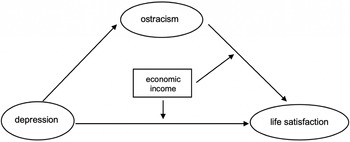
Figure 1 summarizes the theoretical hypothetical model of the study.
The theoretical hypothetical model.

Methods
Participants and procedure
Data were derived from the Renmin University of China’s “Thousands of People and Hundreds of Villages” project in 2019. This project aims to understand the major practical issues of the economic, social, and cultural development in rural China. After receiving the approval of the Ethics Committee of the Renmin University of China, the survey covered 31 provincial-level administrative units across China, and it targeted rural, elderly persons aged 60 and over. The sampling method used in this project was stratified, multi-stage sampling.
The survey process consisted of three stages. The first stage was divided into eight layers according to the seven geographical areas where county-level administrative units are located and a national-level, poverty-stricken county. The number of county-level administrative units extracted from each layer is proportional to the total agricultural population of that layer. In the second stage, for each selected county-level administrative unit, random sampling was used to select one administrative village, resulting in 129 administrative villages. The third stage consisted of 414 college students interviewing at each administrative village; equidistant and map sampling were used to determine who was going to be interviewed. After the elderly were interviewed, the interviewers filled out the questionnaires. The sampling flowchart is shown in Appendix A.
In 2019, the project collected a total of 2,072 questionnaires. After removing respondents under the age of 60, 1,754 valid questionnaires remained, with an effective rate of 84.65%. The sample was composed of 987 males (56.27%) and 767 females (43.73%) aged, in average, 69.61 ± 6.91 years. Educational qualifications were recorded under five categories: no formal education (28.62%), elementary school and below diploma (48%), junior high school diploma (17.16%), high school or technical secondary school diploma (5.99%), and undergraduates and above diploma (0.23%). Marital status included unmarried (1.08%), cohabiting (9.92%), having a spouse from the first marriage (64.03%), remarried (1.43%), separated (1.08%), divorced (0.91%), widowed (21.32%), and refused to answer (0.23%). Work status included non-agricultural workers (4.39%), agricultural workers (49.26%), non-workers (45.90%), and never worked (0.46%).
Measures
Depression
Depression among older adults was measured with the depression subscale from the Chinese version of the Depression Anxiety Stress Scale (DASS21; Moussa et al., Reference Moussa, Lovibond, Laube and Megahead2017). The subscale contains seven items on their experiences over the past week rated on a 4-point severity/frequency scale, ranging from 0 (did not apply to me at all) to 3 (applied to me very much, or most of the time). The Chinese version of the scale has been proven to have good reliability and validity (Gong et al., Reference Gong, Xie, Xu and Luo2010). Cronbach’s α was set to .77.
Life satisfaction
The Satisfaction with Life Scale (SWLS; Diener et al., Reference Diener, Emmons, Larsen and Griffin1985) was administered to assess participants’ global life satisfaction. The SWLS consists of five items; participants were instructed to indicate their agreement or disagreement with each statement (e.g. “I am satisfied with my life”) using a 7-point Likert scale (1 = strongly disagree; 7 = strongly agree). The Chinese version of the SWLS has good reliability and validity in Chinese adults (Xiong and Xu, Reference Xiong and Xu2009). Cronbach’s α was set to .87.
Ostracism
Ostracism was measured by the OES (Carter-Sowell, Reference Carter-Sowell2010). It consists of eight items on two factors: ignoring and excluding (four items each). However, as this study was based on a large-scale data survey, and the number of questions investigated was very large, so in order to limit the number of questions and control the filling time, we selected two items in each dimension of the OES, with a total of four items. The selection criteria were based on the two items with the highest factor load in each dimension of the scale measured in the Chinese version (Shao et al., Reference Shao, Dong, Feng and Zhang2020). Responses were rated on a 7-point Likert scale ranging from 1 (hardly ever) to 7 (almost always). The higher the scores, the more the experiences of ostracism in daily life. The Chinese version of the OES has demonstrated good reliability and validity in Chinese adults (Shao et al., Reference Shao, Dong, Feng and Zhang2020). Cronbach’s α was set to .90 (ignoring = .77; excluding = .84).
Economic income
Economic income was measured by people’s subjective economic income instead of objective economic income, because according to the analysis of the economic income sources of the elderly in rural China, mainly including retirement fund and pension, support from other family members, and labor income (Ding et al., Reference Ding, Zhang and Xia2019), the objective economic income gap of the elderly in rural China was not very big on the whole. And compared with the objective economic income, subjective economic income has a much greater impact on the life satisfaction of the elderly (Ball and Chernova, Reference Ball and Chernova2008). Therefore, participants were asked “What is your economic situation?” with responses ranging from 1 to 4 (1 = very good, 2 = good, 3 = fair, and 4 = bad). In order to facilitate understanding and statistical analysis, the score is reversely scored to represent economic income. The higher the score, the higher the economic income.
Control variations
In this study, socio-demographic characteristics, marital status, and health status were selected as control variables. Socio-demographic characteristics include gender, age, and education. Marital status included having a spouse (cohabitation, a spouse in the first marriage, remarriage, and separation without divorce) and having no spouse (unmarried, divorced, or widowed). Physical health was measured by “What do you think your current physical health is?” rated on a 5-point Likert scale (1 = very unhealthy, 2 = relatively unhealthy, 3 = normal, 4 = relatively healthy, and 5 = very healthy); the higher the score, the better the physical health.
In addition, given that cognition is an important part of the assessment of the elderly, although no cognitive assessment was conducted in this study, the interviewers spoke face to face with the elderly subjects and had screened or excluded subjects who appeared to have cognitive impairment and who could not respond to the questionnaires in a coherent manner. Therefore, the older adults with cognitive impairment could be excluded, and cognitive differences did not affect the results.
Statistical analysis
All analyses were conducted in SPSS version 25. First, bivariate correlations were performed to assess association between the main study variables. Second, to directly test hypothesis 2 (the mediating role of ostracism) and 3 (the moderating role of economic income), bootstrap analysis was conducted with 5,000 iterations using an SPSS macro (PROCESS) provided by Hayes (Reference Hayes2013). In PROCESS model 5, after standardizing all variables and controlling age, education, marital status, and physical health, depression was entered as the predictor, ostracism as the mediator, economic income as the moderator, and life satisfaction as the outcome. Finally, assuming that the hypothesized moderated mediation is supported, a simple slope test was conducted on the mean ± 1 SD of the moderator.
Results
Preliminary analyses
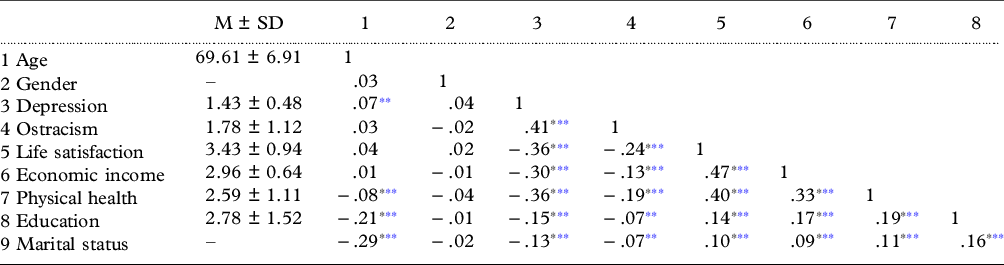
Table 1 shows correlations between the study variables. Results showed that depression was positively associated with ostracism and negatively associated with life satisfaction, economic income, and physical health. Ostracism was significantly negatively correlated with life satisfaction, economic income, and physical health. Life satisfaction was significantly positively correlated with economic income, physical health, education, and marital status.
Descriptive statistics and correlations between the variables

Note: Gender: 0 = “male,” 1 = “female.” Marital status: 0 = “no spouse,” 1 = “spouse.”
** p < .01.
*** p < .001.
Mediating and moderating effect tests
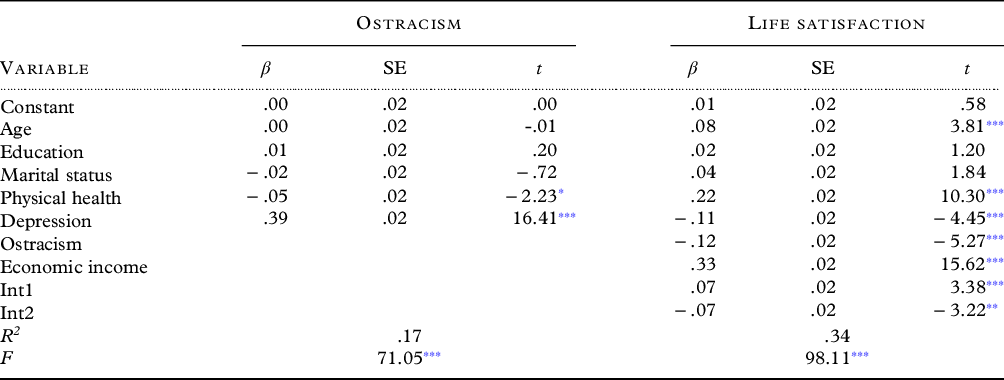
The regression analysis results are shown in Table 2. Results showed that depression not only significantly negatively predicted life satisfaction among elderly people but also indirectly predicted life satisfaction through ostracism. Bootstrap analysis revealed that the mediating effect of ostracism was significant (effect = −.04, Boot SE = .01; [95% CI −.060, −.020]), accounting for 16.51% of the total effect. Ostracism played a partially mediating role between depression and life satisfaction.
The mediating effect of ostracism and the moderating effect of economic income

Note: All values denote standardized coefficients.
“Int1” = Depression × Economic income; “Int2” = Ostracism × Economic income.
* p < .05.
** p < .01.
*** p < .001.
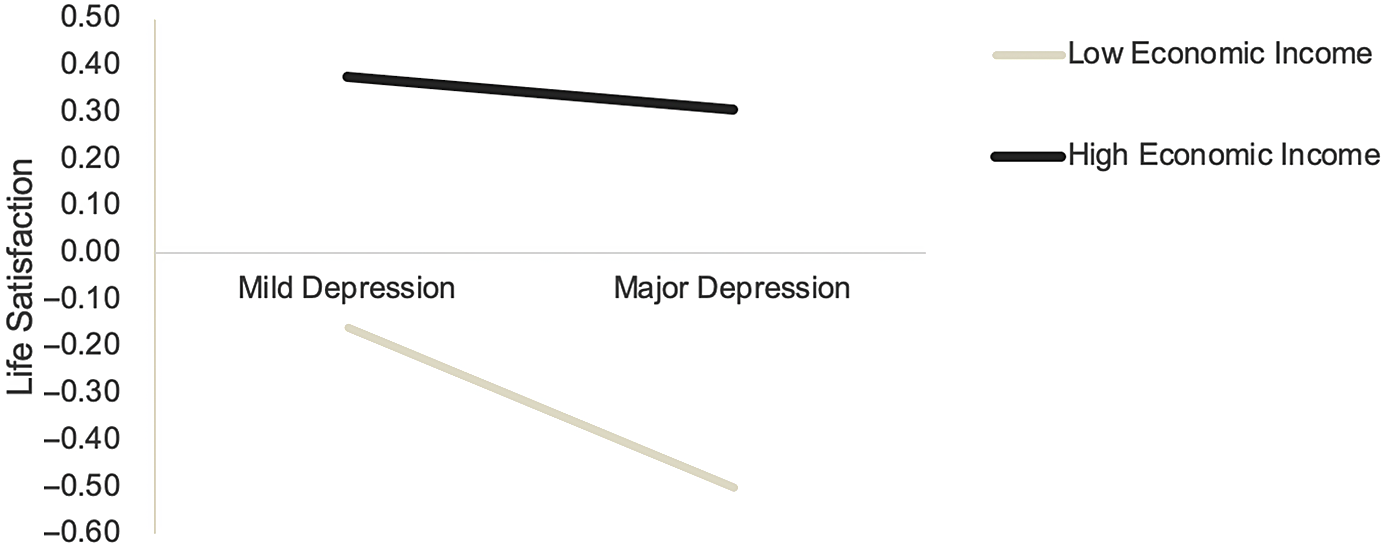
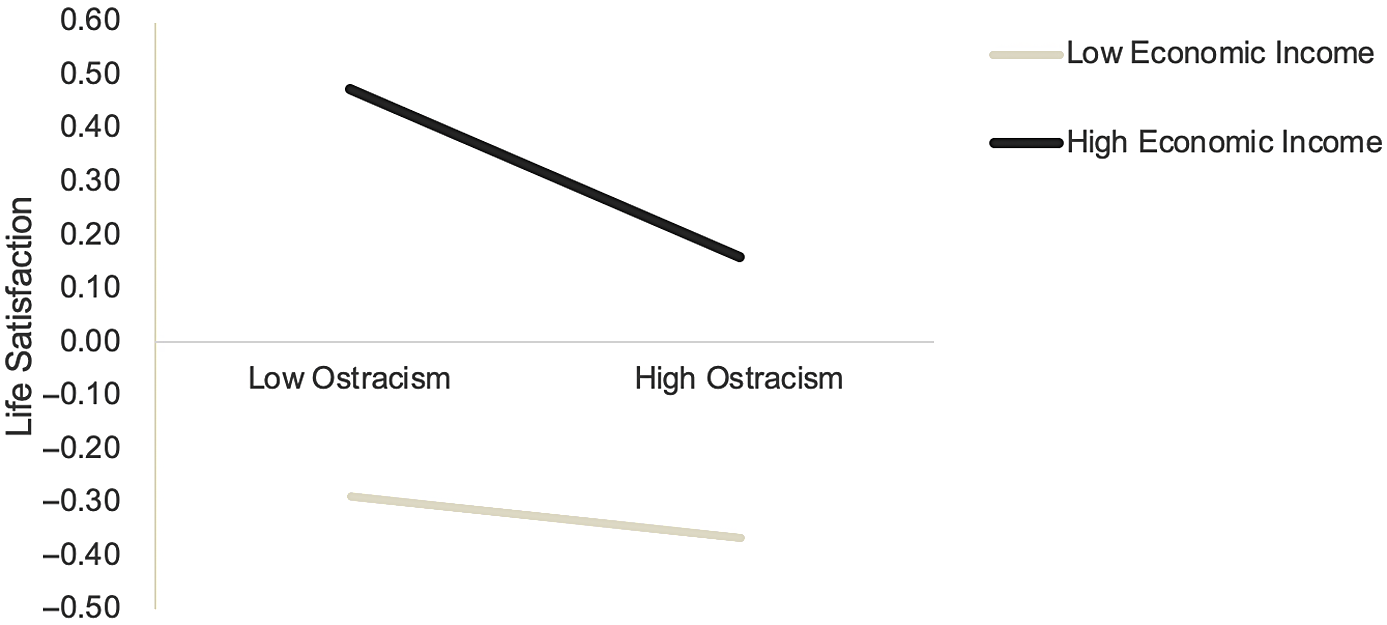
In addition, results pointed that economic income has a significant moderating effect on the paths from depression to life satisfaction and from ostracism to life satisfaction for low (−1 SD) and high (+1 SD) levels of economic income. A simple slope test was further conducted on the moderating effect of economic income and a simple effect analysis chart was drawn (as shown in Figures 2 and 3). For elderly people with low economic income, depression has a significant negative predictive effect on life satisfaction (β simple = −.18, t = −6.83, p < .001, [95% CI −.233, −.129]), while ostracism has no significant predictive effect on life satisfaction (β simple = −.05, t = −1.65, p > .05, [95% CI −.099, .008]). For elderly people with high economic income, depression has no significant predictive effect on life satisfaction (β simple = −.04, t = −1.00, p > .05, [95% CI −.111, .036]), while ostracism has a significant negative predictive effect on life satisfaction (β simple = −.19, t = −5.45, p < .001, [95% CI −.253, −.119]).
Economic income as a moderator in the relationship between depression and life satisfaction among the elderly. Note: The y-axis values denote standardized scores.

Economic income as a moderator in the relationship between ostracism and life satisfaction among the elderly. Note: The y-axis values denote standardized scores.

Discussion
This study explored the mediating effect of ostracism and the moderating effect of economic income on the relationship between depression and life satisfaction among the elderly in China. Depression negatively predicted life satisfaction among the elderly, which is consistent with previous studies (Adams et al., Reference Adams, Rabin, Da Silva, Katz, Fogel and Lipton2016; Berg et al., Reference Berg, Hassing, McClearn and Johansson2006; Berg et al., Reference Berg, Hoffman, Hassing, McClearn and Johansson2009; Ghubach et al., Reference Ghubach, El-Rufaie, Zoubeidi, Sabri, Yousif and Moselhy2010; Kim et al., Reference Kim, Harris and Cha2017; Mhaoláin et al., Reference Mhaoláin2012). Moreover, ostracism serves as a partial mediator, an internal mechanism, in the association between depression and life satisfaction. Hypotheses 1 and 2 are, thus, verified.
According to the model of person-environment interaction, an individual’s psychological processes are affected by both personal and environmental factors (Neufeld et al., Reference Neufeld2006). Quality of life among older adults is affected by depression symptoms, such as depressed mood and diminished interest (Alexopoulos, Reference Alexopoulos2005). At the same time, depression can affect other people’s attitudes towards the depressed, resulting in ostracism (Coyne, Reference Coyne1976b). In turn, ostracism, an environmental factor, will further influence older adults’ mental health, that is, the evaluation of their own quality of life. Therefore, the path model of “depression-ostracism-life satisfaction” conforms to the “person-environment-person” interaction model.
In addition, the activity theory proposes that older adults can alleviate negative emotion such as depression and improve life satisfaction by participating in social activities and enhancing social interactions (Menec, Reference Menec2003). However, for depressed older adults, social interactions are diminished due to reduced social activities (Alexopoulos, Reference Alexopoulos2005) and increased ostracism, which will not only worsen depressive symptoms but also reduce life satisfaction.
This study specifically focused on China’s rural economic development and explored the role of economic income as moderator of life satisfaction among the elderly. We found that economic income can separately moderate the predictive effect of depression and ostracism on life satisfaction. High economic income weakened the negative predictive effect of depression on life satisfaction but enhanced the negative predictive effect of ostracism on life satisfaction. Thus, hypothesis 3 is only partially verified.
Economic income guarantees individual survival (Yan et al., Reference Yan, Su and Wu2019). Greater economic income usually means more choices and higher quality of life (Diener and Seligman, Reference Diener and Seligman2004). In areas such as rural China, where the economy is still developing, high economic income can greatly improve older adults’ living and medical conditions (Areán et al., Reference Areán2010), reducing the negative impact of depression on life satisfaction. However, for elderly people with high economic incomes, the impaired interpersonal relationships caused by ostracism affect life satisfaction more than income itself. Similarly, for the elderly in developed countries such as Europe, social relations have surpassed economic income as the main factor affecting life satisfaction (Diener and Seligman, Reference Diener and Seligman2004). Therefore, economic income may alleviate the negative effect of depression on life satisfaction among the elderly with low incomes; however, for the elderly who have reduced life satisfaction due to ostracism, economic income no longer compensates for the damaged interpersonal relationships and the negative effect on life satisfaction. The results also show that although the economic development of rural areas in China is generally lagging behind and there is a large economic income gap between older adults in the same area, the elderly with low economic income are more likely to assess their life satisfaction in terms of their income and health status (Li et al., Reference Li, Chi, Zhang, Cheng, Zhang and Chen2015), while those with high economic income use interpersonal relationships to evaluate their quality of life (Cheng and Chan, Reference Cheng and Chan2006). However, the results showed that the economic income had a moderating role between depression and life satisfaction, and ostracism and life satisfaction, respectively, but the effects’ size of the two interaction paths were smaller. This may be because there are many other factors on life satisfaction besides economic income. More factors should be considered in the future.
Previous research has only focused on the impact of depression and other factors on life satisfaction among the elderly. Although it is important to know which factors can affect life satisfaction, understanding the internal mechanisms underlying the associations between such factors and life satisfaction and the potential moderating variables may be more helpful for the development of methods and policies to improve life satisfaction among the elderly (Adams et al., Reference Adams, Rabin, Da Silva, Katz, Fogel and Lipton2016). Therefore, based on the interpersonal theory of depression and research on the factors that impact life satisfaction among the elderly, this study sampled rural elderly people in all provinces in China to explore in-depth the internal mechanisms by which depression decreases life satisfaction and verified the mediating role of ostracism and the moderating role of economic income in that association.
Nevertheless, this study has some limitations. First, the cross-sectional study design limits our ability to claim any causal relationships among depression and life satisfaction. Future longitudinal studies are needed to further investigate the impact of depression on life satisfaction among the elderly from a developmental perspective. Second, the measurement tool DASS used in this study to assess depression is a general depression scale, not specific for the elderly. Older people may experience more problems with sleep disorders, loss of appetite, fatigue, or diminished interest due to the deterioration of physical functions. Although these problems are indicators of depression, for the elderly, they are not necessarily caused by depression (Berkman et al., Reference Berkman1986). In addition, high scores on DASS do not automatically equal to a formal diagnosis of any disorder, since the test was developed to encourage self-education and seeking help. Therefore, future studies on depression among elderly people should use a scale that is more suitable for the elderly. Third, because the sample used in this study was a stratified multi-stage sample, the Hayes’ PROCESS macro as standard statistical routines was probably not to estimate the standard errors correctly and lead to biased results. Future research should pay attention to this problem. Finally, this study focuses on the impact of depression on life satisfaction among the elderly and its internal mechanism, ignoring other possible relationships between the variables. For example, depression is both a cause and a result of ostracism and poor life satisfaction. Ostracism, as a negative life event, impairs interpersonal relationships and social networks, and induces depression among the elderly (Kraaij et al., Reference Kraaij, Arensman and Spinhoven2002). The decline in life satisfaction will, in turn, increase symptoms of depression (Haynie et al., Reference Haynie, Berg, Johansson, Gatz and Zarit2001) and make the individuals feel even more ostracized (Bayram et al., Reference Bayram, Aytac, Aytac, Sam and Bilgel2012). Also, economic income is not the only variable that moderates the predictive effect of depression and ostracism on life satisfaction; instead, financial strain can also lead to depression among the elderly (Areán et al., Reference Areán2010). Also, extremely low economic income will increase the possibility of ostracism (Bayram et al., Reference Bayram, Aytac, Aytac, Sam and Bilgel2012). Therefore, future studies should consider building a more complete theoretical model on the relationship between depression and life satisfaction among the elderly.
Conflict of interest
No potential conflict of interest was reported by the authors.
Source of funding
This research was supported by the Fundamental Research Funds for the Central Universities, the Research Funds of Renmin University of China, 19XNLG20, and the Mental Health Education Platform, Major Innovation & Planning Interdisciplinary Platform for the “Double-First Class” Initiative, Renmin University of China.
Description of authors’ roles
Lei Shao was in charge of study conceptualization, drafting of manuscript, carrying out statistical analyses, and interpretation of results. Guoliang Yu revised the manuscript and offered constructive feedback. Denghao Zhang contributed to study conceptualization, provided guidance on statistical analyses, revised the manuscript, and offered constructive feedback.
Acknowledgement
The authors would like to thank the participants for their time and their valuable contributions to this study.
Supplementary material
To view supplementary material for this article, please visit https://doi.org/10.1017/S1041610221001162