Introduction
The isolation and glaciation of Antarctica that began around 28 million years ago (Schultz Reference Schultz1995, Lawver & Gahagan Reference Lawver and Gahagan1998, McLoughlin Reference McLoughlin2001) has transformed the terrestrial landscape into one dominated by long-term habitat fragmentation. It is now well established that the Ross Sea sector (e.g. Victoria Land and Queen Maud Mountains) is one of the few continental regions whose terrestrial fauna are unlikely to be recent colonizers (Stevens & Hogg Reference Stevens and Hogg2006b, Stevens et al. Reference Stevens, Greenslade, Hogg and Sunnocks2006, Torricelli et al. Reference Torricelli, Carapelli, Convey, Nardi, Boore and Frati2010). Consequently, prolonged low temperatures and increased glacial activity have meant that many locations in Victoria Land became further isolated and the survival of terrestrial invertebrates, particularly the springtails (Collembola) could only be possible in ice-free refugia, such as nunataks (e.g. Stevens & Hogg Reference Stevens and Hogg2003, Stevens et al. Reference Stevens, Frati, McGaughran, Spinsanti and Hogg2007). Nunataks would have provided possible refuges during the last glaciation in this region, but many terrestrial habitats have only become available for (re)colonization from these refuges within the current interglacial (< 17 000 years).
The springtail, Gressittacantha terranova has special significance for many Antarctic entomologists, as it is named after one of the prominent researchers of Antarctic entomology, J. Lindsey Gressitt (Wise, Reference Wise1967). The research that Gressitt spearheaded with the Honolulu Bernice Bishop Museum on Antarctic Arthropoda remains the bedrock for all current work on the biogeography of this isolated microfauna (Gressitt Reference Gressitt1967). At the same time, most of what we know about the biogeography, origin and/or dispersal of Antarctic Collembola originated from Wise (Reference Wise1967, Reference Wise1971). In recent years, these questions have been revisited with increasing resolution, using both experimental (Hawes et al. Reference Hawes, Worland, Convey and Bale2007, Reference Hawes, Worland, Bale and Convey2008) and genetic (e.g. Stevens & Hogg Reference Stevens and Hogg2006a, Reference Stevens and Hogg2006b, Stevens et al. Reference Stevens, Greenslade, Hogg and Sunnocks2006) models. The latter, in particular, have begun to provide an informative route into revealing and distentangling the links between species and haplotypes across their fragmented and isolated habitats (see Convey & Stevens Reference Convey and Stevens2007, Convey et al. Reference Convey, Gibson, Hillenbrand, Hodgson and Pugh2008, Reference Convey, Stevens, Hodgson, Smellie, Hillenbrand, Barnes, Clarke, Pugh, Linse and Cary2009).
The evidence for endemism and long-term persistence of microarthropods in continental Antarctic ice-free refugia is increasingly convincing (Stevens et al. Reference Stevens, Greenslade, Hogg and Sunnocks2006, Torricelli et al. Reference Torricelli, Carapelli, Convey, Nardi, Boore and Frati2010; see Convey et al. Reference Convey, Gibson, Hillenbrand, Hodgson and Pugh2008, Reference Convey, Stevens, Hodgson, Smellie, Hillenbrand, Barnes, Clarke, Pugh, Linse and Cary2009 for reviews). This evidence provides a picture of relatively ancient (> 10 m.y.a.) lines of demarcation and separation between species (e.g. Stevens & Hogg Reference Stevens and Hogg2006b, Stevens et al. Reference Stevens, Greenslade, Hogg and Sunnocks2006). However, there is much we do not know about the timing, and extent to which postglacial dispersal patterns have influenced gene flow (if at all) within Antarctica. Recent studies have examined fine spatial scales and reveal populations being effectively isolated across short geographic distances, particularly where glaciers or other landscape features may represent barriers to effective dispersal (Nolan et al. Reference Nolan, Hogg, Stevens and Haase2006, Stevens et al. Reference Stevens, Frati, McGaughran, Spinsanti and Hogg2007, McGaughran et al. Reference McGaughran, Hogg and Stevens2008, Reference McGaughran, Torricelli, Carapelli, Frati, Stevens, Convey and Hogg2010). Habitat fragmentation generally impedes demographic processes (e.g. mobility and resulting gene flow), particularly in the context of range contraction/expansion among glacial populations.
Evidence of Holocene (the temporal window for events of ‘ecological’ rather than geological) signatures in distributional patterns are hard to assess in studies encompassing large spatial scales as the larger phylogenetic signals tend to drown out smaller scales of divergence and sampling regimes are focused around inter- rather than intra-site differences. To date, evidence for more contemporary dispersal signals from molecular data of continental springtails is meagre (although see Stevens & Hogg Reference Stevens and Hogg2003, Nolan et al. Reference Nolan, Hogg, Stevens and Haase2006, McGaughran et al. Reference McGaughran, Hogg and Stevens2008, Reference McGaughran, Torricelli, Carapelli, Frati, Stevens, Convey and Hogg2010). Nonetheless, there is clearly great scope for examining gene flow in such endemics at ‘ecological’ scales.
Gressittacantha terranova is one of the lesser known Antarctic springtails, discovered in the northern foothills of Terra Nova Bay in 1963 by Keith Wise (Wise Reference Wise1967), and additional morphological notes were provided by Dallai et al. (Reference Dallai, Malatesta and Focardi1988). Fanciulli et al. (Reference Fanciulli, Summa, Dallai and Frati2001) compared five enzyme loci in populations across its range, and Caruso et al. (Reference Caruso, Borghini, Bucci, Colacevich and Bargagli2007) have provided ecological data on potential factors governing its distribution. It is an excellent example of Antarctic endemism and isolation, with only a few other species of Collembola and Acari known to occur within its range in northern Victoria Land. At the study site, Terra Nova Bay, it is the only observed species of Collembola geographically isolated from northern populations and other springtail species by the Campbell Glacier and to more southern springtail species by the David Glacier (Wise Reference Wise1967, Caruso & Bargagli Reference Caruso and Bargagli2007). This paper examines mitochondrial haplotype diversity in G. terranova at fine spatial scales in relation to distribution across two altitudinal gradients in the coastal region of Terra Nova Bay.
Methods and materials
Sample collection and study site
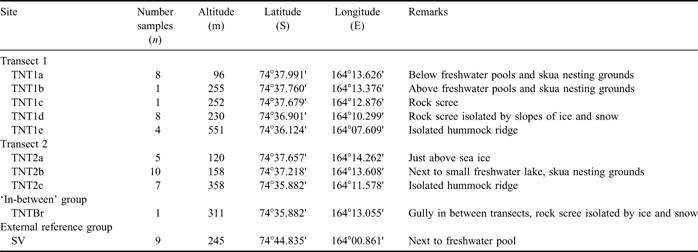
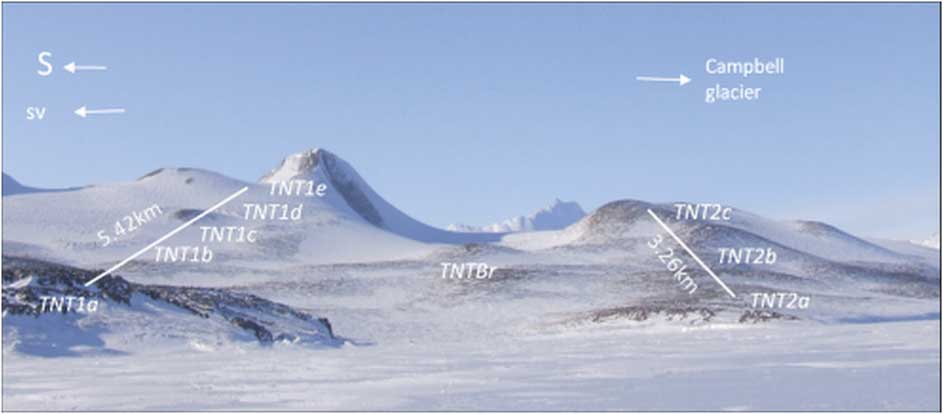
Springtails were collected in the foothills above the German summer station, Gondwana (74°38′S, 164°14′E). Samples from two alpine transects were collected along adjacent ridges, with an additional sample (an ‘in-between group’) collected from a gully between the ridges that was isolated from both ridges by ice and snow (Fig. 1). An ‘external reference’ population was collected from Springtail Valley in the northern foothills of Terra Nova Bay - the Type Locality for G. terranova (Wise Reference Wise1967). Table I provides the sample numbers, GPS positions, and descriptive remarks for each sampling location. Animals were collected from under rocks, transferred individually to Eppendorf tubes using a fine paintbrush and preserved in 95% ethanol. On return to New Zealand, samples were kept at -70°C until DNA extraction.
Location of primary collection sites for Gressittacantha terranova at Terra Nova Bay. The sites are c. 1.7 kms apart at their midpoints (distances between GPS coordinates calculated by the Haversine formula). Sites are indicated by their codes in the text (the external reference population cannot be not shown but is approx. 9.23 km due south of site TNT1a) with indicators for compass direction and the nearest significant landmark (Campbell Glacier).
Location sites and samples analysed for Gressittacantha terranova at Terra Nova Bay.

DNA extraction and sequencing
Total genomic DNA was extracted from individuals using the Mammalian Genomic DNA Miniprep Kit (Sigma) as per manufacturer’s instructions with the exceptions that 175 μl Lysis solution T and 200 μl of Lysis solution C were used in the preparatory steps and 60 μl was used to elute DNA. After extraction a fragment of the mitochondrial cytochrome c oxidase (CO1) gene was amplified with the universal primers LCO1490 (5′-GGT CAA CAA ATC ATA AAG ATA TTG GA-3′) and HCO2198 (5′-TAA ACT TCA GGG TGA CCA AAA AAT CA-3′) (Folmer et al. Reference Folmer, Black, Hoeh, Lutz and Vrijenhoek1994). Amplifications for each forward/reverse fragment used a 10 μl reaction volume containing 1 μl DNA (unquantified), 1 μl PCR buffer (Roche, Penzberg, Germany), 1 μl dNTP (Boehringer-Mannheim, Mannheim, Germany), 0.4 μl of each primer, 6.14 μl MilliQ water, 0.06 μl Taq DNA polymerase (Roche). Thermal cycling conditions were: 94°C for 1 min, followed by five cycles of denaturation and polymerase amplification (94°C for 1 min, 45°C for 1 min, 51°C for 1.5 min, and 1 min at 72°C) followed by 35 cycles of 94°C for 1 min, 51°C for 1.5 min and 1 min at 72°C, followed by 5 min at 72°C. Reaction products were purified using SAP/EXO (USB Corp., Cleveland, OH, USA). Sequencing using forward and reverse primers was performed on a capillary ABI3730 genetic analyser (Applied Biosystems Inc., Forster City, CA) at the Allan Wilson Centre Genome Service, Massey University.
Molecular analyses
Sequences were verified as being consistent with springtail DNA using the GenBank BLASTn search and checked for open reading frames (using MacClade ver. 4; Maddison & Maddison Reference Maddison and Maddison2000), to exclude nuclear copies or other unintended sequence types. Sequences were aligned using SEQUENCHER (Gene Codes ver. 4.7) sequence editor. All sequences are accessible from GenBank (accession numbers HM461270–HM461323). We used χ2-tests, as implemented in PAUP* to determine whether the assumption of equal base frequencies among sequences was violated on all sites, or using third codon positions only. A distance matrix of pairwise nucleotide sequence divergence was calculated using uncorrected distance, in addition to a corrected model model (HKY + Γ, -lnL = 1418.9608: base frequencies set to A = 0.2772, C = 0.1933, G = 0.1665, T = 0.3630, Ti/tv ratio = 4.019, Γ = 0.0138), as indicated by Modeltest ver. 3.7 (Posada & Crandall Reference Posada and Crandall1998). The corrected model was used to estimate a maximum likelihood (ML) phylogram (heuristic search), all other settings remained as default in PAUP*. Confidence in the tree was assessed using bootstrap analysis with 500 pseudoreplicates (Felsenstein Reference Felsenstein1985).
Results
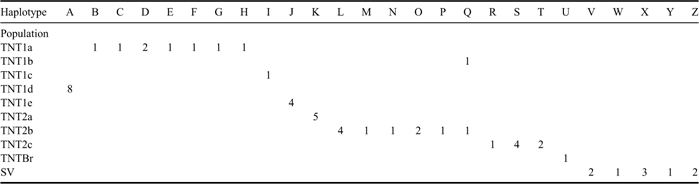
A 618-bp fragment (206 codons) was used in all analyses. No insertions, deletions, or stop codons were detected. The nucleotide composition of all sequences was biased towards A and T (A = 27%, T = 37%, C = 19%, G = 17%). We were unable to reject the hypothesis of homogeneity of base frequencies among sequences for all sites (χ2159 = 5.06, P = 1.00), for the 85 variable sites (χ2159 = 39.03, P = 1.00), or for the 206 third codon sites (χ2159 = 1.56, P = 1.00). Among the 54 G. terranova sequences there were 85 variable (81 parsimony-informative) nucleotide substitutions that resulted in 26 unique haplotypes (Table II).
Haplotype diversity (26 haplotypes from 54 individuals) in Gressittacantha terranova sampled at Terra Nova Bay.
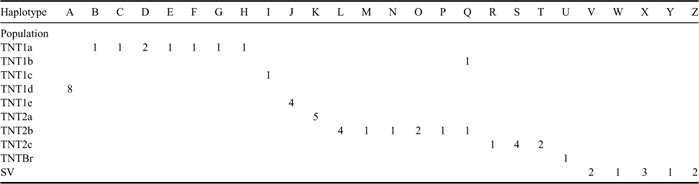
The population TNT1a was found to contain the highest haplotype diversity with seven haplotypes (B–H) identified from eight individuals (Table II). Similar levels of diversity were present at TNT2b with six haplotypes (L–Q) from ten individuals and SV (‘external reference’ population) with five haplotypes (V–Z) from nine individuals. We identified three haplotypes (R-T) at TNT2c (from seven individuals), but the other six populations (TNT1b, 1c, 1d, 1e, 2a, Br) possessed only a single haplotype each (from 1–8 individuals each). Shared haplotypes between populations occurred in only one instance, a single individual at TNT1b was identified with haplotype Q, which was also identified for a single individual at TNT2b (Table II). Analysis of molecular variance (AMOVA) (Excoffier et al. 1992) did not identify any significant pairwise population ϕ-st values for populations within G. terranova (P = 1.00, in all cases).
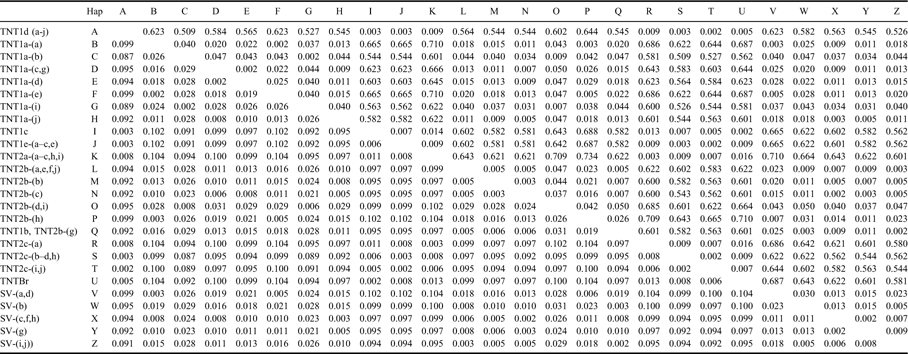
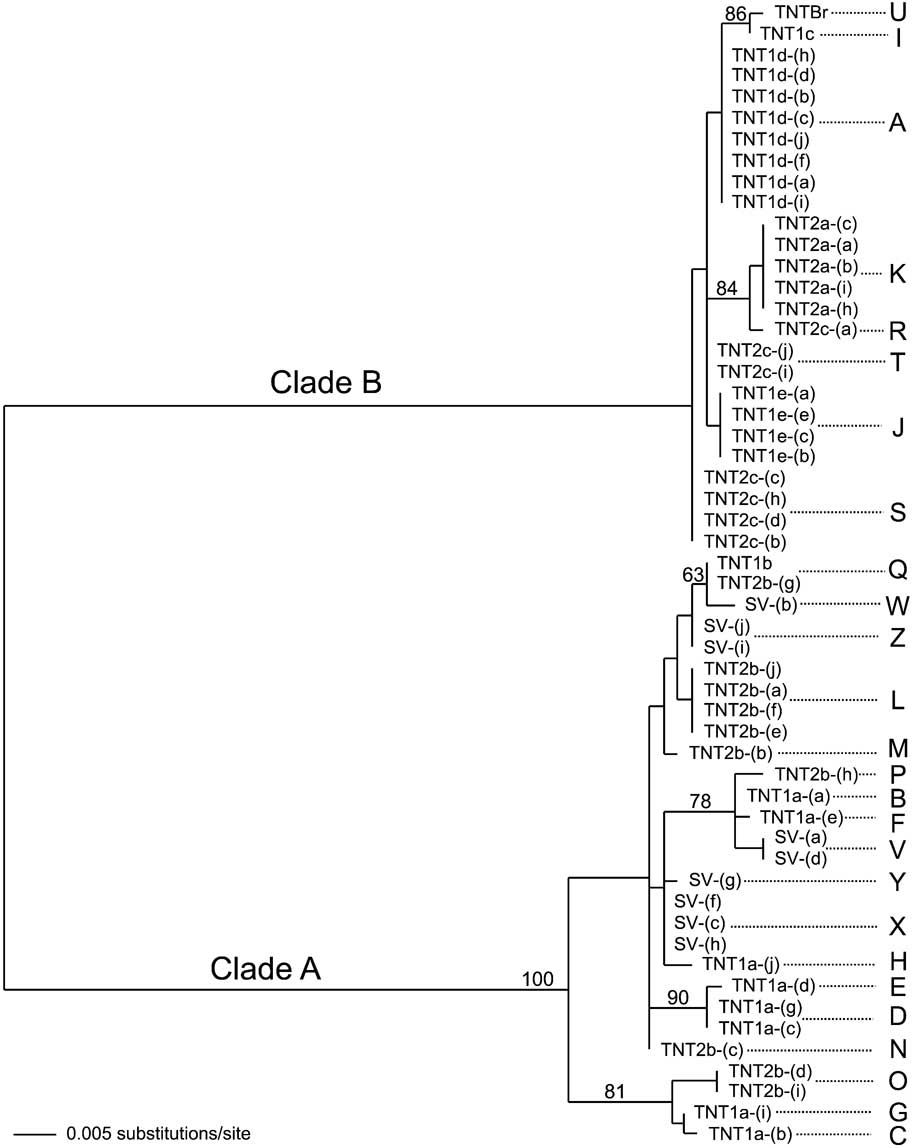
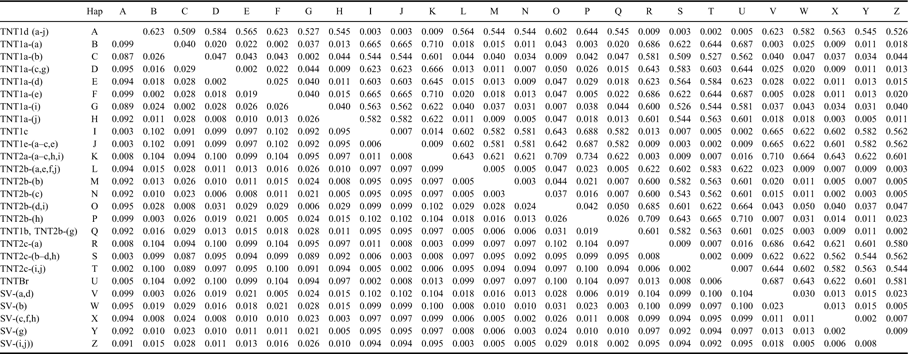
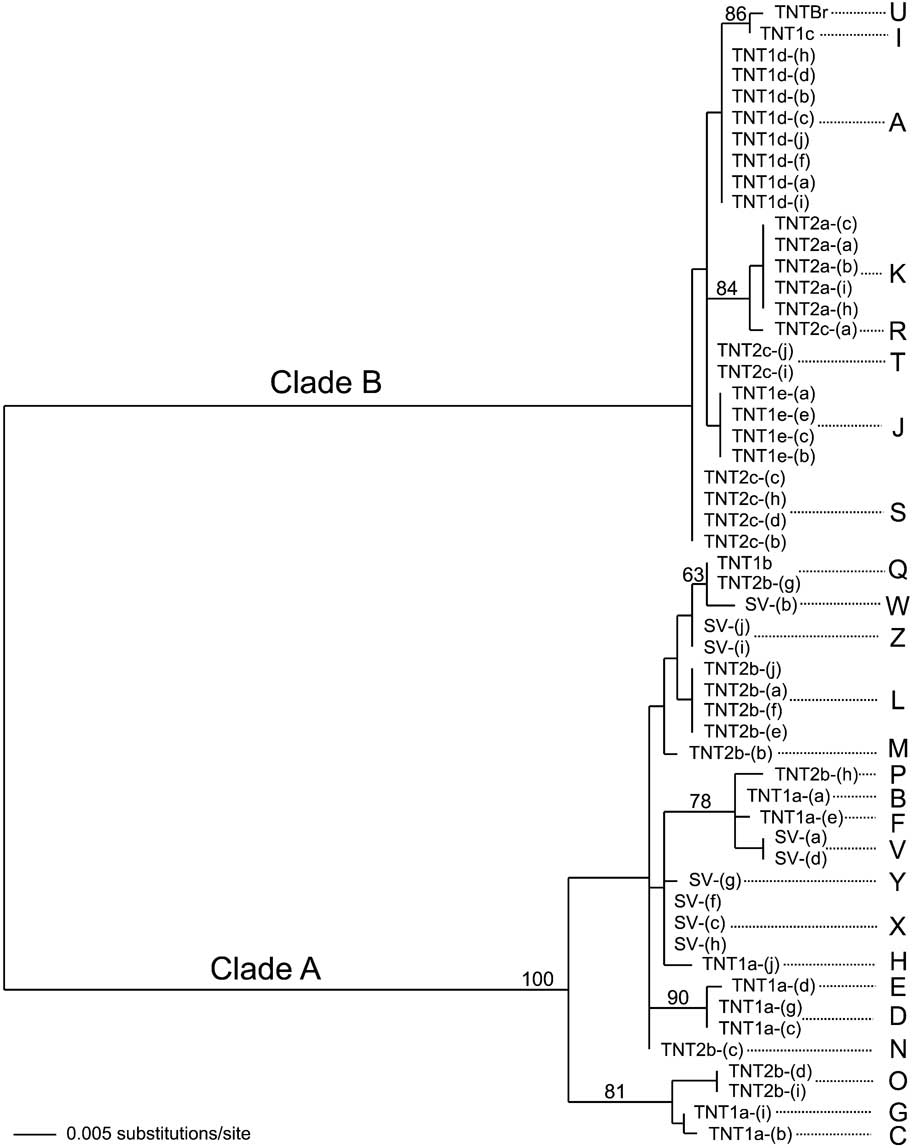
Percentage of sequence divergence (uncorrected) between haplotypes ranges from 0.002 (1 substitution) to 0.104 (85 substitutions) (Table III). This level of divergence was unexpected, and formed two distinct clades (Fig. 2). These two divergent clades consisted of a wide mix of individuals between the two transects (A: TNT1a, 1b, 2b, SV, B: 1d, 1c, 1e, 2a, 2c, Br) (Fig. 1). Despite SV’s direct geographic distance from the transects (9.23 km from TNT1a), it was nested within Clade A. Gressittacantha terranova sequences previously deposited in GenBank (collected in the vicinity of Mario Zucchelli station; Stevens et al. Reference Stevens, Greenslade, Hogg and Sunnocks2006) showed that they also clustered within Clade A (data not shown). Using BLASTn search these were found to have 99% similarity with SV (Clade A) sequences and 90% similarity with sequences from TNTBr (Clade B) - confirming that the 10% divergence between clades was consistant to two clearly defined lineages.
Uncorrected distances (below diagonal) and maximum likelihood (above) between all 26 unique haplotypes from 54 Gressittacantha terranova individuals for the 618-bp mtDNA (COI) fragment. Haplotypes (Hap) are indicated by their codes (A–Z).
Maximum likelihood tree (using midpoint rooting) for Gressittacantha terranova based on the substitution model (HKY + Γ, -lnL = 1418.9608: base frequencies set to A = 0.2772, C = 0.1933, G = 0.1665, T = 0.3630, Ti/tv ratio = 4.019, Γ = 0.0138) derived from Modeltest (see methods) using a 618-bp fragment of the mtDNA (COI) gene. Bootstrap confidence limits (500 replicates) shown above nodes (if > 60).
Discussion
There are many commonalities in the genetic relationships between Antarctic endemic arthropods, but it is important to recognize that each species has it own evolutionary and ecological history on the continent (see Convey et al. Reference Convey, Stevens, Hodgson, Smellie, Hillenbrand, Barnes, Clarke, Pugh, Linse and Cary2009). The degree of sequence divergence and haplotype diversity we have found in G. terranova - consistent with previous evidence for high levels of allelic diversity in this species (Fanciulli et al. Reference Fanciulli, Summa, Dallai and Frati2001) - is greater than any other continental Antarctic springtail in the Ross Sea region. Twenty six haplotypes were identified from 54 individuals (Table II) that formed two divergent clades with sequence divergence of 10% (Table III) within the modest spatial scale examined (c. 10–20 km2). In contrast, Stevens et al. (Reference Stevens, Frati, McGaughran, Spinsanti and Hogg2007) found the same number of haplotypes (from 69 individuals) and only ∼2% sequence divergence in the springtail Desoria klovstadi Carpenter over an area that included the lower half of northern Victoria Land, approximately an order of magnitude greater than the present study.
At the most fundamental level, genetic divergence may be considered a proxy indicator for the relative isolation of populations and species (i.e. the greater the isolation the lower the incidence of genetic similiarity). Gene flow in Antarctic Collembola is primarily delimited by habitat fragmentation. Fanciulli et al. (Reference Fanciulli, Summa, Dallai and Frati2001) have already highlighted the unique macro-barriers (the Campbell and Aviator glaciers) to genetic mixing across G. terranova’s distribution and here we show the extent to which such isolation is apparently re-capitulated at the landscape scale. Our analyses among haplotypes reveals a temporally bifurcated history of genetic divergence across this small area.
The high levels of intraspecific genetic divergences indicate evidence of an event that dates back to the Pliocene. The macro-separation between haplotypes in this study reveals two groups separated by sequence divergence of ∼10%: the first group (Clade A) with 18 haplotypes, the second (Clade B) with eight haplotypes (Fig. 2). Such extensive mtDNA divergence and previous allozyme profiles (Fanciulli et al. Reference Fanciulli, Summa, Dallai and Frati2001) may be evidence that G. terranova - like Frisea grisea Schäffer (Torricelli et al. Reference Torricelli, Carapelli, Convey, Nardi, Boore and Frati2010) - have undergone cryptic (incipient) speciation. There is a suggestion that the clades reflect a north-south gradient to some degree, in that the haplotypes from Clade A cluster with the most southerly sites (SV and Mario Zucchelli station). However, the presence of haplotypes from both altidudinal transects in both clades means that the basis for divergence is complicated by other factors. Temporally, we date this divergence event to the Pliocene ∼5 mya, using the generally accepted molecular clock calibration of 1.5–2.3% divergence per million years (e.g. Brower Reference Brower1994, Quek et al. Reference Quek, Davies, Itino and Pierce2004) which has been used previously for Collembola and has provided plausibile inferences. This is considerably older than other intraspecific divergence patterns seen in continental Antarctic springtails (Stevens et al. Reference Stevens, Frati, McGaughran, Spinsanti and Hogg2007, McGaughran et al. Reference McGaughran, Hogg and Stevens2008). As Fanciulli et al. (Reference Fanciulli, Summa, Dallai and Frati2001) note, Gressittacantha is an endemic Antarctic genus and may have ancient origins (see Stevens et al. Reference Stevens, Greenslade, Hogg and Sunnocks2006 for phylogenetic discussion), as has also been suggested for some Antarctic mites (Marshall & Pugh Reference Marshall and Pugh1996, Marshall & Coetzee Reference Marshall and Coetzee2000). However, the existence of a molecular clock that ‘ticks’ at the same rate for every species is controversial (e.g. Gillooly et al. Reference Gillooly, Allem, West and Brown2005, Thomas et al. Reference Thomas, Welch, Woolfit and Bromham2006, Stevens & Hogg Reference Stevens and Hogg2006a). Differences in nucleotide substitiution rates may have their origins in a number of life history parameters (e.g. Martin & Palumbi Reference Martin and Palumbi1993). Indeed, with regard to Antarctica particularly, there may be a number of environmental factors that could influence substitution rates - for example, varying metabolic rates and extended life history may be associated with high latitudes (e.g. Stevens & Hogg Reference Stevens and Hogg2006a, McGaughran et al. Reference McGaughran, Convey, Redding and Stevens2009a, Reference McGaughran, Redding, Stevens and Convey2009b). Nevertheless, the dates we use follow the ‘clock’ used in the literature for invertebrates (e.g. Quek et al. Reference Quek, Davies, Itino and Pierce2004), and springtails in particular (e.g. Stevens et al. Reference Stevens, Greenslade, Hogg and Sunnocks2006, and references therein). Although dating remains an issue for future examination, the dates used here, if nothing else, allow a basis for preliminary comparison.
The distribution of different haplotypes we identified across the range of populations examined here also suggests the influence of ecological parameters. That the macro-divergence is not reflected by site origins - with evidence for major lines of divergence between haplotypes of the same site - suggests that these earlier lines of separate descent have been superseded in more recent (i.e. Holocene) dispersal events from discretely different refuges. A clue to the basis for this ‘reshuffling’ of haplotypes may lie in the three patterns of haplotype distribution that were encountered: a) multiple haplotypes at single sites, b) ‘lone’ haplotypes at single sites, and c) shared haplotypes between sites that were not physically contiguous. These contemporary patterns of distribution strongly suggest the influence of ecological parameters. Albeit ‘crude’ ecological indicators, our site descriptors (Table I), offer a line of interpretation for all three phenomena. Firstly, sites with many haplotypes (≥5) are only found at the sites (TNT1a, TNT2b, SV) with freshwater bodies. Water is a fundamental factor affecting collembolan physiological and ecological responses, particularly in Antarctica, where ice predominates over water’s liquid phase (e.g. Kennedy Reference Kennedy1993, Hayward et al. Reference Hayward, Worland, Convey and Bale2004). It would be consistent for bodies of water (lakes, ponds and streams) to attract and/or act as conduits for dispersal movements - i.e centres of population heterogeneity. Indeed, Nolan et al. (Reference Nolan, Hogg, Stevens and Haase2006) suggested streams from glacier foreground and lake-edge meltwater as a means of dispersal for the southern Victoria Land springtail Gomphiocephalus hodgsoni Carpenter. Secondly, ‘lone’ haplotypes at single sites (even if, to be conservative, we consider just the three sites where n ≥4: TNT1d, TNT2a) seem to be unambiguously associated with site isolation or recent colonization by a few individuals. The last phenomenon - the occurrence of a shared haplotype (Q) between two non-physically contiguous sites (the two sites are separated by a gully of ice) - is only readily explained by the site descriptor both have in common: proximity to skua (Catharacta maccormicki Saunders) nesting grounds. Although avian phoresy has been suggested in southern Victoria Land (Stevens & Hogg Reference Stevens and Hogg2003), it is of course, a highly stochastic phenomenon. At the spatial scale considered here, however, it is certainly within the realms of possibility as skuas were frequently seen moving between the two breeding grounds (TCH, personal observation). That some degree of passive aerial dispersal (sensu Hawes et al. Reference Hawes, Worland, Convey and Bale2007) has occurred over these foothills in the last 1000 years would also be completely feasible at these spatial and temporal scales.
In conclusion, both the spatial distribution and spatial scale of genetic diveristy and divergence we have identified in G. terranova are unusual to date in continental Antarctica, and suggests two distinct evolutionary lineages once separated that have now formed overlapping distributions, possibly since the LGM. Given the unexpected high divergence found at this spatial scale future work requires considerably more understanding of the mechanisms and basis of haplotype diversification in Antarctic Collembola across multiple temporal and spatial scales. We suggest that further investigation of G. terranova's patterns of diversity is required at macro-spatial scales - i.e. spanning the Campbell and Aviator glaciers - and with the same terms of reference (mitochondrial DNA), will prove particularly useful. Such species range analyses will not only provide information on refuges during the LGM, but will contribute to constraining models aiming to provide insight into glacial events impacting coastal Antarctica.
Authors’ contributions
T.C. Hawes and M.I. Stevens contributed equally to this paper.
Acknowledgements
TCH was funded by the Leverhulme Trust and thanks David Wharton and Craig Marshall for supporting this work. We are grateful to the Italian Antarctic Programme and Antarctica New Zealand for logistical support. This paper forms a contribution to Antarctica New Zealand Latitudinal Gradient Project (LGP, Key Question 2 - role of large scale ice structures), Australian Antarctic Division project 2355 (MS), and to the SCAR EBA research programme. We thank two anonymous reviewers for their constructive comments.