Introduction
The recognition in the United States during World War I of its dependence on German manufactured dyestuffs and advanced pharmaceuticals shocked the public. The dominance of key markets by enemy producers prompted important policy changes. The sequestration of all German-owned U.S. assets by the Alien Property Custodian followed U.S. entry into the war in 1917. German pharmaceutical factories and patents were sold on to U.S. interests with the explicit aim of stimulating domestic production. Prohibitive tariffs on imported chemicals and pharmaceuticals were introduced after the war, stopping any resumption of the import trade in its tracks, and so reducing competitive pressures on the emerging U.S. pharmaceutical sector.Footnote 1
The indigenous American pharmaceutical industry was dominated by “patent-medicine” producers, specialist producers of vigorously promoted herbal elixirs and tinctures of doubtful efficacy. The impact on the American pharmaceutical industry of these policy changes was seemingly profound. German-manufactured medicines were no longer competitive in the U.S. market. After a generation of German producers building “patent thickets” in the U.S. market as a competitive barrier, suddenly U.S. pharmaceutical producers could gain access to German intellectual property.Footnote 2 There were, however, only a few ethical pharmaceutical manufacturers in the United States that had sufficient manufacturing capabilities to be able to use German technologies. Abbott Laboratories successfully acquired the valuable Bayer patent for synthesizing salicylic acid, the basis for producing aspirin, for example, and subsequently developed a science-focused business in the 1920s and 1930s.Footnote 3 Most American producers struggled to adapt. The U.S. pharmaceutical output increased by only just over one-third from 1922 to 1928, nearly half of this in salicylic acid production alone. Given that the dominant suppliers to the U.S. market had been forcibly removed by government decree on entry into the war, this does not seem a particularly fast rate of growth.Footnote 4
Just over a decade later, however, by the time of the U.S. entry into World War II, the biggest American pharmaceutical companies—Abbott, Eli Lilly, Merck, Pfizer, and Parke, Davis—had all acquired sufficient technological capabilities that they were able to make major contributions to the war effort, through the crash penicillin program, plasma production, sulfas, and other important therapies. They were therefore well positioned to benefit after the war and enjoyed around half the global market in the early 1950s.Footnote 5 While the forced removal of German competition created the opportunity for the indigenous U.S. industry to develop in the 1920s, it was in fact in the 1930s that a dramatic transformation in the technological and manufacturing capabilities of the U.S. pharmaceutical industry occurred.Footnote 6
The consensus among historians of the American pharmaceutical industry is that this transition occurred because of a combination of a much greater commitment to internal research among American firms and the growth of increasingly strong collaborative networks between the leading university chemists and private companies.Footnote 7 The fragmentary data that exist for individual firms also suggest that research intensity among the leading firms increased during the 1930s.
Abbott spent around $100,000 annually on research in the early to mid-1930s (and had a research staff of twenty-nine by 1933), probably representing a research intensity of around 2½ percent of sales during the mid-1930s.Footnote 8 Lilly’s expenditure on R&D was claimed to be between 2 and 3 percent of sales in 1930.Footnote 9 Merck & Co.’s research intensity grew from only 0.3 percent of sales in 1929 and 0.5 percent in 1930 to 1.4 percent in 1931, 1.5 percent in 1932, 2.0 percent in 1933, 2.3 percent in 1934, 2.4 percent in 1935, 2.8 percent in 1936, 3.2 percent in 1938, 3.3 percent in 1939, and then to 3.9 percent in 1940.Footnote 10 There are fewer data for other firms. What data do exist seem to indicate that research intensity was lower elsewhere.Footnote 11
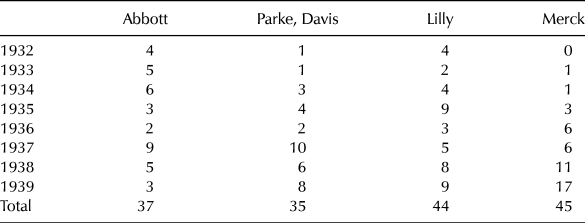
Table 1 shows that the leading American ethical pharmaceutical companies also saw a substantial increase in patenting activities in the 1930s. Before World War I, American pharmaceutical companies had conducted very little patenting. The table indicates that by 1932, Abbott and Lilly were making some efforts to patent pharmaceutical innovations. Until 1936 Abbott and Lilly were behaving somewhat differently than Merck and Parke, Davis. From 1938 Merck began to patent at a level that exceeded all the others. The evidence of increasing research expenditures and patenting levels among these leading American pharmaceutical companies appears to support the view that these firms experienced a transition during the 1930s and became research-focused organizations, developing internal research capabilities and strong links to leading scientists at U.S. universities.
Total U.S. Patents for Abbott Laboratories, Parke, Davis, Eli Lilly, and Merck & Co. (1932–1939)

Source: Google Patents. Total of all U.S. patents by year of publication from January 1, 1932, to December 31, 1939, by selected assignee firms (minus patents for equipment). Firms selected were the four largest U.S. firms (by capital employed in 1950; see Slinn, Abbott, 47-8) that had been producing pharmaceuticals in the 1930s.
This article is a case study of Merck & Co., a firm clearly identified both by contemporaries and subsequently by historians as one of the industry leaders during the 1930s.Footnote 12 As the research expenditure and patenting data suggest, by 1940 Merck & Co. was seemingly the most research-intensive American pharmaceutical producer. This article aims to show that Merck & Co.’ s rise to industry leadership followed a somewhat different path than its peers in the 1930s, depending on a largely concealed transfer of technology and know-how during the 1930s from its former German parent, E. Merck of Darmstadt. This aspect of Merck & Co.’ s history has been omitted from the official corporate histories and largely ignored by academic studies. Transfers of German technology and know-how to American firms were not unknown during the interwar period. Steen describes several such relationships among synthetic dyestuffs producers, for instance.Footnote 13 Within the smaller pharmaceutical niche, Bayer had formed the Winthrop Group with Sterling in order to reacquire its U.S. patents and markets in the early1920s, and Schering reestablished its U.S. subsidiary in 1933.Footnote 14 This article contends that these were relatively insignificant. Neither of the U.S. operations of Winthrop/Sterling or Schering acquired sufficient prominence in research to be included in the U.S. war effort, for example, in contrast to Merck & Co.Footnote 15
The article makes three contributions to the business history literature on the development of the U.S. pharmaceutical industry in the 1930s. First, it offers a substantially more detailed account of the extensive scientific and commercial interrelationships of the two Mercks between 1919 and 1940 than is currently available. Second, the article shows that E. Merck’s research and scientific capabilities remained significantly ahead of Merck & Co. until at least 1938. Third, the case of Merck & Co. shows that where this leading U.S. pharmaceutical producer did gain a clear advantage over its former German parent in the late 1930s was in pharmaceutical manufacturing. Given Merck & Co.’ s prominence in the industry in the late 1930s and 1940s, we speculate that this may suggest that advances in understanding process technologies may have been a more significant source of the U.S. industry’s remarkable success in producing new medicines during World War II than is currently recognized.Footnote 16
The article is organized as follows. The next section describes the two Mercks’ relative positions in 1914, the date from which the U.S. subsidiary effectively became an autonomous unit. The impact of the U.S. entry into the war in 1917 on Merck & Co. and its forced separation from Darmstadt is then outlined. Without access to its former parent’s products, Merck & Co. struggled in the 1920s, precipitating a merger with another former German–U.S. fine chemical producer, Powers Waters Rosengarten (PWR) in 1927. The existing business history literature on Merck & Co. emphasizes the complete separation of the two Mercks by this point, but here we show how, in fact, this merger became the catalyst for the intensification of the commercial relationship between the two Mercks, leading to the signing of a treaty in 1932 that promulgated a very substantial transfer of product and process technologies from Germany to the United States in the 1930s. The implications of this case study are discussed in the concluding section.
E. Merck of Darmstadt and the Growth of Merck & Co. to 1914
While the large German dyestuffs producers (BASF, Bayer, and Hoechst) had already successfully diversified into pharmaceutical production, by 1914 the venerable E. Merck of Darmstadt was Germany’s largest producer of pharmaceuticals.Footnote 17 Merck & Co. was the outcome of E. Merck’s decision in 1891 to upgrade its New York agency into a wholly owned distributor. E. Merck was founded by Emmanuel Merck (1794–1855) as a manufacturer and distributor of fine chemicals to pharmacists. Emmanuel’s sons—Carl, Georg, and Wilhelm—expanded it. Wilhelm was a trained scientist. His elder son, Carl Emmanuel, followed in the family’s scientific tradition, becoming steeped in the chemistry of alkaloids. George F. Merck was Wilhelm’s second son, and was trained in commerce, with a brief to expand the firm’s overseas’ business.Footnote 18 Wilhelm posted George first to London and Paris to learn about the leading foreign markets. George then traveled to New York in 1891 to oversee the newly created subsidiary.Footnote 19
Merck & Co. soon became an important supplier of E. Merck’s products to the U.S. market. It grew quickly, employing 180 people by 1896, somewhat smaller than the leading U.S. wholesaler, SmithKline, which employed 265 in 1895.Footnote 20 In 1902 SmithKline’s sales reached US$3 million and it marketed 15,000 different product lines.Footnote 21 Merck & Co.’ s 1902 sales were just over US$1.5 million. By 1914 it marketed 3,500 to 4,000 items in the United States, but these represented only one-third of the total number of products E. Merck marketed in Germany. The U.S. subsidiary was relocated to Rahway, New Jersey, where it shortly began to manufacture around 1,000 of the more basic items by 1914, by which point its sales exceeded US$3 million. Merck & Co. had grown to attain some significance since 1891, but it remained “organizationally, technically and financially… tightly linked to the German parent.”Footnote 22
German success is typically explained by the creation of a specific model for industrial research pursued at a scale hitherto unknown.Footnote 23 Large German pharmaceutical firms were typically ten times bigger than their U.S. peers, and thus able to finance far more ambitious and therefore successful research programs.Footnote 24 In 1890 E. Merck’s key products were processed alkaloids (cocaine, morphine, etc.), some semisynthesized galenicals (such as salicylic acid) and an enormous range of reagents, intermediate products, and industrial chemicals.Footnote 25 It pursued an ambitious research program, drawing heavily on its collaborations with several of Germany’s leading university scientists and, from 1911 onward, the newly formed Kaiser Wilhelm Institutes.Footnote 26 E. Merck’s increasing research intensity saw its research expenditure rise from just under 2.5 percent of sales between 1902 to 1905 to perhaps more than 3 percent of sales by 1912.Footnote 27 Carsten Burhop’s analysis of E. Merck’s profitability shows that by 1913 and 1918, the company was dependent on ten products for the overwhelming majority of its pharmaceutical sales and profits, all of which were invented between 1890 and 1905 (the leading six sellers in 1918 were all invented in just eight years, from 1895 to 1903).Footnote 28 These blockbusters powered E. Merck’s global growth in the years before 1914, including in the United States.Footnote 29 Veronal (invented in 1903), for example, became the leading barbiturate sedative in the United States.Footnote 30
From late 1914 the British blockade on raw drug imports prompted German producers to innovate, with new products emerging to replace now unobtainable raw drugs. Footnote 31 The absence of raw drugs in Germany also influenced pharmacists’ practice, as it “accelerated the pace at which pharmaceutical specialties were replacing raw materials,” which therefore gave the leading research-intensive producers more incentive to develop their own brands.Footnote 32
E. Merck augmented its position as one of the leading German firms in the interwar period, moving into packaging its medicines in tablet form. Employee numbers increased to 3,600 by 1923 before stabilizing at around 3,000 between 1924 and 1932, then increasing to 4,100 by 1938.Footnote 33 The company increased its investment in in-house research, establishing a central laboratory in 1927, and was successful in developing new products.Footnote 34 This R&D push led to major innovations in plant-protection agents; synthetic vitamins A, C, and D; hormone products; and further developments in sedatives and anesthetics.Footnote 35 By 1939 E. Merck, together with other leading producers, had increased Germany’s share of world exports in pharmaceuticals from 30 percent (in 1913) to 43 percent.Footnote 36
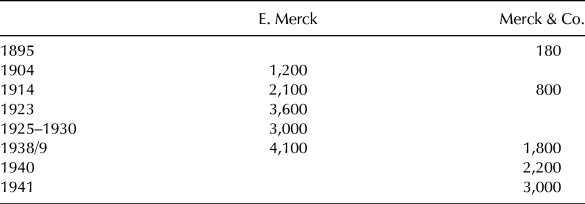
The German parent was therefore very much the dominant partner in the early years of Merck & Co.’ s existence. It was a straightforward parent–subsidiary relationship, like many German immigrant businesses in the United States before 1917. The Darmstadt company was much bigger than the Rahway subsidiary (see Table 2) and remained so through 1940. Despite its losses from World War I, E. Merck continued as one of the world’s leading, research-intensive pharmaceutical producers throughout the interwar period.
Employment at E. Merck (Darmstadt) and Merck & Co. (Rahway)

Notes and sources: Merck & Co. 1914 data inferred from Leon Gortler, “Interview with Adolphe Rosengarten,” p. 5 (archives of Merck & Co., Inc., Whitehouse Station, NJ): After World War I, PWR employed 800, and Merck & Co. was both smaller than PWR and smaller in 1914 than after World War I. The E. Merck employment data sources are listed above, see note 34. Merck & Co. employee numbers are from J. Sturchio and L. Galambos, Values and Visions, appendix.
Notes and sources: Merck & Co. 1914 inferred from Rosengarten interview p. 5 that PWR after WW1 employed 800, and that Merck & Co., was both smaller than PWR and smaller in 1914 than after WW1. E. Merck employment data sources listed in note 35. Merck & Co., in Sturchio and Galambos, Values and Visions, Appendix.
Merck & Co.: World War I Sequestration and Conditional Reacquisition
The U.S. government’s Alien Property Custodian (APC) sequestrated all German-owned U.S. assets upon the United States entering World War I in 1917, including, in April 1918, E. Merck’s 80 percent shareholding in Merck & Co. Despite being a U.S. citizen, George F. Merck was also compelled to turn over two-thirds of his personal 20 percent stake in Merck & Co. to the APC in return for the concession that he could continue as its president.Footnote 37 The APC then sold off as many of these sequestered assets as possible to American companies and American citizens.Footnote 38 Despite being a U.S. citizen and long-time resident, given his German background and continued family links to the original German parent, George F. Merck was viewed with suspicion.Footnote 39 So when George F. emerged victorious at the auction in May 1919 and reacquired control of the company, there was some considerable official consternation surrounding the German connection.Footnote 40 W. H. Moran, chief of the Secret Service, commissioned a report to investigate the sale. The strongest words came from Francis P. Garvan (the APC) writing to the Advisory Sales Committee of the Office of the Aliens Property Custodian, expressing strong reservations at the outcome of the auction.
Garvan’s priority was to safeguard “the importance to the American people of the clean, unGermanized manufacture and sale of drugs,” but George F. Merck had now reacquired control of Merck & Co., where “the temptation which must exist to those of former German inclination [i.e., George F. Merck] to take advantage of the increased return from a combination with E. Merck” would be overwhelming, because the “financial advantage [to Merck & Co] of a re-alliance with E. Merck of Darmstadt would be tremendous.” Furthermore, George F. Merck could not be trusted to keep to any promise to refrain from any connection with Darmstadt, because “his [George F. Merck’s] business practices are of the usual secretive German practices.” This conundrum meant that the “close connection between Merck & Co and E. Merck of Darmstadt, requires unusual supervision and watchfulness against the renewal of this affiliation after the bars are let down for the resumption of trade between this country and Germany.”Footnote 41
The result was that as a condition of the sale, George F. Merck was forced to agree to a trust that oversaw his management of Merck & Co. for ten years from July 23, 1919. The trust’s purpose was “to insure the continuous Americanization of the business of Merck & Co, both in operation and control … to ensure during the term of the Trust no stock be sold to German citizens, German corporations or corporations mainly controlled by German citizens…. The close connection between Merck & Co and E. Merck of Darmstadt, requires unusual supervision and watchfulness against a renewal of this affiliation.” While the trust provided for early termination under limited circumstances, this was conditional on “such termination… not thwart[ing] such purposes.” Direction of the firm remained with George F. Merck. Crucially, the trustees were empowered “to ensure the continuous Americanization of the business.”Footnote 42 Merck & Co. was therefore forced from July 1919 onward to sever all ties with Darmstadt.
In the official corporate history of Merck & Co., Lou Galambos and Jeffrey Sturchio present this transfer of ownership as the fundamental break with Darmstadt.Footnote 43 This view was reinforced with a more detailed discussion of the transfer of ownership and subsequent developments to 1925 in a 1994 publication.Footnote 44 Here the authors emphasized that while the legal break up and the formation of the Trust in 1919 led to a complete and irrevocable separation, there remained some ongoing business ties in the early 1920s. As “soon as the bid was officially accepted by the government, the legal break between E. Merck and Merck & Company was completed. The American company was on its own.”Footnote 45
At times Merck & Co. still drew upon E. Merck for technological assistance, and it again became a distributor for the Darmstadt company’s products. But now the U.S. firm was increasingly able to look to domestic sources of scientific and technological information and expertise as it moved into new products and new technologies…. By [1925] this American offspring of E. Merck was financially and managerially autonomous, a multinational in its own right, and a business that would play an important role in the merger movement that would sweep through the American chemical industry.Footnote 46
This was certainly how the firm later presented its interwar experiences. In 1942 George Perkins wrote to the Foreign Funds Control Division of the Federal Reserve Bank of New York to explore whether Merck & Co. might be a possible bidder for the recently sequestrated U.S. subsidiary of Schering. After reviewing the outcome of the 1919 reacquisition of Merck & Co. by George F. Merck from the APC, Perkins underlined the full and complete separation of Merck & Co. from E. Merck of Darmstadt, emphasizing that Merck & Co. had fully complied with the terms of the trust. While there had been some necessary interchange between the German and American Mercks in the 1920s to resolve the rights to the Merck name, Perkins was vehement, emphasizing that there had never been any mutual “ownership interest,… influence or control, directly or indirectly” between the two companies since 1919.Footnote 47
In a later 2011 publication, Galambos and Sturchio reviewed the relationship between the two Mercks and offered an important nuance to their original view, that the APC-mandated separation was the sole critical event. In this later article the authors outlined how George F. Merck, despite now being in control of the independent American Merck, actually would have preferred to have reverted to the prewar business model.
German blood was thicker than the strict rules of corporate governance… the flow of ideas from Darmstadt continued on an informal basis until George [F] Merck’s death in 1926.
It was only when George F.’s son, George W. Merck, became president in 1925 that,
the company appears to have adopted a new business strategy. The links to Germany and E. Merck appear at last to have been broken, and a thoroughly American corporation emerged. Through acquisition and through a new approach to research and development, the new president of the business internalized functions that had for forty years been provided by E. Merck.Footnote 48
In this later piece the authors suggest that the change in leadership of 1925 led to the decisive break with Darmstadt, as opposed to the formal transfer of ownership of 1919. They go on to state that George W.’s strategy was to replicate the Darmstadt business model in the United States.Footnote 49
But the basic business strategy of getting close to advanced medical science, developing internal capabilities as well as elaborate external networks, and stressing the purity of their products and the scientific nature of the processes were all familiar, well-tested E. Merck strategies.Footnote 50
This need to internalize the previously Darmstadt-based research function, then, explains the investment in new research laboratories in the early 1930s, and notably the Merck Institute of Therapeutic Research.Footnote 51 The authors emphasize that the ability of George W. Merck to replicate the Darmstadt business model at Rahway was based around shared values, leadership, and culture.
German business practices, culture, and history helped lay the foundation for America’s climb to leadership in world pharmaceuticals after World War II and for Merck & Co. Inc.’s achievements in those decades.Footnote 52
The most detailed summaries of the World War I sequestration and reacquisition of Merck & Co. by the Merck family are therefore clear that the 1919 formal separation of the two companies was henceforth irrevocable and that the continuation of ties between the two Merck companies was restricted to a relatively small number of activities. While George F. Merck may have preferred to have returned to the prewar relationship, under the terms of the Trust this was impossible. His son, George W. Merck grasped the nettle of independence on taking formal control of Merck & Co. and sought to replicate the Darmstadt model, internalizing the higher-value activities such as research at Rahway that had previously only been located at Darmstadt. Other scholarly work on Merck & Co.’ s interwar evolution corroborate this view, that George W. Merck successfully built a fully independent American equivalent of E. Merck of Darmstadt.Footnote 53 Much of this understanding of Merck & Co.’ s evolution is based on research on correspondence between the two companies during the 1920s that is held at Merck & Co.’ s archives. The different interpretation presented here is based on hitherto unused materials held at the archive of E. Merck at Darmstadt.Footnote 54 These new data suggest that Merck’s 1919 separation from E. Merck was far from irrevocable and that George W. Merck’s strategy after assuming the presidency was not to pursue total autonomy from Darmstadt.
Breaking the Trust
Constrained by the terms of the trust, George F. Merck was faced with a stark choice after World War I. He could have continued to specialize in fine chemicals production, but after the wartime boom, conditions in fine chemicals were increasingly difficult. He could have copied other ethical pharmaceutical companies, such as Squibb, Sterling, Sharp and Dohme, and others, that were diversifying into consumer goods. Or he could have ignored the terms of the trust and resurrected the prewar business model. It was this last option that he chose.
On September 12, 1919, less than two months after the formal agreement of the trust, and in complete contradiction of its terms, George F. Merck cabled E. Merck, saying, “We are now authorized to trade with you and will be glad to receive quotations. Our George W Merck will call on you next month.”Footnote 55 George F. and George W. Merck were eager to resume ties immediately, but the German cousins, Karl and Louis Merck in Darmstadt, were more circumspect and more concerned with clarifying exactly what U.S. assets E. Merck could lay claim to. The American Mercks were trying to re-create the prewar business relationship as quickly as possible. In December 1920 George W. Merck exclaimed, “[the] physical obstacle of the Atlantic is but a small matter when the basis of our understanding is so firmly established. You need never concern yourself that any small untoward incident will influence the true course of our relations.”Footnote 56
However, wartime restrictions on trade were only slowly repealed. Then, in 1921 and 1922, tariffs on most pharmaceutical imports were doubled or more. This posed a significant threat to any resumption of the two Merck companies’ prewar business relationship. After having been dominated by German imports up to 1914, the U.S. pharmaceutical market suddenly became supplied almost entirely by domestically produced output. Imports represented only 1.8 percent of U.S. consumption of pharmaceutical products in the late 1920s.Footnote 57
It was only with the final settlement of the peace treaties in August 1921 that there was a legal structure in place in the United States to address the outstanding legal claims from German citizens.Footnote 58 In late 1921 Karl Merck visited Rahway to discuss Darmstadt’s loss of its former U.S. subsidiary. There were two issues that needed to be resolved. First, to review the terms and conditions of the compensation E. Merck was to receive from the U.S. government arising from the sequestration and then sale of the German-owned assets of Merck & Co. Second, to clarify the rights to the name “Merck” that the newly independent Merck & Co. might own in the U.S. and other markets.
The financial settlement was complicated by the opacity of cross-ownership ties between the Darmstadt and Rahway branches of the Merck family. While all agreed that Darmstadt owned 80 percent of the U.S. subsidiary and George F. Merck the balance of 20 percent, George F. Merck had also claimed to the APC that he had lost his 19 percent share of ownership in the Darmstadt parent without compensation. The U.S. authorities accepted his valuation of this stake as US$1,020,108, and so reimbursed him from the proceeds of the US$3.75 million raised from the sale of Darmstadt’s 80 percent stake of Merck & Co.Footnote 59 It was this sum that Karl Merck wanted to review during late 1921. The cousins arrived at some satisfactory but unwritten solution, wherein George F. Merck voluntarily returned to Darmstadt US$400,000 in recognition that he had been overpaid for his interest in E. Merck. From this point on, “extremely cordial” relations between the two Merck’s resumed, albeit always on the basis of “informal cooperation.”Footnote 60 Indeed, given the closeness of the ties between the two Mercks from 1921, the number of formal agreements was remarkably small. “Research information was exchanged, the executives of the two companies often visited each other, business information was given to each other,” Merck & Co. resumed its prewar role as the U.S. distributor for E. Merck, and a market share agreement, determining which company was allowed to sell in which market, was strictly observed; but all this was based on verbal agreements. The only written agreements were a handful of licensing agreements.Footnote 61
Once the financial consequences of the sequestration had been resolved, the correspondence between the two companies reflected the fluctuations in the new business relationship. During the early 1920s, as Galambos and Sturchio state, the two companies had cordial but increasingly distant relations. What will become clear, however, is that this fundamentally changed from the end of the 1920s onward.
Dwindling Affections: The 1920s
The first contact after the financial resolution of the two companies’ severance came when George W. Merck wrote to Karl Merck on January 30, 1922. George W. reported that progress was being made in selling Darmstadt’s specialties, albeit deliberately gradual, so as to avoid the “danger of raising a cry of ‘German specialties deluging the market,’” but marketing efforts were nevertheless being increased. While this was a welcome outcome from Karl’s visit of late 1921, it was the “interchange of information [on manufacturing processes that was] most profitable” to Rahway.Footnote 62 George W. hoped that some of Rahway’s processes might be of reciprocal interest to Darmstadt, but Karl replied that none of the manufacturing processes Rahway had suggested Darmstadt might want to adopt were worthwhile.Footnote 63
The increases in tariff barriers in 1921 and 1922 made importing increasingly cost-ineffective. George W. wrote again in early April asking whether the former Rahway factory manager might come and spend some days at Darmstadt, and, through detailed conversations with Fritz Merck, learn how to apply the superior Darmstadt processes in Rahway.Footnote 64 George W. was trying to persuade Darmstadt to let Rahway manufacture more of its specialties rather than simply distribute increasingly costly imported goods.
The Rahway factory manager was welcomed with open arms by Darmstadt and given as much information as he needed about how to change Rahway’s processes and make them more profitable.Footnote 65 George W. pursued this theme in July 1922, emphasizing that tariffs now made it prohibitively expensive to import even the newest specialty (called “Eukodal”), so could Darmstadt please provide the necessary information and materials to support its manufacture at Rahway. He reinforced this with a request for permission to manufacture another product, Skiabaryt, in December 1922.Footnote 66 Karl’s reply did not directly address this request and instead proposed a visit was needed for further discussion, but that visit did not take place.Footnote 67 After the initial surge in enthusiasm for the rekindling of commercial relations between the two Mercks, Darmstadt began to lose interest. Two years later in November 1924, George W. Merck insisted to Louis Merck that it “would be of inordinate value to the business to have you with us again for a while… it has been a long time since someone from Darmstadt has been here,” and that Merck & Co. was eager to “develop the business with your products in our territory,” especially with specialties. Louis’s reply to George W. exposed the fragility of the unwritten “agreement” between the cousins. For while Darmstadt was happy for a few of its products to be manufactured in Rahway, this was predicated on Merck & Co. being an effective distributor for Darmstadt-manufactured goods in the United States, but the U.S. sales of Darmstadt’s products since the end of the war had proven to be very disappointing. Total sales of all E. Merck goods in the United States during 1922 to 1924 were only one-third their (nominal) 1913 value. The sales performance of Darmstadt manufactured specialties was even worse. This criticism must have stung. It exposed Merck & Co.’s dependence on E. Merck’s products. George W.’s response was to insist that the adverse impact of increased tariff barriers as well as the wartime loss of patent protection—“through no fault of ours”—meant that the true “picture is a different one.” Darmstadt was not interested.Footnote 68
Plans for Louis’s visit to New York were cancelled. Silence reigned. In the summer of 1925 George was reduced to rather petulantly complaining about possible sales territory incursions.Footnote 69 In October 1925 George W. tried again, now in his position as president of Merck & Co., after George F.’s retirement. He implored someone to visit. “Except for Karl’s visit [in 1921], which really had to do with financial matters, we have had no one from your House since before the War. But sooner or later, and probably later, there will be a revision of the tariff downward,” he added. If there was little prospect of any meaningful return to Rahway’s role as Darmstadt’s distributor, then surely Darmstadt could show Rahway how to manufacture its specialties, “which at present I see as our greatest hope. I think we could learn a great deal from you. Rudi Gruber is trying to arrange to get abroad early next year to spend some weeks with you, particularly your Specialties Department.”Footnote 70
There was still no response. In the immediate aftermath of resolving the postwar financial settlement and market-sharing agreement, Darmstadt had given manufacturing licenses and supplied complete information on their production to Merck & Co. for six specialties. In return it expected Merck & Co. to promote Darmstadt-manufactured specialties. After 1925, apart from one mutual exchange of information, there were no subsequent agreements before 1932.Footnote 71 Given the sense of optimism in 1922, the stalling of any progress in returning to the prewar business relationship must have been disappointing for the two George Mercks.
The reconstituted Merck & Co. had found conditions difficult in the 1920s. Revenues slumped from US$8.15 million in 1917 to only US$4.36 million in 1921. Employment levels were cut by one-third shortly after Armistice. Sales only slowly rose to US$6.4 million by 1926. In real terms, revenues had fallen by half over the decade.Footnote 72 George W. Merck as the new president made his first major decision to arrest this decline: the acquisition of the larger specialty chemicals manufacturer, Powers Weightman Rosengarten (PWR), in 1927. According to Adolphe Rosengarten, Merck & Co. was “in trouble.” The financing of the reacquisition of Merck and Co. by George F. Merck in 1919 had been undertaken by issuing preference shares, and by 1927 Merck & Co. was falling behind on its repayments.Footnote 73 The merger enabled Merck to immediately acquire some increased significance in the fine chemicals market. Sales rose to US$13.1 million in 1928, but then fell again to US$9.21 million in 1932, and remained stagnant during the worst of the Depression. Costs were cut and manufacturing capacity was rationalized onto the Rahway site.Footnote 74
The merger meant that the newly reconstituted Merck & Co. Inc. was the largest fine chemical manufacturer in the United States. As noted earlier, it has been interpreted by Merck & Co.’ s historians as a statement of George W. Merck’s pursuit of an independent business strategy.Footnote 75 One consequence of the merger with PWR was that the trust was formally ended. Of course, from the outset the two George Mercks had set about to thwart Garvan’s intention to ensure a permanent severance of ties between Darmstadt and Rahway with the trust. Ironically, however, Darmstadt’s calculation of its interests in the United States was leading ineluctably to Garvan’s goal because of Darmstadt’s commitment to a home-base manufacture and export model and Rahway’s inability to promote German imported products to the U.S. market sufficiently well to overcome the prices imposed by the tariff barriers. The merger was the clearest statement by George W. Merck that the strategy of re-creating the prewar relationship had failed, not because of the trust, but because of Darmstadt’s unwillingness to deviate from its strategy of centralized manufacturing and its unwillingness to support Rahway’s desire to increase the range of products (in particular pharmaceutical specialties) it was also able to manufacture. Without access to Darmstadt’s technologies and know-how, Merck & Co. might try and re-create the Darmstadt model at Rahway through its own efforts, but that was an extremely difficult business strategy to pull off. In what can only be seen as a remarkable change of fortunes, the merger precipitated a change of heart at Darmstadt toward Rahway.
The “Treaty Agreement,” November 17, 1932, and the “Protocol,” November 1934
The merger with PWR made Merck & Co. a much more significant operation, perhaps around half the size of E. Merck. After the merger, “a definite change came in E. Merck’s attitude to Merck & Co.”Footnote 76 Within a few months George W. Merck and Fritz Rosengarten had visited Darmstadt. After several years of increasingly frosty relations, George W. was delighted. In a long letter to Karl Merck, he enthused about the renewal of
the close relationship between our two houses [in which] lies a source of great strength—something from which our ever closer entente can be brought about. Perhaps it is not outside the scope of probability that we may live to see the conditions as they should have been before the War established—perhaps even in more extensive form.
Darmstadt insisted on its conditions being met, however.
Of course I have kept daily before me the matters we discussed together in Darmstadt, and in particular various points of contact which must be satisfactorily conducted in order that a relationship of real mutual benefit may be brought about.Footnote 77
George W. went on to detail responses to the long-standing Darmstadt concerns that Merck & Co. was not promoting its German manufactured chemicals and specialties sufficiently, and he reassured Karl that the newly merged Merck and PWR would not encroach on E. Merck’s overseas markets.Footnote 78
George W. emphasized again the impact of tariffs on German imported goods, and while he reiterated that there might be U.S. demand for German-made specialties, he returned to what had been a recurrent, but rebuffed, theme since 1922.
Generally speaking, the best opportunities for developing manufacture over here are not in staple products, but in specialties—either in patented medicinal specialties or special articles for certain industries.Footnote 79
After years of Darmstadt showing little interest in changing its business to accommodate Rahway, the PWR merger had prompted a visit, which now changed Darmstadt’s response. Correspondence grew as business relations intensified through 1929 and 1930.Footnote 80
In October 1930 Karl paid an extended visit to Rahway. This was the precursor to what was a significant international agreement between the two Merck companies. After the passage of the Smoot-Hawley Tariff Act in the summer of 1930, it was evident that tariffs were not going to be reduced. For E. Merck to regain its share of the U.S. market, it would have to open a manufacturing subsidiary in the United States. Since the passage of the Settlement of War Claims Act, the way was open for German firms once again to establish U.S. subsidiaries.Footnote 81 However, Darmstadt’s relationship with Rahway meant that increasing its U.S. market share might be more easily met through agreeing to what had been Rahway’s preferred strategy since 1919, licensing the manufacturing of E. Merck products to Rahway. Darmstadt had resisted any substantial development of this model. Its strong preference was for centralizing production of pharmaceuticals at Darmstadt and then exporting around the world. This was perfectly understandable, given how important quality control was to pharmaceutical production.Footnote 82 Allowing Rahway to manufacture under license introduced the risk of lower manufacturing standards, but the seeming permanence of imports being shut out of the U.S. market meant that the bullet of local manufacturing had to be bitten.
Certainly both parties had a strong incentive to reinvigorate the relationship, but Darmstadt wanted it formalized. After another extended visit to Rahway, Karl Merck gave Louis Merck an update in November 1931 on the discussions that led to what became known as the “Treaty Agreement.” The German objective was threefold: to get a formal agreement about which company could export to which overseas markets; to have a clear idea about and accounting for the profit sharing on the Darmstadt manufacturing processes that Rahway was always so eager to adopt; and to limit Rahway’s access to Darmstadt technology.Footnote 83 It took a further year before the treaty was signed. George W. Merck could only offer a “practical working understanding” with respect to the proposed restrictions on export markets, something that was later seized on by U.S. antitrust investigators.Footnote 84 Karl and Louis, by contrast, insisted that there should be no provision for sharing scientific research.Footnote 85 Disappointed by this, George W. had grasped at the straw that it was the informal exchange of ideas on manufacturing processes that was always for Rahway “the thing of greatest value.”Footnote 86
George W. Merck’s ambitions had undoubtedly grown since the merger with PWR. He had recruited Randolph Major, a chemist from Princeton, to improve research into manufacturing processes.Footnote 87 Major had encouraged George W. Merck to explore the possibility of vitamin production.Footnote 88 The scientific discovery of vitamins and their isolation was one of the most significant developments in pharmaceuticals in the interwar period. Breakthrough discoveries were no longer only emerging from German laboratories; important developments were occurring in France, the United Kingdom, and Hungary, as well as the United States, but developing manufacturing capabilities in any of the newly discovered vitamins was far from straightforward. By 1932 E. Merck had become a pioneer of vitamin manufacturing in Germany. By 1932 it was the market leader there in manufacturing vitamin A (under the brand name Vogan) and vitamin C (Cebion).Footnote 89 So for George W. Merck the treaty represented a significant step toward the ultimate prize of acquiring scientific and manufacturing capabilities in producing vitamin specialties. The not inconsiderable risk he faced, however, was that any kind of agreement on restricting competition in export markets would be judged illegal in the United States. At the same time George W. was planning an expansion in in-house research capabilities at Rahway, with the decision to open the Merck Institute of Therapeutic Research.Footnote 90
George W. took his time over the treaty. His concerns in his correspondence with Darmstadt in early 1932 partly reflected the subdued state of the U.S. economy.Footnote 91 The treaty was eventually signed in November 1932, “I am pleased that we have all agreed with our difficulties so that we shall soon sign the Agreement,” wrote Louis Merck to George W. in November 1932.Footnote 92
The “Treaty Agreement of November 17, 1932,” summarized firstly the mutual rights to the Merck name in different overseas markets (articles 1 and 2), and documented the pooling of technological knowledge between the two companies and the arrangement for profit sharing (articles 5 and 6). There were other significant agreements between U.S. and overseas firms on technology sharing in the interwar period, but this was one of the most comprehensive. The appendix initially contained a list of 250 products that were covered by the treaty, rising to 432 products by 1939.Footnote 93 While the treaty undoubtedly restricted Merck & Co.’s exporting opportunities, locking both parties into their respective “spheres of influence,” it gave Rahway an unprecedented opportunity to benchmark its manufacturing processes.Footnote 94
Almost immediately after the signing, the Rahway staff methodically went through the list of processes, identifying those for which they wanted a detailed comparison with Darmstadt. One of Rahway’s senior factory managers, R. P. Lukens, was dispatched to Darmstadt shortly after, visiting in May 1933. The initial benchmarking exercise undertaken by Lukens and his Darmstadt equivalent, Dr. Kulenkamff, identified forty-six of the 250 preparations for which there were significant variations in cost or yield or method in the two factories. For these forty-six processes, the methods were exchanged and tested at both sites during June and July 1933.Footnote 95 The detailed comparison of manufacturing processes for these forty-six chemical preparations suggested that, on balance, in 1933 Darmstadt methods produced a superior yield, but Rahway’s methods were relatively more efficient in their use of labor.Footnote 96
Lukens had also broached the topic of sharing early-stage research findings during his stay. The treaty of just a few months before had prohibited this, but Lukens reported that the response of the leading scientists at Darmstadt, Dr. Fritz Merck, Dr. Otto Dalmer (Head of Research), and Kulenkamff, was far more positive than Karl and Louis Merck’s earlier response and that the Darmstadt scientists were “willing to co-operate” in sharing research ideas.Footnote 97 George W. Merck quickly followed this up with Karl Merck, suggesting that the two companies would “place the results of their research mutually at the disposal of the contracting parties [both Mercks] on a broad scope. Nothing definite was laid down about the treatment of patents and trademarks pertaining to the products resulting from such research.”Footnote 98 By March 1934 discussions had moved on to agree that “patent data, i.e. scientific and technical features, are to be reported promptly to the contracting parties in connection with the regular exchange of research information.”Footnote 99 A draft agreement on patents and trademarks was also drawn up in 1934. While this was never formally executed, the exchange of intellectual property between the two Merck companies began in earnest. It was a highly unequal exchange. Between 1932 and 1940, at least thirty-eight of Merck & Co.’ s U.S. patents filed were actually E. Merck inventions. Indeed, from 1937 to 1939, eighteen of Merck & Co.’ s thirty-four U.S. patents were for products originating in Darmstadt. By contrast, Merck & Co. applied for zero patents in Germany before 1939.Footnote 100
In the meantime George W. Merck had invested in a major new research building at Rahway and appointed Dr. Hans Molitor (a pharmacologist from Vienna University) to direct the Merck Institute of Therapeutic Research, which opened in June 1933, to herald the advent of basic physiological research within the industry.Footnote 101 Molitor’s role at Merck & Co. was crucial in establishing its scientific and research capabilities. Max Tishler, who went on to be head of research at Merck & Co., insisted that Molitor and his leadership of the Merck Institute’s research program in vitamins was of critical importance. It was Molitor along with Major and George W. Merck who decided the overall research program.Footnote 102
Molitor’s initial research program between 1934 and 1936 was focused on anesthetics, alkaloids, hypnotics, antispasmodics, vagomimetic and sympathomimetic drugs, and vitamins (as food supplements), notably vitamin C. Later, from 1936, vitamin B1 became increasingly important, so that by 1939 vitamin research overall accounted for half of all Merck Institute time.Footnote 103 This initial research program at the institute did not emerge from a vacuum, but it also did not emerge from any preexisting commitment to any particular research pathway within the firm. There were few pharmaceutical research commitments at Rahway of any significance facing Molitor when the Merck Institute opened in 1933. The company’s commitment to research was modest until then, research expenditures were only 1.5 percent of sales in 1932. The current literature views the opening of the institute as the catalyst for the development of independent research capabilities within Merck & Co.Footnote 104 However, Max Tishler later recalled that during his first few months after joining the company in 1937, he was aware that little actual research was done in the company. It was only by 1938 that the Merck Institute began conducting some “fundamental as well as applied research.”Footnote 105 There was very little basic research conducted internally at Merck & Co. before then.Footnote 106 Merck & Co.’ s scientists hardly published in scientific journals at all in the early 1930s. Evidence of Merck & Co.’ s commitment to scientific publication in pharmaceutical journals can only be seen from as late as 1938.Footnote 107 Adolphe Rosengarten later made the point that all Merck & Co.’ s new products before the war came from outside consultants, not from Merck & Co.’ s own scientists.Footnote 108
If the Merck Institute was not the catalyst for the creation of research capabilities at Merck & Co. until the very end of the 1930s, what did it do before then? A clue is found in Molitor’s initial research program at the institute. This very closely maps onto the specialty areas selected for inclusion in the extension to the 1932 treaty agreement, negotiated at two conferences in October and November 1934. This, the “Protocol of Conferences between Rahway and Darmstadt with Regard to Researches and New Products,” of November 1934, incorporated thirty-five new specialties into the treaty.Footnote 109
This “Protocol” document bears close reading. It was the documentary outcome of the process begun by Lukens in the summer of 1933 in broaching the topic of sharing research, a feature that had been deliberately omitted from the 1932 treaty at Darmstadt’s insistence. If the technological competences of both contracting parties were approximately the same, then both stood to gain more or less equally from the research protocol. However, Darmstadt was acutely aware that while Merck & Co. and E. Merck enjoyed approximate parity in chemicals manufacturing expertise by the early 1930s, Darmstadt’s expertise in research and specialties was far ahead of Rahway’s. This is apparent from the list of “researches and new products” covered in the protocol. Out of thirty-five listed, only six were listed as Rahway developments, one of which, vitamin B1, was included but, having only just been offered to Rahway by an external inventor, was too early to make judgments about. Of the twenty-nine preparations emerging from Darmstadt, the products and technologies were focused on anesthetics, improved alkaloids, hypnotics, antispasmodics, vagomimetic and sympathomimetic drugs, and of course vitamins, notably vitamin C research, exactly the same areas as those prioritized by Molitor in the Merck Institute’s initial research program.Footnote 110
Molitor had spent considerable time at Darmstadt on his appointment to the Merck Institute. Within weeks of Molitor’s arrival at Rahway, George W. Merck was sending him back to Europe for an extended visit to Darmstadt. George W. wrote to Karl Merck at the end of October, “I was very glad that you counted the visit of Dr Molitor as beneficial to you; we certainly feel that it was on this side … to further the co-operation between our Companies.”Footnote 111 Given the range of potential subject areas Molitor, Major, and Merck might have chosen to prioritize in 1933, the overlap between exactly those areas prioritized by Molitor and the Merck Institute between 1934 and 1936 and the specialties offered by Darmstadt for the November 1934 extension to the 1932 treaty must lead to the very strong inference that Merck & Co.’s research program emerged from Molitor’s extensive visits to Darmstadt. Molitor undoubtedly sanctioned other, non–protocol related research in the institute, but the selection of the institute’s research in the specialties made available to Rahway by Darmstadt was surely not a coincidence.Footnote 112
Unsurprisingly, the number of visits between Rahway and Darmstadt increased after the 1934 protocol, and their character changed. Instead of the visitors being the most senior managers, from 1934 onward the visitors were increasingly the senior scientists on both sides. From Merck & Co., it was increasingly Gruber and Molitor who visited Darmstadt and who hosted Otto Dalmer and the other senior scientists from E. Merck.Footnote 113 The first result was that Rahway’s manufacturing capabilities in several respects caught up with those of Darmstadt between 1933 and 1938. Rahway’s improvement in research capabilities followed.
The evidence of Rahway’s improvement in manufacturing capabilities can be traced through specific product discussion between the two sites, and then successive benchmarking exercises. First, a February 1935 invitation to discuss Merck & Co.’ s lactic acid processes led to an invitation for Darmstadt to “explore the manufacture of Citric Acid by fermentation process from the point of view of any interest it may hold for E. Merck.” Recall that Darmstadt was one of the world leaders in vitamin C production. After benchmarking, Rahway’s production processes were deemed to be superior, and this led in November 1936 to a separate agreement for ascorbic acid (bulk sales).Footnote 114
During September 1937 there was a further revision to the range of products included in the treaty. Out of the original 250 products, several were no longer being manufactured, but more significantly, each firm had added to its total number of products. The revised list was titled “Processes Operated by Merck & Co., Inc. and E. Merck Darmstadt.” Just over 100 of the chemical processes listed were benchmarked in Darmstadt using both companies’ techniques, following Lukens’s original benchmarking methodology of 1933. The results suggest that while both companies were now approximately evenly divided in the relative cost advantages across the range of processes, Merck & Co. was now consistently outperforming Darmstadt in the yield attainment across the products tested.Footnote 115 This in turn led to Merck & Co. sending to Darmstadt a list of thirty-four of Rahway’s improved processes for articles included in the treaty, and a further twelve processes for nontreaty articles, including, for the first time, Merck & Co.’ s sulfanilamide process.
In return Merck & Co. requested thirty-two processes (mostly for the same products) to be sent from Darmstadt to Rahway for comparison, including Darmstadt’s process for sulfanilamide. Lukens’s letter of December 6, 1937, to Darmstadt lists the twenty-nine German processes received, including Darmstadt’s process for aminobenzene sulfonamide.Footnote 116 By 1938 Rahway’s increasing capabilities for manufacturing even the newer specialties had become clear. In the subsequent revision to the treaty, dated June 10, 1938, the new additions included three very significant new specialties: “Ascorbic Acid (Vitamin C) and Tablets,” “Sulfanilamide (p-aminobenzene-Sulfonamide),” and “Vitamin B1 (crystal, synthetic, natural and tablet).”Footnote 117
The inclusion of vitamin B1 in the summer of 1938 is particularly significant, because vitamin B1 was Merck & Co.’ s own breakthrough product. Its arrival at Rahway, which the November 1934 research protocol had alluded to, was nothing to do with the Merck & Co. research program. Molitor’s vitamin research in 1933 and 1934, as already noted, was focused on Darmstadt’s vitamin C processes. Instead, Robert Williams, an independent researcher employed by Bell Labs but with links to Columbia University, wanted to test his idea that the vitamin occurred naturally in rice husks. For this he required industrial-scale rice-polishing and testing facilities; hence his approach to Merck & Co. Early results were sufficiently promising to lead to its inclusion as one of Rahway’s few specialties in the research protocol list. It took another two years before the critical breakthrough of synthesizing vitamin B1 was accomplished, but this was done by Merck & Co.’ s researchers, notably J. K. Cline. Then “the door was opened for its economical and large scale production.”Footnote 118 With some further months of development research required to establish a pilot and then a manufacturing plant, Merck launched vitamin B1 into the U.S. market at the end of 1937, and by 1940 it was generating significant revenues. In December 1941 the company highlighted the significance of vitamin B1 sales in its prospectus to potential investors for a new stock offering.Footnote 119 At this point Merck & Co. was happy to advertise that since 1936 its research had led to a host of new products, ranging from vitamins B2, B6, C, E, G, and K to sulfonamides, but pride of place went to the increase in sales from vitamin B1.
Vitamin B1 also changed the nature of the relationship with Darmstadt. As was emphasized earlier, from the resumption of commercial relations in late 1921 through to the late 1930s, Rahway was unambiguously the junior partner. It had largely depended on Darmstadt technology, and it was only from 1928 at the very earliest that Darmstadt saw it was in its interests to allow Rahway increasing access to, first, manufacturing processes, and then, from 1934, its research and new specialties. Molitor seemingly focused the Merck Institute research program exactly on those areas of new research that Darmstadt was willing to include in the November 1934 research protocol. The exchange of information on manufacturing processes contributed to improvements in manufacturing productivity on both sides, but notably led to Merck & Co.’s improvement in yield seen by the end of 1937. Merck & Co.’s manufacturing capabilities in chemical production were now, according to the benchmark data, consistently equal to and in many areas ahead of Darmstadt. Its research capabilities were also rapidly catching up.
The synthesis of vitamin B1 in 1936 and 1937 was the critical breakthrough that demonstrated to Darmstadt that Rahway had acquired some considerable scientific competence. While it did not initially lead to much interest from Darmstadt, the obvious commercial significance was such that Darmstadt went to some considerable lengths to acquire the European manufacturing rights.Footnote 120 The agreement was finally signed in October 1939. Before then, during 1938, Darmstadt and Rahway decided to recognize the mutual contribution by each company to the other’s vitamin business by terminating any future separate accounting for either Darmstadt’s vitamin B1 sales or Merck & Co.’s vitamin C sales. “In the future E. Merck and Merck & Co. will exchange manufacturing information on Vitamin B1 and Vitamin C without compensation.”Footnote 121 This, then, was surely the point when George W. Merck’s strategy of replicating German manufacturing standards and internalizing independent research capabilities at Rahway reached fruition. This was evidence of a near parity in the relationship between the two Mercks at last.
Such intimate relations had a cost once the United States entered World War II. The newly reformed APC received an anonymous complaint that German spies were operating at Rahway in February 1942.Footnote 122 This triggered a series of official investigations, first by the FBI, before the APC once again became involved with Merck & Co. during the summer of 1942. It was at the beginning of these investigations that Perkins wrote his March 1942 memo to the Federal Reserve Bank of New York, setting out Merck & Co.’ s case that there had been since 1919 no “interest…, control or influence” by E. Merck over Merck & Co. The 1932 treaty and its impact on Merck & Co. was described as “relatively inconsequential.” The provisions in the treaty on the mutual exchange of information were “nothing more than the reduction to writing of common practice … simply a means by which each party endeavored to get the benefit of the other’s manufacturing experience … nothing unusual in the arrangement to procure new production” from Darmstadt.Footnote 123 The letter was carefully written, for while almost everything in it was credible, it deliberately downplayed the significance of the relationship with Darmstadt. It is noteworthy that none of the investigating agents of the APC or antitrust investigation or the Office of Military Government for Germany believed this version of events. All were convinced that the relationship between the two Mercks was an unofficial and informal partnership, the extent of which had been deliberately obscured from the authorities to protect the private interests of the companies.Footnote 124
Conclusion
George F. Merck reacquired control of Merck & Co. in 1919. The terms of the APC-mandated trust were to ensure that Merck & Co. would be permanently severed from its former parent, E. Merck. The current literature suggests that Merck & Co. very largely complied with the terms of the trust, that exchanges between the two Mercks, once the outstanding wartime financial issues were resolved, were limited to personal correspondence, some technical assistance, and the correspondence to support the sale of a few Darmstadt manufactured products in the United States. Previous studies have suggested that Merck & Co. was entirely independent of any influence from its former German parent by sometime in mid-1920s.Footnote 125 “While some transfers of knowledge were probably re-created in the 1920s, the aftermath of the war was an increasingly independent American firm, Merck & Co. Inc.”Footnote 126 George F. Merck may have wanted to return to the prewar business model. but the current view of Merck & Co.’ s interwar evolution is that George W. Merck, on assuming the presidency, was set on a course of autonomy and independence. George W. Merck is remembered as a business leader unusual for being so farsighted, so focused on science and research, and not on profits. He is generally seen as being central to Merck & Co.’s acquisition of independent research capabilities before 1940.Footnote 127
This interpretation underestimates Merck & Co.’ s continuing dependence on the larger E. Merck for access to the most advanced products in the interwar period. From the moment George F. Merck reacquired control of Merck & Co., considerable efforts were made to re-engage with the company’s former parent and reestablish the prewar business relationship, regardless of the existence of the trust. Nevertheless, the attempts to reestablish the prewar business relationship were dashed between the Scylla of high U.S. tariffs and the Charybdis of Darmstadt’s commitment to retaining central control of almost all manufacturing. As the two companies drifted apart, Merck & Co.’ s fortunes stagnated, forcing a merger with the larger Powers Weightman Rosengarten in 1927. This merger, almost paradoxically after years of stalemate, proved to be the catalyst that re-created the relationship between the two Mercks, leading first to several visits and exchanges of information, then to the 1932 treaty and the 1934 protocol, and ultimately to the very significant transfer of technology from E. Merck to Merck & Co.
The 1932 treaty and its subsequent 1934 extension to include research and specialties (the research protocol) were therefore key events in the formation of Merck & Co.’ s independent research and advanced manufacturing capabilities. The treaty precipitated Lukens’s successive benchmarking exercise from 1933 onward, which, as the later benchmarking exercises confirm, show that Rahway’s manufacturing capabilities were catching up with, and in several areas actually exceeded, those at Darmstadt by 1938. It is against the context of the treaty and the research protocol that the recruitment of Major and Molitor, the establishment of the Merck Institute of Therapeutic Research and the Central Research Laboratories, and the bridges built with university scientists in the United States should be judged. From the time of the November 1934 research protocol onward, Merck & Co.’s scientists gained privileged access to superior process and product technologies, enabling Rahway’s scientists to acquire insight and understanding of advanced research knowledge, routines, and know-how without having to do all the experimental work themselves.
The German influence at Merck & Co. was therefore more profound and much longer lasting than has hitherto been thought. While Merck & Co. was expanding its internal research capabilities from 1933 onward, the evidence on research expenditure, publications, and patents presented here suggests that Merck & Co.’ s Rahway-based scientists were indeed beginning to move from focusing on developmental research to more fundamental pharmaceutical research in the 1930s, but only in the late 1930s, perhaps as late as 1937 and 1938. Judging from the patent data, where even as late as 1937 to 1939 more than half of all Merck & Co.’ s U.S. patents were actually Darmstadt inventions, Merck & Co.’ s scientific and research capabilities still lagged behind those of E. Merck.
By contrast, the case of Merck & Co. suggests that where U.S. pharmaceutical producers may have caught up with and even overtaken German producers was in process technologies. Merck & Co. was generating additional yield with greater labor efficiencies than E. Merck across most benchmarked processes by 1937 and 1938. Merck & Co. was one of the leading pharmaceutical companies in the U.S. war effort and went on to become one of the globally dominant producers after 1945. The current view in the business history literature is that it acquired sufficiently sophisticated research and manufacturing capabilities by 1940 entirely through the decisions made by its senior management, notably George W. Merck, in creating its own internal research capacity. This view is not wrong. It is just incomplete. It is a view that is based on a detailed reconstruction of the company’s relationship with its former parent in the 1920s, and the research presented here confirms that this relationship grew increasingly distant. However, scholars have previously omitted continuing this research for the 1930s. Here, by contrast, and benefiting from access to previously unpublished sources from the extensive Darmstadt archive, we have been able to present a substantially more detailed account of the two companies’ interwar relationship, and in particular to show how the merger with PWR led directly to a dramatic change and to much closer cooperation. This growing closeness was embodied in the 1932 treaty and the 1934 research protocol (and its subsequent revisions). When these documents are analyzed in detail, it is clear that Rahway’s research capabilities were far behind those of Darmstadt in the early 1930s. The imbalance of the 1934 protocol demonstrates that. By 1938, however, after George W. Merck’s substantial increase in research expenditures and the establishment and growth of Molitor’s Merck Institute, and also after the sharing of knowledge between Rahway and Darmstadt, Rahway’s research capabilities had improved significantly, and it could justifiably be considered among the leaders in the U.S. industry. The successful synthesis of vitamin B1 and then its commercially successful launch was undoubtedly a breakthrough episode for Rahway.
The case of Merck & Co. therefore needs to be understood in the light of it being the beneficiary of this substantial and previously ignored technology transfer from its former German parent. George W. Merck was indeed making every effort to replicate the Darmstadt model at Rahway, as scholars have previously noted.Footnote 128 However, his success in achieving these objectives was seemingly dependent on the transfer of technology and process know-how from Darmstadt. Because of Merck’s position of leadership within the U.S. industry, this is a significant caveat to this important case. The conventional understanding is that the U.S. government’s intervention during and after World War I allowed American firms to “accumulate a pool of technical expertise through education and experience.”Footnote 129 The caveat would be that for one of the most important American pharmaceutical firms, Merck & Co., this accumulation of technical expertise was enormously augmented by support from its former German parent, E. Merck of Darmstadt.