A more or less stable territorial order in Europe emerged out of the unprecedented violence, mobility, and ethnic cleansing that characterized the Second World War and its immediate aftermath.Footnote 1 Similar transformations unfolded in the colonial territories of the European empires, and the 1947 advent of the nation-states of India and Pakistan was mediated through great violence, displacement, and victimization. The event known as partition was both a fratricidal civil war and a refugee crisis, which heralded novel political projects that were in many ways the vanguard of a trend of decolonization that defined global history in the decades after 1945. This article argues that the mid-century ruptures in the subcontinent were not incidental to or undermining of the nascent Indian nation-state project, but were instead constitutive events through which a new state and regime of sovereignty emerged. I will explore how the conversion and cooption of subaltern violence were central to generating consent for the nascent nation-state project, and suggest that the transformative potential of crisis and violence has been overlooked in our understanding of how new formations of political power developed in the subcontinent.
The province of Punjab, divided between India and Pakistan, was the principal and most visible site of violence and dislocation in 1947. Through efforts to absorb violence, namely the processes of refugee relief and rehabilitation, expectations of the nation-state burgeoned and it was radically empowered to intervene in Indian society.Footnote 2 Violence was not confined to Punjab, and over the past two decades scholars have brought into partition narratives the divided eastern province of Bengal as well as the princely states.Footnote 3 The still-disputed case of Kashmir has also understandably garnered significant attention. Yet processes of external border making worked in conjunction with violence in the territorial heart of India, what I call here “internal violence,” which was an engine of state formation in India in the period just after independence in August 1947. Following upon recent scholarship regarding contingent and unstable relationships between non-state violence and sovereignty, I will argue that traditional narratives that view the construction of postcolonial sovereignty as a triumph of the national bourgeoisie, or a series of legal-constitutional developments—the “transfer of power” followed by the Constituent Assembly—obscure processes that worked to constitute the nascent nation-state project from the bottom up.Footnote 4
My focus is the conflict over the princely state of Hyderabad, where, as I will lay out, the Indian state achieved a sovereign presence through ambivalent efforts to incite, control, and subdue violence. While the nature of state intervention differed from that in Punjab and other sites of violence, the conflict over Hyderabad was the final sequence of the same process of territorial ordering as were the partition and the transformation of the variegated spaces of colonial India into a single national territory. Scholars have largely presented the Nizam of Hyderabad's quest for international recognition as an independent state as a narrative of failed diplomacy, bizarre political intrigues, and princely delusions of grandeur, ultimately resolved by the September 1948 Indian military invasion of Hyderabad known as the “Police Action.”Footnote 5 I will detail here how, synchronous with the negotiating process, there was a mobilization and dispersal of violence in both Hyderabad and the surrounding Indian Union territories. Moreover, as in Punjab and Bengal, there was a large-scale exchange of populations in Hyderabad, with upwards of 1.2 million people moving in and out of the state between July 1947 and September 1948.
Since the very fact of violence in Hyderabad during and after the Police Action has remained in dispute, I commit considerable space to presenting evidence, largely from government sources, to establish that the Police Action was a major event of violence directed primarily at Hyderabad's Muslims, even if the exact scale of the violence remains debatable. While such violence has long been alleged, scholars have left it uninvestigated, with the notable exception of a recent book by A. G. Noorani.Footnote 6 Noorani's narrative is for the most part one of diplomacy, however, and his account of the violence itself is brief and depends almost entirely on the so-called Sunderlal Report. I will examine that report here alongside other sources to present a fuller reconstruction of the anatomy of the violence.
I begin with a brief introduction to Hyderabad as a third front of partition, then examine the mobilization and dispersal of violence in and around Hyderabad, and follow with an analysis of the considerable evidence that the Police Action was accompanied by widespread anti-Muslim violence. I briefly make the case that this violence can be read in terms of incorporation and the wider process of transforming India's Muslims from a national community into a religious minority after August 1947 and the advent of a territorialized Pakistan. By way of conclusion, I interpret the role of violence in the making of India's postcolonial order.
AZAD (“INDEPENDENT”) HYDERABAD AND THE THIRD FRONT OF PARTITION
Shortly after the 3 June 1947 announcement of partition, Mir Osman Ali Khan, the Nizam of Hyderabad, declared that he would not commit his state to either of the newly announced dominions of Pakistan or India. Landlocked in the heart of peninsular India, Hyderabad was colonial India's largest, most populous, and wealthiest princely state.
The Nizam, known as the “Premier Prince” and officially titled “His Exalted Highness,” occupied something of an exceptional position among the Indian princes and was widely considered a significant symbol of Muslim sovereignty. Over the preceding three decades of debates over so-called “constitutional reform,” no coherent resolution had been reached regarding the nearly six hundred princely states that formed constituent units of British imperial sovereignty in India. Like the 1946 Cabinet Mission Plan before it, the 3 June plan was vague on the subject of these states, cryptically stating that the authority of the British crown would lapse and that “all the rights surrendered by the States to the paramount power will return to the States.”Footnote 7 Nevertheless, all but three princely states acceded to India or Pakistan by 15 August. and the status of one of them, Jammu and Kashmir, remains contested today. Hyderabad signed a “Standstill Agreement” with India in November 1947 that essentially maintained the indeterminate constitutional relationship it had enjoyed with the Government of India under the British system known as “paramountcy.” With neither side willing to consider the question of sovereignty as purely a legal matter, further negotiations regarding accession to the Indian Union followed a tortuous path until their ultimate collapse in June 1948. From the beginning of 1948, the Government of India instituted a blockade of Hyderabad that prevented nearly all goods from entering the state.Footnote 8
India before Partition in 1947. Some information is drawn from B. R. Ambedkar, Pakistan, or Partition of India (Bombay: Thacker and Company, 1945).

The thirteen months from August 1947 to September 1948 was a period of intense uncertainty and unprecedented violence and mobility in the subcontinent. As many as seven hundred thousand Indian Muslims crossed into Hyderabad seeking the Nizam's protection and patronage, which his administration made considerable efforts to provide.Footnote 9 During the same period an estimated five hundred thousand of Hyderabad's “non-Muslims” left for the Indian Union.Footnote 10 By threatening a full replay of the partition paradigm in the territorial heart of peninsular India, Hyderabad was seen to present an existential crisis to the national idea at the very moment of its realization. For B. R. Ambedkar, law minister in the Union Cabinet, Hyderabad was “a new problem which may turn out to be worse than the Hindu-Muslim problem as it is sure to result in the further Balkanisation of India” and would challenge India's claim to sovereignty at the international level.Footnote 11 Dr. Pattabhi Sitaramayya of the ruling Indian National Congress (INC) Working Committee warned:
[T]he fact remains that the first reactions of an armed attack upon Hyderabad cannot but be the visitation of the ‘sins’ of India upon the innocent Hindus of the State. Any hesitancy on the part of the Union forces in taking drastic action against the state forces for fear of injury to the innocents in the state would prolong the agony…. All the same there will be indescribable suffering. The near and distant repercussions of open warfare should be considered. The news of Hindus being butchered in Hyderabad is apt to endanger the lives of the 35 millions of our Muslim brethren all over India and the pogroms of September, 1947, may pale into insignificance before their enlarged and intensified edition of 1948. It is feared that this may in turn lead to a mass exodus of the one crore and twenty-five lakhs of Hindus from East Bengal to West Bengal … which may become the scene of another man-made famine.Footnote 12
Prime Minister Jawaharlal Nehru shared such concerns, observing, “Hyderabad is full of dangerous possibilities.”Footnote 13
The Nizam, a Muslim, was an individual of religious and political significance within India and also internationally. The Muslim League leader Muhammad Ali Jinnah was reported to have warned the viceroy, Lord Mountbatten, in July 1947, “If Congress attempted to exert any pressure on Hyderabad, every Muslim throughout the whole of India, yes, all the hundred million Muslims, would rise as one man to defend the oldest Muslim dynasty in India.”Footnote 14 While Muslims comprised only 12.8 percent of Hyderabad's population, the state had long been considered a symbol of Muslim culture and sovereignty. Yet the Nizam's quest for Azad Hyderabad garnered support not only from Muslims but also from Hyderabad's capitalist, landed, and administrative classes and the state's two largest Dalit organizations. Indian politicians and the nationalist press readily constructed the conflict within the modular idiom of “communalism” and Muslim separatism. In light of the fratricidal violence in Punjab and tremendous displacement and mobility throughout the subcontinent, underlying this discourse was an acute sense of what Arjun Appadurai has called the “anxiety of incompleteness.” Growing fears over territory and national purity converged on Hyderabad.Footnote 15
Hoping to gain international recognition of Hyderabad's independence, the Nizam dispatched a delegation to the United Nations on 4 September 1948. International recognition was Hyderabad's only viable means of achieving independence and it was this attempt to internationalize the conflict that precipitated the Government of India's military intervention (the label “Police Action” was an obvious ploy to domesticate and depoliticize the conflict). The Indian Army entered Hyderabad on the morning of 13 September, with the main force under Major-General J. N. Chaudhuri heading east along the Sholapur-Hyderabad road. Chaudhuri's forces were two infantry brigades, one armored brigade, and a smaller strike force consisting mainly of Stuart and Sherman tanks. Indian Air Force Tempests conducted aerial bombing raids.Footnote 16 The Army was supplemented by 9,615 armed policemen from various provinces and states of the Indian Union.Footnote 17 Both the military and the armed police forces were deployed immediately following the Police Action in a three-year intensive counterinsurgency against the communist-led peasant uprising in the state's Telangana districts, another reason the Indian government was anxious to have a significant armed presence in Hyderabad.Footnote 18
By 17 September, the Indian Army was on the outskirts of Hyderabad city, having easily overpowered the Hyderabad Army and the Razakars (“volunteers”), the paramilitary force of the Majlis-i-Ittehad-ul-Muslimeen (MIM).Footnote 19 The Nizam surrendered and agreed to Hyderabad's unconditional accession to the Indian Union. He was maintained as the titular head of Hyderabad under a military administration led by Chaudhuri, which remained until December 1949, when an unelected civilian government appointed by the Ministry of States took over. Elections were finally held in 1952. Yet the highly visible spectacle of the Indian Army's victory was only one aspect of the violence of the Police Action.
MOBILIZATION OF VIOLENCE
The conflict over Hyderabad was a major event in the reconfiguration of the relationship between the state and violence. Most obviously, the Police Action enacted the institutions of state violence inherited from the colonial state. Perhaps more importantly, violence was generated within Hyderabad and around its borders and dispersed into the body politic. Thousands of state-sanctioned home guards and militants of various political parties violently contested Hyderabad's sovereignty, with the ultimate aim of facilitating the Indian state's claim to its territory. Aside from creating the context for the Police Action, the democratization of violence and acts of killing and being killed signified the internalization of violence for a new state formation invested with agency to act on behalf of the nation.
Most accounts of the conflict over Hyderabad highlight the role played by the Razakars and the MIM, which from November 1947 was the ruling party in the Hyderabad government. Founded in 1929 as a religious and cultural organization dedicated to uniting Hyderabad's Muslims, the MIM propounded a theory of “ana'l-malik,” which held that sovereignty in Hyderabad was invested in the collectivity of Hyderabad's Muslims rather than in the personage of the Nizam.Footnote 20 This was essentially a theory of Muslim nationhood, which held up the Nizam as the head of the sovereign and a partner required for delivering an independent state. The Razakars were typical of Indian politics from at least the late 1930s in that virtually every political party had a wing of militant youth donning uniforms and trained in “self-defense.” Like the Rashtriya Swayamsevak Sangh (RSS), a Hindu nationalist paramilitary group, the Razakars received greater public support as the frequency and severity of Hindu-Muslim violence increased across India from 1946. After Pakistan became a territorial reality, many of Hyderabad's Muslims felt abandoned, vulnerable, and, on account of their demographic position, fearful of democratic politics. In the wake of the territorial sequestering of much of India's Muslim leadership in Pakistan, the notion of kingship suggested by the alliance between the MIM and the Nizam was an attempt to fashion a new basis for Muslim political authority on the subcontinent.Footnote 21 While Ambedkar had years earlier abandoned his hopes of a fruitful alliance between Dalits and Muslims, the two major Dalit organizations in Hyderabad, the Depressed Classes Association and the Independent Scheduled Caste Federation, threw their lot in with the Azad Hyderabad movement in 1947, and thousands of Dalits joined the Razakars.Footnote 22
The Razakars earned notoriety in the Indian press, which paid particular attention to a series of alleged “border raids” into Indian territory and the Razakar's allegedly discriminatory attitude toward Hyderabad's non-Muslim population. The Indian Express, for example, reported that a “well-laid Scheme to massacre, on a vast scale, the Hindus of Hyderabad is almost complete.”Footnote 23 Indian officials labeled the Razakars “fascist,” and warned that their violent activities threatened to plunge peninsular India into chaos and risked further destabilization in an already uncertain post-partition context.Footnote 24 Nehru and Sardar Vallabhbhai Patel, whose position in government and firm grip over the Congress Party machinery gave him power rivaling and perhaps exceeding that of the prime minister, sold the Police Action not as a solution to the question of Hyderabad's accession but rather as a means of solving the grave “law and order” situation created by the Razakars there: “The campaign of murder, arson and loot going on in Hyderabad,” Sardar Patel stated, “rouses communal passion in India and jeopardizes the peace of the Dominion.”Footnote 25 The chief minister of the Central Provinces (C.P.) and Berar, Pandit Ravi Shankar Shukla, wrote to Nehru that the “tales of atrocity and woe” brought by Hindu refugees from Hyderabad, “naturally inflame the feelings of Hindus in our districts, many of whom have friends or relations amongst the refugees. Unfortunately the actions of the local Muslims, amongst whom there are signs of increasing fifth column activity, are not exactly calculated to assuage the outraged feelings of the local population. The result is that the problem of maintaining peace and order and preventing an outburst against the local Muslims is becoming increasingly difficult.”Footnote 26
Shukla's prediction of an “outburst” was prescient. Most infamously, the Razakars were deployed to aid the Nizam's government and the primarily Hindu landed classes in the Telangana region of the state, where the Communist Party of India (CPI) was leading a popular revolutionary movement. Ignoring this context altogether, the Indian press portrayed Razakar “depredations” in Telangana as attacks on Hindus rather than communists. The peasant revolution of Telangana, later brutally suppressed, provided the Government of India with another alibi for intervention in Hyderabad. While Telangana was heralded by the Communist Party of India as an “Indian Yenan,” there were, concurrently, additional mobilizations of violence in and around Hyderabad that have been hitherto obscured. My aim here is not to rehabilitate the Razakars, but rather to situate their activities within a wider context of violent contestation.
These mobilizations took two, often-overlapping forms. First, there were armed campaigns of sabotage and guerilla warfare conducted by members of the Hyderabad State Congress, the Socialist Party, the Arya Samaj, and the Hindu Mahasabha. Second, the governments of the provinces surrounding Hyderabad—Madras, Bombay, and C.P. and Berar—raised tens of thousands of armed “home guards” at the behest of the central government. Before exploring the home guards, let us examine the role of the Hyderabad State Congress and other political parties.
There is evidence of coordination between State Congress militants and the central and state governments. In June 1947, the government of the C.P. and Berar wrote to Sardar Patel that they had,
posted on our border trusted Hindu DCs [district collectors] and DSPs [deputy superintendents of police] with instructions to help those who are working in Hyderabad. Such workers can agitate in Hyderabad and when pursued can cross back into CP and Berar districts. I have requested Morarji Desai to make similar arrangements in their border districts. Shri Ramanadji has gone to Bombay to see Shri Desai. When I visited Mysore in March I had spoken to Reddiar and Bhashyam, the two veteran Mysore Congress leaders, to help the Hyderabad workers on the Mysore border. If a similar situation could be created by Dr. Subbarayan on the Andhra border, I think we would have succeeded in throwing a ring round this treacherous State. Of course all this is subject to your approval.Footnote 27
Initial State Congress protests were largely non-violent after the Nizam announced in June 1947 his intention to pursue Hyderabad's independence. Mass meetings, strikes, and various forms of civil disobedience were held across Hyderabad, culminating in a 7 August “Join the Indian Union Day” and further protests on 15 August. More than 7,103 State Congress supporters ended up in Hyderabad's prisons over the next six months.Footnote 28 Before his arrest in mid-August, the State Congress chief Swami Tirtha met with Patel in Bombay to finalize the Hyderabad strategy. Shortly afterward, “Volunteer squads were organised and most of these functioned on the border” with the explicit approval of the Home Ministry.Footnote 29 The State Congress established a Committee of Action based in the INC headquarters in Bombay and adopted a three-stage plan of action, the third stage consisting of “‘Border incidents’ indulging in acts of sabotage, destruction of means of communications, demolition of customs and police choukies etc.”Footnote 30 The State Congress, of which the Hyderabad branch of the Socialist Party was an integral part, subsequently organized over 1,600 men in seventy-nine camps along Hyderabad's borders.Footnote 31 The majority of these were located in the Marathi-speaking areas along the Bombay-Hyderabad border and the Berar-Hyderabad border. The first training camp was established in August 1947, and the first batch of saboteurs sent into Hyderabad at the beginning of September.Footnote 32 The militant cadres from the border camps burned customs posts, attacked police stations, cut telephone and telegraph lines, and sabotaged the railways.Footnote 33 Patel put the Congress party machinery to work, and the Andhra, Karnatak, and Bombay Provincial Congress Committees were instructed to aid the State Congress cadre. The district and local Congress Committees along the borders subsequently offered material, personnel, and rhetorical support to the agitation against Hyderabad.Footnote 34 In August 1948, the State Congress office in Bombay published a pamphlet entitled “Thus Fought the Marathwada” that detailed their sabotage activities in the Marathwada region of Hyderabad state and claimed they had killed 844 people, mostly Razakars and police, while losing only seventeen “martyrs.”Footnote 35
K. M. Munshi, the Indian government's agent-general in Hyderabad and a close disciple of Patel, wrote to the Sardar in May 1948 that the “suppression of border incidents is not an end in itself” because the “border incidents only provide justification for the exercise of defence power under the Standstill Agreement and otherwise. If the Nizam's Government restrains the Razakars from indulging in border incidents, our end will not be gained.… This, to my mind, is the only point of view which would justify our action in the eyes of the world.”Footnote 36 The Indian government's strategy was to manufacture border incidents and instability within Hyderabad to justify military intervention, and State Congress militants took up the task.
For example, the Socialist leader Ashok Mehta publicly declared, “Nothing is being done by the Socialist Party, so far as Hyderabad is concerned, without consulting the Government of India.” Mehta confirmed Aruna Asaf Ali's earlier statement that the Socialists were “supplying arms to the people of Hyderabad,” and responded to critics by claiming that they were acting in consultation with Secretary V. P. Menon of the Ministry of States.Footnote 37 Moreover, as many as fifteen thousand students responded to the All Hyderabad Student Union's “Quit College Movement” and some joined the “armed squads” at the borders.Footnote 38 Students associated with the Socialist Party attacked police stations and bombed government buildings.Footnote 39
The State Congress and the Arya Samaj had been working together in Hyderabad since the satyagraha of 1938–1939, and many Samajists held leadership positions in the State Congress.Footnote 40 Based out of Sholapur, the Samaj became a major vehicle for political action against the Nizam's government, particularly in Marathwada.Footnote 41 The Samaj organized camps for Hyderabad's displaced Hindus at various sites along the border.Footnote 42 Pandit Narendra, the Samajist leader in Hyderabad, committed his organization and its resources to the State Congress' program and Samajists from these “satyagraha camps” joined the agitation against Hyderabad.Footnote 43
Since the mid-1920s, the RSS and the Hindu Mahasabha had been organizing in the Marathi-speaking areas of Bombay and C.P. and Berar, as well as in the Marathwada region of Hyderabad. Both organizations intensified their efforts to set up training camps in western and central India throughout the 1940s.Footnote 44 M. K. Vellodi, the first civilian chief minister of Hyderabad, observed in 1950, “Arya Samajists and Mahasabhists have been very prominent in this part of the State for some time” and “the Hindu in the Marathwada is aggressively Hindu.”Footnote 45 Located near the Hyderabad border, Nagpur was the headquarters of both the RSS and the Mahasabha, and thus the epicenter of militant Hindu nationalism. During the 1938–1939 satyagraha, the Mahasabha sent thousands of cadres to Hyderabad, declaring in the Hindu Outlook, “On the success or failure [in Hyderabad] of Dharmayuddha [“just war”] depends the political existence of the Hindus of Hindusthan.”Footnote 46 Hyderabad occupied a central position in the rhetoric of V. D. Savarkar, the major ideological innovator of Hindutva, and by the 1940s it had become the archetype of Muslim oppression and foreign misrule for nationalist Hindus of varying ideological persuasions.Footnote 47 Nathuram Godse was a “dictator” of a Mahasabha jatha arrested in November 1938 in Hyderabad, and he later connected the state's bid for independence to his decision to kill Gandhi in January 1948.Footnote 48 The Mahasabha called for military intervention in Hyderabad shortly after August 1947. The conflict created a climate of hostility in Nagpur, where the Intelligence Bureau reported, “The news of the colossal oppression of Hindus in Hyderabad has inflamed public opinion.”Footnote 49 In light of this, it is likely that members of both the RSS and the Mahasabha joined the violent agitation against Hyderabad in the months leading up to the Police Action.
Attacks directed at Hyderabad's Muslims became a regular feature of the armed activity in the border areas. For example, in October 1947 state congressmen attacked a village in Hyderabad's Raichur district and destroyed the local mosque.Footnote 50 The next month the Bombay government reported that houses of Muslims in three different villages in Hyderabad State were burned by “a mob,” and “an armed mob of 60/70 persons attacked Officers and Muslims of Bhanasgaon village in [Hyderabad] State limits, routed the whole of the Muslim population and set their houses on fire.”Footnote 51 These were preludes to the widespread violence against Muslims during and after the Police Action.
THE HOME GUARD AND THE POSTCOLONIAL STATE
From the end of the Second World War in 1945 the Indian state increasingly lost control over violence, a process that reached its apex with partition. On the other hand, the mobilization of violence leading up to the Police Action represented an effort on behalf of the Government of India to arrogate violence for the state. As mentioned, virtually every political party had militant wings, which in the colonial context were aimed at subverting the state's authority and legitimacy. One important characteristic of this project of arrogating violence for the nascent postcolonial state was the dispersal of violence into the body politic in a form that would affirm rather than subvert state sovereignty. Put simply, the home guard was, a means to channel violence in service of the state.
There are certain parallels here with the European experience of mobilization, state formation, and territorial ordering, both in the long-term and in the interwar role of paramilitaries.Footnote 52 The emergence of the “home guard” as a significant political figure from 1946–1948 signified a wider and quite radical reformulation of the relationship between Indian society and the Indian state. The home guard occupied a liminal legal and political position, endowed with the capacity to exercise violence on behalf of the state but not being properly of the state.Footnote 53 The appearance of the home guard not only in conflict areas such as Kashmir and Hyderabad (and later Telangana) but also elsewhere worked to invest sovereignty in an embryonic state formation. In other words, the democratization of the state was accompanied by a democratization of violence.
In November and again in December 1947 Nehru wrote to provincial chief ministers expressing the urgent imperative for home guards in all provinces, but particularly those surrounding Hyderabad.Footnote 54 By January, provincial governments had requested almost two hundred thousand rifles for the home guards. Nehru responded positively and considered the “matter as one of great urgency”; at least sixty thousand rifles were distributed to the provinces.Footnote 55 The provinces that bordered Hyderabad—Bombay to the west, Madras to the south and east, and the C.P and Berar to the north—raised tens of thousands of home guards. In C.P. and Berar they were trained by military personnel and ex-Indian National Army officers. The Defense Minister requested that home guards, if necessary, “be placed at the disposal of the Government of India … in view of the gravity of the situation on the Hyderabad-C.P. border.”Footnote 56 With the upheavals of partition and “the incidents in the districts bordering Hyderabad State,” the Government of Bombay's “ultimate object” was to have a “Village Defence Party in each village,” a goal shared by the other major provinces.Footnote 57 The home guard, disciplined and apparently willing to sacrifice himself for the state, now emerged as an idealized national subject working to build the state at the lowest level: “The ignorant, illiterate and rough villager from the remotest corner of the province, had within three months of training, proved an efficient and well disciplined Home Guard who while affording protection in times of emergency also helped to reconstruct the villages according to Mahatma Gandhi's ideals.”Footnote 58
Nehru seemed to be aware that violence itself could produce, to borrow another Appadurai term, “full attachment” to the state.Footnote 59 Cohering as a sacrificial community around the state had the potential to create bonds of solidarity across societal fissures, with the state's demand that its subjects kill and be killed on its behalf emerging as a constitutive act of postcolonial sovereignty.Footnote 60 For Nehru, the conflicts over Kashmir and Hyderabad had the potential to unite “Hindu and Muslim and Sikh and others on an equal level, and for a political fight for their own freedom,” which “may well be the saving of us in many ways” by changing “the entire communal atmosphere in India.”Footnote 61 He initially considered the Police Action as affirming the legitimacy of his idea of secular nationhood: “Such events have a magical effect on communities…. Forty years ago, Mahatma Gandhi produced such a magical effect….”Footnote 62 In the more than six decades since, the home guard (or an analogous figure) has almost inevitably appeared at moments when the Indian state has faced challenges to its sovereignty.
By the end of May 1948, the government of Bombay had raised fifteen thousand home guards out of a target forty thousand.Footnote 63 Chief Minister B. G. Kher exhorted villagers to collect weapons and organize village defenses.Footnote 64 The provincial government approvingly noted, “Hindus on the borders of the Nizam's State are collecting arms and ammunition.”Footnote 65 A “Special Officer for Border Areas” was deputed to Ahmednagar district to organize village defense parties to be led by local congressmen along the entire Hyderabad border.Footnote 66 In Sholapur, which shared a long border with Hyderabad, the local authorities deployed armed police and aided the formation of “defence squads” in at least 254 villages, often recruiting Hindus displaced from Hyderabad.Footnote 67 The district magistrate reported that he was “issuing weapons very freely in bordering villages.”Footnote 68 Police constables from Sholapur district accompanied a group of three hundred state congressmen to attack a Hyderabad police outpost in February 1948.Footnote 69
After coming to office in 1946, and with growing urgency during 1947–1948, the Congress Ministry in C.P. and Berar under Ravi Shankar Shukla implemented a program to give military-style training to the “young, well-built and able bodied” for the purpose of “self-defence.”Footnote 70 The C.P. government positioned “home guards and extra police and latterly small detachments of the Indian Army to protect the frontier” with Hyderabad.Footnote 71 Shukla argued that the home guards were necessary for defense from “the inhuman atrocities perpetrated by the Razakars” and he publicly boasted that the home guards had won praise from Mountbatten, Nehru, and Patel.Footnote 72 As of mid-May 1948, there were more than five thousand Home Guards in the rural areas of Berar (a territory claimed by the Nizam), all trained and armed by the provincial government.Footnote 73 In an indication of the way in which the Hyderabad conflict was being interpreted, Patel ordered the confiscation of arms from all Muslim licensees in the province, even while weapons were being distributed to Hindus.Footnote 74 Several hundred Muslims, including some MLAs, in the border areas of Bombay, Madras, and the C.P. were arrested in the weeks preceding the Police Action.Footnote 75 Home guards from the C.P. and Berar accompanied the Indian military into Hyderabad during the Police Action.Footnote 76 State Congress “Liberation Groups” did the same, with the Hindu reporting, “3,000 cadets of the State Congress served as guides to the Indian Army when it entered.”Footnote 77
THINGS FALL APART
The “magical effect” that Nehru attributed to the Police Action was by mid-October 1948 increasingly looking like an illusion. The Government of India released figures that over two thousand people had lost their lives during the military operations, but allegations of large-scale anti-Muslim violence appeared in Pakistani newspapers from late September and by November Nehru was receiving disturbing news from trusted sources.Footnote 78 On 14 November he had been informed of “the massacre of some thousands of Muslims by Hindus, as well as a great deal of looting etc.”Footnote 79 He wrote to the Ministry of States twelve days later that he,
had some additional reports about Hyderabad from a number of people. These reports present a picture which is alarming. This picture is chiefly of the past, that is, of events in September-October, when it is said, large-scale killings were indulged in by the civil population (Hindus). It is even more than the killings, it is reported, that looting was on a tremendous scale and as a consequence vast numbers of Muslims are completely destitute. The figures of killings mentioned are so big as to stagger the imagination…. [T]he effect left by these accounts on my mind has been most distressing…. If there is even a fraction of truth in these reports, then the situation in Hyderabad was much worse than we had been led to believe. It is important that the exact facts should be placed before us. We want no optimistic account and no suppression of unsavoury episodes.Footnote 80
A disheartened Maulana Azad, whom Nehru considered the authoritative representative of India's Muslims, conveyed further news regarding violence in Hyderabad to the prime minister.Footnote 81 Yet with the state now under the jurisdiction of his Ministry of States, Patel refused to grant Azad permission to visit Hyderabad.Footnote 82 In late November, however, Nehru dispatched a “Goodwill Mission” to investigate.Footnote 83
In a 1950 article, Wilfred Cantwell Smith claimed it was “widely held” that the figure of Muslim deaths in Hyderabad was fifty thousand and that “other estimates by responsible observers run as high as 200,000.”Footnote 84 Smith based his account on hearsay of the contents of the report compiled by Nehru's Goodwill Mission led by Pandit Sunderlal and Qazi Abdul Ghaffar, whose delegations visited various districts of Hyderabad in November and December of 1948. Pandit Sunderlal was a long-standing congressman, the vice-president of the United Provinces Congress from 1931–1936, and a prominent advocate of Hindu-Muslim cooperation. Abdul Ghaffar was the former editor of the nationalist paper Payam in Hyderabad and a bitter critic of Kasim Razvi and the MIM.Footnote 85
The Sunderlal Report was considered suppressed or destroyed until 1988, when Omar Khalidi published what he claimed to be “fragments” of the report obtained from “anonymous” sources. While Khalidi insisted that the Sunderlal Report holds “that at least 200,000 Muslims were in fact slaughtered” during and after the Police Action, the fragments he reproduced did not make any such claims.Footnote 86 Scholars have since cited Khalidi's work uncritically.Footnote 87 In a 2001 article, however, A. G. Noorani revealed that Khalidi's report was inauthentic, and Noorani then reproduced in full the authentic report in his 2013 book.Footnote 88 Over the last six decades, the Sunderlal Report has come to be seen as the authoritative account of Police Action violence, a reputation fostered by its perceived suppression. It is currently held at the Nehru Museum and Memorial Library in New Delhi,Footnote 89 and the file also contains a draft copy of the report and fourteen pages of “Confidential Notes.” My references to the Sunderlal Report here include both documents.
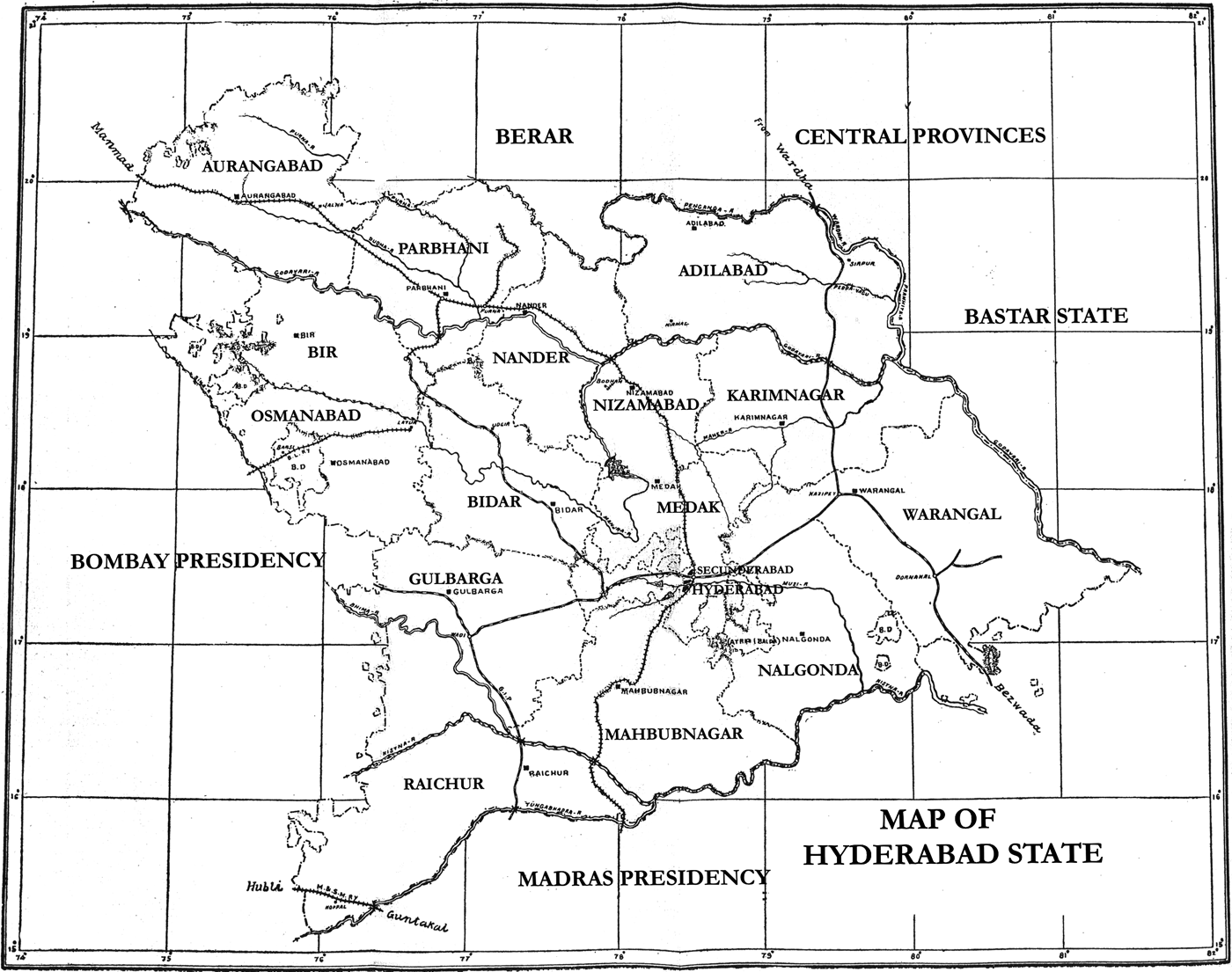
Sunderlal and Ghaffar's delegations toured nine of the sixteen districts of Hyderabad between 29 November and 21 December of 1948. They visited seven district headquarters, twenty-one towns, and twenty-three “important” villages, and interviewed over five hundred people from an additional 109 villages. They concluded that Osmanabad, Gulburga, Bidar, and Nanded were the districts worst affected by the violence, where, they claimed, “the number of people killed during and after the police action was not less, if not more than 18,000.” They estimated that in Aurangabad, Bir, Nalgonda, and Medak districts “those who lost their lives numbered at least 5 thousand.” While these eight districts were the hardest hit, the report claims that no district remained “wholly” free of “communal trouble.” For Hyderabad as a whole, they gave “a very conservative estimate that in the whole state at least 27 thousand to 40 thousand people lost their lives during and after the police action.”Footnote 90
To construct a general geographic schema of the violence it is useful to analyze the Sunderlal Report alongside a document called Hyderabad Reborn, a propaganda publication issued by Hyderabad's Military Government in March 1949.Footnote 91 The Police Action plan developed by the Ministry of States called for teams of “civil administrators” to trail advancing Indian troops to take over government in “liberated” areas. However, in large areas of the state even semi-functional governance was not established for weeks after the Nizam's surrender.Footnote 92 This gap roughly coincided with much of the violence. In Adilabad, for example, the Civil Team did not reach district headquarters until the last day of September, a full two weeks after the surrender. According to Hyderabad Reborn, it was during this period that “Muslims suffered through retaliatory action” in Kinwat and Nirmal talukas [administrative district subdivisions], located along or in close proximity to the Berar border.Footnote 93
Hyderabad Reborn recounts that when the Indian civil team arrived in Bidar, “the retaliatory instinct” of the Hindus “had to be held in leash.” Consequently, it was a considerable time before “law and order” was re-established.Footnote 94 Gulbarga “was faced with the same problem as Bidar of controlling the majority community from wreaking vengeance on their erstwhile oppressors.”Footnote 95 It took weeks to re-establish governance, and the civil team had only “settled down” by early November.Footnote 96 The Sunderlal Report claims that five to eight thousand Muslims were killed in Gulbarga during this time, and Bidar “fared at least as ill if not worse than Gulbarga.”Footnote 97 In Nanded district, which shared a border with Berar, it was only “by the middle of October” that the “situation in the interior had come under control” and military forces were withdrawn only at the end of November.Footnote 98 The Sunderlal Report estimates that between two and four thousand Muslims were killed in Nanded during this time.Footnote 99
Hyderabad State. Marathwada region was comprised of Aurangabad, Parbhani, Bir, Osmanabad, and Nanded. Telangana included Adilabad, Nizamabad, Karimnagar, Medak,Warangal, Nalgonda, and Mahbubnagar districts. The Karnatak region was Bidar, Gulbarga and Raichur. Some information comes from Christoph von Fürer-Haimendorf, The Aboriginal Tribes of Hyderabad, Vol. III: The Reddis of the Bison Hills, A Study in Acculturation (London, Macmillan & Co, 1945).
Hyderabad Reborn is vague regarding Osmanabad. This is unsurprising since the Osmanabad civil team was later revealed to have participated in an auction of Muslim property conducted by the Hyderabad State Congress.Footnote 100 A government-appointed committee led by the State Congressman Narsing Rao visited forty-seven villages in Osmanabad and their report of June 1951 estimated “approximately 2,500” widows and six thousand orphans in these villages alone. The committee recommended that any government plan for rehabilitation should be based on the estimate of “approximately 10,000 widows and 25,000” orphans in Osmanabad district.Footnote 101 A 1950 report by Maulvi Hifzur Rahman, general secretary of the Jamiat-Ulama-i-Hind and a member of both the All-India Congress Committee and the Constituent Assembly, claimed that there were about two thousand Muslim widows in Osmanabad district, with a further 1,222 in Aurangabad.Footnote 102
Hyderabad Reborn says little about Aurangabad district. The Sunderlal Report mentions that the civil team and military there were “exemplary” and “effective,” yet concludes that between two and three thousand Muslims were killed in Aurangabad.Footnote 103 The same holds true for Bir; the government reported little from that district and it is rarely mentioned in later investigations, but the Sunderlal Report estimates that between one thousand and fifteen hundred Muslims died there.Footnote 104
According to Hyderabad Reborn, the “restoration of law and order and normal life” took two weeks in Medak district, during which time looting and occupation of Muslim property was common.Footnote 105 Anticipating trouble, many Muslims in Medak left their villages at the onset of the Police Action.Footnote 106 In Nizamabad, the Indian civil team arrived on 29 September and it “took a month and a half for the situation to return to normal.”Footnote 107 The primary challenge in this district was to assure “the Muslim population of all protection from retaliation.”Footnote 108 However, Nizamabad was ignored by the Sunderlal Report and later investigations, and the same can be said for Raichur, though Hyderabad Reborn mentions its large “Razakar population,” looting, and the kidnapping of women.Footnote 109
The extent of violence remains unclear in the other districts of Telangana, where a communist-led peasant revolution of great scale and scope had been active since 1946. Initial reports, including the Sunderlal Report, indicated Muslims were targeted in both Warangal and Nalgonda. Maulvi Rehman detailed attacks on Muslim property in Warangal.Footnote 110 The communist leader P. Sundarayya later claimed that “ordinary Muslim people” were “pounced upon and untold miseries were inflicted on them” during the Police Action, and he fingered the Indian Army as the primary culprit. He insisted that the areas under revolutionary influence in Telangana were relatively unscathed, but elsewhere “attacks on [Muslims] were widespread.”Footnote 111 And yet, as part of a contentious intra-party debate on whether to continue the armed struggle after the Police Action, the rival communist leader Ravi Narayan Reddy cited numerous incidents during which communist guerrilla squads killed unarmed Razakars who had surrendered, noting, “All the Razakars and soldiers killed this way were poor Muslims.”Footnote 112 From the available sources, then, it seems likely that there was considerable violence in Telangana, but the Marathwada and Karnatak areas suffered the lion's share.
VIOLENCE AND THE STATE AFTER THE POLICE ACTION
Both the Indian government and the national press were conspicuously silent regarding the violence in Hyderabad, and refused to respond to what they considered a hyperbolic Pakistani press campaign intended to delegitimize the Indian state. Confidentially, however, there was official consensus that the fact of widespread violence was irrefutable.Footnote 113 What was questioned was the scale suggested by the Sunderlal Report. A furious Patel wrote to Abdul Ghaffar, “Your estimate and your appreciation of the position lack balance and proportion.”Footnote 114 After meeting with the Sunderlal delegation, Military Governor Chaudhuri described the Report as “full of the grossest inaccuracies as well as some dangerous statements.” Chaudhuri claimed to “know these figures to be grossly untrue” and warned of “the danger of such a document getting into the hands of any interested Pakistani.”Footnote 115 However, Chaudhuri himself reported to the Ministry of States in November 1948:
Immediately after the military occupation started, a large majority of Hindus in all districts of Hyderabad, thought that Hindu Raj had come into being.… As a result of this retaliatory action by Hindus, some Muslims in certain districts suffered. The districts particularly affected were Bidar, Osmanabad, Gulbarga, Nalgonda & Warangal. Though accurate figures cannot be obtained yet of what the casualties were, it is estimated that about 2,000 Muslims may have been massacred. Almost all of this happened in the smaller villages off the main communications.Footnote 116
In October 1950, Nehru wrote to Patel comparing what happened in Hyderabad to the “horrible deeds” and “inhuman atrocities” which took place in Punjab: “In Hyderabad, something of a like nature happened perhaps on a smaller scale.”Footnote 117 A confidential intelligence report from October 1948 noted, “Muslims who did not have much to do with the Razakar organization have also been greatly victimised .… In Secunderabad several Muslim houses and shops were looted both day and night for about ten days from 18-9-48, with Indian troops not effectively intervening to stop the lawlessness. A further outbreak of looting was reported for about five days from 2-10-48.… Both in Hyderabad City and the mofussil it would appear that many sections of the irresponsible Hindu public looted and oppressed Muslims indiscriminately.”Footnote 118
Chaudhuri's successor and the first civilian chief minister of Hyderabad, Indian Civil Service officer M. K. Vellodi, described Marathwada as an area “where militant Hindu orthodoxy prevails, and where Hindu excesses have been gravest in the wake of Police Action.”Footnote 119 Vellodi characterized these “excesses” as “exceptionally savage in nature.”Footnote 120 Chief Secretary to Government of Hyderabad L. C. Jain similarly noted that it was in Marathwada that “the greatest excesses against the Muslims were perpetrated in the wake of Police Action.”Footnote 121
Hyderabad Reborn noted that during the “disturbances” both before and after the Police Action thousands of families “lost their earning male members and were reduced to destitution,” adding that “the worst sufferers of any holocaust are women.”Footnote 122 The government gave out a fixed quota of 4,500 “widow pensions to the women whose husbands had been killed.” Of these, “about 75 percent” were given to those “who suffered immediately after the Police Action on account of the reaction”; that is, Muslims.Footnote 123 Thus, according to government statistics, the husbands of at least 3,375 Muslim women were killed during and after the Police Action.
The Sunderlal Report considered it “a significant fact” that the areas “worst affected” by the violence were previously “the main strongholds of Razakars,” and that the people in these areas “had been the worst sufferers at the hands of the Razakars.” On this account, the report concluded, “In this campaign of retaliation at least a hundred were made to suffer for the sins of each guilty individual.”Footnote 124 This discourse of “retaliation” had long held currency in Indian politics, being variably used by colonial administrators and Indian political leaders alike to construct violence as a social problem rather than a political phenomenon and thereby excuse themselves of any responsibility for political violence.Footnote 125 For example, Hyderabad's home secretary commented, “Following the taking-over of the administration, there was naturally some retaliation and it was understandable that there were quite a few cases of forcible occupation of places of worship or their desecration.”Footnote 126 The Chief Civil Administrator in Hyderabad dismissed the violence as “a retaliation against the brother villagers for their misdeeds committed by them as Razakars.”Footnote 127 Military Governor Chaudhuri similarly explained, “As a result of this retaliatory action by Hindus, some Muslims in certain districts suffered.”Footnote 128 Nehru proffered a similar interpretation: “About the time the Indian forces were entering Hyderabad, and the old governmental structure had broken down, there were upheavals of the Hindu population especially in the rural areas. These people, who had previously suffered from considerable repression from the Razakars, rose against them. They were joined by refugees who returned to Hyderabad. The result was that murder, arson and looting was committed.”Footnote 129
In the course of a contentious exchange between Nehru and Patel in 1950 over the position of Muslims in Hyderabad, the latter explained, “A popular reaction and revulsion against the old order and the persons and authorities behind it were inevitable …. If you remember the nature of the treatment which the Hindu population had been receiving at the hands of the Razakars, the wonder is that the retaliatory violence after the sharp change in the situation after the Police action was so little.”Footnote 130 This logic informed government policy in the wake of the Police Action, including a general amnesty for Hindus. Patel ordered that “all political detenus, under-trial prisoners and prisoners convicted for political offences whether they were involved in acts of violence or not, other than communists, should be released.”Footnote 131 The State Congress was at the time being groomed to govern Hyderabad, and the release of prisoners was done “in consultation with the local Congress organisation.”Footnote 132 Communicating the official line set by Patel, the Ministry of States held that Razakar “crimes were committed as part of a deliberate policy with the knowledge and presumably the connivance of the then administration of Hyderabad,” whereas the crimes “committed by non-Muslims in the wake of the Police Action” were “the natural reaction against long years of oppression by a minority community and were committed in the heat of the moment.”Footnote 133 In June 1949, on Patel's instructions, the Hyderabad government granted amnesty to all “Hindus involved in retaliatory action just after the Police Action,” although Chaudhuri ordered that “no publicity should be given to it.”Footnote 134 After the Police Action, approximately 17,550 suspected Razakars were “rounded up” by the new Military Government. Around the same time when Hindus were granted amnesty, 1,535 suspected Razakars remained in prison, while an additional 563 individuals were “held in detention as detrimental to the security of the State.”Footnote 135
Officials identified an ambiguously defined category of people as responsible for the violence. The consensus culprits were the estimated five hundred thousand Hindu “refugees” who had fled Hyderabad during the previous year.Footnote 136 Many of them were concentrated in the border areas of Bombay Province and C.P. and Berar, settled in cities like Sholapur or in the camps set up by the Congress and Arya Samaj. Many likely participated in the armed struggle against Hyderabad. In the second week of October 1948, the Ministry of States ordered the governments of the neighboring provinces to prevent any Hindus from returning to Hyderabad unless organized and supervised by the government. Chaudhuri was “greatly perturbed at the indiscriminate return of Hindu refugees,” fearing this would lead to further “communal trouble.”Footnote 137
Yet while the Sunderlal Report generally agrees with the official explanation, it also claims that the “perpetrators of these atrocities were not limited to those who had suffered at the hands of Razakars,” but also included,
…individuals and bands of people, with and without arms, from across the border, who had infiltrated through in the wake of the Indian Army. We found definite indications that a number of armed and trained men belonging to a well known Hindu communal organization from Sholapur and other Indian towns as also some local and outside communists participated in these riots and in some cases actually led the rioters. Duty also compels us to add that we had absolutely unimpeachable evidence to the effect that there were instances in which men belonging to the Indian Army and also to the local police took part in looting and even other crimes.Footnote 138
Further, the Report observes that the “State Congress has failed to give an absolutely satisfactory account of itself during the period of trouble,” and then presents a litany of charges against State Congress cadre, including “extracting money from panicky Musalmans,” disrupting local administration, and auctioning property confiscated from Muslims for the benefit of the party.Footnote 139 Chaudhuri reported in November 1948 that “certain members of the State Congress undoubtedly terrorized the Muslims” and looted property following the Police Action.Footnote 140 The State Congress chief Swami Tirtha largely conceded most of these charges: “Soon after the Police Action, there was a great upheaval. People retaliated.”Footnote 141 He further claimed that the military itself was responsible for much of the violence:
It was a natural reaction even though wrong and bad in character to the worse Razakar regime and sufferings of the people in those days. The communal minded section of the Military and Police also indulged in it and encouraged and even threatened the people to do it. That must give them [State Congress] a cover for their own acts.… Some of the Congress workers, who happened to be with these incoming troops, got implicated into it and strangely enough the whole phenomenon is taken by the Muslims and propagated by certain interested sections as the Congress sponsored game.Footnote 142
This situation was used to promote factional interests within the State Congress, with a liberal faction accusing cadre from the border camps of “committing acts unworthy of congressmen.”Footnote 143 Chaudhuri noted that rival factions had “given information against the members of the other group for having been concerned in the commission of atrocities after Police Action.”Footnote 144 The October 1948 confidential intelligence report quoted earlier was unequivocal regarding the responsibility of the State Congress: “It is known that in several areas, immediately after ‘occupation’ these [State Congress] ‘volunteers’ themselves took part in pillage, loot and rape.… Irresponsible ‘volunteers’ looted properties and molested Muslim women in Khammamet, Madira and Warangal, and were restrained by their leaders only with difficulty.”Footnote 145
Yet in an effort order to help re-establish governance after the fall of the Nizam, the military governor sent at least four hundred State Congress workers to the districts, carrying identification cards as proof of their official sanction.Footnote 146 However, Chaudhuri would later report, “Immediately after the Police Action members of the Hyderabad State Congress extorted money, sold property belonging to Muslims by auction and appropriated the proceeds to party funds, etc.”Footnote 147
State Congress cadres were directly implicated in orchestrating looting and violence in the city of Latur in Osmanabad District. In his memoirs, Osmanabad's district collector claimed that “thugs” and “several thousand young men from the border camps” perpetuated the violence.Footnote 148 Noting that Latur was the hometown of Razakar supremo Kasim Razvi, the Sunderlal Report claims, “… the killing continued for over twenty days. Out of a population of about 10 thousand Muslims there we found barely three thousand still in the town. Over a thousand had been killed and the rest had run away with little else besides their lives and completely ruined financially.”Footnote 149 While these figures cannot be corroborated, it is clear that, at the least, Latur was the site of a large-scale confiscation of Muslim property orchestrated by the State Congress.Footnote 150 Yet many of the leaders involved in the armed struggle and accused in the violence remained influential within the party.Footnote 151 Phoolchand Gandhi, for example, was later appointed a minister in the Hyderabad government with the approval of the States Ministry in 1950. The most famous political career launched by the armed struggle was that of P. V. Narasimha Rao, who entered politics fighting the Nizam and ended up as India's Prime Minister from 1991–1996.
The “well known Hindu communal organization from Sholapur” mentioned in the Sunderlal Report was, most likely, the Arya Samaj. According to the report, a “prominent Arya Samajist” converted the “local Arya Samaj mandir into a sub-jail.” He arrested Muslims from the locality on “his own authority” and would only release them after extracting payments. If they refused to pay or could not, they were handed over to the police as Razakars. I have noted that the Samaj organized camps along the border for Hyderabad refugees and that it had a considerable presence within the State Congress and participated in the armed struggle, but there is little further evidence of its role in the violence during and after the Police Action.
The accusations the Sunderlal Report leveled against the Indian Army are difficult to substantiate, but considering the circumstances of a military operation, the military was probably involved in at least some violent incidents against Muslim civilians. Conceding, “on the whole the Army has done splendidly well,” the report claimed that at “a number of places members of the armed forces brought out Muslim adult males from villages and towns and massacred them in cold blood.” Elsewhere, “they encouraged and even persuaded the Hindu mobs to loot Muslim shops and houses” and “even joined in the looting.”Footnote 152 The October 1948 intelligence report noted that Sikh units in the Indian Army “actively assisted” sections of the “irresponsible Hindu public” in both Hyderabad city and the state's rural areas.Footnote 153 A confidential Communist Party of India document leveled similar charges.Footnote 154 The press in Pakistan produced a chorus of accusations against the Indian Army.Footnote 155 Chaudhuri rejected such accusations altogether, but conceded that there was “indiscriminate arresting of Muslims in the districts by both troops and Union Police” during the Police Action.Footnote 156 This consequently left Muslim families and property vulnerable to “certain unsocial Hindu elements.”Footnote 157 What is clear in all this is that the Police Action triggered a coming together of popular and state violence at a significant moment in the making of the postcolonial order.
INCORPORATIVE VIOLENCE AND THE MAKING OF A MINORITY
There are, of course, many ways of interpreting the violence. Aside from “retaliation,” the Sunderlal Report, much like the reports compiled by Maulvi Hifzur Rahman and Narsing Rao, points to property and other material factors.Footnote 158 Gail Omvedt, too, has claimed that land given to Dalits by the Nizam's government in the years preceding the Police Action was “a major source of conflict in Marathwada after the Congress takeover.”Footnote 159 She further argues that the Police Action “included direct army atrocities against many of the poor,” as well as “direct Hindu reprisals in many areas against Muslims and Dalits who were presumed to be ‘pro-Razakar.’”Footnote 160
Since our concern here is the role of the violence in Hyderabad in the making of the sovereignty of the Indian state, I want to interpret the violence in terms of incorporation, not only in the sense of territory but also that of the wider transformation of India's Muslims from a national political community into a religious minority. The Sunderlal Report claims “forcible conversions” were,
a universal factor almost everywhere we went. After the adult males of a locality had been killed the women and children were generally ‘persuaded’ to adopt the Hindu faith. We came across hundreds of Muslim women who had been forcibly tattooed on the forehead in the orthodox Hindu style as a mark of their conversion. Some had even their new Hindu names tattooed on their fore-arms. We saw children whose ears had been freshly bored in the Hindu style. Beards had been shaved off and choties kept. We saw the sacred thread hanging around the neck of Muslims.Footnote 161
An intelligence report noted that “instances of demolition of mosques, desecration of the holy quran, forcing Muslim women to tattoo their foreheads and compelling Muslims to shave off their beard have been reported from Bidar, Nander and Gulbarga districts.”Footnote 162 Ritual endowed violence with legitimacy and meaning, and such ritualized forms of marking Muslim bodies as one's own seemed to mirror the larger geopolitical narrative of the Police Action. Acts of tattooing and naming, for example, can be interpreted as acts of degradation and marks of submission, but they were at the same time marks of association. In such a reading, violence constructed the Muslim as, not the irreconcilable other, but inextricably part of the nation in the territorial heart of the nation. Such simultaneous subjugation and incorporation is similarly decipherable in the installation of Hindu idols in hundreds of rural mosques throughout Hyderabad. Here we have the simultaneous occupying and dispatching of the sovereignty of the Nizam and Hyderabad's Muslims more generally, as such acts evacuated the sovereign content from the Muslim body that had been central to the MIM's political philosophy. In the process of creating such an association, the bodies of Hyderabad's Muslims became spaces for the exercise of violence as a substantiation of national sovereignty.
This narrative of incorporation was most explicitly articulated through instances of human sacrifice. For example, according to a police report, “A group of 15 Congress volunteers led by Raghava Reddi murdered three muslims” and “Raghava Reddi is said to have cut the throats of the Muslims and drank their blood.”Footnote 163 The Sunderlal Report claims that Arya Samajists moved Muslim detainees to temples and “then finished them off in the sacred precincts.” Considering the importance of the Arya Samaj in Marathwada, sacrifice and violent conversion can perhaps be interpreted in light of the Samajist notion of shuddhi, or purification. Indeed, purification was a major theme in the public debate regarding Hyderabad and the territorial integrity of the Indian nation-state. Territory as the corpus of the nation took on an intensified meaning during this debate, and it was common to refer to Hyderabad, in Patel's words, as “a cancer in the belly of India” and the source of a “veritable poison” that threatened the fulfillment of the Indian national project.Footnote 164 As such, Patel referred to the Police Action as a “surgical operation” necessary to remove pollutants from the body politic, a sort of vivisectionist shuddhi ceremony for the nation.Footnote 165 The Nizam's quest for independence and the circulation of popular discourses regarding Muslims as “fifth-columnists” produced an overwhelming ambivalence in the months preceding the Police Action. Acts of naming such as ritualized tattooing, forced conversions, and even sacrifice can be interpreted as a means of producing certainty out of such indeterminacy and, in this way, as acts of epistemological ordering.Footnote 166
Unlike in East Punjab, where Muslims were expelled in mass, in Hyderabad this ordering was, among other things, concerned with internalizing the Muslim within the emerging national order. That is, with Muslim sovereignty territorialized in Pakistan, the Police Action and its violence were important events in the transformation, or reversion, of India's Muslims from a “national” political community to a religious minority. This transformation was marked by a general withdrawal of Muslims from the political sphere, and Indian Muslim leaders maintained a steadied public silence regarding the violence of the Police Action. This transformation deserves a more thorough treatment than is possible here, but I want to argue that it was precisely through victimization that a new relationship between the Indian state and Muslims was forged, with the latter remaining in the first decade or so after 1947–1948 as a depoliticized category and ward of the state requiring protection. Silence was borne not only out of fear, but was an effort on behalf of India's Muslims to enter into a political relationship with the very state at once responsible for their persecution and protection. This was a significant yet under-theorized step in making the nation and the national. In the months preceding the Police Action many Muslim leaders responded to widespread calls for them to make public statements in support of the Government of India, and their subsequent silence can be interpreted as an attempt to demonstrate “proof” of their loyalty that many Indian nationalists—most infamously Sardar Patel himself—had been demanding.Footnote 167
Considering the shortcomings of both the state bureaucracy and the Congress Party in fulfilling its role as the trustee of Hyderabad's Muslims during this period of post-1948 transition, it is perhaps unsurprising that the eventual return of Muslims to the political sphere in Hyderabad came in the form of a revived MIM, which remains the dominant political force among the Muslims of Hyderabad city. The considerable unease that the MIM provokes in virtually all segments of Indian political opinion, including and perhaps especially among the liberal-left, is a continuing reminder of the anxiety surrounding the Muslim as a political category. At the same time, however, such institutional participation is a testament to the expansiveness and incorporative capacity of Indian democracy to recognize and give legitimacy to the question of difference, as well as the country's troubled but relatively favorable record toward its minorities, at least when compared with elsewhere in South Asia.
CONCLUDING REMARKS
I hope this article contributes to opening up alternative and expanded avenues for understanding the partition, and the decolonization of India generally. But a more specific question it raises is that of why and how the events in and around Hyderabad have escaped scholarly attention. Most accounts of the consolidation of Indian state sovereignty have focused on legal-constitutional perspectives or on the establishment of territorial command, without exploring the mechanisms and processes through which such command has been realized. I have demonstrated here that national territoriality was made not only at the external borders but also in the interior, where non-state violence invested territory with new meaning at the inauguration of a new state project.
This relationship between non-state violence and the construction and reproduction of state sovereignty is not unique to India, and I hope my analysis will contribute to wider theoretical and historical debates regarding this issue. The Indian nation-state project was launched at a moment when violence was predominantly outside of the state and threatened to overwhelm the state itself. In Punjab, the project of making peace out of violence through the fixing of national subjects to national territory, and massive state-led efforts of relief and rehabilitation, conditioned the emergence of an interventionist state that was assigned an expanded set of responsibilities. The military operation known as the Police Action was, like state efforts to protect and preserve life in Punjab, a highly visible enactment of state sovereignty. Visibility was a central strategy of a state that sought to reproduce its sovereignty more through pervasiveness than persuasiveness.Footnote 168 The visible and the spectacular were undeniably important to transforming the state into “a legitimate symbol of reference and affect in India,” even if the meaning of the state itself remained contested.Footnote 169 Yet most narratives of this period of transition have rendered invisible the mobilization of violence that led up to and followed the Police Action. This was also a contingent ideological conjuncture, which saw ostensibly secular parties like the Congress and the Socialists come together with avowedly “communal” bodies like the Arya Samaj and Hindu Mahasabha in order to further the nation-state project, despite their disagreements over what sort of nation or state it should be. In light of India's current political context, this should renew debate over whether the nation-state project was majoritarian from its inception.
Patel, correctly, referred to popular participation in the Police Action as “nothing short of a revolution.”Footnote 170 By this he meant direct action by what was perceived to be a popular sovereign. “The people” realized themselves as a historical actor through violence, and this realization was at once given meaning by, and gave meaning to, the state. This revolution did not mean a complete overthrow of the hierarchies of the old order and their replacement with something entirely new, but the late 1940s did witness revolutionary changes that constructed a new order of political meaning and the re-signification of the state in the Indian imaginary. Violence was an essential feature of generating a social basis for the nascent nation-state. And like other revolutions, in this moment of creation, violence exceeded the law, but was nevertheless constitutive or foundational of a new institutional and political order.
The silence surrounding the anti-Muslim violence in Hyderabad reflects the continuing power of the Indian state to craft its own historical narratives. What most distinguished the violence in Hyderabad from previous Hindu-Muslim “riots” or the extreme violence in Punjab was the level of state involvement. This was also an important episode in the transformation of the Indian National Congress from an anti-colonial nationalist movement into a party wielding state power. While here I have analyzed the violence within the specific context of state-formation in the early years of independence, the mobilization of violence and the subsequent amnesty for those involved in it can be seen to have set a precedent for the manner in which political parties have deployed violence in the decades since.
In dissent with the dominant trend in the now-established field of “Partition Studies” that seeks to resist writing histories seen to privilege the “career of the Indian nation-state,”Footnote 171 it is now more important than ever to examine this foundational period of the Indian republic, and think through how violence not only conditioned the emergent postcolonial state, but also provided the context for and gave meaning to India's nascent democratic experiment. While the colonial state was violent and repressive, the Indian nation-state that developed after 1947 was more powerful. The statecraft of nationalist elites was responsive to pressures from below in the years leading up to and following 1947, and this requires us to understand the processes through which the conversion and cooption of subaltern violence generated consent for the nascent nation-state.Footnote 172 The Indian state's efforts to protect and improve life as a shared historical process by expanding its capacity and popular mandate for violence has much to teach us, with broad implications for how we understand the relationship between violence and democracy in the global twentieth century.Footnote 173