Introduction
Europe is home to a range of unique habitats (Evans Reference Evans2006); however, the ongoing landscape modifications (Verburg et al. Reference Verburg, van Berkel, van Doorn, van Eupen and van den Heiligenberg2010) – evident even within Europe’s protected areas (Hermoso et al. Reference Hermoso, Morán-Ordóñez and Brotons2018a) – pose a threat to its biodiversity (Tscharntke et al. Reference Tscharntke, Tylianakis, Rand, Didham, Fahrig, Batary and Bengtsson2012). The European Union’s (EU’s) efforts to conserve its habitats are centred around the Habitats Directive (Directive 92/43/EEC; Evans Reference Evans2006). A key element of the Directive is the mandate for designating a pan-European network of protected areas, called Natura 2000 sites (Council of the European Commission 1992). Within these sites, EU member states are expected to implement actions aimed at improving the conservation status of EU habitats and species (Ellwanger et al. Reference Ellwanger, Runge, Wagner, Ackermann, Neukirchen, Frederking and Müller2018). Particular attention is given to habitats and species of ‘community interest’ listed in the Annexes of the Directive (Council of the European Commission 1992, Ellwanger et al. Reference Ellwanger, Runge, Wagner, Ackermann, Neukirchen, Frederking and Müller2018).
One of the main funding instruments for financing the aforementioned conservation actions is the LIFE programme (European Commission 2018), which since its commencement in 1992 has supported more than 4000 projects across the EU (European Commission 2018). Currently, the programme is running its fifth phase (2014–2020) with a budget of €3.4 billion (European Commission 2018). For the programme to be successful, it is important that the available budget is allocated in the most effective way possible and spent where it is most needed (Sánchez-Fernández et al. Reference Sánchez-Fernández, Abellán, Aragón, Varela and Cabeza2018, Mammides Reference Mammides2019). The allocation of the programme’s budget has been studied and recommendations made for possible improvements (Lung et al. Reference Lung, Meller, van Teeffelen, Thuiller and Cabeza2014, Hermoso et al. Reference Hermoso, Villero, Clavero and Brotons2018b, Sánchez-Fernández et al. Reference Sánchez-Fernández, Abellán, Aragón, Varela and Cabeza2018). Sánchez-Fernández et al. (Reference Sánchez-Fernández, Abellán, Aragón, Varela and Cabeza2018), in particular, found that although in general the spending reflects each member state’s richness in species and extent of protected areas, there are also substantial mismatches, with several states, such as Italy and Spain, receiving a disproportionate amount of funds based on what would be expected according to their biodiversity. Studies have also found mismatches in terms of which species receive the most funding, documenting a bias towards vertebrates, particularly birds and mammals (Sánchez-Fernández et al. Reference Sánchez-Fernández, Abellán, Aragón, Varela and Cabeza2018, Mammides Reference Mammides2019).
No previous study, however, has assessed whether biases also exist in terms of which habitats are funded, and whether the allocation of the funding sufficiently reflects the conservation needs and the status of the habitats across the whole EU. These questions are important because if some member states are more successful than others at securing funding (Sánchez-Fernández et al. Reference Sánchez-Fernández, Abellán, Aragón, Varela and Cabeza2018) – regardless of the number of habitats they hold and their conservation status – then it is probable that habitats in underfunded member states, with unfavourable status, are not receiving enough attention, especially if transnational collaboration is low and if successful member states are only targeting habitats within their own borders. Moreover, researchers have shown that the cost of conserving biodiversity rises dramatically when countries in Europe act independently of each other and do not coordinate their conservation actions (Kark et al. Reference Kark, Levin, Grantham and Possingham2009, Reference Kark, Tulloch, Gordon, Mazor, Bunnefeld and Levin2015, Mazor et al. Reference Mazor, Possingham and Kark2013). Consequently, low transnational cooperation would not only mean that important habitats in underrepresented member states are possibly ignored, but also that the limited funds available for conserving EU habitats are distributed in a suboptimal manner. To understand better these issues, we use a series of analyses to identify potential inefficiencies in the allocation of the EU’s budget available for conserving its habitats – specifically the budget distributed through the LIFE programme (European Commission 2017).
First, we test whether the number of LIFE projects implemented within each member state reflects the number of habitats within that state. Then, we explore whether particular habitats tend to receive more funding than others. Specifically, for each terrestrial and marine habitat in the EU, we examine: (1) whether it has been funded at all since the beginning of the LIFE programme (i.e., more than 25 years ago); and (2) whether it has been overfunded in some member states while underfunded in others. Then, we test whether the number of LIFE projects targeting each habitat is related to the habitat’s conservation status. Lastly, we assess the extent of transnational collaboration across the EU (Kark et al. Reference Kark, Tulloch, Gordon, Mazor, Bunnefeld and Levin2015) by comparing the number of LIFE projects targeting habitats in more than one member state to the number of habitats occurring in multiple member states.
Methods
Data collection
We downloaded the complete European Commission list of LIFE projects funded between 1992 and 2016 (http://ec.europa.eu/environment/life). The LIFE programme funds a gamut of environmental and conservation projects (European Commission 2018). Conservation-related projects are funded almost exclusively under the LIFE Nature scheme; therefore, for the purposes of our analysis, we focused on those projects only. Using the rvest package in R (Wickham Reference Wickham2016) – suitable for mining data from the web – we downloaded the following information for each LIFE Nature project: the recipient country; the total budget and the budget contributed by the EU (€); the year the project was funded; whether it targeted habitats or species (or both); and in which Natura 2000 sites the project was implemented. If the Natura 2000 sites were not specified, then the project was excluded from the analyses since it was not possible to identify in which biogeographical region the targeted habitat was located, and consequently its conservation status, which varies depending on the region (European Environment Agency 2018).
We then downloaded the dataset on the conservation status of EU habitats made available online by the European Environment Agency (2018) at https://www.eea.europa.eu/data-and-maps/data/article-17-database-habitats-directive-92-43-eec-1. The data are part of the mandatory monitoring and reporting required by Articles 11 and 17 of the Habitats Directive (Ellwanger et al. Reference Ellwanger, Runge, Wagner, Ackermann, Neukirchen, Frederking and Müller2018). The Directive requires member states to report every 6 years on the progress made in its implementation (Ellwanger et al. Reference Ellwanger, Runge, Wagner, Ackermann, Neukirchen, Frederking and Müller2018), mainly regarding the conservation status of the habitats and species of community interest, listed in the Annexes (Council of the European Commission 1992). Among other information, the following details are reported and were downloaded for each habitat: biogeographical region; geographical range (km2); and conservation status at the member state and EU levels. Conservation status was designated as one of the following: FV = favourable; U1 = unfavourable – inadequate; U2 = unfavourable – bad; XX = unknown. The status at the member state level represents each habitat’s condition within that particular member state. The status at the EU level represents the overall status across the whole of the EU (European Environment Agency 2018). The two status values may differ since a habitat in certain member states may have a favourable status while at the EU level have an unfavourable status, and vice versa. The status may also differ between the member states; a habitat may have a favourable status in one state but an unfavourable status in another.
Currently, the dataset does not include information on Croatia’s habitats; therefore, this specific member state was excluded from all further analyses. Based on the remaining 27 member states, there are 231 habitats in the EU, officially called ‘habitat types’, found across nine biogeographical regions (European Environment Agency 2018). Five out of the nine biogeographical regions are further divided into terrestrial and marine (e.g., alpine and marine alpine), making a total of 14 regions. Often, a habitat type is part of more than one biogeographical region. For example, habitat type 1110, ‘Sandbanks which are slightly covered by sea water all the time’, is found in all five marine regions. Habitat type 1150, ‘Coastal lagoons’, is found in six of the nine terrestrial regions. Because the conservation status of a habitat type often varies among regions at the member state and EU levels, the status of each habitat type within each biogeographical region is reported separately by the member states and the EU (European Environment Agency 2018). In order to account for this fact, in all of the analyses we describe below, we considered each habitat type within each biogeographical region as a separate entity, a total of 810, hereafter called ‘habitats’.
Data analysis
To avoid biasing our results by including LIFE Nature projects that are unrelated to the protection of habitats (e.g., projects targeting only species), we restricted our analyses to projects that have targeted at least one habitat. We first assessed whether the mismatches for the number of species and the extent of protected areas reported previously (Sánchez-Fernández et al. Reference Sánchez-Fernández, Abellán, Aragón, Varela and Cabeza2018) apply to the habitats as well. In our case, however, we ran the analyses at two different spatial levels using first the biogeographical region as the unit of analysis (n = 14) and then the member states (n = 27). We tested using a linear regression model whether the number of projects implemented within a biogeographical region is related to that region’s total number of habitats. Then, we repeated the analysis for the member states. For this latter analysis, we also added the years of participation in the programme as a covariate in the model in order to control for member states having entered the programme at different phases. We calculated the years of participation by counting how many years had passed since each state’s first LIFE project.
For each member state, we also calculated what percentage of its habitats had been funded. We used a multiple linear regression model to test whether this percentage could be explained by either the number of habitats within each state or the number of years participating in the programme. The rationale behind this analysis was that member states could be more likely to have a higher percentage of their habitats funded if they had fewer habitats and if they had been part of the programme for longer.
Using the full list of habitats in the EU (European Environment Agency 2018), we then assessed what percentage of those has never been funded. For the rest that were funded, we measured the number of projects that have targeted them and the number of occasions there was a ‘mismatch’ in the funding; we defined as a mismatch any occasion in which a habitat with a favourable (FV) conservation status in one member state was targeted by one or more LIFE Nature projects, while simultaneously that same habitat in another member state had an unfavourable status (U1 or U2) but has not received any funding at all.
We used an analysis of variance test in order to assess whether there was a relationship between the number of projects targeting each habitat and that habitat’s conservation status across the EU. We then used a post-hoc Tukey’s test to compare pairwise differences between the four conservation status categories (i.e., FV, U1, U2 and XX). We complemented this analysis with a linear regression model in which we used the range of each habitat (i.e., the area covered within the EU) and its conservation status as explanatory variables. We then used the relaimpo package (Grömping Reference Grömping2006) in R to partition the variance explained by each of these two variables. The number of projects and the range of each habitat were log-transformed to improve linearity. All of the linear regression models were assessed in order to ensure that there were no issues with collinearity.
Finally, we measured the proportion of the projects that included transnational conservation actions (i.e., those actions in more than one member state). We plotted the results on a map diagram and compared them to an analogous diagram drawn based on the number of habitats shared between the member states. All of the analyses were conducted in R programming language (R Core Team 2018).
Results
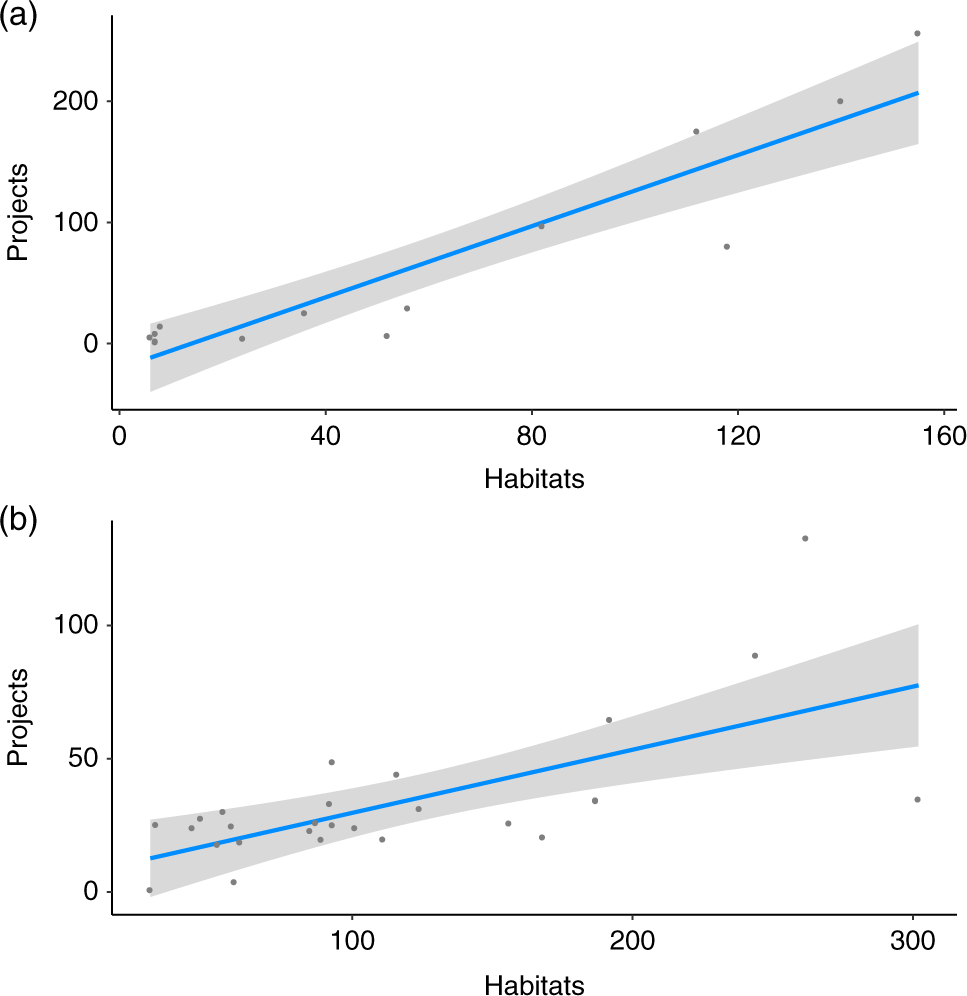
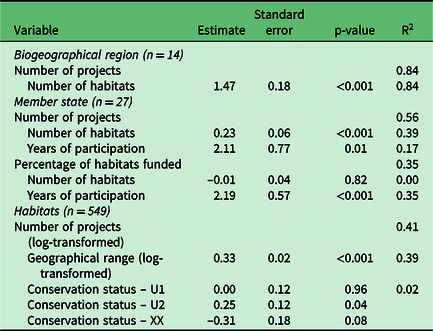
In total, between 1992 and 2016, there were 963 LIFE Nature projects targeting one or more habitats, of which 82% specified in which Natura 2000 sites the project was implemented and therefore were included in the analysis. We found a strong positive relationship between the number of habitats within a biogeographical region and the total number of projects implemented in that region (Fig. 1(a)). On average, for every extra habitat a region had, it received an additional 1.5 projects (Table 1). The number of habitats within each region explained most of the variation in the number of projects (R2 = 0.84). However, the number of habitats found within each member state explained a substantially smaller proportion of the variation in the number of projects implemented (R2 = 0.39). On average, member states received 0.2 projects for every extra habitat they had; the number of habitats was not a strong predictor of the number of projects a member state had received (Table 1). Some states, such as Italy, Spain, Belgium and Germany, received more LIFE projects than expected based on their number of habitats, and some others, such as France, Romania and Portugal, received substantially less (Fig. 1(b)). This was true even after correcting for the longer participation of some countries in the programme. Together, both factors explained c. 56% of the variation in the number of projects received by a member state, out of which 39% was due to the number of habitats and 17% was attributable to participation time (Table 1).
Relationship between the number of projects and the number of habitats within (a) European Union biogeographical regions and (b) member states.

Results of the linear regression models showing: (1) the factors affecting the number of projects funded at the biogeographical region, member state and habitat levels; and (2) the factors affecting the percentage of projects funded within each member state. Total and partitioned R2 values also shown.

U1 = unfavourable – inadequate; U2 = unfavourable – bad; XX = unknown.
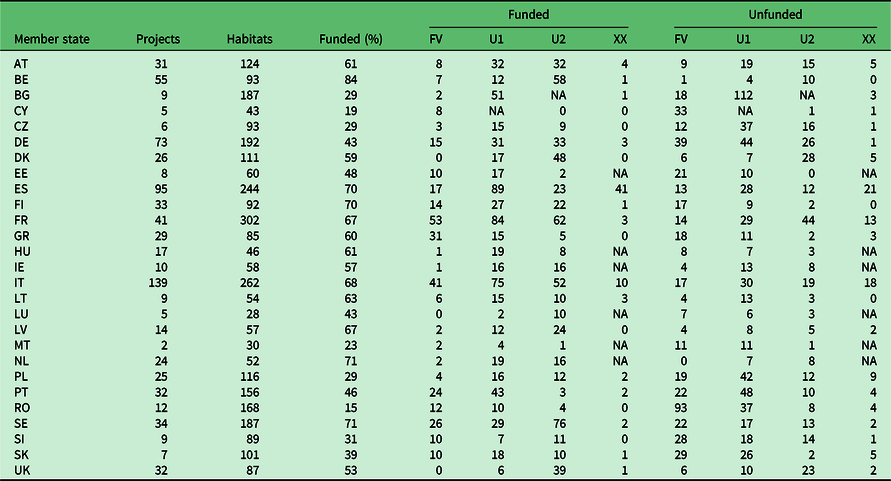
The uneven distribution of the funding was also reflected in the percentage of habitats funded within each member state (mean = 51%, SD = 19%; Table 2). For instance, only 15% of Romania’s habitats have been funded by a LIFE project since the inception of the programme, while Belgium, for example, has received funding for almost 85% of its habitats (Table 2). This disparity was not explicable by Belgium having fewer habitats than Romania (93 versus 168) or having been part of the LIFE programme for longer. In general, the proportion of funded habitats within each member state was not related to its total number of habitats, and was only weakly related to how many years a member state had been participating in the LIFE programme (Table 1). Together, the two variables explained less than 35% of the variation in the percentage of funded habitats; other factors are likely to be determining the proportion of habitats funded within each member state.
Number of projects and habitats per member state. The percentage of habitats funded is also shown, along with the number of projects funded per conservation status category.
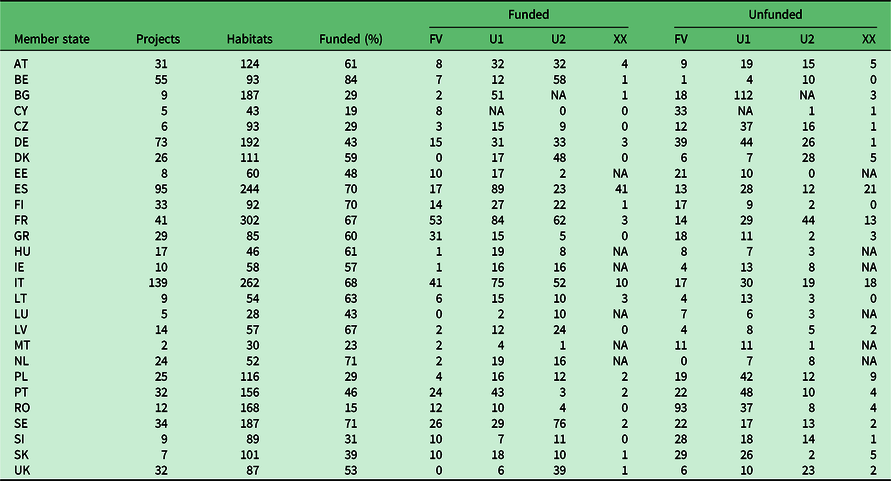
FV = favourable; U1 = unfavourable – inadequate; U2 = unfavourable – bad; XX = unknown; NA = not applicable.
When we examined each habitat separately, we found that out of the 810 habitats in total, 28% had never been funded through a LIFE project. Out of those that were never funded, 65% had an unfavourable status (U1 or U2) at the EU level. Out of those that were funded, the number of projects targeting them ranged from 1 to 110, with 25% of the habitats targeted by at least 11 projects (first quartile and median = 2 and 4, respectively). Additionally, 20% of the funded habitats had received funding in a member state where the status of that habitat was favourable, while at the same time the habitat existed in other countries with an unfavourable status but had not yet been targeted by any project.
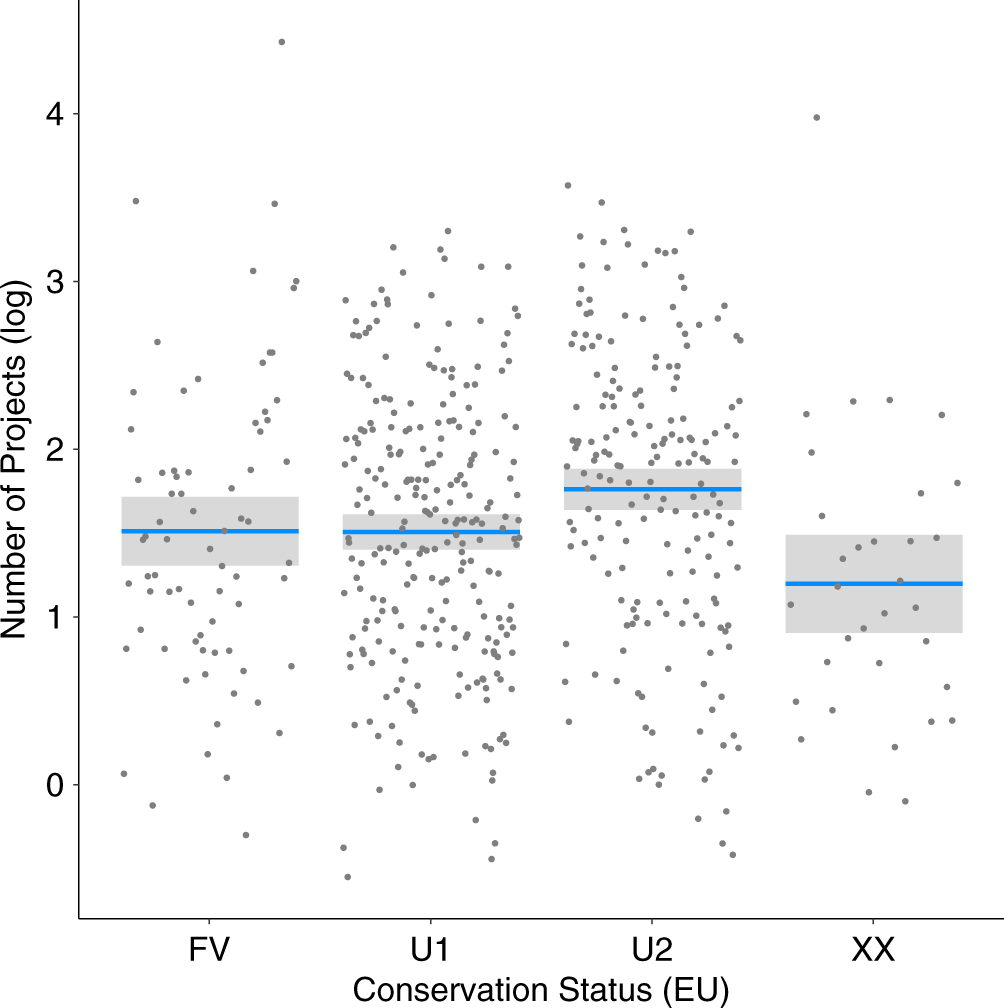
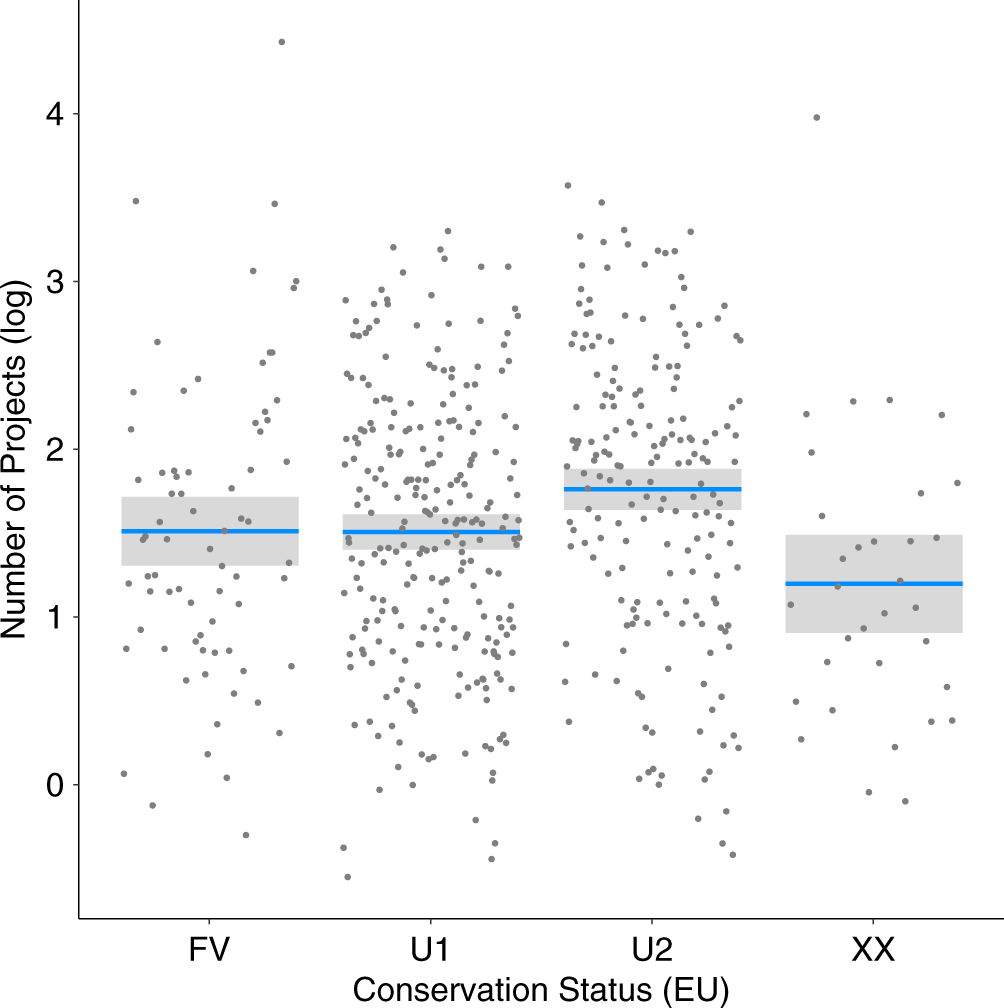
There was a statistically significant relationship between the conservation status of a habitat at the EU level and the number of projects that have targeted it (F(3,569) = 16.55, p < 0.001). Habitats with unfavourable status (U2) have been targeted by more projects than those with a favourable (FV) or unknown (XX) status; however, the percentage of variance explained by conservation status across the whole EU was only 2% (Table 1). This was mainly because there was substantial variation in the number of projects targeting habitats within each conservation status category (Fig. 2). In contrast, the area of each habitat within the EU had a greater explanatory power (Table 1). Habitats with larger ranges – many of them occurring in multiple member states – were targeted by more projects. However, the total variance explained by the conservation status and range was moderate (R2 = 0.41), indicating that other factors determine whether a habitat is included in a LIFE project.
Relationship between the number of projects (log-transformed) and the conservation status across the European Union (EU) of the habitats targeted.
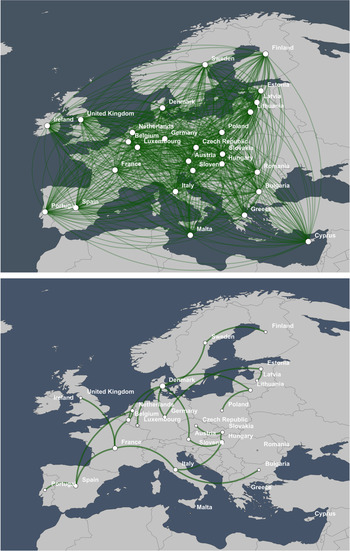
As mentioned above, most European habitats extend into multiple member states (Fig. 3), but this does not translate into many transnational projects. Only a small percentage of the projects have included conservation actions in more than one member state (Fig. 3). In most projects, conservation actions were implemented within the borders of the recipient country only. On the rare occasion in which a project involved conservation actions in another member state besides the recipient state, it was almost exclusively in a neighbouring state (Fig. 3).
Shared habitats between the European Union member states (top) versus transnational cooperation in LIFE Nature projects, which have targeted one or more habitats during 1992–2006 (bottom).

Discussion
There are noticeable biases associated with the allocation of the conservation funding within the EU. Firstly, similarly to the numbers of species and protected areas within each member state (Sánchez-Fernández et al. Reference Sánchez-Fernández, Abellán, Aragón, Varela and Cabeza2018), some states, such as Italy and Spain, have received a number of projects disproportionate to their number of habitats. Even when excluding from the analysis projects that were not targeting habitats (and even after correcting for the member states’ varied participation in the programme), there is still a considerable amount of unexplained variation in the number of projects received by member states. Additionally, the percentage of habitats funded in each member state varies substantially (Table 2), and this is only partially explained by the number of years a member state has participated in the programme (Table 1).
Secondly, there seem to be biases also in terms of which habitats are being funded. Previous research has shown that the distribution of the EU’s LIFE budget is biased towards certain taxonomic groups, such as birds and mammals (Sánchez-Fernández et al. Reference Sánchez-Fernández, Abellán, Aragón, Varela and Cabeza2018, Mammides Reference Mammides2019). A similar pattern appears to apply to habitats as well, with almost a quarter of them having never received any funding at all, while several others have been targeted by multiple projects. For example, the top 25% of the most funded habitats have been targeted by at least 11 projects each (when the median number of projects is only 4). Some habitats, such as the ‘Alluvial forests with Alnus glutinosa and Fraxinus excelsior’, the ‘Lowland hay meadows’ and the ‘Molinia meadows’, have been targeted by more than 50 projects each.
Thirdly, the strikingly low transnational cooperation between the member states is unjustified considering that the majority of the EU’s habitats are found in multiple member states (Fig. 3). Studies in the past have shown that coordinated conservation actions between countries in Europe are substantially more cost-effective than each country acting independently (Kark et al. Reference Kark, Levin, Grantham and Possingham2009, Mazor et al. Reference Mazor, Possingham and Kark2013). LIFE projects rarely including conservation actions in more than one state, and when they do involving a neighbouring state almost exclusively (Fig. 2), are unlikely to reflect the true conservation needs of the habitats across the EU. On the contrary, this pattern is likely driven by transnational relations and practicalities.
The low transnational cooperation could be part of the reason why 20% of the habitats that had received funding were funded in member states with favourable status when the same habitats occurred elsewhere with an unfavourable status but are yet to receive any funding. This specific result, however, should admittedly be interpreted with some caution because it may be partially driven by projects that have focused primarily on habitats (or even species) with unfavourable status, while concurrently they targeted – perhaps for secondary purposes – other habitats with favourable statuses. We are confident, however, that this is unlikely to be a major driver of the specific pattern, because the programme requires a strong justification for any conservation actions included in the project proposal. In other words, the programme makes it difficult to target opportunistically habitats that do not in fact require an intervention.
Moreover, the aforementioned possibility does not negate the fact that: (1) the allocation of the funding among habitats is unequal, and a quarter of the habitats are yet to be funded while others have been targeted by multiple projects; (2) there is large variation in the percentage of habitats funded within each member state (in some cases, the percentage is as low as <20%; Table 2); and (3) transnational cooperation in the programme is low, suggesting large inefficiencies in the conservation efforts of the EU (Kark et al. Reference Kark, Levin, Grantham and Possingham2009, Reference Kark, Tulloch, Gordon, Mazor, Bunnefeld and Levin2015, López-Hoffman et al. Reference López-Hoffman, Varady, Flessa and Balvanera2010, Kukkala et al. Reference Kukkala, Arponen, Maiorano, Moilanen, Thuiller, Toivonen and Zupan2016).
It therefore appears that member states mostly focus on their own conservation needs without necessarily considering what is most effective at the European level (Kark et al. Reference Kark, Levin, Grantham and Possingham2009). Habitats, however, occupy transnational spaces (Fig. 3) and consequently the current approach to allocating the funds should be adjusted (Kark et al. Reference Kark, Levin, Grantham and Possingham2009, Reference Kark, Tulloch, Gordon, Mazor, Bunnefeld and Levin2015) – especially considering the highly uneven distribution of projects between the member states (Table 2). The mid-term assessment report for the most recent phase of the LIFE programme also highlights the disproportionate distribution of the funds (European Commission 2017), confirming for example that Italy and Spain alone absorbed a third of the LIFE programme’s funds in 2014 and 2015.
Some of the distortions in funding arise from the fact that the LIFE programme is important not only for the conservation of EU biodiversity, but also for the financial viability of the various organizations within the Union (European Commission 2017). Organizations, therefore, have strong financial incentives to apply for LIFE projects on a regular basis. This and the fact that certain countries are more successful at securing projects (Sánchez-Fernández et al. Reference Sánchez-Fernández, Abellán, Aragón, Varela and Cabeza2018), such as by submitting more applications of higher quality (European Commission 2017), cause funds to be allocated for reasons that are not always linked to the conservation needs of the biodiversity across the EU. For instance, the positive relationship between the research capacity of the member states and the number of projects they have received thus far (Sánchez-Fernández et al. Reference Sánchez-Fernández, Abellán, Aragón, Varela and Cabeza2018) may be a factor helping to explain why some member states are receiving more projects than others irrespective of their biodiversity (Sánchez-Fernández et al. Reference Sánchez-Fernández, Abellán, Aragón, Varela and Cabeza2018).
Unless stronger efforts are made to address the disproportional distribution of the funding, it is likely that funds will continue to be mainly absorbed by the overfunded member states, which traditionally have been more effective at securing grants (European Commission 2017). To make things even more troublesome, if those member states continue to carry out conservation actions only within their own borders, then the inefficiencies we have identified in this study in terms of which habitats are being funded will be perpetuated (Kark et al. Reference Kark, Levin, Grantham and Possingham2009, Reference Kark, Tulloch, Gordon, Mazor, Bunnefeld and Levin2015).
These inefficiencies could be potentially addressed by providing stronger incentives for transnational cooperation (Mazor et al. Reference Mazor, Possingham and Kark2013, Kark et al. Reference Kark, Tulloch, Gordon, Mazor, Bunnefeld and Levin2015) and by encouraging member states to consider the EU status of the habitats they are interested in conserving. An added advantage of such enhanced transnational cooperation is that it will likely facilitate the exchange of expertise between cooperating member states and will therefore help underfunded countries gain experience and build their capacity – making them more competitive in the future (European Commission 2017). In order to address the unequal distribution of funding between the habitats, the European Commission should give preference to projects that target underfunded habitats, all else being equal.
We are aware that currently the EU is attempting to help underfunded member states build their capacity and improve their participation in the programme (European Commission 2018) by setting aside funds dedicated particularly to this cause (e.g., through the newly established LIFE Capacity Building funding scheme). An example of such a project would be ‘Cyclamen’ (www.lifecyclamen.com.cy), which aims at improving the participation of stakeholders from Cyprus through a series of workshops, training sessions, seminars and other activities. Other underrepresented countries are also targeted; for instance, the programme’s most recent call for such capacity-building projects is addressed specifically to Estonia and Croatia. The EU is also attempting to promote transnational cooperation by allocating, for instance, extra points on project proposals that show ‘added value’ in more than one country (European Commission 2018). However, our findings and those of other studies (e.g., Sánchez-Fernández et al. Reference Sánchez-Fernández, Abellán, Aragón, Varela and Cabeza2018) and of the Commission’s most recent evaluation of the programme (European Commission, 2017) suggest that the present incentives are inadequate to overcome the unequal distribution of the budget and the resulting inefficiencies. This is not to say that the programme overall is ineffective; it is far from that, but further adjustments are needed to improve the allocation of the funding.
Acknowledgements
We are thankful to the researchers who have developed the datasets we used in this study and we appreciate that the European Commission has made them freely and readily accessible online. We are also thankful to Markus Konrad and the WZB Data Science Blog for the online tutorial on how to visualize network graphs on a map using R.
Financial support
This research received no specific grant from any funding agency, commercial or not-for-profit sectors.
Conflict of interest
None.
Ethical standards
None.