

Introduction
In recent years, paramedics have seen their roles and scope of practice expand as pressured health care systems in the United States reallocate health systems personnel and resources in novel ways to decrease cost. In particular, paramedics have become integral actors in population health and preventative care efforts at the community level, effectively creating a new cadre of health care providers. Mobile Integrated Health (MIH) and Community Paramedicine (CP) has been adopted as terminology for programs that utilize paramedics in these expanded roles in the community and is defined as “provision of health care using patient-centered, mobile resources in the out-of-hospital environment.” 1 The MIH-CP programs target chronically ill patients, providing support in medical compliance, social support networking, prevention, and wellness. 2
Wide variation exists among these programs, but the end goals usually focus on preventing unnecessary emergency room visits and hospital admissions.Reference Choi, Blumberg and Williams 3 Strategies employed by MIH-CP programs differ with geography and community needs and include sending paramedics into patients’ homes to assist with chronic disease management, diverting non-emergent ambulance calls to urgent care centers and other outpatient providers, and using telemedicine to connect patients with providers in their own homes. 4 Although community paramedicine programs have been piloted in communities across the US as early as 1992 with varied success, these programs continue to proliferate in number. 4 , Reference Hauswald, Raynovich and Brainard 5 Despite increasing utilization of MIH providers across the country in a variety of innovative roles, their potential usefulness in a disaster response has not been previously discussed.
This article discusses the use of MIH providers during a flooding event which occurred in October of 2015 in the state of South Carolina (USA). Although much of the state was affected, the capital city, Columbia, was the most significantly impacted area. While coastal regions of the state have experienced substantial flooding in previous years, this was a novel event for Columbia and thus for the disaster response that followed. As requests for emergency medical assistance surged and the county struggled to respond to the increased demand, community paramedics became an integral part of the disaster response team.
Report
Columbia is a medium-sized, centrally located city within the state of South Carolina and serves as the state’s capital. Columbia sits within Richland County, which has a population of 409,000 people. 6 The Emergency Medical Services (EMS) system is a county-based 911 agency not incorporated with fire or law enforcement. Richland County Emergency Medical Services (RCEMS) responds to an average of 70,000 calls per year.
During the last days of September 2015, heavy rain poured over the state, producing rainfalls as high as 10 inches over a four-hour period in parts of Richland County. 7 The heavy rainfall caused higher lake and river water levels, in addition to over-saturated ground. Persistent rainfall continued during the following week, secondary to Hurricane Joaquin, which was situated in the Atlantic Ocean approaching the southeastern US. Increased rainfall from Joaquin, paired with the convergence of a southeastern low pressure system with a northern higher pressure system and above average coastal water temperatures, lead to the storm system dubbed by many as the “1000-year flood.” 8 This intensification in weather conditions led to continuing historic rainfall, with the peak rainfall of 16 inches in 24 hours in parts of Richland County becoming the highest ever recorded in the state. 7 On October 1, a state of emergency was declared by the governor of South Carolina, which ultimately resulted in federal disaster declarations for 36 of the 46 counties in South Carolina. 9 More than 20,000 citizens were displaced from their homes, 40,000 were without water, and 941 were housed in emergency shelters, statewide. 9 During this time, 50 dams failed or breached, further exacerbating the flooding and leading to nearly $300 million in privately insured losses and 19 fatalities (Table 1). 9
Statewide Flooding Incident Statistics in US Dollars (Period October 1-23, 2015) 9

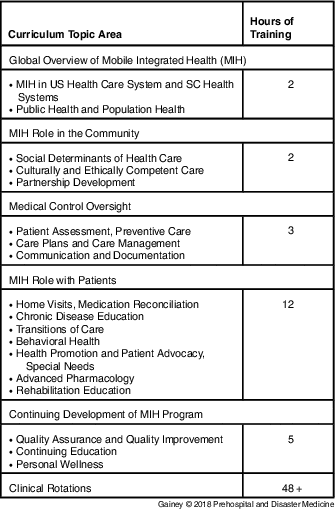
Richland County operated six emergency shelters and eight water distribution sites during disaster response efforts. At the height of the flood, 911 calls requesting emergency assistance more than doubled, affecting agencies including RCEMS, Columbia Fire Department, Columbia Police Department, and Richland County Sheriff’s Department, placing a significant strain on the emergency services system. The RCEMS’ newly formed cadre of MIH providers were recruited early in the flood response to target vulnerable community members in need of the most assistance. The MIH team is a community-based model of care using paramedics to reach patients in their communities and homes. The program began in 2015, funded through a Blue Cross Blue Shield of South Carolina Foundation (Columbia, South Carolina USA) grant. The MIH providers receive additional training that allows for their current scope of practice to be used in novel ways that complement local population health initiatives. Additional training includes skills in performing environmental and socioeconomic patient evaluations, medication reviews, chronic disease management, medication compliance evaluation and counseling, and self-care teaching. Specific training modules cover behavioral health and mental illness, understanding social determinants of health, and accessing community-based resources (Table 2). The training program includes extensive field experience with community providers, care management nurses, social workers, behavioral health counselors, pharmacists, and rapid-access follow-up clinics. The program operates on the premise “expand the setting, not the practice” and utilizes the already trained paramedic, equipping them with the understanding of psychosocial factors and community resources to continue to assist patients in the out-of-hospital setting. The program aims to decrease inappropriate EMS and emergency department utilization and hospital readmissions for high-risk patients.
Initial Curriculum for Richland County (South Carolina, USA) Mobile Integrated Health Care Program

Abbreviations: MIH, Mobile Integrated Health; SC, South Carolina.
While not originally purposed for disaster response, the MIH providers played an integral role in the community’s response to the October 2015 flooding disaster. In the early hours of the disaster response, MIH providers supported air rescue operations by the National Guard, but they were quickly redeployed as operational leadership realized that MIH providers were uniquely situated to utilize pre-existing resources and relationships to navigate the difficulties of supporting patients during an austere event. By nature of their usual assigned duties, they were adept at supplying certain health needs of patients affected by the flood. Subsequently, MIH providers were engaged in supporting affected populations, primarily through response to emergency shelters where many affected or displaced individuals were being housed. The MIH providers served numerous patients by reconnecting them with medications that were lost during the flood, aligning patients with community resources such as alternative housing options, providing viable transportation means to leave the area to relocate with family in unaffected areas, and reconnecting them with health care resources. The MIH providers also aligned with Richland County Sheriff’s Department staff to identify medically vulnerable, elderly, or disabled citizens in the community who necessitated an in-person wellness check to ensure their safety. The MIH team was also engaged to deliver food and water provisions to individuals who were unable to leave their homes due to disabilities or medical conditions.
In addition to the novel utilization of MIH providers to assist disaster victims, the agency’s three medical control physicians, all board-certified in emergency medicine and EMS, were also utilized in novel ways. In the early hours of the disaster, many calls for assistance came from citizens whose homes could not be accessed by traditional EMS ambulances given the extensive flooding. Some calls were forwarded to the physicians for telephone triage and assessment with some patients given self-care instructions via telephone. Additionally, during the operations phase of disaster response, the medical control physicians responded to in-field calls, providing medical care and appropriately triaging patients for transport versus non-transport to local hospitals. This became important for the appropriate utilization of EMS transport units and to maintain control of patient volumes transported to local hospital emergency departments. This utilization of EMS physicians augmented the work being performed by the MIH providers. This integrated physician-paramedic response in the field allowed for a cohesive response to community health care needs during a time of disaster. The physicians both responded independently and were available for consultation to the MIH team.
Following the flood disaster response, MIH provider activities resumed as normal, playing an ever-important role in assisting the patients enrolled in its programs. New consults for patient enrollment increased significantly given the complex health care and social needs of many patients after being affected by the flood. Many individuals required ongoing assistance with rapid access to health care follow-up for management of chronic disease states, reconnection with lost medications, assistance with temporary housing, and continued home visits for checkups.
Discussion
The MIH-CP providers are an increasingly common cadre of allied health professionals primarily purposed to strengthen linkages between the formal health care system and community resources which are essential for health promotion and well-being. As discussed above, MIH-CP providers are uniquely positioned to aid in disaster response through identifying vulnerable patients, assessing the social determinants of health care, and connecting patients with community health and social services. Despite the successful utilization of MIH-CP providers in a disaster response such as this, the MIH-CP curriculum does not routinely incorporate this element into their training.
Beyond disaster response, MIH-CP providers are a logical choice for aiding in disaster planning at the individual and community levels. As part of pre-disaster preparations, MIH-CP providers could counsel patients on the need for personal emergency preparedness, including the need to maintain or have access to adequate supplies of medications, evacuation plans, and determine any special needs for durable medical equipment. In planning for a disaster response, the MIH-CP provider would be crucial in identifying individuals with complex needs that would be especially difficult during response and recovery efforts. These might include patients with home ventilators, ongoing oxygen needs, or devices requiring un-interrupted power such as left ventricular assist devices. Other patients requiring special attention and preparation are those dependent on outpatient hemodialysis whose routine treatment plan may be disrupted by local clinic closings or displacement from their home geographic area. Generally, many of these patients would otherwise summon EMS for transport to the hospital or self-present to an emergency department simply for access to ongoing chronic health care needs, potentially placing an additional burden on the hospitals already receiving increased patient loads directly related to the disaster.
While the response efforts of the MIH-CP providers were most notable in the flooding event of 2015, they have since been re-engaged during hurricane preparations and sheltering operations for both Hurricane Matthew (Florida/southeastern USA) in 2016 and Hurricane Irma (Florida/southeastern USA) in 2017, seeing the same benefits to population health management during the disaster response. Hurricanes and flooding events are common disasters world-wide, resulting in damaged public health systems and increased morbidity and mortality.Reference Jonkman 10 Given that disasters place incredible strains on local resources, others might consider how they could engage similar individuals with ties to community and population health in both planning and response to local disasters.
The physician’s role in MIH-CP programs commonly includes protocol development, phone or telemedicine consultations, development of patient care plans, and guidance on alternative destinations. 4 However, the integrated physician and MIH field response in this flooding incident highlights the utility of physician field response in a MIH-CP program. The MIH providers benefit from real-time access to EMS physicians for consultation on patient encounters. Physicians engagement in field response will only strengthen the critical decision making of MIH-CP providers and the quality of care. The MIH-CP programs would likely benefit from exploring how they could incorporate physician field response, consultation, and mentoring in their program.
Training of a MIH-CP cadre to be used in disaster response represents an opportunity for EMS systems to expand their reach in the community while utilizing pre-existing resources. As MIH-CP programs continue to evolve, it is likely that disaster response is only one example of ways in which these providers are under-utilized. It is unclear the extent to which the utilization of MIH providers impacted actual EMS call volume or how many emergency department visits and hospitalizations were averted by the actions of the MIH providers during the flood event. Quantitative research into the field is warranted but difficult to conduct secondary to the unpredictability of such events and strain on personnel and resources during the event.
Conclusion
The MIH-CP providers are a cadre of health care professionals with training in population health and systems navigation skills which represent an untapped resource for disaster response and planning efforts. The MIH-CP providers can be particularly useful in mitigating morbidity in the post-disaster period when health systems are most fragmented. All MIH-CP programs should consider integrating some basic disaster response training into the curriculum.