INTRODUCTION
In the last decade, some attention has been given to the importance of religion and spirituality and their role in cancer patients' coping and quality of life (Mytko & Knight, Reference Mytko and Knight1999). Spirituality has been defined as “personal views and behaviors that express a sense of relatedness to a transcendent dimension or to something greater than the self” (Reed, Reference Reed1987); religiosity has been defined as "participation in the particular beliefs, rituals and activities of traditional religious systems" (Elkins et al., Reference Elkins, Hedstrom and Hughes1988). Although many authors make a distinction between spirituality, and religiosity, preferring the first, because it is more inclusive and universal (Moberg, Reference Moberg and Moberg1979; Hiatt, Reference Hiatt1986; Reed, Reference Reed1987; Elkins et al., Reference Elkins, Hedstrom and Hughes1988; Ley & Corless, Reference Ley and Corless1988), several studies examined the whole concept of spirituality/religiosity, including the patients' faith and the help they receive from their faith, and several scales have been developed to measure the concept of spirituality in a broader sense (Mytko & Knight, Reference Mytko and Knight1999).
A positive influence of spirituality on various dimensions of health whether it be physical health, mental health, or well-being, have been reported (Matthews et al., Reference Matthews, Larson and Barry1993; Matthews & Larson, Reference Matthews and Larson1995; Fitchett et al., Reference Fitchett, Peterman and Cella1996; Larson & Greenwold-Milano, Reference Larson and Greenwold-Milano1995; Matthews, Reference Matthews1997; Bussing et al., Reference Bussing, Ostermann and Matthiessen2005; Canada et al., Reference Canada, Parker and de Moor2006). Spirituality has also been associated with positive subjective perceptions of health status (St. George & McNamara, Reference St. George and McNamara1984; Broyles & Drenovsky, Reference Broyles and Drenovsky1992), lower levels of depression and psychological distress (Idler, Reference Idler1987; Williams et al., Reference Williams, Larson and Buckler1991; Smith et al., Reference Smith, McCullough and Poll2003), enhanced subjective states of well-being (Ellison, Reference Ellison1991), better coping skills, and better health-related quality of life (Bussing et al., Reference Bussing, Ostermann and Matthiessen2005). Also, religious involvement has been considered a predictor of all-cause mortality in which individuals with lower religious involvement were at greater risk of death at follow-up than those more religiously involved (McCullough et al., Reference McCullough, Hoyt and Larson2000).
In cancer, considering the potentially life threatening nature of the illness, using religion and spirituality resources may be specifically relevant on how cancer patients cope with their illness and suffering. In this sense, numerous studies have found that religion and spirituality provide effective coping mechanisms for patients as well as for family caregivers (Weaver & Flannelly, Reference Weaver and Flannelly2004).
Religious and spiritual coping have been also referred to as serving multiple functions in long-term adjustment to cancer such as maintaining self-esteem, providing a sense of meaning and purpose, giving emotional comfort, and providing a sense of hope (Feher & Maly, Reference Feher and Maly1999; Thune-Boyle et al., Reference Thune-Boyle, Stygall and Keshtgar2006). A number of studies have also shown that religiosity and spirituality significantly contribute to psychosocial adjustment to cancer and its treatments (Musick et al., Reference Musick, Koenig, Larson and Holland1998; Nelson et al., Reference Nelson, Rosenfeld and Breitbart2002; Weaver & Flannelly, Reference Weaver and Flannelly2004) and to quality of life in cancer patients, even in the face of high levels of symptoms such as pain and fatigue (Gioiella et al., Reference Gioiella, Berkman and Robinson1998; Brady et al., Reference Brady, Peterman and Fitchett1999). More recently, spiritual growth and transformation, as a specific dimension associated with spiritual well-being, positive spiritual coping, and intrinsic religiousness, was shown to favor post-traumatic growth in cancer patients (Cole et al., Reference Cole, Hopkins and Tisak2008).
In spite of much evidence about the positive role of spirituality in cancer, there is still some controversy. Some studies have found that religion was associated with poor adjustment (Pettet, Reference Pettet1985; Jenkins & Pargament, Reference Jenkins and Pargament1995) and others do not find any relationship between religiosity and cancer adjustment (Holland et al., Reference Holland, Passik and Kash1999; Ritkin et al., Reference Ritkin, Daddi and Karagji1999).
No data are available about these issues among cancer patients in Southern European countries, in spite of the significant tradition of religion and the role of Catholicism in those countries. The objectives of the present study were to examine: (i) the rate of spirituality/faith and (ii) its effect in molding psychosocial implications in Southern European cancer patients.
METHOD
Subjects and Procedure
The data presented here are part of a broader research project involving countries in the Mediterranean area (Southern European Psycho-Oncology Study-SEPOS) and developed to examine the psychosocial problems secondary to cancer, to rate the extent to which such problems are recognized by oncologists, and to develop and implement a training model designed to improve physicians' ability to recognize and detect psychological disorders. The details of the project and its main results are presented elsewhere (Grassi et al., Reference Grassi, Travado and Gil2004, Reference Grassi, Travado and Gil2005, Reference Grassi, Travado and Gil2010; Gil et al., Reference Gil, Grassi and Travado2005; Travado et al., Reference Travado, Grassi and Gil2005). In summary, the study was conducted in three countries of the European Union (EU), namely Italy (Hospital S. Anna, Ferrara), Spain (Hospital Duran I Reynalds, Barcelona) and Portugal (Hospital S. José, Lisbon), and in a non-EU country (Switzerland, Lugano Hospital). A convenience sample of outpatients meeting the following criteria was recruited: a diagnosis of cancer between 6 to 18 months, a good performance status (Karnofsky Performance Status > 80), no cognitive deficits or Central Nervous System (CNS) involvement by disease. The study was approved by the ethical committee or related boards of the hospitals and each patient gave his/her written consent to participate. Each patient completed a series of questionnaires and instruments aimed at examining several psychosocial variables.
Measures
Spirituality, as defined in this study, was measured through a single question “Please rate how much your faith (including religiosity) and spiritual values are helping you in coping with your illness.” The response was rated on a 0–10 scale. According to data on VAS instruments (e.g., distress thermometer), scores ≥5 were used as a cut-off score identifying patients supported by their faith and spiritual values. We decided to use such a short instrument for several reasons: the diffusion of single questions/items to measure psychological variables (e.g., coping, adjustment, depression, distress) with reported good results in terms of sensitivity and specificity; the complexity of multi-item instruments (Peterman et al., Reference Peterman, Fitchett and Brady2002; Bussing & Koenig, Reference Bussing and Koenig2008), which have not been validated and are not available in the countries where the study has been performed; and the possible role and influence of the cultural background in molding the psychosocial dimension that should be explored in spirituality when applying instruments developed in different cultures.
Anxiety and depression were measured by using the Hospital Anxiety and Depression Scale (HADS) (Zigmond & Snaith, Reference Zigmond and Snaith1983). According to Carroll et al. (Reference Carroll, Kathol and Noyes1993), scores between 8 and 10 on anxiety and depression scales indicate “borderline” cases, whereas scores ≥11 identify “clinical” “cases.” The cut-off scores of 14 and 19 on the HADS Total were used to evaluate “psychiatric caseness” (Ibbotson et al., Reference Ibbotson, Maguire and Selby1994) and “severe caseness” (mostly patients with a diagnosis of major depression) (Razavi et al., Reference Razavi, Delvaux and Farvacques1990), respectively.
The National Comprehensive Cancer Network (NCCN) Distress Thermometer (DT) was used to measure the level of emotional distress according to the NCCN guidelines on distress management (NCCN Clinical Practice Guidelines in Oncology™ Distress Management V.I. 2007). Each patient was asked to answer the question “How distressed have you been today and over the last week?” and to rate on a 0–10 scale his/her level of distress (0 = no distress; 10 = extreme distress). The DT has been shown to be a reliable instrument in several studies (Jacobsen et al., Reference Jacobsen, Donovan and Trask2005; Dolbeault et al., Reference Dolbeault, Bredart and Mignot2008; Shim et al., Reference Shim, Shin and Jeon2008; Grassi et al., Reference Grassi, Sabato and Rossi2009, Reference Grassi, Travado and Gil2010). For the aim of the SEPO study the List of Problems accompanying the DT was not used.
The Mini-Mental Adjustment to Cancer (Mini-MAC) scale (Watson et al., Reference Watson, Greer and Young1988, 1994) was used to assess coping to cancer, rating hopelessness, fighting spirit, anxious preoccupation, fatalism, and avoidance. This is a 29-item four-point Likert scale (1 = it definitely does nor apply to me; 4 = it applies to me) yielding five coping strategies, namely, fighting spirit, assessing the tendency to confront and actively face the illness; hopeless-helpless, measuring the tendency to adopt a pessimistic attitude about the illness; anxious preoccupation, which examines the tendency to feel over-worried about the illness; fatalism, which indicates a fatalistic attitude towards the illness; and avoidance, evaluating the active tendency to distract oneself about thought of illness and to avoid confrontation with it. Provisional cut-off scores on anxious preoccupation and hopelessness (mean score ± 1 SD) were used to assess maladaptive coping (Watson et al., Reference Watson, Greer and Bliss1989).
A further Visual Analogue Quality of Life Scale (VAS-QoL) (Grassi et al., Reference Grassi, Travado and Gil2004) was used to evaluate, on a 0–10 scale, six further dimensions of quality-of-life, namely, mood, general well-being, physical symptoms (e.g., pain, nausea), leisure activity, adjustment/coping with illness, and perceived social support. Higher scores for the majority of items corresponded to a better condition, except for “physical symptoms” and “coping with illness,” where higher scores correspond to worse condition.
A modified version of the Cancer Worries Inventory (CWI) (D'Errico et al., Reference D'Errico, Galassi and Schanberg1999) was used to rate the main preoccupations caused by cancer (e.g., physical and emotional problems, relational worries), which also included three questions on openness, used to rate how open the patient was about his/her illness with the family. Statistical analysis was performed using the SPPS-10 package. Descriptive statistics, ANOVA one-way and Pearson's correlation were used when appropriate.
RESULTS
Socio-Demographic and Clinical Characteristics
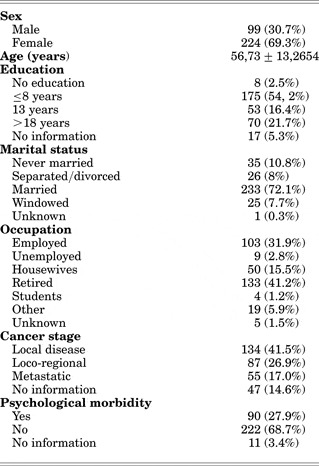
Three hundred and twenty three patients (Italy, n = 119; Portugal, n = 100; Spain, n = 68; Switzerland, n = 36) were recruited. The patients' socio-demographic and clinical characteristics are presented in Table 1. More details about the sample are reported elsewhere (Grassi et al., Reference Grassi, Travado and Gil2004). In summary, there were 212 women (69%) and 95 men (31%) (mean age 56.73 ±13.3), 41% were retired, and 72% of the patients were married. From the clinical point of view, most patients were affected by local or loco-regional disease (83%) and almost half had breast cancer (48%).
Socio-demographic and clinical data for the patients

Spirituality
The majority of cancer patients (79.3%) referred to being supported by their faith/spirituality throughout their illness, which gave meaning to their existence (VAS-QoL/spirituality ≥ 5). The highest percentage of patients were observed in the Portuguese group (90%), followed by the Spanish (80.9%), and the Italian (71.4%). The lowest percentage was observed in Swiss patients (66.7%). These differences were statistically significant between Portuguese and Italian cancer patients (8.07 ± 2.45 versus 6.35 ± 3.75, p = 0.001) and between Portuguese and Swiss patients (8.07 ± 2.45 versus 5.72 ± 3.03, p = 0.002).
The spirituality group of patients had a lower educational level than the non-spirituality group (8.43 ± 5.35 versus 11.0 ± 7.34, p = 0.001). There were no statistically significant differences in the age of patients in the two groups (57.45 ± 13.12 versus 54.38 ± 13.86, p = 0.093), but the spirituality group tended to be older.
Psychological Morbidity and Coping with Cancer
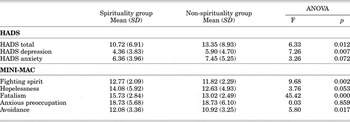
Spiritual patients reported significantly lower scores than non-spiritual ones on the HADS Total (10.72 ± 6.91 versus 13.35 ± 8.93; F = 6.33, p = 0.012) and on HADS Depression (4.36 ± 3.83 versus 5.90 ± 4.70; F = 7.26, p = 0.007). No significant differences were found for the HADS Anxiety. Likewise, patients who had psychological morbidity on the HADS total score (“severe cases” — group 1 - according to the more conservative cut-off ≥19, or “cases” — group 2 - according to the less conservative cut-off ≥14) (Razavi et al., Reference Razavi, Delvaux and Farvacques1990; Ibbotson et al., Reference Ibbotson, Maguire and Selby1994) showed lower scores on the spirituality item than non-cases (group 1: 5.94 ± 3.57 versus 7.27 ± 3.16; t = 2.65, p = 0.008; group 2: 6.19 ± 3.46 versus 7.40 ± 3.12; t = 2.98, p = 0.003).
On the Mini-MAC the spirituality group reported higher scores on “fighting spirit” (12.77 ± 2.09 versus 11.82 ± 2.29; F = 9,68, p =0.002), “fatalism” (15.7 ± 2.80 versus 13.01 ± 2.49; F = 45.42; p = 0.000), and “avoidance” (12.08 ± 3.36 versus 10.92 ± 3.25; F = 5.80 p = 0.017). Results are presented in Table 2.
Psychological morbidity and coping with cancer

Quality of Life
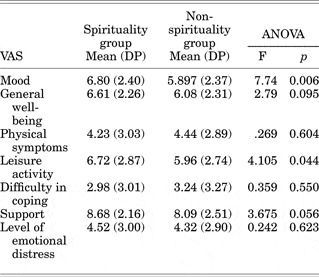
Spiritual patients obtained better scores in terms of mood (6.80 ± 2.40 versus 5.89 ± 2.37; F = 7.74, p = 0.006) and leisure activity (6.72 ± 2.87 versus 6.72 ± 2.74; F = 4.11, p = 0.44). No significant differences were found for the others dimensions of the VAS-QoL. Results are showed in Table 3.
Quality of life

Concerns about Illness and Openness toward Family
No differences were found between the two groups in terms of patients' concerns about illness (17.0 ± 11.56± versus 14.58 ± 10.93; F = .004, p = 0.125).
In the same way, there were no relevant differences found between spirituality versus non-spirituality in terms of openness toward the family (8.44 ± 2.63 versus 8.41 ± 2.27; F = .004, p = 0.125).
Correlations between the Measures and Predictive Factors
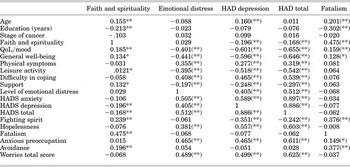
Significant negative correlations (p < .01) were found between spirituality and education (r = −.25), spirituality and psychological morbidity (HADS total, r = −0.17), and spirituality and depression (r = −0.22).
Positive significant correlations (p < 0.01) were found between spirituality and age, fighting spirit (r = 0.27), fatalism (r = 0.50), and avoidance (r = 0.23) coping styles.
Spirituality was positively correlated with four dimensions of the VAS-QoL, namely mood (r = 0.23; p < 0.01), and well being (r = 0.18; p <0 .05), leisure activity (r =0.17; p < 0.05), and perceived social support (r = 0.23; p < 0.05).
No significant correlations were found between spirituality and disease stage with the others assessed dimensions.
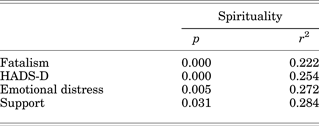
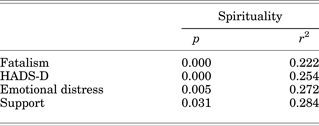
By conducting regression analysis with spirituality as the dependent variable and the psychosocial variables examined as the independent variables (Mini-MAC subscales, HADS, CWI, Openness, QOL-VAS) the four most potent predictors were fatalism which explained 22% of the variance, followed by HAD-S depression, which explained a further 3%, emotional distress (2%) and social support (1%), for a total of 28.4% of the variance on faith. Results for correlations and multiple regression are presented in Tables 4 and 5.
Correlations between measures

*p< 0.05. **p < 0.01.
Multiple regression
DISCUSSION
The purpose of the present study was to examine the relationship between spirituality and psychosocial dimensions among cancer patients of Southern European countries, namely Italy, Portugal, Spain, and Switzerland (Italian speaking area).
A first general result of the study was that the level of spirituality and faith was higher than a cut-off score of 5 in the majority of the sample, confirming the role of these variables in Southern Europe. This was especially true in older patients with a lower level of education. This is in line with similar trends that have been observed in other studies in the same area (Aukst-Margetic et al., Reference Aukst-Margetić, Jakovljević and Margetic2005; Meraviglia, Reference Meraviglia2006).
When examining the possible differences among the countries, Portuguese patients seem to be the most religious group, with 90% referring to being supported by their faith/spirituality in giving meaning to their existence, whereas Swiss patients were the least (66,7%). However, this difference may be explained by the socio-demographic characteristics in our samples in which Portuguese patients were significantly older and less educated than Swiss patients (variables that are correlated with spirituality), rather than by cultural differences between countries.
A second, more specific result is related to the overall role of spirituality/faith in the relationship with cancer patients' psychosocial dimensions. Spirituality, particularly, seems to play a protective role towards psychological morbidity, specifically depression, as observed with HADS results. Spiritual patients presented significantly lower levels of psychological morbidity, and reported to be significantly less depressed than non-spiritual patients. These results were also observed in other studies, for instance, mastectomized patients who belonged to the high-religiosity group were significantly less depressed (Aukst-Margetic et al., Reference Aukst-Margetić, Jakovljević and Margetic2005), and a negative correlation between spirituality (in particular, the existential aspect) and depression was observed in patients with advanced cancer (McCoubrie & Davies, Reference McCoubrie and Davies2006).
Spirituality seems also to have an important impact on the way a person copes with his/her illness. We observed that spiritual patients obtained significantly higher scores for “fighting spirit.” This active coping style refers to patients having a more positive attitude toward outcome, and taking a more active role in their recovery, than non-spiritual patients. This result appears to be similar to those reported by Weaver & Flannelly (Reference Weaver and Flannelly2004), who found that cancer patients who rely on spiritual and religious beliefs to cope with their illness are more likely to use an active coping style in which they accept and try to deal with their illness in a positive and purposeful way. However spiritual patients were also more fatalistic, which apparently means that they believe that no control can be exerted over the situation. Although these results seem to be contradictory, preliminary studies had already observed this relation between fatalism and spirituality, considering that fatalism might be better construed as a type of acceptance rather than stoic resignation (Cotton et al., Reference Cotton, Levine and Fitzpatrick1999). This positive trend and prevalence of fatalism was observed in our previous study in which fatalism was positively related with fighting spirit and negatively associated with psychosocial morbidity (Grassi et al., Reference Grassi, Travado and Gil2004). Similarly, in a longitudinal study with Portuguese- treated breast cancer women (Travado & Matos, Reference Travado and Matos2001) patients who had less psychosocial morbidity had also a more fatalistic coping style.
On the other hand, a positive relation between spirituality and avoidance or denial, was observed, a result that does not converge with literature (Weaver & Flannelly, Reference Weaver and Flannelly2004; Canada et al., Reference Canada, Parker and de Moor2006). This may indicate that spiritual patients try to get on with their life without thinking too much about their disease and are more likely to use spiritual or religious rituals (e.g., prayers) as a cognitive distraction (Weaver & Flannelly, Reference Weaver and Flannelly2004). However, more studies are necessary to test this hypothesis.
Regarding quality of life, there are significant differences between the two groups on some of the dimensions assessed. Spiritual patients have significantly better mood and are more likely to be involved in leisure activities when compared with non-spiritual ones. A positive association was also found between spirituality, general well- being, and support from others. Likewise, in other studies spirituality has been related to quality of life (Brady et al., Reference Brady, Peterman and Fitchett1999; Bussing et al., Reference Bussing, Ostermann and Matthiessen2005), greater emotional well-being, and strengthened emotional support (Mathews et al., 1993).
Results obtained on CWI seem to indicate that there are no differences between spiritual and non-spiritual patients in terms of main preoccupations caused by cancer. This result may suggest that spirituality does not influence patients' concerns, despite its relation to how they cope. However, as the patients in our study had an average low score or few concerns and a good performance status, under these circumstances concerns were neither expressive nor discriminative.
Limitations of the study should be mentioned. As it is a quantitative study, and patients' spirituality was assessed by only one VAS item, further studies need to better understand this important dimension among cancer patients living in Southern Europe and belonging to a tradition where the Catholic religion has been for centuries the core of spiritual values and faith. Because in these countries no data have been collected by using any of the several instruments available in the literature, future studies can provide more information about this area. A second limitation has to do with the good performance status criteria and the lower percentage of patients with a metastatic disease in our study. This does not allow us to generalize the results of this study to patients with poorer performance status and in the advanced phase of illness, where the role of spirituality has traditionally been considered extremely important in the relationship with dignity and quality of life (Thompson & Chochinov, Reference Thompson and Chochinov2008). Third, even if the patients were representative of the four centers and regions where the research was performed, they do not represent the whole cancer population of the four countries. More data are thus needed regarding this aspect.
In summary, our study supports the view that spirituality is an important component of the healing process that should be assessed and valued in integrated cancer care (Fitchett & Handzo, Reference Fitchett, Handzo and Holland1998; Musick et al., Reference Musick, Koenig, Larson and Holland1998; Breitbart, Reference Breitbart2002; Torosian & Biddle, Reference Torosian and Biddle2005). The role of support related to the patients' faith in giving meaning to their existence and their spirituality is an important protective factor for facilitating their adaptation to cancer. Further research is needed in the specific cultural area of Southern Europe.
ACKNOWLEDGMENTS
The study, as part of a larger project (“Improving health staff's communication and assessment skills of psychosocial morbidity and quality of life in cancer patients: A study in Southern European countries”), has been funded by the European Community (Agreement SI2.307317 2000CVGG2-026 – between the European Commission Health and Consumer Protection–Commission on Cancer and the University of Ferrara) and coordinated by L. Grassi, University of Ferrara, Italy. The research group thanks all the colleagues and patients participating in the study.
In the SEPOS project “Improving health staff's communication and assessment skills of psychosocial morbidity and quality of life in cancer patients: a study in Southern European countries” (Principal Investigator Luigi Grassi, M.D.), the following persons participated in different ways: Sónia Cunha(1); Rute Pires(1); Hugo Lucas(1); Maria Francisca Hollenstein(2), Jorge Maté(2); Katia Magnani(2); Silvana Sabato(3); Elena Rossi(3); Giulia Tralli(3); and Michele Tomamichel from Lugano Hospital, Switzerland.