Introduction
Acute psychiatric in-patient care in the UK has been identified as problematic (Department of Health, 2002; Lelliott and Bleksley, Reference Lelliott and Bleksley2010) and evidence about outcomes is limited (Jepson et al. Reference Jepson, De Blasi, Wright and Ter Riet2001). Commonly cited problems include service user dissatisfaction, lack of safety, stigma, difficulties in forming therapeutic relationships and unclear functions (Rose, Reference Rose2001; Lelliott and Quirk, Reference Lelliott and Quirk2004; Totman et al. Reference Totman, Mann and Johnson2010). Given that acute in-patient care remains a central and costly component of the UK mental health system, the need for service innovation and research into how best to respond to mental health crises is clear (Healthcare Commission, 2008).
One development has been the establishment of acute residential alternatives to traditional in-patient care (referred to here as ‘alternatives’), based either in community or hospital settings and aiming to cater for similar patient populations at the point of crisis. A recent survey identified 131 such alternatives in England (Johnson et al. Reference Johnson, Gilburt, Lloyd-Evans, Osborn, Boardman, Lesse, Shepherd, Thornicroft and Slade2009). A second phase of this study (The Alternatives Study) evaluated six alternative services representing different service models. It found considerable overlaps in patient characteristics of these services and those of standard acute hospital wards (Johnson et al. Reference Johnson, Lloyd-Evans, Morant, Gilburt, Shepherd, Slade, Jagielska, Leese, Byford and Osborn2010). There was less clinical improvement during admissions to alternatives compared to standard services (Slade et al. Reference Slade, Byford, Barrett, Lloyd-Evans, Gilburt, Osborn, Skinner, Leese, Thornicroft and Johnson2010), but short- and medium-term costs were less and readmission rates were no greater (Byford et al. Reference Byford, Sharac, Lloyd-Evans, Gilburt, Osborn, Leese, Johnson and Slade2010). Importantly, compared to standard in-patient wards, patient satisfaction with community alternatives was greater (Gilburt et al. Reference Gilburt, Slade, Rose, Lloyd-Evans, Johnson and Osborn2010; Osborn et al. Reference Osborn, Lloyd-Evans, Johnson, Gilburt, Byford, Leese and Slade2010). These findings mirror those of a recent systematic review of residential alternatives showing preliminary evidence for greater patient satisfaction and lower costs (Lloyd-Evans et al. Reference Lloyd-Evans, Slade, Jagielska and Johnson2009).
Thus, there is a growing evidence base suggesting that alternatives have a genuine capacity to cater for acutely ill patients and overcome known problems of in-patient care. However, service models are often not clearly defined and failures to sustain innovative alternatives appear common (Lloyd-Evans et al. Reference Lloyd-Evans, Slade, Jagielska and Johnson2009). In addition to evidence regarding outcomes, an understanding of how to implement and sustain new service models effectively is required to achieve positive change. This ‘implementation science’ (Tansella and Thornicroft, Reference Tansella and Thornicroft2009), although currently under-developed (Greenhalgh et al. Reference Greenhalgh, Robert, MacFarlane, Bate and Kyriakidou2004), will allow us to bridge the considerable translational gap between what is known to be effective and what is delivered in routine mental healthcare (Proctor et al. Reference Proctor, Landsverk, Aarons, Chambers, Glisson and Mittman2009).
Implementation processes are complex, involving facilitators and barriers across policy, organisational, and practitioner levels (Proctor et al. Reference Proctor, Landsverk, Aarons, Chambers, Glisson and Mittman2009). At the local service system level, factors such as commissioning priorities, professional cultures, leadership, staff training and availability of resources may enhance or impede implementation (Mancini et al. Reference Mancini, Moser, Whitley, McHugo, Bond, Finnerty and Burns2009; Tansella and Thornicroft, Reference Tansella and Thornicroft2009; Whitley et al. Reference Whitley, Gingerich, Lutz and Mueser2009). As part of the Alternatives Study, qualitative interviews were conducted with professional stakeholders who were well positioned to discuss how six residential alternative services operated within their local acute care systems. This paper analyses professional stakeholders' perspectives on the successes and limitations of these services in comparison with standard acute in-patient care, and the factors within local service contexts that facilitate or impede their implementation and functioning. Three of these alternatives were more than 10 years old, allowing exploration of factors that promote long-term sustainability.
Methods
Settings
Six services were selected to reflect the most common types of residential alternatives in England, as identified in an earlier survey (Johnson et al. Reference Johnson, Gilburt, Lloyd-Evans, Osborn, Boardman, Lesse, Shepherd, Thornicroft and Slade2009). Services were located in various urban, suburban and rural areas of England, and are fully described elsewhere (Johnson et al. Reference Johnson, Lloyd-Evans, Morant, Gilburt, Shepherd, Slade, Jagielska, Leese, Byford and Osborn2010). They compromised:
(1) Two non-clinical alternatives (one specifically for Black ethnic groups) managed outside the National Health Service (NHS) by voluntary sector organisations with few mental health qualified staff.
(2) A community-based clinical crisis house, with content of care and staffing more closely resembling that found in a hospital.
(3) Crisis team beds located in a community rehabilitation hostel and closely integrated with a Crisis Resolution and Home Treatment service, providing rapid assessment and intensive home treatment for mental health crises.
(4) A short stay hospital ward offering admissions of up to 72 hours.
(5) A general acute hospital ward run according to a specific therapeutic model (the Tidal Model; Barker and Buchanan-Baker, Reference Barker and Buchanan-Baker2005). Unlike the other alternatives that co-existed alongside standard in-patient wards, this was the only in-patient ward for the locality.
Participants
For each service, 5–7 people were interviewed, purposively sampled to access a range of professional perspectives on and interfaces with the alternative. These comprised: the alternative service manager; a senior staff member at the local standard in-patient unit; the crisis resolution team manager; a referring clinician from the local community mental health team (usually a consultant psychiatrist); a senior manager from the local mental health Trust; and a senior representative of service commissioners and funders. Preference was given to respondents who had been in post longest and worked closely with alternative services, so were best able to comment on their impact and role within local service networks. A total of 36 interviews were conducted.
Although the study was specifically designed to draw on the ‘insider’ perspectives of these professionals (who were stakeholders of the service systems they were asked to discuss), we aimed to enhance the validity of findings through a secondary source of qualitative data from a more objective ‘outsider’ perspective. Consequently, a group interview was conducted by the first author with four study researchers who had spent extensive time in the services studied.
Procedure
Semi-structured interviews following a pre-planned topic guide were conducted. At the beginning of each interview, respondents were shown summaries of quantitative data comparing characteristics and short-term outcomes of the local alternative service's clients to those of a local comparison ward. This was designed to stimulate discussion and ensure it was based on local realities. A series of open-ended questions were then posed to all respondents, but with flexibility to expand and explore related issues. Questions covered the following topics: referral pathways; the role and function of alternatives within local service networks; comparisons with standard services; and in what ways services were ‘alternatives’. Managers of alternatives were also asked about the service history including how and why it may have changed. The group interview asked researchers to discuss impressions and experiences of the alternatives, how they compared to standard acute in-patient services, and what features made them ‘alternatives’. All interviews were audio-recorded and transcribed.
Analysis
Data were analysed using thematic analysis within NVivo7 software. Thematic analysis is ‘a foundational method for qualitative analysis’ (Braun and Clarke, Reference Braun and Clarke2006, p. 78) that is theoretically flexible and provides a systematic way of interpreting verbal data (Boyatzis, Reference Boyatzis1998). Analysis sought to answer initial research questions and explore emergent themes and to understand both commonalities and variations within the data corpus. To enhance validity, a collaborative approach was adopted: analysis was conducted primarily by the first two authors, with input from other authors throughout the process. We adopted a staged approach in which a hierarchically organised set of thematic codes was progressively developed based on reading and coding an initial small sub-set of data, reviewing and discussing this process and revising our thematic codes. This process was repeated with progressively larger sub-groups of data until the whole data corpus was coded. The analytic process aimed to move progressively from initially descriptive coding to more interpretative thematic codes that reflect underlying and more abstract themes and concepts, while maintaining close links with specific pieces of data (Saldaña, Reference Saldaña2009). Data from the researchers' group interview were analysed after the principal data corpus and used to validate emergent themes.
Results
Preliminary data analysis concurred with a range of findings from the Alternatives Study indicating that the Tidal model ward did not function as an alternative (Johnson et al. Reference Johnson, Lloyd-Evans, Morant, Gilburt, Shepherd, Slade, Jagielska, Leese, Byford and Osborn2010; Lloyd-Evans, et al. Reference Lloyd-Evans, Johnson, Morant, Gilburt, Osborn, Jagielska, Skinner, Leese, Shepherd and Slade2010a). Accordingly, data from five interviews about this service are excluded from this analysis that considers the remaining five services. Results are structured in terms of underlying themes that emerged from analysis. These do not map onto specific interview questions, but represent issues drawn out from material across the interviews that speak to our initial research questions about: (i) how these services succeed in implementing alternative forms of crisis management; (ii) their limitations in this respect; (iii) factors that facilitate their implementation and sustainability. We focus on issues that are common across the alternatives (although with some variations discussed below). This is not only because of space limitations, but also because there was generally more common ground than variations, and findings based on sub-groups of respondents associated with particular services or professional backgrounds would necessarily be more tentative due to the smaller numbers involved.
Successful features of implementation
Alternatives are generally viewed as complementing standard acute care rather than aiming to replace it entirely, taking the pressure off busy in-patient wards and offering more possibilities in crisis management. These functions are valued across all stakeholders. Several related strengths are identified.
An holistic ethos
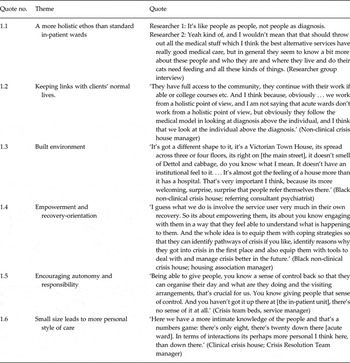
The principal perceived strength is a holistic and collaborative style of care that is less medicalised than in standard acute wards (quote 1.1, Table 1). Features of this broad ethos characterise all the alternatives, but it is most clearly articulated in relation to the two non-NHS voluntary sector services. Three ways that this is manifested are described (These are explored further in the 3 sub-sections below):
Successful features of implementation – illustrative quotes

Retaining links with ‘normal life’
Alternatives are seen as better able to engage with and retain links with clients' normal lives than standard in-patient services. Shorter lengths of stay mean that admissions are focused on crisis management, with an aim to discharge clients back home quickly and avoid disrupting social activities and networks (quote 1.2). Time-limited admissions also encourage prompt engagement with community support services, with alternatives not being limited by organisational factors, such as weekly ward rounds, that may delay hospital discharges. Additionally, alternatives often engage with their clients' practical life problems, from help with housing to fixing a mobile phone, contributing to crisis resolution and to positive client experiences and therapeutic relationships. Finally, alternatives are seen as less stigmatising, with non-statutory services in particular being less obviously identified as mental health services by clients' social networks. This is linked to physical features such as their location in old town houses (the two non-clinical crisis houses), single bedrooms and kitchen facilities, all of which confer a more homely and less institutional atmosphere than hospital settings (quote 1.3).
Autonomy, choice and responsibility
With the exception of the clinical crisis house, a recovery-oriented approach of empowering clients to take responsibility for themselves is perceived as central, aiming to counter the paternalism and coercion often associated with standard acute in-patient care (quote 1.4). This is particularly strong at the two non-clinical crisis houses, which allow self-referrals and encourage involvement in decisions about individual treatment programmes and service routines. The lack of compulsorily detained patients at most alternatives allows them to offer more choices and freedoms, and may create an atmosphere that encourages responsibility and conformity (quote 1.5).
Relationships
Opportunities for developing strong therapeutic and peer relationships are a key perceived strength, related to three factors. Firstly, compared to standard wards, clients of alternatives are more likely to be known to mental health services (Johnson et al. Reference Johnson, Lloyd-Evans, Morant, Gilburt, Shepherd, Slade, Jagielska, Leese, Byford and Osborn2010), providing opportunities for continuity. Secondly, all the alternatives are small, with 12 beds or less, allowing more personalised care (quote 1.6). Finally, the two non-statutory sector crisis houses are perceived to have strong communal atmospheres that encourage supportive peer relationships. There are some suggestions that staff's lack of formal mental health training and orientation towards talking therapies in these two services facilitate positive therapeutic relationships.
Perceived limitations of alternatives
Provision for sectioned and high risk patients
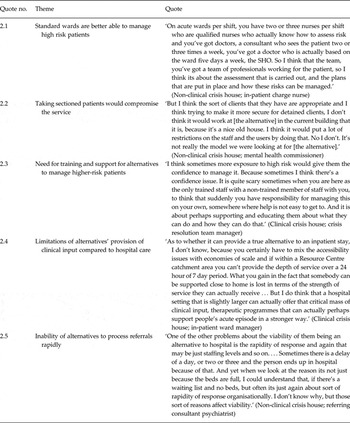
Only one alternative (the clinical crisis house) took sectioned patients, although two others (crisis team beds and the non-clinical crisis house) could accept detained patients on leave from hospital. Respondents acknowledge that most alternatives are not set up to manage sectioned, high risk, highly disturbed or disruptive patients due to their physical lay-out, referral procedures, low staffing levels (particularly at nights and weekends) and staff who lack the necessary qualifications, experience or support (quote 2.1, Table 2). However, this is not necessarily seen as problematic: particularly for the non-clinical crisis houses, accepting sectioned patients would compromise the service ethos (quote 2.2). However, some stakeholders express frustration that alternatives often refuse to accept more severely unwell patients and suggest better staff training and support in managing higher-risk patients (quote 2.3).
Perceived limitations of alternatives – illustrative quotes

Range of interventions
Particularly among staff working in standard in-patient units, a common theme was that alternatives provide less comprehensive treatment packages than hospital settings, with less focus on clients' physical health needs due to their non-medical orientation. This is attributed to staffing levels, and to the range of staff, expertise and economies of scale of hospital settings (quote 2.4).
Size and organisational issues
The small size of alternatives leads to some logistical problems, particularly in managing very disturbed patients. Places are not always available and there is less flexibility if additional or specialist staff are needed or staff are absent. These can be exacerbated by geographical factors: concerns about staffing logistics (especially for psychiatrists) were strongest for one alternative located in a very rural and widely distributed catchment area. For three alternatives (the non-clinical crisis house, crisis beds service and the clinical crisis house) slow referral and admission processes, particularly at night, were viewed by some as significant limitations to crisis management that often resulted in suitable patients being admitted to in-patient wards instead (quote 2.5).
Facilitators to implementation
Stakeholders' views of how the implementation and sustainability of alternatives had been facilitated, what barriers had been encountered and how these had been overcome focus principally on four areas:
Locally valued roles
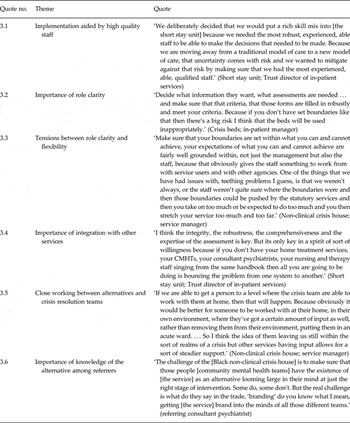
Initial implementation of alternatives had often been motivated by shortcomings in local acute care systems, identified through consultations with existing service providers and local service user and carer groups. Responding to un-met needs was valued most by local stakeholders of the short stay unit, where robust assessments had reduced in-patient admissions and associated costs, and of the Black non-clinical crisis house, catering for a client group that was over-represented in coercive forms of care in an ethnically diverse catchment area. The three other alternatives were also seen as responding positively to service shortcomings (although with less clear consensus), by enhancing the crisis resolution service (crisis team beds), catering for an isolated rural population (clinical crisis house) and providing a less coercive alternative to hospital admission (non-clinical crisis house). Subsequent endurance depends on continuing to play a unique and valued role within the local system. This is facilitated by high quality, committed and enthusiastic staff teams (quote 3.1, Table 3).
Facilitators to implementation – illustrative quotes

Balancing role clarity and adaptability
Role clarity about what alternatives offer (in terms of treatment regimes and clinical presentations) is perceived as central to their effective functioning (quote 3.2). As well as helping to avoid inappropriate referrals, the potential risks associated with acute care may make this especially important. Simultaneously, adaptability is cited as essential, particularly by stakeholders of the more established alternatives. Long-term sustainability within the context of changes and developments in local service systems had required modifications of, for example, referral pathways and criteria. The introduction of crisis resolution teams is cited as particularly significant, impacting positively on the functioning of more established alternatives. Flexibility (e.g. regarding lengths of stay or referral criteria) is also valued in relation to individual care, contributing to good working relationships with other services.
Thus, there is a perceived tension between adaptability and maintaining a clear and distinct role, especially when changes challenge alternatives' original aims or working ethos (quote 3.3). Several examples are described of pressures from statutory services to change or extend alternatives' role beyond their stated aims or competences (e.g. to admit complex, high risk or non-acute patients, waive time limits, or take overspill from wards). The ability to resist pressures to move away from what they can do safely and well appears to contribute to sustainability.
Integration with other services
Stakeholders identify good working relationships with other acute care service providers, particularly crisis resolution teams and community mental health teams (CMHT), as important particularly for initial implementation, but also to the continued endurance of alternatives (quote 3.4). Joint working, assessments or care planning allow alternatives to discharge patients promptly and compensate for input they are unable to provide. For example, community teams provide medical cover for the two non-clinical crisis houses and crisis team beds, allowing appropriate medication management. Collaboration with crisis resolution teams in particular enables alternatives to make a significant contribution to community-based crisis management, allowing patients to be diverted from acute admission (quote 3.5). For the three NHS-based alternatives this is facilitated by proximity to other services located on the same site.
Awareness
Accurate knowledge of alternatives and their working models across a broad range of local health providers is seen as important to ensuring both sufficient and appropriate referrals. Multiple and rapidly evolving community-based services can create barriers to this that require alternatives to engage in continuing awareness-raising activities (quote 3.6). Although all the services are well integrated into local secondary mental health systems, awareness of alternatives is generally weaker in non-mental health services (general practitioners, hospital emergency departments, the police and voluntary and private sector agencies). The two non-statutory sector alternatives in particular receive few direct referrals from non-mental health agencies, and community mental health services often act as gate-keepers. This is seen to sometimes complicate the referral process.
Discussion
The data we have presented focuses on how alternative residential services function within their local acute care systems. This is a unique contribution within the larger Alternatives Study, providing: (a) an in-depth professional perspective on the effectiveness and limitations of these services (see subsections ‘Successful features of implementation’ and ‘Perceived limitations of alternatives’); (b) an understanding of how these service models are implemented within existing service systems (see subsection ‘Facilitators to implementation’). As these are both determinants of the success and endurance of novel or innovative services, we consider each in turn.
Effectiveness of alternative service models
These services are seen by professionals as important components of their local service systems that may improve the acceptability of acute care. At their best, they manage crises in a more personalised and holistic way than standard in-patient care, keeping links with patients' normal social networks, involving patients in care decisions, empowering them to develop functional coping and help-seeking strategies and facilitating meaningful therapeutic alliances. Many of these features are strongest in the two non-clinical crisis houses. The culture and practical set-up of these services may be mutually enhancing: maintaining a holistic care ethos may be easier in environments that are more homely, smaller and less formal than hospital settings, that do not accept involuntary patients and where there are fewer highly disturbed patients. On the other hand, some acutely unwell patients cannot be safely managed in such environments. Compared to traditional in-patient wards, alternatives may focus less on reviewing and managing psychiatric medication, offer a narrower range of therapeutic input and have less access to specialist staff or interventions. The poorer ability of some alternatives to address physical health needs is significant given concerns about this among many mental health service users (Sokal et al. Reference Sokal, Messias, Dikerson, Keyenbuhl, Brown, Goldberg and Dixon2004).
Implementation issues
Alternative service models often fail to endure in the absence of novelty and initial charismatic leaders (Lloyd-Evans et al. Reference Lloyd-Evans, Slade, Jagielska and Johnson2009). Our study highlights the factors that professionals within local service systems perceive to have facilitated the endurance of five different alternative services, three of which were over a decade old. For service developers wishing to implement sustainable alternative forms of acute care, our findings show that shortcomings in existing local service configurations will shape the most appropriate service model. Secondly, changes in local service networks may challenge the sustainability of innovative services, but this can be overcome by alternatives that adapt to evolving contexts while preserving the integrity of their original model. This is facilitated by strong relationships with other components of the local acute care system and promotional work among local agencies that encounter people in mental health crisis.
Successful implementation also depends on national level factors (Tansella and Thornicroft, Reference Tansella and Thornicroft2009). The mandatory national development of crisis resolution and home treatment teams (Department of Health, 2000) may strengthen the functioning of alternatives. The synergy detected between these and some alternative services appears to enhance their capacity to jointly manage severely unwell clients in the community. Services in this study are not as radical as some successful alternative models in other countries, such as user-led services (Greenfield et al. Reference Greenfield, Stoneking, Humphreys, Sundby and Bond2008), family placement schemes (Polak and Kirby, Reference Polak and Kirby1976) and medication-free crisis houses (Bola and Mosher, Reference Bola and Mosher2003; Calton et al. Reference Calton, Ferriter, Huband and Spandler2008). This perhaps reflects organisational constraints of the UK mental health system that may discourage or dilute innovative service models through requirements for compatibility with existing NHS structures, cultures and processes.
Clinical and research implications
The small size of the services studied appears to be integral to their personalised style of care, suggesting that alternatives coexisting with standard acute services within a locality may be the most viable model. This shapes how they function allowing, for example, positive risk-taking with clients. Our study highlights tensions between managing severely unwell or sectioned patients and maintaining an alternative ethos. Thus, commissioners seeking to improve acute care should consider whether they prioritise decreasing hospital bed usage or changing general acute psychiatric services. Given the diversity of alternative service models, it may be desirable for more than one type of alternative to exist in a catchment area, offering possibilities to manage both detained and non-detained patients. An unanswered question is how alternatives impact on the client mix of local in-patient wards (perhaps by increasing the concentration of complex and highly disturbed patients) and the implications for their functioning and for service user experiences. This is an important area for future research that will inform service planning.
Our findings that, across different service models, alternatives are valued for facilitating strong therapeutic relationships concur with data collected from users of these services (Gilburt et al. Reference Gilburt, Slade, Rose, Lloyd-Evans, Johnson and Osborn2010) and wider literature on the importance of relationships and connection during crises (e.g. Martin et al. Reference Martin, Garske and Davis2000; McCabe and Priebe, Reference McCabe and Priebe2004). Findings suggest that this emerges from the broader working ethos of alternatives and further research is needed on the specific factors that support or inhibit relationship-building across a range of acute settings. A related issue concerns the apparent success of acute care provision by two non-statutory voluntary organisations employing mainly unqualified staff. Further research is needed to explore the optimal staff mix for acute care services and the non-statutory sector's role in this provision.
A limitation of this work is its primary reliance on the perspectives of mental health professionals. Although service users' and carers' views of these alternatives have been explored elsewhere (Gilburt et al. Reference Gilburt, Slade, Rose, Lloyd-Evans, Johnson and Osborn2010; Lloyd-Evans et al. Reference Lloyd-Evans, Johnson, Slade, Barrett, Byford, Gilburt, Leese, Morant, Osborn, Skinner, Malone and Thornicroft2010b), the views of others involved in crisis management such as general practitioners (G.P.s), emergency service providers, the police and voluntary sector organisations remain unexplored. A second limitation concerns generalisability from the five services we have studied that may not necessarily represent their respective alternative service models. However, a qualitative approach drawing on professionals' and researchers' knowledge of services allows an in-depth understanding of how services operate within local acute care systems, from which common strengths, limitations and implementation-related factors have been identified. Implementation researchers in mental health are increasingly recognising this balance between generalisable issues and understanding the variability between service configurations and their appropriateness in different social contexts (Mancini, et al. Reference Mancini, Moser, Whitley, McHugo, Bond, Finnerty and Burns2009; Whitley, et al. Reference Whitley, Gingerich, Lutz and Mueser2009).
To conclude, this type of research helps address the translational gap between evidence and implementation in acute psychiatric care by highlighting valued and workable features of care delivery by residential alternatives, limitations and factors associated with their set-up and survival. This should contribute to both the development of acute care services that produce positive outcomes and service user experiences, and to their long-term sustainability, which is arguably how their greatest public health impact can be achieved (Tansella and Thornicroft, Reference Tansella and Thornicroft2009).
Acknowledgements
This paper presents independent research commissioned by the National Institute for Health Research (NIHR) under the Service Delivery and Organisation programme (project number 08/1304/075). The views expressed in this paper are those of the authors and not necessarily of the NHS, NIHR or Department of Health. We are grateful to the practitioners who participated in interviews and to Dorota Jagielska and Rachel Skinner, researchers for The Alternatives Study. This study was undertaken in the context of the NIHR Specialist Mental Health Biomedical Research Centre at the Institute of Psychiatry, King's College, London and the South London and Maudsley NHS Foundation Trust. The study was supported by the Mental Health Research Network (MHRN) and associated with the MHRN acute care group (convenor S.J.).