Implications
Sow environment during gestation can be detrimental for sow welfare and health, which in turn could impair maternal parameters important for neonatal survival. Sows reared in a conventional gestation system on a slatted floor experienced more stress than sows housed in an enriched system with deep straw bedding and additional space (Part I). Gestation housing system also moderately impacted the maturity of piglet neonates (Part II), with the system being stressful for sows having some negative effects. Environmental enrichment for group-housed sows during gestation should therefore be considered in pig farms to improve sow welfare and piglet maturity at birth.
Introduction
Housing and management systems for gestating sows can be detrimental for sow welfare and health, which in turn could impair neonatal health and survival (Merlot et al., Reference Merlot, Quesnel and Prunier2013). Recently, two contrasted environments for gestating sows, a system on a slatted floor, which is a conventional system in many countries, including France, and an enriched system with deep straw bedding and additional space, were associated with contrasted rates of piglet mortality (Merlot et al., Reference Merlot, Calvar and Prunier2017). Therefore, the present study was undertaken to determine whether these two contrasted environments affected piglet characteristics around birth. In a companion paper (Merlot et al., Reference Merlot, Pastorelli, Prunier, Père, Louveau, Lefaucheur, Perruchot, Meunier-Salaün, Robert, Gondret and Quesnel2018), we showed that the conventional system was more stressful for sows during gestation, as illustrated by elevated cortisol levels in saliva of pregnant sows, and that it moderately altered sow health in late gestation. We hypothesized that these changes might have affected foetal development. Indeed, excessive exposure to glucocorticoids can alter organ development during the foetal period (Singh et al., Reference Singh, Cuffe and Moritz2012), with the nature and severity of the developmental impairment depending on the timing of exposure (Kranendonk et al., Reference Kranendonk, Hopster, Fillerup, Ekkel, Mulder, Wiegant and Taverne2006). The present part of the study focusses on piglet features at birth, notably endocrine and metabolic status and functional traits of key tissues, namely skeletal muscle, liver and adipose tissue.
Material and methods
Experimental design
The experiment was carried out in the experimental farm of the Chambre Régionale d’Agriculture de Bretagne (CRAB) at Crécom (Saint-Nicolas du Pélem, Côtes d’Armor, France). The experimental design was fully described in our companion paper (Merlot et al., Reference Merlot, Pastorelli, Prunier, Père, Louveau, Lefaucheur, Perruchot, Meunier-Salaün, Robert, Gondret and Quesnel2018). Briefly, the farm was divided into two adjacent farrow-to-finish units with identical genetic background and management procedures except for the group-housing environment of gestating sows. The conventional system unit (Conventional, C) was on a concrete slatted floor and offered 2.4 m2 of space per gestating sow in early gestation; the enriched unit (Enriched, E) was on deep straw and offered more space per sow (3.5 m2). The sows were housed in groups of 24 per pen. In each system, sows were transferred into identical farrowing rooms on a slatted floor at ∼105 days of gestation (DG105) and were kept in individual crates thereafter. Average ambient temperatures in farrowing rooms were similar in the two systems (P > 0.10). They averaged 23.8 ± 0.2°C on the day of farrowing. Supplemental heating was provided to the piglets by means of two heat lamps in each crate until 24 h postpartum.
Three successive batches of Landrace × Large White sows of mixed parity (1 to 12) were used. Sows of the two systems were inseminated with semen from the same Piétrain boars. On DG114, parturition was induced by an intramuscular injection of cloprostenol (2 ml of Planate®; MSD Santé Animale, Beaucouzé, France). After parturition, sows were injected with Sergotonine® (5 ml, i.m.; Mérial SAS Villeurbanne, France) and then Dynolytic® (2 ml, i.m.; Zoetis, Paris, France) 36 to 48 h afterwards to stimulate uterus emptying. Gestation and lactation data for all sows (n = 106) were provided in our companion paper (Merlot et al., Reference Merlot, Pastorelli, Prunier, Père, Louveau, Lefaucheur, Perruchot, Meunier-Salaün, Robert, Gondret and Quesnel2018). Parturitions were attended non-stop for 30 h. Sows that farrowed during this time frame (18 C and 19 E sows) and their litter were considered in the present paper. All piglets were subjected to specific phenotypic measurements. Blood samples were collected at birth (DL0) on a subset of piglets (6 to 7 piglets per litter) and during the early postnatal period on day 4 of lactation (DL4, 2 piglets per litter). One male piglet of average BW was also euthanized at birth for organ weighing and tissue sampling.
All sows were fed conventional diets during gestation and lactation. The gestation diet contained 9.29 MJ of NE/kg, 12.0% CP, 0.6% lysine, 6.2% crude fibre (as fed basis) and the lactation diet contained 9.8 MJ of NE/kg, 14.0% CP, 0.9% lysine, 4.8% crude fibre. During gestation, sows were individually fed through an automatic dispensing system. Sows were fed the gestation diet up to DL4 when they were changed to the lactation diet without any transition. Feed allowance to lactating sows was greater when litter size was larger. Sows had free access to water.
Farrowing supervision and specific measurements on neonates
Farrowing was attended for this subset of sows, but interventions during farrowing were kept to a minimum. Sex, weight and crown-rump length were recorded for each piglet at birth. These measurements also served to estimate piglet body mass index (BMI, BW/length2) and ponderal index (BW/length3), which were shown to be better predictors of mortality than birth weight (Baxter et al., Reference Baxter, Jarvis, D’Eath, Ross, Robson, Farish, Nevison, Lawrence and Edwards2008). Rectal temperature was recorded for live piglets 1 h after birth. When rectal temperature was below 37°C, the piglet was placed at the udder to facilitate suckling. Piglets were weighed again 24 h after the onset of farrowing (T24). Piglet BW gain between birth and T24 was used to estimate individual colostrum ingestion, based on the equation developed by Devillers et al. (Reference Devillers, Van Milgen, Prunier and Le Dividich2004).
The original litter was kept with the sow up to T24 and no additional help or care was given during this period. Beyond 24 h, piglets were managed according to standard procedures (iron injection, tail and tooth clipping, plant-based preventive treatment against diarrhoea) and litter size was standardized by cross-fostering within C and E groups. Males were castrated under analgesia (intramuscular injection of méloxicam, Metacam®; Boehringer Ingelheim, Pacé, France) 5 days after birth. Piglets had free access to water and had access to creep feed from day 10 of lactation onwards.
Tissue collection from euthanized newborn piglets
For each litter, one male piglet with BW between 1.3 and 1.7 kg, that is, close to the average birth weight in the present herd, was euthanized immediately after birth before the first suckling. Euthanasia included premedication with intramuscular injection of ketamine (0.2 ml/kg; Alcyon France, Paris, France) and death induction by an intra-cardiac injection of T61 (0.5 ml/kg, Alcyon France). Heart, kidneys, liver and the entire gut were excised and weighed. A liver sample was cut into small pieces, frozen in liquid nitrogen and stored at –75°C for gene expression analysis and glycogen content determination. Another liver sample was kept at 4°C before freeze-drying, to allow lipid analysis. Samples of dorsal subcutaneous adipose tissue (SCAT) and longissimus muscle were then collected, cut into small pieces, and frozen in liquid nitrogen and stored at −75°C until biochemical and molecular analyses. The digestive tract was placed in a sterile plastic bag for bacteriological examination. The stomach was punctured and a sterile swab was inserted into its contents. The whole intestine was ligatured at the proximal part of the duodenum and the distal rectal part. Two swabs were made on the surface of the mucosa of the jejunum and the spiral colon. The intestine and the stomach swabs were kept at 4°C until microbiological analysis.
Collection of saliva and blood samples
Saliva samples were collected from sows on DG35 and DG105, then after the transfer into farrowing rooms on DG107 and DL4. Blood samples were collected in heparinized tubes from live piglets at birth (3 ml) from the umbilical cord (6 or 7 piglets per litter; n = 239 in total), and from the jugular vein (5 ml) on day 4 of lactation (DL4, at around 1130 h, one male and one female per litter; n = 74 in total). Blood samples were immediately centrifuged for 10 min at 2600 × g at 4°C and plasma was stored at −20°C.
Biological analyses
Salivary cortisol in sows was assessed using a luminescence immunoassay kit (LIA, IBL, Hamburg, Germany) as described in Merlot et al. (Reference Merlot, Pastorelli, Prunier, Père, Louveau, Lefaucheur, Perruchot, Meunier-Salaün, Robert, Gondret and Quesnel2018). In piglet plasma, hydroperoxides and the global antioxidant capacity of plasma were quantified by dROM and BAP (Biological Antioxidant Power) tests (H&D srl, Parma, Italy), respectively (Merlot et al., Reference Merlot, Pastorelli, Prunier, Père, Louveau, Lefaucheur, Perruchot, Meunier-Salaün, Robert, Gondret and Quesnel2018). An oxidative stress index (OSI) was calculated as the ratio between ROM and BAP values.
Piglet nutrients and hormones
Plasma concentrations of fructose, glucose, NEFA, lactate and albumin were determined using commercial kits and a clinical chemistry analyser Konelab 20i (Thermo Ficher Scientific, Courtaboeuf, France) as previously described (Gondret et al., Reference Gondret, Père, Tacher, Daré, Trefeu, Le Huërou-Luron and Louveau2013). For hormones, all samples were analysed in a single batch. Plasma insulin concentrations were measured using a RIA kit (INSULIN-CT; IBA Molecular, Orangeburg, NY, USA). Plasma IGF-I concentration was determined after an acid–ethanol extraction using the IRMA IGF-I kit (Immunotech, Prague, Czech Republic). Plasma concentrations of cortisol, total triiodothyronine (T3) and total thyroxin (T4) were determined using enzymatic immunoassays (ST AIA-PACK CORT, T3 or T4, TOSOH; Tessenderlo, Belgium). Assay sensitivities were 4.6 μUI/ml, 9.26 ng/ml, 2 ng/ml, 20 ng/dl and 0.5 μg/dl for insulin, IGF-I, cortisol, T3 and T4, respectively. The intra-assay CV were 12.2%, 5.6%, 3.1%, 3.8% and 3.9% for insulin, IGF-I, cortisol, T3 and T4, respectively.
Piglet biochemical composition
Glycogen content was determined in liver and longissimus muscle samples according to the reference method (Good et al., Reference Good, Kramer and Somogyi1933). Total lipid content was assessed in freeze-dried (liver) or frozen (SCAT) tissue samples by the application of the supercritical CO2 method and solvent extraction. Glycogen and lipid contents were expressed as percentages of wet weight.
Gene expression levels
Total RNA was extracted from piglet liver, longissimus muscle and SCAT as previously described (Gondret et al., Reference Gondret, Père, Tacher, Daré, Trefeu, Le Huërou-Luron and Louveau2013). Target genes were selected based on previous studies that have pointed out their differential expression in relation with the acquisition of tissue functionality and maturity in pig foetuses (Rehfeldt et al., Reference Rehfeldt, Lefaucheur, Block, Stabenow, Pfuhl, Otten, Metges and Kalbe2012; Gondret et al., Reference Gondret, Père, Tacher, Daré, Trefeu, Le Huërou-Luron and Louveau2013; Perruchot et al., Reference Perruchot, Lefaucheur, Louveau, Mobuchon, Palin, Farmer and Gondret2015). They were involved in pathways related to energy metabolism, antioxidant capacity, and cell differentiation. The complete list of the studied genes and their primers is given in Supplementary Table S1. Relative expression levels of these genes were determined by real-time qPCR, as previously described (Perruchot et al., Reference Perruchot, Lefaucheur, Louveau, Mobuchon, Palin, Farmer and Gondret2015). Gene expression levels were quantified by the ABI StepOnePlus™ System (Applied Biosystems, Foster City, CA, USA). For liver, two reference genes (HPRT1 and PPIA) were identified as the most stable ones by the GeNorm algorithm. For muscle and SCAT, one reference gene (HPRT1) was identified and used to normalize the results.
Gut bacterial microflora
Swabs of stomach, jejunum and spiral colon collected in euthanized piglets at birth were smeared directly on plates containing trypticase/tryptic soy agar with 5% sheep blood. The plates were incubated for 24 h at 37°C. Typical colonies were isolated and identified by classical biochemical tests, that is, morphological observations, Gram coloration, oxidase and catalysis tests and standardized micro-method systems API®20E and API® 20 Strep (BioMérieux, Bruz, France).
Statistical analyses
Numbers of piglets per litter, mortality rates and proportion of light or heavy piglets were analysed using the GENMOD procedure using a Poisson distribution and a log-transformation as the link function for numbers of piglets and a binomial error distribution and a logit-transformation for other criteria. Other data were analysed by ANOVA using the MIXED procedure of SAS (SAS Institute Inc., Cary, NC, USA). The sow or the piglet represented the experimental unit. Models included the effects of the system (C or E) as main factor and the replicate (1, 2 or 3) as random factor. When performance or physiological data were recorded on several piglets per litter, the random effect of sow nested within system × replicate was included in the model to take into account the effect of the sow. When 6 or 7 piglets per litter were investigated, piglet sex was also considered as a fixed factor and the system × sex interaction included in the model. Data are expressed as least-squares means and SEM when analysed using the MIXED procedure and as raw data when analysed using the GENMOD procedure. Differences between C and E systems were considered significant if P < 0.05.
Results
Sow body condition, reproductive performance and salivary cortisol concentrations
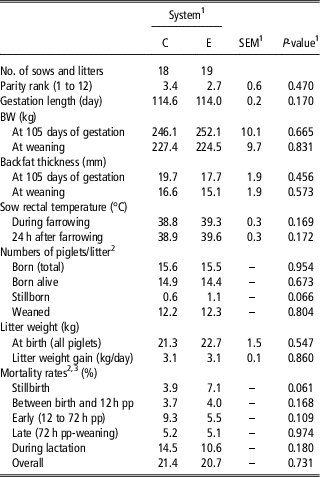
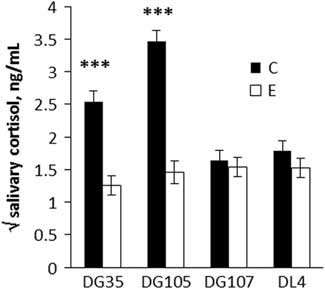
Average parity of sows and the proportions of young sows (parities 1 and 2, 55%) and older sows (parity>2; 45%) were similar in the two gestation systems (Table 1). No significant differences (P > 0.05) were observed between the two systems for sow BW, backfat thickness, gestation length, body temperature, litter size, litter weight and litter growth rate (Table 1). Mortality rates did not significantly differ between systems (Table 1). Compared with C sows, E sows had lower salivary cortisol concentrations on DG35 and DG105 (P < 0.001) but similar concentrations after transfer into farrowing rooms (DG107) and in early lactation (DL4) (Figure 1). Duration of parturition (201 ± 18 min), average birth interval (14 ± 1 min), and rhythm of piglet births (data not shown) did not differ (P > 0.10) between C and E sows.
Body condition and reproductive performance of sows that were housed during gestation in a conventional (C) v. an enriched (E) system

1 Effect of system. Data are expressed as least-squares means and the greatest SEM when analysed using the MIXED procedure and as raw data when analysed using the GENMOD procedure.
2 GENMOD procedure.
3 Stillbirth: the number of stillborn piglets was calculated relatively to the total number of piglets. Between birth and 12 h pp, early and late mortality rates were calculated relatively to the number of piglets born alive. Overall mortality included stillborn piglets and piglets born alive that died before weaning, relatively to total born piglets.
Salivary concentrations of cortisol in sows (18 C and 19 E) reared during gestation in a conventional (C) v. an enriched (E) system. Saliva was collected on days 35, 105 and 107 of gestation (DG35, DG105 and DG107, respectively) and on day 4 of lactation (DL4). Data are expressed as least-squares means ± SEM of the square-root transformed values.

Piglet neonatal phenotype and pre-weaning performance
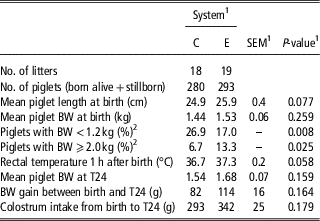
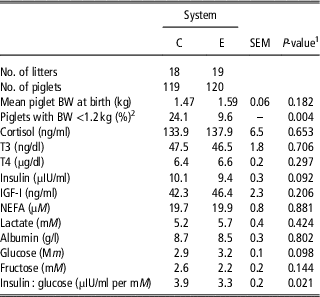
At birth, no significant difference was observed between C and E piglets for cranio-caudal length (P > 0.05), BW (P > 0.10) and rectal temperature (P > 0.05). However, the percentages of light (<1.2 kg) and heavy (⩾2 kg) piglets were greater and lower, respectively, in C than in E litters (P < 0.05, Table 2). Piglet BMI (22.8 ± 0.2) and ponderal index (92.0 ± 1.0) were similar (P > 0.10) in both groups. Piglet BW gain and colostrum intake between birth and T24 did not differ between C and E piglets (P > 0.10, Table 2). Irrespective of the system, the piglets that died between birth and weaning were lighter at birth when compared with piglets still alive at weaning (1.27 ± 0.05 v. 1.54 ± 0.04 kg, P < 0.001).
Neonatal traits of piglets born from sows that were housed during gestation in a conventional (C) v. an enriched (E) system

1 Effect of system. SEM, the highest value was reported.
2 GENMOD procedure.
Oxidative stress in piglets during early postnatal period
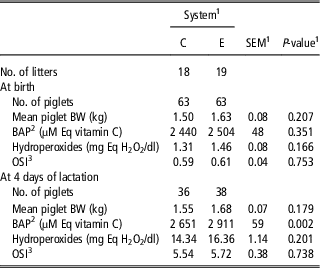
Plasma concentrations of hydroperoxides and BAP at birth were similar in C and E piglets (Table 3). Plasma BAP slightly increased between birth and DL4, while plasma concentration of hydroperoxides and the OSI increased by 11 and 8 times, respectively (P < 0.001). On DL4, piglets from the C system exhibited a lower plasma antioxidant capacity than piglets from the E system (P = 0.002). However, the hydroperoxides and the OSI did not differ between systems (P > 0.10, Table 3).
Plasma oxidative stress parameters of piglets born from sows that were housed during gestation in a conventional (C) v. an enriched (E) system

1 Effect of system. SEM, the highest value was reported.
2 BAP = Biological Antioxidant Power.
3 OSI = Oxidative Stress Index as the ratio between hydroperoxides (mg Eq H2O2/dl) and BAP (μM Eq vitamin C) × 1000.
Plasma hormones and metabolites in neonates
Plasma concentrations of cortisol, IGF-I, T4 and T3 did not differ (P > 0.10) between C and E piglets, nor did plasma concentrations of lactate, NEFA, fructose and albumin (Table 4). The insulin to glucose ratio was greater (P = 0.02) in C than in E neonates. A significant system × sex interaction was observed for glucose concentrations (P = 0.042) but within sex, the system effect was not significant (in females: 2.82 ± 0.23 and 3.45 ± 0.23 mM in C and E systems, respectively, P = 0.064; in males: 2.93 ± 0.14 and 3.03 ± 0.14 mM in C and E systems, respectively, P = 0.616). A sex effect (with no system × sex interaction) was observed for T4 (6.63 ± 0.13 and 6.36 ± 0.13 μg/dl in females and males, respectively, P = 0.019), NEFA (18.97 ± 0.61 and 20.66 ± 0.61 μM in females and males, respectively, P = 0.006) and fructose (2.30 ± 0.12 and 2.49 ± 0.12 mM in females and males, respectively, P = 0.039).
Plasma concentrations of hormones and metabolites at birth in piglets born from sows that were housed during gestation in a conventional (C) v. an enriched (E) system

1 Effect of system. Data are expressed as least-squares means and the greatest SEM.
2 GENMOD procedure.
Piglet organs and tissue maturity at birth
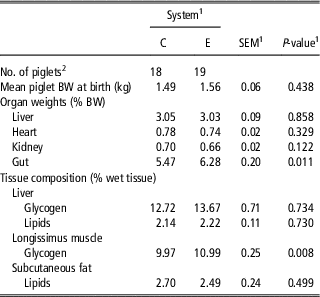
Organ weights relative to BW did not differ between C and E piglets (Table 5), with the exception of the gut which was lighter, relative to BW, in C than in E piglets (−11%, P = 0.01). Glycogen content, the main energy reserve of the neonate, was reduced in longissimus muscle of C piglets when compared with E piglets (−8.6%, P < 0.01), whereas hepatic glycogen content was similar in the two groups (P > 0.10, Table 4). Lipid contents in liver and SCAT of the neonates did not differ between systems (P > 0.10; Table 5).
Effects of gestating sow housing system on organ characteristics of piglets at birth when sows were housed during gestation in a conventional (C) v. an enriched (E) system

1 Effect of system. SEM, the highest value was reported.
2 One male piglet per litter was euthanized.
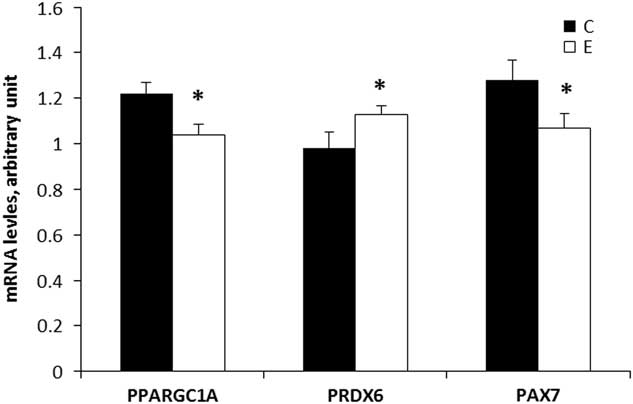
Expression levels of selected genes were assessed in longissimus muscle (Supplementary Table S2), SCAT (Supplementary Table S3) and liver (Supplementary Table S4). In muscle, expression levels of PAX7, a marker of satellite cells, and PPARGC1A, a transcriptional coactivator involved in mitochondriogenesis and mitochondrial energy metabolism, were greater (P = 0.04 and P = 0.01, respectively, Figure 2), whereas the expression level of PRDX6 was lower (P = 0.03) in C than in E piglets. The expression of other genes investigated in muscle, as well as in SCAT and liver did not differ (P > 0.05) between systems (Supplementary Tables S2 to S4).
Messenger (mRNA) levels of factors involved in mitochondrial biogenesis and PAX7, a marker of satellite cells, in muscle of male piglets at birth (18 C and 19 E) when sows were housed during gestation in a conventional (C) v. an enriched (E) system. *P < 0.05.

Piglet gut microflora at birth
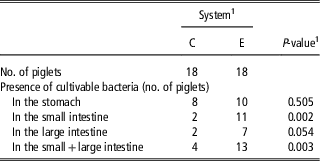
Almost 70% of the newborn piglets had cultivable bacteria in at least one part of their digestive tract. Moreover, a lower proportion of piglets had positive intestine contents (small+large) in the C than in the E system (22% v. 72%, respectively; P < 0.05, Table 6). No difference between systems was observed at the stomach level.
Bacteriological examination of the stomach and intestine contents in male piglets at birth when sows were housed during gestation in a conventional (C) v. an enriched (E) system

1 Effect of system on the proportion of piglets with cultivable bacteria (χ 2 test).
Discussion
The current study shows the impact of sow housing conditions during gestation on morphological and physiological features of piglets at birth and within a few days of birth. Sow and litter performance for the whole experimental design (i.e. 106 sows and their litter) are presented in the companion paper (Merlot et al., Reference Merlot, Pastorelli, Prunier, Père, Louveau, Lefaucheur, Perruchot, Meunier-Salaün, Robert, Gondret and Quesnel2018). In the C system, when compared with the E system, sows had greater salivary concentrations of cortisol in early and late gestation suggesting a more stressful environment, and their litters presented greater rates of mortality. The subset of sows in the present paper (i.e. 37 sows) also exhibited greater concentration of salivary cortisol in the C system than in the E system, but differences in early (12 to 72 h pp) piglet mortality rate between systems did not reach significance (P = 0.11), which could be related to the low number of sows.
Piglet morphology
The degree of development at birth is generally assessed through external morphological traits such as BW and shape, these characteristics being also predictive of mortality (Baxter et al., Reference Baxter, Jarvis, D’Eath, Ross, Robson, Farish, Nevison, Lawrence and Edwards2008). Average BW, body length, BMI and ponderal index, were not significantly influenced by the housing system. However, the percentage of small piglets at birth (<1.2 kg) was greater in C than in E litters, denoting an influence of the sow housing system during gestation on foetal development. Piglet rectal temperature 1 or 2 h after birth reflects piglet success in recovery from postnatal hypothermia (Tuchscherer et al., Reference Tuchscherer, Puppe, Tuchschere and Tiemann2000). On average, the C piglets had lower rectal temperature 1 h after birth but the difference did not reach the level of significance.
Glucose and lipid homeostasis
Besides external morphological traits, organ weights and functional characteristics such as nutrient availability, body-energy reserves and gene expression levels in tissues are also indicative of foetal development (van der Lende et al., Reference van der Lende, Knol and Leenhouwers2001; Gondret et al., Reference Gondret, Père, Tacher, Daré, Trefeu, Le Huërou-Luron and Louveau2013). Among endocrine and metabolic indicators assessed before the first suckling, the insulin to glucose ratio was significantly greater in C than in E piglets, suggesting that C piglets might be more resistant to insulin than E piglets. Another noticeable difference at birth was the lower content of glycogen in longissimus muscle of C piglets compared with E piglets. At birth, piglet neonates have high energy requirements to sustain physical activity (e.g. to reach teats and to suckle) and to ensure thermoregulation; they rely mainly upon glycogen as an endogenous energy-yielding substrate with muscle glycogen being the primary source for heat production (Le Dividich et al., Reference Le Dividich, Noblet, Herpin, van Milgen and Quiniou1998; Theil et al., Reference Theil, Lauridsen and Quesnel2014). Reduced muscle glycogen concentration has been associated with low birth-to-weaning survival rates in piglets (Leenhouwers et al., Reference Leenhouwers, Knol, de Groot, Vos and van der Lende2002). In contrast, we did not observe any differences between groups in liver glycogen content, which plays an important role in glucose homeostasis before colostrum intake. At the molecular level, a greater expression of PPARGC1A (also termed PGC1-alpha) was observed in C piglets compared with E piglets. A marked increase in PGC1-alpha expression has been previously reported in hindlimb muscle of neonatal rats suffering from intrauterine growth retardation (Lane et al., Reference Lane, Maclennan, Daood, Hsu, Janke, Pham, Puri and Watchko2003). External physiological stimuli such as physical exercise and cold environment were also able to increase PGC1-alpha expression in skeletal muscle (Slivka et al., Reference Slivka, Dumke, Tucker, Cuddy and Ruby2012). Due to the role of PGC1-alpha in mitochondrial energy metabolism and mitochondriogenesis, up-regulation of this gene in C piglets might be a response of cells to energy deficit. This remains speculative, however, because expression levels of NRF1, TFAM, COX1, CS nor ATP5A1, five genes for which expression levels have been reported to be positively related to PGC1-alpha expression (Wu et al., Reference Wu, Puigserver, Andersson, Zhang, Adelmant, Mootha, Troy, Cinti, Lowell, Scarpulla and Spiegelman1999), did not significantly differ between C and E piglets. Taken together, the present findings suggest that C piglets with an average BW at birth presented some disadvantages in terms of energy store and metabolism.
Because pigs are devoid of brown adipose tissue (Berg et al., Reference Berg, Gustafson and Andersson2006), a specific type of fat that is essential for non-shivering thermogenesis in other mammals, white adipose tissue development before birth may play a role in piglet performance after birth, as a protecting layer against cold and substrate energy reserve. In the present experiment, expression levels of various genes related to adipogenesis and lipid metabolism as well as lipid content in SCAT did not differ between C and E piglets.
Oxidative stress
In the present study, C and E piglets exhibited no differences in plasma concentrations of hydroperoxides and OSI, and except an increased PRDX6 messenger RNA level in muscle of E neonates, there were no significant changes in the expression levels of antioxidant enzymes in tissues. This suggests that maternal environment during gestation poorly affected the redox status of the foetuses. After birth, the newborns have to cope with a relatively hyperoxic environment, and a large number of reactive oxygen species are usually generated in neonatal cells (Friel et al., Reference Friel, Friesen, Harding and Roberts2004). When assessed 4 days after birth, piglets from C sows showed reduced plasma biological antioxidant potential (BAP), an assay that quantifies the biologically active antioxidants in plasma including bilirubin, uric acid, vitamins C and E, and proteins. This suggests that C piglets had a compromised overall blood antioxidant defence system during early lactation.
Digestive tract development and bacterial colonies
Finally, another sign of reduced physiological maturity or disharmonious functionality in piglets from C sows was the lower development of the gut in those piglets when compared with E piglets. Leenhouwers et al. (Reference Leenhouwers, Knol, de Groot, Vos and van der Lende2002) have shown that small intestine was lighter in pig foetuses with a low genetic merit for early survival than in pig foetuses of similar BW but with a higher early postnatal survival. There is also a growing body of evidence that gastrointestinal microbiota contributes to piglet health and performance (Mach et al., Reference Mach, Berri, Estellé, Levenez, Lemonnier, Denis, Leplat, Chevaleyre, Billon, Doré, Rogel-Gaillard and Lepage2015). In the present study, the presence of bacteria in the digestive tract of most piglets at birth confirms that the microbial establishment likely begins during the passage of foetuses through the urogenital canal (Mach et al., Reference Mach, Berri, Estellé, Levenez, Lemonnier, Denis, Leplat, Chevaleyre, Billon, Doré, Rogel-Gaillard and Lepage2015). Here, the microbial colonies were less abundant in small and large intestines of C piglets than of E piglets at birth. It is not known whether this intestine colonization at birth may contribute to differences in early survival. Indeed, faecal microbiota characterization in 1- and 4-day-old piglets from the present experiment showed only few differences between C and E piglets (Kubasova et al., Reference Kubasova, Davidova-Gerzova, Merlot, Medvecky, Polansky, Gardan-Salmon, Quesnel and Rychlik2017).
Conclusions
Sow environment during gestation affected the physiological maturity of piglets. At birth, piglets born from sows housed in a stressful environment during gestation had lower gut weight and reduced muscle glycogen content, together with some differences in the expression of genes involved in muscular energy metabolism. These effects might contribute to explain the lower survival rates of piglets previously reported in the conventional system when compared with the enriched system.
Acknowledgements
The authors thank C. Calvar and B. Le Bris (Chambre d’Agriculture de Bretagne – CRAB, France) and the staff of Crécom (CRAB, B. Le Guilcher, P. Lirzin, D. Lesaicherre, M. Gautier) for animal care and data collection and the technical staff of UMR1348 PEGASE (S. Tacher, S. Daré, N. Bonhomme, C. Tréfeu, R. Comte, F. Thomas, F. Mayeur, M. Lefebvre) for sample and data collection and for expert technical assistance. They also thank F. Robert, A. Hamard and T. Pinard from Deltavit CCPA group. Research received funding from the EU FP7 Prohealth project (no. 613574).
Declaration of interest
The authors declare that they have no competing interests.
Ethics statement
Animals were cared for according to the French regulations for the humane care and use of animals in research. The experimental protocol (no. 02805-02) was approved by the local Ethics Committee in Animal Experiment of Rennes, France, and by the French Ministry of Higher Education and Research.
Software and data repository resources
None of the data were deposited in an official repository.
Supplementary material
To view supplementary material for this article, please visit https://doi.org/10.1017/S1751731118003087