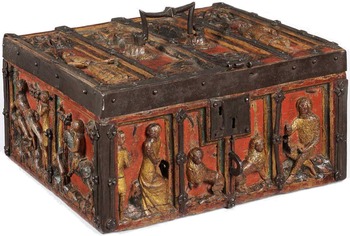
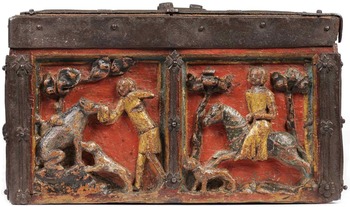
The Victoria and Albert Museum (V&A) owns a painted wooden casket, carved on all four sides and the lid (figs 1–6).Footnote 1 The casket was acquired in 1855 from the collection of Ralph Bernal by the Museum of Ornamental Art, which later became the V&A. How it had entered Bernal’s collection is unknown.Footnote 2 When it was bought, it was regarded as English or French, c 1350, an attribution that has essentially been accepted by later scholars.Footnote 3
Full view of the casket, of carved and painted oak, with iron mounts and locks, and a textile/paper lining: V&A inv. no. 2173-1855. Photograph: © V&A Images/Victoria and Albert Museum, London

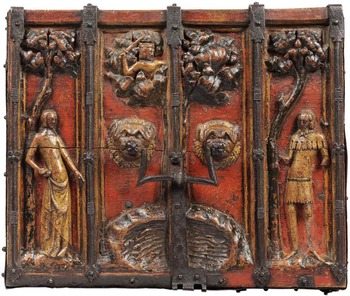
Lid of the casket. Photograph: © V&A Images/Victoria and Albert Museum, London

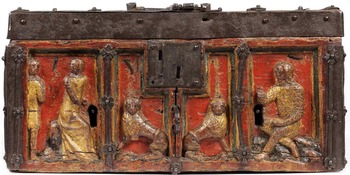
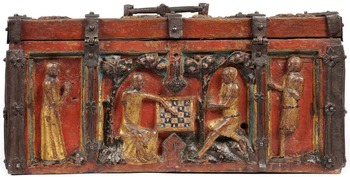
Front panel of the casket. Photograph: © V&A Images/Victoria and Albert Museum, London

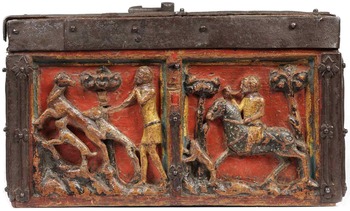
Left side of the casket. Photograph: © V&A Images/Victoria and Albert Museum, London

Right side of the casket. Photograph: © V&A Images/Victoria and Albert Museum, London

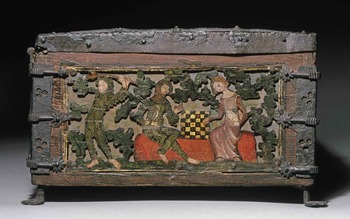
Back panel of the casket. Photograph: © V&A Images/Victoria and Albert Museum, London

Scholarly interest in the casket has principally focused on the scene depicted on the lid (fig 2), identified as the so-called ‘orchard scene’ of the medieval story of Tristan, in which King Mark of Cornwall spies on his wife Isolde and his nephew Tristan, who are suspected of adulterous love. Tristan, who had wooed the Irish princess Isolde on Mark’s behalf, had travelled with her to Cornwall. During the sea voyage they had accidentally drunk a love potion, which Isolde’s mother had designed for Mark and Isolde, and they had secretly pursued their love ever since. At court their love became an open secret, but Mark remained doubtful of the rumours. A dwarf finds out that an orchard is their meeting place and advises Mark to hide in a treetop so as to catch the lovers. However, in the moonlight the lovers discover Mark and the dwarf and pretend to have met purely to discuss what to do against the rumours spread about them. Consequently, Mark believes that the dwarf has duped him.Footnote 4
On the V&A casket the iconographic arrangement of the orchard scene comes unusually close to the German Tristrant text by Eilhart von Oberg, as was noted in 1973.Footnote 5 This verse version narrates how Mark – sitting in the treetop together with the dwarf – tries to kill the dwarf with his sword when he feels betrayed by him in view of Isolde’s apparent loyalty.Footnote 6 In English and French sources, however, there is no equivalent to this attempt at punishing the dwarf in the treetop; in most versions it is simply stated that Mark becomes angry with the dwarf.Footnote 7
The consequences of a discrepancy between the suggested manufacture of the casket in France or England on the basis of its style and its probable connection with a German text have not been discussed hitherto: to reconcile these, it would be necessary to revise assumptions either about the geographical origin of the casket or the spread of Eilhart’s Tristrant, or both. However, the methodical premise that the iconography must derive directly from a textual source should also be reconsidered.Footnote 8 Additionally, the iconography on the side, front and back boards, which has so far received little attention, should also be examined, along with the orchard scene on the casket lid.
An essential precursor to a discussion of the casket and its possible relationship to a particular Tristan version is establishing clear evidence that this is indeed a medieval casket, particularly in view of the intensive debate about the authenticity of so-called Minnekästchen. Since the nineteenth century, the term Minnekästchen has been used to refer to richly decorated medieval caskets, usually made of precious materials. They clearly played a role in noble life, but it is not entirely clear in what contexts. The caskets were certainly used to store jewellery and other personal valuables; they might also have been love gifts. Like many types of medieval objects collected in the nineteenth century, some of the caskets have been shown to be nineteenth-century forgeries.Footnote 9 Therefore the consideration of stylistic and iconographic aspects will build on the results of recent technical analyses of this casket.Footnote 10
The Iconographic Framework Of The Casket
The lid scene shows, in four vertically oriented compartments, a female figure (on the left) and a male figure (on the right), both standing beside a central pool beneath a tree. Another male figure, wearing a crown, is crouching in the treetop (on the left), only the upper part of his body being visible. He has seized a small male figure (on the right) by his hair with his left hand and threatens him with the sword in his right hand. The combination of these various elements – and particularly the motif of a crowned man sitting in a tree – suggest beyond doubt that this must be King Mark, who, together with the dwarf, overhears the rendezvous of Tristan and Isolde in the orchard. Isolde, standing (like Tristan) in a fashionable, sway-backed posture, lifts her close-fitting cote hardie (overgarment) by seizing a generous handful of fabric that demonstrates its conspicuous length and quantity.Footnote 11 Tristan forms the fashionable counterpart to Isolde, as is indicated by his long forked beard and his distinctive caped hood with a dagged (slashed) lower edge, the hood down and gathered at his neck.
As on the lid, the scenes on the front, back and sides of the casket are compartmentalized. The front panel of the casket (fig 3) is dominated by the lock-plate mounted on a moulded platform, clearly designed as part of the composition. Below the plate there are two seated lions placed symmetrically with their backs towards the centre and their gaze towards the viewer. The two outer compartments are slightly broader than those on the lid. As on the lid, a male figure is shown in the right-hand compartment, a female figure in the left-hand one. Both sit on rocks, their bodies turned towards each other. The noble female figure, however, has turned her head backwards – as if interrupted – towards another, elegantly clothed smaller man standing behind her. As both her hands are now missing, it is impossible to know if she held something small in her hands, like a flower. As the male figure in the right-hand compartment is powerfully built and covered with hair (other than his face, hands and feet), he is obviously meant to represent a wild man. Though his left hand rests in his lap, his right arm is raised, deliberately lifted, and he might have been holding something in his (missing) right hand, such as a hawk.Footnote 12 He is sitting cross-legged on a mound, without displaying any obvious sign of aggression, and has a well-groomed, forked beard, though not as long as Tristan’s.
Both side panels (figs 4 and 5) are divided into two individually framed compartments of equal size, which are filled with similar hunting scenes, apparently to be read from right to left. On the left, the left-hand compartment shows a hind turning towards two attacking dogs while being pursued by hunters up rising ground. Standing behind the hind is a hunter on foot, who might have held the dog in front of him on a short leash. The right compartment presents a mounted hunter blowing a horn, with a running dog. On the right side, the left-hand compartment shows a hill, on which an animal, apparently a bear, crouches with wounded back legs. One dog is biting into the bear’s back, another its right front leg, with the wounds illustrated by red streams of blood. The bear is directly confronted by the hunter, who has seized the bear’s mouth with his right hand, covered by a cloth. The hunter had lifted his left elbow up to the height of his shoulder. He probably held a stabbing weapon (now missing). Observing the critical moment in the chase is a woman on horseback, apparently riding astride, although the position of the hands suggests side-saddle.
The back panel (fig 6) shows a noble couple seated on two mounds, the lady to the left and the man to the right of a central chessboard (interrupting the middle compartment border), which is depicted in plan view. It is the lady’s turn to play, and she reaches forward with her left arm, unnaturally elongated (a line of missing paint suggests that her left hand lay in her lap). The chess-playing man’s legs are crossed; he is shown with his dagged hood worn tight around his face, and the tail (known in England as a liripipe and in France as a cornette) hanging forward onto his shoulder. He appears to hold out his cupped hands. Missing paint above his hands suggests that he was holding something small (now missing), perhaps a gift or a hawk. A standing male figure is to be seen behind him, and a standing female figure behind the lady.
Technical Description
Construction and condition
The wooden casket takes the form of a wooden box with a hinged lid, metal mounts and three locks. The four sides are of single boards with the grain running horizontally, which have been nailed together across a mitred joint. The base board is a single panel of quartered oak (with the grain running side to side); all other boards, which are covered by paint (on the outside) and by linen or paper (on the inside), appear to be of oak. The base board is fitted into grooves in the front, back and side panels and was additionally secured by metal mounts, all of which are now broken.Footnote 13 Cross-grain shrinkage has caused cracking across the centre of the lid and base boards, where the boards were fixed by metal pins, and along the lower edge of the front panel (at the weak point where it was carved more thinly). Small holes on either side of the crack in the base board probably indicate an old stapled repair.
On the exterior, the side boards and the lid are divided into compartments (carved in the solid to a maximum depth of 12mm), with bevelled and cavetto moulded edges at the sides and top, containing various figure scenes with minimal undercutting. The consistency of the carving in terms of the rather stiff poses (animated by some fine details on heads and hands) and foliage (with a few, large, undulating trefoil leaves) suggests that all the panels were produced by a single carver. Some exposed elements of the reliefs (particularly the arms of some figures) have been lost, limiting the extent to which poses and gestures may be interpreted.
The interior of the casket is undecorated. Its lid is lined with fairly coarse, undyed, plain-woven linen that has evidently been in place for several centuries, and which may (but need not) be contemporary with the assembly of the casket. Traces of red paint under the linen may indicate the original finish. The base and side boards are now covered with blue paper (over traces of what appears to be a different, plain-woven linen), which cannot be dated securely, but probably belongs to the period before 1700.
Mounts and locks
Two types of ferrous metal mounts have been attached to the oak boards by means of metal pins with irregular, rounded heads.Footnote 14 A plain metal band is nailed around the ends and front of the lid.Footnote 15 This band overlaps the edge of the lid by a few millimetres, concealing the joint between lid and box aperture when the box is closed. A narrow, plain band (with missing sections) is nailed along the upper surface of the front edge of the lid. The second type of mount is a thin metal band of triangular section with petalled flower motifs and quatrefoil leaves pierced by the nails.Footnote 16 These run vertically at each corner (nailed over a plain metal right-angle band) and along the vertical moulded divisions between each carved scene. They originally extended underneath the base board, leaving the remains of the pins and iron staining visible on the bottom.
A more elaborate version of the second type of mount is used five times on the lid. This has raised rectangular milled sections, and a doubled spearhead motif in low relief towards the back edge of the lid, the X of which also marks a nail fixing point. At the back of the casket three of these lid mounts meet similar mounts at a hinge. XRF analysis indicates that the surfaces of both types of mount (the flat band and the triangular section mount) were tinned, a common method that added a silver-coloured, protective coating to wrought-iron surfaces.Footnote 17
In the centre of the lid there is a metal bail handle of M form, with a shaped, central knob. The handle is fixed on two metal bosses on the mouths of distinctive, carved animal masks with short manes and eyebrows that extend to form pointed ears, perhaps intended as symbolic protectors of the casket contents.
Nailed on the front panel is a plain, square lock-plate, with the corresponding lid-hasp missing. Since there is no evidence of an original nail-hole below the lock-plate, where a nail is missing, this lock-plate appears to be a later replacement. Driven directly into the front, below the lock-plate, is a metal fixing loop (probably not original), the hasp for which (now missing) was fixed to an L-shaped band nailed to the lid. Flanking the lock-plate are two keyholes crudely cut through the front panel, which correspond to two internal, sprung locks, nailed from inside; corresponding to these are two barbed lock bolts hammered directly into the lid. No keys survive for any of the locks.
The bottom panel has round holes in the mitred joints at all four corners. It seems likely that the casket originally had at the corners low, angled and shaped metal feet of the type that survive on a casket thought to have been made in the Rhineland (possibly Cologne) in the second half of the fourteenth century (fig 7).Footnote 18 This same casket uses a very similar combination of triangular mounts with raised milled sections and stylized petals and leaf motifs where the nails are fixed, overlaying flat mounts (though the latter are also pierced decoratively).
Left side of a casket of painted limewood over oak, with iron mounts and a textile lining: Cologne, Museum für angewandte Kunst, inv. no. A 318. Photograph: Rheinisches Bildarchiv, Köln

Painted decorationFootnote 19
When the casket was acquired by the museum in 1855, the exterior had been painted dark brown, perhaps intended to give it a uniform appearance of bare wood. Cleaning by the museum between 1855 and 1874 revealed earlier polychromy. Applied directly onto the carved surfaces lies a consistently and thickly applied, dense, vivid orange stratum, characteristic of red lead.Footnote 20 On lower sections of the relief a thin, deep-red layer of vermilion has been added. The faces and hands of the figures exhibit a modelled pink-white paint layer (above the red lead). Red lips and cheeks have been painted on top, as well as the eyes, with black pupils set in the whites. Beads and highlights of a copper resinate green are found on the tree trunks and leaves; on the lid they are also found on the ground beneath Isolde’s feet as well as inside and on the outer lip of the rippling pool. The colour has largely discoloured to a dull brown-black, but originally would have been a vibrant green. On the underside of the base board are traces of gesso and red paint.
On the cavetto mouldings on the carved surfaces is a band (now partially missing and abraded) of vibrant blue (probably azurite) over the vermilion glaze.Footnote 21 Azurite, mixed with other pigments, was also used for the bodies of the horses and the bear (depicted on the sides) to suggest grey and black coats respectively. There is a particular sensitivity in the execution of detail, such as the blood that runs from the bear’s bite wound, the finely painted expressions on the figure’s faces and the individual blades of grass scattered with tiny bright red flowers. In view of these details it is possible that more colours and patterns were once discernible on the clothing of the figures.
Extensive areas of gilding survive on the casket, notably on the clothes worn by the figures, the manes of the lions, the animal heads on the lid and on the compartment mouldings.Footnote 22 Microscopy reveals consistent flecks of gilding along the arris of the triangular metal mounts on the lid, indicating that the gilding extended to the metalwork at one time.
Authenticity, Attribution And Dating
In terms of integrity, the casket is substantially in early condition. No aspect of the construction, carving, wear and wood movement seems more in keeping with a nineteenth- than a fourteenth-century date.Footnote 23 Although the woodwork, and apparently also the metalwork, would originally have been considerably brighter and more colourful, it is remarkable that the casket retains so much evidence of what may be presumed to be the original surface finish.
As the mounts on medieval caskets have often been restored or expertly replaced, the metalwork should be assessed cautiously. The evidence suggests that the two internal locks, the lower lock-ring and lid-hasp and probably the central lock-plate are not original.Footnote 24 While XRF analysis and microscopic examination are inconclusive, there is at least no obvious evidence (such as the remains of damaged fixings for original mounts) that the current mounts are replacements. Both the undecorated plain bands and the triangular-section bands are broadly analogous with others that are believed to be original on other early caskets in wood and leather, mainly from Germany and Alsace.Footnote 25 A possible German origin for the mounts, however, does not mean that the casket need be German, since the mounts could have been exported and used elsewhere.
Few closely comparable wooden caskets have survived, making it difficult to locate with confidence the V&A casket within a known group.Footnote 26 The Cologne casket, already mentioned with reference to its feet and mounts (fig 7), also has a seated wild man in a chess scene broadly analogous to that on the V&A casket.Footnote 27 However, the figure scenes are not relief-carved but painted openwork of limewood over oak, and the representation of the foliage supplies a very different effect.
Neither does stylistic analysis of the figures and trees yield unambiguous indications of the origin of the casket. Although the elongated, sway-backed figures and tree trunks are characteristic of Parisian art of the period,Footnote 28 it would not be surprising if these features were found in the workshops of other artistic centres.Footnote 29 The adoption of Parisian features outside France has been identified for thirteenth- and fourteenth-century ivory caskets, to which the wooden casket under discussion bears a superficial resemblance.Footnote 30 The V&A casket may be compared with ivory caskets in terms of iconography, and probably also function; visually similar are the relief-carved and painted figures set within compartments on five of the six surfaces and the use of carefully positioned metal mounts.Footnote 31 In other technical respects it differs: in size (being about 30 per cent taller and somewhat wider than most of the surviving comparable caskets), construction (the boards being rebated rather than butted) and the quality and type of mounts used (being plainer and of tinned iron, where original mounts on ivory caskets tend to be the work of goldsmiths, reflecting the cost and status of the carved material). Almost all Gothic ivories were originally painted and gilded, so that the whiteness and texture of the ivory was set off by a brilliant palette of gold, red, pink, blues and greens.Footnote 32 On the casket under discussion, in contrast to the enhancement of ivory, the covering of the oak ground under red paint, along with the technical differences noted above, suggests that it cannot be regarded convincingly as a self-conscious imitation of contemporary ivory caskets.
Given the current state of research, it is difficult to develop the proposed geographical attribution very far. Yet the technical features of the casket and the international character of decorative arts in the period (with Paris as the dominant centre) do not preclude a German (or Netherlandish) origin rather than a French or English one.
Since trends in fashion during the fourteenth century are thought to be broadly consistent in the Netherlands, France and England, study of the costume does not demonstrate where the casket was made. However, it can be used to check the generally accepted dating of 1350–75.Footnote 33 Isolde’s cote hardie has sleeves that end above the elbow, suggesting a date of 1350–70, thus pre-dating the fashion of about 1370–1400 for long tippets hanging from the cuffs and a looser fit with greater use of buttons. The cotes hardies worn by the other women on this casket (unbelted and with a wide neckline) are close in style to that worn by Isolde and typical of fashionable dress for noble women in this period. The hairstyle of Isolde and of the lady playing chess, with stiffened plaits worn at the side of the head, is also typical of the period and indicates their high social standing.
Tristan’s distinctive caped hood has a dagged lower edge. Dagging – as it is seen on Tristan’s garments – returned to popularity towards 1350 and remained in fashion throughout the rest of the fourteenth century all over Europe. The hood is worn over a belted cote hardie with dagged hem, hose (which often had contrasting colours) and pointed shoes (which were fashionable c 1350–60). As with the women’s dress, the tight fit and lack of buttons probably indicate a date around 1350–70 rather than the end of the century. Tristan’s forked beard and the less elaborated beards and curled hair of the hunters generally conform to fourteenth-century fashions.Footnote 34
In terms of the costume and headdress, the casket comes particularly close to a Parisian Guillaume de Machaut manuscript dated to about 1350–5 and a Franco-Flemish Roman d’Alexandre completed in 1344,Footnote 35 the style of which corresponds to a group of ivories made in Paris or northern France and dated at about 1340–60.Footnote 36 On the whole, the costume is thus consistent with a date of 1350–70.
The Iconography Of The Lid And Textual Tristan Versions
As regards both material and size, the casket under discussion differs from smaller ivory caskets, attributed to a fourteenth-century Parisian workshop, which depict the tryst beneath the tree on their left side panels.Footnote 37 In comparison with other versions of this scene found on a variety of artistic genres,Footnote 38 there are also obvious iconographic peculiarities: it is unusual for the orchard scene to be spread across several compartments, arranged to fit the distribution of the mounts of the casket and accentuated by a moulded frame. Tristan and Isolde, who have been placed in the two outer sections of the four rectangular compartments, thereby seem to be even further distanced from each other than in other depictions of the scene. The oval pool, meant to represent a spring, and the tree, which extends across the two middle compartments, are divided by the central mount. This arrangement might explain another iconographic particularity: the spring to which Isolde points does not show a mirror image of King Mark. While King Mark – often reduced to his head – is frequently depicted in the treetop on his own,Footnote 39 the wooden casket in the V&A not only shows Mark and the dwarf, but it also portrays Mark being angry with the dwarf and threatening him with the sword. Finally, Tristan’s prominent forked beard is remarkable since Tristan is typically depicted as beardless.
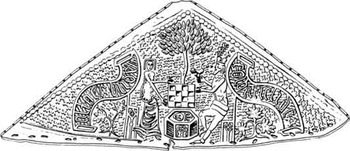
Even though depictions of a bearded Tristan are exceedingly rare, there are several examples within a group of leather fragments of so-called Tristan slippers, which are dated to the period 1370–1450 and have been found in the Dutch and Belgian towns of Dordrecht, Mecheln, Valkenisse, Nieuwland and Leiden (fig 8).Footnote 40 Each of the scenes imprinted on the leather shows a combination of chess game and orchard scene: a male and a female figure sit beneath a tree next to a kind of fountain basin, a chessboard between them, and a reflection of Mark’s head can be seen in the water.Footnote 41 This combination, reinforced by inscriptions in some cases, allows the identification of the two seated figures as Tristan and Isolde.
Drawing of a slipper fragment of cow leather found in Leiden: from Sarfatij Reference Sarfatij1984, 385, fig 4

Just as on the slipper fragments, the Tristan figure in the orchard scene on a sculpted console from the town hall in Bruges (1376–87) wears a beard.Footnote 42 While figures of a bearded Tristan occasionally occur in other regions as well,Footnote 43 there is another iconographic detail on the V&A casket, not found in the Eilhart version, that may indicate an origin in the Low Countries. As far as the gestures of the figures can still be discerned, it is Isolde who makes Tristan aware of Mark’s presence by pointing to the pool. The only surviving text that can be connected with this detail consists in the verses on Tristan in the poem Der Minnen Loep, written by Dirc Potter in 1411–12.Footnote 44 It is assumed that Potter relied on an older Tristan version that is unknown today or followed already existing iconographic formulae.Footnote 45 The characteristic motif in this text, namely that Isolde directs Tristan’s attention to alleged fishes in the water, is, at any rate, already found in an inscription accompanying a wall painting in St Floret (Auvergne), dated to 1350.Footnote 46 A slipper fragment from Mechelen (modern Belgium)Footnote 47 is one of the few pictorial sources from the first half of the fifteenth century in which text scrolls refer to the fish motif.Footnote 48
The origin of the casket cannot be limited beyond doubt to the Netherlands (nideren lande), but the likelihood of French influence in this region supports the possibility of a Netherlandish origin. What would an attribution to the Netherlands mean for the reception of Eilhart’s poem? It is not certain that the poem was known in the Netherlands. It is possible that the detail of Mark threatening the dwarf with his sword while sitting in the treetop was developed independently of Eilhart’s text, just as appears to have happened in a German Tristan tapestry of the period,Footnote 49 but the casket-lid scene agrees overall so precisely with Eilhart’s version that a connection is very likely.Footnote 50 Then the casket would combine elements of different Tristan versions known today (just as Tristan tapestries from Lower Saxony and middle Germany do),Footnote 51 for in Eilhart (as in Gottfried of Strasbourg) it is Tristan who warns Isolde by his behaviour. That Eilhart’s text met with reception in the Netherlands, where hardly any genuine Tristan poems seem to have been composed,Footnote 52 must remain a hypothesis. But that Eilhart’s poem became known there via the region of modern Lower Saxony, where illustrated tapestries suggest knowledge of Eilhart’s text, is possible.Footnote 53 In any case, the casket is more than a mere document of the reception of a text, since the orchard scene on the lid is presented within the context of the scenes on the front, back and sides.
The Iconographic Context Of The Lid Scene
The scenes on the side panels of the casket cannot be directly related to the Tristan story. The assemblage of figures on the front panel is hard to interpret, particularly since the loss of hands renders the meaning of their gestures uncertain. It is not even clear whether the lady and the wild man are meant to interact, though their bodies face each other, or whether each compartmentalized scene was intended to be read in isolation. The wild man, well groomed and perhaps originally holding a hawk, is shown sitting calmly cross-legged like his courtly, chess-playing counterpart on the back panel.Footnote 54 It is not the ungoverned sexuality or the ‘brutish, contentious nature’Footnote 55 of the wild man that is being demonstrated, but rather the overcoming of his innate savagery, perhaps through the ennobling effects of love for a lady.Footnote 56 If the lady and the wild man are linked, then the lady’s turning backwards could be interpreted as a turning away from the ‘wild’ man towards a more courtly suitor, recalling the choice of a lady between knight and wild man,Footnote 57 with the lady in this case choosing the courtly gentleman and perhaps holding one of the conventional attributes of a lady in a love scene. Since, however, the male figure in courtly dress has not been depicted in full, is smaller than the other two figures and is dressed rather simply, he might be an attendant rather than a lover. If the lady and the wild man are directly linked by interaction, then they may be read as epitomes of two conventional types, the lovely lady and the wild man tamed by the ‘presence’ of a noble lady. The lions clearly do not belong to the human figures, as they look out of the composition and towards the viewer. They can be interpreted as guardians of the lock and therefore of the contents of the casket.
Hunting scenes like those on the side panels were often used as images of male wooing for a lady and are not unusual on Minnekästchen.Footnote 58 The left panel depicts a canonical hunting scene.Footnote 59 In comparison with similar hunting scenes it is remarkable that a hind (and not a stag) is being hunted – whereby the aspect of wooing is particularly highlightedFootnote 60 – and that the leading hunter is on foot.Footnote 61 The hunting scene on the right side of the casket is less conventional. That bears were killed with spears by hunters on foot towards the end of the chase is described, for instance, in the Livre de la Chasse by Gaston Phoebus (ch 8). However, this text emphatically warns of the dangers caused by wounded bears;Footnote 62 it is therefore virtually unthinkable to approach a bear alone. Here the hunter even grabs the bear’s jaws, only protected by a cloth of the same gold colour as his doublet.Footnote 63 Hence the hunting scene is less connected with actual hunting conventions than with the tradition of heroic single combat between man and beast.Footnote 64 The bear hunt on the casket is obviously meant to be a demonstration of male courage,Footnote 65 witnessed by the lady on horseback.
The female figure takes on an active role in another scene with a couple in the broad, central compartment of the back panel, which shows a game of chess between a lady and a man, another conventional erotic encounter.Footnote 66 The two accompanying figures endow the erotic chess game with a courtly, official character, rather than suggesting a bucolic dalliance.
As the chess scene is located in the open countryside, with rocky ground and trees above, it corresponds with the other scenes, but the figures cannot be identified with those in the other scenes, since the beardless male chess-player’s dress is significantly more elaborate than that of the male figures on the side and front panels; in particular he wears a dagged, tailed hood.Footnote 67 His elegant sitting pose is typical of chess scenes.Footnote 68 What is significant in this scene is that only the lady is actively involved in the game. She seems to be taking the game, reaching exactly into the centre of the board,Footnote 69 while he holds something (now missing) in front of him, probably a love token, maybe even his heart.
In view of the Tristan slippers, on which chess game and orchard scene have been connected, one might be inclined to identify the couple playing chess as Tristan and Isolde; the assistants could then be interpreted as his tutor Governal and her attendant Brangwain.Footnote 70 However, the male figure at the chessboard lacks the forked beard and the dagged hood and hem by which he could be recognized as another depiction of the Tristan on the lid. The same is true for the hunting scenes. Even if Tristan’s hunting abilities are not stressed in all Tristan versions to the same extent as they are in the one by Gottfried of Strasbourg (for example, vv 2757–3376), one could imagine him hunting deer or being engaged in a heroic fight with a bear, accompanied by Isolde.Footnote 71 However, if such an identification of the figures had been intended, one would expect clearer pictorial signals. Consequently, the connection between the scene on the lid and those on the side panels is more likely to be found on a more general level.
If the V&A wooden casket is compared with French ivory caskets depicting the orchard scene or with the Regensburg medallion embroidery with minne scenes (c 1370), it becomes evident that the orchard scene on the casket is not combined with other scenes of women’s tricks – as a warning, principally to male viewers, against female wiles.Footnote 72 Instead, the sides depict scenes of decent courtly wooing; even the wild man appears to be tamed or self-governed.Footnote 73 In this context, the orchard scene could be interpreted as an example of good love (as later in Dirc Potter’s version), which has to be protected and cultivated against the potential opposition of ill-willing authority figures/guardians.Footnote 74 The open punishment of the dwarf would then – beyond the probable connection with Eilhart’s text – have to be understood as a defence of this good love, and perhaps as a comic moment to be enjoyed alongside the vindication of the lovers’ caution in the way they express their love.
The casket as a Minnekästchen
The V&A casket was clearly a luxury object, designed and executed to present a coherent appearance, and intended to hold and protect items of value, even if it was not constructed using intrinsically precious materials (other than gold leaf). In recent studies it has been argued that small caskets with love scenes were given as presents marking noble betrothals, and that some contemporaries (at least) would have understood that a casket could be read as a metaphor for the female body.Footnote 75 It has been suggested that such caskets would have been specifically commissioned by prospective husbands at the point at which the marriage was arranged, to contain smaller valuables, such as combs or chaplets, and to express their financial and erotic commitment to their brides, although written and pictorial evidence for such usage is scarce.Footnote 76 Ivory caskets are listed in medieval French inventories and wills of both noblewomen and noblemen.Footnote 77 While the decoration of the caskets is, in most cases, not mentioned in the sources, they are said to have been used for jewels and other small items.Footnote 78
This is confirmed by Gottfried’s Tristan as an early literary ‘source’. Having arrived in Ireland, Tristan defeats the dragon threatening the country; afterwards he has sent to him from the ship not only his clothes but also a cleinen schrîn (a ‘little chest’) (vv 10763–4) with small items. Tristan takes a head ornament, a girdle and a little fibula out of the casket for himself, selects girdles for Isolde, her mother and the attendant Brangwain and finally presents the casket, filled with head ornaments, fibulae, little bags and rings, to the three ladies as a gift (vv 10820–42). There is no reference to a particular decoration of the casket, but it is explicitly mentioned as part of the gift (v 10840).
Whether the wooden V&A casket originally was a love present can no longer be determined. The iconography of the casket as a whole seems to present positive images of heroism, courtly passion and self-restraint. Both male and female figures participate actively in love games. And the scenes on the casket illustrate the correct (courtly) behaviour of the two sexes.Footnote 79 This is also true for the lid scene, since it alludes to the betrayal of Mark, but gives no hint of unbridled, instinctive love. Tristan and Isolde’s passion, although variously presented, for example, as illness or as ideal love, is sanctioned – at least on the superficial level of the narrative: the magic potion that causes them to fall in love releases them from the conventional obligation to respect matrimony. What may be inferred from the lid scene is that coded signals between lovers were a legitimate way to express their true feelings and nurture their relationship. Similarly, the casket itself may be the bearer of a coded language between lovers, which can no longer fully be decoded. Even if the casket was used as a gift given in public, a sense of privacy and secrecy could be maintained through its decoration, the language of love, and through the privileged access provided by a lockable box.
Conclusion
The iconographic scheme of the casket under discussion, integrated through carving and colour, unites elements from different versions of the Tristan story with more conventional, accumulated scenes of the pursuit of love and erotic negotiation. This analysis suggests tentatively that the casket may have originated in the Netherlands about 1350–70, rather than in England or France, as traditionally thought. However, without analogous, securely provenanced woodwork, such an attribution should remain cautious.
Acknowledgements
Both authors would like to thank for their advice and comments the following V&A staff: Nicola Costaras, Norbert Jopek, Susan North, Helen Persson, Paul Williamson and Sophia Wills. Nick Humphrey would like to thank Anne von Baeyer for generous help with translation. A shorter version of this article was published in German in the Zeitschrift für deutsche Literatur 128 (2009, 107–24). The authors are grateful for the permission of that journal’s editors to reuse some of the material here.
BIBLIOGRAPHY
- Manuscript sources
- Gotha, Forschungsbibliothek, Memb I 90
- Heidelberg, Universitätsbibliothek, Cpg 848
- Krakau, Bibl Jagiellońska, Berol mgq 1418
- London, BL, Egerton ms 1146
- London, BL, Royal ms 19 C
- Munich, Bayerische Staatsbibliothek, Cgm 51
- Oxford, Bodleian Library, ms Bodl 264
- Paris, Bibliothèque nationale de France, ms fr 1586