On 19 May 1921 the US government enacted the Emergency Quota Act, a law that introduced national immigration quotas. Passed with overwhelming bipartisan support, the Quota Act was at once the apex of four decades of legislative efforts to restrict US immigration, and the beginning of a new era of ‘mobility regulation’ in which exemption shifted from the exception to the norm.Footnote 1 From 3 June that year, each sending nation was allocated an annual immigration quota equal to 3% of foreign-born from that country listed in the 1910 US census. As a result, immigration dropped from 805,228 to 309,556 per annum, and the ‘presumption of open borders became a presumption of closed ones’.Footnote 2 Although the Act was framed as a temporary stopgap, Congress later voted to extend the 1921 legislation, and the quotas remained in place until they were tightened and made permanent by the Immigration Act of 1924. Further restrictions followed in 1929, when the quotas were recalculated to reflect the ‘national origins’ of the US population in 1920. The quota system ultimately persisted until 1965.Footnote 3
As was typical of white settler immigration policy, these restrictions hinged on ideas about race. In particular, the US quotas represented a nativist backlash to the preceding influx of racialized migrants from south-east Europe who, since the 1890s, had represented the majority of transatlantic migrants. Known as the ‘new immigration’, these arrivals were demonized as ‘undesirables’ of ‘inferior racial value’ who compared unfavourably to the ‘old immigration’ from Scandinavia, Germany, and Britain. During the 1900s and 1910s, a coalition of restrictionist forces warned that the ‘new immigration’ endangered the hegemony of ‘native Americans of British descent’.Footnote 4 The quotas sought to reverse these demographic trends by favouring immigration from the ‘Nordic’ parts of Europe. Although each nation received the same 3% quota, the decision to use the 1910 census as the baseline ensured that north-west Europe would receive 55% of quotas, whereas south-east Europe was allocated 45%. This bias grew more acute in 1924, when the baseline was shifted back to 1890, a formula that allocated south-east Europe only 15% of total allotments. The 1921 and 1924 acts were hence triumphs of ‘racial nationalism’ intended to preserve the imagined ‘white’ or ‘Anglo-Saxon’ character of the United States.Footnote 5 Alongside earlier anti-Asian restrictions such as the Asiatic Exclusion Zone, the quota laws sought to make the United States a nation of ‘Nordic blood’ akin to Australia and New Zealand.Footnote 6 As Senator James D. Phelan proclaimed in 1919, ‘our business is to build up, as the Australians are so gallantly trying to do, a white man’s country’.Footnote 7
Yet the US quotas also restricted entry to white British subjects – even the ‘gallant’ Australians that Phelan so admired. As members of ‘the same sterling stock’ as America’s ‘original settlers’, white Britons were among the most ‘desirable’ immigrants.Footnote 8 But this desirability did not exempt them from the new restrictions, which carried the pretence of being colour-blind. Like the literacy tests employed throughout the white settler world, the quotas were a ‘raceless’ exclusionary mechanism that ‘restrict[ed] particular populations without actually naming them’.Footnote 9 Through the use of statistical science and mathematical formulae, the 1921 and 1924 acts created the veneer of equitable treatment. In keeping with this ostensible even-handedness, both laws extended to the ‘white’ nations of Britain, Australia, New Zealand, and South Africa. Each was assigned annual quotas – using the standard formulae – from 1921 onwards. In the case of the Dominions, this number-crunching produced quotas that were conspicuously meagre. Owing to their small settler populations and under-representation in US census data (as colonial Britons in the US were apt to record their nationality as ‘English’), the Dominions’ quotas were among the lowest assigned. In 1921, the Italian quota came to 42,057, while the German quota numbered 62,607. Australia, by contrast, was allocated a mere 279 quota places. New Zealand fared even worse, with only 80 places. By 1929, Australia, New Zealand, and South Africa were each allocated the bare minimum of 100 quota places. Of the British settler colonies, only Canada was exempt from the restrictions, as quotas were not applied to any nation in the western hemisphere.
Britain’s quota was far greater, ranging between 77,342 and 34,007. As part of the north-west European bloc favoured by the quotas, Britain was an ostensible winner under the new system. Yet even this comparatively generous quota was not always sufficient to meet demand, and metropolitan Britons would likewise face exclusion. Britain was also heavily invested in the low quotas assigned to the Dominions, as white Australians, New Zealanders, and South Africans remained British subjects legally indistinguishable from Englishmen and women. Although US immigration law used the category of ‘nation’ to map stark distinctions between white Britons, the empire itself had little conception of stable and unitary national identifications. Despite the emergence of colonial nationalisms and the shift towards Dominion status, white colonials continued to be regarded – and to regard themselves – as first and foremost British subjects. The meagre Dominion quotas were therefore, for both legal and affective reasons, a problem for London as much as for Melbourne, Wellington, or Cape Town.
The following article takes up this history of white immigration restriction, and considers the impact of the US quotas on Anglo-American relations. By focusing on the Australian case during the 1920s, I explore how forms of mobility regulation intended to preserve the US’s Anglo-Saxon credentials also exposed fault-lines in Anglospheric kinship by restricting entry and assigning illegal alienage to white British subjects. In doing so, the article takes up the challenge posed by Alison Bashford to ‘expand the scope of immigration histories’ beyond their traditional focus on white settler exclusion of ‘coloured aliens’.Footnote 10 Like Bashford herself, I venture into the little-known terrain of white exclusion, and thereby map a counter-cartography of transnational immigration history that couples the United States and the Dominions as antagonists rather than co-conspirators, and rewrites Britain into the story.Footnote 11 By weaving together archival records from Australia, Britain, and the United States, I map how Australians’ skirmishes with US border control had ripple effects that extended to Melbourne, Washington, Vancouver, London, and beyond. As telegrams and letters darted across the world’s oceans, the Dominions, Britain, and the US were brought into a triangulated relationship in which global power and allegiances were indexed and remade.
As such, this article is a study of ‘migration diplomacy’ situated within an emerging literature that entangles the formerly divergent histories of immigration and international relations to consider what Paul Kramer terms the ‘geopolitics of mobility’.Footnote 12 Although recent years have seen a proliferation of research at this juncture – especially within the United States – existing studies have been limited to the racialized nations that were the conscious target of immigration restriction. Like the broader field of US migration history, this newly internationalized immigration scholarship concentrates on China, Japan, Mexico, and eastern Europe.Footnote 13 The following discussion, then, is the first to consider the immigration–diplomacy nexus as it pertains to relations between ‘white man’s countries’. Just as US migration policy reshaped and often strained relations with China and Mexico, so too did it throw cold water on the newfound ‘special relationship’ with Britain and its Dominions.Footnote 14
This argument constitutes a departure from recent transnational histories of whiteness, which posit immigration restriction as a crucible of Anglo-American fraternity and common purpose. In Marilyn Lake and Henry Reynolds’ influential Drawing the global colour line (2008), the 1924 Immigration Act is depicted as the climax of a half-century of white kinship. The book narrates how, over the five decades from the 1880s, elites from the United States and the British empire worked in concert to develop an imagined community of white men structured around the celebration of Anglo-Saxon heritage and antipathy towards the so-called ‘rising tide of color’. During this era of fervent Anglo-Saxonism, white intellectuals and politicians exchanged theories and legislative experiments, and some even dreamed of political union.Footnote 15 Race solidarity also underpinned what Stuart Anderson famously identified as an Anglo-American diplomatic ‘rapprochement’.Footnote 16 By 1921, this discourse of racial kinship was encrusted with an authority that was taken for truth. ‘[W]e and the British are Anglo-Saxons’ was axiomatic within US Congress.Footnote 17
In Lake and Reynolds’ telling, America’s interwar embrace of immigration restriction was the ultimate expression of this shared racial and political agenda. By instituting national origin quotas and excluding Asian migrants, the United States raised its own version of the ‘great white walls’ already erected by British settler colonies, and committed the white man’s world to a common fantasy of Anglo-Saxon dominion.Footnote 18 Subsequent research by Kornel Chang, Mae Ngai, and the late Adam McKeown has echoed this characterization of US immigration restriction as part and parcel of a larger politics of ‘transnational white solidarity’.Footnote 19 More recently, David Atkinson has modified this vision, producing a revisionist study that emphasizes the ‘divisiveness’ of Anglo-American efforts at immigration restriction, and shows that transnational white collaboration ‘was more often aspirational than real’.Footnote 20 Yet for all that Atkinson’s work stresses disunity and divergence, the focus remains on the analogous and contemporaneous efforts to exclude racialized ‘undesirables’ from self-identified white national spaces.
As the following discussion reveals, the US quota laws also jeopardized the liberty and status of white migrants. From their exalted position as America’s ‘blood brothers’, Britons now found themselves reduced to foreign – and potentially illegal – ‘aliens’ with no guarantee of entry into the United States. From 1921 onwards, white men and women from around the empire would be excluded, detained, and deported for no crime other than exceeding their assigned national quota. In one sense, this strict national gatekeeping was not inconsistent with the larger politics of whiteness. As Lake and Reynolds write, ‘the project of whiteness was a paradoxical politics, at once transnational in its inspirations and identifications, but nationalist in its methods and goals’.Footnote 21 But Britons themselves thought otherwise. Both at the US border and at home, Australians’ and other white Britons’ newfound restricted entry was interpreted as a betrayal of the fraternity and reciprocity otherwise believed to characterize the white man’s world. Embedded within this history of restriction and resentment are thus two competing understandings of white race solidarity. Whereas US legislators born of a republican tradition prioritized national self-interest, white Britons habituated to an imperial model of open borders and supranational identifications expected that white kinship and privilege should trump state-based gatekeeping. As these conflicting visions of the white man’s world went head to head, both popular anger and diplomatic tensions burned bright.
To foreground this history of white restriction is not to deny that US immigration law was above all a tool of racial demarcation, primarily weaponized against aliens of colour. It is these peoples – not white Britons – whose exclusion, detention, and deportation merits greatest remembrance and understanding. But there are nonetheless at least four reasons why a close study of Britons’ restricted entry yields historical insight. First, this research refines understanding of the transnational politics of whiteness by complicating existing narratives of white fraternity and common interest – narratives that have focused on the pre-1920 decades. A study of US mobility regulation suggests that, from 1921, ideas of ‘blood brotherhood’ were brought into question by the quota laws, as both Britons and Americans struggled to reconcile transnational racial identifications with the uncompromising legal and administrative realities of national immigration restriction. Second, the US’s restriction and perceived mistreatment of white Britons would develop into a significant but little studied source of Anglo-American friction that indexed the growth of US global power. The highest levels of government in London and Washington were concerned with this issue, which proved an intractable thorn in the relationship between these twin pillars of the English-speaking world.Footnote 22 Third, the story of white Britons’ interactions with US immigration policy provides a rare ‘social history’ of the quota laws that highlights their complexity, uneven application, and unpredictable effects. In a similar vein to Libby Garland’s study of Jewish illegal immigration, this article provides a corrective to a historiography weighted towards law-making by using archives of ‘people’s actual experience’ to illuminate ‘what the laws meant in real life’.Footnote 23 And finally, the introduction and administration of the quotas would shape the trajectory and internal dynamics of the British empire itself. On the one hand, the national origin quotas brought greater salience to questions of national identification at a time when Australians, New Zealanders, and South Africans were still British subjects. On the other hand, the newly barricaded US border kept the Dominions oriented towards the ‘mother country’, and united colonial and metropolitan Britons against a common foe. In sum, the US restriction of white Britons represents a notable and hitherto disregarded chapter in the histories of whiteness, Anglo-American relations, immigration restriction, and the British empire.
From brotherhood to alienage
As a pair of Anglophone settler colonies on the Pacific Rim, Australia and the United States were long regarded as sibling societies. When gold was discovered in California, and then in eastern Australia, waves of fortune-hunters began to traverse the Pacific. In their wake, shared fears of Chinese migration emerged.Footnote 24 These gold-rush connections gave impetus to new maritime arteries. Following the completion of the US transcontinental railroad in 1869, shipping companies vied to establish a transpacific mail and trade route. As Frances Steel has documented, regular steamship services between Sydney and San Francisco commenced in 1875, a development that prompted Australia to ‘imagine and situate itself in a transpacific sphere’.Footnote 25 During the 1880s and 1890s, a new transpacific imaginary manifested in the growth of tourism, the proliferation of literary conversations, and the thickening of economic ties.
These fraternal visions continued into the twentieth century, when they were increasingly expressed in terms of race. Although divergent histories and demographics ensured that ‘whiteness’ had different valences on either side of the Pacific, the mutual pursuit of white supremacy nonetheless came to underpin a halcyon era of Australian–US kinship.Footnote 26 Marilyn Lake has traced the friendships and exchanges between Progressive-era intellectuals such as the Australian Prime Minister Alfred Deakin and the Harvard philosopher Josiah Royce, and identifies a discourse of transpacific ‘blood brotherhood’ that emerged during the Spanish–American War.Footnote 27 In 1908, when the US naval fleet – known as the Great White Fleet – made a celebrated visit to Australian waters, this racial alliance was consummated in the eyes of the world.Footnote 28 Over the next decade, the export of American mass culture – especially Hollywood films – and the military alliance of the First World War gave the United States even greater prominence in Australian society. Transpacific trade expanded in step. Australian exports to the US increased sevenfold during the 1910s, and US imports more than tripled.Footnote 29 And while wartime anti-German sentiment compromised Anglo-Saxon discourse (the Germans also being ostensible Anglo-Saxons), both Australians and Americans continued to speak of a transpacific bond that was at heart a matter of blood.Footnote 30 ‘Blood brothers: Aussies and Yanks’ was an oft-repeated refrain.Footnote 31
This brotherhood would be sorely tested by the immigration quotas introduced in 1921. Prior to this date, the US largely welcomed white Britons, who then constituted 98% of Australia’s non-indigenous population.Footnote 32 With its borders barricaded by the bipartisan White Australia policy (1901–73), Australia had retained the predominantly ‘white’ and ethnically British character it had cultivated since colonization began in 1788. These Australian Britons enjoyed untrammelled mobility within the still-vast British empire, and also had similar privileges across the Pacific. Just as Australia welcomed white Americans as ideal immigrants, so too did the United States extend a warm greeting to Anglo-Australians. Apart from the diseased, the destitute, and contract labourers, all were free to sojourn or settle in the US. Growing numbers did so each year. In a nation of ‘unsettled settlers’ distinguished by a ‘fetish for mobility’, overseas adventures were a celebrated and relatively democratized rite of passage.Footnote 33 Although Australian departures for the US would long be overshadowed by the ‘secular pilgrimage’ to London, they nonetheless surged during the first two decades of the century.Footnote 34 Between 1900 and 1920, annual Australian and New Zealand arrivals in the States climbed from 500 to nearly 6,000. By 1920, when the total Australian population was under 2.7 million, there were 11,000 Australians resident in the United States.Footnote 35
The Emergency Quota Act brought this age of open borders to an abrupt close. The US decision to adopt quotas as an exclusionary mechanism emerged in response to the failure of a literacy test to achieve the desired diminution in ‘undesirable’ immigration. First developed in 1890 to disenfranchise black voters in Mississippi, and later adopted in Natal (1897), Australia (1901), and Canada (1919), the literacy test was a ‘raceless’ means of race-based exclusion that American restrictionists were likewise determined to implement in the States.Footnote 36 Although attempts in 1896 and 1907 to legislate for a literacy test both came to naught, the concept was given newfound legitimacy by the 1911 Dillingham Report. The result of a multi-year government investigation into the ‘changed character’ of US immigration, this forty-two-volume report both demonized ‘new immigration’ and recommended exclusionary policies structured around a literacy test that would exploit the high rates of illiteracy among ‘undesirables’.Footnote 37 Six years later, the 1917 Immigration Act made this proposal a reality. But increased literacy rates among migrants rendered the 1917 test less effective than hoped, necessitating additional restrictive measures.Footnote 38 After a failed 1920 congressional attempt to ban immigration altogether, US legislators reached a compromise by adopting a second Dillingham recommendation: immigration quotas. To ensure the exclusion of ‘undesirables’, the report had proposed the ‘limitation of the number of each race arriving each year to a certain percentage of the average of that race arriving during the given period of years’.Footnote 39 In May 1921 a version of this idea that swapped out ‘race’ for ‘nation’ was passed with overwhelming bicameral support.
Whereas the 1917 literacy test had presented little challenge to Anglophone white Australians, the new quota system placed immediate constraints on their right of entry. From 3 June 1921, Australia was allotted an annual quota of 279 persons, with a monthly limit of 56. Special provision was made for actors, artists, singers, lecturers, religious ministers, domestic servants, and ‘aliens belonging to any recognized profession’. Arrivals from these categories were counted against the quota, but were still admissible once the quota was exhausted. All other arrivals received a non-renewable six-month visa, and were prohibited from remunerative employment. Crucially, arrivals’ nationality was determined by ‘country of birth’. Although interwar Australians remained British subjects who travelled on British passports (Australian citizenship was not created until 1948), they could only enter the US under the Australian quota. Britain’s more generous quota was reserved for Britons born in England, Wales, Scotland, and Ireland (later modified to Northern Ireland). The ‘country of birth’ principle also ensured that Britons born in Australia but long resident elsewhere were counted against the Australian quota. Yet the birthplace test only held true for white Australians. For Australian-born Britons with Chinese heritage, race usurped national and imperial identifications. As members of the ‘Chinese race’, they were subject to the 1882 and 1888 Chinese exclusion laws, which dictated that only elite Chinese could enter the US. Through this prejudicial treatment of Chinese Australians, the racial logic that underpinned the ‘national’ quotas was starkly exposed.
When the quotas were first announced, the Australian response was muted. There was approval of this US move to emulate the exclusionary spirit of White Australia, accompanied by some concern that ‘undesirables’ henceforth excluded from the States might flood Australian shores.Footnote 40 Yet there was little disquiet about the quotas’ potential effect on Australians themselves. Given the low numbers of permanent US-bound migrants, and the unlimited supply of short-term US visas, officials assumed that the quotas would not ‘be of any detriment to Australians’. In fact, the federal government under Billy Hughes initially welcomed the Emergency Quota Act as a force that promised to redirect British migratory flows towards Australia’s ‘vast empty spaces’. With Hughes desperate to boost the Dominion’s white population, Australian immigration – not emigration – was the focus of his concern.Footnote 41
Events at the US border soon put paid to this nonchalance. Once the quotas came into effect, the new restrictions were felt and resented by Australian travellers no less than migrants. These unforeseen difficulties had several causes. The first was the six-month limit on non-migrant visas. Given the time and expense of transpacific travel, interwar Australians often desired to linger in the US longer than six months. Businessmen fostering trade relationships, travellers visiting American family, and even sight-seeing tourists all regularly arrived with itineraries stretching to a year or more. These travellers had no plans to settle in the States, but nonetheless found themselves designated ‘migrants’ and counted against the quota. The six-month limit also bedevilled students, hundreds of whom arrived from Australia each year.Footnote 42 The Emergency Quota Act made no provision for international students, yet such visitors were invariably enrolled in multi-year courses. In the absence of a student visa category, visiting Australian students were remade as ‘quota migrants’.Footnote 43 Migrant status could likewise be assigned to any arrival whose vague plans or questionable finances raised suspicions among immigration officials. Whenever unable to establish their bona fides, such self-described ‘travellers’ faced a Board of Special Inquiry. If the three-person board deemed them likely to seek work or assume residency, they were categorized as a quota entrant. In practice, this was a common occurrence. With passport control an innovation dating from the First World War, interwar Australians were little habituated to the strictures of mobility regulation. Even prosperous tourists with no illicit intent were apt to arrive without documentary evidence sufficient to prove their visitor status. As a result, Australians and other Britons found themselves flailing before a sceptical board owing to simple oversight or misinformation.
With such non-migrant travellers claiming quota places, the monthly and yearly limits were rapidly exhausted. In 1921–22 and 1922–23, the Australian quota was reached within six months, and it was a rare month that ended with places still available.Footnote 44 Once the limit had been reached, any further quota arrivals were debarred at the border. Until 1924, quota places could not be secured in advance, but were filled on a first-come, first-served basis as arrivals disembarked. This meant that boarding a steamer to the United States was an expensive lottery. With a three-week voyage separating eastern Australia from California, there was no failsafe means to predict whether the quota would be open upon arrival. Each month witnessed a race to the border as Australians competed to claim the fifty-six slots available.Footnote 45 And, much to the chagrin of Australian-based travellers, their compatriots sailing from Southampton had a head start. With the transatlantic passage a mere six days, British-based ‘Australians’ arrived first and claimed the bulk of each month’s Australian quota.
Given the above, from July 1921 a steady stream of Australian quota entrants – both actual migrants and those classed as such – arrived in the States to find the border closed. Among transpacific travellers, this meant a stint at San Francisco’s Angel Island Immigration Station. Both men and women, ranging from youths to dowagers, would experience this fate. Even powerbrokers such as the Sydney multi-millionaire B. J. Higgins found themselves deprived of their liberty in prison-like surrounds. Amid a familiar landscape of eucalypts and sun-drenched waters, reminiscent of Sydney Harbour, detainees were cast into the jarring role of ‘aliens’. After three weeks at sea, they had returned to an Australian-like setting, only to discover that the very Australianness that set them at ease also rendered them illegal. For most, detention was as unexpected a fate as it was unwelcome: travellers did not yet fully comprehend the quota restrictions, and many arrived under the misapprehension that a consular-issued visa would guarantee entry.Footnote 46 Multi-day detentions were typical, and those who appealed to Washington could spend weeks awaiting a verdict. Detention conditions were notoriously insalubrious, with unpalatable food and dirty bedding. Driven to despair by these bleak environs, several Australians renamed the site ‘Devil’s Island’.Footnote 47
A similar situation developed at Ellis Island, the main point of arrival for transatlantic travellers. In January 1922, the Australian-born Nestor Watkins was ‘penned like an animal’ after sailing from Southampton. Her ‘imprisonment’ proved so traumatic that she suffered a ‘nervous breakdown’, and retreated to the care of a Harley Street specialist in London.Footnote 48 The following month, ten Australians were refused entry, increasing to thirteen in March and twenty-one in April.Footnote 49 Australians also faced exclusion at other ports of entry, most notably Vancouver, where steamers arriving from Sydney were greeted by US immigration officers with extraterritorial powers. Under the 1894 Canadian Agreement, designed to combat ‘Asiatic’ border crossings, the US Immigration Bureau processed US-bound aliens upon arrival in Canadian ports.Footnote 50 For Australians, this too often meant the unwelcome news that the quota was exhausted, as occurred in March 1922 when twenty-five passengers from the Niagara were refused admittance.Footnote 51
Even Australians lucky enough to gain entrance still encountered delays, as each migrant’s admittance was dependent upon confirmation from Washington that quota places were still available.Footnote 52 In the age of telegraph communication, this process could take multiple days, during which time arrivals languished aboard steamers transformed into ‘vessels of confinement’.Footnote 53 When the Niagara arrived in Vancouver on 4 July 1921, several hundred passengers waited three full days while officials worked ‘to secure an allotment by wire’.Footnote 54 The following September, nine Australians were suspended in Seattle for four days, only to learn that the quota was full and the border closed.Footnote 55 In such cases, debarred aliens were not permitted to wait and reapply under the next month’s allotment. Instead they must return home and set out anew – an expensive and time-consuming process, with no guarantee of success.
‘Vile treatment’ and ‘bad blood’
As such border difficulties proliferated, the Australian public began to grasp the full significance of the quota law. This dawning comprehension came at a moment when US border detention was already a sensitive topic in Australia, owing to the fatal illness contracted by the Sydney youth Ormonde McDermott at Ellis Island back in March 1921.Footnote 56 Amid the high dudgeon whipped up by McDermott’s demise, Australians were quick to condemn the emerging tide of quota-based exclusions. Newspapers published lurid accounts of detention conditions, and editorialized that the meagre quota would undermine transpacific trade and goodwill. From the respectable metropolitan dailies to the sensationalist scandal-sheets, Australians encountered headlines decrying ‘America’s barred door’, ‘Vile treatment at ‘Frisco’ and ‘Australian’s shocking treatment by United States authorities’.Footnote 57
Australians were also conscious that this was an empire-wide issue, with their rising sense of grievance stoked by similar tales of hardship from New Zealanders, South Africans, and metropolitan Britons. Conspicuous among these was the July 1921 detention of the Glanvills, a white family headed by the Cape Town YMCA secretary Mark Glanvill. When the Glanvills arrived in New York to find the South African quota full, their delicate sensibilities were tested by four days in Ellis Island’s ‘cells’. Following the family’s subsequent deportation, Glanvill mobilized his extensive international connections to publicize this ‘cruel, revolting and humiliating’ ordeal – which had reportedly driven his wife to the brink of suicide.Footnote 58 With such news in circulation, Australians came to view their own border difficulties within an imperial frame. The quota question was imagined as a frontline in Anglo-American relations, with Britons cast as ‘innocent victims’ who had fallen victim to punitive American justice.Footnote 59
As resentment mounted at home, the New York-based Australian commissioner, (Sir) Mark Sheldon, began to voice official misgivings. The two nations would not exchange ambassadors until 1939, so Sheldon was then the only Australian government representative in the United States. Although his prescribed duties were commercial rather than diplomatic, the Commissioner’s Manhattan headquarters put him at the coalface of the quota controversy, and he took it upon himself to remedy the situation. From late 1921, Sheldon was in regular communication with the Immigration Bureau (situated within the Department of Labor), and made multiple trips to Washington, DC to press his case. In early 1922, he pinned his hopes on a mooted legislative amendment to raise the minimum national quota to 1,200 – a plan that would most benefit the Dominions.Footnote 60 But this was not to be. Although endorsed by the Labor Secretary James Davis and the restrictionist Congressman Albert Johnson, the proposal was abandoned owing to concerns that preferential treatment for ‘desirable’ migrants would prompt charges of ‘discrimination’.Footnote 61
In July 1922, these simmering tensions escalated when news of a further quota detention case reach Australia. Reginald Reynolds was an Australian-born and South African-based aspiring missionary with plans to study at the Moody Bible Institute in Chicago. But when his steamer docked at New York, this man of faith was held in an overcrowded Ellis Island dormitory with ‘doors and windows barred’. He was served dry bread for dinner, slept in soiled clothes, and awoke covered in flea bites.Footnote 62 As a prosperous white man accustomed to deference, Reynolds did not take this experience lightly. He sent word to family members in London, who complained to the US consul and the Australian high commissioner. Before long, a lurid first-person account of his ordeal was syndicated in newspapers across Australasia. ‘Here in New York we get treated like so many dogs’, Reynolds told his fellow Britons.Footnote 63 Within days, Reynolds’ case had catalysed diffuse grievance into widespread lobbying and activism. The quota question was taken up in the Australian parliament, and the federal government launched a formal investigation.Footnote 64 Over the following months, a coalition of travellers, business leaders, and the press began to seek remedy. Their demand was either an increased Australian quota or Australian access to the more generous British quota. To facilitate this outcome, many advocated sanctions: either equivalent restrictions on US immigration or punitive tariffs on US imports.
That same July, the quota system entered its second year, and US attitudes hardened. During the previous twelve months, foreign arrivals and border officials were both thrown by the new restrictions. Throughout the fiscal year 1921–22, the resulting climate of confusion had engendered considerable leniency. Notwithstanding the exclusion cases cited above, ‘desirable’ immigrants could – and did – slip under the radar. Even the Immigration Commissioner, W. W. Husband was complicit, instructing Vancouver officials in January 1922 that ‘Australia exhausted but please handle cases judiciously’.Footnote 65 But, during year two, the initial confusion abated, and a new hard-line attitude emerged. By August 1922, the Australian commissioner reported that officials had begun ‘rigidly administering Immigration Laws’.Footnote 66
Once the Australian quota was better enforced, new exclusion cases proliferated. Angel Island housed 6 Australians in August, 31 the following July, and more than 300 the year after.Footnote 67 As of July 1923, there were 266 ‘white persons’ in custody on the island.Footnote 68 But the most sensational case occurred in New York, where the Australian-born Blanche Cooper was separated from her English-born husband and infant daughter in August 1922. The latter were allowed to enter on the British quota, but Blanche was detained because the Australian quota was exhausted. She appealed to authorities in Washington, but to no avail. After several weeks in detention, Cooper returned to London, alone and ‘heart-broken’.Footnote 69 Thanks to her wounded Madonna persona, Cooper proved an ideal martyr for the anti-quota cause, and her story soon generated global headlines. For all its apparent conservatism, US immigration restriction was shown to menace the conservative ideal of motherhood. This was an upset that captured the sympathies of otherwise disinterested forces, making gender politics crucial to the quotas’ delegitimization. In the wake of the Cooper case, the New York Times published an ‘Australian protest against the hardships of the present quota system’, along with a letter that warned that the low quota threatened to foster ‘bad blood’ between Australia and the United States.Footnote 70
Blood was indeed at the heart of the matter. As the quota controversy heated up, questions of race came to the fore. The US failure to make special provision for white Australians was interpreted as a racial insult – an oversight that gave the lie to the rhetoric of blood brotherhood and reduced white people to the status of racial others. To add insult to injury, the new restrictions also constrained the white mobility that underpinned both white privilege and ‘the logic of settler colonialism’.Footnote 71 By enforcing quotas for the Dominions alongside ‘undesirable’ nations, the US undercut the ‘differential access to mobility’ that reflected and constituted racial hierarchies within the British empire.Footnote 72 In short, both white kinship and white pre-eminence were at stake. The US quotas were judged ‘reasonable enough so far as inferior races from Europe or Asia are concerned’, but their application to Australia was an ‘insulting stigma’.Footnote 73 As a US shipping agent reported from Sydney in January 1922, Australians now believed themselves to be ‘treated like Chinamen’ in the United States.Footnote 74
Racial anxieties were also key to the furore surrounding individual cases of detention. Whereas the quotas symbolically subsumed white Australians into the general pool of aliens, the conditions at Angel and Ellis Islands brought this fact to life. Through the mixing and indiscriminate treatment of differently raced bodies, the legal disregard for white privilege and kinship was made flesh. This was most conspicuous on the Pacific coast, the main screening point for Chinese arrivals. By 1924, they represented 85% of those seeking admission at Angel Island. When Australians were detained at San Francisco, they found themselves cohabiting with the ‘coolies’ otherwise kept at a distance by their own Immigration Restriction Act (1901). Detention facilities were theoretically segregated by race, but constant overcrowding made intermixing endemic.Footnote 75 ‘We were forced to eat with dirty foreigners, who lapped up food like dogs’, a Mrs Lowe reported. Her compatriot complained that a ‘Chinese baby’ died in her dormitory, and asked: ‘What have we done to be made to suffer in this way?’Footnote 76 The situation was similar up in Seattle, where the Sydney doctor H. Picton Clark was detained ‘among Chinese and blacks’.Footnote 77 Again, this was no isolated incident but systematic practice. As the Immigration Bureau acknowledged, ‘Oriental warrant cases are detained in the same quarters as white warrant cases.’Footnote 78
Chinese arrivals were fewer on the east coast, but crudely expressed racial anxieties also saturated Ellis Island reportage. Sydneysiders read of the ‘herding of decent white Australians with niggers’; Brisbane readers learned that ‘white women’ were detained among ‘Wops and Dagos and Chows’. Reginald Reynolds complained that enforced proximity to ‘Blacks, browns, yellows’ had ‘just about made me sick’.Footnote 79 Coming amid the heyday of White Australia, this forced association and implied equivalence of differently raced bodies represented an unsettling collapse of hierarchy and erasure of privilege that was evoked using the racially loaded language of dirt and defilement. Time and again, border detention was presented as a soiling experience, a literal and symbolic de-whitening that was as much a product of the dark skin of fellow inmates as the grime on the floors. Filth was even deemed inherent to non-white bodies: the most ‘unbearable’ aspect of Ellis Island was reportedly ‘the filthiness of the other racial groups’.Footnote 80 In this paradigm, to be proximate to such so-called ‘scum of the earth’ was to be dirtied in body and debased in spirit.Footnote 81 That white Australians could have their whiteness so despoiled by their ‘Yankee cousins’ was deemed a betrayal of the first order.Footnote 82
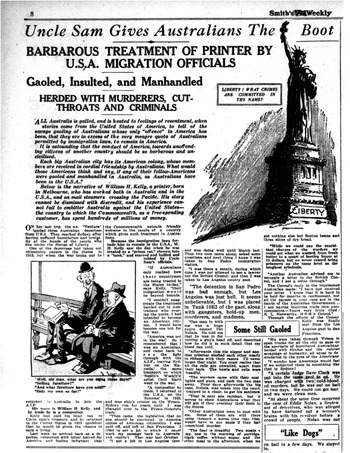
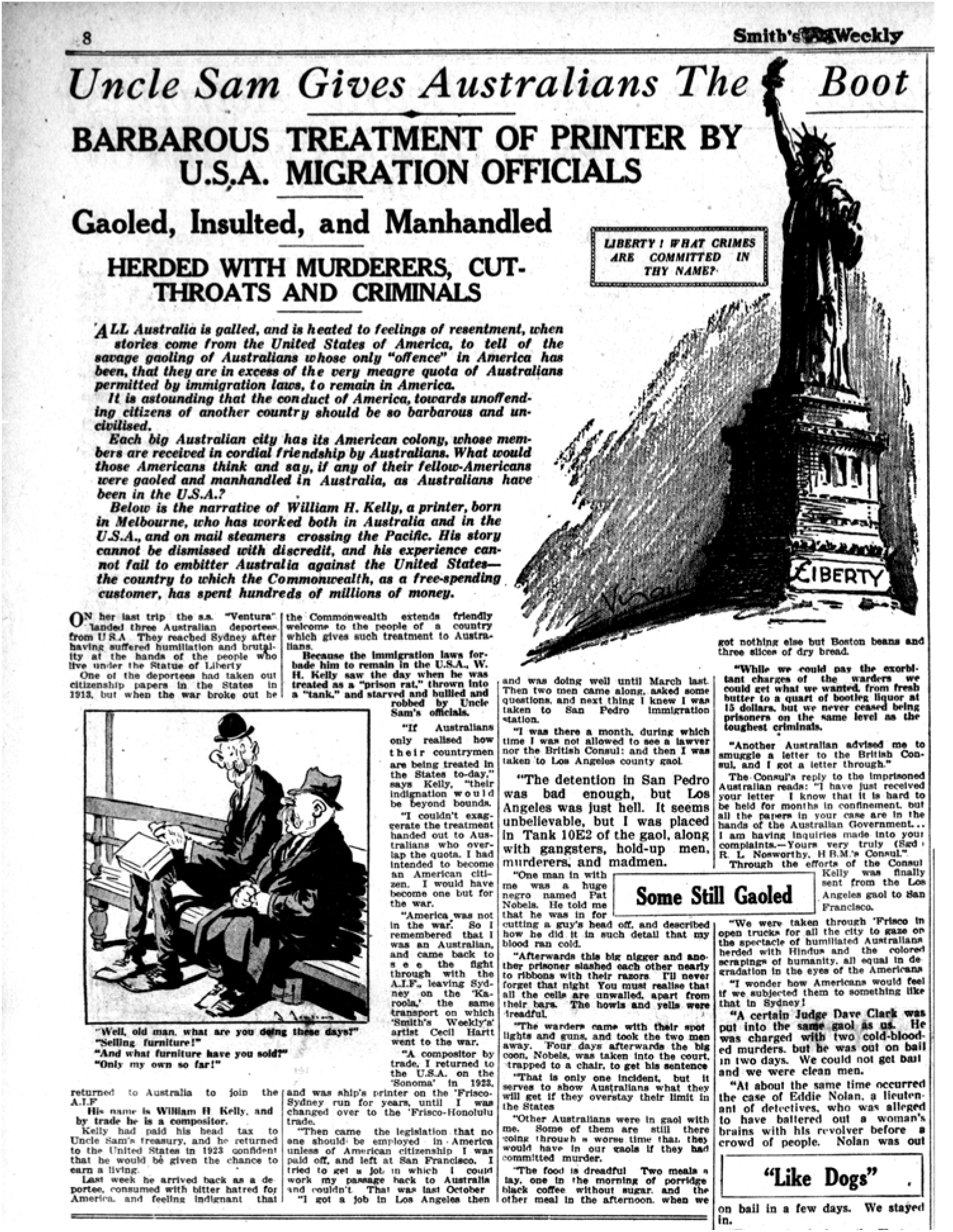
Likewise betrayed was the shared ideal of liberty – long imagined as the hallmark of the Anglo-Saxon race. Within the racial determinism that flowered during the late nineteenth century, Anglo-Saxons were cast as a ‘consistently liberated people’ who also ‘liberated others’ via ‘empires of liberty’.Footnote 83 Yet with white Britons held behind bars alongside icons of American freedom – the Statue of Liberty, the Golden Gate Bridge – the maxim that liberty defined and united white men’s countries was thrown into doubt. This tension was not lost on British commentators, and ‘liberty’ became a touchstone of anti-quota discourse. ‘A lot of liberty in this country’, snorted Reynolds, after a week on Ellis Island with the ‘great statue of “Liberty” looking at us’.Footnote 84 Headlines spoke of ‘Baby banned from “Land of Liberty”’; cartoonists illustrated quota reportage with sketches of Lady Liberty herself (see Figure 1). Accompanied by the French revolutionary exclamation ‘Liberty! What crimes are committed in thy name?’, these images left no doubt that America had made a mockery of its founding principles.Footnote 85 By equating quota enforcement with illiberalism, such rhetoric implied that both individual Anglo-Saxons and Anglo-Saxon precepts had fallen victim to US border control. Here was a gross contravention of race loyalty, and pundits clamoured to express their indignation. The consensus by late 1922 was that ‘it is time Australia kicked at the manner in which its nationals are being treated’.Footnote 86
‘Uncle Sam gives Australians the boot’, Smith’s Weekly (Sydney), 5 September 1931, p. 8.
Chorus of complaint
With such sentiments abroad, government authorities were prodded into action. But their capacity to orchestrate an effective response was hampered by Australia’s underdeveloped diplomatic machinery. Although the Dominion had won independent representation at the League of Nations, Britain still acted as Australia’s spokesperson and guide on the global stage. Even two decades after Federation, Australia had no ambassadors and no dedicated department of external affairs. Until 1935, external affairs remained a notional concern of the Prime Minister’s Department, with policy largely shaped by London. In this embryonic phase of Australian foreign relations, questions of responsibility and procedure were opaque, militating against decisive action on the quota question. Further complicating the matter were Australian population anxieties. Despite widespread calls for an increased Australian quota, the Hughes – and, from 1923, the Bruce – federal government remained concerned that higher US quotas would promote Australian depopulation.Footnote 87 Yet an alternative solution was not forthcoming. All agreed that the situation was untenable, but few could articulate an appropriate remedy.
In the absence of a clear policy and a transparent chain of command, the official response defaulted to an ill-coordinated chorus of complaint. From Melbourne, Prime Minister Hughes entered into correspondence with the local US Consul-General, Thomas Sammonds, demanding an end to border ‘hardships’.Footnote 88 Over in New York, the Australian commissioner continued his own enquiries. Sheldon and his successors, James Mackinnon (1923–24) and James Elder (1924–26), each petitioned Husband to make special provision for Australians. But, without diplomatic status, these Australian commissioners were readily disregarded, and their objections to ‘unfair treatment’ came to naught.Footnote 89 With the Dominion ill-equipped to launch effective protest, the British government stepped into the breach, taking charge of Australian complaints as part of a centralized empire-wide response. In the process, Whitehall both escalated Australians’ grievance and reasserted the bonds of dependency and protection that bound the Dominions to the mother country.
For its part, Britain was eager to advocate the Australian cause, making scant distinction between English- and Dominion-born British subjects. From June 1921, the Foreign and Colonial Offices each collated tales of quota-induced hardship, and parliamentarians vented spleen in the House of Commons.Footnote 90 As early as September 1921, the Foreign Secretary, Lord Curzon, instructed the British Ambassador in Washington, Sir Auckland Geddes, to protest ‘the indignities which may await British subjects upon arrival in the United States’.Footnote 91 From that point, Geddes was in regular communication with the Secretary of State, Charles Hughes. Barely two months later, Britain had made ‘diplomatic protests’ in ‘quite a number of cases’.Footnote 92 The following year, as British grievances mounted, Geddes investigated conditions at Ellis Island, and cast his medically trained eye over the maligned facilities. The ensuing report evoked a latter-day ‘Black Hole of Calcutta’. ‘I should prefer imprisonment in Sing Sing to incarceration at Ellis Island’, Geddes opined.Footnote 93 When these findings were published in June 1923, British parliamentarians called for retaliation, and Geddes’ condemnation attracted attention worldwide.Footnote 94 From Singapore to Geneva, publics read of the ‘indignities’ and ‘déplorable situation’ uncovered by the ambassador.Footnote 95 Anglo-American relations were further strained when, that same summer, the British quota was itself exhausted, leading the quota system to claim its first English victims. From May onwards, Ellis Island played host to dozens of English tourists who sweltered through a New York heatwave ‘like a lot of rats in a heap’. To contain the crisis, transatlantic steamers were diverted to Canada, while British officials inundated Washington with complaints about ‘great inconvenience and considerable hardship’.Footnote 96
By this point, anti-quota feeling festered across the British empire. Alongside the Australian representations, US authorities fielded complaints from New Zealand and South Africa, as well as the colonies of Malta and St Helena.Footnote 97 Canada, too, joined the chorus. Given that the US–Canada border was a major site of British exclusion, Canadians were moved to express solidarity with their ‘countrymen of the British stock’.Footnote 98 In Vancouver, the local Western Tribune launched a Forgotten Man Fund to raise money for British detainees’ legal defence, insisting that ‘There are no heathen in China or savages in Africa one fraction as much in want of assistance as these countrymen of ours.’Footnote 99 Even the small British community of Lourenço Marques, in Portuguese East Africa, berated the local US consul about British hardships, and voiced ‘ill feeling’ towards the States.Footnote 100 For an immigration regime based on ‘national origins’, the quotas had proved a remarkable stimulus to British imperial solidarities. In the face of a common foe, white Britons around the globe linked arms anew.
Faced with this mounting antagonism, US authorities stood firm. Behind closed doors, American officials adopted a conciliatory tone, and soothed ruffled feathers with the language of race kinship.Footnote 101 The United States would ‘naturally like to show preference … to people from “Anglo-Saxondom”’, insisted the Sydney-based consul E. M. Lawton, ‘but this could not be done without offending other nations’.Footnote 102 Beyond such toothless reassurances, however, Australian and British complaints went unheeded. By the mid 1920s, it was clear that the US government viewed white Britons as collateral in the crusade to stem ‘undesirable’ immigration, and had no plans to discard or expand Dominion quotas. Officials were increasingly unapologetic about Britons’ exclusion, and refuted accusations of mistreatment. ‘[T]he subjects of [British] countries are amenable to our Immigration laws in the same manner and to the same extent as are aliens of other races and nationalities’, insisted the Labor Secretary, James Davis, ‘and they like other aliens are obliged to undergo detention when found to be not eligible for admission under our laws’.Footnote 103
Lurking behind this hard-line attitude was the Anglophobia that lingered alongside the excesses of Anglo-Saxonism.Footnote 104 Ellis Island officials were perceived as ‘biased against British subjects’, while, within the Immigration Bureau, Britons were chastised for their arrogance and entitlement.Footnote 105 The Immigration Commissioner observed that ‘the trouble with the average Britisher is that he feels entitled to be treated as an American citizen as soon as he reaches the United States’. Although elite Britons believed that their ‘high standing’ was ‘sufficient to set aside the law of any nation he might favor with a visit’, Husband was adamant that ‘every Britisher must be examined like any other alien at Ellis Island’.Footnote 106 In keeping with this undercurrent of rancour, British representations were dismissed as ‘propaganda’ intended to ‘adversely affect our trade relations’. Coming at the high-water mark of a post-war anti-propaganda backlash, this rebranding effectively delegitimized British complaints.Footnote 107 Here was a further instantiation of the eroded British authority that distinguished Anglo-American relations in the wake of the First World War. As Britain’s global pre-eminence came under question, the United States engaged in a ‘struggle for supremacy’. Alongside the issues of naval strength and war debts, US immigration policy would be a frontline in Washington’s newly refractory transatlantic relations.Footnote 108
Although US federal officials proved intransigent, American civilians were not insensitive to the Australian cause. The press kept a watchful eye on ‘continued Australian criticism of the immigration quota system’, news of which prompted businessmen, pastors, and colleges to lobby government to address ‘this disgrace to the United States’.Footnote 109 This sentiment was most pronounced on the west coast. Given their similar histories and environments, and their common Pacific outlook, Australia and California were bound by thick economic and affective ties. Anxious to preserve these good relations, business interests such as the Los Angeles Chamber of Commerce and the San Francisco Foreign Trade Club urged an open-door policy towards Australia.Footnote 110 When these efforts were to no avail, the San Francisco mayor took direct action. In September 1924, when more than 300 Sydney arrivals were detained at Angel Island, the long-time mayor, James Rolph, personally contributed the US$500 bonds necessary for several detainees to land.Footnote 111
Financial self-interest was a key motivation for these Californian protests. For the Pacific-facing business community, the low Australian and New Zealand quotas hampered the free flow of people necessary for transpacific commerce to flourish. The San Francisco-based Oceanic Shipping Company was sufficiently concerned about ‘shrinking passenger revenue’ to launch a concerted campaign against the Australian quota. As had been the case with earlier Asian exclusion laws, the financial toll of restricted transpacific mobility prompted US steamship companies to contest federal immigration policy.Footnote 112 Hand in hand with such economic pragmatism went more abstract but no less potent ideas about white privilege and solidarity. The San Francisco Chronicle protested the ‘absurdity’ of restricting Australasians, who were ‘desirable’ immigrants of the ‘highest standing’.Footnote 113 Surely the quota law ‘was never intended to apply against a good type of white men’, agreed Oceanic Shipping.Footnote 114 Such racialized fellow feeling had less currency on the east coast, where Australians were subsumed within the larger sea of incoming Britons, and met with indifference or Anglophobia more often than friendship. Time and again, Australians detained at Ellis Island were informed that it was their responsibility to understand and comply with US immigration law, which must be applied ‘irrespective of color or social standing’.Footnote 115
In practice, however, social standing was far from insignificant. Elite travellers were processed with greater consideration and privacy, and were less frequently interrogated by officials. From 1924, first-class arrivals generally underwent border control aboard ship, whereas steerage passengers faced the unsavoury conditions of Angel and Ellis Islands. Well-heeled men and women were detained and excluded, but it was these elite cases of hardship that garnered greatest sympathy from government officials and the press.Footnote 116 Although wealthy Britons habituated to deference were quicker to perceive insult in interactions with immigration officials, class privilege nonetheless afforded reliable insulation against the worst extremes of border control. Prosperous travellers were also better able to pay the US$500 bonds demanded to secure the admittance of questionable non-quota arrivals, whereas those without sufficient funds faced exclusion.
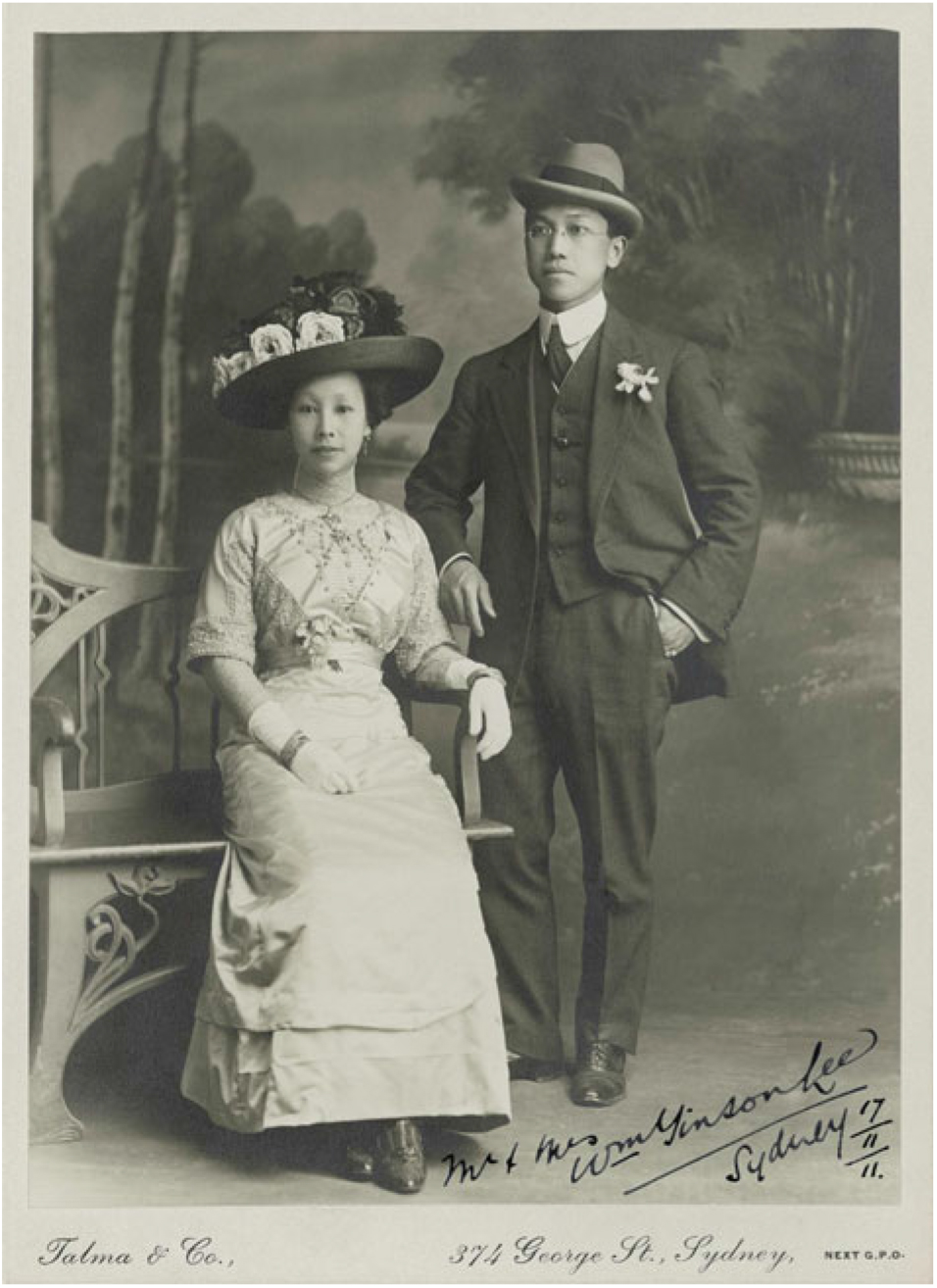
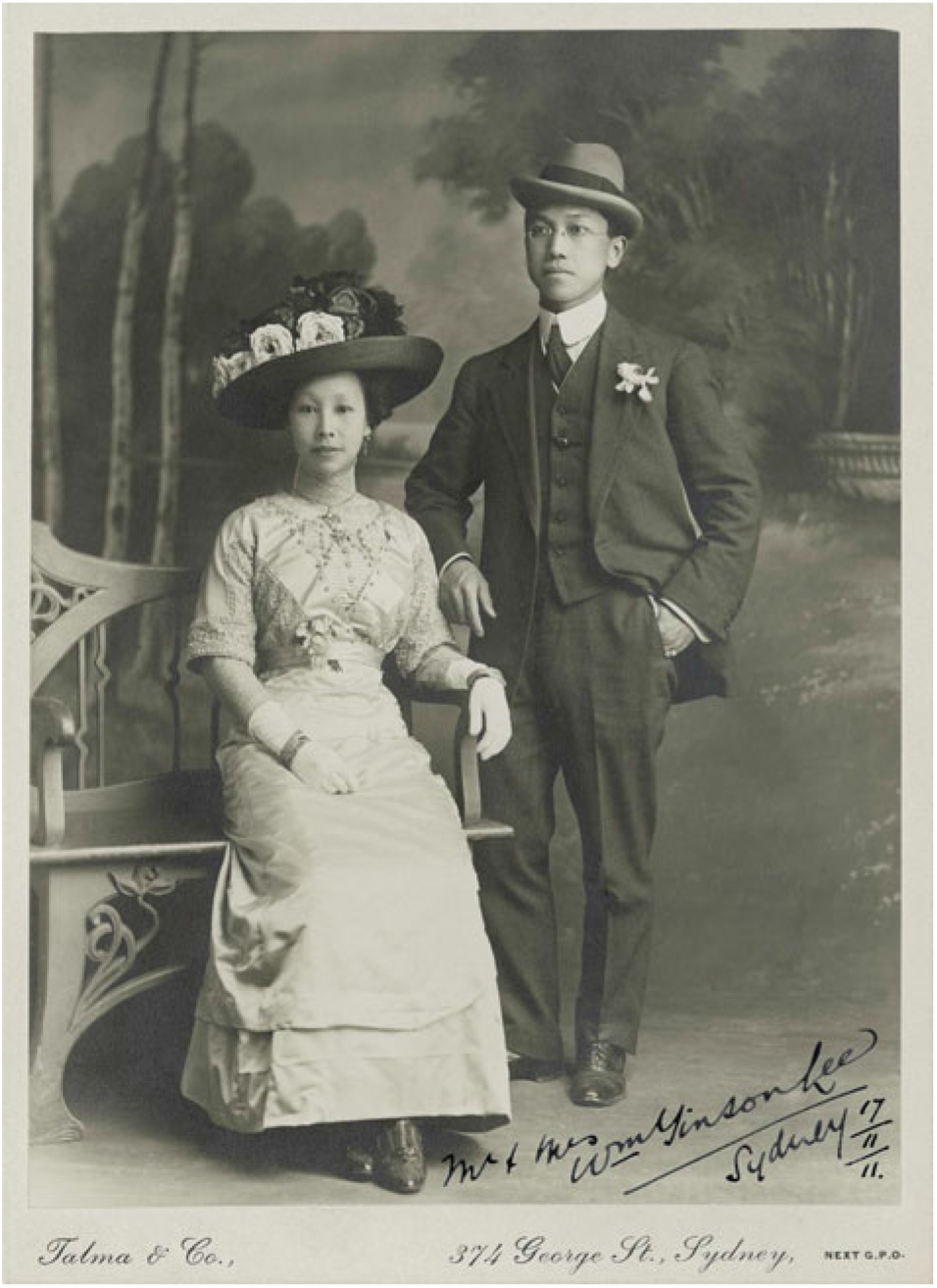
In rare cases, class privilege even trumped racial prejudice. Under the 1882 Chinese exclusion law, only elite Chinese armed with a ‘Section 6’ exemption certificate could legally enter the US. This requirement proved problematic for the businessman William Yinson Lee, who arrived at Angel Island in December 1922. Although a Sydney-born British subject, Lee’s membership of the ‘Chinese race’ saw him questioned and detained. As a merchant, Lee was eligible for an exemption certificate, but the Australian government had neglected to appoint an official to issue these documents. Section 6 certificates were available at the Chinese Consulate in Melbourne, but only Chinese citizens could avail themselves of this option.Footnote 117 ‘British subjects of the Chinese race’, such as Lee, were unable to obtain the necessary documentation, and therefore had no right to land.Footnote 118 Yet, remarkably, Lee’s social status overrode these legal and racial considerations. On the verge of exclusion, he produced a testimonial from the lord mayor of Sydney vouching for his credentials as a ‘millionaire trader’ who intended ‘to place large orders for machinery’ in the States.Footnote 119 Lee’s elegant European wardrobe doubtless also worked in his favour (see Figure 2), as immigration officials relied upon ‘physical markers of class and identity’ to verify Chinese arrivals’ social status.Footnote 120 At any rate, once convinced that Lee was a well-connected merchant with a commercial agenda, officials permitted him to land. As was the case throughout the Chinese exclusion era, anti-Chinese sentiment could be overridden when American economic interests were at stake.Footnote 121
William Yinson Lee and wife, 1916. Source: National Archives of Australia, A1, 1916/31599.
1924 and beyond
These dynamics shifted in the wake of the 1924 Immigration Act, when the US adopted a policy since termed ‘remote control’. Under this new paradigm, US consuls administered the quotas, and allotments could be secured before departure.Footnote 122 Now able to complete the necessary paperwork in Sydney, Australians no longer risked their luck at the border. The 1924 legislation also introduced provision for international students, whose frequent detention had inhibited the educational internationalism deemed crucial to the US’s global standing.Footnote 123 Under section 4(e) of the 1924 Act, a ‘bona fide student’ bound for an accredited institution would now be exempt from the quota restrictions. These twin reforms – remote control and student exemptions – diminished the element of chance that dogged US border crossings, and hence reduced the incidence of Australian border detention.
But the ill-will manifest since 1921 failed to dissipate, as the underlying grievance remained: the Australian quota was too low. Worse still, it was getting lower. The 1924 legislation more than halved the initial 279 figure to 121. In 1929, it fell to 100. Although the ‘national origins formula’ introduced that year sought to restrict ‘undesirable’ Europeans in favour of ‘British race stock’, the Dominions were in fact further disadvantaged by the new arithmetic.Footnote 124 Great Britain’s quota almost doubled – from 34,007 to 65,894 – yet Australia, New Zealand, and South Africa were each assigned the bare minimum of 100 quota places. Once again, commentators discerned a racial slight. Despite its ‘pure British stock’, Australia had been ‘ranked with such not wanted nations as Chinese, Japanese, Bulgarians and Turks’.Footnote 125 But such appeals to Anglo-Saxon kinship were fast losing traction within a United States that was, thanks to the quotas themselves, developing a new taxonomy of human difference in which ‘whiteness’ denoted ‘non-blackness’ more than ‘British stock’. After almost a decade of quota-driven restrictionism, European migrants were no longer imagined as a threat to the nation’s white hegemony, and had instead been redefined as ‘Caucasian’. As the US’s whiteness grew less embattled, and the national politics of ‘bi-racialism’ came to the fore, the salience and hence the clout of transnational white solidarities likewise diminished.Footnote 126
Although Australian calls for special treatment continued to go unheeded, no sense of grievance could lessen their ardour to pass through the Golden Gate. The US consul was inundated with requests for quota places, and waiting lists lengthened each year. By 1928, Australian demand was twenty times the allocated figure. Footnote 127 Prior to the 1929 reforms, Britain’s quota was also in demand, with a four-year waiting list as of February 1925.Footnote 128 Prominent among the Australians inconvenienced by the quota were business travellers seeking to foster transpacific commerce. Owing to the fierce competition for quota places, combined with US suspicions that supposed ‘business travel’ was often a ruse to secure entry, Australian entrepreneurs had only limited and unpredictable access to the States. As a result, frustrations flourished. The economic clout of this community soon drew the attention of government, and from 1927 both Australia and Britain made repeated attempts to negotiate a treaty that would authorize Australian merchants to remain in the US ‘as long as they desire for the purpose of carrying on their business’.Footnote 129 The 1815 British–American Commerce and Navigation Convention already granted this right to merchants from Great Britain, and British authorities were now eager to have the same privileges extended to the Dominions. By 1929, the Australian government identified the ‘businessman question’ as the most pressing matter in Australian–US relations.Footnote 130 Yet the US State Department was ambivalent about the mooted treaty. Despite encouragement from the US Chamber of Commerce, and a threatened Australian trade boycott, agreement on treaty terms proved elusive and negotiations fizzled out by 1932.Footnote 131
Faced with scant chance of a quota place, untold Australians sought to join the largely invisible community of white indocumentados.Footnote 132 One strategy was to sneak across the Canadian–US border. By mid decade, border crossings were a ‘booming business’, and in 1924 Border Patrol was established to combat this new threat.Footnote 133 Although this clandestine traffic eludes quantification, it certainly included Australians and other Britons. As a fellow Dominion with strong transport links to Australasia and Great Britain, Canada was a favoured arrival point for Britons bound for the New World. From Vancouver or Toronto, many would then request a US quota place. Of these, hundreds missed out each month. By July 1924, Canada was host to 5,000 rejected British subjects, each of whom was deemed a prospective illegal entrant.Footnote 134 From 1925, voluminous lists of these debarred ‘European aliens’ were circulated around the United States, allowing local officials to respond to any suspected illegal entry with investigations at the alien’s intended US address.Footnote 135
The more straightforward method to dodge the quota was visa overstaying. Unable to secure legal residency rights, Australian sojourners and settlers were well known to simply ignore their visa expiration date.Footnote 136 But visa overstaying also invited acrimonious encounters with US authorities. In 1925, federal authorities began concentrating their energies on the deportation of illegal aliens. Although this sweep focused on racialized ‘undesirables’ (especially Mexicans labourers), Britons were also caught in the net. Within months, the Australian commissioner was inundated with distraught compatriots who had been instructed to depart post-haste. Those who refused to leave were forced to do so. In 1925–26, thirty-eight Australians were coerced into the ‘process of abjection’ that was deportation from the United States. Similar numbers followed in subsequent years. Untold more people would voluntarily ‘check out’ to avoid a stain on their record. Footnote 137
What is significant about these deportations is not so much the numbers involved as the sense of injustice that accompanied any instance of prescribed removal. Even Australians who freely admitted to breaching US immigration law were aghast to be criminalized and expelled. Again, this grievance was infused with racial entitlement. Cynthia Reed’s autobiographical novel Lucky Alphonse (1944) contains a scene in which the eponymous Australian heroine, illegally ensconced in 1930s Chicago, receives marching orders from a racialized immigration official. The official, who is unmistakably the villain of the piece, is conspicuous for his ‘unpleasant accent’ and ‘odour of garlic’. In Reed’s telling, this episode connotes an insulting inversion of racial hierarchies: a racially suspect official is empowered to embody the US state, while lily-white Alphonse faces expulsion.Footnote 138 This literary rendering of deportation provides yet another instantiation of the fundamental tension at work: Australians accustomed to supranational identities and allegiances expected that white kinship should excuse them from the strictures of US immigration law, whereas the US republican tradition lent itself to a modern regime of national border surveillance that prioritized strict legalism above administrative discretion in the service of race solidarity. Preferential treatment for ‘desirable’ aliens certainly took place, especially in the provision of visa extensions (introduced in 1924), but such privileges were unpredictable and more the exception than the rule.Footnote 139 Given their expectations of unqualified special treatment, Australians and other white Britons were far from satisfied by occasional rule-bending in their favour.
This fundamental mismatch in expectation was endlessly played out at the US border. By introducing migration quotas, the 1921 and 1924 laws had also inaugurated a new age of border policing. The border was now a site of intense state surveillance, a bureaucratic netherworld where foreigners were remade into ‘aliens’ and some degree of dehumanization was near universal.Footnote 140 Expected to be welcomed with open arms, Anglo-Australians instead reported bruising encounters with brusque officials who engaged in close questioning and invasive medical examinations. ‘I resent being asked these questions’, the Sydney tourist Idris Scott told a Seattle Board of Special Inquiry in 1927. ‘I have never in my life been asked these questions. I think you are absolutely rude. I refuse to answer any more questions.’ Scott then stormed out, ‘in a rather indignant state of mind’.Footnote 141 Other Australians inundated the Immigration Bureau with complaints about ‘humiliating’, ‘insulting’, ‘dreadful’, ‘diabolical’, and ‘ludicrous’ border experiences.Footnote 142 Even the mere fact of alienage sparked distress. After enduring New York’s ‘aliens’ customs queue in 1937, the Melbourne playwright Doris Hayball was left ‘perilously near tears’. As she explained, to be ‘classed as “aliens” and not “native born” Americans … always affronts the English and Australian as we are apt to regard the American as our blood brother’.Footnote 143
By this point, Australian resentment over US immigration policy had festered for nearly two decades, with no sign of abatement. Yet, while ill-will remained constant, the legal and social context had evolved. On the one hand, white Britons now benefited from several reforms that created immigration backdoors for ‘desirable’ aliens. These included the 1929 Registry Act, which allowed aliens of ‘good character’ who had lived Stateside since 1921 to register as permanent residents and unmake their illegal status. Also significant was ‘pre-examination’, a process whereby aliens within the US could be ‘pre-examined’ for legal admission and then re-enter via Canada as bona fide migrants. Both practices were used to covertly extend preferential treatment to white immigrants, while maintaining the fiction of even-handedness.Footnote 144 Alongside these new legal loopholes, however, 1930s arrivals encountered the heightened border scrutiny prompted by the Depression. With the United States already overburdened by its own needy masses, officials were quick to debar Australians deemed liable to appropriate local jobs or become a public charge. Deportation cases also increased, causing congestion and delays at immigration stations nationwide.Footnote 145 And through all this, the Australian quota remained fixed, while proposals to include Australia in the British quota were ignored. As a result, the cycle of exclusion, grievance, and complaint persisted throughout the 1930s and beyond. By 1937, Australian resentment over US immigration policy was so notorious that it provided inspiration for a Hollywood film starring Cary Grant and Grace Moore.Footnote 146
The total number of Australian exclusion cases is impossible to estimate, as many relevant records were later destroyed. Yet precise enumeration is arguably beside the point. Given their small populations, Dominion Britons could never be debarred or deported from the US en masse. The unknowable total of Australian (or New Zealand or South African) cases doubtless pales in comparison to that from more populous and more ‘undesirable’ nations. But this numerical paucity is of little consequence, as it was the symbolism – not the quantity – of Australian cases that mattered. In the racial climate of the interwar years, the mere institution and (at least partial) enforcement of white immigration restriction was sufficient to attract and sustain concern throughout the British empire and the United States.
Empire, race, and nation
The ongoing US restrictions formed a stark contrast to the untrammelled mobility that Australians enjoyed (until 1962) within the British empire, and therefore helped ensure that transpacific connections could little compete with imperial ties. Recent research testifies to the powerful allure of America for interwar Australians; there was no shortage of desire to visit or live Stateside, but legalities stood in their way.Footnote 147 These legalities would prove a powerful deterrent to transpacific mobility, and thereby helped perpetuate Australia’s well-worn imperial networks. As one woman reflected in 1927, ‘I was going to the United States but I went to England instead. I was told there was so much trouble.’Footnote 148 With the Golden Gate now barely ajar, Australians were flung back into the British embrace. There they would remain, despite a strategic ‘turn to America’ during the Pacific war, until American influences finally began to usurp British models during the mid 1960s. US immigration restriction must therefore be recognized as one factor that preserved imperial bonds into the latter half of the century. Had Australians and other Dominion Britons been able to satiate their appetite for the United States, the ‘American Century’ might well have infiltrated the empire at an earlier point. Presented with a viable alternative to London’s ‘Kangaroo Court’ (as Earl’s Court was long known), Australia and other Dominions would have developed stronger US links that could have overshadowed the imperial bond – and increased America’s relative power – long before the 1960s.
Yet the quotas’ boost to empire also went hand in hand with the elevation of national identifications. By ascribing separate quotas for each Dominion, US immigration restriction brought greater salience to questions of nationality within the British empire. At a time when Dominion Britons shifted between racial, imperial, and national identifications, the quota system placed the emphasis squarely on the last category. At the US border, Australasians found their status as British subjects or Anglo-Saxons subordinated to their still tentative national ties. Categorized as ‘Australian’ or ‘New Zealander’, they were given fresh cause to imagine themselves as such. Reginald Reynolds is a case in point. Although born in Australia, Reynolds omitted his natal home from the ship’s manifest that heralded his arrival in New York. His nationality was listed as ‘Gt. Britain’, his race as ‘English’, and his last residence as ‘East Africa’.Footnote 149 Yet it was as an Australian that Reynolds was greeted at Ellis Island. It was this externally imposed identity that determined his subsequent detention, and ensured that concern for and identification with his experience was concentrated in Australia itself. Reynolds may not have arrived as a self-conscious ‘Australian’, but he certainly left as one. Increased national consciousness was hence a further unforeseen effect of US immigration policy.
In the 1920s and beyond, the US quotas had international reverberations that extended far beyond the ‘undesirable’ migrant nations that were the intended focus of the restrictions. With quotas also enforced for Britain and its Dominions, US immigration policy would have profound if unintended consequences for the global imagined community of white men. Although the quotas had a comparatively minor impact on white Britons, their exclusion held great significance in the context of Anglo-American relations, where the rhetoric of transnational white solidarity produced expectations of unqualified welcome in the United States. After 1921, as such welcome disappeared and then failed to rematerialize, the global community of white men’s countries was shaken and reorganized. Britons’ insistence upon a special relationship based on mutuality and kinship was only selectively honoured by Americans, who were prepared to insult and alienate fellow white men in pursuit of national self-interest. From these competing visions of the politics of whiteness flowed ongoing Anglo-American discord, as well as reinvigorated imperial allegiances. At once the apex and the perceived betrayal of white race patriotism, the US quota laws reveal immigration restriction to have been a threat to as well as a consequence of the transnational solidarity of white men.
Anne Rees is a David Myers Research Fellow in History at La Trobe University, and the co-editor of Transnationalism, nationalism and Australian history (2017).