Introduction
The Atlantic bonito, Sarda sarda, Bloch 1973, a member of the Scombridae family, is an epipelagic and neritic schooling fish species that inhabits temperate and tropical areas of the Atlantic Ocean, Gulf of Mexico, Mediterranean and Black seas (Yoshida, Reference Yoshida1980; Collette & Nauen, Reference Collette and Nauen1983; Sabatés & Recasens, Reference Sabates and Recasens2001). This fish is particularly important in the Mediterranean and Black seas, where it is caught with a variety of fishing gear (trap net, ring net, gillnet, trammel net, purse seine, beach seine, and hook and line; Demir, Reference Demir1963), with total catches of up to 77,000 tonnes (in 2005; ICCAT, 2006). In the Adriatic Sea, catches are around 21 tonnes (in 2017; DCRF data).
The Atlantic bonito is a migratory species that is able to travel long distances (Rey et al., Reference Rey, Alot and Ramos1984). It is known to migrate along the coast from the Atlantic to the Alboran Sea and from the Aegean to the Black Sea for spawning; after spawning, it migrates the opposite route (Nümann, Reference Numann1954).
Sarda sarda is a multiple spawner with asynchronous oocyte development (Majorova & Tkacheva, Reference Majorova and Tkacheva1959; Rey et al., Reference Rey, Alot and Ramos1984) and spawning in the warmer part of the year – from May to July (Sanzo, Reference Sanzo1932; Rodriguez-Roda, Reference Rodrigues-Roda1966). Apparently, there are two spatially and temporally discrete spawning grounds in the Mediterranean: (1) the Black, Ionian and Marmara seas in the east, where spawning occurs from May to June; and (2) the Algerian coasts, Sicily and the Balearic Islands, the Tyrrhenian, the Ligurian and the Catalan Sea in the western Mediterranean, where spawning occurs from June to July (Dardignac, Reference Dardignac1962; Rodriguez-Roda & Di Centa, Reference Rodrigues-Roda and Di Centa1980; Sabates, Reference Sabates1990; Sabates & Recasen, Reference Sabates and Recasens2001).
Although Atlantic bonito fisheries have existed for a long time in the Adriatic Sea, and the biology of the species in the area is known, there are still almost no indications of the early life stages and spawning traits of this species. However, the larvae and juveniles of this species were recently documented and genetically determined in the Croatian fishing ground (Zorica & Sinovčić, Reference Zorica and Sinovčić2008). Accordingly, there is an obvious need for a profound scientific investigation of the Atlantic bonito spawning cycle within the boundaries of the Adriatic Basin. Therefore, the aim of this paper was to explore the strong possibility that Atlantic bonito are reproducing in the Adriatic Sea.
Materials and methods
Specimens of Atlantic bonito (N = 122) were collected in 2017 during the EU Data Collection Framework investigating the purse seine net ‘palamidara’, a special form of surrounding net that targets tuna-like species (Sarda sarda, Auxis rochei, Euthunnus alletteratus and Seriola dumerilii), in the Adriatic Sea. Sampling was conducted in four seasons – in January (N = 32, winter), April (N = 30, spring), June (N = 30, summer) and November (N = 30, autumn) of 2017.
Immediately after landing on the boat, a random subsample was separated from the total catch, put on ice and transferred to the laboratory. In the laboratory, fork length was measured to the nearest mm, while the total weight of the specimens was determined to the nearest 0.01 g. The relationship between the length and weight of the fish was estimated using the equation W = aFLb, where W is the total body weight, FL the fork length, and a and b are constants. A Student's t-test was performed to define the statistical difference between b from the length-weight relationship and ideal isometric growth (b = 3).
Sex was determined macroscopically and gonads were weighed to the nearest 0.01 g. The gonadosomatic index (GSI) was calculated by expressing the gonad weight (Wg) as a percentage of total body weight (W). Additionally, a small amount of ovarian tissue was dehydrated and embedded in paraffin, after which histological sections were cut to 5 µm thick specimens and placed on the glass. Under a ZEISS stereomicroscope (Discovery V12), the developmental stages of the oocytes and the presence and histological characteristics of the post-ovulatory follicles (POFs) were recorded.
The stages of the gonads were macroscopically classified according to the following scale:
Stage 1 – gonads are small and translucent, found only in specimens that have still not reached first sexual maturity;
Stage 2 – gonads are in the development phase;
Stage 3 – gonads are fully ripped, eggs and sperm are released with touch, eggs are translucent-hydrated;
Stage 4 – gonads are empty and cover one-third of the visceral cavity.
Five distinct developmental oocyte stages (perinucleolar, previtellogenic, partially yolked, totally yolked and hydrated oocytes) were defined using histology (Yamamoto, Reference Yamamoto1956; Forberg, Reference Forberg1982; Hunter et al., Reference Hunter, Macewicz, Lo and Kimbrel1992). Staging of the gonads was as follows (Macias et al., Reference Macias, Gomez-Vives, Garcia and Ortiz de Urbina2005):
Inactive females (stage 1): the histological analysis indicates that the ovary contains no yolked oocytes and no atresia structures.
Active females: females are classified as active when the ovary contains yolked oocytes and there is no or only minor atresia. Active females are further classified into other stages according to additional criteria.
Ripening and ripe females (Maturing, stage 2): These females show signs of sexual maturity (yolked oocytes), but no signs of imminent spawn or signs of past spawn steps, or show signs of an imminent spawning, like hydrated or nuclear migration phase oocytes, but no post-ovulatory follicles or extended atresia. A high density of oocytes can be seen in the ovary.
Spawning females (stage 3): spawning females are considered those whose ovaries present post-ovulatory follicles or imminent spawning signs, such as hydrated or migratory-nucleus oocytes. Histological analysis shows signs of past spawning (post-ovulatory follicles) and enough vitellogenic oocytes to complete more spawning.
Post-spawning females (stage 4): These females show signs of past spawning (post-ovulatory follicles), but do not have enough vitellogenic oocytes to complete more spawning. Extended atresia in vitellogenic oocytes. Low oocyte density in the ovary.
The similarity between the microscopic and macroscopic staging was tested with a χ2 test.
Results
Morphometric measurements
The fork length of all Atlantic bonito specimens (N = 122) varied from 37.5 to 60.8 cm, with a mean of 48.83 ± 5.59 cm. The narrowest range of fork lengths was observed in the summer samples, when it was from 40.3 to 47.6 cm, also resulting in the lowest mean (43.07 ± 1.73 cm). On the other hand, the widest range of fork lengths was observed during winter sampling (39.4 to 56.2 cm). The largest mean value was recorded during the spring (55.54 ± 2.87 cm; Table 1). Fork length distributions were unimodal overall, as well as in all seasons separately.
Mean (with standard deviation), minimum and maximum fork length of Atlantic bonito Sarda sarda during investigation, Adriatic Sea, 2017

LF, fork length; W, body weight; WG, weight of gonads.
Overall total body weight varied between 742.68 and 3102.59 g, with a mean value of 1700.49 ± 543.82 g. The widest range of total weight was recorded during the winter (850.50–2504.99 g) and the narrowest during the summer (906.15–1452.25 g), similarly to pattern of the fork length range (Table 1).
The allometric coefficient (b) of the length-weight relationship for the overall sample was 2.877, with a coefficient of correlation of 0.959 (Figure 1); this was not significantly different from b = 3 or isometric growth (t = 0.06722, P > 0.05).
Length-weight relationship of Atlantic bonito Sarda sarda, Adriatic Sea, 2017.

Gonad development
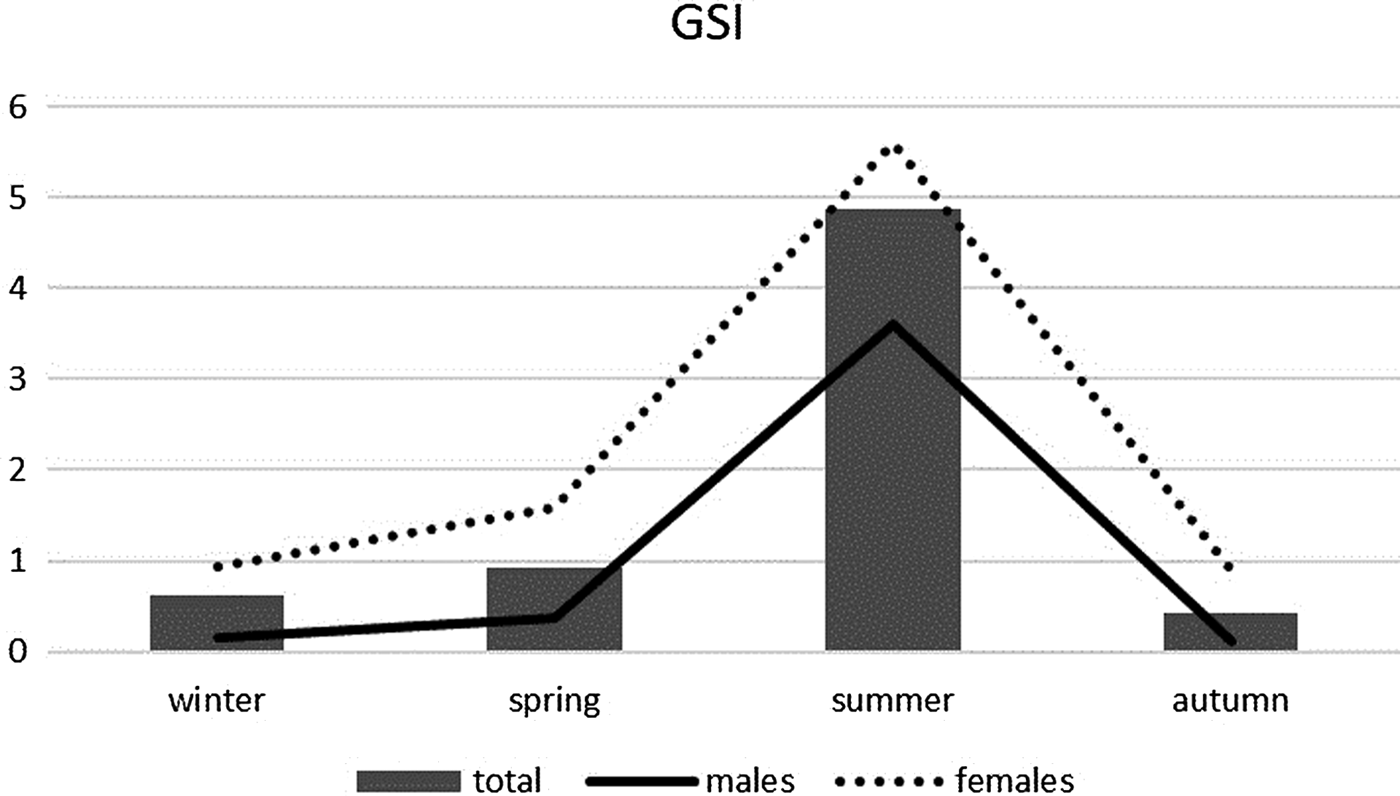
The gonad weight and gonadosomatic index (GSI) for both sexes and the species overall followed the same pattern (Figure 2); the smallest gonad weights were accompanied by the smallest gonadosomatic index values. Namely, the lowest mean gonad weight value, for the overall sample, was obtained during the autumn (7.929 ± 6.992 g) and the highest during the summer (54.528 ± 21.276 g). Values showed an increasing trend from winter until spring, while in summer, they reached maximum values before decreasing sharply in the autumn. Atlantic bonito gonadosomatic indices in the investigated area, similarly, had the largest values (3.609 for males and 5.604 for females) during the summer months. Subsequently, the lowest values were observed in the autumn (0.123 for males and 0.897 for females; Figure 2).
Gonadosomatic index (GSI) for females, males and overall Atlantic bonito Sarda sarda, Adriatic Sea, 2017.

All macroscopically determined stages were successfully confirmed with histological slides. Namely, stage 2 (during the winter) was mostly comprised of a perinuclear and previtellogenic oocyte. Yolked and hydrated oocytes characterized stage 3 (during the spring). Stage 4 (in the summer) had numerous POF stages. In the autumn, ovaries had perinuclear and previtellogenic oocytes again.
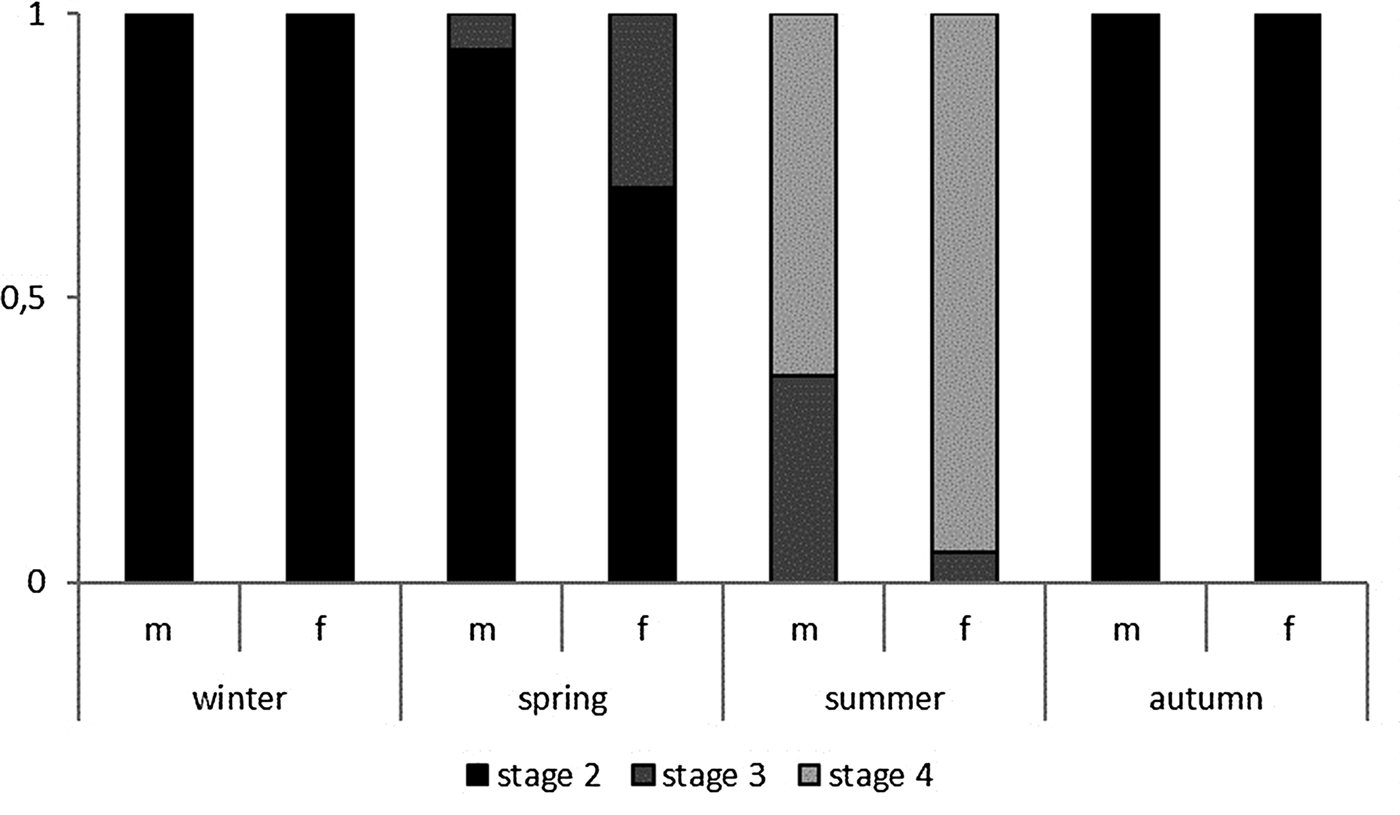
During the winter (January), all analysed female and male Atlantic bonito were in stage 2 of gonadal development. In the spring (April), the gonads were mostly in stage 2 (93.7% of males, 71.4% of females) and partially in stage 3. During the summer (June), most of the gonads were in stage 4 (64.6% of males, 94.7% of females) and a small portion were in stage 3 (males 34.6% and females 5.3%). Autumn (November) was characterized with Atlantic bonito in stage 2 (Figure 3). All macroscopic and microscopic staging was the same in all samples, except in the autumn. Hence, a χ2 test was performed on the autumn sample and revealed that there was no significant difference between the microscopic and macroscopic determinations of the gonad stages (P = 0.1336, df = 4).
Percentage of gonad development stages 2, 3 and 4 in the males and females of Atlantic bonito Sarda sarda, Adriatic Sea, 2017.

Discussion
The Atlantic bonito fork length range (37.5 < FL < 60.8 cm) during this investigation mainly overlapped throughout the seasons (Table 1), as well as with previously reported fork lengths of S. sarda in the Adriatic Sea. Namely, by analysing 665 specimens, Franičević et al. (Reference Franičević, Sinovčić, Čikeš Keč and Zorica2005), observed a fork length range from 33.0 to 67.0 cm in the 1997–2000 period, whereas Zorica & Sinovčić (Reference Zorica and Sinovčić2008) found FL in the range of 39.3–56.7 cm in 101 specimens in 2007.
Researchers in the Mediterranean area have reported Atlantic bonito with similar fork length ranges, which could indicate that these sizes are preferable for fishing, either from an economic or gear-selectivity point of view (Baibbat et al., Reference Baibbat, Malouli, Abid, Kell, Lucena and Benazzouz2017). Namely, in the Turkish waters, Kahraman et al. (Reference Kahraman, Gokturk, Yildiz and Uzer2014) studied commercially caught Atlantic bonitos with fork lengths that ranged from 17.7 to 63.0 cm, and Baibbat et al. (Reference Baibbat, Malouli, Abid and Benazzouz2016, Reference Baibbat, Malouli, Abid, Kell, Lucena and Benazzouz2017) reported specimens ranging from 31.0 to 74.0 cm from commercial catches in Morocco.
The length-weight relationship in this paper (W = 0.0227FL2.8773) was similar to those given by Franičević et al. (Reference Franičević, Sinovčić, Čikeš Keč and Zorica2005; W = 0.085FL3.1230) and Zorica & Sinovčić (Reference Zorica and Sinovčić2008; W = 0.0149FL2.984) in the same area, highlighting the isometry in this relationship (t = 0.06722, P > 0.05) for the adult population in the Adriatic Sea. Namely, it seems that Atlantic bonito grow simultaneously proportional in length, as well as in weight, in this area. In the other parts of the Mediterranean Sea, the allometric coefficient varies from 2.297 (Tyrrhenian Sea; Di Natale et al., Reference Di Natale, Mangano, Celona, Navarra and Valastro2006) to 3.215 (Marmora and Black seas; Ates et al., Reference Ateş, Cengiz Deval and Bök2008); this is probably linked to the temperature, salinity and available nutrients (Moutopoulos & Stergiou, Reference Moutopoulos and Stergiou2002).
Atlantic bonito spawning behaviour is well documented in other areas of the Mediterranean Sea. Namely, Baibbat et al. (Reference Baibbat, Malouli, Abid and Benazzouz2016) found that the Atlantic bonito reproduction period was between May and July in Morocco. Macias et al. (Reference Macias, Gomez-Vives, Garcia and Ortiz de Urbina2005) reported that the spawning season occurs mainly in later spring and early summer, with a peak in June, in the south-western Spanish Mediterranean. Additionally, Kahraman et al. (Reference Kahraman, Gokturk, Yildiz and Uzer2014) determined that the spawning period extends from May to August, with a peak occurring in June and July, in the Marmora and Black seas.
Franičević (unpublished data, PhD) established that maximum gonad development was in July–August in the Adriatic Sea. Zorica & Sinovčić (Reference Zorica and Sinovčić2008), based on macroscopic analyses of adults in the autumn (October), suggested that all analysed individuals were adults in a post-spawning period. Results obtained within this study are consistent with their findings for Atlantic bonito in the Adriatic Sea. Namely, the gonadosomatic index and the stages of gonads determined in this study indicated a summer spawning time for both sexes in the Adriatic Sea. Specifically, during the spring, gonads in the development phase, as well as mature gonads, were found (and histologically confirmed by the presence of hydrated oocytes), suggesting that gonads had started to mature; during the summer, mature gonads were found along with spent ones (with post-ovulatory follicles), indicating that spawning was or had been taking place (Figure 3). Histological analyses of ovaries during and after the peak of spawning confirmed that the oocyte development of Atlantic bonito in the Adriatic Sea is an ‘asynchronous’ type, as indicated by Majorova & Tkacheva (Reference Majorova and Tkacheva1959), Rey et al. (Reference Rey, Alot and Ramos1984) and Kahraman et al. (Reference Kahraman, Gokturk, Yildiz and Uzer2014) for the Mediterranean Sea.
The present study has confirmed, through gonadosomatic index fluctuations and the macroscopic and microscopic determinations of adult ovarian development, along with previously reported larvae and juvenile specimens in this area, the strong possibility that Atlantic bonito spawn in the Adriatic Sea. This fact was not previously considered, but could have a significant influence on the management of this species; therefore, it is expected that results of this study could be used as the basis for future investigations, leading to the sustainable fishing of Atlantic bonito in the Adriatic Sea.
Acknowledgements
This study was supported by the Ministry of Agriculture of the Republic of Croatia, as part of the research project ‘Data Collection Framework (DCF)’. We wish to thank the anonymous reviewers for their useful comments on the manuscript.