Introduction
Nasal obstruction is one of the most frequent symptoms encountered by otorhinolaryngological surgeons. Hypertrophy of the inferior turbinates is the most common, and often only, triggering factor.Reference Courtiss1–Reference Passali, Lauriello, De Filippi and Bellussi4 Enlargement of the nasal turbinates can be due to either mucosal or bony hypertrophy, and surgery is usually reserved for bony abnormalities or cases in which mucosal congestion is unresponsive to topical vasoconstriction.Reference Friedman, Vidyasagar, Bailey, Johnson and Newlands5 Enlargement of the erectile mucosa of the inferior nasal concha significantly increases nasal airway resistance, contributing greatly to symptoms of nasal airway obstruction. Common belief ascribes most of the enlargement of the inferior nasal concha to mucosal elements. However, Fairbanks stated that such enlargement involves the bone as well as the mucosa, and reported that the inferior nasal concha becomes thicker and spongier and arches further medially into the airway.Reference Fairbanks6 A study of the nasal valve confirmed that most nasal resistance occurs at the level of the anterior end of the inferior nasal concha.Reference Haight and Cole7
Chronic nasal obstruction restricts the patient's nasal breathing. The usual treatment is decongestant nasal drops. However, extensive use of nasal decongestants often leads to damage of the nasal mucosa.Reference Hofmann, Wolf and Koidl8, Reference Tasman, Soor, Zaiss and Weidauer9 Therefore, conservative therapy is restricted to decongestion with antihistamines, topical and systemic steroids, allergen avoidance, and specific immunotherapy involving hyposensitisation.Reference Baumgarten, Nichols, Naclerio, Lichtenstein, Norman and Proud10 Since these treatment modalities last only for a short period, surgery is necessary in many cases.Reference Haackevon and Hardcastle11
A review by Hol and Huizing evaluated a variety of surgical treatments for the reduction of hyperplastic inferior nasal turbinates, and concluded that most of these techniques provided satisfactory results although their duration of effect varied.Reference Hol and Huizing12 However, no technique is perfect, and each is associated with known short- and long-term complications such as post-operative bleeding, crusting, foul odour, pain, hyposmia and synechiae.Reference Passali, Lauriello, De Filippi and Bellussi4, Reference Kimmelman and Gamal13–Reference Passali, Lauriello, Anselmi and Bellussi15
With the introduction of microdebriders to rhinosurgery by Setcliff and Parsons, many surgeons began to perform submucosal resection during inferior turbinoplasty, utilising the advantages of the powered system.Reference Setcliff and Parsons16 The common complications of standard submucosal resection of the inferior turbinates (e.g. excessive resection, post-operative bleeding and crusting) were largely avoided. In addition, this technique of turbinate reduction has been shown to be reliable, safe and mucosa-sparing.l7–19
Endonasal laser surgery techniques were first applied to inferior turbinate surgery by Lenz in 1977.Reference Lenz, Eichler, Schafer and Salk20 The principal use was the treatment of nasal turbinates in patients with vasomotor rhinitis, and the main advantage was reduced mucosal bleeding.Reference Lenz21 Now, there are many published studies assessing the value of different laser systems for the treatment of hyperplastic inferior nasal turbinates. As a result, many different findings, and interpretations thereof, have been reported and summarised in comparative reviews.Reference Janda, Sroka, Baumgartner, Greevers and Leunig22–Reference Janda, Sroka, Mundweil, Baumgartner and Leunig25
In the present study, we aimed to compare the clinical efficacy of diode laser (one of the most popular laser types for turbinate ablation) versus endoscopic microdebrider (a convenient and minimally invasive method), for inferior turbinoplasty.Reference Janda, Sroka, Stefan, Baumgartner, Greevers and Leunig26 To our best knowledge, such a comparison has not previously been conducted.
Materials and methods
This study was conducted in the Otorhinolaryngology Department, Suez Canal University Hospital, Ismailia, in association with the Otorhinolaryngology Unit, Department of Medical Laser Applications, National Institute of Laser Enhanced Sciences, Cairo University, Egypt. Before conducting the study, detailed information about the treatment was related to the patients, and full, written consent was obtained from all patients. The study was approved by the Suez Canal University Ethical Committee.
This study included 40 adult patients complaining of bilateral chronic nasal obstruction, who had a previous history of failed medical treatment for at least 2 months, in the form of systemic antibiotics, oral decongestants and/or topical steroid treatment. The inclusion criterion was nasal obstruction due to grade 2 or 3 mucosal hypertrophy (according to the turbinate size evaluation system of Yañez and Mora).Reference Yañez and Mora27 Exclusion criteria comprised bony hypertrophy of the inferior turbinate, rhinosinusitis, nasal polyposis, antrochoanal polyps, enlarged adenoids or any other nasopharyngeal lesion, deviated septum, and previous nasal surgery. None of the patients had a history of allergy.
All patients were required to complete a questionnaire assessing their nasal symptoms, pre-operatively and one and six months post-operatively. In all patients, a visual analogue scale (VAS) was used to assess subjective symptoms, with 0 indicating no symptoms and 10 indicating severe and/or constant symptoms.
Anterior rhinoscopic and rigid nasal endoscopic examinations (the latter using a 4 mm diameter, 0°, Hopkins II endoscope; Karl Storz, Tuttlingen, Germany) were performed to assess the size of the inferior turbinate pre- and post-operatively. Cottele's test was performed to ensure that the obstruction was in the nasal valve area at the anterior end of the hypertrophied inferior turbinate. Nasal and paranasal sinus computed tomography scanning was also performed.
Acoustic rhinometry using the Personal Computer based Eccovision system (Model AR-1003; Hood Laboratories, Pembroke, Massachusetts, USA) was performed. The nasal cavity volume from the nostril to 5 cm inside the nasal cavity was assessed, pre-operatively and one and six months post-operatively. The total nasal cavity volume (comprising the right plus left nasal cavity volumes) was calculated for each patient.
The 40 patients were randomly divided into two groups prior to study commencement, as follows. Opaque envelopes were numbered sequentially from 1 to 40. A computer-generated table of random numbers was used for treatment assignment: if the last digit of the random number was from 0 to 4, a note was placed into the envelope specifying endoscopic microdebrider assisted turbinate reduction, while if the last digit was from 5 to 9 the note specified turbinate reduction using the 980 nm diode laser. The envelopes were sealed. As eligible participants were entered into the trial, the envelopes were opened in sequential order to give each patient his or her randomised group assignment. The envelopes were opened by the operating surgeon after patient consent had been obtained, just prior to surgery.
Both treatment groups consisted of 20 patients: 15 men and 5 women in the microdebrider-assisted turbinate reduction group, and 13 men and 7 women in the laser-assisted turbinate reduction group. The mean patient age was 28.1 years in the microdebrider group and 29.2 years in the laser group.
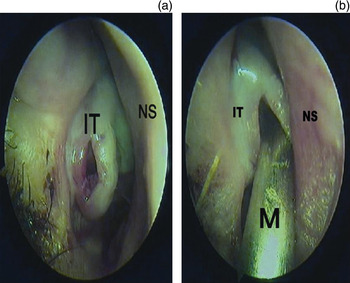
In the microdebrider-assisted turbinate reduction group, procedures were performed under general anaesthesia. Nasal packing with oxymetazoline 1 per cent was done 10 minutes pre-operatively. Both inferior turbinates were injected with 2–3 ml of local anaesthesia containing lidocaine 1 per cent with 1:100 000 adrenaline. Injections were performed along the inferior and medial edges of both turbinates. An incision was made into the anterior aspect of the inferior turbinate, using a number 15 blade aligned vertically. A Hall Linvatec straight microdebrider 4.2 mm blade (largo, FL, USA) was applied through the incision (Figure 1). The speed was gradually increased to 3000 cycles per second with the suction level set to low. Cautious circular movements of the tip were made, so that debridement was limited to the stromal tissue of the turbinate and spared the bony portion. The entire procedure was performed under endoscopic guidance. The mean operation time was 8 minutes per turbinate. The reduction in inferior turbinate size was easily seen immediately after the procedure. Finally, nasal sponge packing was inserted, then removed after 48 hours. Systemic antibiotics were prescribed for 7 days post-operatively.
Nasendoscopic views showing: (a) the incision at the anterior aspect of the inferior turbinate; and (b) introduction of the microdebrider through this incision. M = microdebrider; IT = inferior turbinate; NS = nasal septum

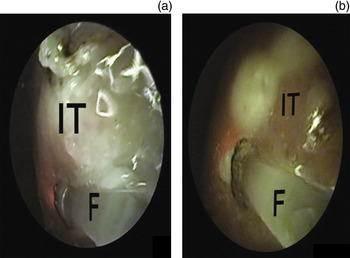
In the laser-assisted turbinate reduction group, procedures were performed under local anaesthesia using lignocaine spray 10 per cent (Xylocaine; AstraZeneca, Luton, UK) and topical application of lidocaine–prilocaine cream (Emla; AstraZeneca) applied 10 minutes before surgery. The turbinate was subjected to 980 nm wavelength diode laser pulses (Quanta, Solbiate Olona, Italy) using a bare optical fibre (320 µm). The procedure was performed under 0° and 30° endoscopic guidance, to enable delivery of laser pulses to the turbinate in an anterior–posterior sequence as much as possible. Laser pulses were delivered, under aseptic conditions, to adjacent, non-overlapping sites, sparing islands of healthy mucosa in between contact points (Figure 2). Single, repeated, 3 second applications were used, using 5 W power with an energy fluence of 15 J/cm2. The number of pulses ranged from 7 to 10. The mean operative time was 6 minutes per turbinate. During the laser session, the patient and the medical personnel wore safety goggles for the appropriate wavelength. Following the procedure, anterior nasal packing was not needed and systemic antibiotics were not used.
Nasendoscopic views showing the delivery of diode laser pulses via an optic fibre, during ablation of the inferior turbinate. F = optic fibre; IT = inferior turbinate

Patients in both groups performed alkaline nasal douching for 7 days post-operatively.
Patients in both groups were followed up weekly for four weeks. Their subjective and objective outcomes were assessed one and six months post-operatively, as described above.
Statistical analysis
Data were processed using the Statistical Package for the Social Sciences version 15 software program (SPSS Inc, Chicago, Illinois, USA). Quantitative data were expressed as means ± standard deviations, while qualitative data were expressed as numbers and percentages. The Student t-test was used to test the significance of differences in quantitative variables which followed a normal distribution.
Results
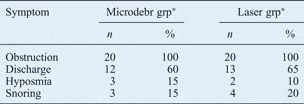
The study included 40 patients all suffering from bilateral nasal obstruction. Twenty patients underwent microdebrider-assisted turbinate reduction and 20 laser-assisted turbinate reduction. Pre-operatively, the mean nasal obstruction VAS score was 8.5 in the microdebrider group and 8.3 in the laser group. The patients' nasal symptoms, including nasal discharge, hyposmia and snoring, are listed in Table I.
Pre-operative nasal symptoms

*n = 20. There was no statistically significant difference between the two groups (p > 0.05). Microdebr grp = microdebrider group
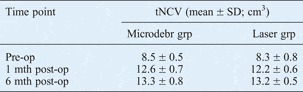
Nasal endoscopy in the microdebrider and laser groups identified grade 3 turbinates in 75 and 70 per cent and grade 2 turbinates in 25 and 30 per cent, respectively. Pre-operative acoustic rhinometry indicated a mean total nasal cavity volume of 8.5 ± 0.5 cm3 in the microdebrider group and 8.3 ± 0.8 cm3 in the laser group. There were no statistically significant differences between the two groups pre-operatively, for either subjective or objective parameters (p > 0.05). There was no intra- or post-operative bleeding in the laser group, while in the microdebrider group there was a mean 15 ml of intra-operative blood loss. There was no statistically significant difference between the two groups concerning mean operative time and immediate post-operative pain.
In the first three weeks following surgery, crust formation was not observed in the microdebrider group, while in the laser group a few isolated crusts were seen which disappeared during the fourth post-operative week.
One month post-operatively, 17 (85 per cent) microdebrider group patients described significant subjective improvement, while 3 in this group (15 per cent) were still suffering nasal obstruction. In the laser group, 15 patients (75 per cent) described satisfactory improvement in nasal breathing 1 month post-operatively, while 5 (25 per cent) were still suffering nasal obstruction.
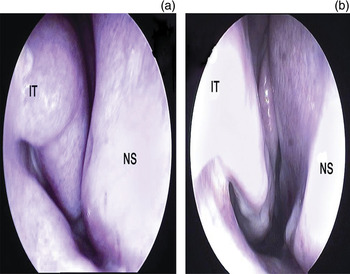
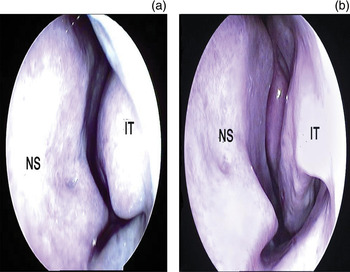
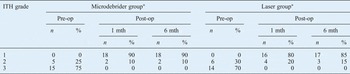
Six months post-operatively, 18 (90 per cent) microdebrider group patients and 17 (85 per cent) laser group patients were completely relieved of their nasal obstruction. In the remaining patients, objective improvements were indicated by both endoscopic (Table II) and acoustic rhinometric (Table III) findings. Figures 3 and 4 give examples of the improvement in endoscopic appearance following microdebridement and laser ablation, respectively.
Nasendoscopic views showing a hypertrophied turbinate (a) before debridement and (b) after debridement with the microdebrider. IT = inferior turbinate; NS = nasal septum

Nasendoscopic views showing a hypertrophied turbinate (a) before ablation and (b) after ablation with the diode laser. IT = inferior turbinate; NS = nasal septum

Endoscopic findings

*n = 20. There was no statistically significant difference between the microdebrider and laser groups (p > 0.05). Within both groups, there was a statistically significant difference between pre-operative (pre-op) and post-operative (post-op) findings (p < 0.05). ITH = inferior turbinate hypertrophy; mth = months
Total nasal cavity volume*

There was no statistically significant difference between the microdebrider (microdebr) and laser groups (p > 0.05). Within both groups, there was a statistically significant difference between pre-operative (pre-op) and post-operative (post-op) findings (p < 0.05). *Measured by acoustic rhinometry. tNCV = total nasal cavity volume; SD = standard deviation; grp = group; mth = month
There were no statistically significant differences between the two groups (p > 0.05). However, there were statistically significant differences between pre- and post-operative findings, within both groups (p < 0.05).
Discussion
The inferior turbinates serve several important functions, including warming, humidifying and cleansing the inspired air.Reference Abramson and Harker28 However, they are also the main structures contributing to chronic nasal obstruction. Chronic inflammatory conditions result in the deposition of collagen beneath the basement membrane of the sinonasal mucosa, together with mucous gland hyperplasia and resultant hyperactive secretion.Reference Cook29
Several surgical techniques have been used to reduce the turbinate, including turbinectomy, submucous turbinectomy, inferior turbinoplasty, cryotherapy and submucous electrosurgery.Reference Principato30–Reference Jones and Lancer37 Most of the described techniques involve submucous tissue treatments which require sacrifice of the mucosa, thereby interfering with nasal physiology.Reference Dawes14, Reference Friedman, Tanyeri, Lim, Landsberg and Caldarelli18 Nasal mucociliary function is also impaired in the majority of patients undergoing surgical reduction of the inferior turbinates.Reference Sapci, Sahin, Karavus and Akbulut38, Reference Nuutinen39 The introduction of microdebrider-assisted endoscopic partial turbinectomy has enabled optimal volume reduction of the turbinate, in order to alleviate nasal obstruction, together with preservation of function.Reference Setcliff and Parsons16 Power-assisted turbinoplasty has since been used by many surgeons, and has been reported to be fast and effective, with success rates ranging from 90 to 100 per cent, and with a low morbidity rate.Reference Yañez17–Reference Lee, Hwang and Kingdom19, Reference Yañez and Mora27, Reference Kizilkaya, Ceylan, Emir, Yavanoglu, Unlu and Samim40–Reference Liu, Tan, Lee, Lin and Huang44
The need for a less traumatic and minimally invasive procedure for the treatment of hyperplastic inferior turbinates has led to the introduction of laser surgery. Lenz and colleagues reported high success rates following inferior turbinate surgery using an argon laser.Reference Lenz, Eichler, Schafer and Salk20, Reference Lenz21 Lenz et al. also described delayed healing and significant crusting for a period of four to six weeks, as well as complications and side effects such as nasal dryness and bony sequestra.Reference Lenz and Preussler45
Carbon dioxide lasers have been widely used to treat inferior turbinate hypertrophy, with great success.Reference Elwany and Abdel-Moniem46–Reference Tanigawa, Yashiki, Hazshi and Sato50 However, carbon dioxide laser has the lowest thermal tissue effect of all the surgical lasers, and therefore has the highest risk of intra-operative bleeding, and the greatest possibility that more than one therapeutic session will be required to obtain an adequate result.Reference Janda, Sroka, Betz, Baumgartner and Leunig24
Unlike the carbon dioxide laser, the Ho:YAG laser has good coagulation capability and is therefore suitable for inferior turbinate treatment, enabling minimal carbonisation and satisfactory haemostasis.Reference Leunig, Janda, Sroka, Baumgartner and Grevers51, Reference Oswal and Bingham52 However, a study of the long-term efficacy of diode versus Ho:YAG laser found success rates of 74.4 and 67.5 per cent, respectively, after three years' follow up.Reference Sroka, Janda, Killian, Vaz, Betz and Leunig53
Other authors have reported on the use of the Nd:YAG laser for the treatment of inferior nasal turbinate hypertrophy.Reference Kirschner, McDonnel and Brodkin54–Reference Lippert and Werner57 However, a potential disadvantage of this laser is the observed reactive post-operative swelling of the nasal mucosa, which may cause worsening of nasal breathing for the first one to two post-operative months.Reference Lippert and Werner57
The diode laser enables effective reduction in hyperplastic inferior turbinate size with good haemostasis, similar to the Nd:YAG laser.Reference Janda, Sroka, Stefan, Baumgartner, Greevers and Leunig26, Reference Hopf, Hopf and Koffroth58 Due to the diode laser's deeper penetration depth and strong scattering within tissue, larger coagulation zones can be obtained in comparison with the argon and KTP lasers.Reference Eichler and Alves23 However, the diode laser's coagulation capabilities are not as great as those of the Nd:YAG laser; therefore, a large but controlled coagulation zone can be created within the venous plexus of the nasal turbinate, with little risk to the turbinate periosteum.Reference Janda, Sroka, Baumgartner, Greevers and Leunig22, Reference Janda, Sroka, Betz, Baumgartner and Leunig24 Moreover, a shorter period of post-operative nasal mucosa swelling (three to four weeks) has been reported.Reference Janda, Sroka, Stefan, Baumgartner, Greevers and Leunig26, Reference Sroka, Janda, Killian, Vaz, Betz and Leunig53, Reference Hopf, Hopf and Koffroth58, Reference Newman and Ananad59 Considering the aforementioned clinical findings, a 980 nm wavelength diode laser was chosen for the current study.
Janda et al. have reported the use of a continuous, 940 nm wavelength diode laser in non-contact mode, with a power setting of 8–10 W, in the treatment of inferior turbinate hypertrophy.Reference Janda, Sroka, Stefan, Baumgartner, Greevers and Leunig26 They found a subjective improvement in 86 per cent of their patients after six months, which decreased to 76 per cent after one year. In another study using a diode laser with the same parameters, this same group reported a success rate of 74.4 per cent after three years' clinical follow up.Reference Sroka, Janda, Killian, Vaz, Betz and Leunig53 Patients treated with the diode laser showed moderate to severe nasal obstruction due to immediate post-operative swelling of coagulated tissue, which sloughed off within four post-operative weeks and was replaced by scar tissue. Subsequently, nasal crusting subsided, the turbinate re-epithelialised, and subjective relief of the nasal obstruction became apparent.
Other clinical studies have used a continuous wave, 810 nm wavelength diode laser in contact mode with different power settings, and reported subjective improvement of nasal air flow in all patients over a six-month follow-up period.Reference Hopf, Hopf and Koffroth58, Reference Min, Kim, Yun, Kim, Jang and Jung60
In contrast to the above reports, DeRowe et al. reported subjective improvement in nasal breathing at one year post-operatively in 41 per cent of patients treated with continuous wave, 805 nm wavelength diode laser in contact mode with a power setting of 8 W.Reference DeRowe, Landsberg, Leonov, Katzir and Ophir61
In the current study, we used previously unreported laser parameters: the patients in our laser group received 980 nm wavelength, 5 W, pulsed diode laser used at non-overlapping contact sites along the turbinate, sparing islands of healthy mucosa in-between in order to enhance re-epithelialisation. The pulsed diode laser created controlled coagulation zones on the turbinate, which necrosed and detached from the healthy underlying tissue within four weeks of surgery. This resulted in increased nasal cavity volume and improved nasal breathing.
Our diode laser results are comparable to those of Janda et al. up to six post-operative months.Reference Janda, Sroka, Stefan, Baumgartner, Greevers and Leunig26 We observed subjective improvement in nasal breathing in 85 per cent of our laser group patients. In addition, endoscopic examination showed a significant reduction in turbinate size, confirmed by an increase in total nasal cavity volume of 46.9 and 56.6 per cent after one and six post-operative months, respectively, compared with pre-operative values. Laser group patients suffered transient nasal obstruction between two and four weeks post-operatively, but at the end of the first post-operative month 75 per cent of patients reported significant relief of their nasal obstruction.
In our microdebrider group, subjective improvement was reported by 17 (85 per cent) patients after 1 post-operative month and by 18 (90 per cent) patients after 6 months. The turbinate size was significantly reduced after the surgery and the total nasal cavity volume increased by 48.2 per cent at one post-operative month and by 56.4 per cent at six months, respectively. Patients in this group also complained of nasal congestion at one to three weeks post-operatively.
In our study, comparison of the microdebrider and laser group results indicated no statistically significant differences at one and six months post-operatively, for either subjective or objective parameters. This is in contrast to a recent comparative clinical study with three months' follow up, which reported success rates of 60 per cent in the carbon dioxide laser group versus 86.4 per cent in the microdebrider group.Reference Lee and Kim62 Hence, in agreement with Newman and Anand, it can be concluded that 980 nm wavelength diode laser is ideally suited for intranasal use, resulting in controlled coagulation and soft tissue ablation in a short treatment time.Reference Newman and Ananad59 In addition, this therapeutic modality is favoured for its facility for bloodless operation under local anaesthesia, and for its highly satisfactory results compared with many surgical techniques which risk intra- and/or post-operative bleeding and require nasal packing, antibiotic administration, general anaesthesia and hospitalisation.
• This study assessed outcomes for microdebrider versus laser assisted turbinoplasty
• Success rates were 85–90 per cent at six months for both techniques
• There were no significant differences in operative time, post-operative complications or outcomes between the two techniques
Microdebrider-assisted turbinoplasty is also a safe technique for achieving turbinate size reduction, with acceptable morbidity. Bleeding is a minor complication, and preservation of mucosa facilitates early healing and the absence of crusting or exposed bone.
Conclusion
This clinical study, with six months' follow up, indicates that both microdebrider and 980 nm diode laser techniques are effective and equally successful in reducing inferior turbinate hypertrophy. Unfortunately, for reasons beyond our control, it was impossible follow up our patients for a longer period. Therefore, we are not able to comment on the long-term outcomes of these two techniques.