The myocardial injury induced by aortic cross-clamping in paediatric cardiac surgery is evitable. Despite major advances in the technical aspects of surgical repair, paediatric myocardial protective techniques remain relatively unchanged.Reference Allen1 Endogenous protection by ischaemic pre-conditioning or post-conditioning has emerged as a powerful new strategy for limiting myocardial injury during cardiopulmonary bypass.Reference Zhao, Corvera and Alkos2 Both remote ischaemic pre-conditioning and cardiac ischaemic post-conditioning are shown to provide myocardial protection.Reference Cheung, Kharbanda and Konstantinov3–Reference Li, Chen, Huang and Luo10 Our group has reported that cardiac ischaemic post-conditioning decreases the release of Troponin I and creatine kinase activity-MB during paediatric cardiac surgery.Reference Luo, Li, Lin, Chen and Huang7, Reference Luo, Li, Lin and Huang9, Reference Li, Chen, Huang and Luo10 That said, these two endogenous strategies for myocardial protection have not been directly compared in the clinical setting. This study compares the efficacy of remote ischaemic pre-conditioning and post-conditioning in limiting myocardical injury in children undergoing operative ventricular septal defect repair.
We hypothesised that both strategies would protect against myocardial ischaemic reperfusion injury in children subjected to cardiopulmonary bypass.
Methods
The hospital ethics committee approved this study, and written informed consent was obtained from all patients’ parents. The study population consisted of 60 patients (1–5 years old) with isolated ventricular septal defect who were treated at the Xiang Ya Hospital between October, 2008 and September, 2009. Study patients were randomised into a control group (n = 20), an ischaemic pre-conditioning group (n = 20), and a post-conditioning group (n = 20). The randomised table was used for making group assignments. The staff members who collected and analysed post-operative data were all blinded to the groupings.
All patients included in the study were scheduled for elective closure of ventricular septal defect on cardiopulmonary bypass with cardioplegic arrest. Patients had to be between 1 and 5 years old. We excluded patients undergoing surgery for concomitant major anomalies such as aortic or valve surgery, as well as those with concomitant cardiac-associated infections such as infective endocarditis. None of the patients in the study received pre-operative medications. Pre-operative hepatic and renal function in both groups was normal.
Anaesthesia and surgical techniques
The details of anaesthesia and the surgical procedure itself were reported previously.Reference Luo, Li, Lin, Chen and Huang7 Anaesthesia was similar across the three groups, and included induction with intravenous midazolam and vecuronium bromide, followed by intravenous fentanyl and intermittent inhaled isoflurane to maintain anaesthesia. Ventricular septal defects were repaired via the right atrial or transpulmonary approaches under hypothermic cardiopulmonary bypass (28–30°C), using the hollow fibre oxygenator. All operations were performed by the same team of surgeons. Myocardial protection was achieved by intermittent perfusion of cold blood cardioplegia in a ratio of one to four parts crystalloid cardioplegia (St Thomas crystalloid cardioplegia solution) to autologous blood. Cardioplegia was administered an initial dose of 20 millilitres per kilogram, followed by subsequent doses of 10 millilitres per kilogram at 30-minute intervals.
Ischaemic post-conditioning
In post-conditioning, the aorta was declamped for 30 seconds after establishing cardioplegic arrest, and then re-clamped for 30 seconds. This cycle was repeated three times over 3 minutes in total. In the control group, the same protocol was performed as in post-conditioning patients, except that the aorta was not repeatedly re-clamped after cardioplegic arrest.
Remote ischaemic pre-conditioning
Remote ischaemic pre-conditioning involved three cycles of 5 minutes of lower limb (thigh) ischaemia and 5 minutes of reperfusion immediately after anaesthetic induction. We used a blood-pressure cuff inflated to a pressure of 200–300 millimetres of mercury to establish and maintain lower limb ischaemia in 5-minute intervals. Control and post-conditioning patients underwent sham placement of the blood pressure cuff around the leg without inflation.
Blood sampling and biochemical analysis
Creatine kinase-MB and Troponin I levels were measured before surgery and 6, 20, and 48 hours after removing the aortic crossclamp. The creatine kinase-MB level was determined immediately after sampling using an immunoturbidimetric assay.Reference Luo, Li, Lin, Chen and Huang7 The value was expressed as units per litre, with the normal value in our hospital defined as less than 24 units per litre. For measurement of troponin I, the plasma was transferred to a sterile polypropylene tube and stored at −20°C until assayed using a commercially available enzyme-linked immunosorbent kit. The value was expressed as nanogram per millilitre, with the normal value in our hospital set at less than 0.15 nanogram per millilitre.
Haemodynamic measurements and follow-up
We recorded the mean arterial pressure, heart rate, central venous pressure, use of inotropes, ventilatory support, and length of stay in the intensive care unit and hospital. We calculated the inotropic score for the first 24 hours post-operatively.Reference Li, Chen, Huang and Luo10 All patients were followed up for at least 30 days after the operation.
Statistical analysis
If not otherwise indicated, values were expressed as mean plus or minus standard deviation. Statistical analysis was performed with SPSS 13.0 software (SPSS Inc., Chicago, Illinois, United States of America). The repeated-measures analysis of variance was used to evaluate between-group differences in troponin I and creatine kinase-MB levels over time. Post-hoc tests were used to compare these parameters at each time point. Categorical data were analysed using Fisher's exact test or chi-square test as appropriate. A p-value less than 0.05 was considered significant.
Results
Clinical outcomes
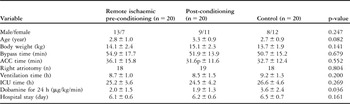
No deaths or major complications occurred in any group. The perioperative clinical data are shown in Table 1. There were no significant between-group differences in age, gender, or weight. Patients from the three groups were similar with regard to the type of procedure, bypass time, periods of aortic clamping, ventilatory duration, and length of stay in the intensive care unit. The inotrope score during the first 24 hours post-operation in patients undergoing post-conditioning or ischaemic pre-conditioning was significantly less than the inotrope score in the control group during this same interval (p = 0.036; Table 1). Follow-up results revealed no residual shunt in any patient 1 month after discharge.
Perioperative data in three groups (mean ± SD).

ACC = aortic cross clamping; ICU = intensive care unit
Creatine kinase-MB activity
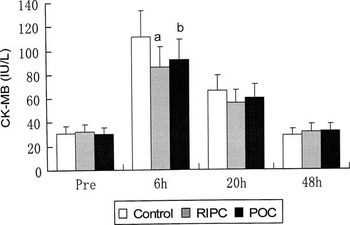
Pre-operative concentrations of creatine kinase in the plasma were within normal limits in all patients, and no differences were found between groups. A significant post-operative increase in creatine kinase activity-MB activity was observed in three groups at 6 and 20 hours after aortic declamping. There was a significant difference over time between the three groups (group effect, p = 0.03), and significant differences between the control group and the post-conditioning and remote ischaemic pre-conditioning groups were found 6 hours after aortic declamping. There were no significant differences observed between the post-conditioning group and the remote ischaemic pre-conditioning group at any time point (Fig 1).
A significant decrease in creatine kinase-MB activity at 6 hours in the remote ischaemic pre-conditioning and post-conditioning groups compared with control. ap = 0.021 versus control, bp = 0.024 versus control. There were no significant differences between the remote ischaemic pre-conditioning and post-conditioning groups at all time points. RIPC: remote ischaemic pre-conditioning. POC: post-conditioning.

Levels of troponin I
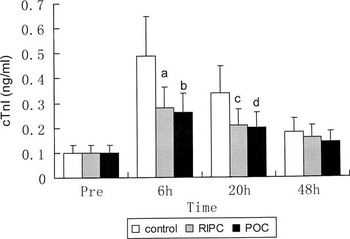
Troponin I levels at each sampling time are presented in Figure 2. The pre-operative levels were similar in both groups. Repeated measures of analysis of variance revealed significant increases at 6, 20, and 48 hours after aortic declamping in each of the three groups. The levels of Troponin I were significantly lower in post-conditioning patients and in remote ischaemic pre-conditioning patients than in control patients. There were significant differences between the control group and the post-conditioning and remote ischaemic pre-conditioning groups at 6 and 20 hours after aortic declamping (Fig 2). There was no significant difference between Troponin I level in the post-conditioning group and the remote ischaemic pre-conditioning group at any time point.
A significant decrease in Troponin I at 6 hours and 20 hours in the remote ischaemic pre-conditioning and post-conditioning groups compared with control. ap = 0.013 versus control, bp = 0.022 versus control, cp = 0.028 versus control, dp = 0.036 versus control. There were no significant differences between the remote ischaemic pre-conditioning and post-conditioning groups at all time points. RIPC: remote ischaemic pre-conditioning. POC: post-conditioning.

Discussion
To our knowledge, this is the first clinical study to compare the effects of post-conditioning and remote ischaemic pre-conditioning on myocardial injury. We found that both remote ischaemic pre-conditioning and post-conditioning provided a significant cardioprotective effect during operative ventricular septal defect repair with cardiopulmonary bypass. Relative to the control group, both conditioning groups demonstrated significantly lower post-operative levels of biomarkers indicative of myocardial injury (creatine kinase-MB and troponin I). This result confirmed our previous findings regarding post-conditioning in children undergoing cardiac surgery and in adults undergoing valve replacement,Reference Luo, Li, Lin, Chen and Huang7–Reference Li, Chen, Huang and Luo10 and also supported other authors’ conclusions regarding remote ischaemic pre-conditioning in paediatric cardiac surgery.Reference Cheung, Kharbanda and Konstantinov3 In addition, we found no significant differences between the remote ischaemic pre-conditioning and post-conditioning groups with respect to the post-operative levels of creatine kinase activity-MB and troponin I. This suggested that cardiac post-conditioning and remote ischaemic pre-conditioning provide equivocal protection from myocardial injury in the setting of cardioplegic arrest, which supports prior animal studies by Zhao et al.Reference Zhao, Corvera and Alkos2
Direct ischaemic pre-conditioning by brief aortic cross-clamping before cardioplegic arrest has been limited clinically due to its relatively invasive nature and the long duration of aortic cross-clamping (usually 2–3 minutes) required to trigger a conditioning effect.Reference Wu, Iivainen, Pehkonen, Laurikka and Tarkka11 Compared with cardiac ischaemic pre-conditioning and cardiac post-conditioning, the remote ischaemic pre-conditioning induced by brief transient limb ischaemia is non-invasive. However, remote ischaemic pre-conditioning requires at least 30 minutes, whereas post-conditioning induced by brief intermittent aortic clamping after myocardial ischaemia requires only 3 minutes, and manipulation is relatively easy after completion of repair. Unlike adults, the aortic wall in paediatric patients is usually relatively normal; postc-onditioning by brief clamping generally poses no major embolic risk. Thus, post-conditioning may be considered a valid alternative to cardiac ischaemic pre-conditioning or limb remote ischaemic pre-conditioning in paediatric cardiac surgery.
Owing to the small number of low-risk patients enrolled in our study, the two endogenous strategies of myocardial protection showed no clinical benefits beyond quantifiable biomarker levels. Further study is needed in patients with high risk or complex cardiac defects. Furthermore, whether the combination of two powerful endogenous protections has additive protective effects on the heart or other organs such as the lungs or kidneys also deserves further consideration.Reference Venugopal, Ludman, Yellon and Hausenloy12 Another limitation in this study is that we did not use echocardiography to evaluate myocardial perfusion.
In conclusion, this study found that both remote ischaemic pre-conditioning and post-conditioning reduce subclinical myocardial injury quantified by troponin I and creatine kinase activity-MB levels in paediatric patients undergoing cardiopulmonary bypass for ventricular septal defect repair. No significant difference was found between pre-conditioning and post-conditioning with respect to myocardial protection.
Acknowledgements
We are grateful to Matthew Hornick, Yale University School of Medicine, for a critical reading and editing of the manuscript.