





Introduction
The André E. Lalonde National Facility for Accelerator Mass Spectrometry (AEL-AMS) is Canada’s sole AMS laboratory, hosted at the University of Ottawa. It houses a suite of specialized sample preparation laboratories, including Tritium, Noble Gases, Radioiodine, Actinides & Fission Products, and Radiocarbon, which is the focus of this review. The Radiocarbon unit prepares a wide range of carbon-bearing materials for AMS analysis, supporting researchers across diverse fields such as archaeology, earth and environmental sciences, quaternary and climate change studies, carbon cycling, hydrology and oceanography, and forensics. The facility operates two AMS systems: a 3MV HVE Tandem AMS (Kieser et al. Reference Kieser, Zhao, Clark, Cornett, Litherland, Klein, Mous and Alary2015), and a dedicated 14C AMS (MICADAS by Ionplus AG), installed in 2021 to accommodate the growing demand for radiocarbon analysis. To date, the AEL-AMS National Facility has performed over 30,000 14C measurements for users across Canada and internationally.
As scientific techniques advance and new applications emerge, the demand for accurate and precise radiocarbon analysis continues to grow, ensuring reliable data for interpretations and valuable insights across a wide range of disciplines. As such, the AEL-AMS National Facility has undergone a decade of transformation and innovation since its establishment in 2014. This paper presents a comprehensive update on the radiocarbon laboratory’s operational advancements, methodological enhancements, and future directions. Focus is given to improvements in sample preparation (particularly for bone collagen), a review of the performance of the MICADAS system during its first three years of operation, and the development of robust quality assurance protocols, all of which underscore the facility’s commitment to advancing radiocarbon analysis and supporting a broadening spectrum of research applications.
Sample preparation
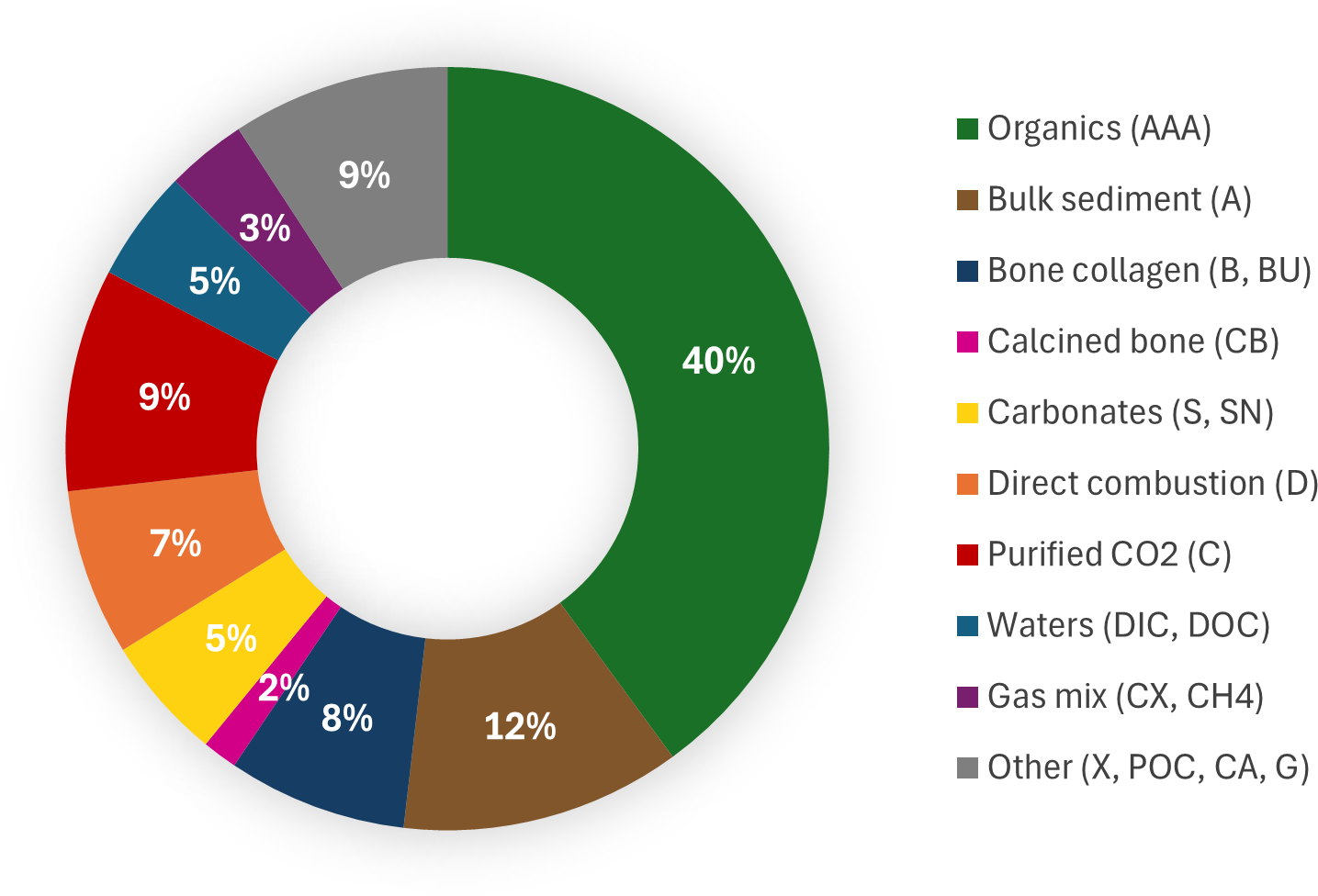
The radiocarbon sample preparation laboratory processes approximately 3,000–4,000 graphite targets annually for 14C AMS analysis, spanning a wide range of sample types and reference materials. These include organic solids (e.g., wood, charcoal, peat, plant macrofossils, sediment and bone collagen), inorganic materials (e.g., carbonates, shells, foraminifera, and calcined bone), water samples (dissolved inorganic carbon [DIC] and dissolved organic carbon [DOC, freshwater only]), and gas samples containing CO₂ or CH4. The diversity of sample types processed over the past three years is shown in Figure 1.
Sample types (and associated material codes) analyzed for radiocarbon at AEL-AMS from 2022-01 to 2024-12 (n=7426).

AMS analysis of 14C delivers high-precision results on samples with low carbon mass (∼1 mg C or less). To ensure successful outcomes, careful attention to sample selection, collection and handling prior to laboratory submission are essential. All prospective submissions are reviewed by the laboratory manager or designated specialist to assess their suitability and, where necessary, advise on sampling requirements, storage and preservation. Screening all samples at the submission stage is critical for identifying potential contaminants, such as preservatives on museum artifacts or oils in leather, parchment, and textiles. To prevent laboratory contamination, only samples of natural 14C abundance are accepted. Enriched or labelled 14C samples are not accepted. In cases where radioisotope contamination is suspected or there is an elevated likelihood of historic use (e.g., research vessels), a swipe test is required prior to sample submission.
Clean laboratory conditions and meticulous attention to detail during sample preparation is paramount for ensuring high-quality results. These high standards are upheld by experienced personnel in the sample preparation laboratory. Borosilicate glassware used in sample preparation is heated to 500 °C for 3 hours prior to use to eliminate C-bearing contaminants. Ultrapure Milli-Q water (TOC <3 ppb) is used in preparation processes, and stock solutions are prepared in small batches and refreshed regularly. NaOH solutions are limited to a one-month shelf life and kept sealed before use to minimize atmospheric CO2 uptake. Critical laboratory areas—including the microbalance sampling room, graphitization area, and target pressing station—are maintained under positive air pressure to minimize ambient dust and airborne particulates.
Samples are processed according to established pretreatment protocols for each material code, as detailed below. All materials, including standards and unknowns, are assigned a unique laboratory code identifier (UOC-#) for tracking and reporting. Sample processing follows sequential stages: physical and chemical pretreatment as required, conversion of samples to purified CO₂, graphitization, target pressing, and AMS measurement. Methods are tailored to each sample type, with recent refinements outlined in the following sections, that build on Crann et al. (Reference Crann, Murseli, St-Jean, Zhao, Clark and Kieser2017) and Murseli et al. (Reference Murseli, Middlestead, St-Jean, Zhao, Jean, Crann, Kieser and Clark2019).
Organic solids (AAA, A, a-c, X)
Most solid organics—including wood, charcoal, peat, plant macrofossils—undergo an acid-alkali-acid chemical pretreatment (material code AAA) to remove carbonates and humic acids, as outlined in Crann et al. (Reference Crann, Murseli, St-Jean, Zhao, Clark and Kieser2017). Samples are carefully monitored during chemistry, with acid/alkali washes repeated or halted early as needed depending on observed sample response (e.g., an acid wash may be repeated if the sample continues to effervesce). Fragile or low-mass samples (<8 mg), such as peat or plant macrofossils, are particularly susceptible to excess degradation during AAA chemistry. For these, a gentle AAA protocol may be applied if the sample appears relatively clean. This modified approach omits the initial HCl step, beginning instead with a 0.2 N NaOH wash at room temperature, followed by a Milli-Q rinse, then a 1 N HCl wash at 80 °C, and a final Milli-Q rinse. In some cases, the base wash may be omitted depending on sample preservation. Careful pipetting and centrifugation are essential for smaller or delicate samples to minimize sample loss during rinsing.
For tree-ring dating, an alpha-cellulose extraction is carried out (material code a-C) following a protocol adapted from Hogg et al. (Reference Hogg, Turney, Palmer, Southon, Kromer, Bronk Ramsey, Boswijk, Fenwick, Noronha, Staff, Friedrich, Reynard, Guetter, Wacker and Jones2013). Resins are removed using solvents in a Soxhlet extractor (2:1 hexane:ethanol for 6 hours, followed by ethanol for 6 hours), then oven-dried overnight. Samples are subsequently treated with a 50:50 bleach/acid mixture (1.6 wt/vol% NaClO₂ and 1 N HCl), rinsed with Milli-Q water at 80 °C for 30 minutes, and dried again overnight. Final steps include a base wash (5 N NaOH at 80 °C or room temperature for 1 hour, with close monitoring in case of degradation), followed by an acid wash (1 N HCl at 80 °C for 30 minutes), and a final Milli-Q rinse (80 °C, 30 minutes) before drying overnight.
Bulk organic carbon from sediment contains carbon from multiple sources within a single matrix. Despite this complexity, such samples can often provide a rough approximation of sedimentary age. Sediments receive an acid-only treatment (material code A) to remove inorganic carbonate and soluble acids. The acid step may be repeated if necessary (e.g., continued reaction). This is followed by careful Milli-Q rinsing to minimize carbon loss from fine fractions.
While it is preferable to avoid samples contaminated with substances such as consolidants or oils, this is not always feasible. In such cases, solvent washes prior to AAA pretreatment may be required. These samples are assigned material code X. If the contaminant is known, a targeted solvent wash is applied—for example, acetone/ethanol to remove polyethylene glycol (PEG), as described in Wood et al. (Reference Wood, Esmay, Usher and Fallon2023). If the contaminant is unknown, a series of solvent washes (typically acetone–methanol–chloroform) may be used as a broad-spectrum approach, tailored to the sample type following the methods of Brock et al. (Reference Brock, Higham, Ditchfield and Bronk Ramsey2010a).
Following chemical pretreatment, all samples are rinsed to neutral pH with ultrapure Milli-Q water and freeze-dried overnight. The dried organic material is then combusted to CO2 using an elemental analyzer (EA) and sealed in a glass ampoule, as described in Crann et al. (Reference Crann, Murseli, St-Jean, Zhao, Clark and Kieser2017).
Bone, antler, tooth (B, BU)
Collagen (material code B) is extracted from bone, antler, and tooth samples using a modified Longin (Reference Longin1971) method, as described in Crann et al. (Reference Crann, Murseli, St-Jean, Zhao, Clark and Kieser2017). At the submitter’s request, collagen may be ultrafiltered (material code BU). Bone pretreatment challenges are well documented in the radiocarbon literature (e.g., Herrando-Pérez and Stafford Reference Herrando-Perez and Stafford2025; Talamo et al. Reference Talamo, Fewlass, Maria and Jaouen2021), including low collagen recovery, degradation during chemical treatment and elevated process blanks. In recent years, we have refined our bone collagen extraction protocols to improve yield and reduce processing blanks. Key updates to our protocol include:
-
• Pre-cleaning: Removal of surficial contamination using a Dremel® rotary tool with diamond-coated wheel and aluminum oxide sanding bands (model #545 & 407), with preference for selecting hard cortical bone when available.
-
• Crushing: Samples are crushed to a grain size of 1–2 mm to increase surface area.
-
• Solvent cleaning: Acetone is used to remove lipids (Seiler et al. Reference Seiler, Grootes, Haarsaker, Lélu, Rzadeczka-Juga, Stene, Svarva, Thun, Værnes and Nadeau2019).
-
• Decalcification: Carried out until complete (typically 5–10 days. depending on preservation) with incremental acid adjustments to maintain pH <1. Completion is indicated by a light, fluffy texture.
-
• Agitation: Gentle shaking during decalcification promotes acid contact with the sample.
-
• Cold decalcification: Poorly preserved samples (friable, low structural integrity) are decalcified at 4 °C for ≥10 days.
-
• Gelatinization: Conducted at 70 °C for B and 65 °C for BU, with careful pH monitoring throughout.
-
• Enhanced ultrafilter cleaning: Vivaspin® Turbo 15 ultrafilters (30 kDa, Sartorius, cat#: VS15T21) are pre-cleaned with a 1 g/L alkaline detergent solution (pH 13), specifically Superflow Green— sourced from a local maple syrup producer to clean filter membranes (J. Southon, personal communication, June 6, 2023). Filters are ultrasonicated with Superflow Green at 50 °C for 30 minutes, followed by multiple cleaning cycles in Milli-Q water, alternating between ultrasonication at 50 °C and centrifugation (10 minutes per cycle).
Following extraction, collagen is freeze-dried, combusted to CO2 on an EA, and sealed in a glass ampoule. The atomic C:N ratio from the EA combustion is verified to fall within the acceptable range for collagen (2.9–3.6; Brock et al. Reference Brock, Wood, Higham, Ditchfield and Bayliss2010b). As part of our quality assurance, an aliquot of the extracted collagen is analyzed for δ 13C and δ 15N composition, and the stable isotope values are reported to the submitter for environmental and dietary information, which can inform age interpretation. Collagen yield (%) and atomic C:N ratios are also provided. While collagen yields of <1% are generally considered suboptimal due to collagen degradation (Brock et al. Reference Brock, Wood, Higham, Ditchfield and Bayliss2010b), a sample with an acceptable C:N ratio offers additional confidence in the integrity of the result.
Calcined bone (CB)
Radiocarbon dating of calcined bone—bone that has been burned at high temperatures (typically >600 °C)—targets structurally bound carbonate within the bioapatite lattice, rather than organic collagen. These carbonates are more thermally stable and less susceptible to contamination, making them suitable for dating when collagen is no longer preserved. Calcined bone samples (material code CB) are processed following the protocol described by Lanting et al. (Reference Lanting, Aerts-Bijma and van der Plicht2001).
Initial preparation involves removing any surficial dirt or soft crusts. Samples are then treated with a 1.5% NaClO solution for 48 hours at room temperature to eliminate residual organics, followed by a Milli-Q water rinse. This is followed by a 1 N acetic acid wash for 24 hours at room temperature to remove soluble carbonates, and a final triple rinse in Milli-Q water. After cleaning, samples are freeze-dried, digested in 100% phosphoric acid (to mitigate water vapour pressure during evacuation) within large-volume carbonate reaction vessels and allowed to react overnight at 60 °C to exsolve CO₂. The evolved gas is transferred via a vacuum extraction line and sealed in a glass ampoule.
Sulfur contamination may arise from the burial environment (e.g., sulfates in soil or groundwater) or from combustion residues if the bone was burned in contact with organic-rich sediments or fuels (Zazzo et al. Reference Zazzo, Saliège, Lebon, Lepetz and Moreau2012; Chatters et al. Reference Chatters, Hackenberger and Kennett2017). As a result, sulfur compounds can interfere with graphitization by poisoning the iron catalyst. To mitigate this, the CO2 is re-combusted in a sealed ampoule containing CuO and Ag at 500 °C for 3 hours prior to graphitization.
Inorganic solids (S, SN)
For most carbonate samples—including shells and foraminifera—a gentle acid pre-etch in 0.1–0.2 N HCl is recommended (material code S) to remove 10–30% of the sample’s potentially contaminated exterior. When present, secondary calcite deposits (soft, chalky layers) on aragonite shells are physically removed prior to acid treatment. If the sample is very small and visibly clean, no pre-etch is applied (material code SN).
After cleaning, samples are freeze-dried, placed into sealed carbonate reaction vessels containing 100% phosphoric acid (to mitigate water vapour) in a side arm. The vessels are evacuated, tipped and allowed to react overnight, dissolving the sample via acid hydrolysis and creating a separate CO2 phase in the headspace. The resulting CO2 is transferred directly to our graphitization lines for further processing.
Water and gas samples (DIC, DOC, CX, CH4)
Dissolved inorganic carbon (material code DIC), dissolved organic carbon (material code DOC; freshwater only), CO₂ in gas mixtures (material code CX), and CH4 gas (material code CH4) are routinely processed for radiocarbon analysis at AEL-AMS. For water samples, target analytes are extracted from gas-tight borosilicate bottles using a helium-sparging gas extraction line coupled to a vacuum manifold. DIC samples are acidified with 85% phosphoric acid and heated to release CO2 in the headspace. DOC samples undergo DIC removal sparging, followed by wet chemical oxidation to convert organic carbon to CO₂. Gas samples are introduced via septum-capped bottles or gas-tight canisters either by helium flushing or slow metering under vacuum. CH4 is combusted in a high-temperature furnace with CuO and silvered cobaltous/cobaltic oxide to remove sulfur and halides prior to CO₂ trapping. Once the resultant CO₂ has been cryogenically purified, it is transferred to a Pyrex ampoule and sealed. For detailed methodology and validation of water and gas samples at AEL-AMS, see Murseli et al. (Reference Murseli, Middlestead, St-Jean, Zhao, Jean, Crann, Kieser and Clark2019).
Graphite targets
All samples are prepared to yield ∼1 mg C graphite targets for AMS analysis, with acceptable mass yields in the range of 400–1300 µg C. Current sample processing is capped at a minimum sample size of 400 µg C due to mass-dependent fractionation effects observed on the AMS below this threshold (see Fig. 4 in supplemental materials). Graphitization is performed on custom-built, semi-automated reduction lines developed at the University of Ottawa (St-Jean et al. Reference St-Jean, Kieser, Crann and Murseli2017). Purified CO2 is reduced to graphite using 5 mg of iron catalyst (Fisher, <100 mesh, cat. #I60-500, lot #189083) via hydrogen reduction at 550 °C. The graphitization lines are LabVIEW-controlled and equipped with real-time pressure monitoring to track reaction progress and detect anomalies. Graphite is deposited directly onto the iron catalyst and pressed into aluminum-backed targets using an Ionplus pneumatic sample press (PSP). Pressed targets are kept in nitrogen-flushed bells and loaded onto the AMS within ∼48 hours to prevent adsorption of ambient CO₂ or moisture. Routine runs include process blanks and secondary standards to monitor background levels and confirm reproducibility and stability.
AMS measurement, data analysis and reporting
In the autumn of 2021, a 14C-dedicated AMS—MICADAS #33—was installed at AEL-AMS, providing high-precision radiocarbon analyses. Following several months of testing, all 14C sample measurements were transitioned to the MICADAS in Winter of 2022. 12,13,14C+1 ions are measured after tandem acceleration by a terminal at 185 kV and equipped with He stripping.
Prior to measurement, the system is tuned using OxII (Oxalic Acid II, NIST SRM 4990C), where raw ratios of OxII (1.48–1.52 × 10⁻¹²) and the processing blank (glycine; 2.0–4.0 × 10⁻¹⁶) are verified. Magazines are typically run for 13 passes (∼48 hours), yielding ∼700,000 14C counts on a modern target, with external error equal to or lower than the internal error. Operating parameters are set to produce ∼40–50 µA 12C-current, with average C beam transmission of 45-48%.
Post-measurement, data are processed using BATS data analysis software (Wacker et al. Reference Wacker, Christl and Synal2010). Fraction-modern (F14C) is calculated per Reimer et al. (Reference Reimer, Brown and Reimer2004) as the ratio of the sample 14C/12C to that of primary standard Ox-II, measured quasi-simultaneously. Both ratios are corrected for background and isotopic fractionation (occurring both from the spectrometer and sample preparation) to δ13CPDB = –25‰. Conventional Radiocarbon Ages (CRA) are calculated as –8033ln(F14C) and reported in 14C yr BP (BP = AD 1950), following Stuiver and Polach (Reference Stuiver and Polach1977). Uncertainties (1σ) reflect the greater of the variability of 14C/12C and 13C/12C measurements between passes, or the error-propagated Poisson counting statistics, and include long-term error inflation for historical laboratory performance assessed by evaluating the excess error (quadratic difference of the standard deviation and quoted error) of routinely measured known reference materials (following the methods of Salazar and Szidat Reference Salazar and Szidat2021). AMS-derived 13C values are not reported due to machine-induced fractionation.
A batch-by-batch correction approach is utilized at AEL-AMS, grouping unknowns, process blanks and secondary references for QA/QC that have been treated following the same experimental process (i.e., material code). Sample magazines typically consist of ∼30% knowns and ∼70% unknowns. A standard 39-position magazine includes 24–28 unknowns measured against ≥14 reference materials, including:
-
• 1× high-purity graphite machine blank (Alfa Aesar, cat#14734, lot#S23A002) to assess the ion source background (∼50–58Ka; source revision is performed once <50Ka).
-
• 5× OxII primary standards for normalization, interleafed throughout.
-
• 1× glycine (cat#G7126, lot# SLBS6578) as a 14C-free combustion blank.
-
• ≥2× process blanks and ≥2× secondary known-age reference materials per material code.
Minimum error inflation and blank uncertainty are based on historical laboratory performance of each material code (Salazar and Szidat Reference Salazar and Szidat2021), with additional inflation applied as needed to account for reference material scatter. Data analysis undergoes a two-step review process to ensure data integrity.
Analysis reports follow conventions from Millard (Reference Millard2014) and Stuiver and Polach (Reference Stuiver and Polach1977). Reports include the unique lab code (UOC-#), submitter sample ID, material type and code, and any relevant processing notes. CRA and F14C values with 1σ uncertainties are provided, along with D14C and Δ14C if requested. CRA is calibrated against the most recent international calibration curves in OxCal (Bronk Ramsay Reference Bronk Ramsey2009) to report calendar dates upon request.
Laboratory performance
AEL-AMS maintains high data integrity through systematic quality control and routine validation using reference materials. Routine measurement of a high proportion of known reference materials from established international intercomparisons (IAEA, TIRI, FIRI, VIRI) enables tight control over data quality. OxII primary normalization standards measured on the MICADAS for the first 3 years of measurement demonstrate high precision and excellent repeatability (Figure 2), with typical analytical precision of ∼2‰ on modern targets (∼15–30 14C yrs BP, depending on final error inflation).
Long-term internal reproducibility of normalized OxII standards (1 mg C) for the first 3 years of operation of MICADAS #33. Error bars are 1σ. Solid black line is consensus value (1.3407), dotted black lines represent 1σ standard deviation of the mean.

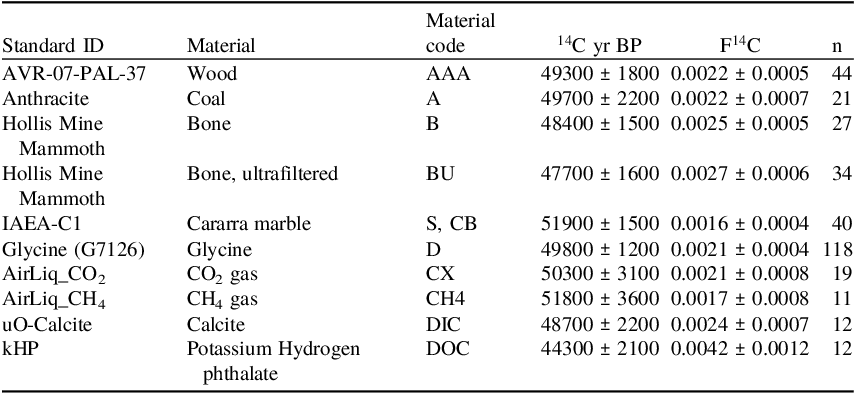
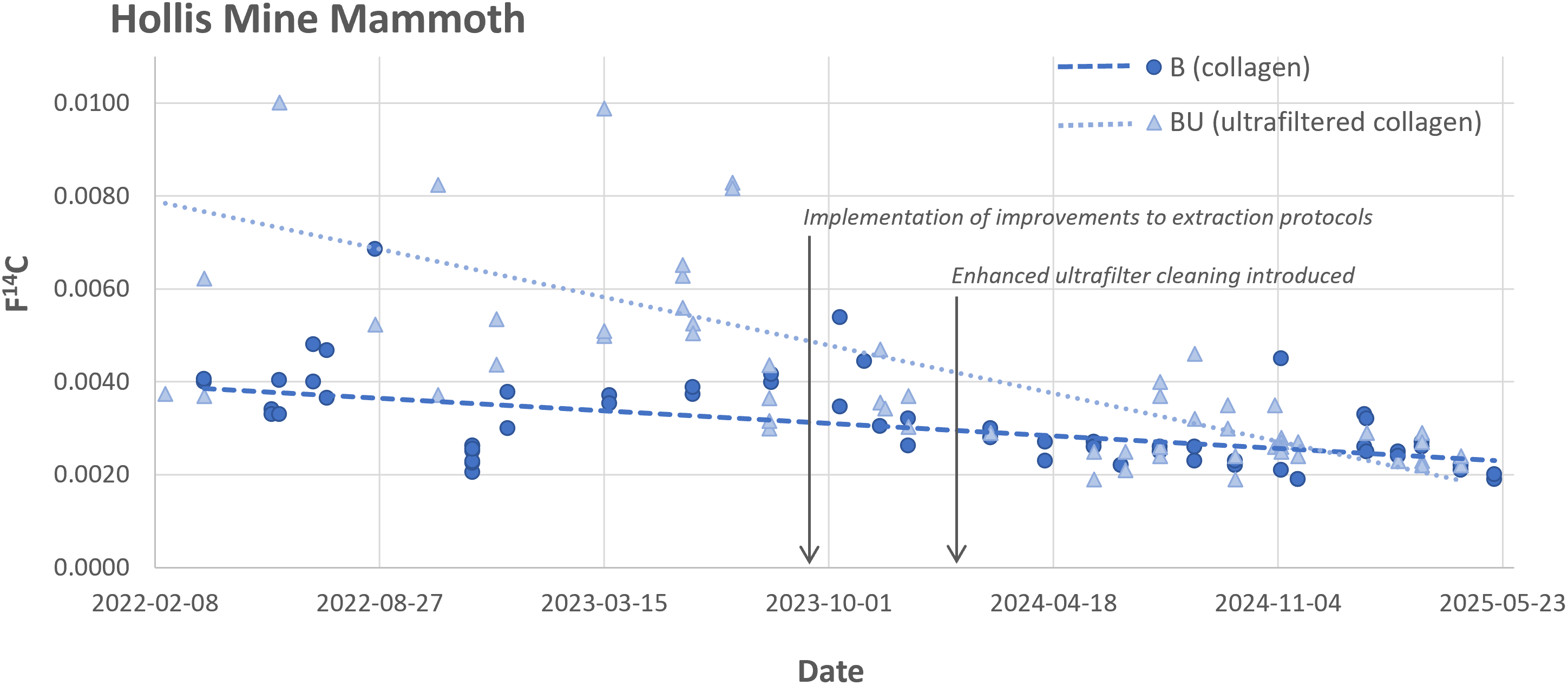
Process blank results for the most recent period of 2024-05 to 2025-05 are summarized in Table 1, reflecting a current snapshot of operational performance of the facility with recent improvements to QA/QC. Materials undergoing more straightforward chemistry (e.g., AAA, carbonate acid hydrolysis) yield the lowest blanks (F14C < 0.0022). More complex procedures (e.g., DOC via wet oxidation) meanwhile produce higher blanks (F14C = 0.0042) due to additive chemistry steps, though performance remains consistent (σ < 30%) as with DOC extraction protocols used at other laboratories (Xu et al. Reference Xu, Roberts, Elder, Hansman, Gagnon and Kurz2022). Notably, bone process blanks have improved significantly over the past three years, particularly for ultrafiltered collagen. Figure 3 highlights the timing of key procedural improvements, which correspond with the observed downward trend and reduction in data scatter.
Summary of process blanks background standards by material type from 2024-05 to 2025-05. Sample mass ranges are 400–1300 µg C. Quoted uncertainties are 1σ of the mean.

Table 1. Long description
A table with 10 rows and 6 columns. The columns are labeled Standard ID, Material, Material code, 14C yr BP, F14C, and n. The rows list different materials and their corresponding data. Row 1: Standard ID, AVR-07-PAL-37; Material, Wood; Material code, AAA; 14C yr BP, 49300 ± 1800; F14C, 0.0022 ± 0.0005; n, 44. Row 2: Standard ID, Anthracite; Material, Coal; Material code, A; 14C yr BP, 49700 ± 2200; F14C, 0.0022 ± 0.0007; n, 21. Row 3: Standard ID, Hollis Mine Mammoth; Material, Bone; Material code, B; 14C yr BP, 48400 ± 1500; F14C, 0.0025 ± 0.0005; n, 27. Row 4: Standard ID, Hollis Mine Mammoth; Material, Bone, ultrafiltered; Material code, BU; 14C yr BP, 47700 ± 1600; F14C, 0.0027 ± 0.0006; n, 34. Row 5: Standard ID, IAEA-C1; Material, Cararra marble; Material code, S, CB; 14C yr BP, 51900 ± 1500; F14C, 0.0016 ± 0.0004; n, 40. Row 6: Standard ID, Glycine (G7126); Material, Glycine; Material code, D; 14C yr BP, 49800 ± 1200; F14C, 0.0021 ± 0.0004; n, 118. Row 7: Standard ID, AirLiq_CO2; Material, CO2 gas; Material code, CX; 14C yr BP, 50300 ± 3100; F14C, 0.0021 ± 0.0008; n, 19. Row 8: Standard ID, AirLiq_CH4; Material, CH4 gas; Material code, CH4; 14C yr BP, 51800 ± 3600; F14C, 0.0017 ± 0.0008; n, 11. Row 9: Standard ID, uO-Calcite; Material, Calcite; Material code, DIC; 14C yr BP, 48700 ± 2200; F14C, 0.0024 ± 0.0007; n, 12. Row 10: Standard ID, kHP; Material, Potassium Hydrogen phthalate; Material code, DOC; 14C yr BP, 44300 ± 2100; F14C, 0.0042 ± 0.0012; n, 12.
Improvement of process blank background performance of bone standards (B and BU). Implementation of enhanced extraction and cleaning protocols are identified on the plot.

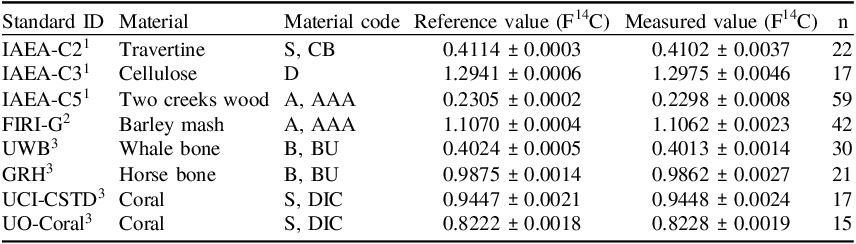
The performance of routinely used secondary reference materials measured on the MICADAS from the same 1-year period (2024-05 to 2025-05) is summarized in Table 2. This time interval highlights the most recent improvements to sample chemistry procedures. These materials are available in sufficient quantities to support repeated AMS measurements over time and include standards from the IAEA, FIRI, and internally developed reference materials validated through interlaboratory comparison (see supplemental information for reference information). Reported values consistently fall within 1σ of consensus values.
Performance of routinely used reference materials from 2024-05 to 2025-05. Sample mass ranges are 400–1300 µg C. Quoted uncertainties are 1σ of the mean.

Table 2. Long description
A table with 8 rows and 6 columns comparing the performance of secondary reference materials measured on the MICADAS from 2024-05 to 2025-05. The columns are Standard ID, Material, Material code, Reference value (F14C), Measured value (F14C), and n. Row 1: Standard ID, IAEA-C2; Material, Travertine; Material code, S, CB; Reference value (F14C), 0.4114 ± 0.0003; Measured value (F14C), 0.4102 ± 0.0037; n, 22. Row 2: Standard ID, IAEA-C3; Material, Cellulose; Material code, D; Reference value (F14C), 1.2941 ± 0.0006; Measured value (F14C), 1.2975 ± 0.0046; n, 17. Row 3: Standard ID, IAEA-C5; Material, Two creeks wood; Material code, A, AAA; Reference value (F14C), 0.2305 ± 0.0002; Measured value (F14C), 0.2298 ± 0.0008; n, 59. Row 4: Standard ID, FIRI-G; Material, Barley mash; Material code, A, AAA; Reference value (F14C), 1.1070 ± 0.0004; Measured value (F14C), 1.1062 ± 0.0023; n, 42. Row 5: Standard ID, UWB; Material, Whale bone; Material code, B, BU; Reference value (F14C), 0.4024 ± 0.0005; Measured value (F14C), 0.4013 ± 0.0014; n, 30. Row 6: Standard ID, GRH; Material, Horse bone; Material code, B, BU; Reference value (F14C), 0.9875 ± 0.0014; Measured value (F14C), 0.9862 ± 0.0027; n, 21. Row 7: Standard ID, UCI-CSTD; Material, Coral; Material code, S, DIC; Reference value (F14C), 0.9447 ± 0.0021; Measured value (F14C), 0.9448 ± 0.0024; n, 17. Row 8: Standard ID, UO-Coral; Material, Coral; Material code, S, DIC; Reference value (F14C), 0.8222 ± 0.0018; Measured value (F14C), 0.8228 ± 0.0019; n, 15.
1 International RM (IAEA 2014)
2 Interncomparison RM (Scott et al. 2003)
3 In-house RM (see supplemental materials)
Future work
Building on a decade of operational refinement, AEL-AMS is actively expanding its capabilities to meet emerging demands in radiocarbon science. Current efforts focus on pushing conventional limits to analyse smaller samples with greater precision and developing new analytical workflows. Several initiatives are underway to enhance precision and accuracy, increase throughput, broaden application scope, and support novel uses of 14C analysis:
-
• Graphitization capacity is being expanded by integrating a fourth line to increase sample throughput and reduce turnaround times.
-
• Automation of a new elemental analyzer (EA) combustion system is under development to streamline workflows and minimize manual intervention.
-
• Bone sample pre-screening will be supported by a compact FTIR (Agilent Cary 630), enabling:
-
i Rapid assessment of collagen preservation prior to chemical preparation
-
ii Evaluation of degree of cremation for calcined bone
-
iii Detection of contaminants (preservatives, consolidants) that may skew 14C ages (Crann and Grant Reference Crann and Grant2019), enabling tailored chemical treatment strategies.
-
-
• Bio-based carbon testing is being expanded with the acquisition of a Hidex 600 OX oxidizer and Hidex ULLA system, enabling 14C analysis by Liquid Scintillation Counting (LSC). The automated oxidizer facilitates the preparation of 6 samples at once, converting organic carbon to CO2 with delivery to scintillation cocktail.
-
• Data infrastructure is being modernized through development of a custom 14C Laboratory Information Management System (LIMS) and automated data analysis (ADA) platform to improve traceability, consistency, and reporting.
-
• Small-to medium-graphite testing (<400 µg C) continues, with an emphasis on refining mass-balance correction models to account for size-dependent behaviour.
-
• Gas ion source development for direct CO2 analysis is underway, targeting small sample applications in environmental studies where high precision is not required.
These initiatives align with AEL-AMS’s commitment to continuous improvement and responsiveness to evolving research needs in archaeology and environmental science.
Summary
This status report provides an overview of a decade of methodological development and operational progress in radiocarbon analysis at AEL-AMS, with emphasis on the first three years of 14C measurements using the MICADAS. The transition to the MICADAS has enabled high-throughput, high-precision 14C analysis, supported by consistent performance across standards, blanks, and reference materials spanning a wide range of sample types. Recent enhancements to sample processing protocols, QA/QC performance, and reporting practices underscore AEL-AMS’s commitment to scientific rigor and reproducibility. As part of this practice, AEL-AMS also participates in various international intercomparison exercises; final performance results from the most recent GIRI intercomparison are forthcoming. This report is intended as a reference for facility users and collaborators, outlining the current analytical capabilities, quality benchmarks, and future directions.
Supplementary material
To view supplementary material for this article, please visit https://doi.org/10.1017/RDC.2026.10285
Acknowlegments
This work was supported by the Canadian Foundation for Innovation Major Sciences Initiative (CFI-MSI) and the Ontario Research Fund. The authors thank former staff members Brett and Jennifer Walker for their contributions to the Radiocarbon program at AEL-AMS, and Marie-Josée Nadeau for her guidance on bone chemistry protocols. We also acknowledge the International Scientific Advisory Committee for their expertise in guiding the facility towards international best practices in radiocarbon analysis.



 Open access

