Introduction
In his seminal 1907 paper, Alois Alzheimer reported delusions, misidentifications, hallucinations, anxiety, and apathy, now referred to as neuropsychiatric symptoms (NPS), as major clinical symptoms of the “unusual illness” later named after him (Alzheimer, Reference Alzheimer1907; Stelzmann et al., Reference Stelzmann, Schnitzlein and Murtagh1995). This was not accounted for by diagnostic criteria developed during the 1980s (McKhann et al., Reference McKhann, Drachman, Folstein, Katzman, Price and Stadlan1984) and later (American Psychiatric Association, 2000), which classified such symptoms as consistent with, rather than supportive of, Alzheimer's disease (AD). Meanwhile, large population-based studies have confirmed that NPS are regularly found in patients with AD and vascular dementia (VaD) (Lyketsos et al., Reference Lyketsos, Steinberg, Tschanz, Norton, Steffens and Breitner2000; Chan et al., Reference Chan, Kasper, Black and Rabins2003; Steinberg et al., Reference Steinberg2008) and even in patients with mild cognitive impairment (MCI) (Lyketsos et al., Reference Lyketsos, Lopez, Jones, Fitzpatrick, Breitner and DeKosky2002; Chan et al., Reference Chan, Kasper, Black and Rabins2003; Geda et al., Reference Geda2008) and should be considered as central features of the disease (Cummings, Reference Cummings1997; Lyketsos, Reference Lyketsos2007).
The Neuropsychiatric Inventory (NPI) was developed to assess behavioral and psychological symptoms in dementia (Cummings et al., Reference Cummings, Mega, Gray, Rosenberg-Thompson, Carusi and Gornbein1994; Cummings, Reference Cummings1997). The assessment is done by a clinician interviewing an informant, usually the patient's caregiver. The NPI consists of 12 items, each of which is scored for frequency and severity. The composite score is calculated by multiplying frequency and severity for each item and then summing up the 12 item scores. Moreover, a caregiver distress score may be assigned for each item and for the whole scale. In recent years, the NPI has become a standard instrument for NPS assessment in dementia trials. While the instrument has been found useful in the overall evaluation of NPS, it is less suitable as a measure for specific target domains. The NPI clinician rating scale (NPI-C) has been developed to this end (de Medeiros et al., Reference de Medeiros2010), but this has not been used widely yet in clinical trials.
An expert consensus conference was convened during the 2008 Hong Kong/Springfield Symposium on advances in Alzheimer therapy to discuss the future importance of NPS assessment in clinical trials in dementia and MCI. They suggested exploring the use of the frequency score rather than the composite score for measuring treatment effects in patients with MCI and mild dementia, as reduced variance by eliminating the influence of informants’ subjective appraisal of severity was anticipated (Gauthier et al., Reference Gauthier2010).
We analyzed data from three clinical drug trials in patients with mild to moderate dementia, in which the NPI was used. This allowed us to investigate the assumption that the frequency measure of the NPI is superior to the composite score.
Methods
In three randomized, double-blind, placebo-controlled, multi-center trials, the 12-item NPI was used to assess treatment effects of Ginkgo biloba extract EGb 761® on NPS of dementia. In all three trials, patients with mild to moderate dementia were enrolled who scored between 9 and 23 (both inclusive) on the SKT cognitive test battery (roughly corresponding to a range from 25 to 14 on the MMSE; Ihl et al., Reference Ihl, Grass-Kapanke, Jänner and Weyer1999) and at least 6 on the 12-item NPI (total of composite item scores). They were eligible if they were at least 50 years of age (no upper limit) and had one of the following diagnoses: a) probable AD in accordance with the National Institute of Neurological and Communicative Disorders and Stroke/Alzheimer's Disease and Related Disorders Association (NINCDS/ADRDA) criteria (McKhann et al., Reference McKhann, Drachman, Folstein, Katzman, Price and Stadlan1984), b) possible AD according to NINCDS/ADRDA with cerebrovascular disease as defined by National Institute of Neurological Disorders and Stroke/Association Internationale pour la Recherche et l' Enseignement an Neurosciences (NINDS/AIREN) criteria (Román et al., Reference Román1993), or c) probable VaD according to NINDS/AIREN. Patients and methods of the trials are described in detail in the original publications (see below). For the GINDEM-NP Study (Napryeyenko et al., Reference Napryeyenko and Borzenko2007), 400 outpatients were recruited by 14 psychiatric clinics in Ukraine between June 2003 and February 2004; the GOTADAY Study (Ihl et al., Reference Ihl2011) included 410 outpatients enrolled by 20 clinics of psychiatry, neurology, or geriatrics in Ukraine between April and November 2006; and the GOT-IT! Study (Herrschaft et al., Reference Herrschaft, Nacu, Likhachev, Sholomov, Hoerr and Schlaefke2012) involved 410 outpatients recruited by 17 clinics of psychiatry or neurology in Russia, Belarus, and Moldova between March 2008 and April 2009. In all three trials, only Russian-speaking patients were enrolled by Russian-speaking investigators. Investigators were required to have a sufficient command of English to understand the trial protocol and all study-related instructions. Before the start of each study, the investigators were trained in the administration of the NPI by one and the same experienced geriatric psychiatrist and psychologist (R.I.) and following the same approach. This involved in-depth explanation of all single items, the interview strategy, and the scoring method. Plausibility of changes in NPI scores recorded during the trial was checked for sub-samples of patients by an experienced neurologist and psychiatrist (H.H.). The NPI assessments at baseline, after 12 weeks, and after 22/24 weeks of treatment had to be performed by the same caregiver. The NPI version used in all three studies had been culturally and linguistically validated for Russian-speaking populations following standard procedures.
To explore the differences between the NPI composite and frequency scores to detect treatment-induced changes during the treatment phase, standardized changes between baseline and end of study were calculated (mean change divided by standard deviation) and compared descriptively. To further evaluate whether the NPI frequency score is more sensitive in patients with milder degrees of cognitive impairment, regression analyses between the SKT total score at baseline with the NPI frequency as well as the NPI composite score were performed.
Results
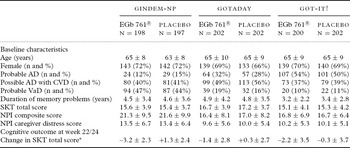
Baseline characteristics and cognitive outcomes of the three patient samples are shown in Table 1. On average, the patients were relatively young, NPS were most pronounced in the GINDEM-NP Study, whereas cognitive impairment was most severe in the GOTADAY Study.
Baseline characteristics and cognitive outcomes at week 24 of the patient samples of the three trials (means ± standard deviations or numbers and percentages)

*Negative change means improvement; the corresponding change on the ADAS-Cog may be estimated as approximately 1.3 times the change on the SKT.
AD = Alzheimer's disease; CVD = cerebrovascular disease; NPI = Neuropsychiatric Inventory; VaD = vascular dementia.
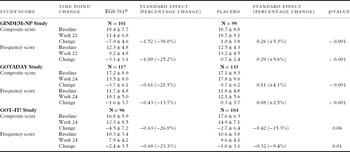
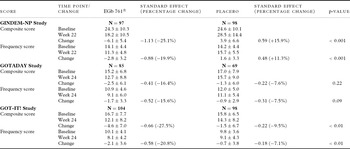
The effect sizes for NPI scores obtained with EGb 761® were largest in the GINDEM-NP Study; the most favorable results for placebo were found in the GOT-IT! Study. The three trials did not show a systematic or conspicuous difference in effect sizes for changes from baseline to end of follow up between NPI composite scores and NPI frequency scores, neither for active drug nor for placebo (Tables 2 and 3). In both severity strata, differences between treatment groups tend to be slightly larger for the composite score in two of three studies. Only in the GOT-IT! Study, treatment effects and discriminative power in patients with more severe cognitive impairment seem to be slightly better, using the frequency score. In the GOTADAY Study, the frequency score seems to have a slight advantage over the composite score in patients with less severe cognitive impairment. In the GOTADAY Study, differences between EGb 761® and placebo were more pronounced in the subgroup of patients who had more advanced dementia at baseline.
Changes on NPI score from baseline to end of treatment with standardized effect sizes (Δ/σ) and change in percentage from baseline for patients with more severe cognitive impairment (SKT baseline score > 15; p-value of the two-sided t-test)

NPI = Neuropsychiatric Inventory.
Changes on NPI score from baseline to end of treatment with standardized effect sizes (Δ/σ) and change in percentage from baseline for patients with less severe cognitive impairment (SKT baseline score ≤ 15; p-value of the two-sided t-test)

NPI = Neuropsychiatric Inventory.
The effect sizes for frequency, severity, and composite scores found in the three clinical trials were similar, and the analyses do not provide evidence of differential sensitivity to change; specifically, the frequency score was not found to be more sensitive than the others.
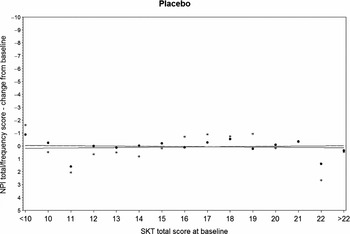
Regression analyses based on the pooled data of the three trials did not reveal a notable association between baseline severity of cognitive impairment and changes in NPI scores from baseline to end of treatment, neither for the composite score nor for the severity score (Figures 1 and 2). Irrespective of the degree of cognitive impairment at baseline, patients to whom placebo was administered showed little change in the NPI total composite, as well as in the NPI frequency score between baseline and end of study. Patients treated with EGb 761®, on the contrary, showed a nearly parallel improvement of 5 and 2.5 points in the NPI total and frequency score, respectively, across the whole range of mild to moderate dementia, while the difference between the change in total and frequency scores seems to be independent of the degree of cognitive impairment at baseline.
Changes from baseline to end of treatment in frequency (●) and composite scores (*) under active drug treatment do not depend on baseline severity of cognitive impairment. (For the sake of clarity, the symbols represent mean scores; the regression lines are calculated based on patients’ individual data.)

Changes from baseline to end of treatment in frequency (●) and composite scores (*) under placebo treatment do not depend on baseline severity of cognitive impairment. (For the sake of clarity, the symbols represent mean scores; the regression lines are calculated based on patients’ individual data.)

To explore whether sensitivity to change might be different at different points in time, we also analyzed the data recorded after 12-week treatment. While effect sizes generally were smaller after 12 weeks, neither effect sizes nor p-values showed an advantage for the frequency score over the composite score or vice versa. This was true for the total study samples as well as for the subgroups with lesser cognitive impairment (data not shown).
Discussion
With the development of new and potentially disease-modifying treatments for AD and other neurocognitive disorders, there is an increasing interest in shifting efficacy trials to the earliest stages of cognitive decline. It is therefore important to systematically evaluate the feasibility of existing instruments for the assessment of clinical efficacy at the early (including MCI) stages of the diseases.
Our data show that the (total) composite score and the frequency score of the NPI are equally sensitive to treatment-related changes along the spectrum of severity of cognitive impairment encompassed by the mild and moderate stages of dementia. The composite score yields larger measurable differences between baseline and follow-up, as well as between treatment groups. The data do not support the hypothesis that the frequency score is more sensitive at the earlier stages of dementia.
As the discriminative power of the frequency score is similar to that of the composite score, one might speculate that using the frequency score alone could be more efficient. This may be true if change alone matters. To assess a patient's NPS-related burden as a whole, however, the composite score that comprises both frequency and severity is presumed to be more informative.
The generalizability of our findings is limited by the fact that no patients with MCI were enrolled in the three clinical trials on which our analyses were based. Considering however that the difference between the MCI stage and the dementia stage of neurocognitive disorders is a quantitative rather than a qualitative one (Dubois et al., Reference Dubois2007; Reference Dubois2010), there does not seem to be a convincing reason to believe that the properties of the NPI change markedly when administered at the MCI stage. Although it might be interesting for specific research questions, we did not look at potentially different sensitivity of frequency and frequency-times-severity ratings for single symptoms or symptom groups, because the NPI is commonly used for the overall assessment of NPS in clinical trials and power estimates are therefore based on total scores. Another potential limitation is that all data underlying our analyses were collected in Russian-speaking areas. Although there are no obvious reasons to believe that ethnic or cultural differences have a significant influence on the proportions to which frequency and severity of symptoms contribute to the composite score, our conclusions would be strengthened by concordant findings from other parts of the world, e.g. the USA.
It is a strength of this study that the results are remarkably consistent across three independent trials involving numerous investigators in different countries. This underlines the robustness of the NPI as a tool to assess NPS across a variety of settings.
Conflict of interest
JLC is the copyright owner of the NPI. RI, HH, RH, and MT have no conflict of interest with regard to the NPI. None of the authors received financial support related to this methodological paper. The three trials from which the data were derived were sponsored by Dr. Willmar Schwabe GmbH & Co. KG, Karlsruhe, Germany. RI and HH were involved in these trials as paid consultants. RH is and MT was an employee of Dr. Willmar Schwabe GmbH & Co. KG receiving fixed salaries. This paper was initiated by RH.
Description of authors’ roles
J. L. Cummings contributed to the formulation of the research question, assisted in writing the paper, and interpreting the results. R. Ihl trained the study investigators in administering the NPI and contributed to the interpretation of the results. H. Herrschaft was involved in quality assurance of the studies and contributed to the discussion. R. Hoerr contributed to the formulation of the research question and wrote the first draft of the paper. M. Tribanek conducted the statistical analyses and assisted in writing the paper.
Acknowledgments
The authors thank Dr. Willmar Schwabe GmbH & Co. KG for providing the data for the analyses.