The most difficult social problem in the matter of Negro health is the peculiar attitude of the nation toward the well-being of the race. There have, for instance, been few other cases in the history of civilized people where human suffering has been viewed with such peculiar indifference.
—W. E. B. Du Bois, The Philadelphia Negro, [1899] 1996, p. 163
…this is the crime of which I accuse my country and my countrymen, …that they have destroyed and are destroying hundreds of thousands of lives and do not know it and do not want to know it.
—James Baldwin, The Fire Next Time, [1962] 1991, p. 5
People could find no place in their consciousness for such an unimaginable horror…and they did not have the courage to face it. It is possible to live in a twilight between knowing and not knowing.
—W. A. Visser’t Hooft, 1973 [Protestant theologian quoted in Cohen Reference Cohen2001]
INTRODUCTION
A profound gap in mortality rates between Whites and African Americans persisted throughout the twentieth century and continues into the twenty-first. This is simultaneously well known and yet not known. There is a long, distinguished body of demographic research documenting the Black-White gap in mortality rates and life expectancy over the twentieth century (Demeny and Gingrich, Reference Demeny and Gingrich1967; Elo Reference Elo2001; Elo and Drevenstedt, Reference Elo and Drevenstedt2004; Farley Reference Farley1970, Reference Farley1996; Farley and Allen, Reference Farley and Allen1987; Harper et al., Reference Harper, Lynch, Burris and Davey Smith2007; Kochanek et al., Reference Kochanek, Maurer and Rosenberg1994; Preston et al., Reference Preston, Elo, Foster and Fu1998; Preston and Haines, Reference Preston and Haines1984). But comprehension of this racial disparity has rested in a twilight state, as a remote set of statistics disconnected from the consequent human toll of excess African American deaths.
Over the course of the twentieth century, how many extra deaths occurred among African Americans as a result of the racial gap in mortality rates, and what was the contribution of the excess deaths to the total death toll among African Americans? How did gender and age affect Blacks’ vulnerability to excess deaths, and did these effects vary across the twentieth century? These questions interrogate the human cost that Blacks have borne for racial inequality. The blight of excess deaths has also been an indelible, if hidden, force that has rebounded on African American communities to erode further their social welfare and economic vitality.
We estimate excess deaths by gender and age for discrete five-year intervals from 1900 through 1999. This allows us to identify the toll of excess deaths for different time points across the century, as well as the segments of the Black population that sustained the greatest losses. These analyses reveal the disproportionate burden of mortality in African American communities over a century of racial inequality. We conclude with a discussion of the implications of our analyses for the past and future of racial inequality in the United States, and an assessment of racial mortality trends in the early years of the twenty-first century.
RACIAL INEQUALITY AND EXCESS DEATHS
Death rates are widely recognized as a key indicator of the overall health and welfare of populations, and are regularly referenced as such by national and international organizations (United Nations 1990–2015; World Bank 2010). Checchi and Roberts (Reference Checchi and Roberts2005) put the matter incisively: “Information on mortality, and on its evolution over time, is strikingly eloquent, offering an immediately comprehensible, overarching view of the physical experience of affected populations over a given time interval…It is to a population in distress what vital signs are to a patient” (p. 1). When we find a gulf in mortality rates between two groups within the same political state, it thus speaks volumes about the unequal standards of living and quality of life that have been delivered to those groups.
Our measure of excess deaths formalizes this comparative perspective. It counts the number of deaths that occurred among African Americans that exceeds what would be expected under the counterfactual condition of racial equality in mortality. To estimate the excess deaths, we apply the racial differential in mortality rates in a specific time period to the observed Black population in that period. By identifying the number of excess deaths that occurred in discrete, five-year intervals across the twentieth century, we identify the number of deaths that would not have occurred during each half-decade if Blacks’ mortality rates had equaled the lower rates of Whites. We can then compare different time intervals across the century, and the excess deaths for each time interval can also be summed to give the cumulative count over the twentieth century.
Excess deaths are routinely estimated to measure the impact of public health crises (e.g., epidemics, famines), natural disasters, wars, genocides, and purges (e.g., Anderson and Silver, Reference Anderson and Silver1985; Heuveline Reference Heuveline1998; Klinenberg Reference Klinenberg2002). In these studies, the benchmark that scholars have used to estimate the excess deaths attributable to the event of interest has been the mortality rate of a comparable, unaffected population or of the subject population itself prior to the event. Similarly, Case and Deaton (Reference Case and Deaton2015) summarized the impact of rising mortality rates among middle-aged non-Hispanic White Americans from 1999 to 2013 by estimating the number of excess deaths that “would have been avoided” if their mortality rates had continued to decline at their previous pace (p. 1). The “excess deaths” approach has also gained popularity among both social scientists and journalists as a tool to assess the size and social impact of subpopulations “missing” because of discriminatory social practices, such as selective female abortion, infanticide, and neglect (Coale Reference Coale1991; Klasen and Wink, Reference Klasen and Wink2003; Sen Reference Sen1990) and incarceration practices that have removed select subgroups from the civilian population (e.g., Pettit Reference Pettit2012; Wolfers et al., Reference Wolfers, Leonhardt and Quealy2015).
There have been relatively few studies, however, of the excess deaths resulting from the racial mortality gap. Sociologists of racial inequality have generally treated death as outside their purview, choosing instead to focus on the many forms of racial inequality that exist among the living. Demographers have devoted much attention to the racial mortality gap, but they have generally relied on mortality rates or, more commonly, estimates of life expectancy. Those measures provide a compelling, but incomplete, story. They are abstracted from the human toll that results from racial inequality, and they can mask underlying patterns in mortality that are pertinent to the social impact of deaths in families and communities.
A few pioneering studies have tackled the estimation of excess deaths among Blacks in the United States. Those studies cover restricted time periods and selected age ranges, but they are suggestive of the magnitude of excess mortality among Blacks. A task force on racial health disparities commissioned by the U.S. Department of Health and Human Services (Heckler Reference Heckler1985) reported 58,942 average annual excess deaths among African Americans under age seventy for 1979–1981; those excess deaths accounted for 47% of the total annual deaths of those under age forty-five, and for 43% of deaths of those under age seventy. Manton et al. (Reference Manton, Patrick and Johnson1987) calculated average annual excess deaths for Black males and females under age seventy for the years 1969–1971 and 1979–1981: they reported 73,000 average annual excess deaths for 1969–1971 and 59,000 for 1979–1981. Geronimus et al. (Reference Geronimus, Bound, Waidmann, Hillemeier and Burns1996) estimated average annual excess-death rates for 1989-1991 for Blacks aged 15-64, for the United States and for selected locations with disparate income levels: for the United States, they estimated average annual excess-death rates of 374/100,000 for Black males and 214/100,000 for Black females. In a more recent study, Geronimus et al. (Reference Geronimus, Bound and Colen2011) estimated excess-death rates for Black males and females aged 16-64 for 1980, 1990 and 2000, for the United States and for selected high-poverty locations: they reported some decline in excess deaths in the last decade of the century, but by 2000 the excess-death rate in the United States was still 327/100,000 for Black males and 213/100,000 for Black females. Levine et al. (Reference Levine, Foster, Fullilove, Fullilove and Briggs2001) used standard population age-distributions to calculate Black excess deaths for the years 1940, 1950, 1960, 1970, 1980, 1990, and 1998, and from these they extrapolated an estimated total of 4 million excess deaths for the period 1940–2000. Satcher et al. (2005) estimated excess deaths for Black males and females for 1960 and 2000: they reported a total of 62,718 excess deaths for 1960 and 83,369 for 2000. Krieger et al. (Reference Krieger, Rehkopf, Chen, Waterman, Marcelli and Kennedy2008) compared deaths under age sixty-five from 1960 to 2002 among people of color (a broader category than African Americans that became increasingly heterogeneous) with deaths among Whites who lived in counties in the highest quintile for median income. They estimated that 30% of the deaths among people of color would not have occurred if they had shared the survival rates of the most affluent Whites. Most recently, Rodriguez et al. (2015) used state-level data to estimate that there were 2.7 million excess deaths among American Blacks between 1970 and 2004.
Those estimates provide disturbing snapshots of the toll of excess deaths among African Americans at different time points and for various age ranges. They suggest that the toll is high, but the composite account they provide is limited by temporal gaps and methodological inconsistencies across the studies. First, none of the studies addresses the period prior to 1940, when the majority of Blacks were living in the Jim Crow South under particularly harsh conditions. That period has doubtless been avoided at least in part because of misgivings about the incomplete registration of deaths (and births) prior to 1933, especially in the South. We address this issue in our analysis and we make use of demographic scholarship to introduce corrections to the published mortality data for the early decades of the twentieth century. The first four decades are essential for a complete accounting of the twentieth century and as a baseline against which to assess subsequent trends in racial disparities.
Second, methodological inconsistencies across the studies hinder direct comparison of the estimates over time, even for 1940 onwards. The studies use different methods to estimate excess deaths (e.g., excess death rates vs. counts, and average annual excess deaths vs. direct counts for specific years), the age-ranges vary across studies, some analyses are not disaggregated by age, some are based on standardized rather than observed population data, and the only study that encompasses a broad time period (Levine et al., Reference Levine, Foster, Fullilove, Fullilove and Briggs2001) relies on observed data from just seven decadal years to extrapolate to the sixty years from 1940 to 2000. In order to interrogate variation in the impact of Black-White inequality over successive periods of U.S. race relations in the twentieth century, we provide systematic estimates of African American excess deaths over the entire period, using observed population data, disaggregated by time period, age, and gender.
Why Excess Deaths Matter
Racial inequality has evolved in a multifaceted, dynamic process that has infused every aspect of American life: educational opportunity, housing and neighborhood quality, medical care, exposure to material toxins and social predation, state-authorized policing and punishment, occupational attainment, worker safety, earnings, and wealth accumulation, to name the most obvious. Each of those factors contributes vitally to the quality of life, but they also operate in concert to affect the ultimate benefit that societies dispense—life itself. Excess Black deaths reflect the accumulated impact of all the material and social disadvantages that racial inequality has delivered, making them the most telling single indicator of Blacks’ overall social welfare.
In addition, excess deaths inject a venomous bite of their own. In death’s wake come the debilitating aftershocks of grief and loss. Apart from the immediate emotional loss, the deaths of children negate the efficacy of parental love and protection, while adult deaths bring the specter of economic insecurity to the surviving family members as well as ruptured social and emotional bonds and disrupted civic and economic networks in the wider community. These effects ripple through families and communities long afterwards. Purposeful social and economic investments are capriciously disrupted and rendered futile, and the ensuing hardships render the survivors more vulnerable to disease and death themselves (Evans and Kim, Reference Evans and Kim2010; Umberson et al., Reference Umberson, Olson, Crosnoe, Liu, Pudrovska and Donnelly2017). When a subordinated group experiences excess deaths on a chronic basis, the disproportionate damage accumulates to reinforce the social conditions that generated the excess mortality, further undermining the social and economic efficacy and morale of the affected group.
The Social Etiology of Excess Black Deaths
A reverse socioeconomic gradient in morbidity and mortality has long been recognized as a staple feature of populations (e.g., Adler and Stewart, Reference Adler and Stewart1999, Reference Adler and Stewart2010; Antonovsky Reference Antonovsky1967; Braveman et al., Reference Braveman, Jane, Williams and Egerter2009; Crimmins Reference Crimmins2018; Farmer Reference Farmer2001; Kitagawa and Hauser, Reference Kitagawa and Hauser1973; Link and Phelan, Reference Link and Phelan1995; Marmot Reference Marmot2001; O’Rand and Lynch, Reference O’Rand, Lynch, Hayward and Majmundar2018; Phelan et al., Reference Phelan, Link and Tehranifar2010; Wilkinson Reference Wilkinson1996; Wilkinson and Marmot, Reference Wilkinson and Marmot2003; Williams et al., Reference Williams, Mohammed, Leavell and Collins2010). Multiple factors contribute to the greater vulnerability of those with lower socioeconomic status (SES).
First, people’s access to medical care declines with lower SES, as does the quality of care; additionally, advances in medical care, public-health measures, and sanitation infrastructure are typically distributed to those with higher SES first, with multi-year delays before they are extended to those with lower SES (Alsan and Goldin, Reference Alsan and Goldin2015; Antonovsky Reference Antonovsky1967; Cutler and Miller, Reference Cutler and Miller2005; O’Rand and Lynch, Reference O’Rand, Lynch, Hayward and Majmundar2018; Williams and Cooper, Reference Williams and Cooper2019; Williams et al., Reference Williams, Mohammed, Leavell and Collins2010). Second, lower educational levels impair people’s access to health-related information as well as depriving them of the social capital that is a key asset in negotiating the medical system effectively (Kawachi et al., Reference Kawachi, Adler and Dow2010; Lareau Reference Lareau2011; O’Rand and Lynch, Reference O’Rand, Lynch, Hayward and Majmundar2018). Third, higher rates of economic insecurity and privation bring material hardships into people’s lives as well as being major life stressors, both of which are damaging to people’s health. Insecurity in jobs, income, and housing are pervasive sources of economic hardship and anxiety that wear down people’s psychological and physiological resilience. And because of the economic vulnerability of low SES families, any single negative economic event (e.g., loss of employment) can also trigger a cascade of further stressful events (e.g., loss of income, eviction from one’s home, family conflict or dissolution), amplifying the negative health impact (Adler and Stewart, Reference Adler and Stewart2010; Evans and Kim, Reference Evans and Kim2010; O’Rand and Lynch, Reference O’Rand, Lynch, Hayward and Majmundar2018; Thoits Reference Thoits2010; Williams et al., Reference Williams, Mohammed, Leavell and Collins2010; Wolfe et al., Reference Wolfe, Evans and Seeman2012). Fourth, the health prospects of those with lower SES are chronically undermined by their greater exposure to a host of environmental hazards—chemical toxins and pollutants in their jobs and neighborhoods, unsafe working conditions, substandard housing, residential overcrowding, social disorder, criminal predation and violence, and poor access to healthy foods combined with commercial targeting by the purveyors of junk food, tobacco, alcohol, and illicit drugs (Bower et al., Reference Bower, Thorpe, Rohde and Gaskin2014; Brailsford et al., Reference Brailsford, Hill, Burdette and Jorgenson2018; Cagney and York Cornwall, 2018; Clougherty et al., Reference Clougherty, Kerry Souza and Cullen2010; Diez Roux and Mair, 2010; O’Rand and Lynch, Reference O’Rand, Lynch, Hayward and Majmundar2018; Sampson Reference Sampson2012; Wilkinson and Marmot, Reference Wilkinson and Marmot2003; Williams et al., Reference Williams, Mohammed, Leavell and Collins2010). Finally, those with lower SES have less control or autonomy in both their work and personal lives, deficits that undermine personal efficacy and generate chronic stress (Lundberg Reference Lundberg1999; Marmot et al., Reference Marmot, Bosma, Hemingway, Brunner and Stansfeld1997; Marmot Reference Marmot2001; Matthews et al., Reference Matthews, Gallo and Taylor2010).
Scholars have increasingly recognized the importance of both acute-catastrophic and chronic life stressors in jobs, homes, families, and neighborhoods in elevating the health risks to those with lower SES (Baum et al., Reference Baum, Garofalo and Yali1999; Crimmins Reference Crimmins2018; Evans and Kim, Reference Evans and Kim2010; Kawachi Reference Kawachi1999; Lundberg Reference Lundberg1999; Thoits Reference Thoits2010; Umberson et al., Reference Umberson, Olson, Crosnoe, Liu, Pudrovska and Donnelly2017; Waite Reference Waite, Hayward and Majmundar2018; Wilkinson Reference Wilkinson1999; Wilkinson and Marmot, Reference Wilkinson and Marmot2003). As material and social stressors accumulate over the life course, people with lower SES become burdened with a higher “allostatic load” (i.e., multiple forms of physiological dysregulation, reflected in a variety of key biomarkers), which primes their bodies to succumb to a variety of life-threatening illnesses (O’Rand and Lynch, Reference O’Rand, Lynch, Hayward and Majmundar2018; Seeman et al., Reference Seeman, Crimmins, Huang, Singer, Bucur, Gruenewald, Berkman and Reuben2004; Seeman et al., Reference Seeman, Epel, Gruenewald, Karlamangla and McEwen2010; Wolfe et al., Reference Wolfe, Evans and Seeman2012). The repeated exposure to stressful life events also damages people’s ability to resist and rebound from each additional event, thus gradually accentuating the negative health impact of successive stressful events over the life course (Epel et al., Reference Epel, Lin, Wilhelm, Wolkowitz, Cawthon, Adler, Dolbier, Mendes and Blackburn2006; Matthews et al., Reference Matthews, Gallo and Taylor2010; McEwen and Gianaros, Reference McEwen and Gianaros2010; O’Rand and Lynch, Reference O’Rand, Lynch, Hayward and Majmundar2018; Waite Reference Waite, Hayward and Majmundar2018). People with low SES are thought to age faster because of the accumulated physical and psychological wear and tear—“weathering”—that begins in utero and persists throughout life (Crimmins Reference Crimmins2018; Geronimus et al., Reference Geronimus, Hicken, Keene and Bound2006a; O’Rand and Lynch, Reference O’Rand, Lynch, Hayward and Majmundar2018; Seeman et al., Reference Seeman, Crimmins, Huang, Singer, Bucur, Gruenewald, Berkman and Reuben2004; Seeman et al., Reference Seeman, Epel, Gruenewald, Karlamangla and McEwen2010; Singer and Ryff, Reference Singer and Ryff1999).
Race has been a major determinant of social and economic allocations in North America ever since the first Africans were brought here to perform servile labor in the early 1600s. The costs associated with low SES have thus been borne disproportionately by African Americans throughout U.S. history. But the costs of being Black run deeper than that. Studies have identified residual racial disparities in health and mortality within SES categories (Ansell Reference Ansell2017; Braveman et al., Reference Braveman, Jane, Williams and Egerter2009; Currie and Hotz, 2004; Geronimus et al., Reference Geronimus, Bound, Waidmann, Hillemeier and Burns1996; Hayward et al., Reference Hayward, Miles, Crimmins and Yang2000; Williams and Mohammed, Reference Williams and Mohammed2009; Williams et al., Reference Williams, Mohammed, Leavell and Collins2010). This reflects the pervasive and multifaceted nature of racial discrimination (Gee and Ford, Reference Gee and Ford2011; Phelan and Link, Reference Phelan and Link2015). As Phelan and Link (Reference Phelan and Link2015) point out, racism is a social force that has produced a “massive multiplicity” of disadvantages that operate at the individual, family, neighborhood, and institutional levels. Thus, gains in education or income do not confer the same socioeconomic benefits to Blacks as they do to Whites in terms of social status, economic security, housing and neighborhood security, wealth accumulation, or socioeconomic transfers to children (Braveman et al., Reference Braveman, Jane, Williams and Egerter2009; Feagin Reference Feagin1991; Isaacs Reference Isaacs2010; Oliver and Shapiro, Reference Oliver and Shapiro1997; Williams et al., Reference Williams, Mohammed, Leavell and Collins2010). Further, there is evidence that Blacks’ recurrent exposure—across the socioeconomic spectrum—to individual, communal, and institutional acts of racial discrimination (e.g., Feagin Reference Feagin1991; Keith and Herring, Reference Keith and Herring1991; Schuman et al., Reference Schuman, Steeh, Bobo and Krysan1997; Sigelman and Welch, Reference Sigelman and Welch1991) is an additional source of health-damaging chronic stress that weathers their bodies prematurely (Chae et al., Reference Chae, Nuru-Jeter, Adler, Brody, Lin, Blackburn and Epel2014; Geronimus Reference Geronimus1992; Geronimus et al., Reference Geronimus, Hicken, Keene and Bound2006a; Lewis et al., Reference Lewis, Cogburn and Williams2015; Phelan and Link, Reference Phelan and Link2015; Sternthal et al., Reference Sternthal, Slopen and Williams2011; Williams and Mohammed, Reference Williams and Mohammed2009; Williams et al., Reference Williams, Mohammed, Leavell and Collins2010).
The entrenchment of severe residential segregation by race over the twentieth century has exacerbated Blacks’ exposure to all these risk factors. At every income level, Blacks are more likely than comparable Whites to live in neighborhoods that inflict negative health risks: greater proximity to poverty; greater exposure to environmental pollutants and criminal predation and violence; more fast-food outlets and targeted marketing of alcohol, tobacco, and illicit drugs; fewer recreational facilities or healthy food sources; less police or fire protection or other governmental investments; lower access to medical care; and lower social cohesion (Algert et al., Reference Algert, Agrawal and Lewis2006; Allard et al., Reference Allard, Tolman and Rosen2003; Anderson Reference Anderson and Jacobs Kronenfeld2017a, Reference Anderson2017b, Reference Anderson2018; Anderson and Fullerton, Reference Anderson, Fullerton and Jacobs Kronenfeld2012; Ansell Reference Ansell2017; Ard Reference Ard2016; Beaulac et al., Reference Beaulac, Kristjansson and Cummins2009; Bower et al., Reference Bower, Thorpe, Rohde and Gaskin2014; Burris et al., Reference Burris, Lorch, Kirpalani, Pursley, Elovitz and Clougherty2019; Cagney and York Cornwall, 2018; Fiscella and Sanders, Reference Fiscella and Sanders2016; Krivo et al., Reference Krivo, Peterson and Kuhl2009; Massey Reference Massey2004; Phelan and Link, Reference Phelan and Link2015; Sampson Reference Sampson2012; Williams and Cooper, Reference Williams and Cooper2019; Williams and Collins, Reference Williams and Collins2001; Wilson Reference Wilson1987). Added to this, racial segregation has intensified Blacks’ exposure to racial discrimination and inequality, as individuals’ negative experiences are reinforced daily by the experiences of other members of their residential community, undermining both collective efficacy and individual aspiration (Geronimus et al., Reference Geronimus, Bound, Waidmann, Hillemeier and Burns1996; Geronimus et al., Reference Geronimus, Colen, Shochet, Ingber and James2006b; Jackson et al., Reference Jackson, Anderson, Johnson and Sorlie2000; MacLeod Reference MacLeod1987; Massey and Denton, Reference Massey and Denton1993; Massey and Eggers, Reference Massey and Eggers1990; Sampson Reference Sampson2012; Williams and Collins, Reference Williams and Collins2001). Finally, the ghettoization of race has also created residential concentrations of distress, resulting in resource-poor communities in which it is more difficult for individuals and families to find the social or economic support needed to rebound from stressful life events (Massey and Eggers, Reference Massey and Eggers1990; Williams and Cooper, Reference Williams and Cooper2019; Wilson Reference Wilson1987).
The combined impact of all these assaults on Blacks’ social wellbeing is that Blacks’ bodies are more likely than Whites’ to develop multiple forms of physiological dysregulation, accelerating their physiological age beyond their chronological age and thus increasing their vulnerability to death (Braveman et al., Reference Braveman, Jane, Williams and Egerter2009; Crimmins Reference Crimmins2018; Geronimus Reference Geronimus1992; Geronimus et al., Reference Geronimus, Hicken, Keene and Bound2006a; Levine and Crimmins, Reference Levine and Crimmins2014). This web of assaults from racial stratification has led many scholars to identify racism as a fundamental cause of health and mortality differentials in the United States (Freese and Lutfey, Reference Freese, Lutfey, Pescosolido, Martin, McLeod and Rogers2011; House et al., Reference House, Kessler and Regula Herzog1990; House et al., Reference House, Lepkowski, Kinney, Mero, Kessler and Regula Herzog1994; Hummer Reference Hummer1996; Hummer and Gutin, Reference Hummer, Gutin, Hayward and Majmundar2018; Phelan and Link, Reference Phelan and Link2015). Even as the proximate causes of death change and significant medical and technological advances are introduced, the prevailing social etiologies remain in place to perpetuate racial inequalities in disease and death (Phelan and Link, Reference Phelan and Link2015).
In the latter decades of the twentieth century, scholarship on racial differentials in health outcomes became absorbed with the question, “Is it race or class?” This was a question that primed us to think of race and SES as two independent causal factors determining the gap in health outcomes between Whites and Blacks (e.g., Kaufman et al., Reference Kaufman, Cooper and McGee1997; Rogers Reference Rogers1992). Research has moved beyond that false dichotomy (e.g., Hummer Reference Hummer1996; Phelan and Link, Reference Phelan and Link2015), but the question still haunts the way many people think about racial health and mortality disparities.
Thus, it bears emphasizing that race has been deliberately and inextricably linked to SES from the very start of Africans’ forced entry into American society. Their relationship with Euro-Americans was explicitly designed to ensure that African Americans’ economic, political, and social opportunities were sharply curtailed. Because Blacks’ lower average SES levels are the direct product of institutionalized racial discrimination, it is fallacious to treat racial differentials in SES as independent of race. Instead, SES partially mediates the impact of race on health outcomes. As Phelan and Link (Reference Phelan and Link2015) explain, racism is a fundamental cause of racial disparities in health and mortality because (1) racism has caused and continues to cause the SES gap between Blacks and Whites, and (2) racism introduces additional issues into Blacks’ life experiences that contribute directly to the racial gap in health and mortality.
All the factors discussed above are manifested in the experience of African Americans over the twentieth century. In the early decades of the century, the majority of Blacks lived in the rural South, where they were kept subjugated and impoverished by the share-cropping/debt-peonage system of agricultural production and the repressive Jim Crow laws that replaced slavery (Ewbank 1987; Farley and Allen, Reference Farley and Allen1987; Lemann Reference Lemann1991; Myrdal Reference Myrdal1944; Tolnay Reference Tolnay1999; Wilkerson Reference Wilkerson2010). The social organization of Southern agriculture ensured that Black farmers and share-croppers were affected disproportionately by the exogenous disasters of falling cotton prices, boll weevil disease, and economic depression that precipitously eroded their already depressed material welfare from the 1910s through the 1930s (Farley Reference Farley1970; Farley and Allen, Reference Farley and Allen1987; Myrdal Reference Myrdal1944). The living conditions of the minority of Blacks who lived in cities in the early twentieth century are thought to have been even worse, since American cities at that time were less healthy than rural areas, and conditions for the urban poor were especially bad (Ewbank 1987). As a consequence, both urban and rural Blacks typically subsisted with unsanitary water, inadequate clothing, primitive housing, and highly deficient diets, while also being restricted to the most dangerous, physically onerous, unhealthy, and poorly paid jobs (Ewbank 1987; Farley and Allen, Reference Farley and Allen1987; Jones Reference Jones1985; Lemann Reference Lemann1991; Tolnay Reference Tolnay1999; Trotter Reference Trotter1985). These living conditions put Blacks at disproportionate risk of the infectious diseases (tuberculosis, venereal disease, pneumonia, diarrhea, typhoid fever, and malaria) that were the prime causes of death at that time. The impoverished diet of rural Blacks also caused a pellagra epidemic that combined with their high rates of TB and VD to trigger a marked increase in sterility and fetal deaths from 1910 to 1930 (Farley Reference Farley1970; Farley and Allen, Reference Farley and Allen1987).
Advances in infrastructure (most notably sanitary water and sewer systems, and refrigeration), public health programs, and medical treatments significantly reduced the incidence of infectious diseases by the 1930s and 1940s, although the distribution of those advances to the most disadvantaged members of society in both rural and urban areas was systematically delayed by several years (Alsan and Goldin, Reference Alsan and Goldin2015; Cutler and Miller, Reference Cutler and Miller2005; Ewbank 1987; Farley Reference Farley1970; Troesken Reference Troesken2004). Public health initiatives in the rural South began to appear in the 1920s but they expanded substantially only after the Social Security Act of 1935 (Ewbank 1987; Farley Reference Farley1970). These policy measures took effect during the Great Migration of many rural Southern Blacks to Northern cities where their reception from Whites ranged from frosty to openly hostile. Urban Black migrants were driven into increasingly overcrowded ghettos that rapidly deteriorated into areas of concentrated poverty and institutional neglect (Drake and Cayton, [1945] 1970; Farley Reference Farley1970; Lemann Reference Lemann1991; Massey and Denton, Reference Massey and Denton1993; Tolnay Reference Tolnay2003; Trotter Reference Trotter1985; Wilkerson Reference Wilkerson2010; Wilson Reference Wilson1987, Reference Wilson1996).
Structural discrimination was also reflected in Blacks’ access to health care, which was severely restricted well into the twentieth century by numerous mechanisms: the racial segregation of hospitals and the paltry number of Black hospitals (e.g., in 1923 only 202 of the 4,534 hospitals in the United States were designated for Blacks), the dearth of White doctors willing to practice in Black communities, the limited availability of medical training for Blacks, and the exclusion of the Black health care infrastructure from the early health financing system (Beardsley Reference Beardsley1987; Byrd and Clayton, Reference Byrd and Clayton2002). Access to health services has a particularly strong impact on infant and maternal health (Byrd and Clayton, Reference Byrd and Clayton2002). Institutional barriers led to Blacks’ persistently low rates of physician-attended births (Byrd and Clayton, Reference Byrd and Clayton2002; Dart Reference Dart1921; Ewbank 1987), and it was not until the 1950s that hospital births became modal for Blacks in the United States (Ewbank 1987; Farley Reference Farley1970). High rates of maternal and infant mortality among Blacks persisted through the 1960s (Ewbank 1987; Farley Reference Farley1970; Heckler Reference Heckler1985). Infant mortality rates declined sharply after 1965 for all Americans, but Blacks’ rates have remained 2 to 2.5 times higher than Whites’ throughout the remainder of the twentieth and into the twenty-first century (Eckholm Reference Eckholm2007; Farley Reference Farley1996; Farley and Allen, Reference Farley and Allen1987; Manton et al., Reference Manton, Patrick and Johnson1987; Satcher et al., 2005).
The most significant period of progress in narrowing the racial mortality gap occurred from 1935 to 1949, before Blacks experienced any significant economic gains but when improvements in sanitation and public health systems significantly reduced infectious disease and improved maternal and infant health. After 1950, further advances were halting and subject to reversal. As infectious diseases declined after 1950, chronic diseases ascended as the primary causes of death. Chronic diseases also tend to have social and environmental etiologies (Adler and Stewart, Reference Adler and Stewart2010; Crimmins Reference Crimmins2018; O’Rand and Lynch, Reference O’Rand, Lynch, Hayward and Majmundar2018). Pervasive racial inequalities in housing and neighborhoods, jobs, education, wages, and medical care (Farley Reference Farley1996; Lieberson Reference Lieberson1980; National Research Council 1989; Williams and Cooper, Reference Williams and Cooper2019) generated significantly higher rates of heart disease, stroke, cancer, diabetes, hypertension, and cirrhosis among Blacks (Elo and Drevenstedt, Reference Elo and Drevenstedt2004; Farley and Allen, Reference Farley and Allen1987; Heckler Reference Heckler1985; Kochanek et al., Reference Kochanek, Maurer and Rosenberg1994; Manton et al., Reference Manton, Patrick and Johnson1987). There was another decline in the racial mortality gap in the 1970s following the rollout of Medicare, Medicaid and other social welfare programs in the 1960s, along with the abolition of Jim Crow laws in the Southern states (Krieger et al., Reference Krieger, Chen, Coull, Waterman and Beckfield2013) and the increasing racial integration of hospitals (Beardsley Reference Beardsley1987; Byrd and Clayton, Reference Byrd and Clayton2002). But in the 1980s new socially-generated causes of death, such as the unchecked spread of AIDS and increasing homicide rates, added disproportionately to death rates among Blacks (Elo and Drevenstedt, Reference Elo and Drevenstedt2004; Harper et al., Reference Harper, Lynch, Burris and Davey Smith2007; Kochanek et al., Reference Kochanek, Maurer and Rosenberg1994). Deaths attributable to AIDS and homicide subsided after 1995, but the disparities in chronic diseases persisted (Harper et al., Reference Harper, Lynch, Burris and Davey Smith2007).
Excess Deaths as the Incidental Byproduct of Racial Inequality
For the most part, the excess deaths that befell African Americans did not occur as the result of targeted acts of racial aggression. To be sure, U.S. history is splattered with eruptions of White racial terrorism such as lynching (e.g., Allen et al., Reference Allen, Als, Lewis and Litwack2000; Dray Reference Dray2002; Equal Justice Initiative 2015), communal race riots and massacres (e.g., Drake and Cayton, [1945] 1970; Phillips Reference Phillips2016; The Oklahoma Commission to Study the Tulsa Race Riot of 1921, 2001; Woodruff Reference Woodruff2003; Zucchino 2020), and other racially-motivated hate crimes.Footnote 1 Blacks have also been subjected to ruthless corporal treatment, first by slaveholders (e.g., Elkins Reference Elkins1968; Genovese Reference Genovese1972; Kolchin Reference Kolchin1987) and subsequently by criminal justice systems (e.g., Alexander Reference Alexander2010; Blackmon Reference Blackmon2008; Goffman Reference Goffman2015; King Reference King2012; National Research Council 2014; Oshinsky Reference Oshinsky1996; Western Reference Western2006) and law enforcement (e.g., Burghart Reference Burghart2019; King Reference King2012; Lowery Reference Lowery2016). It is the deaths resulting from those actions that are more likely to have penetrated the American consciousness, thanks to their explicitly harmful intent, their graphic brutality, and their visceral impact in asserting White racial dominance and terrorizing Black communities. Indeed, the recent growth of the Black Lives Matter movement was ignited by the continued use of deadly force against Blacks by the police (Taylor Reference Taylor2016).
The exact number of deaths resulting from physical acts of racial violence remains murky, since an unknown number of deaths from lynching and other forms of brutality were never reported, and the number of casualties from incidents of communal and institutional violence has been subject to suppression (e.g., Blackmon Reference Blackmon2008; Woodruff Reference Woodruff2003; Zucchino 2020). The Equal Justice Initiative (2015) reports 4,075 documented deaths from lynching in the twelve Southern states between 1877 and 1950 (the period when most lynchings occurred); that count would be enlarged by an unknown number if we could incorporate the fatalities from all individual and communal acts of White racial violence nationwide over the twentieth century. The number of Black deaths from institutional violence is likewise uncertain. No data on civilian deaths resulting from interactions with police during the twentieth century are available from the FBI or elsewhere, but the Fatal Encounters Project reports that between 851 and 985 Blacks died annually from 2000 to 2002 as a result of encounters with police (Burghart Reference Burghart2019). If we assume a similar count of fatalities for each year of the twentieth century, that would amount to about 90,000 Black fatalities from police encounters from 1900 to 1999 (many more than from lynching). This rough estimate does not include the unknown number of Black prisoners who perished as a result of inhumane treatment from criminal justice systems (see, e.g., Blackmon Reference Blackmon2008; King Reference King2012; Oshinsky Reference Oshinsky1996). But even if we tripled the number of Black deaths that have been reported from lynching and police actions, the total would still fall far short of the number required to account for the wide racial differentials in mortality rates that endured across the twentieth century.
Euro-Americans brought Africans to the American colonies for a single purpose—to do the back-breaking work required to establish a prosperous neo-Europe in the New World (Crosby Reference Crosby1986; Hochschild Reference Hochschild2005; Taylor Reference Taylor2001). Thus, Whites’ intent was not to annihilate African Americans, but to subjugate and exploit them. To that end, Whites imposed myriad forms of racial discrimination and inequality that became institutionalized in systems of racial stratification. Those systems have generally granted Whites the latitude to assert their racial authority and dominance with deadly force whenever they deemed it was warranted, and Blacks’ lower status and paucity of political or legal protections also made them relatively easy targets for random acts of corporal violence by White individuals, collectivities, and institutions.
Just as inevitably, however, racial stratification also spawned a soundless, but even more deadly, incidental byproduct—an excess toll of illness and death among Blacks. Those mortal injuries are not the result of a deliberately murderous intent, but they have occurred just as surely as if they had been consciously planned. The vast majority of the excess deaths among Blacks have thus piled up quietly, one by one, from a miscellany of proximate causes emanating from an accumulation of exposures to seemingly unconnected policies, institutional practices, and individual actions that are the everyday stuff of racial inequality. The pathways connecting cause and effect are submerged in daily life: they are various and cumulative, and they involve diverse actors, policies and institutions, with many lagged and interacting effects.
Injuries that are inflicted incidentally in the pursuit of other objectives are, for many reasons, difficult for people to perceive and attribute (Jackman Reference Jackman2002). First, such injuries are not the determinate outcome of a deliberate, legally identifiable intent. Instead, they occur as the silent byproduct of other goals, and their occurrence is probabilistic since people vary in their personal health vulnerabilities and the number and severity of toxic exposures that they encounter. Second, there is typically a significant time lag between any single exposure and the manifestation of the resulting injuries, as people’s bodies are gradually worn down by the accumulation of damage from multiple exposures. Third, when injuries occur as the byproduct of communal or institutional actions, the attribution of causality or responsibility is further obscured by the multiplicity and fragmentation of actors and the social distance between agents and victims. Finally, the architects and beneficiaries of inequality have little incentive to search out the fatal costs borne by subordinates, and the spatial segregation of Blacks (orchestrated by Whites) has cast a convenient veil over their disparate conditions of life.
The quote from Visser’t Hooft at the opening of our paper identifies the human aversion to acknowledging unpleasant realities. His comment was directed to the many Germans who lapsed into a twilight denial about an organized genocide being executed in their midst in the space of a few years in the 1930s and 1940s. But how much easier is it for White Americans to remain oblivious to the excess deaths that have amassed quietly among African Americans over the successive decades of the twentieth century, as the incidental fallout from commonplace racial discrimination? An accounting is overdue. It is intrinsic to a reckoning of the irrevocable price paid by African Americans for racial inequality.
DATA
To estimate African American excess deaths from 1900 through 1999, we compiled multiple sources of data on mortality, fertility, immigration, and population size for Blacks and Whites, by age and gender for five-year intervals. Historical demographic data are subject to deficiencies, especially for the Black population during the early decades of the twentieth century. These include incomplete geographic coverage for vital statistics registries, under-registration of births and deaths, under-enumeration of the population, and variation over time in census classification for race. Corrections for these deficiencies have been the focus of much demographic research, and we take advantage of that scholarship by utilizing the adjusted population counts, mortality and fertility rates, and net immigration counts that are considered most reliable. Appendix 1 provides detailed descriptions of the data sources that we use for our analysis, the relevant measurement issues, and the data adjustments we employ.
Authoritative sources provide demographic rates and population counts for most of the twentieth century, with one notable exception: mortality rates for the period 1900–1935. Death registration was incomplete in the United States prior to 1933, when Texas became the last state to register deaths. Until 1910, the Death Registration Area (DRA) was restricted primarily to the Northeastern states where the Black population was small and uncharacteristically urban. This problem was gradually corrected between 1915 and 1933 as the Southern and Western states adopted death registration systems (Dunn Reference Dunn1968; Hetzel Reference Hetzel1997). Because living conditions for the urban poor are thought to have been even more unhealthy than in the rural South, the DRA data are widely believed to overstate the mortality rates of Blacks, especially their infant and child mortality (Ewbank 1987; Preston and Haines, Reference Preston and Haines1984). These misgivings have hampered the empirical examination of racial disparities during the period 1900–1935, when African Americans faced especially acute social, economic, and political dispossession. We address this gap in the historical record in two ways.
First, we critically assess the DRA mortality rates and the common concerns about their potential biases. This discussion is detailed in Appendix 1, but three points are noted here: (1) during the first fifteen years of the century, living conditions were undoubtedly worse for the urban poor than the rural poor, but that became progressively less true after 1915, as cities gradually improved their sanitation systems and milk supply while the rural South slumped increasingly into economic depression (Farley and Allen, Reference Farley and Allen1987; Myrdal Reference Myrdal1944); (2) the lower infant and child mortality rates reported for rural areas are at least partially an artifact of the under-registration of births and deaths among impoverished, socially neglected Blacks in the rural South (Ewbank 1987); and (3) in the early years of the century Black males’ mortality rates exceeded females’ in urban areas, but in rural areas Black females’ mortality rates exceeded males’ (Ewbank 1987). These factors suggest that the DRA’s overstatement of the racial mortality gap may not have been as large or prolonged as scholars have feared, and it might apply more to males than females. It is likely that the DRA overstated Black mortality rates from 1900 to 1915, but as the DRA gradually expanded into the Southern states, the overstatement should have diminished and indeed might have transformed into an understatement because of the under-registration of Blacks’ deaths in the rural South.
Second, we make use of Ewbank’s (1987) research to introduce corrections to the mortality rates for infants and young children from 1900 to 1935. Ewbank (1987) used child-survival data from the decennial censuses for 1900 to 1940 to produce more reliable estimates of the probability of dying by age five for Blacks and Whites during that period. Ewbank’s estimates are especially useful because they focus on infant and child mortality (identified as the main source of the DRA overstatement of Black mortality) and they are drawn from census data rather than death-registration records (which undercounted Blacks’ deaths in the rural South). Our procedures for using Ewbank’s estimates to adjust the DRA mortality data for 1900–1935 are detailed in Appendix 1.
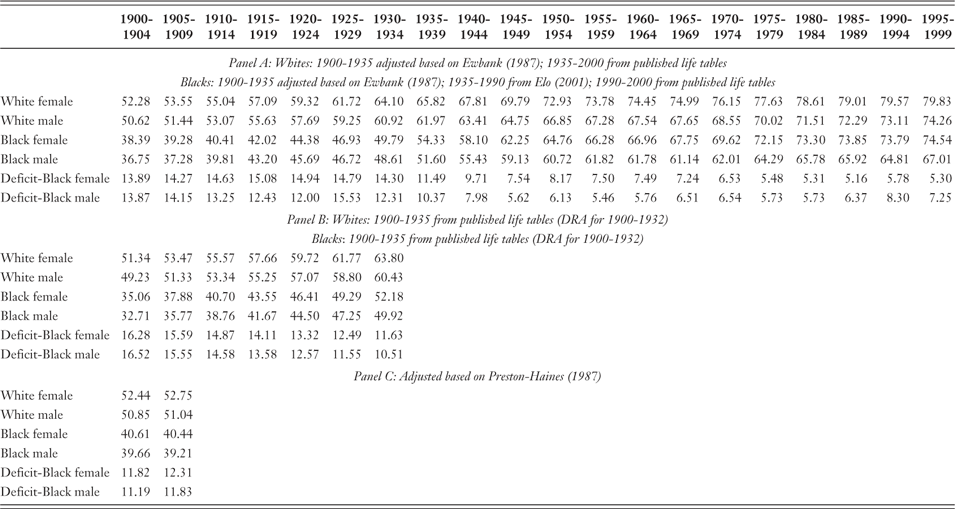
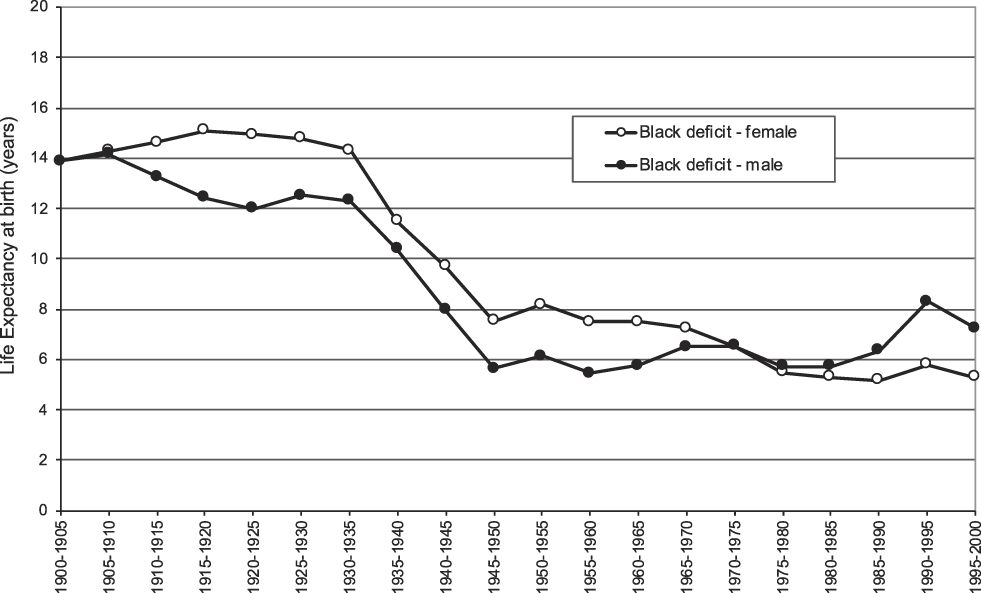
The resulting estimates of life expectancy by race and gender for five-year intervals from 1900 through 1999 are presented in Table A1.1 and Figure A1. For comparison, Table A1.1 also presents life-expectancy estimates from the unadjusted DRA data for 1900–1935. The Ewbank-adjusted mortality rates provide estimates of life expectancy that align closely with the historical evidence about trends in Blacks’ living conditions from 1900 to 1935. And the differences between the Ewbank-adjusted estimates and the unadjusted DRA estimates are generally consistent with our expectations: the DRA data do yield a substantially higher racial life-expectancy gap for both Black males and females for 1900–1904, but that rapidly diminishes and becomes differentiated by gender. For males, the larger racial gap in the DRA data diminishes steadily until 1924, after which it reverses to become smaller than our Ewbank-adjusted estimates for 1925–1934; for females, the racial gap in the DRA data becomes approximately equal to our Ewbank-adjusted estimates by 1910–1914, and thereafter the DRA data yield a smaller racial gap for 1915 through 1934. For the century as a whole, our Ewbank-adjusted estimates indicate a life-expectancy deficit of about 14 years for both Black males and females at the beginning of the century, followed by a bumpy downward trajectory to a deficit of 8.3 years for Black males and 5.3 years for Black females by the end of the century. (A more detailed discussion of the trends in the racial life expectancy gap over the century is provided in Appendix 1.)
METHODS
To estimate the excess deaths that Blacks experienced because of racial inequality in mortality, we compare the observed number of African American deaths in each half-decade with the estimated number that would have occurred in the same half-decade if they had experienced the same mortality rates as Whites. The counterfactual of racial equality is employed as a measurement device. It is neither realistic nor necessary to propose that racial equality (social, economic, and political) might have been introduced abruptly in 1900 or that its impact on mortality would have been instantaneous. Instead, the assumption of equal mortality is used as a benchmark against which to measure the impact of twentieth-century racial inequality. The estimation of excess deaths thus replicates the logic of the Gini coefficient, which uses the counterfactual standard of income equality as a tool to measure the extent of income inequality in a population (Gini Reference Gini1921; King et al., Reference King, Keohane and Verba1994).Footnote 2
We estimate the excess number of African Americans who died, E, in each discrete five-year period from 1900 through 1999, by comparing (1) the Black population at the end of each five-year interval estimated with the observed Black mortality rates, POPt+5, and (2) the Black population at the end of each five-year interval estimated under the counterfactual assumption that Blacks experienced the same age- and gender-specific mortality rates as Whites,  ${\rm{POP}}_{t + 5}^ *$:
 $${E_{t + 5}} = PO{P_{t + 5}} - POP_{t + 5}^*.$$
Equation 1 estimates the number of excess deaths among African Americans during each discrete half-decade—that is, the number of African American deaths that would have been avoided during each five-year period if the mortality rates for Blacks had equaled those of whites. We restrict this analysis to those aged from birth to seventy-nine years.Footnote 3
We estimate  $PO{P_{t + 5}}$ and
 $POP_{t + 5}^*$ using the component method of population projection (Newell Reference Newell1988; Pollard et al., Reference Pollard, Farhat and Pollard1974) such that
 $$PO{P_{t + 5}} = \left( {POP_t^{AA} + {}_5B_t^{AA} + {}_5I_t^{AA} - {}_5D_t^{AA}} \right)$$
and
 $$POP_{t + 5}^* = \left( {POP_t^{AA} + {}_5B_t^{AA} + {}_5I_t^{AA} - {}_5D_t^W} \right),$$
where  $POP_t^{AA}$ is the observed African American population count at the start of each five-year interval,
 ${}_5B_t^{AA}$ is the number of African American births between t and t+5,
 ${}_5I_t^{AA}$ is the net addition to the population through Black immigration between t and t+5, and
 ${}_5{D_t}$ is the number of deaths between t and t+5, applying the adjusted mortality rates for either Blacks
 $\left( {{}_5D_t^{AA}} \right)$ or Whites
 $\left( {{}_5D_t^W} \right)$. All estimates are gender- and age-specific and calculated using data corrected for relevant reliability issues (see Appendix 1).Footnote 4
Our measure of excess deaths should be differentiated from estimates of life expectancy at birth, which project the average length of life for people born in a given year assuming they experience the current schedule of mortality rates as they age. Life expectancy projections are necessarily affected by the age distribution of death rates, with high mortality rates in infancy and childhood being especially influential in lowering average life expectancy (indeed, low average life expectancy generally reflects high rates of infant and child mortality). Death rates at later ages are progressively less damaging to life expectancy estimates. Thus, a differential between two groups in life expectancy reflects differences in both the magnitude and age distribution of their mortality rates. In essence, it captures the average years of life lost in the disadvantaged group. Because life expectancy is estimated for a standard population, it is abstracted from the observed population, in which variation in population size and distribution by gender and age affect the actual human impact of mortality differentials. And because life expectancy is an average, the estimates cannot be summed over time to assess the cumulative toll of inequality over successive periods.
In contrast, we apply age- and gender-specific mortality rates to the observed Black population to generate a simple count of the number of excess deaths that occurred among Blacks in discrete five-year intervals from 1900 through 1999. In this accounting, each death carries the same weight, whatever the age at which it occurred. Because our estimate is a raw count of excess deaths in the observed Black population at a particular time point, it is influenced by the size and the age and gender distribution of that population (since mortality rates vary by age and gender). The excess deaths from discrete time periods can be compared to track trends (as with life expectancy), but they also can be summed to assess the cumulative death toll over the twentieth century that is attributable to racial inequality.
RESULTS
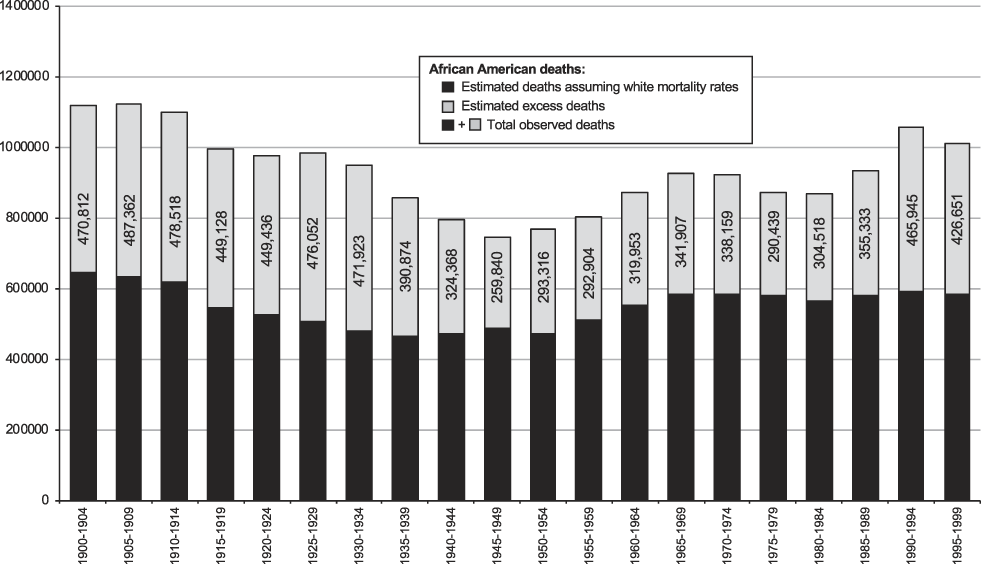
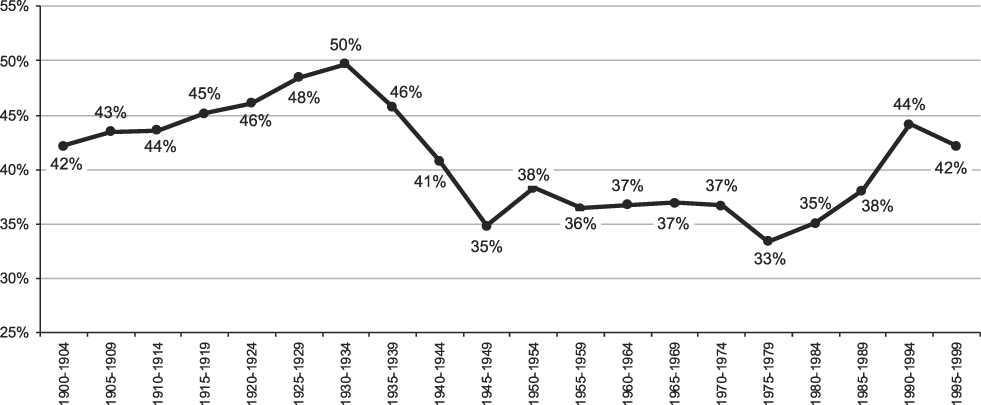
Figure 1 displays the total observed number of deaths among African Americans from birth to age seventy-nine, for discrete half-decades from 1900 through 1999. Those totals are partitioned into two components: (1) the estimated number of deaths that Blacks would have experienced if their mortality rates had equaled the lower rates of Whites, and (2) the additional deaths, i.e., the excess deaths, that Blacks experienced because their mortality rates were higher than Whites’. To assess the contribution of the excess deaths to the total death toll among Blacks, Figure 2 displays the percentage of all observed Black deaths that were excess for each half-decade.
Total observed deaths, partitioned into estimated deaths assuming White mortality rates and excess deaths, for Africans Amercians aged 0-79, by half-decade 1900-1999

Percentage of total observed deaths that were excess for African Americans aged 0-79, by half-decade 1900-1999

Prevalence of Excess Deaths
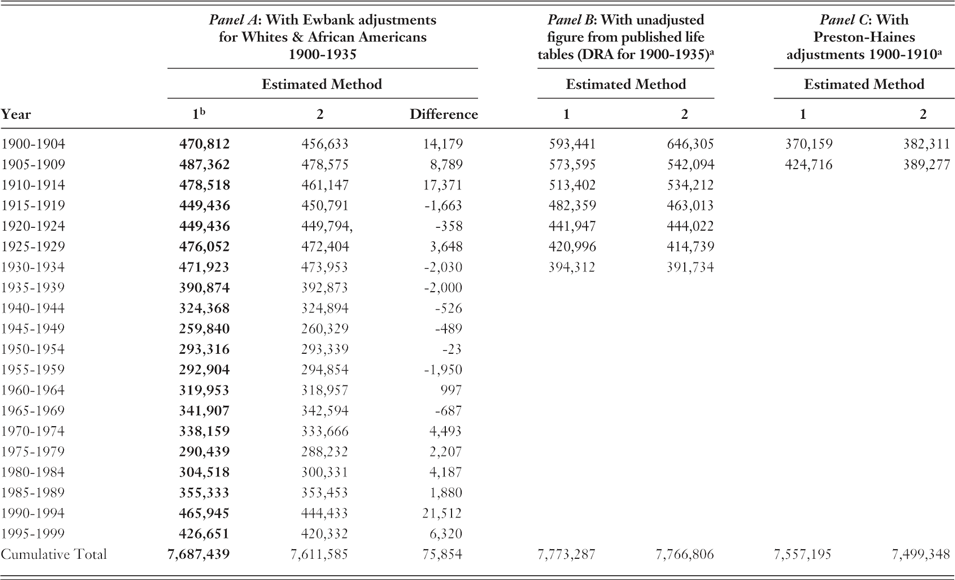
The number of excess deaths was large in every half-decade of the twentieth century, ranging from about 260,000 to about 487,000. The excess deaths always constituted a substantial percentage of all observed African Americans’ deaths: in the worst period (1925–1934) about one half of their deaths were excess deaths, and even in the best periods (1945–1949 and 1975–1979) excess deaths still comprised about one third of all Blacks’ deaths. Thus, the excess deaths critically increased the prevalence of death in Black communities throughout the twentieth century. The cumulative total of excess deaths across the twenty half-decades of the century was almost 7.7 million (see Appendix 2, Table A2). These constituted over 40% of all observed Black deaths over the century.
Trends in Excess Deaths
There was some amelioration in the number and percentage of excess deaths over the century, but progress was unstable. The percentage of deaths that were excess was generally highest in the early decades, peaking from 1925 to 1934. Then it dropped significantly from 1935 to 1949, following the passage of the Social Security Act. The percentage rose again slightly in 1950–1954, and then stayed fairly level before a small, brief dip to the lowest level of the century in 1975–1979, following the policy advances in social welfare and civil rights that were introduced in the 1960s. But after that, the excess deaths began to increase again, reaching levels in the 1990s that were comparable to those experienced in the first decade of the century. Neither of the two best half-decades (1945–1949 and 1975–1979) set a new standard that was built upon in subsequent years. And the last fifteen years of the century brought a steep rise in the number and percentage of excess deaths. Although the period from 1985 to 1999 did not match the worst period of the century (1925–1934), the percentage of deaths that were excess in the 1990s reverted to levels as high as the first decade of the century (42%–44%).
Overall, there were fewer excess deaths during the second half of the century (3,429,126) than in the first half (4,258,313), despite the increasing size of the Black population; and the contribution of the excess deaths to Blacks’ cumulative death toll was lower between 1950 and 1999 (38%) than it was for 1900–1949 (44%). This reflects the fact that the racial gap in mortality rates was generally narrower in the second half of the century (data not presented here). Yet there was no period during the second half of the century that yielded a sustained trend of decline in excess deaths to match the sharp decline from 1935 to 1949: any progress made after 1950 was modest, halting, and unstable.Footnote 5
Comparison between Trends in Excess Deaths and the Racial Life Expectancy Gap
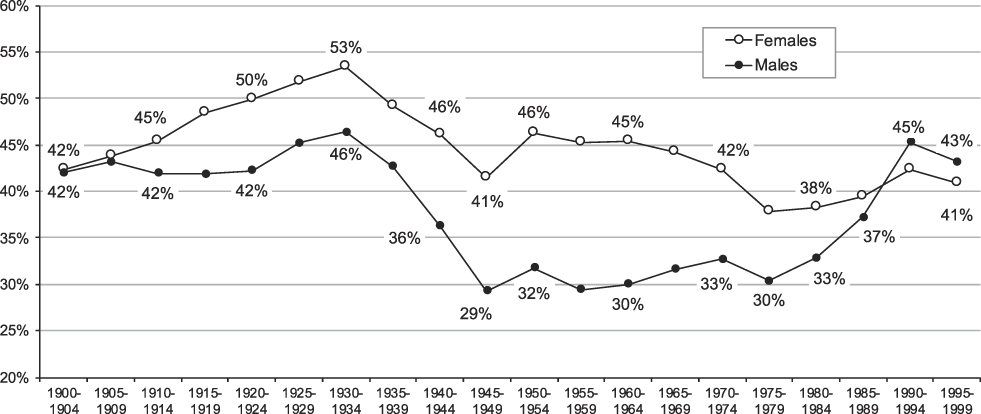
The trends and fluctuations in excess deaths over the twentieth century are broadly consistent with those observed for the racial gap in life expectancy at birth, but there are some notable divergences. Both declined steeply from 1935 to 1949 and then more slowly, with some fluctuation, until the 1980s when they reversed and began to rise. For excess deaths, however, the reductions after 1950 were more modest, and the negative reversal at the end of the century started a little earlier and became more consequential in the 1990s than for life expectancy. In 1990–1994, the racial gap in life expectancy increased moderately for Black females (to almost a six-year deficit) and more steeply for Black males, pushing Black males’ deficit back up to a level not seen since 1940–1944 (to about eight years)—but still leaving the deficit for both males and females substantially smaller than the racial gap in life expectancy (of about fourteen years) in the first decade of the century. By comparison, the percentage of excess deaths for both males and females (see Figure 3 below) shot back up for all of the last decade to levels that were at least as high as in the first decade of the century. In sum, the declines in excess deaths after 1950 were more modest and less stable than in the racial life expectancy gap, and they portray a less sanguine picture of advances in racial equality over the century.
Percentage of total observed deaths that were excess for African Americans aged 0-79 by gender, by half-decade 1900-1999

The divergence is explained by the changing age distribution of deaths over the century, which was the product of changes in both the age distribution of mortality rates and the age distribution of the Black population. We address this issue more fully below. For now, we note that infant and child mortality rates plummeted over the century for all Americans as infectious diseases were quelled and more births were medically attended. Blacks’ significant gains over the century in narrowing the racial gap in life expectancy were driven by and anchored in this dramatic shift. Once improvements were introduced in sanitation, public health, and medical practice, they became permanent societal features that continued to improve survival rates for babies and young children over the century. At the same time, the survival rates for adults improved more modestly. As a higher proportion of the population survived to adulthood, the distribution of the population increasingly shifted to older ages where mortality rates and the racial gaps in mortality rates became relatively large.Footnote 6 Those death rates and racial disparities are less detrimental to life expectancy estimates because they occur at older ages, but in our estimates of excess deaths they have the same weight as deaths at younger ages. It is important to acknowledge the increasing racial mortality gap among mature adults because, as we discuss below, it has far-reaching effects on Black families and communities and it poses a more complicated and daunting policy challenge than racial disparities in infant and child mortality.
Excess Deaths by Gender and Age
Decomposition of excess deaths by gender and age reveals the population dynamics underlying trends in their incidence and provides insight into their social and experiential impact.
Figure 3 presents the percent of deaths that were excess for males and females, by half-decade from 1900 through 1999. The toll of excess deaths was especially heavy among Black females. For the century as a whole, excess deaths constituted almost 45% of Black females’ deaths, compared with 38% of Black males’ deaths. Excess deaths comprised a larger percentage of Black females’ deaths in every decade except the first (when there was no gender difference) and the last (when males’ percentage of excess deaths overtook females’).Footnote 7 The female disadvantage was especially large in the middle decades (the 1940s–1960s), when excess deaths generally constituted 44%–46% of Black females’ deaths compared with 31%–33% of Black males’ deaths. Additional analyses (data available on request) show that the female disadvantage was felt in every age group, but it was especially pronounced among adults aged fifty to sixty-nine (among whom the percentage of excess deaths was 20%–25% higher for females than for males in the 1940s–1960s).
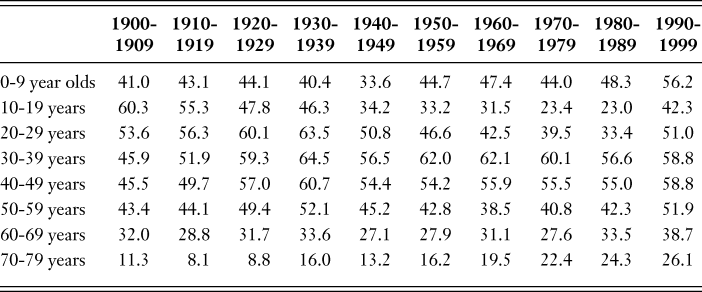
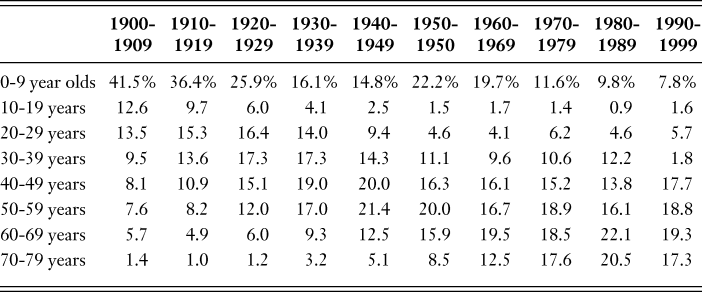
Table 1 presents the percent of deaths that were excess for eight age groups, summarized by decade, for 1900–1999. Over most of the century, the highest percentage of excess deaths occurred among those aged twenty to forty-nine—that is, adults in the prime years of the life course when key life investments are being made that underpin the social and economic stability of families and communities. In the early decades, it was the younger members of this age range who had the highest percentage of excess deaths (about 54%–64% among those aged twenty to twenty-nine), but this began to shift in the 1920s and by mid-century it was those aged thirty to forty-nine who had the highest percentage of excess deaths (about 54%–62%), and by the 1990s it was those aged thirty to fifty-nine who had the highest percentage of excess deaths (about 52%–59%).Footnote 8 Black females contributed disproportionately to those high percentages, especially from the 1940s through the 1960s (data available on request).
Percentage of deaths that were excess, by age group, for African Amercians aged 0-79, by decade 1900-1999

Not surprisingly, the oldest age group (seventy to seventy-nine years) had the smallest percentage of excess deaths in every decade (although those percentages are likely understated because of age misreporting among older African Americans (Preston and Elo, Reference Preston and Elo2006; Preston et al., Reference Preston, Elo, Rosenwaike and Hill1996)). However, the percentage of their deaths that were excess increased over the century, starting in the 1930s. In the first three decades of the century, only 8%–11% of the deaths in this age group were excess, whereas by the last decade it had more than doubled to 26%. This reflects the increasing prominence of chronic diseases (which have more of an impact on mature and older adults) as causes of death.
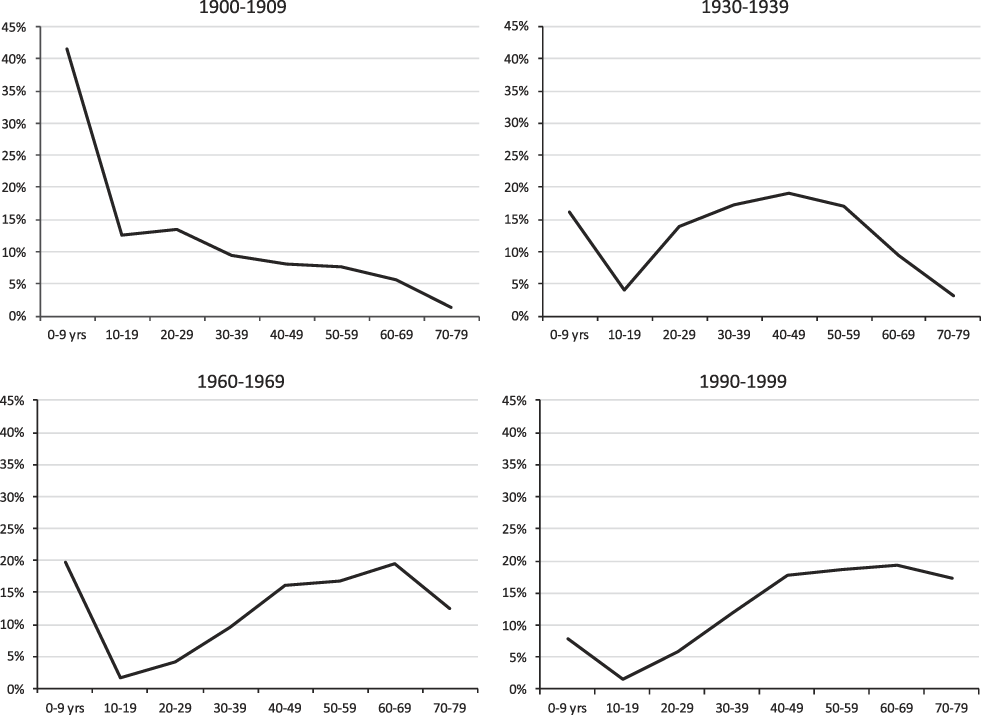
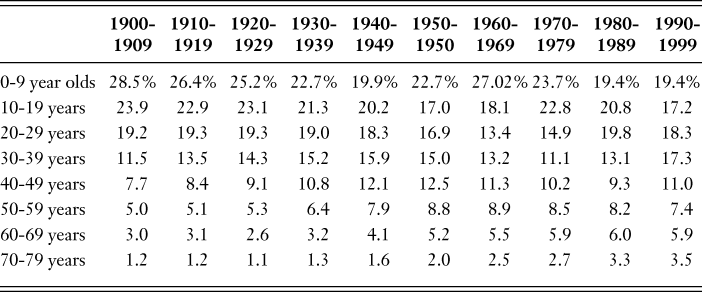
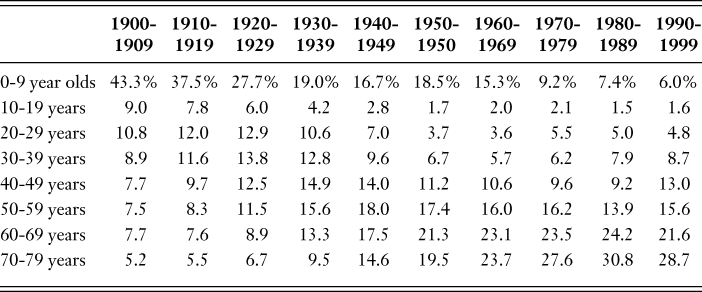
The percentage of deaths that were excess in the youngest age group (birth to age nine) also increased somewhat, from 41% in the first decade to 56% in the last, even as infant mortality declined steeply for all Americans. Most of the increase occurred in the last two decades of the century, when the racial gap in infant mortality accelerated to put Blacks’ infant mortality rates at about two and a half times those of Whites (Farley Reference Farley1996; Gennuso et al., Reference Gennuso, Blomme, Givens, Pollock and Roubal2019; Rossen and Schoendorf, Reference Rossen and Schoendorf2014; Satcher et al., 2005; Singh and Stella, 2019). This suggests that the public-health and medical advances that reduced overall mortality among infants and young children gave an increasingly disparate benefit to Whites toward the end of the century, either because of lagged delivery to Blacks or because other health-related conditions experienced by Blacks counteracted those advances. At the same time, the steep decline in infant mortality for all Americans meant that the increased percentage of excess deaths in the youngest age group made a much smaller contribution to Blacks’ total death toll by the end of the century. Figure 4 illustrates the trend in the age distribution of excess deaths for four selected time points over the century; Appendix 3 presents complete data for the age distribution of both excess deaths and all observed Black deaths for the ten decades of the century (see Tables A3.2 and A3.3). These data show that in the first decade, deaths among infants and young children (birth to age nine) accounted for a staggering 41.5% of excess deaths and 43% of all observed deaths among African Americans; by the last decade, those percentages were radically reduced to about 8% and 6%, respectively.
Age distribution of excess African Americans deaths, for selected decades, 1900-1999

As the twentieth century progressed, a greater proportion of the Black population survived to mature adulthood (see Appendix 3 Table A3.1), where chronic diseases awaited as the primary causes of death. Thus, the age distribution of Blacks’ deaths (both total observed and excess) shifted so that a smaller proportion occurred among those between birth and age twenty-nine and a larger proportion occurred among those aged forty and over. Table A3.3 shows that in the first decade of the century, the age distribution of excess deaths was overwhelmingly young (with about 68% of excess deaths coming from the three youngest age groups combined), and the percentages diminished across successive age groups. But by the last decade, the largest contribution to excess deaths (about 73%) came from those aged forty and over, with about 17%–19% coming from each of the four oldest age groups. Additional analyses indicate that this trend was slightly more pronounced among females, who were also more likely to survive to older ages (data available on request). If we focus on adults in the prime economic years of the life course (ages thirty to fifty-nine), their combined contribution to excess deaths more than doubled between the first decade of the century and the 1930s and 1940s (from about 25% to well over 50%), declining only slightly thereafter until the 1990s when their contribution rose again to about 48% of all excess deaths. Thus, the first half of the century had a somewhat larger toll of excess deaths overall, but a high proportion of those deaths were among the youngest members of the community (especially infants and young children), whereas excess deaths in the second half of the century struck more heavily among mature adults, most of them in the prime of life.
DISCUSSION
Over the decades of the twentieth century, we estimate that a total of almost 7.7 million excess deaths occurred among African Americans because of the racial gap in mortality rates. This estimate is probably conservative, given the procedures we used (see Appendix 1). To put that number in perspective, it is equivalent to almost one half of the observed Black population at mid-century of 16.2 million. The excess deaths constituted over 40% of all African American deaths over the century, thus critically increasing the prevalence of death in Black communities.
During the early twentieth century, excess deaths occurred disproportionately among the young, but in the succeeding decades they hit progressively harder among older African Americans whose economic and social pursuits were vital to their families and communities. Excess deaths were also especially heavy among Black women for most of the century (1910s–1980s), underscoring the well-documented reality that Black women have not shared in the privileges and protections that were increasingly extended to White women as general social affluence improved over the twentieth century (Farley Reference Farley1996; Farley and Allen Reference Farley and Allen1987; Jones Reference Jones1985). Our estimates suggest that for most of the twentieth century the accumulated hardships and stressors that assaulted the lives of Black women set them further apart from White women than the comparable disparity in quality of life that existed between Black and White men.
African Americans’ quality of life over the twentieth century was blighted incalculably by the excess deaths that battered their families and communities. But those deaths have evaded public awareness because most of them occurred, not from starkly visible events or murderous acts of racial aggression, but instead as the gradual, incidental fallout from an enduring regime of racial stratification. That regime was designed to subjugate and control African Americans, not to annihilate them, but the result was that Blacks’ bodies were subjected to the chronic, everyday injuries of racial discrimination and economic inequality. The inevitable outcome was that Blacks fell ill and died at much higher rates than Whites.
The excess deaths occurred one by one, from a variety of proximate causes, temporally lagged from the multitude of toxic exposures—delivered by seemingly unconnected institutions and individuals—that inflicted a wide range of health injuries. All of these factors have conspired to cast a haze over the vast majority of the excess deaths that result from racial stratification, pushing any inferences of causality or culpability beyond ordinary comprehension. Of course, those who benefit from the inequality have little incentive to investigate its costs. But the manner in which most excess deaths occur makes it difficult even for those who live amidst them to attribute them to systemic rather than individual causes. Baldwin’s bold assertion in 1962 that “my country and my countrymen…have destroyed and are destroying hundreds of thousands of lives and do not know it and do not want to know it” was surely viewed as radical by most of his contemporaries. But even with his remarkable prescience he underestimated the human toll from racial inequality by several million.
Trends over the Twentieth Century
The toll of excess deaths was especially severe in the early decades, when Blacks’ social and material welfare was at its nadir, but the count remained high throughout the century, even as life expectancy improved for all Americans and the racial gap in average life expectancy narrowed. In the worst half-decade (1930-1934) Blacks’ excess deaths comprised one half of all observed Black deaths, but even in the best half-decade (1975-1979) excess deaths still constituted one third of all observed Black deaths. The only sustained period of improvement was 1935–1949, when the introduction of broad-based social programs and public health measures defeated the common infectious diseases that had preyed more heavily on the poor, and thus on African Americans. Those public health advances had a lagged delivery to the disadvantaged members of society, but once delivered, they provided them with an immediate, disproportionate benefit. This is consistent with the general historical pattern for Western nations, where the only significant reduction in the socioeconomic mortality gradient followed the conquest of infectious diseases that had claimed more victims among the disadvantaged (Antonovsky Reference Antonovsky1967).
The second half of the twentieth century brought no comparable period of sustained decline in excess deaths, but instead delivered considerable instability. In the 1950s and 1960s, the toll of excess deaths remained well below the pre-1935 levels, but it rose slightly from the low point of 1945–1949. A century low was briefly attained in 1975–1979, following the passage of civil rights legislation and the rollout or expansion of several social welfare programs (most notably, the rollout of Medicare and Medicaid and the expansion of Aid to Families with Dependent Children (AFDC), Food Stamps, Supplemental Security Income (SSI), and racially integrated hospitals). But after that, excess deaths increased steeply again, driven primarily by a new infectious disease, AIDS, and the rapid rise in homicides and drug addiction in economically blighted urban ghettos. By the 1990s the number and percent of African American deaths that were excess had climbed back up to levels comparable to those experienced in the first decade of the century, despite the fact that the racial gap in life expectancy was significantly smaller at the end of the century than it had been at the beginning.
The Racial Life Expectancy Gap and Excess Deaths
The disparity between the racial gap in life expectancy and the incidence of excess deaths at the end of the twentieth century highlights the changing age distribution of African American deaths. In the first decade of the century, Blacks’ deaths were overwhelmingly among the youngest age groups, especially infants and young children. But as more people survived to adulthood and chronic diseases replaced infectious diseases as the leading causes of death, the age distribution of deaths shifted increasingly to mature adults. Both of those trends reduced the racial gap in life expectancy, whereas they did not reduce estimates of excess deaths because the latter assign equal weight to all deaths that result from the racial gap in mortality rates, regardless of age at death. Taken together, these two measures provide a richer picture of the depth and nature of the racial mortality differential over the twentieth century. The public policy programs and advances in infrastructure that quelled infectious diseases in the early decades of the century had an enduring positive effect on the racial gap in estimates of life expectancy, primarily because they dramatically reduced infant and child mortality rates. But those estimates mask the continued racial disparity in living conditions that has kept Blacks much more vulnerable to the chronic diseases that strike mature adults.
Social and Policy Implications
The shifting distribution of the excess death toll toward mature adults has significant social implications. Increasingly, African Americans have been losing community members who were the social and economic anchors of their families and communities. This adverse development was exacerbated by the disproportionate incidence of excess deaths among Black females for most of the century, since Black women are often the primary or sole contributors to their families’ social and economic welfare. From this perspective, the positive impact of the dramatic reduction in the overall toll of excess deaths in the 1930s and 1940s was likely diminished by the countervailing trend of adults in their prime economic years (ages thirty to fifty-nine) comprising an increasing proportion of excess deaths. Deaths at any age inflict a heavy burden on the survivors, but deaths of mature adults inflict a more pervasive arc of loss. Families not only endure the social and emotional wounds that follow the death of any family member; typically they also suffer economic loss, often catastrophically. These stressors burden the surviving family members, in turn amplifying their vulnerability to illness and death (Evans and Kim, Reference Evans and Kim2010; Umberson et al., Reference Umberson, Olson, Crosnoe, Liu, Pudrovska and Donnelly2017). And the damage also extends into the social, economic, and political networks of communities when they are ruptured by the loss of mature actors (Umberson et al., Reference Umberson, Olson, Crosnoe, Liu, Pudrovska and Donnelly2017). When deaths disrupt community networks repeatedly over sustained periods, the collective will is capriciously undermined, corroding efficacy and morale (McNeill Reference McNeill1998).
The increasing significance of chronic diseases among mature adults has also posed a more complex, daunting problem for public policy. Infectious diseases could be conquered with technological advances and straightforward policy measures (e.g., improved sanitation, refrigeration, and rudimentary public health programs) that brought benefits across all socioeconomic levels, even as serious economic inequality remained in place. Those advances brought immediate benefits to those with higher SES; distribution to the less privileged was delayed but they then benefitted disproportionately because their living conditions were more unhealthy.
The etiology of chronic diseases, however, is more intricately embedded in the everyday fabric of social inequality, as many of the endemic features of lower SES and lower racial status (e.g., lower education, economic insecurity, substandard housing, hazardous workplaces, more exposure to pollutants, lower personal control and autonomy, vulnerability to discriminatory treatment, higher daily levels of stress) pummel the human body from in utero and infancy onwards and gradually increase people’s susceptibility to such chronic diseases as hypertension, stroke, heart disease, cancer, diabetes, and cirrhosis. The eradication of mortality differentials from chronic diseases thus requires more directly redistributive policies that would dismantle elements of the inequality itself (e.g., free and equal medical care, free and equal education, government-subsidized quality housing, redistributive taxation and income policies, equal treatment and protection from the criminal justice system, and increased governmental and business investment in impoverished communities, to name a few).Footnote 9
Such policies would address the excess death toll simultaneously from both class and racial inequality, but they would require a radical change in America’s social and economic priorities. Targeted redistributive policies routinely face stauncher political opposition from those who fear a diminution of their societal advantages. Another political hurdle is posed by the etiology of chronic diseases: because they generally result from cumulative exposures over decades, there would be a significant time lag before the health benefits of far-reaching, redistributive policy initiatives would be fully manifested. This amplifies the political costs of implementing and sustaining such policies: elected politicians have no incentive to pursue policy initiatives that do not deliver short-term results before they face competitors in the next election.
Early Indicators for the Twenty-first Century
The early years of the twenty-first century brought a welcome period of decline in the racial mortality gap. The trend began with a modest descent in the latter half of the 1990s from the historically high racial gap in 1990–1994 and then continued through to 2014. This sustained period of decline has fueled optimism among those who monitor the racial mortality gap (Tavernise Reference Tavernise2016). There are several factors, however, that cast shadows over that optimism.
First, Blacks’ mortality rates have indeed declined. But at the same time Whites’ mortality rates have been increasing, especially among lower income Whites (Alexander et al., Reference Alexander, Kiang and Barbieri2018; Case and Deaton, Reference Case and Deaton2015, Reference Case and Deaton2020; Crimmins Reference Crimmins2018; Gennuso et al., Reference Gennuso, Blomme, Givens, Pollock and Roubal2019; Harper et al., Reference Harper, Rushani and Kaufman2012)—this is not the preferred way to lower the racial gap. Much of the increasing mortality among Whites is attributed to the rapid rise in opioid addiction that affected Whites disproportionately (Alexander et al., Reference Alexander, Kiang and Barbieri2018; Case and Deaton, Reference Case and Deaton2015; Hummer and Gutin, Reference Hummer, Gutin, Hayward and Majmundar2018; Kochanek et al., Reference Kochanek, Arias and Bastian2016). In the late 1990s pharmaceutical companies began marketing new opioid drugs to physicians with energetic (false) claims that the new formulations were not addictive. The medical use of opioids then increased, as physicians began prescribing the new formulations as a welcome treatment for chronic pain (Case and Deaton, Reference Case and Deaton2015). But racial bias made them less likely to extend this apparent medical advance to Blacks (Hoffman et al., Reference Hoffman, Trawalter, Axt and Norman Oliver2016; Sabin et al., Reference Sabin, Nosek, Greenwald and Rivara2009; Van Ryn et al., Reference Van Ryn, Burgess, Dovidio, Phelan, Saha, Malat, Griffin, Fu and Perry2011; Williams and Cooper, Reference Williams and Cooper2019). This conforms to the general pattern of advances in medical care having a lagged distribution to Blacks. In this case, perversely, Blacks benefitted from being left out. (Alexander et al., Reference Alexander, Kiang and Barbieri2018; Frakt and Monkovic Reference Frakt and Monkovic2019; Katz and Goodnough Reference Katz and Goodnough2017). And regrettably, that benefit was only temporary: after 2010, the supply of opioids expanded beyond prescription medicine to the less expensive and more deadly illicit market, propelling an increase in Blacks’ opioid death rates that accelerated sharply after 2014 (Alexander, et al., Reference Alexander, Kiang and Barbieri2018; Frakt and Monkovic, Reference Frakt and Monkovic2019; Katz and Goodnough, Reference Katz and Goodnough2017).
Second, the incidence of excess deaths has not declined as steeply as the racial gap in life expectancy. Significant declines in the life expectancy gap were observed for 2000–2010 (Miniño et al., Reference Miniño, Murphy, Xu and Kochanek2011; Murphy et al., Reference Murphy, Xu and Kochanek2012), and by 2014 it had declined to an historic low of only 3.4 years (Tavernise Reference Tavernise2016), fully two years lower than the lowest racial gap achieved at any time during the twentieth century. The percentage of Blacks’ deaths that were excess (for those between birth and age seventy-nine) also declined, but less markedly—from their late-twentieth-century peak of about 44% in 1990–1994 to 42% in 1995–1999, just over 40% for 2000–2004, 36% in 2005–2009 and about 30% in 2010–2014. (All data from our twenty-first century analyses are available on request). Thus, by 2010–2014 the percent of deaths that were excess finally did fall below the lowest point of the twentieth century (of about 33% in 1975–1979), but by only about three percentage points. Between 2000 and 2014, African Americans lost a cumulative total of well over one million people in excess deaths, and in the last five years of that period, the racial gap in mortality rates was still responsible for close to one third of African Americans’ deaths.
Third, although infant mortality rates have maintained their overall decline in the twenty-first century (Mathews and Driscoll, Reference Mathews and Driscoll2017), the percent of deaths that were excess among the youngest African Americans (birth to age nine) actually increased over their previous peak of 56% in the 1990s to 65% in 2000–2004, before declining gradually to 53% by 2010–2014, which is still only slightly lower than in the 1990s. The decline after 2004 is encouraging, but shockingly more than one half of the deaths among the youngest African Americans in 2010–2014 still stem from the racial mortality gap. The persistently high racial disparity in infant mortality, along with the higher incidence of pregnancy-related maternal deaths among Black women, has been the subject of much recent scholarly research and journalistic coverage (Creanga et al., Reference Creanga, Syverson, Seed and Callaghan2017; Gennuso et al., Reference Gennuso, Blomme, Givens, Pollock and Roubal2019; Liese et al., Reference Liese, Mogos, Abboud, Decocker, Koch and Geller2019; Rossen and Schoendorf, Reference Rossen and Schoendorf2014; Singh and Stella, 2019; Villarosa Reference Villarosa2018).
Fourth, among those over age nine, it is mature adults in the prime of life (ages thirty to fifty-nine) who continue to have the highest percent of deaths that are excess, despite declines across all age groups. In 2000–2004, the percent of deaths that were excess among Blacks aged thirty to fifty-nine declined from the 1990s, but nevertheless about one half of their deaths were excess; there were further declines after that, but by 2010–2014 slightly more than one third of their deaths were still excess. The continuing preponderance of mature adults in the age distribution of deaths accounts for the less dramatic declines in excess deaths than in the racial life-expectancy gap in recent years. It is good news that Blacks are losing fewer average years of life than they formerly did. But the social benefits of that positive change are counteracted by the continued trend of excess deaths striking hardest among mature adults, who are critically important for the social cohesion and economic security of Black families and communities.
Finally, as this paper goes to press in April, 2020, in the midst of the COVID-19 pandemic, there are numerous reports of large racial, ethnic and class disparities in the incidence of and deaths from this disease in the United States (see, e.g., Cohen Reference Cohen2020; Johnson and Buford, Reference Johnson and Buford2020; Mays and Newman, 2020; Thebault, et al., Reference Thebault, Tran and Williams2020). Among localities reporting data by race, the disparities are often alarmingly large. As with the infectious diseases of the twentieth century, COVID-19 has been killing African Americans more than Whites. In the familiar pattern, ongoing racial inequalities in the allocation of societal resources diminish Blacks’ opportunities to avoid exposure to this highly contagious infection, and, in a double hit, their disproportionate experience of hardships throughout their lives leaves them with a higher incidence of chronic health conditions that exacerbate the severity of their infections. This sends up yet another flare, reminding us that racial inequalities in the quality of life continue to have dire consequences for Blacks’ health and physical survival.
CONCLUSION
As we trace the trends in excess Black deaths from the twentieth-century low that was briefly grasped in the 1970s through the subsequent surge in excess deaths in the 1980s and 1990s and the gradual but sustained declines from 1995 through 2014, we have to ask why the recent improvements occurred and whether they are robust or fragile. The twentieth century low-point in excess deaths was briefly achieved about a decade after the rollout or expansion of several social welfare programs in the 1960s. We conjecture that the sudden appearance of a new infectious disease, AIDS, and the steep increase in drug addiction and homicides in the 1980s and 1990s drowned out the gains that were beginning to be made by social policy. When those afflictions subsided in the late 1990s, the benefits of the social welfare programs resurfaced in the declining racial mortality gap from 1995 to 2014. Since chronic diseases are now the main contributors to the continuing racial mortality gap, we would expect a lagged effect from social welfare programs that target families and children. By providing healthier conditions for infants and children, the programs that were rolled out or expanded in the 1960s made it possible for more individuals to mature with less vulnerability to chronic diseases. Johnson’s (2017) research tracking cohorts born during the rollout of Medicaid provides evidence that the lagged pay-offs were indeed manifested well into adulthood.
But the United States maintains an ambivalent disposition, at best, toward redistributive policies aimed at the reduction of poverty and inequality. The Affordable Care Act eventually passed in 2013 only after substantial compromises that limited its effectiveness (e.g., seven of the ten states with the largest Black populations opted out of the ACA offer to expand Medicaid benefits (Duggan and Scimeca, Reference Duggan and Scimeca2017; Johnson Reference Johnson2017)). And the ACA has been under relentless political attack since its inception, barely escaping abolition by Congress in 2017 and suffering continued challenges and cuts in 2018 and 2019. In the meantime, income inequality in the United States has continued to grow, perpetuating a trend that has been observed since the 1970s (Saez Reference Saez2016; Leonhardt and Thompson, Reference Leonhardt and Thompson2020)—and differentials across education and income levels in mortality rates and life expectancy have also increased in recent years (Bor, et al., Reference Bor, Cohen and Galea2017, Chetty et al., Reference Chetty, Michael Stepner, Abraham, Lin, Scuderi, Turner, Bergeron and Cutler2016; Crimmins Reference Crimmins2018; Leonhardt and Thompson, Reference Leonhardt and Thompson2020). Added to those trends, the racial gap in family income increased in the early years of the twenty-first century (Isaacs Reference Isaacs2010), and the racial gap in wealth, already substantial, increased dramatically, with Black families’ median net worth only about 8% of White families’ in 2013 (Shapiro Reference Shapiro2017; Taylor et al., Reference Taylor, Kochhar, Fry, Velasco and Motel2011).
The twenty-year period from 1995 through 2014 presents a longer period of decline in the racial mortality gap than at any time during the twentieth century. The civil rights legislation and social policies of the 1960s and 1970s, limited as they were, do appear to have made a dent in the racial death gap. That said, the political and economic realities in the United States do not encourage optimism about the years to come. Policies to address economic and racial inequalities in the United States have been sporadic, limited in scope, and subject to bitter political opposition. Indeed, in recent years more political energy has been directed toward cutting back or abolishing what were already limited civil rights advances and social welfare programs, rather than trying to expand them. At the same time, Black families and communities continue to be undermined by excessive illness and death. Three trends are especially troubling: the continued prevalence of excess deaths among Blacks in the prime years of the life course; the persistently higher rates of infant and maternal deaths among Blacks, even as infant and maternal mortality rates have declined overall; and the recent increase in Black deaths from opioids, as illicit, non-prescription opioids have infiltrated Black communities. Added to this, the large racial disparities being reported in deaths from COVID-19 infections in the early weeks of this pandemic threaten to cause a surge in excess Black deaths in 2020 similar to that of the 1990s.
In short, the death toll from racial inequality abated somewhat in the early years of the twenty-first century, but troublesome issues persist. Those issues are driven by racial inequalities in the allocation of societal resources that have framed Blacks’ lives for a long time. Unless there is a change in our political and economic priorities, optimism about the future thus seems misplaced. Without a significant, tangible change in the current regime of racial and economic inequality, we expect that Americans will continue to confront a calloused political economy of race, with the attendant blight of disproportionate illness and death among African Americans.
ACKNOWLEDGMENTS
The authors gratefully acknowledge the invaluable advice and feedback given by Douglas C. Ewbank, Reynolds Farley, and Samuel H. Preston at the outset of this project. This paper also benefitted immeasurably from the comments and suggestions of numerous other scholars, most notably James Cramer, Eric Grodsky, Robert W. Jackman, Ronald Lee, William D. McCarthy, Barbara Reskin, Franklin D. Wilson, and anonymous reviewers. Any remaining errors or omissions are the authors’ sole responsibility.
APPENDIX 1: DATA SOURCES AND ADJUSTMENTS
We compiled data from a large number of sources for mortality rates, fertility rates, net immigration, and population estimates by race, sex, and five-year age groups for 1900–2014. Where necessary, we introduced adjustments to correct for data issues. The most pervasive issues for data from the twentieth century are the under-registration of deaths and births and under-enumeration in Census population counts. For much of the twentieth century, especially after 1935, we could rely on published sources that have made the necessary data adjustments, but this was not always the case for the years prior to 1935. For each type of data, we outline pertinent data issues, explain our procedures for any necessary adjustments, and list our sources for both baseline data and adjustments.
Mortality Rates
For 1935–2000, published sources are available that provide corrected mortality data (listed below). Prior to 1935, however, official statistics for registered deaths are incomplete and there are no published studies that provide adjusted mortality data. The first source of death statistics, the Death Registration Area (DRA), was initiated by the Bureau of the Census in 1880 and it did not include all states until 1933; before 1910 representation was restricted primarily to Northeastern states where the Black population was small and uncharacteristically urban. By 1920, the DRA included most Southern states and by 1930 Texas was the only state that was not included (Dunn 1968; Hetzel 1997).
Because living conditions are thought to have been even less healthy in urban than in rural areas, especially for the poor, the DRA data are believed to overstate Black mortality rates, particularly infant mortality, and to overstate Whites’ mortality more mildly (Ewbank 1987; Preston and Haines, 1984). When one considers all of the relevant factors, however, the DRA mortality data are probably not as far off the mark for African Americans as is generally believed.
First, living conditions were certainly unhealthier for the urban poor than for the rural poor at the start of the century, but the urban disadvantage should have gradually diminished from 1910 to 1930. In the 1910s and 1920s, cities were gradually improving their sanitation systems and milk supply (Ewbank 1987), at the same time that rural Blacks’ poverty was increasing with detrimental effects on their diet and housing (Farley 1970; Farley and Allen, 1987; Myrdal 1944). Second, the lower infant mortality rates reported for rural areas may be at least partially an artifact of the under-registration of Black births and deaths in the rural South. The full extent of under-registration has been debated, but registration of births and deaths required contact with a physician, mid-wife, undertaker, or registrar (Dunn 1968), which impoverished, socially neglected, rural Blacks were less likely to have. Many rural Blacks probably buried their dead kin on their land (especially infants and children) without the ministrations of a physician, mid-wife, or undertaker who would have been financially or racially out of reach. Thus, as the DRA gradually expanded into Southern states with large rural Black populations during the 1910s and 1920s, it may have understated Black mortality rates, especially infant and child mortality. Third, in the early years of the century Black males’ mortality exceeded females’ in urban areas, but in rural areas Black females’ mortality rates exceeded males’ (Ewbank 1987). Thus, the DRA data may overstate mortality for Black males more than for Black females. When one considers all these factors, one would expect the DRA data to overstate Black mortality in the first ten to fifteen years of the century, but the overstatement should diminish rapidly, and after 1915 it is likely that it understated African American mortality.
To construct life tables for 1900–1935, we introduced a correction to the DRA data by incorporating Ewbank’s (1987) adjusted estimates for q(5) for Blacks and Whites for 1900–1935. Ewbank used child-survival data from the 1900 through 1940 decennial censuses to produce reliable estimates of the probability of dying by age 5, q(5), for Blacks for the years 1900, 1915, 1920, 1930 and 1940, and for Whites for the years 1900 and 1940. To use Ewbank’s estimates as the basis for adjusted life tables, we first completed the 1900–1940 time series of q(5)’s for five-year intervals for both Blacks and Whites. We used a series of exponential means to complete the q(5) series for Blacks. For Whites, we estimated the rate of change across each five-year interval in the value of q(5) from the published DRA life tables and then applied these rates of change sequentially to the value of q(5) for 1900 supplied by Ewbank. To generate full schedules of adjusted mortality rates, we then substituted the race-specific corrected q(5)’s into published DRA race- and gender-specific life tables and corrected all succeeding q(a)’s (i.e., the probability of dying by specific ages). Since Ewbank’s estimates are not gender-specific, we use the same estimated q(a)’s to adjust both the male and female life tables. This provided adjusted life tables for the years 1900, 1905, 1915, 1920, 1925, 1930, and 1935. To obtain the full schedule of mortality rates that reflect the likelihood of death across the five years in each half-decade between 1900 and 1935, we then averaged the survivorship ratios from the start and finish of each five-year period for each age-group from the adjusted (race- and gender-specific) life tables .
For comparison, we also estimated adjusted life tables for Blacks and Whites for 1900, 1905, and 1910, based on alternative adjusted child mortality estimates provided in an earlier article by Preston and Haines (1984). Preston and Haines estimated alternative sets of adjusted childhood mortality rates for Blacks and Whites in 1900 in the form of q(a)’s – probabilities of death between birth and exact age a for the following ages: 1, 2, 3, 4, 10, 15, and 20. We used Preston and Haines’ adjusted mortality rates generated with the surviving-children method to estimate race-specific adjusted life tables and full schedules of mortality rates for 1900, 1905 and 1910. Preston and Haines (1984) re-estimated mortality probabilities for females only: we used the same estimated q(a)’s to adjust both the male and female life tables. We averaged the survivorship ratios for 1900 and 1905 to obtain estimates of mortality over the period 1900–1905. Similarly, we averaged the ratios for 1905 and 1910 to represent mortality over the period 1905–1910.
Table A1.1 presents our life expectancy estimates, by race and gender, for five-year intervals from 1900 through 1999. Panel A displays estimates for 1900–1999, based on the Ewbank-adjusted data for 1900–1934, Elo’s (2001) adjusted rates for Blacks for 1935–1990, and the published vital statistics data for Whites for 1935–1999 and for Blacks for 1990–1999 (all sources are listed below). For comparison, Panel B displays life expectancy estimates for 1900–1934 based on the unadjusted DRA data, while Panel C shows estimates for 1900–1909 based on Preston and Haines’ (1984) alternative data adjustments.
Life expectancy at birth by race and gender, and the racial deficit in life expectancy at birth, estimated with alternative data adjustments, 1900–1999

The data in Table A1.1 show two key patterns relating to life expectancy from 1900 to 1935. First, the differences between the Ewbank-adjusted data (Panel A) and the unadjusted DRA data (Panel B) are generally consistent with our expectations outlined above. The DRA data do indeed yield a substantially larger racial gap in life expectancy for both males and females for 1900–1904 (over 16 years vs. about 14 years), but the discrepancy narrows sharply from 1905 to 1914, especially for females. By 1915–1919, the DRA data show a racial life expectancy gap that is just over one year larger for males and almost one year smaller for females than the Ewbank-adjusted estimates; by 1925–1934, the DRA data yield a smaller racial gap in life expectancy for both genders. As a result, the DRA data suggest that the racial life- expectancy gap declined substantially in the period 1900–1934, while the Ewbank-corrected data suggest that the racial gap increased gradually for females from 1900 to 1919 and increased slightly for males from 1900 to 1909, followed by small declines for both genders until 1935. The estimates with the Ewbank-corrected data are more plausible, given the historical context: Blacks in the rural South experienced worsening economic conditions in the 1910s and 1920s, but they also began to receive the attention of some philanthropic public-health initiatives in the 1920s (Farley and Allen, 1987). Second, the Preston and Haines (1984) adjusted data (Panel C) yield a smaller racial gap in life expectancy for 1900–1909 (11 to 12 years) than do the Ewbank-adjusted estimates in Panel A (about 14 years). The Preston and Haines estimates thus imply a sharp increase in the racial life-expectancy gap over the subsequent two decades, a pattern that is less plausible than the more gradual, non-linear changes with the Ewbank-adjusted data in Panel A. We therefore rely on the Ewbank-adjusted data for our analyses.
Figure A1 summarizes our estimates of the racial gap in average life expectancy at birth, by gender, for five-year intervals from 1900 to 1999, using the same data sources as those used in Panel A of Table A1.1. At the beginning of the century, Blacks’ expected life span was only 37 years for males and 38 years for females (see Table A1.1). The racial deficit in life expectancy was about 14 years for both genders (gender differences may be understated for 1900–1934 because Ewbank’s (1987) corrections for q(5) are not gender-specific). Blacks’ life expectancy improved over most of the century (with the exception of the 1960s for Black males)—but the racial gap in life expectancy did not follow the same trend of steady improvement. For Black females, the racial gap widened slightly to peak at 15 years by 1915–1920, and then showed no significant improvement until 1935–1949, when it narrowed dramatically to 7.5 years. Black females experienced no further improvement in the following fifteen years, but after 1965 their gains recommenced at a modest, halting rate to narrow their racial deficit to 5.3 years by 1995–2000. For Black males, the racial deficit peaked earlier, at 14 years, in 1905–1910, and then showed only slight, faltering declines until 1935–1949, when it narrowed sharply from 10.4 years to 5.6 years. Thereafter, the trajectory for Black males’ life expectancy deficit followed alternating periods of stagnation, increase, and minor declines. By 1990–1994, Black males’ racial deficit in life expectancy had increased to 8.3 years (equal to what it had been in 1940–1944 and 3 years greater than the century low of 5.5 years in 1955–1959), and then it dropped slightly to 7.3 years in 1995–1999. For most of the century (1910–1969), the racial gap in life expectancy was greater for females than for males, with an especially marked gender difference from 1915 to 1934. But in the mid-1970s the racial gap in life expectancy became slightly larger for males than females, and the male disadvantage accelerated after 1985.
Estimated racial difference in life expectancy at birth, by gender, 1900-2000

These patterns are consistent with previous research (Farley 1996; Manton et al., 1987; National Research Council 1989), but the size of the racial life expectancy gap at mid-century is smaller in our data, especially for males. Two main factors account for the difference: (1) Elo’s (2001) revised African American life tables increase Black life expectancy and lower the estimated racial mortality gap at mid-century, relative to estimates from official life tables, especially for males, and (2) our use of five-year averages (instead of one-year intervals) attenuates the estimated racial mortality gap at mid-century, as Blacks’ mortality rates were dropping more rapidly than Whites’ 1935–1950. These differences have a conservative impact on our estimates of excess deaths.
African Americans and Whites 1900–1935
Published life tables for 1900, 1910, 1920, and 1930 (Department of Commerce, Bureau of the Census).
Adjustment: Ewbank (1987, pp. 108-109).
Comparison adjustment: Preston and Haines (1984).
African Americans 1935–1990
Elo (2001).
African Americans 1990–2000
Life tables for the U.S. population from “Vital Statistics of the United States” Volume II, Part A for the years 1991–2000. Published by the U.S. Department of Health and Human Services, National Center for Health Statistics.
Whites 1940 and 1950
“United States Life Tables: 1939–1941.” U.S. Public Health Service, National Office of Vital Statistics.
“United States Life Tables: 1949–1951.” U.S. Department of Health, Education, and Welfare, National Office of Vital Statistics.
Whites 1951–1959
Year-specific publications of “Vital Statistics of the United States, Volume1.” U.S. Department of Health, Education, and Welfare, National Office of Vital Statistics.
Whites 1960–1966
Year-specific publications of “Vital Statistics of the United States, Volume II – Mortality, Part A.” U.S. Department of Health, Education, and Welfare, National Office of Vital Statistics.
Whites 1967–1978
Year-specific publications of “Vital Statistics of the United States, Volume II – Section 5.” U.S. Department of Health, Education, and Welfare, National Center for Health Statistics.
Whites 1979–1995
Year-specific publications of “Vital Statistics of the United States, Volume II – Section 6.” U.S. Department of Health and Human Services, National Center for Health Statistics.
Whites 1996–2000
Life tables published in National Vital Statistics Reports, U.S. Department of Health and Human Services, National Center for Health Statistics:
Anderson, Robert N. 1998. “United States Life Tables, 1996.” Vol. 47 no.13.
Anderson, Robert N. 1999. “United States Life Tables, 1997.” Vol. 47 no.28.
Anderson, Robert N. 2001. “United States Life Tables, 1998.” Vol. 48 no.18.
Anderson, Robert N. 2002. “United States Life Tables, 1999.” Vol. 50 no.6.
Arias, Elizabeth. 2002. “United States Life Tables, 2000.” Vol. 51 no.3.
African Americans and Whites 2001–2014
Life tables published in National Vital Statistics Reports, U.S. Department of Health and Human Services, National Center for Health Statistics:
Arias, Elizabeth. 2004. “United States Life Tables, 2001.” Vol. 52 no.14.
Arias, Elizabeth. 2004. “United States Life Tables, 2002.” Vol. 53 no.6.
Arias, Elizabeth. 2006. “United States Life Tables, 2003.” Vol. 54 no.14.
Arias, Elizabeth. 2007. “United States Life Tables, 2004.” Vol. 56 no.9.
Arias, Elizabeth, Brian L. Rostron, and Betzaida Tejada-Vera. 2010. “United States Life Tables, 2005.” Vol. 58 no.10.
Arias, Elizabeth. 2010. “United States Life Tables, 2006.” Vol. 58 no.21.
Arias, Elizabeth. 2011. “United States Life Tables, 2007.” Vol. 59 no.9.
Arias, Elizabeth. 2012. “United States Life Tables, 2008.” Vol. 61 no.3.
Arias, Elizabeth. 2014. “United States Life Tables, 2009.” Vol. 62 no.7.
Arias, Elizabeth. 2014. “United States Life Tables, 2010.” Vol. 63 no.7.
Arias, Elizabeth. 2015. “United States Life Tables, 2011.” Vol. 64 no.11.
Arias, Elizabeth. 2016. “United States Life Tables, 2012.” Vol. 65 no.8.
Arias, Elizabeth. 2017. “United States Life Tables, 2013.” Vol. 66 no.3.
Arias, Elizabeth, Melonie Heron, and Jiaquan Xu. 2017. “United States Life Tables, 2014.” Vol. 66 no.4.
Fertility Rates
Systematic birth registration did not commence until 1915, and it was 1933 before the entire nation was participating in reliable birth registration systems (Preston et al., 1998). As with deaths, African American births were under-registered in the early twentieth century, especially in rural areas. However, we were able to rely on published sources for adjusted fertility estimates for Blacks for the entire twentieth century and for Whites for 1940–2000 (listed below). For Whites for the period 1900–1940, we estimated age-specific fertility rates for five-year intervals, drawing on the work of Haines (1989) and Coale and Zelnik (1963). Haines (1989) provides age-specific and total fertility rates for 1900–1910 and 1905–1910, using the two-census method (for 1900–1910) and the own-children method (for 1905–1910). We used Haines’ estimates (we assigned his 1900–1910 estimates to the year 1905 and his 1905–1910 estimates to the year 1907.5) in conjunction with NCHS fertility rates for 1940 to generate Whites’ age-specific proportionate distribution of births for 1900–1940. To do this, we regressed the birth rates on age, year, year-squared and the interactions age*year and age*year-squared. We used the regression estimates to predict Whites’ age-specific proportionate distribution of births for each five-year interval between 1900 and 1940. Finally, we drew on the total fertility rates for 1900–1940 that were estimated by Coale and Zelnik (1963) to convert our age-specific proportionate distributions to age-specific birth rates.
Our estimates for total fertility for African Americans and Whites for five-year intervals from 1900 to 2000 are presented in Table A1.2.
Observed Total Fertility Rate of African Americans and Whites, 1900–2000

African Americans 1900–1935
Coale, Ansley J., and Norfleet W. Rives, Jr. 1973. “A statistical reconstruction of the Black population of the United States 1880–1970: Estimates of true numbers by age and sex, birth rates, and total fertility.” Population Index 39 (1): 3-36.
African Americans 1935–1990
Preston, Samuel H., Irma T. Elo, Mark E. Hill, and Ira Rosenwaike. 2003. The Demography of African Americans, 1930–1990. Boston: Kluwer Academic Publishers (Table 6.5, p. 145)
African Americans 1990–2000
Internet release of Vital Statistics of the United States, 2000, Volume I, Natality, Table 1–7. Total Fertility Rates and Birth Rates, by Age of Mother and Race: United States, 1940–2000 (NCHS). http://www.cdc.gov/nchs/data/statab/t001x07.pdf
Whites 1900–1940
Haines, Michael R. 1989. “American Fertility in Transition: New Estimates of Birth Rates in the United States, 1900–1910.” Demography 26:137-148.
Coale, Ansley J., and Melvin Zelnik. 1963. New Estimates of Fertility and Population in the United States: A Study of Annual White Births from 1855 to 1960 and of Completeness of Enumeration in the Censuses from 1880 to 1960. Princeton, NJ: Princeton University Press, Table 2, page 36.
Whites 1940–2000
Vital Statistics of the United States, 2000, Volume I, Natality, Tables 1–7. Total Fertility Rates and Birth Rates, by Age of Mother and Race: United States, 1940–2000 (NCHS). http://www.cdc.gov/nchs/data/statab/t001x07.pdf.
African Americans and Whites 2001–2014
Birth and fertility rates published in National Vital Statistics Reports, U.S. Department of Health and Human Services, National Center for Health Statistics:
Martin, Joyce A., Brady E. Hamilton, Stephanie J. Ventura, Fay Menacker, Melissa M. Park, and Paul D. Sutton. 2002. “Births: Final data for 2001.” Vol. 51 no.2.
Martin, Joyce A., Brady E. Hamilton, Paul D. Sutton, Stephanie J. Ventura, Fay Menacker, and Martha L. Munson. 2003. “Births: Final data for 2002.” Vol. 52 no.10.
Martin, Joyce A., Brady E. Hamilton, Paul D. Sutton, Stephanie J. Ventura, Fay Menacker, and Martha L. Munson. 2005. “Births: Final data for 2003.” Vol. 54 no.2.
Martin, Joyce A., Brady E. Hamilton, Paul D. Sutton, Stephanie J. Ventura, Fay Menacker, and Sharon Kirmeyer. 2006. “Births: Final data for 2004.” Vol. 55 no.1.
Martin, Joyce A., Brady E. Hamilton, Paul D. Sutton, Stephanie J. Ventura, Fay Menacker, Sharon Kirmeyer, and Martha L. Munson. 2007. “Births: Final data for 2005.” Vol. 56 no.6.
Martin, Joyce A., Brady E. Hamilton, Paul D. Sutton, Stephanie J. Ventura, Fay Menacker, Sharon Kirmeyer, and T.J. Mathews. 2009. “Births: Final data for 2006.” Vol. 57 no.7.
Martin, Joyce A., Brady E. Hamilton, Paul D. Sutton, Stephanie J. Ventura, T.J. Mathews, Sharon Kirmeyer, and Michelle J.K. Osterman. 2010. “Births: Final data for 2007.” Vol. 58 no.24.
Martin, Joyce A., Brady E. Hamilton, Paul D. Sutton, Stephanie J. Ventura, T.J. Mathews, and Michelle J.K. Osterman. 2010. “Births: Final data for 2008.” Vol. 59 no.1.
Martin, Joyce A., Brady E. Hamilton, Paul D. Sutton, Stephanie J. Ventura, Michelle J.K. Osterman, Sharon Kirmeyer, T.J. Mathews, and Elizabeth C. Wilson. 2011. “Births: Final data for 2009.” Vol. 60 no.1.
Martin, Joyce A., Brady E. Hamilton, Stephanie J. Ventura, Michelle J.K. Osterman, Elizabeth C. Wilson, and T.J. Mathews. 2012. “Births: Final data for 2010.” Vol. 61 no.1.
Martin, Joyce A., Brady E. Hamilton, Stephanie J. Ventura, Michelle J.K. Osterman, and T.J. Mathews. 2013. “Births: Final data for 2011.” Vol. 62 no.1.
Martin, Joyce A., Brady E. Hamilton, Michelle J.K. Osterman, Sally C. Curtin, and T.J. Mathews. 2013. “Births: Final data for 2012.” Vol. 62 no.9.
Martin, Joyce A., Brady E. Hamilton, Michelle J.K. Osterman, Sally C. Curtin, and T.J. Mathews. 2015. “Births: Final data for 2013.” Vol. 64 no.1.
Hamilton, Brady E., Joyce A. Martin, Michelle J.K. Osterman, Sally C. Curtin, and T.J. Mathews. 2015. “Births: Final data for 2014.” Vol. 64 no.12.
Net Immigration Counts
We assume zero net Black immigration for 1900–1940 (Farley 1996). Estimates for Black immigration 1940–1970 were provided by decade by J. Gregory Robinson at the U.S. Census Bureau; we divided each decade by two to derive immigration data for five-year intervals. Estimates for non-Hispanic Black immigration for five-year intervals for 1970–2000 are from Passel (2004). Figures are not available for Hispanic Black immigration for 1970–2000.
African Americans 1900–1940
We assume zero net immigration of African Americans during this time period.
African Americans 1940–1970
Estimates for each decade provided by J. Gregory Robinson, U.S. Census Bureau.
Adjustment: We assumed equal distribution of immigration across each decade and divided the total figure in half to obtain estimates for each five-year interval.
African Americans 1970–2000
Estimates provided by Jeffrey S. Passel, Senior Demographer, Pew Hispanic Center; supporting documentation in Passel (2004).
Population Estimates
The U.S. Census provides population counts by race, age, and sex for each decade of the twentieth century. We used the published data for Whites without further correction. For African Americans, however, there are several issues with Census population counts that require correction. We were able to rely on published adjusted data to correct for some of those issues, but there were four remaining issues that required additional adjustments. Each is outlined below.
1. Under-enumeration of African Americans is a recurring issue from 1900 to 1990 (Farley and Allen, 1987; Preston et al., 1998). The undercount of all demographic groups was significantly reduced in the 2000 Census (Robinson et al., 2002), and so we used unadjusted Census estimates for 2000 and 2010. For the decades 1930–1990, we used the corrected population counts for African Americans by age and sex provided by Preston et al. (1998). The censuses of 1900, 1910, and 1920 have not been subjected to any systematic analysis of omission rates, but it is reasonable to assume that Blacks were also under-enumerated in those censuses, in view of Southern Blacks’ rural poverty and isolation and the under-registration of their births and deaths in that period. The Census of 1920 is known to suffer especially from under-enumeration, in part because it was taken in January instead of April (Ruggles et al., 2008). Indeed, the published Census population counts for 1920 are significantly lower than would be expected from population growth models, even after adjusting for undercount based on the 1930 omission rates published by Preston et al. (1998).
We took the following measures to replace or adjust the published Census population counts for Blacks for 1900–1920:
• For 1920, we replaced the unreliable Census counts by projecting backwards from Preston et al.’s (1998) age- and sex-specific corrected population counts for 1930, using estimates of births from Coale and Rives (1973) and the age- and sex-specific survival ratios based on DRA mortality figures with the Ewbank (1987) adjustments for q(5) (see Mortality Rates above). To accomplish this, we divided Blacks’ 1930 age- and sex-specific population counts by their age- and sex-specific survivorship ratios for the period 1925–1930 to project back to 1925. The estimated population counts for 1925 were then divided by the age- and sex-specific survivorship ratios for the time period 1920–1925 to project back to 1920.
• For 1900 and 1910, we made the conservative assumption that African American under-enumeration was the same as that found for 1930 by Preston et al. (1998), and so we applied their age- and sex-specific corrections for the 1930 Census to the Black population counts for 1900 and 1910.
2. Census racial classifications changed over the twentieth century. Prior to 1960, the published Census figures combined African Americans with other non-Whites into one category labeled “Other races.” This created an issue for our data for 1900 and 1910, in which we rely on Census figures for baseline Black population counts. We used data from the IPUMS (Ruggles et al., 2008) for 1900 and 1910 to calculate the age- and sex-specific proportions of non-Whites who were Black in the 1900 and 1910 censuses. We then multiplied the Census figures for “Other races” by these factors to estimate the population counts for Blacks for 1900 and 1910. From 1960 to 1990, Blacks were identified separately in the Census, but the 2000 Census, which we again used for Black population counts, introduced a more detailed racial classification: this does not pose an issue, however, because the published Census figures for 2000 are adjusted for inconsistencies introduced by the implementation of the modified race classification (U.S. Census Bureau 2007).
3. In the censuses of 1900 and 1910, the published data truncate those aged seventy-five and older into a single open-ended category. Since our analyses exclude those aged eighty and over, we needed to disaggregate this group. We drew on data from the 1900 and 1910 IPUMS (Ruggles et al., 2008) to estimate the sex-specific proportionate distribution of the seventy-five-plus age category for two groups, seventy-five to seventy-nine years and eighty-plus years. We then calculated the census-specific population counts for those aged seventy-five to seventy-nine, and excluded the remainder.
4. Our analyses for the twentieth century required corrected mid-decade Black population counts, but there are no published data available for any mid-decade dates. We estimated mid-decade population counts by projecting backward from the end of each decade, using the age- and sex-specific survival ratios and subtracting newcomers from births and immigration (the latter for 1945–1995 only). We compared these mid-decade estimates with those made using forward projections from the start of each decade. Backward projections provide smaller mid-decade population counts, and thus we selected the backward projections for our analyses, since they yield more conservative estimates of the number of excess deaths.
African Americans 1900–1915
Population Estimates Program, U.S. Bureau of the Census, “National Estimates by Age, Sex, Race: 1900-1979 (PE-11)”, available online at http://www.census.gov/popest/archives/pre-1980/PE-11.html.
Ruggles, Steven, Matthew Sobek, Trent Alexander, Catherine A. Fitch, Ronald Goeken, Patricia Kelly Hall, Miriam King, and Chad Ronnander. 2008. Integrated Public Use Microdata Series: Version 4.0 [Machine-readable database]. Minneapolis, MN: Minnesota Population Center [producer and distributor]. http://usa.ipums.org/usa/.
African Americans 1920–1925
Extrapolated from Preston et al. (1998).
African Americans 1930–1990
Preston et al. (1998).
Whites 1900–1950
Coale, Ansley J., and Melvin Zelnik. 1963. New Estimates of Fertility and Population in the United States: A Study of Annual White Births from 1855 to 1960 and of Completeness of Enumeration in the Censuses from 1880 to 1960. Princeton, NJ: Princeton University Press.
Whites 1955–1990
Statistical Abstracts of the United States: 1961, 1972, 1981 and 1992.
African Americans and Whites 1995–2010
United States Department of Health and Human Services (US DHHS), Centers for Disease Control and Prevention (CDC), National Center for Health Statistics (NCHS), Bridged-Race Population Estimates, United States July 1st resident population by state, county, age, sex, bridged-race, and Hispanic origin. Compiled from 1990-1999 bridged-race intercensal population estimates (released by NCHS on 7/26/2004); revised bridged-race 2000-2009 intercensal population estimates (released by NCHS on 10/26/2012); and bridged-race Vintage 2014 (2010-2014) postcensal population estimates (released by NCHS on 6/30/2015). Available on CDC WONDER Online Database. Accessed at http://wonder.cdc.gov/bridged-race-v2014.html on May 16, 2017.
APPENDIX 2: ALTERNATIVE ESTIMATES OF EXCESS DEATHS
Method 1 (used for estimates reported in text)
POPt+5 and  ${\rm{POP}}_{t + 5}^ *$ are estimated using the component method of population projection (Newell 1988; Pollard et al., 1974) such that
 $$PO{P_{t + 5}} = \left( {POP_t^{AA} + {}_5B_t^{AA} + {}_5I_t^{AA} - {}_5D_t^{AA}} \right)$$
and
 $$POP_{t + 5}^* = \left( {POP_t^{AA} + {}_5B_t^{AA} + {}_5I_t^{AA} - {}_5D_t^W} \right),$$
where  $POP_t^{AA}$ is the observed African American population count at the start of the five-year interval (using our corrected data),
 ${}_5B_t^{AA}$ is the number of African American births that occur between t and t+5,
 ${}_5I_t^{AA}$ is the net addition to the population through Black immigration between t and t+5, and
 ${}_5{D_t}$ is the number of deaths that occur between t and t+5, applying the observed rates for either Blacks
 $\left( {{}_5D_t^{AA}} \right)$ or Whites
 $\left( {{}_5D_t^W} \right)$. All estimates are sex- and age-specific (in five-year age intervals).
Method 2 (used for alternate estimates reported in Table A2)
This method begins with  $$POP_{t + 5}^{AA}$$, the observed African American population count (age-and sex-specific) at the end of each five-year interval. We project
 $$POP_{t + 5}^{AA}$$ backward to time t by dividing the population count in each age- and sex- specific category by the appropriate African American survivorship ratio between t and t+5, and then project forward to t+5 by multiplying the resulting population count at time t for each age- and sex- specific group by the appropriate White survivorship ratio between t and t+5. More formally,
 $$POP_{t + 5}^* = \left( {POP_t^{AA} + {}_5B_t^{AA} + {}_5I_t^{AA} - {}_5D_t^W} \right),$$
where x is age, 5N x(t+5) is the number of Black males or females aged x to x+5 at time t+5,  ${}_5P_n \left( t \right)$ is the survivorship ratio, 5L x / 5L x-5, i.e., the proportion of Blacks aged x-5 to x who are alive five years later (and thus aged x to x+5) given the observed age- and sex-specific death rates for the period t to t+5, for African Americans (AA) and Whites (W).
Estimates of excess African American deaths from the two methods are displayed in Table A2.
Estimated number of excess deaths for African Americans aged 0-79, by half-decade 1900–1999, for two methods of estimation and with alternative data adjustments

APPENDIX 3: AGE DISTRIBUTION OF THE POPULATION, OF ALL OBSERVED DEATHS, AND OF EXCESS DEATHS, FOR AFRICAN AMERICANS, BY DECADE 1900–1999
Age distribution of the African American population aged 0-79, by decade 1900–1999

Age distribution of all observed deaths among African Americans aged 0-79, by decade 1900–1999

Age distribution of excess deaths among African Americans aged 0-79, by decade 1900–1999