I. INTRODUCTION
The ability to perform and operate under harsh conditions that combine high temperatures, water vapor, as well as oxidative and corrosive environments significantly affects the efficiency and power of gas-turbine engines. Reference Miller1–Reference Clarke and Levi4 Because the gas temperatures are typically higher than the melting point of metal substrate, protective thermal barrier coatings (TBCs) are required which can provide thermal insulation to metallic components from the hot gas environments. Reference Padture, Gell and Jordan5 Until now, Y2O3-stabilized-ZrO2 (YSZ) is the most commonly used TBC material. Reference Slifka, Filla, Phelps, Bancke and Berndt6–Reference Zhan, Li, Liu, Wang, Zhou and Hu8 However, its working temperature is restricted because of phase transformation at high temperatures. Reference Miller, Smialek, Garlick, Heuer and Hobbs9 Such phase transformations are usually accompanied by volume changes, which detract from the strain compatibility and reversibility of the coating. Reference Clarke and Phillpot10 Additionally, the oxygen diffusivity of YSZ is high at elevated temperatures. Reference Ramaswamy, Seetharamu, Varma and Rao11 Thus, searching for new TBC candidates is still needed. Pan et al. Reference Pan, Phillpot, Wan, Chernatynskiy and Qu12 have demonstrated that oxides hold great promise as novel and improved materials for TBC applications. Therefore, the demand for TBCs with superior high-temperature properties than the currently used YSZ has driven a worldwide effort to identify new oxide compositions.
Recent theoretical results by Zhou et al. Reference Zhou, Xiang and Feng13 have confirmed that ytterbium aluminum garnet (i.e., Yb3Al5O12) is a promising candidate for TBCs due to its superior mechanical and thermal properties. Klemm Reference Klemm14 have also reported that Yb3Al5O12 has good resistance to vapor corrosion. Furthermore, the melting point of Yb3Al5O12 is up to 2000 °C, guaranteeing its potential high-temperature structural application. Reference Mizuno and Noguchi15 Hence, Yb3Al5O12 is considered as a prospective TBC material. Previous works are mainly focused on the preparation of Yb3Al5O12 using various approaches such as sol–gel method, Reference Dubnikova, Garskaite, Beganskiene and Kareiva16 coprecipitation method, Reference Wu, Li, Pan, Liu and Guo17 micro-pulling-down technique, Reference Chani, Yoshikawa, Machida and Fukuda18 and RF-heating Czochralski method. Reference Xu, Zhao, Xu and Deng19 However, the fundamental mechanical and thermal properties of Yb3Al5O12 are seldom reported to the best of our knowledge. And these data are indispensable for selection of Yb3Al5O12 as a candidate for TBC materials. In our previous work, we have synthesized phase-pure Yb3Al5O12 from Yb2O3 and Al2O3 powders, and evaluated its mechanical properties. Reference Wang, Xiang, Sun, Liu, Hou and Zhou20,Reference Wang, Xiang, Sun, Liu, Hou and Zhou21 Yb3Al5O12 has superior mechanical properties and high damage tolerance, which makes it a very promising coating application. To further promote the potential applications of Yb3Al5O12 as high-temperature structural components and TBCs, it is necessary to systematically investigate its thermal properties.
In this work, the thermal expansion of Yb3Al5O12 is studied by measuring the cell parameter changes and dimensional variations using high-temperature x-ray diffractometer (XRD) and push-rod dilatometer, respectively. The other thermal properties of Yb3Al5O12 including Debye temperature, thermal diffusivity, heat capacity, and thermal conductivity are also investigated. These fundamental data are helpful for the potential application of Yb3Al5O12 as high-temperature structural components or TBCs.
II. EXPERIMENTAL PROCEDURE
A. Sample preparation
The Yb3Al5O12 powders were synthesized via a solid-state reaction method. The initial ytterbia and alumina powders were calcined at 1150 °C for 2 h in air. Bulk material with a 99% theoretical density was obtained by hot-pressing of the synthesized Yb3Al5O12 powders at 1500 °C in Ar atmosphere for 60 min under a pressure of 30 MPa. Details of the preparation method can be found in our previous work. Reference Wang, Xiang, Sun, Liu, Hou and Zhou20,Reference Wang, Xiang, Sun, Liu, Hou and Zhou21
The synthesized powders and hot-pressed Yb3Al5O12 ceramic were identified by an XRD (D8 Advanced, Bruker, Germany) utilizing Cu Kα radiation (λ = 1.54178 Å) with a step size of 0.02° at a scanning speed of 1°/min. The lattice parameters of Yb3Al5O12 were refined by the Rietveld method (Topas software, Bruker, Germany). Microstructural characterization of the samples was performed by scanning electron microscope (SEM, Apollo 300, CamScan, UK).
B. Thermal properties
1. Thermal expansion coefficient
To study the linear and volumetric thermal expansions of Yb3Al5O12, high-temperature XRD was performed on Yb3Al5O12 powders during a stepwise heating to 1273 K with a step width of 100 K. The heating rate was 5 K/min and the dwell time was 15 min before each test. The profile data were collected in the range from 15° to 40° at a scanning speed of 1°/min. The cell dimensions were refined for each ∼100 K interval in temperature using Rietveld method. The linear thermal expansion coefficient (TEC) and volumetric TEC were obtained by fitting the cell parameter changes and dimensional variations versus temperature curves, respectively.
To determine the average TEC of polycrystalline Yb3Al5O12, dense bulk samples of Yb3Al5O12 were examined by using a high-temperature dilatometer (Setaram Setsys 24, Caluire, France). The average linear TEC of polycrystalline Yb3Al5O12 was obtained from the temperature dependent changes of the length of the sample from room temperature (RT) to 1573 K in air. The data were continuously recorded during heating at a rate of 2 K/min as well as cooling processes. The samples were rectangular bar with dimensions of 3 mm in width, 4 mm in length, and 15 mm in height, and three samples were used for the measurements. After testing, the thermal expansion curves were corrected by subtracting the baseline.
2. Thermal diffusivity and heat capacity
The thermal diffusivity measurement was conducted on a Flashline 5000 thermal properties analyzer (Anter Corporation, Pittsburgh) according to the procedure described in ASTM E1461-01, which is based on delivering a pulse of thermal energy to one face of the analyzed specimen and monitoring the temperature rise of the opposite face. 22 The thermal diffusivity, D th (cm2/s) was evaluated from sample thickness L (cm), and the time, t 1/2 (s), elapsed from the moment when the pulse of thermal energy was delivered to the moment when the temperature of the opposite face of the sample reached half of its maximum:
 $${D_{{\rm{th}}}} = {{0.13879{L^2}} \over {{t_{1/2}}}}\quad .$$
To measure the constant pressure molar heat capacity (C p) and thermal conductivity (κ), a disc sample (Φ 10 mm × 1.0 mm) was used. The thermal conductivity was determined in the temperature range from 373 to 1273 K. Three measurements were taken at each temperature and the data were recorded using an Anter FL5000 software. Before testing, the samples were sputtered with a thin film of platinum and then sprayed with a thin layer of colloidal graphite to prevent the laser beam from direct transmission through the sample.
Using a multisample configuration system and testing a reference sample (graphite and Pyroceram provided by Anter Co.) adjacent to Yb3Al5O12, the heat capacity of Yb3Al5O12 can be obtained in parallel with thermal diffusivity. Reference Parker, Jenkins, Butler and Abbott23–Reference Hayashi, Kyaw and Okamoto27 Then, the thermal diffusivity results can be converted to thermal conductivity using the heat capacity results and measured density of Yb3Al5O12.
3. Thermal conductivity
Thermal conductivity (κ) was calculated from the values of thermal diffusivity, specific heat capacity, and measured density, according to the relation:
 $$\kappa \left( T \right) = {D_{{\rm{th}}}}\left( T \right){C_{\rm{p}}}\left( T \right)d\left( T \right)\quad ,$$
where D th(T) is the thermal diffusivity, C p(T) is the heat capacity, and d(T) is the measured density, at the tested temperature.
III. RESULTS AND DISCUSSION
A. Characterization of Yb3Al5O12
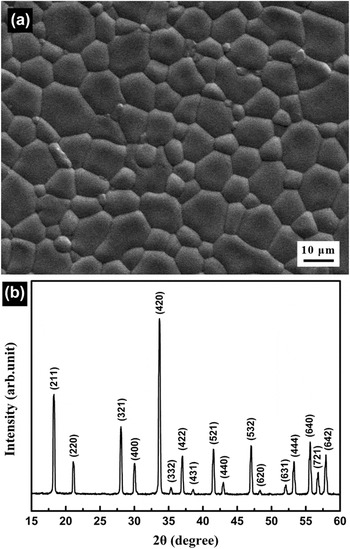
Figure 1(a) presents the microstructure of the thermal etched surface of Yb3Al5O12 material via heating to 1400 °C with a rate of 10 °C/min, holding for 1 h, and then cooling to RT with a rate of 15–20 °C/min. The specimen displays equiaxed grains with an average grain size of about 10 μm. It is obvious to see that no microcracks formed in the sample after the above heat treatment. Figure 1(b) shows an XRD pattern collected on the sample after hot-pressing. It is clear that the hot-pressed material is phase-pure Yb3Al5O12 according to JCPDS card No. 73-1369 without impurity phases detectable. Furthermore, no visible preferred orientation is observed in the XRD pattern.
(a) Microstructure of the thermal etched surface of Yb3Al5O12, and (b) XRD pattern collected on the hot-pressed material.

B. Thermal properties of Yb3Al5O12
The fundamental thermal property data of Yb3Al5O12, such as Debye temperature (θD), TEC, thermal diffusivity (D th), heat capacity (C p), and thermal conductivity (κ), are scarcely investigated. And these thermal parameters are very important for the design and application of TBC. Therefore, the thermal properties of Yb3Al5O12 are systematically studied in this work. The results are described and discussed in the following sections.
1. Debye temperature
In our previous work, we have synthesized phase-pure Yb3Al5O12 from Yb2O3 and Al2O3 powders, and evaluated its mechanical properties, including Young's modulus, shear modulus, Poisson ratio, etc. Reference Wang, Xiang, Sun, Liu, Hou and Zhou21 These data are listed in Table I and used for our calculation of the sound velocities and Debye temperature.
Mechanical properties of phase-pure bulk Yb3Al5O12.

The Debye temperature, θD, of solids is always associated with their melting point. Reference Newnham28 For Yb3Al5O12, θD is calculated from the average sound velocity, νm, based on the following equation Reference Anderson29 :
 $${\theta _{\rm{D}}} = {h \over {{k_{\rm{B}}}}}{\left[ {{{3n} \over {4\pi }}\left( {{{{N_{\rm{A}}}d} \over M}} \right)} \right]^{1/3}}{\nu _{\rm{m}}} = CL{\nu _{\rm{m}}}\quad {\rm{,}}$$
where h is the Planck's constant, k
B is the Boltzmann's constant, n is the number of atoms in the molecular formula, N
A is the Avogadro's number, d is the density, M is the molecular weight.
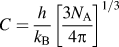 $C = {h \over {{k_{\rm{B}}}}}{\left[ {{{3{N_{\rm{A}}}} \over {4\pi }}} \right]^{1/3}}$
is a constant and
 $L = {\left( {{{nd} \over M}} \right)^{1/3}}$
is defined as the linear density of the crystal structure of the materials. The average sound velocity is defined as
Reference Schreiber, Aderson and Soga30
 $${\nu _{\rm{m}}} = {\left[ {{{3{{\left( {{\nu _{\rm{S}}}{\nu _{\rm{l}}}} \right)}^3}} \over {2\nu _{\rm{l}}^3 + \nu _{\rm{S}}^3}}} \right]^{1/3}}\quad {\rm{,}}$$
where νl and νs are longitudinal and shear sound velocities, respectively, which can be calculated from the shear modulus G and bulk modulus B using the following equations Reference Schreiber, Aderson and Soga30 :
 $${\nu _{\rm{l}}} = {\left( {{{B + {{4G} \over 3}} \over d}} \right)^{1/2}},\;{\nu _{\rm{S}}} = {\left( {{G \over d}} \right)^{1/2}}\quad {\rm{.}}$$
The calculated values based on the above equations are summarized in Table II, and the calculated Debye temperature of Yb3Al5O12 from the measured elastic properties is 625 K.
Summary of density d, linear density L, and sound velocities (longitudinal, shear, and average sound velocity νl, νs, νm), and the Debye temperature θD for Yb3Al5O12.

2. Thermal expansion coefficient
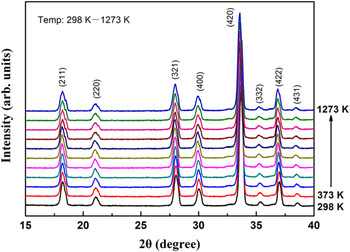
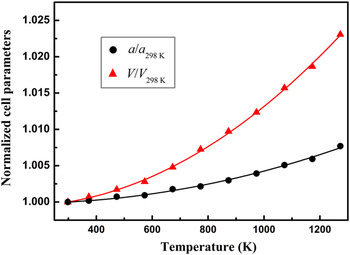
Figure 2 shows the XRD patterns collected from RT to 1273 K, from which one can see that there is no phase transformation up to 1273 K. The change of lattice constants with temperature is plotted in Fig. 3. Lattice parameter a steadily increases with temperature up to 1273 K. The volume increases from 298 to 1273 K is 2.43(8)%. The variations of the cell dimensions are fitted with the least squares to a linear combination of second-order polynomials of temperature:
 $${\lambda \mathord{\left/ {\vphantom {\lambda {{\lambda _{298\;{\rm{K}}}}}}} \right. \kern-\nulldelimiterspace} {{\lambda _{298\;{\rm{K}}}}}} = A + B\Delta T + C{\left( {\Delta T} \right)^2}\quad {\rm{,}}$$
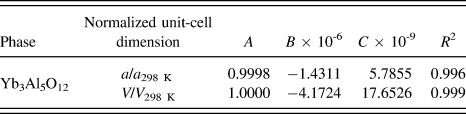
where λ is the cell dimensions at T (K), λ298 K is the cell dimensions at 298 K, and ΔT = (T − 298 K). The fitted curves for variation of normalized cell parameters are plotted in Fig. 3 and the constants A, B, and C are given in Table III. The volumetric TEC at constant pressure, αv, is defined by the expression:
 $${\alpha _{\rm{V}}} = {1 \over V}{\left( {{{\partial V} \over {\partial T}}} \right)_{\rm{P}}}{\rm{or}}\;V(T) = {V_0} \exp \left[ {\int {{\alpha _{\rm{V}}}(T)dT} } \right]\quad {\rm{,}}$$
where V 0 is the measured volume at RT and αv(T) is a temperature-dependent thermal expansion. The results of thermal expansion measurements are most often given in terms of a constant. When the temperature is higher than θD, there is αv(T) = αv. Equation (7) can be simplified as
 $$\ln \left( {{V \mathord{\left/ {\vphantom {V {{V_0}}}} \right. \kern-\nulldelimiterspace} {{V_0}}}} \right) = {\alpha _{\rm{V}}}\left( {T - {T_0}} \right)\quad {\rm{.}}$$
High-temperature XRD data collected from Yb3Al5O12 powders at 298 K and in the temperature range of 373–1273 K with a 100 K interval.

Variation of normalized cell dimensions (a and V) with increasing temperature.

Least-squares fitting results of the normalized cell dimensions for Yb3Al5O12.

By linear fitting the data in the plot of ln (V/V 0) versus (T − T 0) above the temperature of 673 K, we obtain the volumetric TEC of Yb3Al5O12 as αv = (23.74 ± 0.42) × 10−6 K−1 from 673 to 1273 K. In the same way, the calculated linear TEC of Yb3Al5O12 from 673 to 1273 K is (7.83 ± 0.14) × 10−6 K−1.
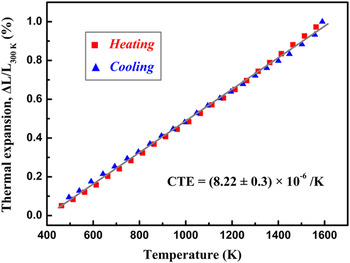
The average linear TEC of polycrystalline Yb3Al5O12 measured by the push-rod dilatometer is illustrated in Fig. 4. With the increase of temperature to 1573 K, the length of Yb3Al5O12 specimens expands almost linearly. An isotropic thermal expansion for Yb3Al5O12 bulk materials is observed due to the hot-pressed sample has no preferred orientation [Fig. 1(b)]. The fractional change in the linear thermal expansion of Yb3Al5O12,
 ${{\Delta L} \mathord{\left/ {\vphantom {{\Delta L} {L_{300\;{\rm{K}}} = {{\left( {L - L_{300\;{\rm{K}}} } \right)} \mathord{\left/ {\vphantom {{\left( {L - L_{300\;{\rm{K}}} } \right)} {L_{300\;{\rm{K}}} }}} \right. \kern-\nulldelimiterspace} {L_{300\;{\rm{K}}} }}}}} \right. \kern-\nulldelimiterspace} {L_{300\;{\rm{K}}} = {{\left( {L - L_{300\;{\rm{K}}} } \right)} \mathord{\left/ {\vphantom {{\left( {L - L_{300\;{\rm{K}}} } \right)} {L_{300\;{\rm{K}}} }}} \right. \kern-\nulldelimiterspace} {L_{300\;{\rm{K}}} }}}}$
, expressed as a percent is shown in Fig. 4. The linear TEC is determined in terms of the slope of thermal expansion versus temperature during heating and cooling, and the average linear TEC of polycrystalline bulk Yb3Al5O12 is (8.22 ± 0.3) × 10−6 K−1. Furthermore, no abnormal expansion and saltation are observed in Fig. 4 either in the heating or the cooling process.
Linear TEC of polycrystalline Yb3Al5O12 measured by push-rod dilatometer.

3. Thermal diffusivity and heat capacity
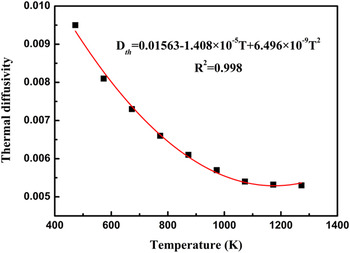
Figure 5 displays the thermal diffusivity data fitted by the second-order polynomial equation, and the obtained result takes on a form like:
 $${D_{{\rm{th}}}} = 0.01563 - 1.408 \times {10^{ - 5}}T + 6.496 \times {10^{ - 9}}{T^2}\quad {\rm{,}}$$
with a reliability value of R 2 = 0.998.
Thermal diffusivity versus temperature for Yb3Al5O12.

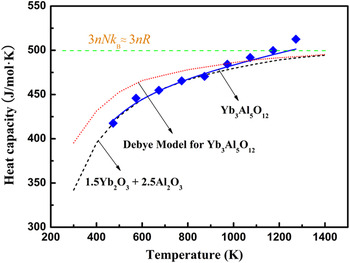
The temperature dependence of the heat capacity of Yb3Al5O12 is plotted in Fig. 6, wherein the data derived from Yb2O3 and Al2O3 are also given for comparison. Curve fitting of the experimental data of Yb3Al5O12 yields:
 $${C_{\rm{p}}} = 466.2 + 33.8 \times {10^{ - 3}}T - 104.25 \times {10^5}{T^{ - 2}}\quad {\rm{,}}$$
with a R
2 value of 0.994. The molar heat capacities extrapolated from this relationship are 361 and 508 J/(mol K) at RT (300 K) and at high temperature (1400 K), respectively. The experimental obtained heat capacity data of Yb3Al5O12 coincide well with those derived from the 1.5Yb2O3 + 2.5Al2O3
Reference Leitner, Chuchvalec, Sedmidubsky, Strejc and Abrman31,Reference Barin32
expect for a minor deviation at high temperatures. As predicted by the Dulong–Petit equation,
Reference Kittel33
when the temperatures are in excess of the Debye temperature, the heat capacity approaches its asymptotic value of C
p → 3nNk
B each atom. Here, the calculated temperature-independent heat capacity of Yb3Al5O12 above Debye temperature is approximately 500 J/(mol K) (see green dash line in Fig. 6), which is slightly lower than the measured value at high temperatures. Based on the Neumann–Kopp law, the heat capacity of Yb3Al5O12 can be determined as a summation of the atomic heat capacities of the constituent elements.
Reference Gopal34
At the temperature of T > θD, the molar heat capacity only correlates with the number of atoms and independent of the crystal structure and chemical component, thus, the heat capacity of Yb3Al5O12 agrees well with the summation of 1.5Yb2O3 + 2.5Al2O3 at high temperature. Moreover, the good agreement at the temperature of
 $T \,\lt \,{\theta _{\rm{D}}}$
demonstrates that the average bond lengths or bond strengths between Yb3Al5O12 and 1.5Yb2O3 + 2.5Al2O3 display no considerable difference.
Reference Barsoum, EI-Raghy, Rawn, Porter, Wang, Payzant and Hubbard35
For nonmagnetic insulators, the energy derived from lattice vibrations is the only contribution to the heat capacity. To verify the heat capacity, the theoretical lattice heat capacity of Yb3Al5O12 was calculated according to Debye model using the following equation
Reference Kittel33
:
 $$C = 9nNk_{\rm{B}} \left( {{T \over {\theta _{\rm{D}} }}} \right)^3 \int_0^{{{\theta _{\rm{D}} } \mathord{\left/ {\vphantom {{\theta _{\rm{D}} } T}} \right. \kern-\nulldelimiterspace} T}} {{{x^4 e^x dx} \over {\left( {e^x - 1} \right)^2 }}} \quad .$$
Measured heat capacity versus temperature for Yb3Al5O12 together with theoretical one.

As presented in Fig. 6, a good conformity was observed between the measured and theoretical heat capacity values, demonstrating that the measured heat capacity by laser flash method in our work is acceptable.
4. Thermal conductivity
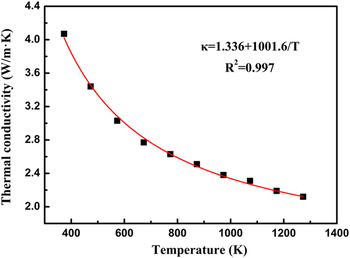
The thermal conductivity of Yb3Al5O12 versus temperature curve is plotted in Fig. 7. Because the thermal conductivities for most oxides are almost inversely proportional to temperature, a least squares fit of the data yields the following relationship:
 $$\kappa = 1.336 + 1001.6/T\quad ,$$
with an R 2 value of 0.997. From this equation, the thermal conductivities of Yb3Al5O12 are extrapolated to be 4.67 and 2.05 W (m K)−1, respectively, at 300 and 1400 K.
Thermal conductivity versus temperature for Yb3Al5O12.

Usually, the thermal conductivity of a material describes the diffusivity of the heat flow by both the electronic and phonon transport on temperature gradient. But for a dielectric material, electrons are not free to move through the structure and the heat is transferred by the lattice vibrations alone. Debye used an analogy of the kinetic theory of gases to derive lattice thermal conductivity of a solid, which can be expressed as Reference Kittel33
 $$\kappa = {1 \over 3}C\nu l\quad ,$$
where C is the heat capacity of the phonons, ν is the speed of sound, and l is the phonon mean free path. At a temperature above θD, the heat capacity and the wave velocity are both approximately constant, while the mean free path for crystalline dielectric materials is nearly proportional to 1/T. Reference Kittel36,Reference Kingery37 In this case, the thermal conductivity of Yb3Al5O12 can be fitted by a 1/T equation in the range over 300–973 K. For the temperature above 973 K, the thermal conductivity should yield a platform and become independent of temperature. For most materials, such a plateau value of thermal conductivity should be the minimum thermal conductivity κmin. In the experiment, the actual measured κmin is very processing-sensitive, so κmin was estimated using Clarke's model Reference Clarke and Phillpot10,Reference Clarke38 :
 $$\kappa _{{\rm{min}}} \to 0.87k_{\rm{B}} N_{\rm{A}}^{2/3} {{m^{2/3} \rho ^{1/6} E^{1/2} } \over {M^{2/3} }}\quad ,$$
where M is the molecular mass, m is the number of atoms per molecule, E is the Young's modulus, and ρ is the theoretical density. However, Eq. (14) typically needs the input values of experimental Young's modulus and bulk density, which limits its wide application and weakens its accuracy because it is difficult to prepare fully dense bulk material. To estimate precisely the lower limit of intrinsic thermal conductivity (κmin) of Yb3Al5O12, a modified Clarke's model reported by Liu et al. Reference Liu, Wang, Li and Zhou39 is used here, which can be expressed by
 $$\kappa _{{\rm{min}}} \to k_{\rm{B}} \nu _{\rm{m}} \left( {{M \over {n\rho N_{\rm{A}} }}} \right)^{ - 2/3} \quad ,$$
where νm is the average sound velocity that can be calculated by Eq. (4), and n is the number of atoms in the molecule. This modified model has been successfully applied to estimate the κmin of several complex oxides, such as La2T2O7, Reference Liu, Wang, Li and Zhou39 ZrP2O7, Reference Xiang, Feng and Zhou40 MPO4, Reference Zhou and Liu41 and Y4Si2O7N2. Reference Sun, Liu, Wang, Wang, Zhou and Hu42
For Yb3Al5O12, the estimated κmin using the modified Clarke's method, as illustrated by Eq. (15), is 1.22 W (m K)−1. The origin of low thermal conductivity of Yb3Al5O12 is mainly ascribed to the heterogeneous bond strength and the relatively larger mean atomic weight M/n in Eq. (15), as reported by Zhou et al. Reference Zhou, Xiang and Feng13 At 1273 K, the experimentally measured κ is 2.12 W (m K)−1, which is slightly higher than the estimated κmin value but still close to it. The measured κmin is higher than the evaluated one is common for most oxides. The reason may be that the testing temperature (1273 K) is relatively low and does not approach to the value that thermal conductivity saturates to κmin. Additionally, radiative heat transport, which obviously increases at high temperatures, may also contribute to the enhanced experimental thermal conductivity. Reference Zhan, Li, Liu, Wang, Zhou and Hu8 Therefore, Yb3Al5O12 has a thermal conductivity lower than most commonly used TBC materials, such as YSZ, γ-Y2Si2O7, etc., 43–Reference Vassen, Cao, Tietz, Basu and Stover46 suggesting that it can be served as a potential TBC material.
C. Potential thermal-barrier-coating applications for Yb3Al5O12
The low thermal conductivity of Yb3Al5O12 makes it prospective candidate as a TBC material, especially when considering the match of TECs between the coating and the underlying alloys. In general, there are three key factors in searching for TBC layer: (i) lowest possible thermal conductivity, (ii) TEC matches with substrate, (iii) good thermodynamic stability. At present, nickel-based superalloy is most commonly used as substrate material for gas turbine engines. Hence, materials for the TBC layer are hoped for having a relatively close TEC to that of nickel-based superalloy and having a low thermal conductivity combined with good thermal stability.
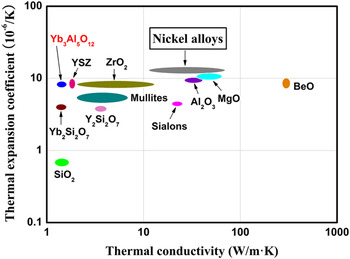
Figure 8 presents the TEC versus thermal conductivity for some TBC materials and nickel-based superalloys. 43,Reference Hass47,Reference Sun, Li and Zhou48 The nickel alloy used for turbine blades have a TEC from 14.0 to 16.0 × 10⁻⁶ K−1. In Fig. 8, YSZ has a TEC of ∼9.0 × 10⁻⁶ K−1 and Yb3Al5O12 has a TEC of about (8.22 ± 0.3) × 10−6 K−1. Thus, a relatively close TEC is notified between Yb3Al5O12 and nickel-based superalloy, guaranteeing a low thermal stress at the coating and substrate interfaces and thereby a good thermal cycling resistance. According to Fig. 8, one can see that the thermal conductivity of Yb3Al5O12 is lower than the most commonly used TBC material such as YSZ, implying more potential advantages for TBC application. If only TEC and thermal conductivity are considerable, Yb3Al5O12 can be regarded as the most prospective TBC material for nickel-based superalloys.
TEC versus thermal conductivity for some promising TBC materials on nickel-based superalloys.

Furthermore, nickel-based superalloy for turbine applications is largely based on its ability to form a slow-growing Al2O3 that is an effective barrier to oxygen diffusion. Reference Clarke, Oechsner and Padture3,Reference Clarke and Phillpot10 This suggests that compatibility with Al2O3 is a supplemental constraint on the choice of new TBCs. For Yb3Al5O12, it is thermodynamically stable with Al2O3 till they melt at around 2100 K. Reference Zhou, Xiang and Feng13,Reference Wu and Pelton49 Besides, an additional TBC selection criterion is that the material should not exhibit appreciable weight loss at high temperatures. Although many of the silicates display low thermal conductivity, they are liable to SiO vaporization, especially in the presence of water vapor. Reference Clarke38 Fortunately, the surface corrosion rate of Yb3Al5O12 in hot steam environments is considerably smaller than that of many promising TBCs, such as Y3Al5O12, Yb2Si2O7 etc., as reported by Klemm, Reference Klemm14 which is also positive to advance the potential of applications as structural components and coatings.
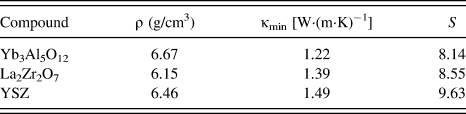
For a TBC material, when it is used in real application, its weight would increase linearly with both its thickness and density, thus, another important factor affecting the design of TBCs is specific thermal conductivity, namely the product of the thermal conductivity and the density. The calculated specific thermal conductivity of Yb3Al5O12 is shown in Table IV, together with that of La2Zr2O7 Reference Liu, Wang, Zhou, Liao and Li50 and YSZ Reference Clarke38 for comparison. One can find that Yb3Al5O12 exhibits a low value of specific thermal conductivity of only 8.14. This value is ∼4.8 and ∼15.5% smaller than that of La2Zr2O7 (8.55) and the most successful and commercialized thermal barrier material such as YSZ (9.63), respectively. The smaller specific thermal conductivity further demonstrates the advantage of this material as a potential TBC. Therefore, low thermal conductivity, relatively close TEC to nickel-based superalloys, and good thermodynamical compatibility with Al2O3 at water vapor environments, as well as small specific thermal conductivity endow Yb3Al5O12 being a very competitive candidate material for high-temperature structural components and TBCs.
Density ρ, minimum thermal conductivity κmin, and calculated specific thermal conductivity S of Yb3Al5O12 together with those of La2Zr2O7 and YSZ.

IV. CONCLUSIONS
The thermal properties of Yb3Al5O12 are comprehensively investigated in this study. The Debye temperature of Yb3Al5O12 is calculated to be 625 K. The linear and volumetric thermal expansions of Yb3Al5O12 determined by using high-temperature XRD from 298 K to 1273 K are (7.83 ± 0.14) × 10−6 and (23.74 ± 0.42) × 10−6 K−1, respectively. The linear TEC of polycrystalline bulk Yb3Al5O12 determined by push-rod dilatometer is (8.22 ± 0.3) × 10−6 K−1. The measured minimum thermal conductivity of Yb3Al5O12 is ∼2.12 W (m K)−1 at 1273 K, which is lower than the most commonly used TBC material such as YSZ. During the thermal property testing processes, Yb3Al5O12 is found to be stable and no phase transformation is detected. Our experimental results highlight that the low thermal conductivity, good thermodynamical stability, as well as a relatively high TEC ensure it a very potential candidate of TBC.
ACKNOWLEDGMENTS
This work was supported by the National Outstanding Young Scientist Foundation for Y.C. Zhou under Grant No. 59925208, and the Natural Sciences Foundation of China under Grant Nos. 50672102, 50832008.