Introduction
Since the publication of the Primulaceae in the Flora Reipublicae Popularis Sinicae (Hu, Reference Hu, Chen and Hu1990) and the treatment for the Primulaceae in the Flora of China (Hu & Kelso, Reference Hu, Kelso, Wu and Raven1996), the family has been intensively investigated using molecular phylogenetic methods (Zhu et al., Reference Zhu, Yang, Zhang and Li2002; Hao et al., Reference Hao, Yuan, Hu, Ge and Zhao2004; Yan et al., Reference Yan, Peng, Hu and Hao2007, Reference Yan, He, Peng, Hu and Hao2010; Wang et al., Reference Wang, Gong, Hu and Hao2008a, Reference Wang, Ge, Gong, Hu and Hao2008b). Under the auspices of the National Natural Science Foundation of China several field expeditions have been undertaken in various parts of China to collect samples for these research programmes. In the course of naming the voucher specimens in the genus Primula L. a new species was discovered and is described here. The new species, Primula fenghwaiana, is closely related to P. petelotii W.W.Sm. in Primula sect. Chartacea Balf.f. but can be easily distinguished from other species of the section by its very short flowering scape and longer pedicels. The new species is named in honour of Prof. F. H. Chen, a famous taxonomist and horticulturist and the late Director of the South China Institute of Botany. He devoted all of his adult life to the development of botanic gardens in China and made valuable contributions to the study of Primulaceae and Asteraceae.
Primula petelotii W.W.Sm. (Smith, Reference Smith1932; Smith & Fletcher, Reference Smith and Fletcher1944) is a rare species previously known only from the type locality on Mount Chapa [Sa Pa] in northern Vietnam. Recently, however, we collected it in Yunnan, near the border of Vietnam. It is a new and noteworthy addition to the Primula flora of China and, as the original description of the species is far from complete, we include a full description below.
Species Descriptions
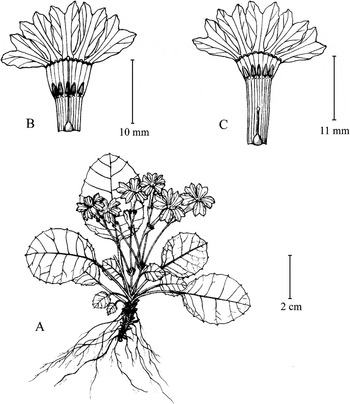
Primula fenghwaiana C.M.Hu & G.Hao, sp. nov.Fig. 1.
Ex affinitate P. petelotii W.W.Sm. scapo pedicellis 2–3-plo breviore, tubo corollae quam calyce duplo longiore distinguenda. – Type: China, Yunnan, Chuxiong Xian, Xiao Liang Shan, 2510 m, 31 i 2004, G.P. Yang 384 (holo IBSC).
Primula fenghwaiana C.M.Hu & G.Hao. A, the plant; B, long-styled flower; C, short-styled flower (drawn from Yang 384, holotype IBSC).

Perennial herbs, efarinose, with a short rootstock and numerous fibrous roots, without paleaceous basal scales at flowering time. Leaves forming a rosette of 8–10 cm in diameter; petioles 1.5–3 cm long, c.2/3 the length of the leaf blade, scarcely winged, glabrous or with a few minute glands; leaf blade broadly elliptic to broadly obovate, 2.5–4 × 2–2.5 cm, apex rounded, rarely broadly obtuse, base broadly cuneate to almost rounded, margin remotely denticulate, teeth remotely spaced 5–8 mm apart, callose-tipped, glabrous on both surfaces; lateral veins 5–6 on each side of midvein, c.70° angled to midvein, reticulation of veins obscure on both surfaces. Scapes 1–2 per plant, 0.8–1.2 cm long, together with pedicels densely covered with minute glandular hairs; umbels 2–5-flowered; bracts ovate, 4–5 mm long, apex acuminate, slightly pubescent; pedicels 2–2.5 cm long. Flowers distylous. Calyx narrowly campanulate, c.6 mm long, 5-veined, ± puberulent, split hardly to the middle; lobes ovate-lanceolate, 2–2.8 mm long, puberulent and minutely ciliate. Corolla pink to white (according to the collector), annulate, limb c.1.8 cm across, lobes obovate, c.7 × 6 mm, bilobed, lobules entire or toothed; thrum flower with corolla tube c.14 mm long, stamens inserted towards apex, style c.6 mm long reaching to middle of the corolla tube; pin flower with corolla tube 10–11 mm long, stamens inserted at middle of the corolla tube, style equalling the length of the corolla tube. Capsule unknown.
Distribution and habitat. The new species is currently known only from the type locality in Yunnan, Chu Xiong Xian, Xiao Liang Shan, clustered in small groups in secondary evergreen broad-leaved forests.
Primula petelotii W.W.Sm., Notes Roy. Bot. Gard. Edinburgh 16: 226 (1932). – Type: Vietnam, on Mt. Chapa [Sa Pa], 1800 m, 1930, Pételot s.n. (lecto E, designated here; isolecto NY, P).
When Smith (Reference Smith1932) originally described the species, he was dealing with a poor specimen with only a leaf rosette and detached flowers. For the sake of completeness, an addendum to the description is given here.
Perennial herbs, efarinose, with a short rootstock and numerous fibrous roots, without paleaceous basal scales at flowering time. Leaves forming a rosette of 8–16 cm in diameter; petioles 0.5–4 cm long, faintly winged, with minute rusty glands; leaf blade broadly obovate to suborbicular, 2–5.5(–7.5) × 1.3–3(–5) cm, apex rounded, base cuneate, margin remotely denticulate, teeth 1–3 mm spaced, glabrous, with minute rusty glands on both surfaces, especially on the midrib and veins; lateral veins 6–8 on each side of midvein, almost at right angles to the midvein, reticulation of veins prominent on both surfaces. Scapes 1–2 per plant, 2.5–12 cm long, together with pedicels covered with rusty minute glands; umbels 3–7-flowered; bracts oblong-ovate to oblong-lanceolate, 8–9 mm long, apex acuminate, glabrous or with a few rusty glands on the lower part; pedicels initially shorter than bracts, later lengthening to 12 mm long, glabrous. Flowers distylous. Calyx campanulate, 9–10 mm, glabrous, split to the middle; lobes ovate-lanceolate, c.5 mm long, apex acuminate, glabrous. Corolla pink, annulate, limb 1.5–2 mm across, lobes obovate, c.6 × 5 mm, bilobed, lobules entire or toothed; thrum flower with corolla tube c.9 mm long, stamens inserted in upper part of tube, with the anther-tip almost reaching the annulus, style c.3 mm long and reaching to middle of the corolla tube; pin flower with corolla tube c.8 mm long, stamens inserted at middle of the corolla tube, style equalling the length of the corolla tube. Capsule unknown.
Distribution and habitat. Vietnam, Mount Chapa; China, SE Yunnan. Margin of evergreen broad-leaved forests.
Additional specimen examined. China. Yunnan, Jin Ping Xian, 22°52′N, 103°14′10″E, just near the border of Vietnam, 2370 m, 16 i 2010, SE Yunnan Exped. GBOWS946 (IBSC).
Acknowledgements
The study was supported financially by the National Natural Science Foundation of China (grants No. 40671066, 30870171) and a Research Fund for the Large-scale Scientific Facilities of the Chinese Academy of Sciences (2009-LSF-GBOWS-01). The authors thank Ms Liu Yun Xiao for inking the line drawings.