Introduction
Less than 25 years old, mass-gathering health (MGH) is a relatively new field of research.Reference Arbon 1 As such, the science underpinning this body of knowledge is young and developing rapidly.Reference Arbon 2 Current knowledge, however, fails to adequately inform the understanding of mass gatherings (MGs) because of the lack of theory development and adequate conceptual analysis.Reference Arbon, Cusack and Verdonk 3 In December of 2013, the World Health Organization (WHO; Geneva, Switzerland) Collaborating Center for Mass Gatherings and High Risk/Visibility Events at Flinders University, South Australia, hosted a scientific meeting bringing together international MGH researchers. Representatives were from: Flinders University and University of Canberra, in Australia; the University of British Columbia (BC) and the Justice Institute of BC, in Canada; the WHO; and Public Health England (London, England, United Kingdom).
The MGH Collaborating Team, formed during this meeting, discussed various models related to MG populations and events to support a common understanding about their human health effects. The goal of a larger, international consensus project is the creation of a minimum data set and data dictionary for MGH research. This will support description, measurement, comparison, evaluation, and reporting on parameters of interest, permitting international comparisons that, to date, has been impossible.Reference Arbon 2 , Reference Memish 4 - Reference Turris and Lund 6
Mass-gathering events are complex phenomena involving the interaction between a number of elements. This manuscript is the second of two related reports that explore key elements of MGH research. The first paperReference Lund, Turris and Bowles 7 concerns the various populations of people involved in MGs and proposes a MGH population model. The current manuscript complements this work by describing and characterizing MG events, identifying specific variables of interest to MG researchers, and addressing a gap in the current body of knowledge with regard to understanding the full scope of MGs and their health effects.
A robust event model is increasingly important as some events attract international participants and attendees in large numbers. In the interactions between members of the host and event populations, there exist opportunities for injuries,Reference Alquthami and Pines 8 , Reference Steffen, Bouchama and Johansson 9 the spread of infectious disease (ID),Reference Abubakar, Gautret and Brumnette 10 - Reference Tam, Barbeschi, Shapovalova, Briand, Memish and Kieny 17 disorderly crowd behavior and movement,Reference Tam, Barbeschi, Shapovalova, Briand, Memish and Kieny 17 - Reference Turris, Lund and Bowles 21 and the overflow of ill and injured from the event to the surrounding community during a mass-casualty incident, perhaps overwhelming the host infrastructure.Reference Soomaroo and Murray 20 , Reference Begum 22 - Reference Mahoney, Harrington, Biffl, Metzger, Oka and Cioffi 26
Consistent data collection with regard to events will potentially: (1) permit meta-analysis and pooling of data sources internationally; (2) further develop the methodology for evaluating health promotion and harm reduction efforts; (3) create a solid foundation for risk assessment and illness and injury prediction modeling; and (4) provide operational support for front-line clinicians with regard to planning for on-site medical teams.Reference Arbon, Cusack and Verdonk 3 , Reference Ranse and Hutton 5 , Reference Turris and Lund 6 , Reference Steffen, Bouchama and Johansson 9
Methods
The authors critically appraised existing MG definitions and descriptions in published literature. When it became apparent that published definitions lacked sufficient breadth and depth to support the group in defining, describing, and explaining the health effects of MGs, a series of tables with event characteristics were developed in an iterative fashion, capturing both academically- and operationally-relevant lenses for MGs.
Findings and Interpretation
Characterizing MG Events
An ongoing challenge for MG researchers and organizers is how to categorize events in a way that allows for grouping, comparing, and contrasting findings. The MG literature covers a staggering range of events, each with a number of event-related characteristics.
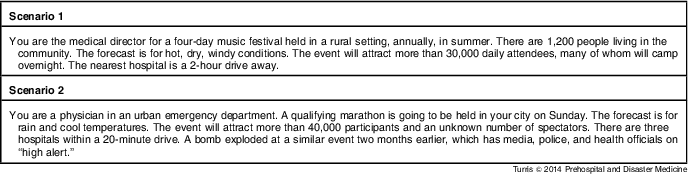
The cases above (Table 1) are similar in that large groups (ie, 30-40,000 people) will gather for a specific event, but their divergent characteristics are far more intriguing (ie, one is a 1-day sporting event, the other a multi-day cultural event). One is in a small community with limited local health care capacity, while the other is a large community with a substantial pre-existing medical system.
Event Scenarios

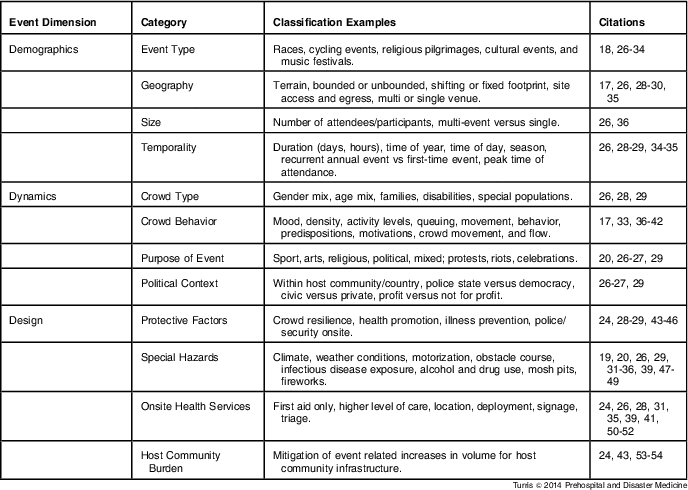
How might these differences affect illness and injury rates? Can injury and illness rates be reduced? How will treatment planning differ for individuals who present for care? A careful read of existing event descriptionsReference Hnatow and Gordon 27 - Reference Lund and Turris 55 reveals a multitude of event-related variables that are inconsistently reported and currently lack clear definitions (Table 2).
Dimensions of an Event Model as Reported in the Literature

The results of the team's iterative process are presented below. Macro-level characteristics explore the interplay between the place, people, and the event itself, informing methodology, data collection, and meta-analysis. Meso-level characteristics include the “demographics” (ie, the immutable parts of the event), the “dynamics” (ie, what people do; how they feel and react), and the “design” (ie, what event planners/producers do to protect attendees/participants from illness and injury) of MGs and their relationship to risk assessment and predictive modeling. Micro-level characteristics inform planning and mitigation efforts of frontline clinicians, medical teams, and other event personnel. Micro-level characteristics will be detailed in a future publication regarding the consensus-based minimum data set and data dictionary.
Below, the authors present a broader explanation of MG demographics, dynamics, and design. The elements in this discussion represent various variables of interest to MG researchers that may be useful for risk assessment and predictive modeling.
Demographics of an Event
In existing literature, common starting points for grouping and characterizing MG events include event type, geography, size, and temporal considerations.
Event Type
With the exception of relatively-common events, such as marathons or cycling events, event types are typically recorded without reference to a category. That is, every event is treated as unique. However, Turris et al argued that an initial typology of events would include sporting, arts-related, religious/political, and miscellaneous events.Reference Turris, Lund and Bowles 21 This is a macro-level model, which has limited utility for developing nuanced explanatory and predictive models. For example, it does not distinguish between contact and noncontact sporting events, spectator vs participant sporting events, and so on. It does, however, present an initial “high-level” categorization as a starting point for grouping and comparing various types of MGs.
Strictly speaking, the event type (eg, fireworks display, boat show, and Papal visit) is only one piece of data that will help researchers and clinicians determine the degree to which two different events may be alike. Other parameters, such as whether or not an event is primarily spectator- or participant-based, may be as helpful in selecting events for comparison.
Geography
Every event has a geographical character and site-specific descriptors. For example, at a local music festival held annually in Vancouver, BC (Canada), the grounds include a lake, raising the specter of accidental drowning. Similarly, at the Suwa Onbashira Festival held every six years in Japan, men ride logs down steep slopes.Reference Yazawa, Kamijo, Sakai, Ohashi and Owa 34 The geography of both events described creates a set of safety issues for event planners, attendees, and on-site medical services.
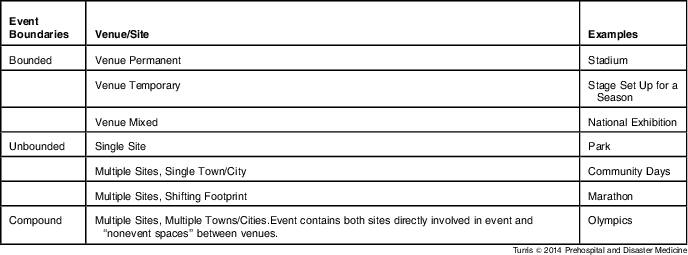
Bounded, Unbounded, or Compound Events
Milsten et al identified that an event with a mobile population would have a different risk profile than an event for which spectators were seated throughout the event.Reference Milsten, Seaman, Lui, Bissell and Maguire 50 This is, in part, due to the fact that in unbounded events, there is no control with regard to the capacity of the venue. In contrast, for an event held at a stadium with fixed seats, event planners have some control over the number of participants and spectators. A variety of event “footprints” that might be of interest to researchers and clinicians are presented in Table 3.
Classification of Mass Gatherings by Event Boundaries and Venue

Considerations with regard to event boundaries are reported in the literature. For example, marathons tend to have a shifting footprint. As runners continue along the course, the early parts of the course are closed. This has implications for medical deployment as health care may be offered by both fixed and mobile response teams, depending on the nature of the event.Reference Turris, Lund, Gutman, Mui, Wang and Lewis 33 Similarly, if an event is primarily spectator-based (eg, a football match in a stadium with assigned seats), considerations related to site access and egress issues become highly relevant due to the not infrequent occurrence of riots and stampedes.Reference Turris, Lund and Bowles 21 , Reference Giulianotti 56 - Reference Stott and Adang 59 Access and egress between the event and emergency services, as well as between the event and local hospitals or clinics, should also be a consideration.
Event Size
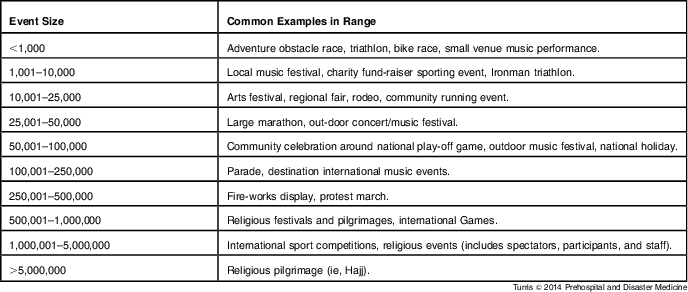
Early work by researchers in the field of MGH began with describing and classifying MGs according to the absolute number of attendees and/or participants. Malloy and colleagues cast a wide net and proposed that MGs be categorized according to a variety of sizes, including small, medium, large, major, super, extreme, and mega.Reference Malloy, Sherif, Natin and McDonnell 60 This work contributes an understanding of the vast range of sizes, from local community events that occur on a small scale to international events that involve movement of large numbers of people across international boundaries.
Based on existing classification schemes with regard to size, the following synthesis is presented (Table 4). The authors acknowledge that there are challenges related to labeling a given event as small, medium, and large, as such designations are difficult to interpret without information about the size of the host community. Instead, a range is provided.
Classification of Mass Gatherings According to Event Size

The size of a given MG has been used to quantify risk. In Western Australia, the public health authority uses the size of a MG as one variable contributing to risk assessment score. 61 This work links the absolute size of an event to risk assessment, which is an important consideration in relation to the permitting, planning, and execution of specific events.
Ratio of Event to Host Population Size
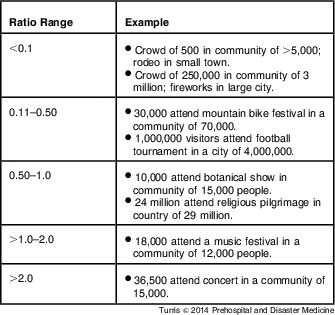
Recently, attention has shifted toward defining MGs as a preplanned event held at a specific location for a defined period of time that has the potential to strain planning and response resources. 62 This definition is appealing as it takes into account the baseline response capacity of the host community. Understanding the size of the event crowd relative to the size of the baseline host community population may contribute to understanding and quantifying risk or anticipating the impact of the MG. This could be expressed as a ratio of the event population relative to the host population (Table 5), or the event-to-host population (EHP) ratio. Essentially, this may be calculated as the number of people in the event community (NEV) divided by the number of people in the host community (NHC).
Examples of MGs Described by the EHP Ratio

Abbreviations: EHP, event-to-host population; MG, mass gathering.
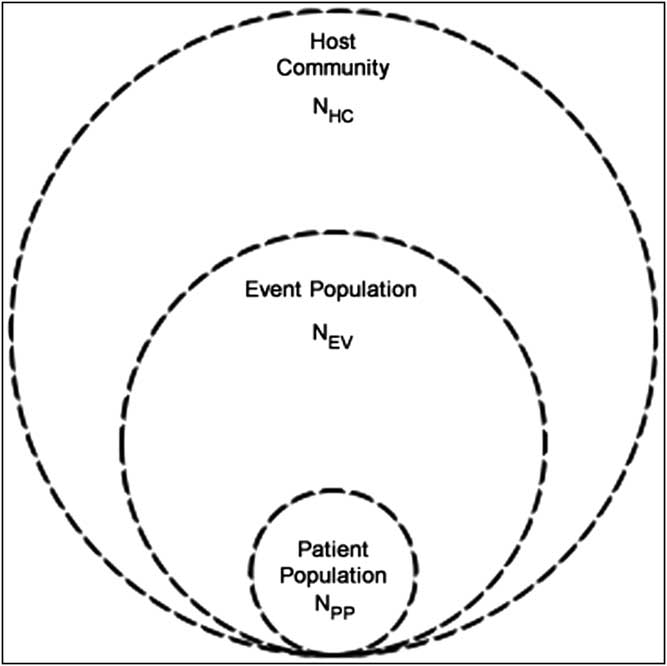
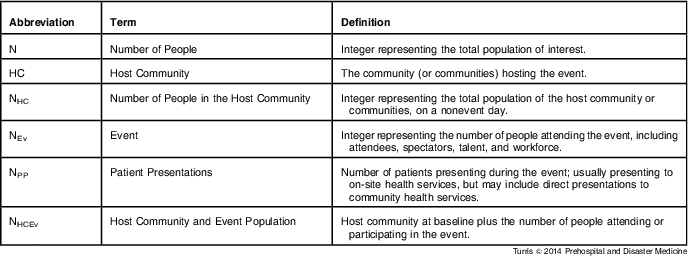
Figure 1 draws on the proposed MG population model outlined in Part 1 of this series and presents a description and diagrammatic representation of the relative size of events, according to the size of the population attending (Table 6). Operationally and practically speaking, arising from the EHP ratio are considerations about response capacity. In other words, if the absolute size of an event exceeds the size of the host community, health infrastructure may need to be augmented. Further work is needed to delineate how response capacity might be objectively described and determined.
Population Model for Mass-gathering Health.

Abbreviations and Definition of Terms, Population Model for MGH

Abbreviation: MGH, mass-gathering health.
Temporal Considerations
For this class of data, a myriad of time considerations apply. For example, how long is a given event (eg, hours, days, or weeks)? Does the event run for several days? Is the event taking place during the daytime, at night, or both? Outdoor seasonal events carry particular risks according to the weather conditions. Also, consider the differences between recurring (eg, annual) and one-off events. For example, recurring events may have the benefit of a legacy of experienced clinicians, volunteers, and participants.
Dynamics of an Event
Crowd Mood
Political rallies, funerals of public figures, and protests are examples of event classifications that influence the risk profile of a given MG. This is because crowd mood and behavior will be directly influenced by the tone of a given event, perhaps making the crowd more volatile. Increased stress for individual participants may play a role in crowd volatility; also, the risks associated with events that may be targets for deliberate acts of terror shape the relationship between the purpose of the event and risk to attendees.Reference Steffen, Bouchama and Johansson 9 Crowd mobility and density are sometimes used as proxies for crowd mood or indicators of risk (qualitative). Objective measures of crowd mood are not yet well developed for use in a MG context.Reference Memish 19
Crowd Mobility
Events have different “shapes” that influence how a crowd of participants and/or spectators may be distributed through the event, ultimately shaping crowd dynamics. Understanding the event “flow” as it relates to crowd mood and behavior may be valuable for both researchers and clinicians. For example, in relation to crowd mobility at a music festival where there is a highly-active stage front, crowd surfing is more likely to occur and must be planned for.
Crowd Density
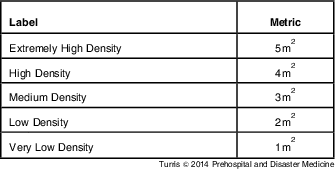
Crowd density is another important feature of event description. Crowd density is defined as the ratio between the number of persons in the area (eg, 2.8 people/square meter is considered to be medium density; Table 7). Steffen et al argued that crowd density was a more important consideration than the absolute number of people present.Reference Steffen, Bouchama and Johansson 9 Measuring density at MGs is currently done in a nonstructured or anecdotal way. However, at a specific event, the environment can be divided into different regions and the density may be measured in each region (eg, entrance to an event and stage fronts).Reference Hutton, Brown and Verdonk 39 Similarly, Sun and Qin suggested dividing the environment into different regions to reflect the intensity and spaces of the crowd.Reference Sun, Li and Wenhu 63
Crowd Density MeasurementReference Arbon 38

Density affects people in many ways. Berk argued that density affects visibility of those within the crowd, and dense crowds will automatically undercut the effect of crowd activity.Reference Berk 64 For individuals in high-density crowds, it is difficult to see more than a few neighboring individuals. Polus claimed that there is no dispute that higher crowd densities lead to a greater interaction between individuals, and it is the impact of this interaction that is of interest, as is its impact on audience members during an event and how it might impact behaviour.Reference Polus, Schofer and Ushpiz 65 A vivid example of the effect of crowd density on illness and injury rates may be found in the literature of stampedes that occur during religious gatheringsReference Hsieh, Ngai, Burkle and Hsu 23 , Reference Ngai, Burkle, Hsu and Hsu 66 and other types of events.Reference Ackermann, Lahm and Pfohl 67 - Reference Helbing, Johansson and Al-Abideen 69
Primarily Spectator, Primarily Participant, Mixed Events
People at an event belong to one of three groups: spectators, participants, and event crew (eg, volunteers, security, vendors, artists, and medical personnel). The activity levels of the attendees will influence the risk related to attending a specific event.Reference Milsten, Maguire, Bissell and Seaman 30
Design of an Event
Special Hazards
The WHO adopts an “all hazards” approach to risk management and disaster planning, which may be applied to examining and understanding event design. A hazard (ie, “any phenomenon with the potential to cause disruption or damage to people or their environment”) creates a degree of risk (ie, “the probability of a harmful consequence”). 70 Adopting an all-hazards approach involves planning and developing a plan to address the range of risks and possible emergencies that might occur during a given MG. In the context of health care in general, clinicians think about “modifiable” and “nonmodifiable” factors; however, in the context of MGs, the majority of hazards may be modifiable to some degree, through careful event design. Consider the following examples.
Infectious Disease Exposure
The degree of risk presented by ID exposure during a MG is an active area of inquiry for researchers. What can be accomplished to reduce risk for attendees is clear in the example of The Hajj, an annual religious festival attended by millions in Saudi Arabia (a review of the health risks posed is detailed in Ahmed et al).Reference Ahmed, Arabi and Memish 71 Based on the data from this annual event, the Saudi's have instituted a series of proactive measures to limit morbidity and mortality, thus the government supports 24 hospitals with a capacity of roughly 5,000 beds. Medical clinics (N = 136) in the vicinity of the Hajj offer free medical care to all pilgrims, and there are 18 stationary and 21 mobile health care teams at the event itself. Airports have clinical examination rooms and any pilgrim suspected of having a communicable disease is taken by ambulance to a dedicated 200-bed hospital.Reference Memish 15
Event Weather and Environmental Conditions
Depending on the season, temperature, and humidity, illness and injuries at a given outdoor event may increase.Reference Milsten, Maguire, Bissell and Seaman 30 For example, as described by Bruce, heat-related casualties can run in the thousands when there is no available protection for participants.Reference Bruce, Tunstall, Boutler and Coneybeare 72 In July of 2006, during the annual Nijmegen March in Holland, thousands of people walked 100 miles over four days, and a reported 2,725 heat-related casualties presented for treatment during a single day when the temperature rose to 42°C. Similarly, the temperature and the humidity index may contribute to the illness rates for marathons, air shows, and other outdoor events held when temperatures are high, or even indoor events with inadequate air conditioning and/or ventilation.
In addition to reports of temperature-related illness, there have been mass-casualty incidents at MGs related to weather conditions. For example, a lightning strike caused fatalities during a festival, 73 a hailstorm triggered a human stampede, 74 and windy conditions caused the collapse of a large tent.Reference Deal, Synovitz, Goodloe, King and Stewart 75 Although climactic conditions can be predicted, weather conditions on a particular day are variable and may change throughout the day. These examples point to the need to anticipate the unexpected by considering the range of expected weather conditions in a particular region rather than focusing on a single day or days.
Alcohol and Drug Use
The presence of drugs and alcohol, whether available through on-site vendors or brought in concealed by patrons, is an important consideration and can be difficult to capture in a meaningful way. For example, at an electronic dance music festival, alcohol may be sold on site; however, attendees who are underage and know that their bags will be searched upon entry to the event may choose to imbibe right before the event (eg, while waiting in the queue to enter), increasing their risk of alcohol toxicity.Reference Lund and Turris 55
Mechanical or Other Hazards
Mechanical and other hazards are rarely reported on directly in event case reports. Instead, these types of hazards (eg, small planes at airshows,Reference Howell 76 amusement park rides, livestock at a rodeo, and fireworks at community celebrations 77 - 81 ) only appear in the literature when a mass-casualty event occurs. Collecting data on events with special hazards, prospectively, may assist researchers in measuring the degree of risk presented by similar events, ultimately informing event design.
Protective Factors
Illness and injury prevention is an emerging topic of discussion in the MGH literature. Several researchers have argued that prevention efforts should be a focus during event planning. For example, Hewitt and colleagues argued that many injuries that occurred during a rock concert were preventable if planners reduced the distribution of items that could serve as missiles, and suggested that limiting the size of liquid containers could be considered as one means of reducing overall alcohol intake.Reference Hewitt, Jarrett and Winter 45
Intrinsic hazards, present by virtue of participation in particular types (eg, participation in a marathon or cycling event increases the risk of musculo-skeletal injury), might be, to some degree, modifiable through careful event design. For example, organizers of the New York Marathon (USA) send out education materials about the prevention of injuries and illnesses both before and after the event (Personal Communication, Dr. Stuart Weiss, November 2012). The effect of this intervention has not yet been tested prospectively. Embedding illness and injury prevention in the event model will help researchers collect data and report on strategies being used to reduce the health care burden of MGs.
Health promotion vis a vis MGs has similarly been absent from the MGH literature until relatively recently. One example of an event-related, illness-prevention strategy is the Dance Safe initiative, designed to provide information to attendees of electronic dance music events. 82 At a more granular level, water stations, shelter, shade, access to sunscreen or earplugs, and available “chill out zones” are all examples of event design that have yet to be prospectively tested with regard to the effect on illness and injury rates.
Thinking more broadly about the positive health effects of events, Tewari and colleagues reported thought-provoking findings around the longitudinal health benefits of Hindu pilgrimage event. They found that participation in the pilgrimage increased the well-being of participants and argued that events should be reframed as not only presenting health risks, but also presenting opportunities for health benefits.Reference Tewari, Khan, Hopkins, Srinivasan and Reicher 46
On-site Health Services
Community stakeholders have a vested interest in ensuring adequate planning to prevent or minimize the health impact of MGs in their communities. One of the ways to minimize the burden on local health care services is to offer risk-relevant, on-site first aid and/or advanced health services throughout a special event.Reference Gutman, Lund and Turris 44 , Reference Ackermann, Lahm and Pfohl 67 , Reference Kerr 83 - Reference Rubin 85 The MG literature is replete with case reports detailing event medical services. Researchers have been working on determining the “right” ratio of health care providers to attendees/participants for a given type of event, required equipment and supplies, effective communication plans, necessary transportation assets, and the appropriate infrastructure to support on-site health care services at different types of events.Reference Lund, Turris and Bowles 25 , Reference Arbon, Bridgewater and Smith 86 , Reference Zeitz, Zeitz and Arbon 87
Host Community Burden
In order to mitigate the health care burden MGs may place on baseline community health services, researchers would benefit from a common pool of data with which to measure community impact. Arbon et al noted that published MG literature to date consists predominantly of observational studies and cohort studies (>58%), most commonly focused on operations and Emergency Medical Services on site at the event (>48%).Reference Arbon, Cusack and Verdonk 3 Case reports and case series provide snapshots of specific events, commonly reporting patient presentations and transfers to hospital on the day(s) the event occurred. Unfortunately, these reports will underestimate the true impact of MGs on local community resources. Case reports rarely capture data regarding increased workload on health resources in the days or hours before and/or after the event. As argued by Lund and colleagues, a full-operational analysis would account for both the consumptive and disruptive effects of MGs on the host community's health resources.Reference Lund, Turris and Bowles 25 Well-executed medical and safety plans for events with appropriate, comprehensive risk assessments and stakeholder engagement have the best chance of ameliorating the potential negative impact of MGs on communities.
Overlay of the Population Model
This report has proposed a series of analytic lenses through which people might better understand and describe MGs and their health effects. This set of lenses is drawn from existing literature and forms the beginnings of an event model. In a companion paper, the present authors developed a population model, also central to further theory development. When the population model overlays the event model, this may focus the attention of researchers and clinicians on the links between the event characteristics and the event population. For example, the application of the event and population models may focus attention on the host-to-event population ratio in a rural setting, as in the first example (Table 1). The inverse high EHP ratio should prompt clinicians to coordinate with local health service infrastructure to temporarily increase capacity.
Moreover, as was the case with the population model, there is also an overlay of time for the event model. Ideally, the event model should be considered pre, during, and post event with data collection taking place during three phases in time.
Future Implications and Limitations
None of the event lenses described operate independently. For example, considering crowd behavior and density data together would support taking action to reduce risk for attendees, ideally before a negative health event takes place. Aly talks about “improving” and “dampening factors.” He posited that as factors such as temperature and overall noise levels rise, so too does the probability of aggression, making a strong case for considering the interactions between event factors.Reference Aly 88
The contribution of the work in this report is in helping researchers and clinicians articulate and understand risk related to specific events and may ultimately inform the execution of safer events. A more expanded view takes into account the variable scale of events and considers the respective health, security, and environmental impacts of MGs. Event models and classifications must have room for growth and adaptation as the science clarifies operational and academic validity of categories, and so on. As the science underpinning MGH continues to develop, it will move beyond identifying important parameters and existing conceptualizations toward the development of a robust event model.
Numerous definitions and classifications for MG events appear in the published literature. Ultimately, the purpose of event models will be to describe events in as much detail as possible in order that researchers and others can make comparisons between similar events and across similar event types. Also, researching the relationship between event type and risk will require consistency of event classifications and categories.
Conclusions
Because there will always be an interaction between event type and the people who attend or participate in the event, both event models and population models are required.
By moving towards a common understanding of population and event modeling as it pertains to MGs, the academic community will be better able to develop methodologies to describe, evaluate, establish evidence-based minimum standards, and study interventions aimed at medical services provision, health promotion, injury and illness prevention, and surveillance.
Clarity in definitions and descriptions of host community, event, and patient populations in the context of MGs will permit consistent description and reporting in the international literature. Importantly, it will also permit a better understanding of injury and illness presentations and clarify the health service impacts on the various populations of interest. Operational planning for emergency response, health promotion, injury and illness prevention, and surveillance will be measurable against more precisely-defined populations.
Research in Context
Literature Review
The writing team consisted of an international collaborative group with substantial experience with clinical, research, and policy development in the context of MGs. Review of the literature and addressing gaps in theory building identified in published reviews of the literature prompted the consensus process.
Interpretation
This manuscript puts forward theory-building concepts and models that may stimulate further discussion and consensus building amongst MG researchers in the international community.
Acknowledgements
The authors would like to acknowledge: Dr. Greg Anderson, PhD, Dean, Office of Applied Research, Justice Institute of BC, New Westminster, BC, Canada; Dr. Katherine Arbuthnott, WHO and Public Health England; and Dr. Mark Salter, Public Health England.
Authors’ Contributions
Paul Arbon participated in the discussions at the Flinders University meeting and on team conference calls discussing the model and the publication; he also commented on the various drafts of the document. Ron Bowles contributed significantly to the theoretical modelling and, in conjunction with the principle author, expanded the paper into two parts in order to clarify the population of events vs the populations of people affected by mass gatherings. Elizabeth Ellison conducted the literature review for the two companion papers; she also commented on drafts of the document. Alison Hutton contributed to the initial draft of this paper and wrote the section on crowd dynamics; she was also part of the panel that gave feedback to the initial diagram concepts for this paper. Adam Lund cowrote the paper with the principle author; he also created the initial draft and the diagram concepts and was involved in synthesizing and editing all drafts of the manuscript. Consistent event description and modeling has been a focus of the University of British Columbia Mass-gathering Medicine Interest Group since 2009. Jamie Ranse contributed to the development of the event model at the Flinders University meeting and on team conference calls; he also contributed to the initial draft of this paper. Malinda Steenkamp participated in discussions at the Flinders University meeting and on team conference calls discussing the model and the publication; she also commented on the various drafts of the document. Sheila Turris is the principle author on this paper; she coordinated the team process and brought the paper to completion. She is also a member of the panel that created the original drafts of the figures and tables.