Introduction
School history textbooks have often sparked debate and conflict, in Asia and beyond. Their unique role in educating children about the past, especially the national past, makes them a crucial battleground upon which diverging views about national identity can be fought out.Footnote 1 Japan's school history textbooks have been a focus of particularly sustained controversy, stretching over several decades, mainly due to the view that they deal inadequately with Japan's imperialist aggression and colonial oppression in Asia between 1895 and 1945, and, as a result, fail to help Japanese children acquire a proper understanding of a past whose wounds run deep.Footnote 2 In recent years, passions have raged around a junior high school textbook produced by the strongly nationalistic Atarashii Rekishi Kyōkasho o Tsukuru Kai (Japanese Society for History Textbook Reform—hereafter ‘Tsukuru Kai’). The Tsukuru Kai argued that Japan's history textbooks had become ‘masochistic’ (jigyaku-teki) as a result of what it saw as excessive focus on the darker aspects of Japanese history. Consequently, its textbook portrayed what the group considered to be a more positive picture of Japanese history, aimed at stimulating a sense of national pride in students.Footnote 3 Though the textbook was strongly attacked both within and outside Japan for defending Japanese colonialism and aggression in Asia, since 2001 successive editions have been approved for school use by Japan's Ministry of Education and Science, joined in 2009 by a second, similar book produced by the Kyōkasho Kaizen no Kai (Society for Textbook Improvement), another nationalistic group that includes former Tsukuru Kai members. However, these books were only rarely adopted for school use, gaining a market share of just 0.047 per cent in 2001, and 0.4 per cent in 2005,Footnote 4 increasing to 1.7 per cent in 2009, when a Tsukuru Kai textbook was adopted by the Yokohama City Board of Education for use in eight of the city's 18 wards.Footnote 5
Nonetheless, concern has been voiced about recent reductions in other junior high history textbooks’ references to Japanese wartime atrocities and oppression in Asia, described by one leading scholar of the subject as a ‘sea change in the realm of history textbook content’.Footnote 6 Changes to these textbooks will have affected far more children than the few exposed to the nationalist textbooks that have been the main focus of criticism. It has been argued that the causes of this alleged retreat from historical openness should be sought primarily in government pressure on publishers. However, while the controversies of earlier decades, as well as the Tsukuru Kai textbook, have been given detailed scholarly attention, there have been only brief and selective discussions of those junior high history textbooks that dominate the contemporary market, and of the factors that have determined their content.Footnote 7
The content of history textbooks is important because it provides a basic knowledge framework for teaching and learning in schools, and because of textbooks’ status as a public version of history—though we must also be cautious about overestimating their influence, given the creative use often made of them by teachers, and the many other sources of historical knowledge that are available to children.Footnote 8 In Japan, junior high textbooks are particularly significant because they are the only detailed account of history that all adolescents use in their studies.Footnote 9 It is important to have a well-rounded and accurate picture of the way modern Japan's relations with Asia are portrayed in these textbooks, not only because it indicates what young Japanese are learning about this crucial topic, but also because these representations have such a perennially explosive effect on international relations in East Asia and on popular attitudes to Japan throughout the region.
If textbook revisions since 2001 do indeed represent a ‘sea change’, this has disturbing implications, suggesting that a generation of Japanese young people might be in danger of growing up in relative ignorance of the darker aspects of their country's recent past. Taken together with other indications of nationalist assertiveness, such as the repeated visits of former Prime Minister Koizumi and other politicians to the Yasukuni Shrine,Footnote 10 the revision of the Fundamental Law of Education under former Prime Minister Abe in 2006,Footnote 11 and the polemical activities of the Tsukuru Kai and their supporters, self-censorship in school history could indicate a gradual drift towards nationalistic denial or even justification of Japan's imperial belligerence before 1945. This could increase tension with Japan's neighbours in East Asia. We also need to understand why textbooks represent modern Japan's relations with Asia as they do—whose views are really reflected in textbook content, and how durable may existing representations be? Are textbook representations mainly determined by Japan's central government and the dominant ideologies within it? Or are they the result of more complex and unpredictable processes?
In aiming to answer these questions, this paper provides a much fuller account than previously available of the way in which contemporary Japan's junior high history textbooks deal with the aggression and imperialism of modern Japan in Asia. It shows how changes in textbook content have been more varied and unexpected than is often thought. I show that while there has indeed been some retreat from historical openness by some textbooks in the last decade, this retreat has been neither uniform nor complete.
The paper questions the common argument that most recent reductions in junior high textbooks’ treatment of war and imperial oppression result primarily from state pressure, including Japan's government textbook approval system. I argue that the main determinants of recent content revisions have been changes in local textbook adoption systems, along with publishers’ marketing strategies and their approaches to managing the relationship between textbook authors and textbook editors. I highlight problems with the textbook adoption system, and point out that its increasing importance potentially poses a greater problem for advocates of historical openness than the much-reviled textbook approval system. Finally, I examine recent political and educational developments that may affect the content of Japan's junior high history textbooks in the future.
Methodology
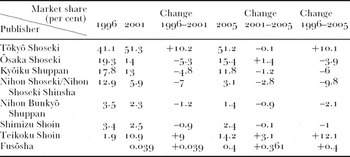
This paper combines detailed documentary analysis with use of interviews, especially with major actors in textbook production. It analyse textbooks themselves, together with documents relating to textbook production, approval, and selection, and it uses interviews with textbook publishers, textbook authors, officials of the Ministry of Education and Science, labour unions, and representatives and members of civil society groups concerned with textbooks and history education.Footnote 12 It focuses primarily on the junior high school history textbooks produced by four publishers: Tōkyō Shoseki, Teikoku Shoin, Kyōiku Shuppan, and Nihon Shoseki/Nihon Shoseki Shinsha.Footnote 13 These textbooks were selected because of their significant market share, and because the first three saw major content changes between 1992 and 2005, compared to other textbooks analysed. Tōkyō Shoseki has long been the market leader in junior high history textbooks. According to James Orr, the junior high social studies textbooks of Tōkyō Shoseki and Chūkyō Shuppan ‘together accounted for 50 to 60 per cent of market share up to 1981, after which Tōkyō Shoseki rose to 30 to 40 per cent—more than double any of its competitors’.Footnote 14 In 2001 and 2005, meanwhile, Tōkyō Shoseki's market share rose even further, to 51 per cent (see Table 1). It is thus Tōkyō Shoseki's textbooks that have had the greatest influence on Japanese junior high students. Kyōiku Shuppan has also had a significant market share of between 18 per cent (1996) and 12 per cent (2005), while Teikoku Shoin's share rose sharply between 1996 and 2005, from only 2 per cent to 14 per cent; in contrast, Nihon Shoseki's market share plummeted from 13 per cent in 1996 to 6 per cent in 2001 and then 3 per cent in 2005.Footnote 15
Changes in junior high history textbooks’ market share, 1996–2005.

Sources: Asahi Shinbun, ‘Tsukuru kai kyōkasho shea 0.039%’, 12 September 2001; Asahi Shinbun, ‘Fusōsha rekishi kyōkasho shea 0.4%’, 6 October 2005.
In order to gain a comprehensive picture of how junior high textbooks represent Japan's modern history of colonialism and aggression in Asia, I examined the coverage of the 1895–1945 period in the 1992, 1996, 2001, and 2005/2009 editions of the history textbooks of Tōkyō Shoseki, Ōsaka Shoseki, Kyōiku Shuppan, Nihon Shoseki, and Teikoku Shoin.Footnote 16 I focused especially on certain key historical episodes that were covered to a greater or lesser extent by all the textbooks: the March First Independence Movement in Korea in 1919, the 1937 Nanking Massacre, the use of Korean and Chinese forced labour during the Asia-Pacific War of 1937–1945, the effect of Japanese wartime occupation of South-East Asia on the local population, and the effects of the war on Okinawa.Footnote 17 The textbooks were consulted in the library of the Japan Textbook Research Center (Kyōkasho Kenkyū Sentā) in Sengoku, Tokyo, as were recent copies of teacher's manuals, which I shall also touch on.
1996 content changes in junior high history textbooks
It was not until the mid-1960s that junior high history textbooks mentioned Japanese colonial and wartime oppression in Asia, and not until the 1970s that treatment of these topics began to be at all extensive.Footnote 18 Textbook coverage of the topics expanded gradually through the 1980s and early 1990s. In 1996, however, leading publishers Tōkyō Shoseki and Kyōiku Shuppan suddenly introduced increases in coverage that were dramatic in comparison with the previously incremental pace of change. Tōkyō Shoseki, whose 1996 textbook gained a 41 per cent market share, introduced several new full-page features on special topics. One was entitled ‘Yanagi Muneyoshi the Internationalist’, and stated that ‘while most Japanese people saw the March First Movement in Korea as riots, there were a few Japanese who sympathized with the independence movement’, including the artist Yanagi Muneyoshi. It explained how Yanagi admired Korean ceramics, respected the Korean people, and criticized Japanese oppression in Korea, in contrast to most Japanese, who merely saw Korea as a poor and backward country. Another new full-page feature, entitled ‘The mirage (maboroshi) of the “Greater East Asia Co-Prosperity Sphere”’, explained ‘what Japan did under the banner of this beautiful name’:
In the Philippines, after the fall of Bataan, many American and Filipino military POWs were allowed to die in a brutal march under the burning sun. This is called the ‘Bataan Death March’. Even in Japan's ally Thailand, POWs and local labourers were made to work long hours under severe conditions, building the Taimen railway to carry resources for military needs to Burma (now Myanmar). This construction work is called the ‘railway of death’ because tens of thousands died from the heavy labour. Elsewhere, in Indonesia, which had been made a supply base for foodstuffs for the Japanese soldiers sent south, great quantities of rice were seized (ubawareta) by the Japanese army, and when in addition there were repeated disasters such as cold-weather damage [to crops], many people starved to death. On the Malay peninsula, local people of Chinese descent were regarded as resisting Japan, and many were oppressed and executed. In Indonesia, resources such as oil were seized, and many people were made to engage in forced labour.Footnote 19
Yet another new full-page feature, entitled ‘The forcible mobilisation (renkō) of Koreans’, again spelled out Japanese oppression in graphic detail:
The forcible mobilisation of Koreans began in 1939. At the start, it was carried out in the form of ‘recruitment’ (boshū), but it was definitely not according to free will. From 1942, it was done by ‘official placement’ by the colonial government of Korea. Japanese public organizations came to participate directly. In order to meet the colonial government's quotas, police and officials sometimes entered houses without ceremony and took away sleeping men. It is said that those who resisted were beaten with wooden swords, and that wives and children who ran close behind the trucks, crying and shouting, were kicked away.
When they arrived at coal mines and similar workplaces in Japan, they were able to enjoy eating white rice, but only at the start. Later, the recruitment conditions were completely ignored, and what awaited them was long hours of dangerous work, poor meals, and harsh labour management. Even if they complained of illness, it was judged to be feigned, without any medical examination. For this reason, a work attendance rate of 99 per cent was recorded at one mine's Korean dormitory, even though an absence rate of about five per cent due to sickness was normal in coal mines.
It is estimated that between 1939 and 1945, about 700,000 people from Korea were brought to Japan by means of this kind of forcible mobilisation.Footnote 20
Similarly, the textbook produced by Kyōiku Shuppan (18 per cent market share) contained several new two-page features, on the March First Independence Movement in Korea, on the forced labour of Koreans and Chinese during the Asia-Pacific War, and on how contemporary secondary school students in South-East Asia were learning about the Japanese invasion. The last feature included translated excerpts of textbooks from Singapore, Indonesia, and Burma.Footnote 21
It was not only the textbook produced by Tōkyō Shoseki in 1996, but also the accompanying teacher's manual (shidōsho) that encouraged teachers and children actively to examine Japan's imperialist adventures. For example, the manual suggested that the teacher have students write their thoughts and feelings (kansō) about Japan's invasions (shinryaku kōi) of Korea and China, and then tell other class members about this.Footnote 22 For the section on the Manchurian Incident and its aftermath, the manual advised that the teacher ‘have the students debate (giron saseru) from various points of view who was responsible for the expansion of the war’.Footnote 23 It went on:
The reckless conduct of the militarists, led by the Kwantung Army, gave rise to the war, but note (ryūi) that responsibility definitely does not lie only with the militarists; it is necessary to make a comprehensive judgement about how each party—the emperor and government, the political parties, the zaibatsu, the mass media, and the people (kokumin)—were involved. It is desirable for the teacher himself to study this well beforehand, using materials such as Ienaga Saburō's Sensō Sekinin [War Responsibility].Footnote 24
In advocating that students debate war responsibility in such a wide-ranging way, the manual was going well beyond the kind of approach described by Orr as common to many postwar history textbooks, in which the responsibility of the Japanese people themselves, as opposed to their government or simply ‘the militarists’, had not been called into question.Footnote 25 By also raising the question of the responsibility of the emperor, and recommending a book by Ienaga Saburō, by far the most prominent left-wing intellectual in the history education debate, the manual placed itself firmly in the progressive camp.
Tōkyō Shoseki and Kyōiku Shuppan were unusual in increasing their coverage of Japanese aggression in Asia so dramatically. Other leading publishers continued the approach of increasing such coverage incrementally, though some of these incremental changes attracted considerable media attention, especially the inclusion for the first time of brief mentions of the ‘comfort women’. However, the sudden increase in controversial material by these two publishers was important because in 1996, they gained a combined market share of almost 60 per cent.
Explaining the progressive shift in 1996
The dramatic changes in 1996 were explained by a senior manager/editor at Tōkyō Shoseki as the result of several influences that came together in the period when the 1996 textbook was being put together.
There had been initiatives in fields such as peace education (heiwa kyōiku) and human rights education (jinken kyōiku) all through from the 1970s and in the 1980s, in various localities, including the development of teaching materials, and there were long-running calls that the fruits of this should be incorporated into textbooks—though it wasn't necessarily the mainstream. . . People argued for investigating and teaching about the ways that Koreans in Japan had actively stood up to things and made social contributions. . . The peak was just when we were putting this [1996] textbook together. . . And just at the same time it was the fiftieth anniversary of the end of World War Two in 1995 and as you'd expect, there was a fresh reevaluation of the war—and at the same time the problem of postwar compensation came to light and became a big issue, with the military comfort women and those forcibly mobilized (kyōsei renkō), for instance. . . At that time the atmosphere as a whole (zentai no fun'iki) was that those kinds of issues should be taken up and brought into textbooks, and our editors, who had their fingers on the pulse of how teachers were moving, proposed that we actively incorporate this kind of material into the textbook in response.
While the influence of teachers’ movements was no doubt real,Footnote 26 it also seems very likely that the ‘atmosphere’ that influenced publishers’ decisions about textbook content included the contemporary political context—though interviewees were guarded in their comments on this. The initial eruption of the ‘comfort women’ controversy in fact took place in 1991, before planning for the 1996 textbook. What may well have had a significant impact on textbook preparation, however, was the apology to the ‘comfort women’ from the chief cabinet secretary, Kōno Yōhei, in the last days of the Liberal Democratic Party government headed by Miyazawa Kiichi in 1993.Footnote 27 Very likely as important was the defeat of the Liberal Democratic Party in the Lower House election of 1993 and its replacement in government by a seven-party coalition that included the left-wing, pacifist Japan Socialist Party. The new prime minister, Hosokawa Morihiro, stated in a press conference that he regarded the war in China as ‘a war of aggression’ (shinryaku sensō),Footnote 28 a very different view from that of many prominent Liberal Democratic Party figures. Even when the Liberal Democratic Party returned to government the following year, it did so in a coalition with the Japan Socialist Party, whose leader, Murayama Tomiichi, was prime minister between June 1994 and January 1996. The fiftieth anniversary of the end of the Second World War fell on 15 August 1995, and Murayama took the opportunity to issue a formal apology for the war (the ‘Murayama danwa’).Footnote 29 It is easy to see how textbook publishers might consider that a more open approach to Japanese imperialism and wartime aggression, long advocated by many teachers, had now also been widely legitimized by the choices of the electorate in the democratic process, and was thus appropriate for the public version of history that school textbooks represent.
Changes in junior high history textbook content since 2001
To date, scholars writing on history textbooks have paid little attention to the increased coverage of Japan's aggression in Asia in the 1996 textbooks. If anything, the impression is given that the tendency to slim down such coverage started some years before 2001: Saaler, for example, writes that ‘over a number of years. . . the mainstream publishing houses were increasingly tending to delete from their textbooks the so-called “dark” chapters of Japanese wartime atrocities’.Footnote 30 Writers have instead focused on the withdrawal of controversial material in 2001, especially certain items that have become regarded (by both ‘progressives’ and ‘conservatives’) as totemic, in particular mentions of the ‘comfort women’ and numbers killed in the Nanking Massacre. However, focusing attention so narrowly oversimplifies a complex situation.
Many of the dramatic innovations in history textbook content in 1996 were indeed short-lived. The changes introduced into the 1996 edition of Tōkyō Shoseki's textbook were largely reversed in the next edition (2001), and this approach has been maintained in subsequent editions. The full-page features on ‘The mirage of the “Greater East Asia Co-Prosperity Sphere”’ and ‘The forcible mobilisation of Koreans’ vanished.Footnote 31 Other junior high history textbooks approved in 2001 also cut down their coverage of controversial issues, though what remained was substantial. Kyōiku Shuppan's textbook reduced its two A5 pages on the March First Independence Movement in Korea to one (larger) B5 page in its 2001 edition,Footnote 32 though much detail critical of Japanese rule in Korea remained; this was then reduced further to one paragraph in 2005. Similarly, their two pages on forced Korean and Chinese labour in 1996 were reduced to one in 2001, and then dropped entirely in 2005. The 1996 Kyōiku Shuppan textbook's two pages of excerpts from Southeast Asian history textbooks also vanished completely in 2001. Most textbooks cut down their coverage of the Nanking Massacre from 2001, replacing figures with a statement that ‘many’ Chinese people were killed.Footnote 33 For example, Tōkyō Shoseki's 2005 textbook wrote as follows:
The flames of war spread from north into central China, and the Japanese army occupied the capital, Nanking, at the end of the same year. In the process, they killed many (tairyō ni) Chinese people, including women and children (Nanking Incident). [Marginal note: This incident was criticised internationally as the Great Nanking Massacre, but was not communicated to the people of Japan.]Footnote 34
Details about Japanese oppression in Southeast Asia diminished quite considerably in the main text of Tōkyō Shoseki's textbook from 2001, though some information was provided outside the main text; in the 2005 textbook, for example, pictures of labourers on the Thai-Burma railway, and of the memorial to the victims of the Japanese army in Singapore, were accompanied by the following captions:
Local people pressed into service and engaging in railway construction. In the construction of a railway to transport goods for military use from Thailand to Burma (now Myanmar), local people and POWs were made to work, and it is said that tens of thousands died.
Memorial to victims of the Japanese military. In Singapore, many citizens of Chinese descent were killed for being deemed uncooperative with the Japanese army.Footnote 35
Nonetheless, Tōkyō Shoseki's textbook did continue to include significant amounts of material on Japanese oppression in Asia. The special feature on ‘Yanagi Muneyoshi the Internationalist’ was retained in 2001 and 2005.Footnote 36 The main text about the late 1930s and 1940s also retained information about the ‘Japanization’ measures in Korea, and the forced labour recruitment of Koreans and Chinese:
In Korea, the government pushed forward (oshisusumemashita) the use of Japanese and the policy of having people change their names into a Japanese form. This was done in the name of the policy of Kōminka [making people into Imperial subjects]. Furthermore, a system to recruit volunteers for the military was set up, and Korean people too were mobilised to the battlefield. ‘Kōminka’ was also pushed forward in Taiwan.Footnote 37
In East and South-East Asia, which Japan had invaded, there were many victims, including ordinary people, who died in the war or were hunted out to do labour, women and children included. There were also Koreans and Chinese who were brought to Japan and forced to work against their will. Their working conditions were harsh, their wages were low, and they were forced to live extremely hard lives.Footnote 38
Yet amid this reduction in coverage of controversial material by most textbooks from 2001, there was a notable exception. One publisher, Teikoku Shoin, bucked the trend by substantially increasing its coverage in 2001 and maintaining this in 2005. On Japan's annexation of Korea in 1910, for example, its main text stated that while Japan's victory in the Russo-Japanese War encouraged other Asians suffering under colonialism, Japan itself then went against those hopes, colonizing Korea and becoming active as ‘an imperialist nation’.Footnote 39 A text box contained an extract from a letter by Nehru, stating that the end result of the Russo-Japanese War ‘was nothing more than the addition of one more country to the small group of invasive imperialist nations; and it was Korea that first tasted that bitter result’. Another text box on the same page explained that while Itō Hirobumi's killer, An Jung-geun, is seen as an assassin in Japan, in Korea he is seen as a national hero. The box quoted from a Korean textbook that stated, ‘This action of An Jung-geun well expressed our nation's strong spirit for independence with regard to the invasion of Japan.’Footnote 40 The features on Nehru and An Jung-geun, newly introduced in 2001, exemplified the way this textbook repeatedly presented students with perspectives on Japanese history from other Asian countries. A further example was the introduction from 2001 of a picture of a memorial to Yu Kwan-soon, a 16-year-old martyr of Korea's March First Independence Movement of 1919 who was also featured in Tōkyō Shoseki's 1996 and 2001 textbooks. The Teikoku Shoin text read:
Yu Kwan-soon encountered the March First Independence Movement while a student at Yi-wha Girls’ School in Seoul. Kwan-soon joined the movement and was arrested for shouting ‘Long live Korean independence!’ Because she would not swerve from that attitude even in prison, she underwent torture and died in prison. She was 16 years old.Footnote 41
The 2001 and 2005 editions of Teikoku Shoin's textbook also gave considerable coverage to oppression and atrocities by the Japanese military during the Asia-Pacific War. Though giving no figures for the atrocities at Nanking, for example, its main text did state that the Japanese army ‘killed many Chinese people, including women and children, not only soldiers, and this was criticized by various foreign countries as “an atrocity (bankō) by the Japanese army” (Great Nanking Massacre)’.Footnote 42 Half a page of the main text covered kōminka policies in Korea and Taiwan, the forced labour of Koreans and Chinese in Japan, and the oppression by the Japanese army in South-East Asia, in somewhat more detailed terms than those of the 2001 and 2005 Tōkyō Shoseki textbooks. A quarter-page of the 2005 book was taken up by a lengthy quotation about Japanese rule from an Indonesian textbook, which ran in part as follows:
The period of occupation by the Japanese army took away people's power and wealth root and branch. . . The oppression of the local people still continued. Besides being forced to work as labourers, some of the people were compelled to work on farms producing agricultural products. The profits gained there went for use on war expenses as a matter of course. In addition, a set amount of rice, corn, and livestock was demanded of people to supply food for the soldiers. . . The obligations and coercions that were made one after another caused the people to suffer. Because of the large-scale exactions of labour, they did not have enough labour power for their own productive activities. As a result, malnutrition and famine spread. After the lack of food, there followed a lack of clothing. People then ate food and wore clothes that were not fit for humans.Footnote 43
This replaced similar features using textbooks from Singapore and South Korea in Teikoku Shoin's 1996 and 2001 textbooks. Finally, the 2001 and 2005 editions contained a whole page about the war in Okinawa, including a damning portrayal of the actions of the Japanese army:
In March 1945, the American forces surrounded the island of Okinawa, and landed on the Kerama islands. After a fierce battle, in May the Japanese army lost its fighting capability, and withdrew to the southern part of the island of Okinawa, where the local people had taken refuge. As a result, many local people died after the Japanese army took their food and drove them out of safe refuges to wander around as shells rained down.
The commander of the Japanese army committed suicide on 22 June, and the organized resistance of the Japanese forces came to an end, but because the order to ‘fight to the last man’ remained, the sacrifice of soldiers and local people continued to increase. People were driven into mass deaths (shūdanshi), and some local people who used the banned Ryukyu dialect were killed by the Japanese soldiers.Footnote 44
The claim that textbook publishers retreated into self-censorship and avoidance of controversial material from 2001, while containing a degree of truth in some cases, is thus an oversimplification. Most textbooks did reduce their coverage of modern Japan's aggression in Asia, especially of the most controversial issues—the ‘comfort women’ and the numbers killed in the Nanking Massacre. Even so, substantial coverage remained in all mainstream textbooks, and one textbook even increased its coverage. Nozaki's assertion that the 2001 revisions represented a ‘sea change’ is something of an exaggeration, especially since it ignores some textbooks’ substantial increases in coverage in 1996. The reductions in coverage have rightly been cause for serious concern. However, we should recognize that children continue to be presented with extensive information on the darker aspects of modern Japan's relations with Asia.
Saaler has argued that since 2001, ‘progressive’ textbooks with more detailed treatment of controversial material have been losing market share to less progressive books.Footnote 45 Saaler categorizes the textbooks of Nihon Shoseki, Ōsaka Shoseki, and Kyōiku Shuppan as ‘progressive’, and contrasts these with the textbook of Tōkyō Shoseki. However, a closer look suggests a more complex reality. Between 1996 and 2005, Tōkyō Shoseki and Teikoku Shoin—the two publishers that substantially increased their market shares—adopted diametrically opposed approaches to ‘progressive’ textbook content: Tōkyō Shoseki cut it back, while Teikoku Shoin increased it. Meanwhile, Kyōiku Shuppan lost market share both when they retained substantial ‘progressive’ content in 2001 and also when they dramatically reduced such content in 2005; in contrast, Ōsaka Shoseki gained market share in 2005, despite making few, if any, cuts in ‘progressive’ content. In fact, there has been no simple relationship between amount of ‘progressive’ content and market share. What has almost certainly played a part, however, have been perceptions of particular textbooks as being far from the mainstream in their representation of history, as I shall discuss later.
Explaining changes in textbook content
Why did textbook content change as it did in 2001? To date, the finger has been pointed primarily at pressures brought to bear on publishers before and during the Ministry of Education and Science's textbook approval process. While acknowledging the possible effects of publishers’ fears about losing market share due to the Tsukuru Kai's campaigns against controversial content, Nozaki ultimately sees the changes in textbook content in 2001 as ‘guided self-censorship’, with publishers responding to guidance from the state.Footnote 46 The same conclusion is reached by an article on the subject, written in the name of five groups of progressive textbook activists, in Kyōkasho Repōto, an annual publication issued by the Japan Federation of Publishers’ Workers Unions.Footnote 47 However, neither Nozaki nor the activist groups give a reason for seeing state pressure as being more decisive than anxiety about textbook adoption decisions.
The Ministry of Education's textbook approval system has been subject to repeated criticism over several decades by textbook authors (generally scholars) and others. While some critics have attacked the principle of government textbook approval itself, others have concentrated their fire on the personnel and workings of the approval system. Criticism has focused on the lack of transparency in the system, including the appointment of the key personnel in the textbook approval process (the textbook advisers (kyōkasho chōsakan) who write the detailed appraisals of the textbooks submitted to the Ministry). It has been pointed out that a number of textbook advisers for history have had strong associations with right-wing historians or institutions.Footnote 48 Most recently, it was reported in 2007 that two of the four textbook advisers then responsible for advising on Japanese history were former students of Professor Itō Takashi, a former history professor at Tokyo University and former official of the Tsukuru Kai, now associated with the alternative nationalist textbook group, the Kyōkasho Kaizen no Kai.Footnote 49
Ishiyama Hisao, a textbook author and chair of the left-leaning history educators’ association, the Rekishi Kyōikusha Kyōgikai (History Educationalists’ Conference of Japan), points to further problems in the approval process: no records are kept of the meetings of the Textbook Approval Committee (kyōkasho kentei shingikai). Also, the written instructions about textbook revisions issued by the approval committee tend to be vague, meaning that textbook editors and authors often need to request oral clarification by the textbook advisers, which is not minuted.Footnote 50
The most celebrated and successful attacks on the textbook approval process came from Ienaga Saburō, historian and author of a high school history textbook that was repeatedly rejected or revised by the Ministry. Ienaga brought court cases against the principle of government textbook approval and against particular decisions of the approval committee, and these have been credited with forcing the Ministry to carry out its procedures more transparently and circumspectly.Footnote 51 Nonetheless, further major controversies have followed: in 2007, for example, there were mass protests in Okinawa after the Ministry's textbook approval committee instructed six publishers of high school history textbooks to alter texts on the mass suicides (shūdan jiketsu) of Okinawans during the 1945 Battle of Okinawa, in order to weaken originally clear statements that these were sometimes the result of coercion by the Japanese military.Footnote 52
Despite the existence of such criticisms, however, textbook publishers and authors alike whom I interviewed minimized the influence of the Ministry of Education and Science's approval process upon controversial content in junior high textbooks in recent years. All publishers stated that gaining Ministry approval was relatively unproblematic, provided that textbooks followed the curriculum and avoided outright mistakes or excessively difficult language. Similarly, the author chiefly responsible for the modern history section of the 2001 Nihon Shoseki textbook stated that he encountered very few negative comments from the Ministry of Education and Science's textbook adviser (kyōkasho chōsakan), and that the text passed through screening very smoothly.Footnote 53 This is significant, given that Nihon Shoseki's 2001 textbook was subject to special attack by nationalists, in particular because of its mention of ‘comfort women’.
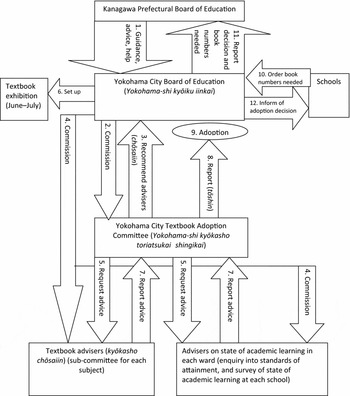
Interview evidence suggests that, instead, revisions were mainly aimed at increasing the chances of the books’ being adopted for school use by local boards of education. In Japan, the exact system of textbook adoption varies locally, but the basic procedures to be followed are laid down by the Ministry of Education and Science in accordance with law.Footnote 54 Legal authority to adopt textbooks for elementary and junior high schools rests with the local board of education (kyōiku iinkai).Footnote 55 The board of education proper is composed of a superintendent (kyōiku-chō), who represents and is responsible for the educational administration, and four or five board members (kyōiku-iin) nominated by the mayor (shuchō) of the local city, town or village with the endorsement of the local assembly (gikai).Footnote 56 The board proper normally receives an advisory report from an adoption committee, which the Ministry of Education and Science recommends should be composed of persons with specialist knowledge: ‘school principals and teachers, persons connected to the board of education, and former teachers’.Footnote 57 In 2009, for example, the Yokohama City adoption committee was composed of eight principals or vice-principals, five administrators from the city board of education, three university professors, and four parents of schoolchildren, a total of 20 in all.Footnote 58 The adoption committees in turn base their advice on reports about each textbook written by advisers (chōsa-iin) appointed for this purpose. The advisers are appointed by the board of education;Footnote 59 according to a representative of the Zenkoku Chūgakkō Shakai-ka Kyōiku Kenkyūkai (Zenchūsha, the National Junior High School Social Studies Education Research Association), who is also a junior high principal, such advisers are generally subject teachers who are either known for their record of action research or else are seen as either highly motivated or promising.Footnote 60 The process conducted by Yokohama in 2009 is illustrated in Figure 1.
2009 textbook adoption process in Yokohama.
Sources: Based on Hinkyōso kyōbun nyūsu [Yokohama Teachers’ Union bulletin], 29 June 2009, p. 1, and ‘Heisei 21-nendo kyōkasho saitaku tejun’ [2009 textbook adoption process] from Yokohama Board of Education website.

Since the five or six members of the board of education proper are not necessarily educational experts, and since the number of textbooks that need to be scrutinized during the short period of the adoption process is very large, it is not surprising that, until recently, boards of education proper generally rubber-stamped the recommendations of the adoption committees, which in turn accepted the recommendations of the advisers (i.e. the expert teachers). The decision about which textbook to adopt was thus effectively in the hands of teachers. In some areas (notably Tokyo and Yokohama), teachers had an even more direct say, as the decision about which textbooks to adopt was based on a ‘school vote’ (gakkōhyō) system, with each school casting a vote for its preferred textbook in each subject.Footnote 61
In 2001, however, campaigns by the nationalist activists of the Tsukuru Kai led to changes in this process. They argued that the Board of Education itself should exercise the textbook selection authority legally vested in it, albeit after taking advice. The Tsukuru Kai chairman, Fujioka Nobukatsu, has given a detailed account of the rationale for this view in his book, Kyōkasho Saitaku no Shinsō (The Truth about Textbook Adoption). Fujioka's primary argument was that teachers’ views are unduly influenced by assessments of textbooks published by the Japan Teachers’ Union and other bodies concerned with human rights.Footnote 62 However, his more fundamental concern seemed to be that boards’ reliance on teachers’ views had resulted in textbooks providing what he and other conservative nationalists considered a ‘masochistic’ view of Japan's history. Since local mayors and assemblies have shown a strong tendency to be politically conservative in Japan,Footnote 63 textbook selection by local boards of education themselves would be likely to result in more conservative textbook selection choices.
The Tsukuru Kai's campaigns resulted in a flood of petitions from its supporters to local assemblies, urging that the authority of the board of education to adopt textbooks be asserted, the ‘school vote’ system abolished, and the power of textbook advisers to rank textbooks for adoption committees curbed.Footnote 64 In February 2001, the Tokyo Metropolitan Board of Education directed the local boards of education to stop using the ‘school vote’ system of textbook adoption, and in April of the same year, nationalist governor of Tokyo, Ishihara Shintarō, urged boards of education to take responsibility for reading and choosing textbooks themselves, claiming that if they did not, ‘the country would go to ruin’.Footnote 65 Yokohama also abandoned the ‘school vote’ system, though in 2001 the school principals’ committee (kōchōkai) of each ward (ku) did advise the Yokohama City Board of Education of their opinion; this advice was not solicited after 2001, however.Footnote 66 About a third of prefectures prohibited textbook advisers from recommending a shortlist of suitable textbooks.Footnote 67
In interview, publishers explained that they saw local textbook adoption as a source of much greater concern than Ministry approval. The Tsukuru Kai campaigns and the alterations in the adoption system immediately before the 2001 adoption process caused them particular worry, because of uncertainty about who would actually be making textbook adoption decisions. Traditionally, publishers stated, they had aimed textbooks at the expert teachers who had most influence in the adoption process, but now their textbooks had to appeal to both teachers and boards of education. As one editor put it, teachers wanted textbooks that were easy to teach from, but boards of education were influenced by politics. A senior manager/editor at Tōkyō Shoseki commented:
The textbook adoption procedures have been changing. . . As far as publishers are concerned, the users of the textbooks are those who select them—that used to be keen, expert teachers, and the number one point in terms of sales was to make textbooks that appealed to keen, expert teachers in each subject, but now that has been changing, so who the textbook needs to appeal and sell to is something we're don't really know and we worry about (yoku wakaranakute nayandeiru tokoro). One thinks, well, if those we are selling to change, then we'll probably have to change the way we make the textbooks, but we don't yet know how we should change. . .
According to this interviewee, revisions were made partly in response to a change in public discourse on history textbook content, and partly because of the need to slim down textbooks in accordance with the cuts in curricular time from 2002. His comments suggest how sensitive publishers were to public perceptions of their textbooks, with the possible impact on adoption decisions in the background:
In the summer of 1996 textbooks went on public display. Fujioka Nobukatsu had been starting to talk about a reexamination of history education, and he wrote a lot in the media about how the way that all the textbooks were taking up the military comfort women and forced mobilisation was a ‘masochistic view of history’ (jigyaku shikan). What I thought was symbolic of all of that was that, until then he'd written approvingly of our textbook, but now he wrote, ‘even Tōkyō Shoseki’—‘et tu, Tōkyō Shoseki!’ as it were—and that when things got to this then textbooks couldn't be overlooked. When I read that I thought, ‘Uh-huh’ (aa, naruhodo na); it made a lasting impression on me. And then such voices were heard more widely, saying that textbooks should be reexamined, and in response to such criticisms, well, we had to take into account to some extent (aru teido hairyo) that there were such voices and deal with that (sō iu koe ga aru to iu koto wa osaenakute wa ikenai). . . And then the next edition [2001]—the curriculum changed, and it was the point that content reduction was most emphasised, the school five-day week started, lesson time was cut by 20 per cent. . . so we had to cut content a lot. And then criteria about textbook format were relaxed [by the Ministry of Education]; we were allowed to move from A5 to larger B5 size books and colour was allowed throughout the book, instead of just a few pages as before, so our editing changed a lot. . . we decided to use photos as much as possible, and we reduced the text. . . and as part of all that, features that weren't part of the main text, like the ones on the Greater East Asia Co-Prosperity Sphere and forced mobilisation of Koreans, were dropped.
Interviews revealed a further important influence on textbook content—the relationships between editors and authors. These differed between publishers, even though all three publishers interviewed, stressed that editors rather than authors made the final decisions on textbook content. The author responsible for the modern history section of Teikoku Shoin's textbook stated that the eight authors of this textbook met quite often to discuss the writing of the text, and estimated that about half its content was decided by the authors, who did the actual writing, and about half by the editors; he contrasted this with the situation at Tōkyō Shoseki, where the very large number of authors (38 in 2001) meant that they rarely—if ever—met, implying much greater editorial control.Footnote 68 In contrast, the author responsible for the modern history section of Nihon Shoseki's text explained that its editors had allowed him to determine the content; while they had expressed preferences, they had deferred to his final decision. Thus, the greatest editorial control seemed to have been exercised at Tōkyō Shoseki, and the least at Nihon Shoseki, with Teikoku Shoin in an intermediate position. This may help to explain why Tōkyō Shoseki's revisions of content were more commercially cautious in 2001.
Finally, a publisher's decisions about content can be related to its position in the market. Between 1996 and 2001, Tōkyō Shoseki enjoyed the largest, and Kyōiku Shuppan the third largest, market share, at 40 per cent and 18 per cent respectively. With considerable market share to lose, it is easy to understand why both should have prioritised risk avoidance in revising their textbooks. On the other hand, with a market share of just 1.9 per cent after 1996, Teikoku Shoin had little to lose from a more adventurous approach. As their editor commented, ‘our textbook hadn't been selling, so we had to undertake a major reform’. Moreover, as one teacher pointed out to me in interview, Teikoku Shoin could probably afford to take a greater risk because it derived considerable income from its dominance of the atlas (chizu-chō) market, and was not dependent on success in the history textbook market.
The possible effects of behind-the-scenes government pressure before, and separate from, the approval process cannot be ruled out, given evidence emanating from textbook editors and authors,Footnote 69 and such pressure may explain why most publishers removed the particularly controversial references to the ‘comfort women’ and estimates of numbers killed in the Nanking Massacre from their 2001 textbooks. However, the broader tendency to remove controversial content is better explained by publishers’ anxiety over the changed textbook adoption process and the influence of nationalist campaigns on boards of education.Footnote 70 Where controversial content was expanded, it was either because the publisher gave a free rein to the authors (Nihon Shoseki) or because the publisher's market position induced a more adventurous approach (Teikoku Shoin). Rather than state pressure before or during the government textbook approval process, the most important influences on textbook content were thus local textbook adoption processes and market strategies.
Explaining changes in textbooks’ market share
I argued earlier that perceptions of certain textbooks as more progressive or conservative than others can be misleading. Nonetheless, however mistaken, such perceptions are likely to have exercised some influence on textbook adoption decisions. In particular, perceptions of Nihon Shoseki's textbook as particularly ‘progressive’ (or alternatively, ‘masochistic’, depending on the political viewpoint) were probably important reasons for its loss of market share from 2001 onwards.Footnote 71 That loss was particularly catastrophic because of the firm's extreme dependence on two large textbook markets, Tokyo and Yokohama.Footnote 72 This dependence left Nihon Shoseki extremely vulnerable to the changes in the textbook adoption system brought about by conservative administrations in Tokyo and Yokohama from 2001, which weakened the voice of teachers in textbook adoption.
However, ideology was probably not the only influence on textbook adoption decisions. Changes in market share were likely also to have been influenced by the demands of the new school curriculum, published in 1998 and introduced in 2002. The new curriculum was the centrepiece of an educational reform programme aimed at reducing study pressure and promoting independent thinking and learning.Footnote 73 Not only were hours for teaching junior high history reduced, but the educational tides favoured textbooks that were in the spirit of the new curriculum, containing materials that encouraged exploratory thinking and learning. According to Teikoku Shoin's editor, this had offered the firm an opportunity to change their approach to focus more on how to use the textbook in class, with specialists in history education recruited as authors alongside historians. The aim was a text that enabled students to make their own judgements and form their own values, rather than having values forced upon them by the textbook. The author responsible for Teikoku Shoin's modern history sections represented its approach similarly, contrasting it with what he referred to as the fact-centred ‘positivism’ of Tōkyō Shoseki and the ‘old-style Marxism’ of Nihon Shoseki and its authors. Text boxes and panels alongside the main text introduced a range of perspectives on the subjects and invited students to look at topics from various angles, rather than either presenting history from a particular interpretive framework or as a positivist series of facts. According to the Teikoku Shoin editor, this intentionally innovative textbook had been welcomed by teachers who were keen to get away from lecturing and to introduce more student activities into lessons.
Tōkyō Shoseki's 2001 and 2005 textbooks also featured innovative teaching materials in the spirit of the 2002 curriculum. These came in the form of sections on investigating, interrogating, and interpreting historical sources such as museum exhibits, photographs, and maps. These were entitled ‘Rekishi ni charenji’ (Try your hand at history) in the 2001 edition, and ‘Sukiru appu’ (Skill up) in 2005. According to a senior manager/editor at the firm, these sections were highly evaluated by teachers as responding well to the demands of the new curriculum and, as a result, the number of pages devoted to them increased between 2001 and 2005. Though seen by textbook activists as having become less progressive in its historical coverage from 2001 on, Tōkyō Shoseki's textbook had thus become more progressive in pedagogical terms.
In contrast, textbooks from other firms (including Kyōiku Shuppan, Ōsaka Shoseki, and Nihon Shoseki) did not contain the kind of innovations adopted by Tōkyō Shoseki and Teikoku Shoin, and this may be an additional clue to their loss of market share. Indeed, Kyōiku Shuppan's editor commented that teachers reported finding their 2001 textbook hard to get through in the reduced time available under the revised curriculum, suggesting that this may also have been a significant reason for the firm's drop in market share in that year. It is essential to remember that altered perceptions about pedagogical suitability can bring about very dramatic rises and falls in textbooks’ market share; in 2001, for example, Mitsumura Tosho's bestselling junior high Japanese (kokugo) textbook suffered a 16.4 per cent drop in market share, from 54.6 to 38.2 per cent.Footnote 74 These pedagogical considerations apply to textbooks in history as to other subjects, despite the tendency among some to see history textbooks mainly in terms of their historical content.Footnote 75
Textbook selection, local democracy, and educational control
Since the local textbook adoption process is so important, it is necessary to ensure that it is legitimate and working properly. Textbook adoption processes are frequently matters of controversy, not only in Japan but also in the United States, for example. Ultimately, the questions of who should make adoption decisions, and how, are part of wider questions about the control and management of education. It is frequently asserted that the control of education should reflect both the expertise of educational professionals and the voice of the local community;Footnote 76 however, deciding exactly how these two elements should be balanced, and by what means, is a much harder task.
The Tsukuru Kai campaigns in Japan raise this issue acutely because of their assertion that the views of educational professionals should be subordinate to those of boards of education. As explained above, until 2001 teachers had the major say in the textbook adoption process in Japan, though parent and community representatives were also involved. Since then, however, Tsukuru Kai campaigns have diminished the influence of educational professionals in favour of that of community representatives, in the form of boards of education. This raises two questions. First, are boards of education appropriate representatives of the local community? Secondly, have these boards given adequate weight to the advice of educational professionals in textbook adoption?
The first question arises due to the fact that boards of education in Japan have jurisdiction over large areas and are not directly elected. As in the United States, where boards of education have similarly come to govern large areas,Footnote 77 it is questionable how far five or six people can adequately represent the views of tens or even hundreds of thousands of others.Footnote 78 However, American boards are generally directly elected and are therefore accountable to the local population. In Japan, on the other hand, boards are appointed by the local mayor, with the agreement of the local assembly. While indirect accountability remains, this is inevitably imperfect, especially given that the nominating mayor is in a much better position to know the ideological views of nominees than are assembly members; this information imbalance hinders the assembly's scrutinizing role. Moreover, mayors and assembly members are not elected solely on their educational policies. The potential problems that can arise are well illustrated by the case of the board of education in the Tokyo borough of Suginami, a prominent example of a board that has selected a Tsukuru Kai textbook.Footnote 79
Between 1999 and May 2010 the mayor of Suginami was Yamada Hiroshi. A nationalist and neo-liberal, he favoured small government, privatization, and deregulation.Footnote 80 He became mayor with the support of the then opposition Democratic Party of Japan, defeating the elderly incumbent mayor supported by Japan's dominant conservative party, the Liberal Democrats.Footnote 81 He made his name by refusing Suginami's participation in Juki Net, a ‘national database system containing the names, addresses, and various other details’ of all Japanese citizens and long-term residents,Footnote 82 until personal information protection laws were introduced in 2003.Footnote 83 Under his mayoralty, Suginami also became nationally known for initiatives such as appointing a former businessman as principal of Wada Junior High SchoolFootnote 84 and setting up Suginami's own teacher training institute.Footnote 85 While some voters may have shared his nationalistic views, much of his electoral support probably stemmed from his image as a radical reformer and outsider backed by the main opposition party.Footnote 86
Yamada's appointments to the Suginami Board of Education included Ōkura Yūnosuke and Miyazaka Kimio, whose strong support of the controversial Tsukuru Kai textbook was considered to be important in its adoption by the board in 2005.Footnote 87 When Yamada nominated Ōkura and Miyazaka for a further four-year term on the board in November 2008, approval by the Suginami borough assembly did not go smoothly. Representatives from the Kōmeitō party, part of the governing coalition, absented themselves from the endorsement vote, and when assembly members from opposition parties also absented themselves, the assembly became inquorate. An approval vote was secured only when Kōmeitō members returned to vote in favour, along with the Liberal Democrats and Democratic Party members.Footnote 88 However, as the Kōmeitō group's subsequently issued statement made clear, the reappointment of these two nationalist board members did not mean that a majority of assembly members (let alone a majority of voters) approved the decision to adopt the Tsukuru Kai textbook. Of course, this made the Suginami board's August 2009 decision to readopt this textbook even more controversial. The case is a good illustration of the problems with the current appointment system for board members, in terms of satisfactory representation of the voice of the local community.
The second question—whether boards have given due weight to the views of educational professionals—is raised particularly sharply by the decisions to adopt nationalist textbooks made by the Suginami Board of Education and the Yokohama City Board of Education in 2009. After four years of using the Tsukuru Kai textbook published by Fusōsha, 14 of Suginami's 23 junior high schools gave it a negative assessment, with only three assessing it positively, yet the Suginami Board of Education nonetheless proceeded to select the textbook for a second time.Footnote 89 Similarly, the Yokohama City textbook adoption committee gave the most positive assessment to the history textbooks published by Teikoku Shoin and (to a lesser extent) Tōkyō Shoseki, basing this on the reports of the textbook advisers (that is, expert teachers), but the Yokohama Board of Education disregarded these assessments and selected the Tsukuru Kai textbook published by Jiyūsha for use in eight of Yokohama's 18 wards.Footnote 90 The educational views of the board's chair, Imada Tadahiko, were expressed during the Board's textbook adoption meeting on 4 August 2009 as follows:
At the time of the textbook adoption of 2005, I remarked that given that these days there seem to be a great many people with extremely self-centred ideas, shouldn't we put more effort into education that turns people's eyes a bit more to the public, the locality, the nation? To that end, I asked whether we shouldn't carry out education that lets people have pride and confidence as Japanese, based on a correct historical consciousness, as well as carrying out moral education properly. As the state of the world hasn't changed since then, or may even have worsened, my views have also changed little. . . I've looked at various textbooks, and none are perfect, but I consider that a history textbook that makes people sad to have been born Japanese is no good.Footnote 91
Although none of the other Board members voiced such views explicitly, evidence of the conservative outlook of some is available elsewhere.Footnote 92 The members of the Board had been appointed by Nakada Hiroshi, mayor of Yokohama between 2002 and 2009, and, like Yamada Hiroshi, a nationalist neo-liberal.Footnote 93
Decisions such as those reached in 2009 in Suginami and Yokohama raise serious questions about whether the current textbook adoption process in Japan is adequate. In the cases highlighted, it seems that textbook adoption has been determined by the predilections of the small number of individuals who comprise the Board of Education, without sufficient weight being given to professional educational expertise. Controversy is compounded when there are questions about whether the views of the Board represent those of the local community. Textbook adoption would command more confidence if it were clearly shown that professional expertise had been given due consideration, and only rejected if the views of the local community gave strong reason to do so. It would also be desirable if local representatives were directly chosen by and accountable to the community, as was the case in Japan between 1948 and 1956.Footnote 94 Where boards of education are responsible for a large or populous area, there is a strong argument that they should adopt not a single textbook for all schools in the area, as is the case now, but a list of several textbooks, from which schools can choose whichever they judge to be most suitable for their local community. If combined with stronger community involvement in school decision-making, this would potentially better enable parents and local people to voice their views on textbook content.Footnote 95 Needless to say, such measures by themselves would not provide an ideal of educational governance, for it would still be necessary to strive for inclusive decision-making that involved all sections of the local community, rather than this being dominated either by teachers or local elites or both, as research outside Japan suggests is often the case.Footnote 96 Indeed, some anti-nationalist textbook activists in Japan might view an increased voice for local people in textbook selection with trepidation and might argue that such decisions should be left to the professional expertise of teachers,Footnote 97 precisely because of their fears of the increased conflict and possible nationalist influence that might follow if local conservatives were successful in creating vocal activist groups—as has been seen on successive occasions in struggles over textbooks in the United States.Footnote 98 Yet, while there is much to be said for entrusting teachers with the leading role in textbook adoption, democratic principles make it difficult to argue for the exclusion of the voice of the local community from the textbook adoption process.
Recent developments and future prospects
How might the history textbook system and the content of history textbooks develop in the foreseeable future? As I have argued, the past decade has shown the importance of the textbook adoption system for history textbook content. Nationalist campaigns have succeeded in shifting influence over textbook adoption towards boards of education, though expert teachers retain a major role in the process as advisers. As a result, publishers have needed to produce textbooks that appeal both to teachers and to boards of education. The latter's ideological views are hard to predict, though the long-standing dominance of Japanese local government by the political Right means that many boards might be expected to have conservative leanings. Faced with this difficult task, publishers have adopted a variety of strategies, attempting to appeal on the basis of both content and pedagogical approach. The publishers that have seen the greatest growth in market share—Teikoku Shoin and Tōkyō Shoseki—have both attempted to appeal through pedagogical innovation, while adopting diametrically opposite approaches to the issue of whether to increase or decrease content about Japan's wartime atrocities and colonial oppression. This suggests that pedagogical appeal may be more important than the presence or absence of controversial content, contrary to widespread perceptions. Nonetheless, it also seems clear that some publishers have concluded, even if mistakenly, that cutting controversial material is the safest way to secure market share. In this way, the changes in the textbook adoption system have affected textbook content. To date, researchers on Japan's history textbooks have paid much less attention to textbook adoption processes than to textbook approval, but this imbalance will need to change.
At the same time, a recent tightening of the textbook approval system may revive its role as an ideological tool in Japan's history wars. New textbook approval criteria issued by the Ministry of Education and Science in April 2009 require textbooks to conform to the goals of education laid out in Article 2 of the revised Fundamental Law of Education enacted in 2006, and compel publishers to give details of how the textbooks they are submitting do this.Footnote 99 The revision of the Fundamental Law of Education, enacted during the administration of nationalist-leaning Prime Minister Abe Shinzō, introduces into the aims of education an emphasis on patriotism and ‘Japanese tradition and culture’ that was absent from the previous Fundamental Law of Education, enacted under the post-Second World War Allied Occupation.Footnote 100 Textbook criteria did not previously require conformity to the educational goals set out in the Fundamental Law of Education—not surprisingly, given the hostility of successive conservative administrations to the original Law.Footnote 101 In an interview, an official of the Ministry of Education and Science indicated that, in practice, certain goals were easier to apply to some subjects (such as social studies) than to others (such as mathematics). There can be little doubt that the introduction of the new criteria was part of an attempt to ensure that the revised Law, and specifically the new stress on patriotism and tradition, has an effect upon classroom teaching.
On the other hand, the landslide victory of the Democratic Party of Japan in the Japanese general election of August 2009 was a setback for advocates of nationalistic history, given that their political support was concentrated in the defeated Liberal Democrats. This was amply demonstrated by the statement issued by Democratic Party Prime Minister Kan Naoto on 10 August 2010, the hundredth anniversary of Japan's annexation of Korea. Kan ‘acknowledged the suffering caused by Japan's “colonial rule” and apologized to the Republic of Korea’; his statement was immediately attacked by conservatives.Footnote 102 Given the Democratic Party-led government's willingness to be open about the suffering caused by imperial Japan in Asia, it is unlikely to countenance pressure on publishers to avoid such openness. This is important, as new editions of junior high history textbooks were due to be approved in 2011, and suggests that any avoidance of openness by publishers is likely to stem from their concerns about how controversial content may fare in the textbook adoption process. At the same time, the Democratic Party-led government has not yet taken any action to amend either the textbook approval or textbook adoption processes, despite the statement in the Democratic Party 2009 policy programme that the Party aimed to move towards textbook adoption at a more local (ultimately school) level, so that the views of parents and teachers would be clearly reflected in textbook choice.Footnote 103 Without such changes, the problems inherent in the current textbook adoption procedures are likely to continue, while retaining the 2009 textbook approval criteria would make it easier for a future, more nationalistic government to exercise pressure on publishers to cut back coverage of imperial Japan's oppressive actions in Asia.
Conclusion
Recent scholarly writing on the representation of modern Japan's relations with Asia in Japanese junior high school textbooks has focused overwhelmingly on reductions in textbook coverage of Japanese war atrocities and colonial oppression. While concern about this is understandable and right, the result has been a partial and oversimplified picture of changing textbook representations. Scholars have focused on cuts in the coverage of controversial topics, without noting that these cuts were preceded by significant increases in such coverage in the second half of the 1990s, or that there have been important differences in the way textbooks have approached these topics.
It is important to note that the vast majority of Japanese junior high students use textbooks that still contain substantial material on these topics. In some cases, notably that of Tōkyō Shoseki, which publishes the market-leading textbook, the teacher's manual also provides extensive additional material. Moreover, one textbook, that of Teikoku Shoin, has significantly increased its coverage of these controversial topics. What is regrettable is that whereas the 1996 textbooks of Tōkyō Shoseki and Kyōiku Shuppan provided extensive materials driving home the human suffering caused by Japanese imperialism in Asia, most textbooks since 2001 have left the task of elaborating the human significance of historical facts to the teacher. This is a significant step backwards, given that teachers’ abilities inevitably vary.
What has determined these changes in textbook content? It has been most common to argue that government pressure has been behind cuts in controversial content. While such behind-the-scenes pressure may have played a role in some cases, it is likely that publishers’ decisions about content were driven primarily by strategic calculations about how best to gain or maintain market share, in the context of a textbook adoption system subject to change and to significant local variation amid vigorous campaigns by nationalists. Thus, market leader Tōkyō Shoseki adopted a cautious, low-risk strategy of reducing controversial content, while minor player Teikoku Shoin boldly took the opposite approach. Strikingly, both publishers saw major gains in market share despite these opposing decisions, suggesting that the amount of controversial content in itself may have had a limited relationship to textbook adoption. Probably more significant were judgements about pedagogical quality, along with popular perceptions of competing textbooks. Publishers that gained significant market share produced textbooks that were pedagogically progressive and in tune with the 2002 curriculum reform. On the other hand, textbooks popularly perceived as well away from the mainstream in their representation of history were less successful. Aside from the Tsukuru Kai textbook published by Fusōsha, this fate particularly befell the textbook produced by Nihon Shoseki, which was strongly attacked by nationalist campaigners. The plunge in Nihon Shoseki's market share was also due to the move away from the ‘school vote’ textbook adoption system under right-wing administrations in Tokyo and Yokohama, the markets upon which it was heavily dependent.
Most writing on the content of Japanese history textbooks to date has focused on the effects of state power upon textbook content, whether through the Ministry of Education's textbook approval system or through behind-the-scenes pressure. As this paper suggests, however, in recent years local decisions about textbook adoption have become increasingly significant in their influence on textbooks’ content. This certainly does not mean that state power has become unimportant. As I have noted, the 2009 revision of the textbook approval criteria, requiring publishers to give details of how their textbooks conform to the revised Fundamental Law of Education, creates ample potential for such power to be brought to bear on publishers. The increasing significance of local textbook adoption, however, makes it difficult to frame the textbook issue any longer as simply as a struggle between liberalism and state control, in which progressive-minded authors and publishers seek to throw off the shackles of an overbearing, censorious state. The last decade has made clear that even in the (unlikely) event of the textbook approval system's demise, publishers’ decisions about content would be constrained by concerns about textbook adoption and market share, meaning that textbook content would not necessarily change dramatically. For progressives, the issue of textbook adoption is potentially more problematic than that of textbook approval. It is relatively easy to argue that the latter is outdated at best (at least in the form it takes in Japan), subjected as it has been to repeated and wounding criticisms of its procedures and personnel. In arguing that textbook adoption should be the sole prerogative of teachers, however, progressives are making a case that sits uneasily with their professed commitment to democracy. As I have suggested, democratic principles make it hard to deny the case for local community involvement in the adoption process, although the flaws in the current system, as revealed in Suginami and Yokohama, make it clear that major reform of that system is needed. Even granted reform allowing more representative community involvement, however, there is no reason to think that conflict over textbook content will become a thing of the past. As the example of the United States shows, such conflict is likely to persist for as long as the differing convictions and visions from which it springs. And there are no signs that the rival convictions at the root of Japan's history wars will themselves become consigned to history any time soon.