Introduction
The adsorption of heavy metal ions from aqueous solutions is a critical environmental concern due to their toxicity and bioaccumulation. The origin of heavy metals is usually ascribed to metal mining, smelting operations, and various industrial practices involving metals. Also, the leakage of metal ions from diverse sources such as landfill sites, waste disposal areas, animal waste, and construction activities further aggravates the matter (Briffa et al., Reference Briffa, Sinagra and Blundell2020). Among these heavy metal ions, nickel (Ni2+) is widespread in various industrial processes and consumer products, leading to water and soil pollution. The latter, in particular, affects bioaccumulation, giving rise to long-term risks. The World Health Organization (WHO) has established that the permissible nickel concentrations in drinking water and wastewater are 0.02 mg L–1 and 900 mg L–1, respectively (Wołowicz and Wawrzkiewicz, Reference Wołowicz and Wawrzkiewicz2021).
A wide range of materials, including natural adsorbents such as activated carbon, clays, and biosorbents derived from agricultural waste, as well as engineered materials such as metal-organic frameworks (MOFs) and nanocomposites, have been used for efficient nickel removal (Raval et al., Reference Raval, Shah and Shah2016). Each of these adsorbents presents distinct advantages and challenges due to their unique properties, such as surface area, pore structure, and chemical reactivity. These features not only enhance the efficiency of nickel removal but also reduce operational costs as adsorption conditions, such as pH, temperature, and contact time from contaminated waters, have to be optimized for maximum Ni2+ removal to reduce the risks associated with nickel ions.
Recent studies suggest that the adsorption efficiency of nickel ions onto sepiolite is not only influenced by its basic characteristics but is also significantly affected by the solution pH (Sheikhhosseini et al., Reference Sheikhhosseini, Shirvani and Shariatmadari2013; Bourliva et al., Reference Bourliva, Sikalidis, Papadopoulou, Betsiou, Michailidis, Sikalidis and Filippidis2018; Kıpçak et al., Reference Kıpçak, Kurtaran Ersal and Özdemir2020). The variation in pH modifies the surface charge of sepiolite and the distribution of nickel, thereby affecting adsorption affinity (Dabiri and Amiri Shiraz, Reference Dabiri and Amiri Shiraz2018; Kıpçak et al., Reference Kıpçak, Kurtaran Ersal and Özdemir2020). Furthermore, the precipitation of nickel compounds is another crucial factor in the adsorption process (Elzinga and Sparks, Reference Elzinga and Sparks1999; Bhattacharyya and Sen Gupta, Reference Bhattacharyya and Sen Gupta2008).
A comprehensive survey of 54 studies of the adsorption of metal ions, including 20 related to nickel uptake, was carried out. Two ions, including Ni2+, were covered in 16 published papers, whereas more than three metal ions (Ni, Co, Cd, Pb, Zn, Cr, Mn, Fe) were investigated in 11 published papers. While the nickel-containing solutions in most studies used distilled water as the aqueous medium, four used wastewater in their metal ion studies. Some of the studies employed pH as a controlled variable instead of natural pH (Puls and Bohn, Reference Puls and Bohn1988; Gupta and Bhattacharyya, Reference Gupta and Bhattacharyya2006; Abollino et al., Reference Abollino, Giacomino, Malandrino and Mentasti2008; Ijagbemi et al., Reference Ijagbemi, Baek and Kim2009; Alandis et al., Reference Alandis, Aldayel, Mekhemer, Hefne and Jokhab2010; Katsou et al., Reference Katsou, Malamis, Haralambous and Loizidou2010; Srivastava et al., Reference Srivastava, Weng, Singh and Sharma2011), while others examined Ni uptake using acidic pH, avoiding the precipitation region of Ni2+ ions (Green-Pedersen et al., Reference Green-Pedersen, Jensen and Pind1997; Gupta, Reference Gupta1998; Ouki and Kavannagh, Reference Ouki and Kavannagh1999; Chantawong et al., Reference Chantawong, Harvey and Bashkin2003; Álvarez‐Ayuso and García‐Sánchez, Reference Álvarez Ayuso and García-Sánchez2003; Donat et al., Reference Donat, Akdogan, Erdem and Cetisli2005; Oter and Akcay, Reference Oter and Akcay2007; Bhattacharyya and Sen Gupta, Reference Bhattacharyya and Sen Gupta2008; Çoruh and Ergun, Reference Çoruh and Ergun2009; Ijagbemi et al., Reference Ijagbemi, Baek and Kim2010; Vieira et al., Reference Vieira, Almeida Neto, Gimenes and da Silva2010). A review by Raval et al. (Reference Raval, Shah and Shah2016) cited 190 published articles that mention agricultural solid waste materials, natural materials, and biosorbents in terms of their adsorption capabilities of Ni2+ ions; they cited 50 papers in which the uptake of Ni2+ ions onto clay minerals from water or wastewater had been studied. Those papers examined both sepiolite and palygorskite (Sheikhhosseini et al., Reference Sheikhhosseini, Shirvani and Shariatmadari2013; Bourliva et al., Reference Bourliva, Sikalidis, Papadopoulou, Betsiou, Michailidis, Sikalidis and Filippidis2018; Kipçak et al., Reference Kıpçak, Kurtaran Ersal and Özdemir2020).
The present literature review indicated that there is not yet sufficient awareness of the precipitation phenomenon in adsorption systems containing metal ions such as Ni2+. It should be noted that nickel ions under certain pH conditions may form insoluble complexes, leading to decreased concentrations of free ions in solution and influencing the overall adsorption dynamics. The interplay between adsorption and precipitation is complex and necessitates a thorough investigation to elucidate the optimal conditions for effective nickel removal. The objective of the present study was to analyze the pH-dependent adsorption behavior of nickel ions onto sepiolite while simultaneously accounting for the precipitation of nickel compounds during adsorption. A further objective was to delineate the reaction kinetics and thermodynamics to enhance the understanding of adsorption isotherms, both for future research and practical applications in environmental remediation.
Materials and methods
Materials
The sepiolite sample used as an adsorbent, specifically the raw brown sepiolite (BS), was obtained from the Sivrihisar-Yenidoğan locality within the upper Sakarya Section of the Central Anatolian Miocene Basin, southeast of Eskişehir, Türkiye. Before its use in adsorption experiments, the BS underwent a meticulous preparation process. It was dry-ground carefully to ensure a consistent particle size of <65 μm, which resulted in an average particle size (d 50) of 1.98 μm, as determined by a Malvern Zetasizer-3 instrument.
Nickel (II) sulfate hexahydrate, purchased from Fluka and specified as high purity, was utilized as the nickel ion source for the adsorption experiments. The pH of the suspension was adjusted with Sigma-Aldrich quality 0.1 mol L–1 NaOH and 0.1 mol L–1 HCl. All experiments used deionized (DI) water with a conductivity of 2×10⁻⁶ mhos cm–1.
Methods
The chemical composition of the BS sample was analyzed using an atomic absorption spectrometer (AAS; Perkin Elmer 2380, Illinois, USA). To determine the chemical composition of the sample, a representative sample of BS was weighed (~0.1 g) and placed in a Teflon beaker. Second, a mixture of concentrated acids, consisting of 5 mL of HF, 2 mL of HNO3, and 2 mL of HClO4 was added to the sample. The mixture was then heated on a hot plate at ~150°C until the sample was completely dissolved and dense white HClO4 fumes appeared. After cooling, the digest was transferred to a 50 mL flask. Five milliliters of a 5% (w/v) H3BO3 solution was added to the digest to complex the residual HF acid, and the solution was allowed to stand for ~15 min to complete the reaction. Finally, the solution was diluted to volume with DI water. The elemental concentrations of the BS sample were then determined using the AAS. The cation ratios for the raw BS were computed based on 33 oxygen molecules (Jones and Galán, Reference Jones, Galán and Bailey1988) per half-unit cell and by employing the molecular quantities of oxygen-containing compounds from chemical analysis data. The BET surface area and average pore diameter of the BS were measured using a Micromeritics Flowsorb11-2300 instrument (N2 adsorption at 196°C) and Micromeritics Autopore Model 9220 mercury porosimeter, respectively. The Micromeritics 1320-Auto Pycnometer device was used for density measurement.
Zeta potential measurements of the BS particles were carried out using Zeta Meter 3.0 in the pH range 2–10. For these measurements, all suspensions were prepared using deionized (DI) water. Two sets of experiments were conducted: (1) in the absence of Ni²⁺; and (2) in the presence of 2.5×10⁻³ mol L–1 Ni2+. For each measurement, a stock suspension was prepared by adding 2.5 g of sepiolite to 50 mL of the corresponding solution (DI water or Ni2+ in DI water) in a glass beaker. The pH of the suspensions was adjusted to the desired value using HCl or NaOH. The suspension was then stirred using a magnetic stirrer for 10 min to ensure equilibration. After stirring, the suspension was left for 5 min to allow the large particles to settle. To perform the measurement, a supernatant sample was first taken from the top of the suspension and used to rinse and fill the electrophoresis cell. A small and representative sample of fine sepiolite particles was then transferred into the filled cell by carefully pipetting from the settled solids at the bottom of the beaker. This two-step procedure allows particles to be measured in an equilibrium solution reflecting in situ conditions. The final zeta potential for each pH value was reported as the average of 10 measurements.
Adsorption experiments as a function of pH were conducted in 100 mL beakers. A 5 g sepiolite sample was mixed in 100 mL of Ni (II) sulfate hexahydrate solutions and shaken for 15 min on a magnetic stirrer. The pH values of solutions were monitored continuously during the conditioning period of 15 min with 0.1 mol L–1 HNO3 or 0.1 mol L–1 NaOH. The syringes were then fitted to filter holders of 0.5 μm in pore size and filtered. The filtrates collected were used in the analysis of the supernatant for Ni2+ and Mg2+ ions using an inductively coupled plasma atomic emission (ICP-AES) spectrophotometer (Thermo Jarrell-Ash Atomscan 25, Franklin, USA). The amount of nickel or its various species adsorbed onto sepiolite was calculated from the difference between the initial and the residual concentration in solution using Eqn 1:
 $$ \varGamma =\frac{\left({C}_{\mathrm{i}}-{C}_{\mathrm{r}}\right)V}{(mS)} $$
where C i and C r represent the initial and residual concentrations (mol L–1), m is the amount of solid (g), V is the volume of the solution (L), S is the specific surface area of sepiolite (m2 g–1), and Γ is the adsorption density (mol m–2).
An experiment was also conducted to examine the behavior of Mg2+ ions during Ni2+ ion adsorption. In this experiment, the change in Mg2+ ion concentration in the sepiolite/distilled water system was monitored as a function of pH. The experiment was conducted by mixing 0.5 g of sepiolite with 10 mL of distilled water for 2 h. During the experiment, acid and base were used to control the pH. The solution was then centrifuged for 5 min to separate the solid and liquid phases, and the Mg2+ ion concentration in the collected aliquot was determined. The pH of the solution was again measured immediately after centrifugation.
The rate of Ni2+ adsorption onto sepiolite was investigated through a series of batch kinetic experiments. In a typical experiment, a 0.5 g sample of sepiolite was added to 10 mL of a 1.0×10⁻³ mol L–1 Ni2+ solution in a series of sealed polyethylene flasks. The experiments were conducted in a temperature-controlled shaker (Incubator Shaker Series 25, Edison, NJ, USA) at 20°C and 180 rpm. The pH of the suspensions was not adjusted and was allowed to equilibrate naturally. At pre-determined time intervals (0.25, 0.5, 1, 2, 4, 6, 12, and 24 h), a separate flask was removed from the shaker, and the solid and liquid phases were separated by centrifugation (Sigma Laborzentrifugen 2-15, Osterodeam Harz, Lower Saxony, Germany) at 4500 rpm (480×g) for 5 min. The supernatant was then collected carefully and the final Ni2+ concentration (C e) was determined by AAS. The amount of Ni2+ adsorbed per unit mass of sepiolite at time t, qₜ (mol g–1), was calculated using Eqn 2:
 $$ qt=\frac{\left({C}_{\mathrm{o}}-{C}_{\mathrm{e}}\right)V}{m} $$
where C o and C e are the initial and final concentrations of Ni2+ (mol L–1) at time t, respectively, V is the volume of the solution (L), and m is the mass of the adsorbent (g).
To analyse the adsorption process and determine adsorbent/adsorbate interactions, various kinetic models, such as pseudo-first order, pseudo-second order, and intraparticle diffusion models, were adapted to the empirical data. The form of the pseudo-first order model is given by:
 $$ qt={q}_e\left(1-{e}^{-{\mathrm{k}}_1t}\right) $$
where qt is the amount of solute adsorbed at time t, q e is the equilibrium adsorption capacity, and k1 is the rate constant.
The linearized form of the pseudo-second order model is expressed as:
 $$ qt=\frac{{\mathrm{k}}_2{q}_{\mathrm{e}}^2t}{1+{\mathrm{k}}_2{q}_{\mathrm{e}}t} $$
where k2 is the rate constant of pseudo-second order adsorption.
Also, using Eqns 10–14, the concentrations of Ni2+ compounds were calculated (Table 1), and the pH–concentration diagram was produced.
Results and Discussion
Characterization of sepiolite
The chemical analysis of the BS sample (Table 1) confirmed that Mg2+ is the dominant cation, consistent with its primary role in the octahedral sheet of the sepiolite structure. Minor amounts of Al3+, Fe3+, and Ti are also present, probably substituting for Mg2+ in the octahedral sites. The presence of Ca2+ in the bulk analysis was attributed to a carbonate mineral impurity, which is common in natural sepiolite deposits. To identify this carbonate phase, the molar Ca/Mg ratio of the bulk sample was calculated as 0.02. According to Karakaya et al. (Reference Karakaya, Çelik Karakaya, Temel, Küpeli and Tunoğlu2004), a Ca/Mg ratio of <0.04 in such samples is indicative of calcite (CaCO3) rather than dolomite or Mg-rich carbonates. Therefore, calcite was inferred to be the carbonate impurity in the sample. The remaining interlayer cations balancing the charge deficits in the sepiolite structure probably consisted of minor amounts of K+ and Na+ given by the unit-cell formula:
 $$ {\mathrm{Si}}_{11.84}\left({\mathrm{Mg}}_{8.23}{\mathrm{Al}}_{0.41}{\mathrm{Fe}}_{0.12}{\mathrm{Ti}}_{0.01}\right)\left({\mathrm{Ca}}_{0.19}{\mathrm{Na}}_{0.05}{\mathrm{K}}_{0.10}\right){\mathrm{O}}_{30}{\left(\mathrm{OH}\right)}_6 $$
The calculated cation ratios in the chemical formula of BS indicate a slight excess of Mg2+ (8.23) compared with the nominal 8, suggesting that a small fraction of Mg2+ may be present in exchangeable positions rather than solely in the octahedral sites. This may be attributable to ion-exchange processes in which some Mg2+ ions are weakly bound to the surface or between layers rather than becoming part of the lattice.
A Micromeritics Flowsorb11-2300 instrument was utilized to measure the surface area of BS. The BET surface area calculated through N2 adsorption at a cryogenic temperature of –196°C resulted in a specific surface area of 68 m² g–1. Complementing this, the average pore diameter was assessed using the Micromeritics Autopore Model 9220 mercury porosimeter, indicating a uniform micropore size distribution and multi-modal pore-size distribution with an average diameter of 3.7 nm. These characteristics suggest that BS possesses a finely porous structure, making it a potential candidate for adsorption applications where surface area and pore size play critical roles.
Electrokinetic experiments
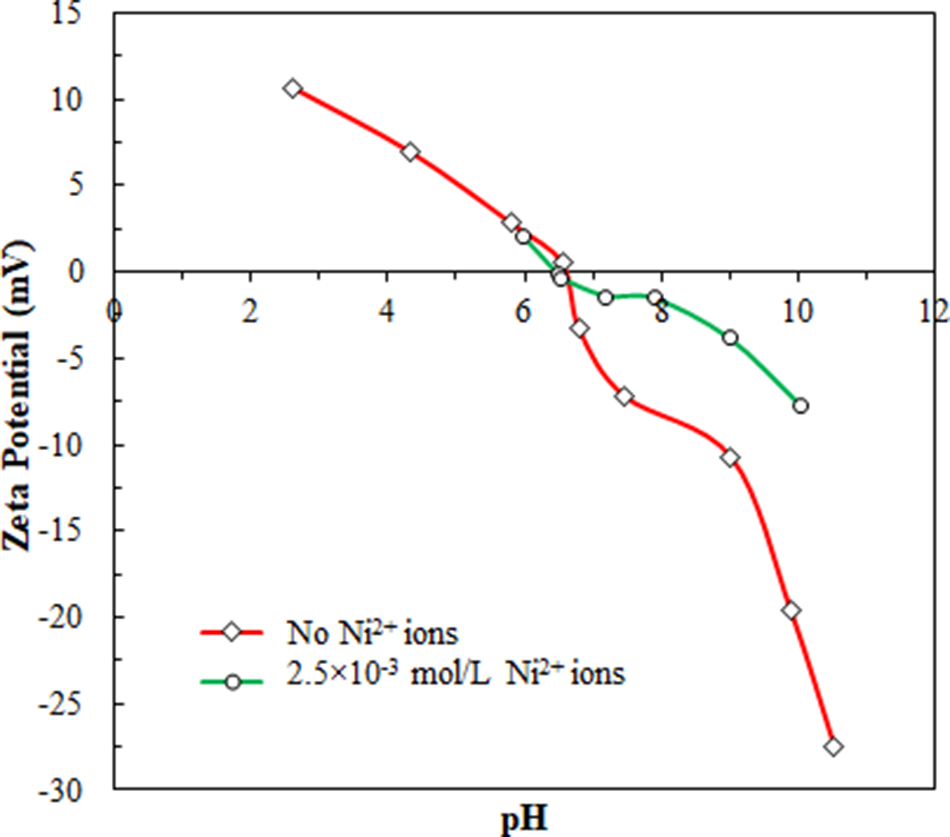
The zeta potential measurements of the BS sample were performed as a function of pH in the absence and presence of 2.5×10⁻³ mol L–1 Ni2+ ions (Fig. 1). This concentration was chosen because the total Ni removal from the solution after adsorption (residual Ni concentration) is approximately half of the initial Ni concentration of 2.5×10⁻³ mol L–1. Furthermore, as seen in Fig. 6 (below), 2.5×10⁻³ mol L–1 is a convenient concentration to provide a good view of the distribution of the entire nickel hydroxy compound. In the absence of nickel, the sepiolite exhibits an isoelectric point (IEP) at pH ~6.5. Unlike most clay minerals, which exhibit negative charges throughout the practical pH range, the zeta potential values of BS showed a pattern closer to oxide minerals, i.e. in the pH range of 6–8, typically graph shifted to the right as the pH value increased (Çelik, Reference Çelik and Wypych2004).
Chemical analysis of BS

* LOI = loss on ignition.
Zeta potential–pH profiles of the BS sample in the absence of Ni2+ and in the presence of 2.5×10⁻³ mol L–1 Ni2+ ions.

Parameters of kinetics models for the adsorption of Ni2+ ions on BS

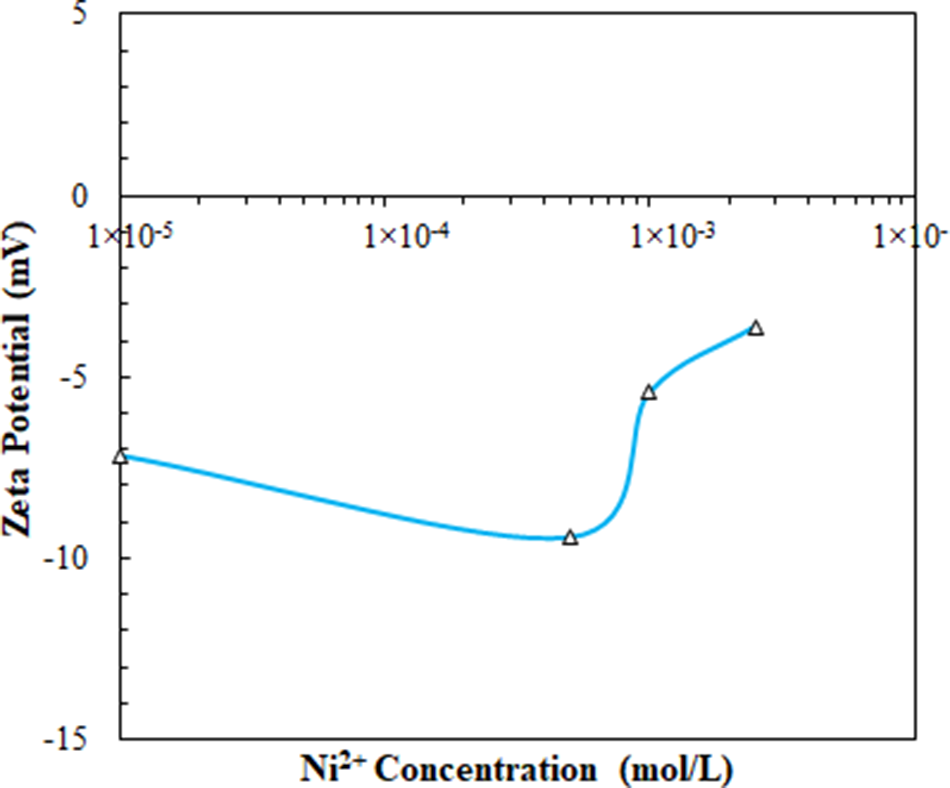
In the presence of Ni²⁺, the zeta potential profile overlaps significantly with that of sepiolite at acidic to neutral pH values (pH <7). This behavior strongly supports the hypothesis that the primary uptake mechanism in this pH range is ion exchange. Varying the Ni2+ concentration at a constant pH (e.g. pH 6.0) does not cause a monotonic shift toward positive potentials (Fig. 2), which would be expected from simple electrostatic adsorption of divalent cations onto a negative surface. Instead, the complex behavior suggests a process with minimal net charge alteration at the Stern layer, consistent with the exchange of structural Mg2+ ions from the sepiolite with Ni2+ ions from the solution. A dramatic divergence between the two curves was observed at pH >7 (Fig. 1). While the sepiolite surface became increasingly negative, the presence of Ni2+ caused the zeta potential to become significantly less negative, approaching zero at pH ~8. This marks a transition from an ion-exchange-dominated system to one governed by the surface activity of Ni (II) hydroxide species. As the pH rises above the onset of hydrolysis (pH ~7.95), positively charged hydrolysis products such as NiOH+ can specifically adsorb onto the negative sepiolite surface, neutralizing the surface charge. More significantly, as the system approaches the point of bulk precipitation, surface precipitation of neutral Ni(OH)2(s) occurs. This process formed a distinct coating of nickel hydroxide on the sepiolite particles. Consequently, the measured zeta potential no longer reflected the surface of the sepiolite itself, but rather the electrokinetic properties of this newly formed Ni(OH)2 layer. A previous study (Çelik and Özdemir, Reference Çelik and Özdemir2018) gave ample experimental evidence that solid particles heterocoagulated in the presence of any kind of precipitate acquire the zeta potential of the precipitate itself through surface coating of the particles.
Parameters of the intraparticle diffusion model for Ni2+ ion adsorption on BS

Zeta potential of sepiolite as a function of Ni2+ ion concentration at natural pH (8.5).

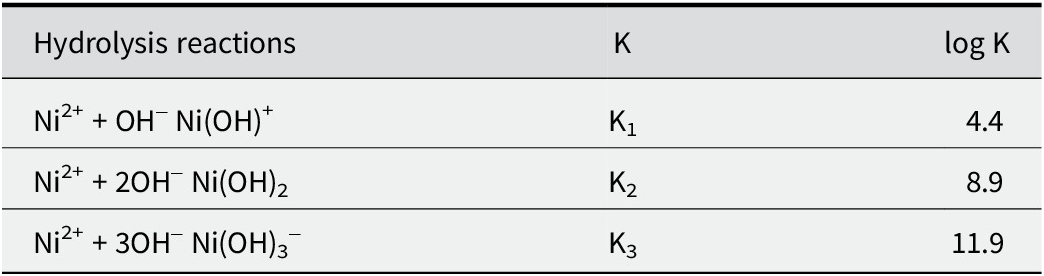
Ni2+ hydrolysis reactions and equilibrium constants (Barnum, Reference Barnum1983)

This explains the sharp deviation and the establishment of a new surface charge regime at alkaline pH, providing clear evidence for the co-occurrence of adsorption and precipitation.
Adsorption experiments
Effect of pH
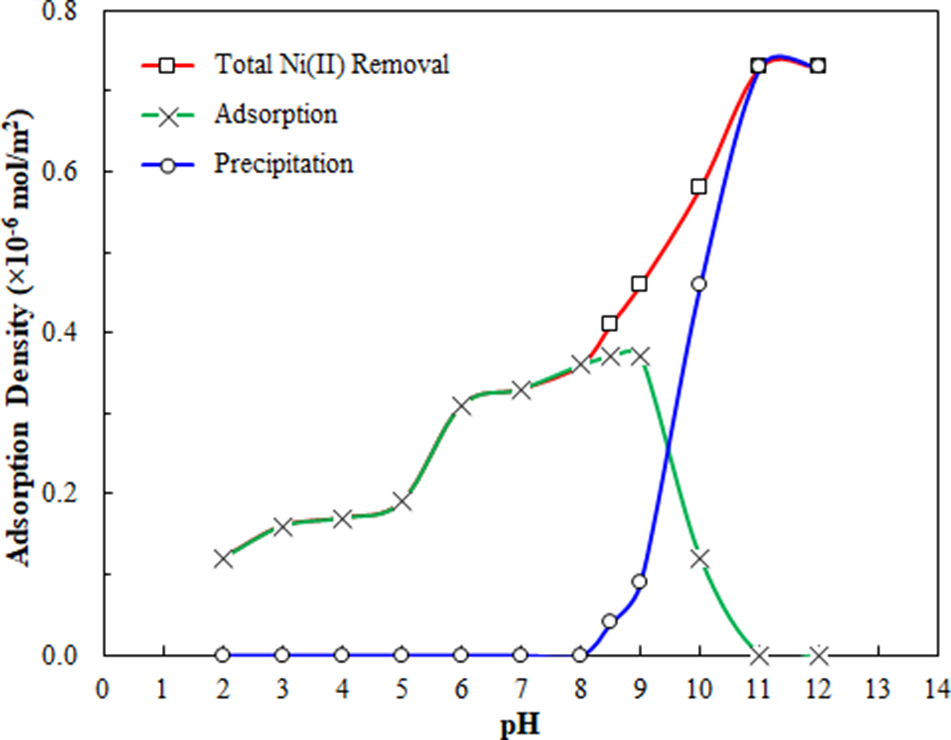
In these experiments, the adsorption mechanism of Ni2+ ions on the BS sample was examined under alkaline and acidic conditions. The initial concentration of Ni2+ was set at 2.5×10⁻³ mol L–1, while other variables (solid/liquid ratio, stirring time, and experimental temperature) were kept constant. The results (Fig. 3) indicated that rapid adsorption occurred up to a pH value of 7.95. Beyond this point, adsorption decreased and formed a shallow plateau. As discussed below, for 2.5×10⁻³ mol L–1 Ni2+ ions, hydrolysis reactions occurred between nickel and water above pH 7.95 (Table 4). Free Ni2+ ions form complex compounds in the forms of NiOH+, Ni(OH)2aq, and Ni(OH)3– (Barnum, Reference Barnum1983). A study conducted by Al-Haj Ali and El-Bishtawi (Reference Al-Haj Ali and El-Bishtawi1997) reported that Ni2+ ions begin to precipitate as Ni(OH)2 at a pH of ~7, depending on the initial nickel concentration. Another study by Gagnon et al. (Reference Gagnon, Arnac and Brindle1992) showed that the adsorption of Ni2+ ions on clay minerals occurred at a pH of <8, whereas at pH 8 or higher, Ni (II) hydroxide complexes begin to form, affecting Ni sorption on sepiolite. Similarly, in a study by Green-Pedersen et al. (Reference Green-Pedersen, Jensen and Pind1997), the onset of precipitation for Ni2+ ions during sorption was reported as pH 8. The general inverse proportionality rule between concentration and precipitation pH applies to all compounds undergoing precipitation. At high Ni2+ ion concentrations, the precipitation pH of Ni(OH)2 decreases. Therefore, for pH values higher than the onset of pH precipitation, the dependence of pH on Ni2+ ion concentration, e.g. precipitated Ni2+ ions, must be considered in the adsorption isotherm. Alternatively, adsorption studies should be conducted at pH values which are lower than precipitation pH for Ni to avoid forming such compounds. The contribution of Ni ion precipitation to total measured uptake at high pH has not usually been accounted for in many earlier studies. Consequently, their reported values often represent the total Ni2+ removal from solution (i.e. a combination of adsorption and precipitation) rather than solely true adsorption. With a metal cation such as Ni2+, the uptake from solution at pH >7.95 (Fig. 3) should be recognized as a combination of adsorption and precipitation as follows (Çelik, Reference Çelik1995):
 $$ \mathrm{Total}\;{\mathrm{Ni}}^{2+}\mathrm{removal}=\mathrm{adsorption}+\mathrm{precipitation} $$

Variation of total Ni (II) removal by sepiolite (adsorption+precipitation) with pH (C i = 2.5×10⁻³ mol L–1, contact time = 2 h, solid to liquid ratio = 0.05, T = 20°C).

Accordingly, in order to obtain a net adsorption isotherm, precipitation values need to be subtracted from those of total Ni2+ removal.
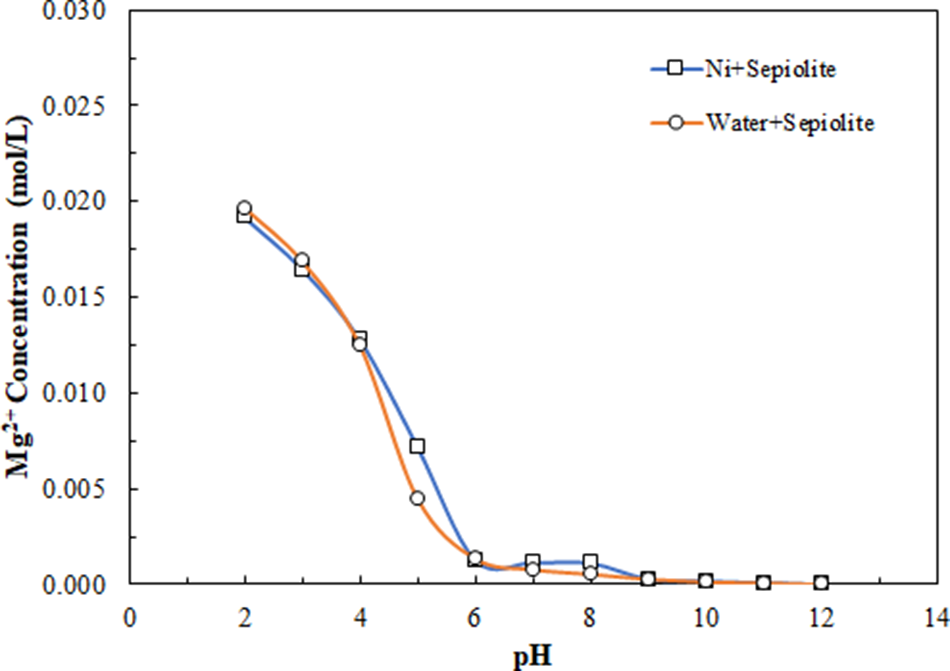
Also, the increase in pH is accompanied by a decrease in the Mg2+ ions released into the solution during nickel adsorption (Fig. 4). Conversely, at low pH, the dissolution of Mg2+ ions from the octahedral sheet of sepiolite increases, which is attributed to the rapid ion exchange between Mg2+ and H+ ions from the acidic solution. For a 2.5×10⁻³ mol L–1 nickel ion concentration, at pH >7.95, nickel ions begin to precipitate, and a smaller proportion of Mg2+ ions is released into the solution to compensate for the small amount of adsorbed Ni2+. As pH rises above 7.95, the decrease in adsorbed Ni2+ is accompanied by a decrease in Mg2+ ions passing into the solution. Additionally, at pH=10.24 and above, Mg2+ ions react with OH– ions in the medium, leading to precipitation of hydroxy complexes. For both reasons, adsorption is significantly lower at high pH values.
Variation of Mg2+ ions released in water-sepiolite and Ni-water-sepiolite systems with pH.

The results of this experiment were compared with the behavior of Mg2+ ions presented in Fig. 4. In the experiment conducted with water and sepiolite (in the absence of Ni2+), the increase in pH corresponded to the concentration of Mg2+ ions released into the solution. A similar relationship was observed in the Ni2+ adsorption experiment, where the concentration of Mg2+ ions passing into the solution showed a distinct correlation (Fig. 4); in solutions at pH <7.95, Mg²⁺ ions in the octahedral coordination of sepiolite were transferred into the solution and exchanged with the Ni2+ ions present in the solution. At acidic pH values, H+ ions, which are more active than Ni2+ ions in the solution, exchange with Mg2+ ions in the sepiolite structure. At pH values >7.95, precipitation occurred due to the hydrolysis of Ni2+ ions, and possibly nickel adsorption decreased in parallel with increasing pH. Similar results for Co2+ ions were reported elsewhere (Kara et al., Reference Kara, Yüzer, Sabah and Çelik2003).
Adsorption kinetics
Mathematical expressions involving kinetics modeling were applied to examine the adsorption density of Ni2+ ions onto BS vs contact time, and the parameters of the pseudo-first order and pseudo-second order kinetics models were obtained (Table 2).
The suitability of the models was evaluated by comparing the theoretical value calculated from the kinetics model (q m(cal)) with the experimental value (q m(exp)) and by examining the linear regression coefficient of R 2. The results revealed that the pseudo-second order model fitted the data better than the pseudo-first order model, as indicated by the larger R 2 values and the closer agreement between q m(cal) and q m(exp). This means that several factors, including surface area, intraparticle diffusion, and intrapore liquid film diffusion, affect the adsorption of Ni2+ ions on BS.
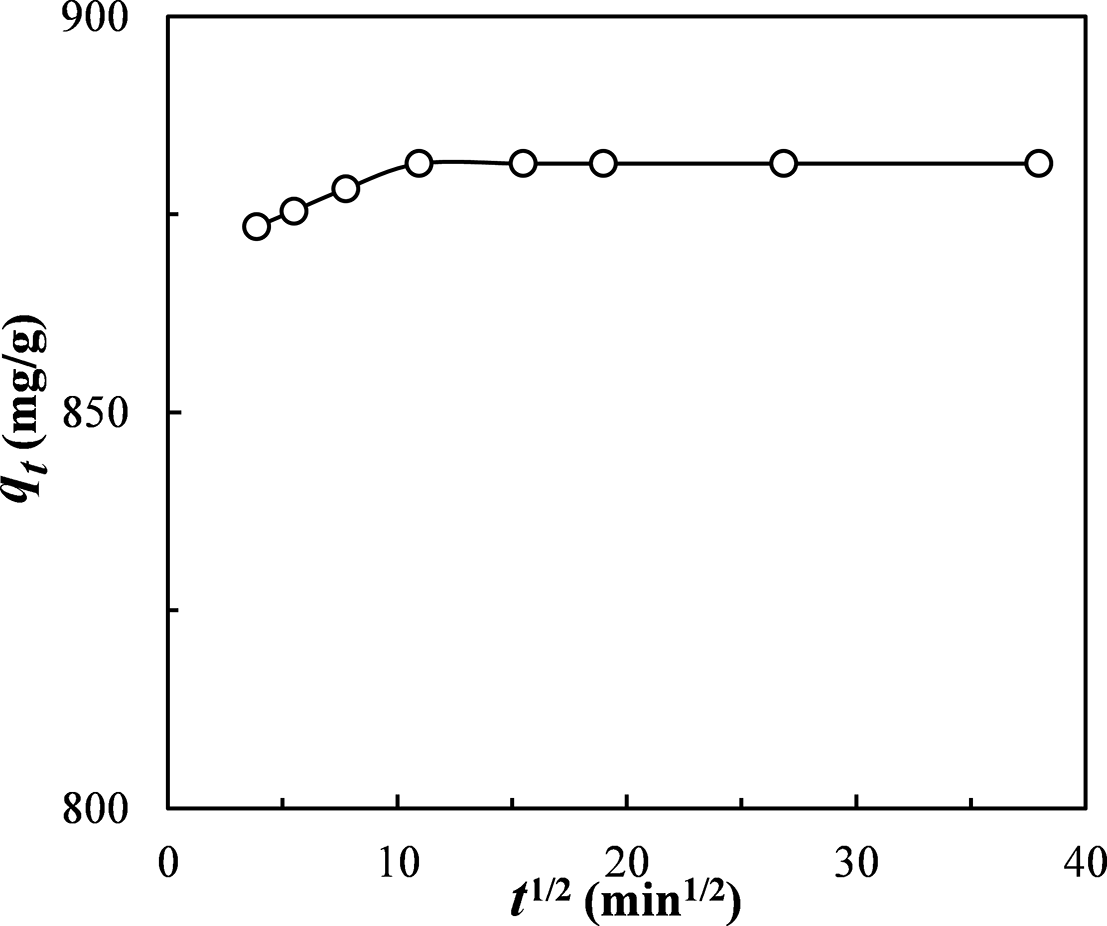
In terms of investigating the diffusion process, the intraparticle diffusion model was also applied to Ni ion adsorption to BS (Fig. 5).
Intraparticle diffusion kinetic model applied to the Ni/BS system (C 0 = 58.71 mg L–1, T = 20°C, pH = 7.5, and BS dosage = 0.5 g 10 mL–1).

This model assumes that the adsorption rate is controlled by the diffusion of the adsorbate molecules from the bulk solution to the pores of the adsorbent, which can be expressed as:
 $$ {q}_t={\mathrm{k}}_{\mathrm{p}}{t}^{1/2}+C $$
where C is a constant related to the boundary layer thickness, kp is the intraparticle diffusion rate constant (mg (g min)–1/2), and qt (mg g–1) is the amount of Ni2+ ions adsorbed at time t (min). The graph of qt vs t 1/2 should give a straight line with an intercept of C and a slope of kp (Laohaprapanon et al., Reference Laohaprapanon, Marques and Hogland2010). If the plot passes through the origin, it indicates that intraparticle diffusion is the sole rate-limiting step (Tran et al., Reference Tran, Youb and Chao2016). However, the fact that the plot does not pass through the origin and the low correlation coefficient (R 2=0.4871) mean that Ni2+ ion adsorption on the BS sample can be considered a complex process involving multiple steps.
As seen in the model parameters summarized in Table 3, the value of C can also provide information about the pore sizes and the type of diffusion. A large value for C indicates a significant boundary layer resistance or a large pore volume in the adsorbent. A small value for C indicates a small boundary layer resistance or a small pore volume in the adsorbent. It is also clear that the constant related to the boundary layer thickness (C) is large (876.18 mg g–1), indicating that the boundary layer effect of BS is quite significant (Table 3). This suggests that Ni2+ ion adsorption on BS is controlled by a combination of pore and surface diffusion, meaning that internal mass transfer resistances are insignificant.
pH–concentration diagrams
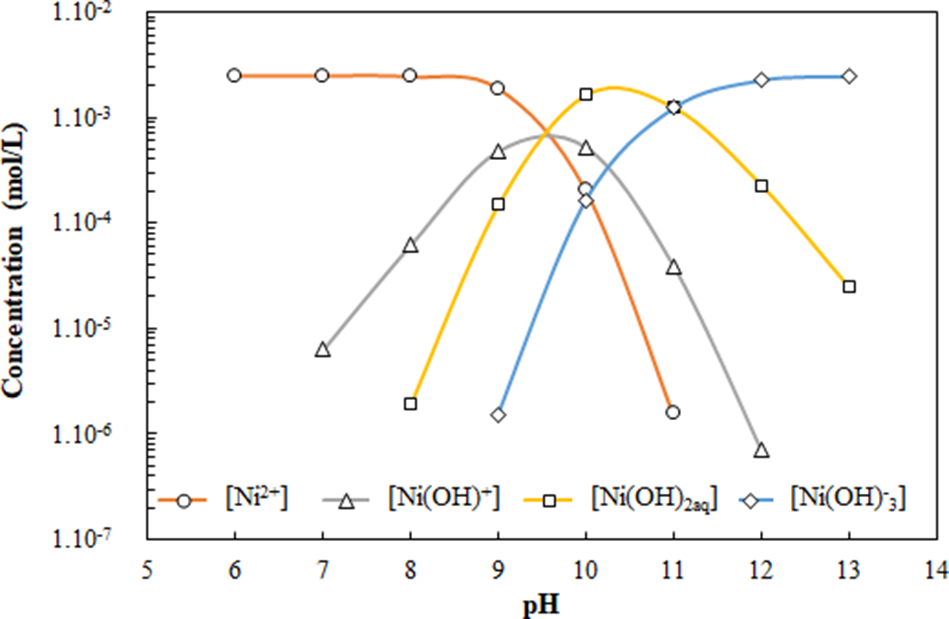
pH–concentration diagrams were constructed by taking a 2.5×10⁻³ mol L–1 initial Ni2+ concentration as a constant based on hydrolysis reactions (Eqns 8–10) and the corresponding equilibrium constants (Table 4) taken from Barnum (Reference Barnum1983). Note that no activity coefficient correction was applied.
Equilibrium constants for formation of Ni(II) hydroxides:
 $$ {\mathrm{K}}_1=\frac{\left[\mathrm{Ni}{\left(\mathrm{OH}\right)}^{+}\right]}{\left[{\mathrm{Ni}}^{2+}\right]\left[{\mathrm{OH}}^{-}\right]} $$
 $$ {\mathrm{K}}_2=\frac{\left[\mathrm{Ni}{\left(\mathrm{OH}\right)}_2\right]}{\left[{\mathrm{Ni}}^{2+}\right]{\left[{\mathrm{OH}}^{-}\right]}^2} $$
 $$ {\mathrm{K}}_3=\frac{\left[\mathrm{Ni}{\left(\mathrm{OH}\right)}_3^{-}\right]}{\left[{\mathrm{Ni}}^{2+}\right]{\left[{\mathrm{OH}}^{-}\right]}^3} $$
The total ion concentration in the solution is equal to the total number of species given in Eqns 8–10. Here, C i = 2.5×10⁻³ mol L–1.
The total ion concentration in the solution is equal to the total number of species given in Eqn 11. Here C i = 2.5×10⁻³ mol L–1:
 $$ \left[{\mathrm{Ni}}^{2+}\right]+\Big[\mathrm{Ni}\left(\mathrm{OH}\Big){}^{+}\right]+\left[\mathrm{Ni}{\left(\mathrm{OH}\right)}_2\right]+\left[\mathrm{Ni}{\left(\mathrm{OH}\right)}_3^{-}\right]={C}_{\mathrm{i}} $$
Using Eqns 8–11, each species in solution can be calculated:
 $$ \left[{\mathrm{Ni}}^{2+}\right]=\frac{C_{\mathrm{i}}}{1+{\mathrm{K}}_1.\left[{\mathrm{OH}}^{-}\right]+{\mathrm{K}}_2.{\left[{\mathrm{OH}}^{-}\right]}^2+{\mathrm{K}}_3.{\left[{\mathrm{OH}}^{-}\right]}^3} $$
 $$ \left[\mathrm{Ni}{\left(\mathrm{OH}\right)}^{+}\right]=\frac{C_{\mathrm{i}}.{\mathrm{K}}_1.\left[{\mathrm{OH}}^{-}\right]}{1+{\mathrm{K}}_1.\left[{\mathrm{OH}}^{-}\right]+{\mathrm{K}}_2.{\left[{\mathrm{OH}}^{-}\right]}^2+{\mathrm{K}}_3.{\left[{\mathrm{OH}}^{-}\right]}^3} $$
 $$ \left[\mathrm{Ni}{\left(\mathrm{OH}\right)}_2\right]=\frac{C_{\mathrm{i}}.{\mathrm{K}}_2.{\left[{\mathrm{OH}}^{-}\right]}^2}{1+{\mathrm{K}}_1.\left[{\mathrm{OH}}^{-}\right]+{\mathrm{K}}_2.{\left[{\mathrm{OH}}^{-}\right]}^2+{\mathrm{K}}_3.{\left[{\mathrm{OH}}^{-}\right]}^3} $$
 $$ \left[\mathrm{Ni}{\left(\mathrm{OH}\right)}_3^{-}\right]=\frac{C_{\mathrm{i}}.{\mathrm{K}}_3.{\left[{\mathrm{OH}}^{-}\right]}^3}{1+{\mathrm{K}}_1.\left[{\mathrm{OH}}^{-}\right]+{\mathrm{K}}_2.{\left[{\mathrm{OH}}^{-}\right]}^2+{\mathrm{K}}_3.{\left[{\mathrm{OH}}^{-}\right]}^3} $$
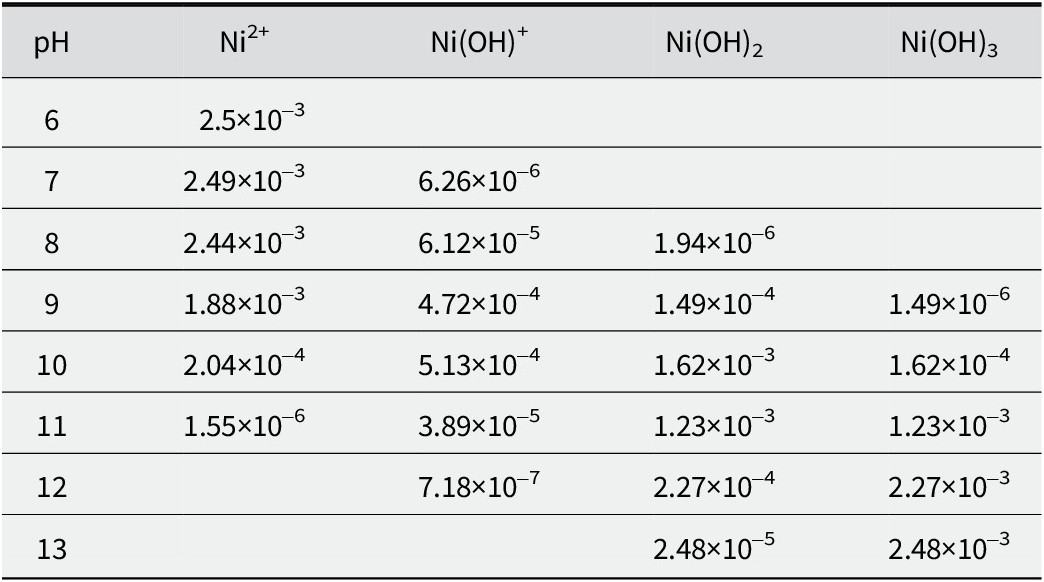
Eqns 11–15 were used to generate the data in Table 5. Accordingly, the pC diagram was plotted as a function of pH (Fig. 6).
pH–concentration diagram for nickel species at C i = 2.5×10⁻³ mol L–1.

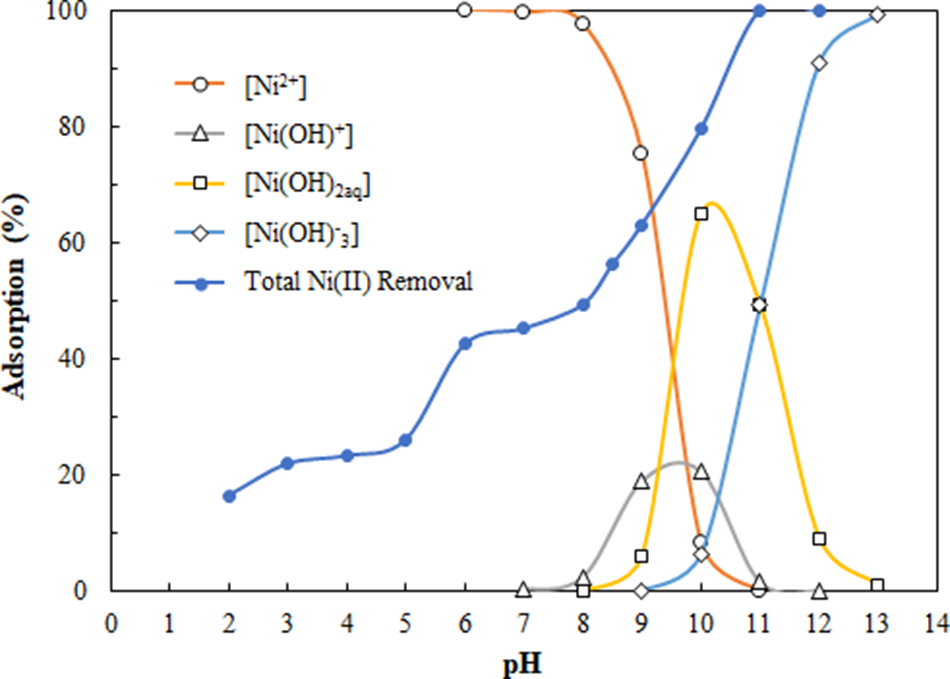
Most Ni2+ ions were adsorbed by sepiolite until pH ~7.95, above which adsorption started to decrease (Fig. 6). In other words, above pH 7.95, free Ni2+ ions decreased in the solution, and Ni(OH)+ compound started to form. The nickel species removed above pH 8 were distributed as 97.4% Ni2+, 2.5% NiOH+, and 0.1% Ni(OH)2. As the pH value increased, Ni(OH)2aq and Ni(OH)–3 compounds were formed in the solution and adsorption eventually decreased to zero (Fig. 3). The combined percentage adsorption values of Figs 3 and 6 are given in Fig. 7.
Percentage distribution of each nickel complex vs pH and the corresponding experimental curve for total Ni (II) removal.

The total removal of Ni2+ from solution occurred at a slow rate up to pH 7.95, above which the removal rate increased rapidly due to precipitation of nickel compounds (Fig. 7). The distribution of Ni2+ species as a function of pH followed their percentage distribution. The formation of Ni compounds above pH 9.5 appeared to cease for Ni2+ and Ni(OH)+, and to increase for Ni(OH)2 and Ni(OH)3–. Unlike minerals dominated by ion exchange, minerals whose surface charge is controlled by H⁺ and OH⁻ as potential-determining ions (e.g. sepiolite, oxides, and silicates) can exhibit similar nickel uptake before and after the onset of precipitation pH (Yüzer et al., Reference Yüzer, Kara, Sabah and Çelik2008).
Conclusions
The contribution of metal ion precipitation to the adsorption of Ni (II) ions from aqueous solutions onto sepiolite has been evaluated as a function of pH using the available solubility products and equilibrium constants. The pH of the solution affects the adsorption affinity of sepiolite significantly by altering its surface charge and influencing the speciation of Ni2+ ions.
The precipitation of nickel compounds is a critical phenomenon that can lead to the overall removal of Ni(II) from solution. However, it differs from adsorption and, if not properly accounted for, can lead to an over-estimation of true adsorption capacity. Prior to the onset of bulk precipitation, the uptake of Ni2+ ions by sepiolite is mainly governed by ion exchange with the released Mg2+ ions from the sepiolite matrix.
In this context, adsorption and precipitation isotherms along with the total nickel ion removal were constructed to isolate the precipitation of nickel from the true adsorption. The distribution of nickel species as a function of pH and their contribution to adsorption and precipitation was calculated. It was shown that at pH 7.95, which is the onset of nickel hydroxide precipitation for 2.5×10⁻³ mol L–1 total nickel concentration, the removed nickel species are distributed as 97.4% Ni2+, 2.5% NiOH+, and 0.1% Ni(OH)2. The results on the role of metal ion precipitation in the adsorption and removal of Ni (II) ions from sepiolite showed clearly that pH affects the adsorption process significantly by changing the surface charge of sepiolite and the speciation of Ni2+ ions with pH, thereby distinguishing true adsorption from precipitation; a good agreement was found between the calculated and experimental adsorption capacities.
Author contribution
Eyup Sabah: Writing – original draft, Conceptualization, Methodology, Investigation, Visualization, Data curation, Resources; Orhan Özdemir: Writing – review and editing, Writing – original draft, Validation; Mustafa Kara: Writing – review and editing, Methodology, Investigation, Formal analysis, Data curation; Mehmet Sabri Çelik: Writing – review and editing, Supervision, Methodology, Investigation.
Financial support
The authors received no specific funding for this research.
Competing interests
The authors declare that they have no competing interests related to this work.
Data availability statement
All data generated or analyzed during this study are included in this published article.