Researchers and practitioners in the field of second language acquisition (SLA) have become increasingly interested in examining the role of variable structures in language learning (see, e.g., Geeslin & Long, Reference Geeslin and Long2014). Indeed, linguistic variation (contextual, stylistic, social, and regional) is a fundamental characteristic of human language and is present in all language varieties. While in general learners may be presented with a standard or pedagogical norm in the language classroom (Valdman, Reference Valdman1988), they will inevitably be exposed to a wide variety of dialectal, social, and stylistic variations in real world language contexts. Learning how to navigate this variation—in terms of comprehending diverse speakers, recognizing regionally and socially marked features, and successfully using variable forms to effectively participate in different speech contexts, show politeness, and project one’s social identity, for example—is a critical component of successful language use (see, e.g., Geeslin et al., Reference Geeslin, Gudmestad, Kanwit, Linford, Long, Schmidt and Alonso2018). Indeed, these skills form part of a language user’s “sociolinguistic competence,” one of the essential components that Canale and Swain (Reference Canale and Swain1980) refer to almost forty years ago in their discussion of what it means to possess full communicative competence in a language.
Only more recently, however, has a wave of empirical studies emerged within SLA that investigate the acquisition of sociolinguistic variants in the L2. A range of structures subject to what Rehner (Reference Rehner2002) terms “type II variation,” or variable forms in native speaker (NS) language, have been explored; for example, English final /t d/ deletion (Bayley, Reference Bayley, Bayley and Preston1996), French first-person subject nous vs. on forms (Rehner, Mougeon, & Nadasdi, Reference Rehner, Mougeon and Nadasdi2003), and Japanese politeness patterns (Marriott, Reference Marriott and Freed1995). However, research to date has focused predominantly on the production of variable forms, and on those linguistic, social, and stylistic factors that determine their use (see Howard, Mougeon, & Dewaele, Reference Howard, Mougeon, Dewaele, Bayley, Cameron and Lucas2013, for an overview); much less is understood regarding how variable forms of the target language are perceived and processed by L2 learners. The current study addresses this gap, by examining L2 learners’ perceptual norms of a dialectal phone of the target language, Spanish aspirated-s. Specifically, the study investigates differences in how the dialectal phone is phonetically categorized by learners at different levels of language study, and, furthermore, explores how individual learner experiences relating to dialect exposure may play an important role in the perceptual development of variable forms in the L2.
The article is organized in the following manner: First, SLA research conducted to date on the acquisition of dialectal sounds is discussed, situating the current study, followed by a description of the target dialectal phone. Research questions and hypotheses are then posited in light of the theoretical models of speech perception in an L2 (Perceptual Assimilation Model [PAM-L2], Speech Learning Model [SLM], Second Language Linguistic Perception Model [L2LP]). The method of study is then detailed, followed by the presentation and discussion of the experimental results.
BACKGROUND
L2 ACQUISITION OF DIALECTAL ALLOPHONES
Study to date on the acquisition of dialectal, or regionally variable, sounds and suprasegmentals by L2 learners has largely examined L2 acquisition of regional sounds of English (Drummond, Reference Drummond2012; Escudero & Boersma, Reference Escudero and Boersma2004; Fox & McGory, Reference Fox, McGory, Bohn and Munro2007; Wolfram, Carter, & Moriello Reference Wolfram, Carter and Moriello2004) and Spanish (George, Reference George2014; Henriksen, Geeslin, & Willis, Reference Henriksen, Geeslin and Willis2010; Knouse, Reference Knouse2012; Ringer-Hilfinger, Reference Ringer-Hilfinger2012), but also of Arabic (Raish, Reference Raish2015), French (Baker & Smith, Reference Baker and Smith2010), and German (Smith & Baker, Reference Smith and Baker2011). These studies have focused primarily on the effects of a study or living abroad experience on adoption of regional phonological features of the local target variety. Overall, they have found that some individual L2 speakers do come to use local dialectal sounds in their speech after a study abroad or immersion experience, although these individuals tend to be in the minority. For example, Fox and McGory (Reference Fox, McGory, Bohn and Munro2007) found that Japanese learners of English living in Alabama for at least two years produced only 2 of the 10 English vowels like Southern American English vowels, and Wolfram, Carter, and Moriello (Reference Wolfram, Carter and Moriello2004) were surprised to find that the local Southern American English unglided /ai/ diphthong was not extensively used by Hispanic youths living in urban and rural North Carolina.
That only some individual L2 speakers come to incorporate dialectal phones of the target language in their speech might be explained in part by issues of speaker identity and desire to maintain variants that are part of the classroom norm or used by social peers (George, Reference George2014; Ringer-Hilfinger, Reference Ringer-Hilfinger2012). For example, Drummond (Reference Drummond2012) found that Polish migrants living in Manchester, England, with long length of residence but strong negative attitudes toward Manchester and its people continued to use the pedagogical standard (Standard Southern British English) vowel and did not adopt the local STRUT vowel. As such, while exposure to speakers of regional varieties of the target language, such as through a study abroad or immersion experience, seems to be a critical component to the adoption of dialectal forms by L2 speakers, these speakers still appear to retain autonomy over their language use, and may, to some degree, choose not to incorporate these new local forms. L2 learners, indeed, are not “passive recipients of comprehensible input or incomprehensible input from native speakers (NSs) but active participants in choosing the target language models they prefer and thus acquiring ‘the right stuff’ according to their values” (Beebe, Reference Beebe1980, p. 404).
In the case of speech perception, however, these sociolinguistic factors—such as identity construction, attitudes toward target communities, and peer influence—may play a lesser role, as the L2 learner is not in a situation in which they must choose between alternating forms but rather in one in which they perceive, process, and interpret those forms that are already selected by another speaker.Footnote 1 As such, it may be possible that an L2 learner adopts a regional or social feature of the target language in terms of reorganization of the perceptual system (perception), but the form is never or rarely observed in his or her language use at the surface level (production).
Indeed, in a perception categorization task, Escudero and Boersma (Reference Escudero and Boersma2004) found that while beginning Spanish-speaking learners of English who had spent time in either Scotland or England (and/or higher education in English) did not seem to discriminate between the new target vowel contrast /i ɪ/, the type of perceptual cues (either spectral or durational) used by the learners in making the categorization judgments varied according to the dialect to which they had been previously exposed. Likewise, Baker and Smith observed differences in patterns of discrimination and identification of regional vowels by English-speaking L2 learners of French (Baker & Smith, Reference Baker and Smith2010) and of German (Smith & Baker, Reference Smith and Baker2011), when comparing groups of learners who studied abroad in different dialect regions (Quebec vs. southern France; Northern Germany vs. Austria or Southern Germany, respectively). These perceptual adaptations to regional forms in the target language have even been observed even at the prosodic level (Trimble, Reference Trimble, Howe, Blackwell and Quesada2013).
The current study builds on these dialectal studies and specifically adds to the understanding of these phenomena through an examination of development in perceptual norms of L2 dialectal forms. This is accomplished by testing multiple levels of L2 learners and by investigating how individual dialect experiences, even across learners in the same program and language level, result in varying perceptual abilities.
SPANISH DIALECTAL ASPIRATED-/S/
The dialectal feature under investigation in the current study is lenition of syllable-final /s/. In several dialects of Spanish, including regions in southern Spain, the Caribbean, and the Pacific coast of South America, the sibilant /s/ is variably lenited to a period of aspiration [h], in which only the sublingual articulation of glottal frication remains, or to total deletion (Hualde, Reference Hualde2005), resulting in variable allophonic realizations of /s/, such as in the examples (1-3) of listo “smart.”
1. /listo/ > [ˈlis.to] sibilant
2. /listo/ > [ˈlih.to] aspiration
3. /listo/ > [ˈli.to] deletion
Up to 50% of the varieties of the Spanish-speaking world are characterized by this lenition process (Hammond, Reference Hammond2001). In other varieties, final /s/ is conserved in its sibilant form, which is characteristic of the Spanish spoken in the highlands of Mexico and Central America and in the Andean regions of South America (Hualde, Reference Hualde2005).
In terms of linguistic contexts, the aspirated variant tends to occur more frequently in word-internal position, while deletion is more common word-finally (Samper Padilla, Reference Samper Padilla1990; Terrell, Reference Terrell1979). The present study, thus, targets the word-internal context. Finally, Spanish /s/-weakening is subject to social and stylistic variation in the varieties in which it occurs and has been studied extensively in Spanish sociolinguistic literature (see File-Muriel, Reference File-Muriel2007, for a review). In general, the more advanced stages of /s/-weakening within a particular dialect tend to be found to a greater extent in the speech of males and speakers from lower socioeconomic levels, while females and speakers from higher socioeconomic levels tend to favor less-advanced stages or full sibilant variants (e.g., Dohotaru, Reference Dohotaru and Valdés Bernal2004; Ruiz-Sanchez, Reference Ruiz-Sánchez2004). Moreover, in many varieties, retention of /s/ is associated with more formal or prestigious speech than the lenited forms (Lafford, Reference Lafford, Núñez Cedeño, Páez Urdaneta and Guitart1986; Terrell, Reference Terrell, Sankoff and Cedergren1981), although sociolinguistic values associated with the different variants of /s/ may vary across speech communities.
Aspirated-/s/ was selected as the target dialectal feature for several reasons. First, it is a novel allophonic variant of /s/ for this population of adult L2 learners, native English speakers, who must acquire the association of a new allophone to the Spanish phonetic category /s/. Second, learner accuracy in perception and identification of /s/-weakened forms is of particular importance in Spanish not only for lexical meaning, but also because final -/s/ can serve as a morphological marker, marking grammatical information such as plurality and the second-person singular on verb forms. Additionally, as described previously, /s/-weakening is a widespread feature, occurring in most coastal and lowland varieties, thus increasing the likelihood that L2 learners have or will come across this feature in input received at some point in the learning experience. Finally, the full sibilant, aspirated, and deleted variants occur variably in /s/-weakening dialects of Spanish and are subject to an interplay of linguistic and extralinguistic variables; such variation in the input and complexity of factors associated with /s/-weakening may contribute to a later or incomplete acquisition of such variable forms by L2 learners (see, e.g., Geeslin & Long, Reference Geeslin and Long2014). Indeed, in a cross-sectional analysis of the production of dialectal phones in the speech of 130 Spanish L2 learners completing a monologic role-play task, Geeslin and Gudmestad (Reference Geeslin and Gudmestad2011) found that the lenited-/s/ was produced extremely infrequently by the learners (by only 4% of the L2 participants) and never observed in the speech of learners at lower levels of proficiency.
English has a phonetically similar sound to the Spanish aspirated variant, which is the English glottal fricative /h/. Like the Spanish aspirated-/s/, English /h/ is produced without use of the tongue or articulators (McMahon, Reference McMahon2002) and has been described as a “voiceless counterpart of surrounding sounds” (Ladefoged, Reference Ladefoged2006, p. 68), similar to a voiceless vowel when occurring at the beginning of a sentence. However, while the English glottal fricative is articulatorally and acoustically similar to Spanish [h], it differs phonologically. First, /h/ and /s/ are contrastive in English and form lexical contrasts (e.g., hat [hæt] vs. sat [sæt]), while [h] and [s] are allophonic variants of the same phonetic category in /s/-weakening varieties of Spanish. Second, /h/ occurs only in syllable-initial position in modern English and does not appear syllable-finally, which is precisely the phonetic context in which weakening of /s/ occurs in Spanish.
THEORETICAL MODELS OF SPEECH PERCEPTION IN A SECOND LANGUAGE
Next, those models of second language perception that have been influential in the field of second language phonology are briefly considered in light of the current study’s research questions: the PAM (Best, Reference Best and Strange1995; and the PAM-L2: Best & Tyler, Reference Best, Tyler, Bohn and Munro2007), the SLM (Flege, Reference Flege and Strange1995), and the L2LP (Escudero, Reference Escudero2005; van Leussen & Escudero, Reference van Leussen and Escudero2015).
The PAM was originally developed to explain the perception of nonnative segments by naïve listeners. The model makes predictions as to the difficulties in discriminating nonnative contrasts according to the degree of articulatory-phonetic similarity of the speech sounds to native categories, with discrimination most difficult when two nonnative sounds are assimilated into the same native category and easier when assimilated into different native categories or perceived as better or worse exemplars of the same category. The PAM was later extended to account for development in perception of nonnative sounds by L2 learners (PAM-L2: Best & Tyler, Reference Best, Tyler, Bohn and Munro2007). The updated model predicts that L2 learners will begin like a naïve listener, assimilating L2 sounds as examples of L1 categories depending upon articulatory-phonetic (articulatory gestures) or phonological similarities (e.g., phonotactic biases, allophonic variations) between the sounds. However, perceptual learning can occur as learners with more experience with the L2 may attune to a new contrast: The more experienced L2 learners may categorize and discriminate L2 contrasts better than less experienced learners—but still less accurately than native speakers—and this learning may occur early in the learning process, as early as 6 to 12 months of experience in an L2 environment (p. 14). Furthermore, the authors propose that the L2 learner will develop a common L1-L2 (interlanguage) system that incorporates both phonetic and phonological levels; for example, the listener may identify L1 and L2 sounds as functionally equivalent (phonological assimilation), even if the sounds are not perceived similarly at the phonetic level.
The SLM (Flege, Reference Flege and Strange1995) proposes a series of hypotheses to explain how inaccuracies in perception of L2 sounds lead to a foreign accent in speech production. Under this model, L1 and L2 phonetic systems are shared within a same phonological space and L2 sounds will be assimilated into existing L1 phonetic categories depending upon the acoustic-phonetic similarity to established L1 sounds. Similar to the PAM, the model predicts that if two contrasting L2 sounds are perceptually assimilated into a single existing L1 category, then discrimination between the two L2 sounds will be difficult and will lead to accented pronunciation. However, if an L2 sound is acoustically-phonetically different from L1 sounds, then the L2 learner will create a new phonetic category over time and will be able to come to accurately produce the new sound. As such, the SLM assumes that phonetic systems in perception and production continue to be adaptive through the speaker’s life span.
Finally, the L2LP model (Escudero, Reference Escudero2005) provides a computational model that, like the PAM-L2 and SLM, allows for predictions regarding the ease or difficulty of perception of L2 sounds by comparing these new sounds to sounds in native categories. The model assumes that learners initially duplicate their L1 perception system and perceive new L2 sounds through the native system (the “Full Copying Hypothesis”). The model presents three learning scenarios, and their corresponding learning tasks: (1) the New Scenario (similar to PAM’s Single Category Assimilation), in which two L2 sounds are mapped to one L1 category, (2) the Similar Scenario (like PAM’s Two Category Assimilation), in which two L2 sounds are mapped to two different L1 categories, and (3) the Subset or Multiple Category Assimilation Scenario, in which a single L2 sound is mapped as more than one L1 category. Over time, development takes place as connections of the duplicated system are shifted as learners are exposed to the L2, with the creation of new perceptual mappings and categories or the modification of existing mappings. The model assumes that speakers create two separate phonetic systems, and, therefore, can achieve nativelike performance in both languages.
These L2 perception models allow for predictions to be made regarding the ease or difficulty in discriminating new target language sounds based on whether they may be assimilated to established L1 phonetic categories. Initially, early L2 learners of Spanish (with minimal target language experience) may have difficulties discriminating Spanish aspirated-/s/ from a phonetically-acoustically similar L1 English phonetic category: English /h/. However, as discussed previously, while a phonetic category for an articulatory similar /h/ phone exists in English, it does not occur in syllable-final position. In fact, it is also possible that given the phonetic-articulatory properties of Spanish [h] (similar to a voiceless vowel [Ladefoged, Reference Ladefoged2006]), in the syllable-final position (i.e., following a vowel), early L2 learners may have difficulties in discriminating final [h] from an open syllable (vowel only). These models would also predict that with greater language experience, the L2 learners may progress in their perception of aspirated-/s/, as established categories are modified and new categories are created, potentially making discrimination an easier task for the learner.
While the models discussed in the preceding text have been very important in the field in predicting and explaining why L2 learners have difficulties in discriminating and learning new contrasts in the L2, in some acquisition cases L2 learners will, in fact, need to “collapse” phonetic categories, or assimilate sounds that are contrastive in the L1 into a single L2 phonetic category (as in van Leussen and Escudero’s [Reference van Leussen and Escudero2015] Subset scenario of Dutch learners of Spanish mapping three L1 Dutch front vowels [i ɪ ɛ] onto two L2 Spanish vowels [i. e]). Such is the case of Spanish dialectal aspirated-/s/: English-speaking learners must come to assimilate both the full sibilant [s] and aspirated [h] sounds into a single L2 phonetic category, /s/. In other words, these learners must reorganize how [h] is categorized in their new language, both in terms of the phonetic category to which it is assimilated as well as with respect to the phonetic position in which it appears.
RESEARCH QUESTIONS OF THE PRESENT STUDY
The current study is motivated by the following research questions. While specific predictions regarding how the L2 learners will categorize Spanish aspirated-/s/ cannot be made based on the L2 speech perception models described previously (as these models allow for predictions regarding discrimination, but not identification, of new speech sounds), the following assumptions are made based on postulations within these models as well as previous findings in speech perception research:
1. How is Spanish dialectal aspirated-/s/ perceptually categorized by English-speaking learners of Spanish?
Categorization of the syllable-final aspirated allophone as Spanish /s/ will be interpreted as the accurate mapping of aspirated-/s/ as a legitimate allophonic variant, and functionally perceptual equivalent, of the /s/ phonetic category (i.e., perceptual acquisition of the dialectal phone has occurred). However, it is hypothesized that English-speaking learners of Spanish will fail to categorize the Spanish aspirated variant as /s/, at least initially.
2. (How) does perceptual categorization of dialectal aspirated-/s/ change with L2 learner development?
At earlier levels (less L2 experience), learners will categorize aspirated-/s/ according to L1 perceptual norms. However, with increased overall language experience, learners may modify their categorization patterns of the dialectal sound.
3. What roles do dialect contact factors—study abroad, social contacts outside of the classroom, and linguistics training—play in the perceptual development of the dialectal sound?
Exposure to multiple forms of a phonetic category can lead to their perceptual equivalence for the listener, regardless of whether the listener produces the forms in their own speech (see Sumner & Samuel, Reference Sumner and Samuel2009). Exposure to dialectal aspirated-/s/ through contact with Spanish dialects in which the variant occurs may be necessary for the learner to develop the new mapping of the variable form.
To answer these questions, the study employed an identification task and a Language Background and Dialect Contact Questionnaire, which are described in the following section.
METHOD
PERCEPTUAL IDENTIFICATION TASK
An identification task is a common methodological tool used in speech perception studies, in which listeners are presented with a speech stimulus and then are asked to explicitly label, or categorize, what they hear, either through an open response or by choosing one of several response choices provided (Strange & Shafer, Reference Strange, Shafer, Hansen Edwards and Zampini2008). This task type was chosen in an attempt to reconstruct more similarly how a listener uses the language in real-world contexts, as “perception of phonetic segments/contrasts involves not only the detection of differences in the acoustic signals that differentiate phonetic categories, but the accessing of internalized phonetic categories to make a decision about the identity of the stimuli” (ibid., p. 159). While both real word or invented or pseudoword stimuli may be used in this type of perception task, the current task used only (invented) pseudoword items to force listeners to use phonetic and phonological knowledge in making their identifications rather than allowing them to invoke lexical representations of stored real word items. In this way, the task aims to measure how the L2 listeners phonetically categorize (i.e., assimilate to phonetic categories) the Spanish syllable-final aspirated-/s/ phone, while minimizing the confounding effect of lexical knowledge.
PROCEDURE
Participants completed the following tasks at individual computer stations in a classroom or computer laboratory at their university campus in a single testing session: (a) an identification task and (b) a written Language Background and Dialect Contact Questionnaire. The entire session took 30 to 40 minutes to complete.
For the identification task, participants used headphones to listen to speech stimuli and then made responses to the stimuli by selecting the appropriate choice on the computer screen using an external mouse. The task was run and responses recorded using Praat software (Boersma & Weenik, Reference Boersma and Weenik2009). Participants were told that they would hear made-up words in Spanish and that they should chose the written representation of the word from six options and a “none-of-the-above” (<none>) choice. The response options presented to the participants were identical except for the targeted sound within the pseudoword. Participants could listen to each stimulus one additional time if desired by clicking on a <repeat> button. The order of presentation of the stimuli was randomized for each participant by the computer program. Participants first completed six pretest trials with distractor items to become familiarized with the task instructions and the two speakers’ voices. The practice trials were not repeated within the task and were balanced across the speakers. No feedback was provided in the pretest or testing sessions. As trials were not timed, participants advanced throughout the task at their own pace and were provided with an optional break halfway through the task to minimize task fatigue.
After finishing the perception task, participants completed a written Language Background and Dialect Contact Questionnaire. The questionnaire targeted extralinguistic and dialect exposure information for each individual, including previous experience with Spanish and other languages, exposure to regional varieties of Spanish (through social contacts, Spanish instructors, and/or study abroad), and awareness of dialectal pronunciations in Spanish (see the Online Supplementary Material for a complete description of the information elicited).
STIMULI
The 158 task stimuli for the identification task consisted of bisyllabic pseudowords, [ˈCVC.CV] (n = 78) or [ˈCV.CV] (n = 80), created from naturalistic speech samples produced by a male speaker from Caracas, Venezuela, a Caribbean variety of Spanish, and a female speaker from Buenos Aires, Argentina, a Southern Cone variety (see the Online Supplementary Material for the complete list of target and control stimuli). Speakers from these two dialectal regions were specifically sought out as aspiration is a commonly occurring variant of syllable-final /s/ in these varieties (Lipski, Reference Lipski1994). The target stimuli included the full sibilant and the aspirated variants of /s/ in word-internal, syllable-final position, [ˈCVs.CV] and [ˈCVh.CV] (e.g., [ˈfos.ka] and [ˈbah.pe]). To elicit both variants of /s/, the speakers were instructed to read word lists in two different speech styles, a more formal style as if reporting on a television newscast and a more colloquial style as if speaking with friends or family. As the two speakers were a trained linguist and a university language instructor who had both lived many years in the United States in contact with Spanish speakers of nonweakening dialects, they were adept at producing both the aspirated and full sibilant forms. There was a total of 14 target stimuli with the aspirated coda condition and a total of 14 stimuli with the full sibilant coda condition.
Fifty control items that targeted other phones in the same phonetic context were also included to ensure that any difficulties in identification of the variants of /s/ were due to characteristics of the sounds and not to general difficulties in perception of sounds in this phonetic context. Indeed, it was found that identification accuracy was at or approaching ceiling levels (with means between 92–100%) for identification of each control condition, [f, l, ɾ, n] and [V] (vowel) for both the native and L2 listener groups; thus, it can safely be assumed that any difficulties in identification of dialectal aspirated-/s/ were not simply due to perception of phones in this syllable-final context per se. Additionally, the inclusion of these control contexts encouraged participants to make use of all six of the provided response options for the target and control stimuli, which were presented orthographically as <s, f, l, r, n> and no coda. The five coda control conditions were (n = 10 of each condition): the labiodental fricative, nasal, liquid, rhotic, and no coda. Examples of pseudoword stimuli for each of these conditions include: [ˈlof.ta], [ˈpen.te], [ˈdal.po], [ˈfiɾ.pa], and [ˈla.ko]. As for the target stimuli, control stimuli were balanced across the two speakers for each coda condition.
Finally, to draw the listeners’ attention away from the coda position and to distract from the objective of the current study, an additional 80 distractor stimuli were included in the task. Distractors targeted different positions and sounds within the pseudoword forms [ˈCVC.CV] and [ˈCV.CV], including the word-initial consonant, onset of the second syllable, and word-internal and word-final vowels (e.g., [ˈfin.ko], [ˈpo.le], [ˈne.lo], [ˈfa.pe]). The distractor items were designed to ensure an equal representation of word-internal heavy-syllable [ˈCVC.CV] and light-syllable [ˈCV.CV] forms in the task.
PARTICIPANTS
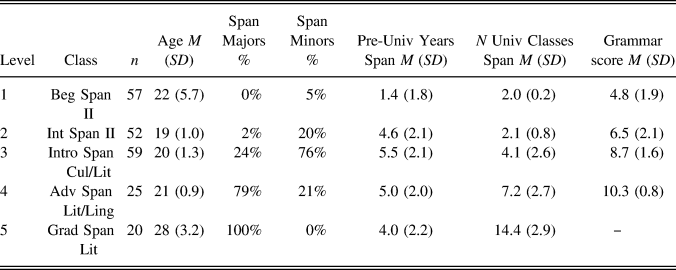
Adult American English-speaking L2 learners of Spanish were recruited from five levels of Spanish classes in a large public midwestern university to participate in the current study (total N = 213, M age = 21.1 years, age range = 18 to 36 years). Developmental levels included Beginning Spanish II (level 1, second semester of first year Spanish language), Intermediate Spanish II (level 2, second semester of second year Spanish language), third-year introductory topics courses in Spanish culture and literature (level 3), fourth-year advanced topics courses in Spanish literature and linguistics (level 4), and masters and doctoral students of Spanish literature, who were also university instructors of Spanish (level 5). The descriptive background statistics from the questionnaire are provided in Table 1 for each of the five levels of learners.
Language background information for the five levels of L2 learners of Spanish

Notes. Span = Spanish. Univ = University. Grammar score out of 11 points.
Participants at the undergraduate levels (levels 1–4) also completed a short 11-point multiple-choice contextualized grammar task at the end of the questionnaire to ascertain differences in language proficiency across the undergraduate levels included in the study. The grammar task, adapted from Geeslin and Gudmestad (Reference Geeslin, Gudmestad, Bruhn de Garavito and Valenzuela2008), was designed to test learner knowledge of different Spanish grammatical structures attributed to different levels of language proficiency. A one-way ANOVA revealed significant differences in grammar scores between each undergraduate class level (F(3, 189) = 77.426, p < .001); with all Bonferroni post hoc comparisons between groups at (p < .01).
NS groups representing two varieties of Spanish were also recruited to participate in the study to provide a native baseline. The 47 NS controls were recruited in their home variety, either in /s/-aspirating La Rioja, Argentina (n = 27), or in /s/-conserving Bogotá, Colombia (n = 20). The Spanish NS groups were matched to the L2 learner population according to background (i.e., all were university students) and age (M age = 21.5 years, age range = 18 to 32 years for the Argentine group, and M age = 20.0 years, age range = 18 to 29 years for the Colombian group).
ANALYSIS
For the target and control stimuli, participants categorized the word-internal syllable-final context as one of the following six written response options: s, f, n, r, l, or ø (no coda). Participants also had the option of selecting <none>, although this option was extremely rarely selected (only 1% and 2% of the time for the L2 and NS groups, respectively). Thus, for example, upon hearing the stimulus [ˈbah.pe], participants would categorize the stimulus as <baspe>, <bafpe>, <banpe>, <barpe>, <balpe>, <bape>, or <none>. Orthographic <h> was deliberately not provided as one of the written response options (e.g., <bahpe>), as the grapheme h does not appear in syllable-final position in standard Spanish spelling conventions. Furthermore, in most modern Spanish varieties, graphemic h does not, in fact, correspond to phonetic [h], as the grapheme h is not pronounced (i.e., “silent h”; for an explanation of the origins of orthographic h in Spanish, see Hualde, Reference Hualde2005, pp. 280–281).
Participant categorization responses were analyzed according to two measures: (a) a calculated categorization accuracy measure and (b) a description of categorization response patterns. First, for each participant response to the target and control stimuli, a production-identification match score was given. The response was coded 1 (match) if the participant response matched the target produced by the speaker and coded 0 (no match) if there was no match. For example, a response of <s> for the stimulus [ˈleh.pe] was coded 1, while a response of <f> was coded 0, as the second response did not match the production intended by the speaker who read aloud the pseudoword stimuli. For each subject, categorization accuracy percentages for each of the target variants of /s/ ([s] and [h]) were calculated by dividing the number of accurately matched (categorized) responses by 14, the total number of target stimuli within each set. Statistical analyses were run with categorization accuracy as the dependent variable and variant of /s/, listener group, L2 level, and dialect contact as independent variables (see further details of the different analyses conducted in the “Results” section). Second, as it is of interest to determine how the dialectal aspirated-/s/ was categorized when not identified as Spanish /s/ (i.e., no match), the distribution of categorization responses of the target coda [h] stimuli were then tabulated, and explored descriptively across listener group, L2 level, and dialect contact experience, to observe changes in the perceptual mapping patterns of the dialectal aspirated-/s/.
RESULTS
CATEGORIZATION OF DIALECTAL ASPIRATED-/s/
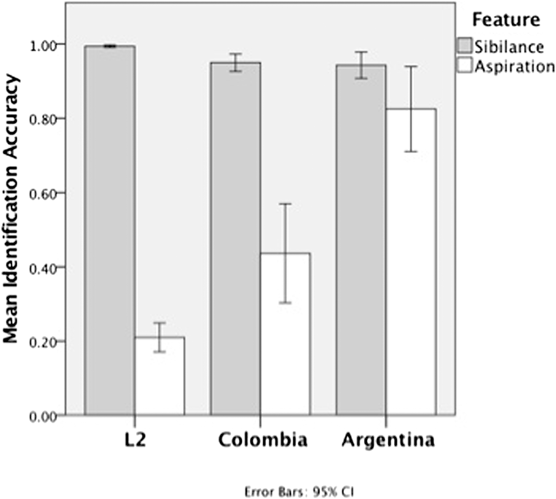
Differences across listener groups (L2 learners vs. each of the two native dialect groups) in the identification accuracies of the two allophones of syllable-final /s/, sibilant [s] and aspirated [h], were tested using a linear mixed model in SPSS (IBM Corp., 2016). Participant was fit in the model as a random effect and variant of /s/ and listener group, along with the interaction between variant and listener group, as fixed effects. Significant main effects of variant (F(1, 257) = 257.743, p < .001) and listener group (F(2, 257) = 35.949, p < .001) were found; along with a significant interaction between variant and group (F(2, 257) = 54.376, p < .001). The mean identification accuracies of the two allophones, sibilant [s] and aspirated [h], are presented in Figure 1 for the L2 group and two NS groups.
Mean identification accuracy of variants of /s/ according to listener group.

While all three groups were at ceiling levels in identification of the full sibilant variant as <s> (M = 99.4% and SD = .027 for L2; M = 95.0% and SD = .059 for Colombia; and M = 94.3% and SD = .075 for Argentina) and were not significantly different from one another, for identification accuracies of the aspirated variant, the L2 group (M = 21.0%; SD = .288) scored significantly lower than both NS groups, and the /s/-conserving Colombian group (M = 44.0%; SD = .337) scored significantly lower than the /s/-weakening Argentine group (M = 82.5%; SD = .244), with all post hoc pairwise comparisons at (p < .001). Furthermore, when considering within-group variation, for both the L2 listener group and the Colombian listener group, the accuracy of identification of aspirated-/s/ was significantly lower than that of identification of sibilant-/s/, (p < .001) for both pairwise comparisons, while the difference was not significant for the Argentine listeners (p = .07). Thus, the /s/-weakening Argentine listeners accepted both the full sibilant and the aspirated variants as Spanish <s>, while the L2 listeners and the /s/-conserving Colombian listeners only consistently identified the full sibilant variant as Spanish <s>.
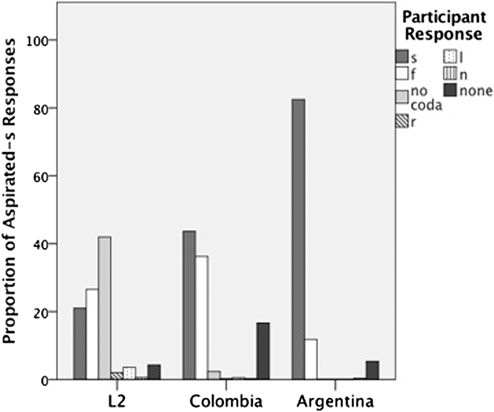
How did the listeners categorize aspirated-/s/ when not as a variant of /s/? The distribution of categorization responses for the aspirated-/s/ stimuli for each listener group is presented in Figure 2.
Distribution of [h] categorization responses according to listener group.

As discussed earlier, for the /s/-weakening NS group (Argentina), there was a preference to identify the aspirated [h] variant as Spanish <s>. For the /s/-conserving NS group (Colombia), categorizations were divided primarily between <s> and the phonetically similar voiceless labiodental fricative <f>. The distribution between these two categories appears to be motivated by social contacts of the Colombian listeners: Those who reported social contacts from weakening dialectal regions tended to identify [h] as <s> to a greater extent than those without these contacts (see Schmidt, Reference Schmidt2015, for further detail). While the L2 group also categorized the aspirated-/s/ variant as <f> and <s>, the most frequent categorization of the variant was, in fact, “no coda” (i.e., absence of any consonantal segment), a response practically absent in the NS data. Thus, the L2 listener group frequently “ignored” the aspiration cue in syllable-final position or failed to associate it with any consonant segment (e.g., [ˈleh.te] identified as “lete”).
DEVELOPMENT IN L2 CATEGORIZATION OF ASPIRATED-/S/
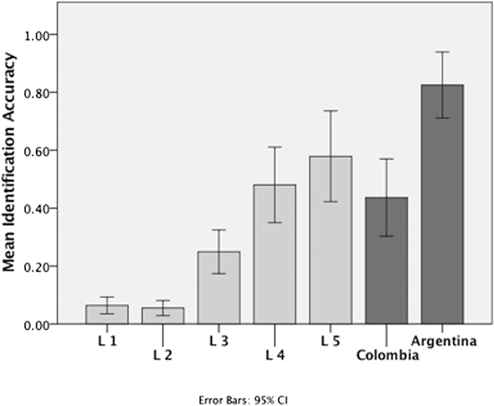
Next, changes in identification of aspirated-/s/ with increased Spanish experience were considered (here measured by learner developmental level). The mean identification accuracies of the aspirated [h] variant across L2 level, as compared with the two NS groups, are presented in Figure 3. A clear developmental pattern is observed across L2 level and beginning at class level 3 (introductory courses in Spanish literature, culture, and linguistics).
Mean identification accuracy of [h] across L2 level. Note. NS groups in dark grey.

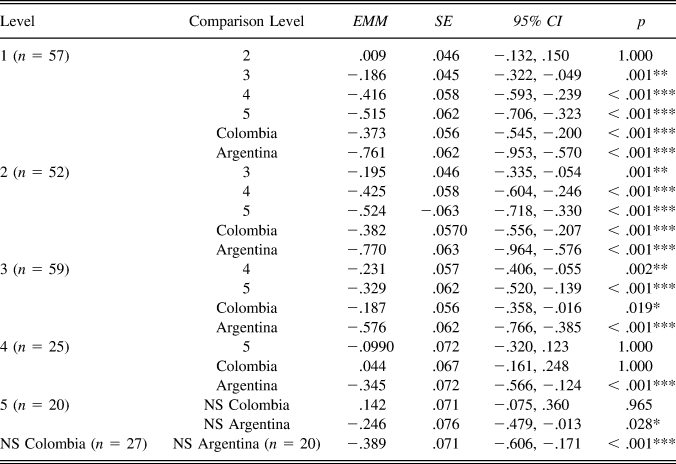
A one-way ANOVA was run with identification accuracy of [h] as the dependent variable and listener level (5 L2 levels and 2 native dialect groups) as the independent variable. Listener level was found to have a significant effect on identification accuracy (F(6, 253) = 42.614, p < .001). Table 2 presents a summary of the differences of estimated marginal means (EMMs), which provides information regarding the differences in identification accuracy of the aspirated variant [h] between levels.
Summary of the differences of EMMs of identification accuracies of aspirated-/s/ for the five learner levels and two native groups

Notes. *p < .05; **p < .01; ***p < .001.
As can be observed in the table, there was no significant difference in identification accuracy of [h] between class levels 1 and 2 (M = 6.4%, SD = .110; and M = 5.5%, SD = .093; respectively); however, these two levels scored significantly lower than levels 3 (M = 25.0%, SD = .299), 4 (M = 48.0%, SD = .316) and 5 (M = 57.9%, SD = .335), and than the two native groups, Colombia (M = 43.7%, SD = .37) and Argentina (M = 82.5%, SD = .244). Level 3 learners scored significantly lower than levels 4 and 5, while learners at these highest levels (4 and 5) scored significantly lower than the native s-weakening dialect group (Argentina), but showed no significant differences from the native s-conserving dialect group (Colombia), nor from one another.
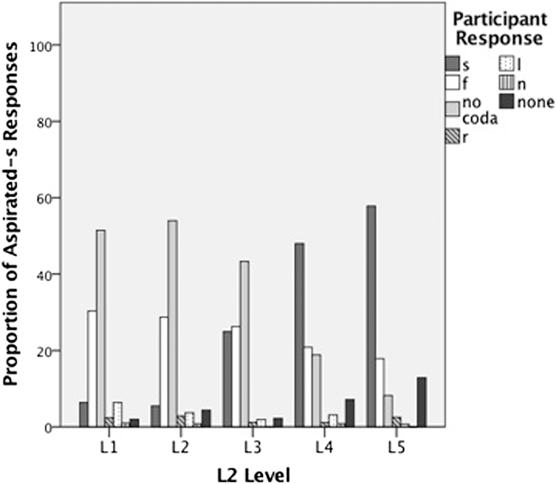
When the distribution of categorization responses for aspirated-/s/ across L2 level was considered, clear developmental changes in category assignation were revealed (Figure 4).
Distribution of [h] categorization responses according to L2 level.

For learners enrolled in beginning and intermediate Spanish classes (class levels 1, 2, and carrying into level 3), the English-speaking learners of Spanish tended to categorize syllable-final aspiration either as having no coda consonant present or as the voiceless fricative, <f>. At level 3, some learners began to accept the aspirated variant as Spanish <s>. By the highest enrollment levels (level 4 and level 5), the fourth-year Spanish majors and graduate students most commonly assigned [h] to the <s> category, followed by <f> or <none>.Footnote 2 In other words, the predominant categorization pattern at early levels of L2 Spanish experience was to “ignore” the acoustic aspiration information in this word-internal, syllable-final position, and to fail to map it onto any consonantal category (“no coda,” light grey bars). As experience with the L2 increased, the “no coda” categorization response decreased and was steadily replaced by the Spanish <s> phonetic category (dark grey bars). L2 listeners appeared to recognize that the acoustic information in the speech signal for aspirated-/s/ signaled a consonantal segment and began to interpret this information as an allophonic variant of /s/.
DIALECT EXPERIENCE AND CATEGORIZATION OF ASPIRATED-/S/
To begin to explore why the observed developmental patterns of categorization of dialectal aspirated-/s/ occur at these levels, the dialect contact experiences of the participants were then compared to individual categorization patterns. The dialect contact experiences are first described in the following tables, as based on information reported by the participants in the background questionnaire for the following contact factors: prior study abroad location, dialects spoken by social contacts, and metalinguistic knowledge (based on prior linguistics training).
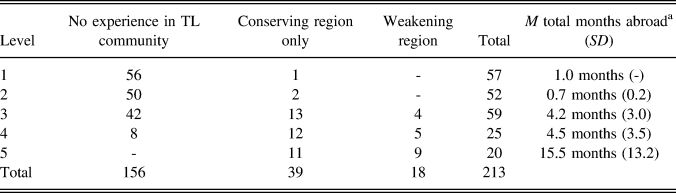
The summary of study abroad experiences is reported in Table 3. The proportion of students who had had experiences abroad and the average duration of time abroad varied across L2 level; L2 learners in this program did not tend to have an abroad experience until level 3, and the graduate students (level 5) spent a considerably longer total period in Spanish-speaking regions (M duration = 15.5 months) than learners at earlier levels (levels 3 and 4, M duration = 4.2 and 4.5 months, respectively). Overall, however, approximately one fourth (27%) of the L2 participants had previously studied abroad in a Spanish-speaking country. Of these, one third (18 of the 57 who had been abroad) had spent time in a /s/-weakening dialectal region.Footnote 3
Distribution (n) of study abroad experiences and time abroad across level

a For those learners with a study abroad experience only.
Notes. TL = target language. The weakening region group also includes learners who had an experience in both a weakening and a conserving region.
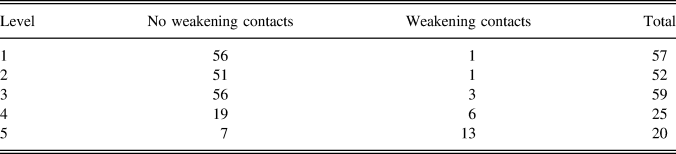
Table 4 reveals the distribution of learners according to reported regular contact (more than five times per month) with speakers of Spanish from /s/-weakening dialectal regions. Overall, learners reported very little interaction with social contacts—defined in the questionnaire as friends, family and/or colleagues—from weakening dialects of Spanish until level 4, where approximately one fourth of the group reported weakening contacts, and level 5, where the majority of the group reported such contacts.
Students (n) in contact with /s/-weakening dialect speakers across level

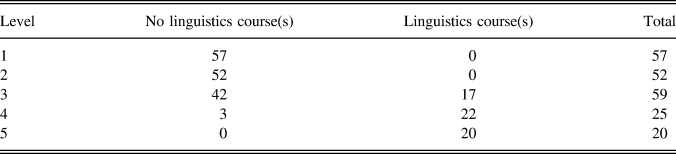
Finally, the number of L2 participants who reported that they had taken or were currently enrolled in a Spanish linguistics course is presented in Table 5. As Spanish /s/-lenition is a common sociolinguistic feature of many varieties of Spanish, it is common practice that this feature is taught in the linguistics training that students of Spanish degrees receive. Thus, those learners with linguistics training may have a metalinguistic or explicit knowledge of this common dialectal feature of /s/-weakening. Almost all learners had taken at least one Spanish linguistics course by the time they reached levels 4 and 5 (fourth-year Spanish majors and graduate students), while few or no learners had yet received this degree of linguistics training at the earlier levels.
Students (n) with metalinguistic training across level

A multiple linear regression was run to model the relationship between the explanatory variables of dialect contact and class level and the dependent variable, identification accuracy of aspirated-/s/. Each dialect contact variable was measured as the presence (1) or absence (0) of that contact experience: a study abroad experience in a weakening dialectal region, social contact(s) from a weakening dialect, and prior linguistic class(es). A significant regression equation was found (F(4, 208) = 51.684, p < .001, R 2 = .498): participants’ predicted identification accuracy = .285 (WEAKENING ABROAD EXPERIENCE) + .240 (CLASS LEVEL) + .233 (LINGUISTICS CLASS(ES)) + .135 (WEAKENING SOCIAL CONTACTS). All independent variables included in the regression were significant predictors of identification accuracy at (p < .05).
As the L2 learners in this population overall did not experience any of the /s/-weakening dialect contact variables until level 3, the regression was fit a second time with the data from levels 3 through 5 only. Again, a significant regression equation was found (F(4, 99) = 13.247, p < .001, R 2 = .349): participants’ predicted identification accuracy = .331 (WEAKENING ABROAD EXPERIENCE) + .205 (LINGUISTICS CLASS(ES)) + .200 (WEAKENING SOCIAL CONTACTS) + .052 (CLASS LEVEL). When the regression equation was fit for levels 3 through 5 only, all dialect contact variables were again significant predictors of identification accuracy at (p < .05), while L2 class level was no longer significant (p = .663). Thus, it seems that once the learner had reached a certain class level (here, level 3, third-year Spanish majors and minors), dialect contact experiences, rather than overall proficiency in the target language, were the important contributors to how Spanish dialectal aspirated-/s/ was perceptually categorized. Results from the effect of each of the dialect contact variables are presented as follows, in order of the strongest effect (i.e., largest β value). Only data from learners in levels 3 through 5 are included in the following figures.
Effects of Prior Study Abroad Experience
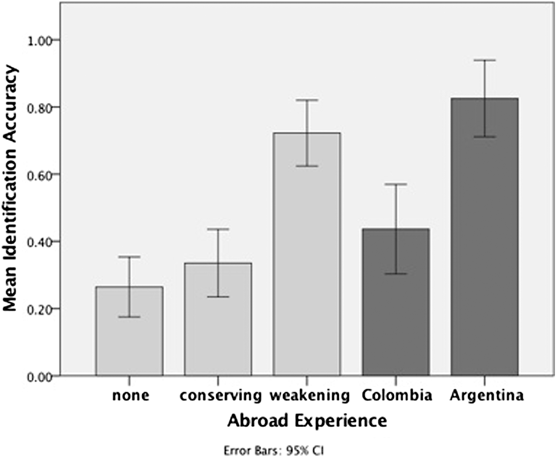
The mean identification accuracies of aspirated-/s/ according to type of study abroad experience are presented in Figure 5 (data from levels 3–5 are collapsed due to the lack of significance of class level in the second regression equation).
Mean identification accuracy of [h] according to study abroad location (levels 3–5).

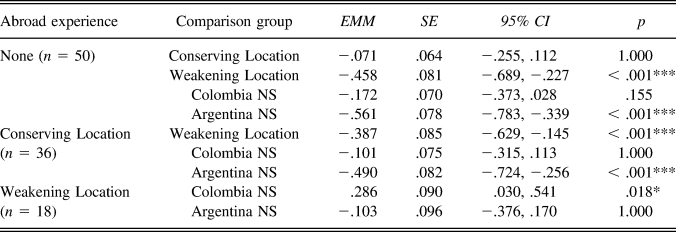
A one-way ANOVA revealed a significant effect of location of study abroad experience, (F(4, 146) = 18.268, p < .001); the summary of the differences of estimated marginal means are presented in Table 6. The post hoc pairwise comparisons revealed a similar identification performance for those L2 learners who had no study abroad experience (M = 26.5%, SD = .314), those who had only studied abroad in a /s/-conserving dialectal region (M = 33.5%, SD = .297), and the /s/-conserving Colombian group (M = 43.7%, SD = .337). Likewise, those L2 learners who had studied abroad in a /s/-weakening dialectal region (M = 72.2%, SD = .197) were not significantly different in identification accuracy of aspirated-/s/ from the /s/-weakening Argentine group (M = 82.5%, SD = .244). Thus, the important determiner in the categorization of the dialectal phone was not a study abroad experience per se, but rather that the learner studied in the “right” (i.e., an s-weakening) location.
Summary of the differences of EMMs of identification accuracies of aspirated-/s/ according prior study abroad experience

Notes. Levels 3–5 only for learner groups. *p < .05; **p < .01; ***p < .001.
Effects of Metalinguistic Knowledge
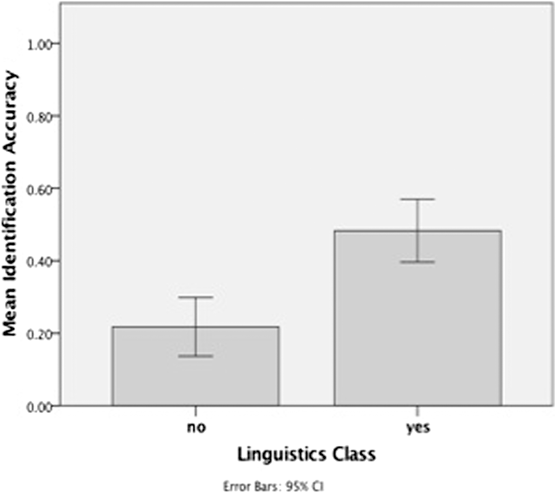
The mean identification accuracies of aspirated-/s/ according to metalinguistic training experience (levels 3–5) are presented in Figure 6. For those learners who had no prior linguistics training (n = 45), identification of aspirated-/s/ was significantly lower (M = 22.8%, SD = .269) than for those who had taken a linguistics course (n = 59, M = 48.3%, SD = .333), (F(1, 102) = 19.103, p < .001).
Mean identification accuracy of [h] according to prior linguistics training (levels 3–5).

Effects of Social Contacts
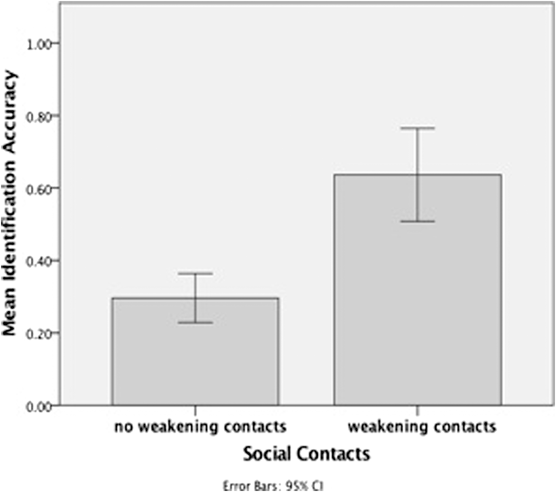
Finally, the mean identification accuracies of aspirated-/s/ according to reported social contacts (again, levels 3–5 only) are displayed in Figure 7. Those L2 learners who reported frequently communicating with one or more social contacts from Spanish /s/-weakening dialects (n = 22) more accurately identified aspirated-/s/ (M = 63.6%, SD =.289) than those learners who did not report /s/-weakening dialect contacts (n = 82, M = 29.6%, SD = .307), (F(1, 102) = 21.764, p < .001).
Mean identification accuracy of [h] according to social contacts (levels 3–5).

DISCUSSION
PERCEPTUAL CATEGORIZATION OF DIALECTAL ASPIRATED-/S/
While the s-aspirating Argentine NS group equally accepted both the aspirated [h] and the sibilant [s] forms as legitimate variants of /s/, as a whole, the L2 group, like the s-conserving Colombia NS group, did not categorize the aspirated allophonic variant as Spanish /s/ to the same extent as they did the full sibilant form. However, the L2 group also differed from both native dialectal groups in their categorization of aspirated-/s/: while s-conserving Colombians tended to categorize [h] as another Spanish voiceless fricative consonant (/f/) when not as /s/, the L2 listeners frequently ignored the aspiration cue completely (i.e., selected “no coda”), likely attributing it to part of the preceding vowel and ignoring its phonological relevance as a separate consonant segment all together. However, as will be discussed in the following sections, L2 identification of dialectal aspirated-/s/ changed with increased target language experience (across class level) and with varying dialect exposure experience, with L2 learners moving toward different native targets, depending upon individual experiences.
DEVELOPMENT IN CATEGORIZATION OF THE DIALECTAL PHONE
Clear developmental changes were observed in how the dialectal phone was categorized by the L2 listeners across class level. At early levels, the beginning and intermediate language courses (levels 1 and 2), the L2 learners failed to associate [h] with Spanish /s/ and tended to map it to the preceding vowel (no coda response), or assigned it to the /f/ category, a phonetically and acoustically similar phone. As predicted by the L2 speech perception models (PAM-L2, SLM, L2LP), at these earliest levels, perceptual identification of dialectal [h] was dictated by the L1 perceptual norms already set in place. The [h] phone does not occur contrastively in syllable-final position in the L1, English, and these learners appear to attribute the aspiration articulation to part of the preceding vowel, or as (phonologically) unimportant noise. [h], however, is contrastive in English in word-initial position (e.g., hi vs. I), and, thus, should be perceptually salient to English listeners in this (initial) position. An advantage of both the SLM and the L2LP model is that both acknowledge that perception is context-specific. Hypothesis 1 of the SLM specifies that L1-L2 sounds are perceptually related “at a position-sensitive allophonic level, rather than at a more abstract phonemic level” (Flege, Reference Flege and Strange1995, p. 239), and the L2LP model recognizes that “context-specific allophonic detail” is encoded at the phonetic level of representation (van Leussen & Escudero, Reference van Leussen and Escudero2015, p. 4). This context-specific perception would explain why the L2 learners frequently “ignored” the [h] phone in syllable-final position (i.e., chose the “no coda” response), even though [h] is a contrastive sound in other position-specific contexts in the L1.
Beginning with learners in third-year introductory content courses in Hispanic literature and culture (class level 3), the L2 learners’ perceptual norms in identification of aspirated-/s/ began to shift. It was at this level that some individual L2 listeners began to identify [h] as a variant of Spanish /s/. This shift accelerated for the more experienced fourth-year Spanish majors and Spanish literature graduate students (class levels 4 and 5). By these higher levels, the perceptual effects of the L1 phonological system (i.e., the no coda response) were practically eliminated, and these more experienced L2 users made nativelike categorizations of [h], as either /s/ or /f/, patterning like the two native dialect groups. The PAM-L2, SLM, and L2LP all recognize that perceptual systems continue to be adaptive through the speaker’s life span, and indeed, this was found to be the case here.
Moreover, by the advanced levels (graduating Spanish majors and graduate students), the <s> response became the most frequent categorization response. In other words, the L2 learners with greater target language experience had developed a new perceptual association and had come to identify both the full-sibilant [s] and the aspirated [h] phones as variants of the Spanish phonetic category /s/ in syllable-final position, in a sense “collapsing” two L1 sounds into a single L2 category. While the SLM, PAM-L2, and L2LP model all account for the difficulties in dividing established phonetic categories and in creating new discriminations in the L2, only the L2LP model specifically addresses the challenges of the type of learning situation present in the current study. In the L2LP model, Escudero (Reference Escudero2005) and van Leussen and Escudero (Reference van Leussen and Escudero2015) discuss the Subset scenario, in which there are fewer phonemic categories in the L2 than in the L1 along a particular acoustic continuum. They propose that in this scenario, learners must modify L1 boundaries as well as reduce the number of categories, and that such a scenario could pose problems for the learner, because, if the L1 contrasts persist intact, “this may in turn lead to spurious contrasts at the word level (i.e., lexical contrasts), ultimately hampering the attainment of a fully native-like command of the L2” (van Leussen & Escudero, Reference van Leussen and Escudero2015, p. 2). Indeed, this is precisely the case for the English-speaking learners of Spanish acquiring aspirated-s: Learners must modify the L1 boundaries and reduce the number of categories so as to assimilate both [h] and [s] phones to the same phonemic category, /s/, to eliminate the incorrect interpretation of lexical contrasts where there are none (e.g., interpreting mascota “pet” [mas-ˈko-ta] and [mah-ˈko-ta] as separate lexical items, when in fact they are variable articulations of the same item).
Why does this perceptual shift begin with learners in third-year introductory Spanish literature and culture courses (class level 3)? Possible explanations of these developmental effects include (a) increased opportunities for exposure to the dialect sound and/or (b) the possibility of a necessary proficiency level “threshold” for perceptual acquisition to occur. First, while /s/-lenition is a common feature across many varieties of Spanish spoken throughout the world, L2 learners may vary in the degree of exposure to this dialectal form; certainly, the findings from this study strongly support the role of dialect exposure on development of perceptual norms (discussed in the following section). While learners at all levels may be exposed to /s/-weakening speech to some degree, more consistent or extensive exposure may not occur until higher L2 levels. Indeed, Howard, Mougeon, and Dewaele (Reference Howard, Mougeon, Dewaele, Bayley, Cameron and Lucas2013) emphasize the role of the learning context in sociolinguistic development and the particular benefits of naturalistic exposure for the acquisition of native variable forms (see pp. 343–346 for an overview of research documenting these benefits).
Second, even if learners at various levels are exposed to the variable pronunciation of syllable-final /s/, it is possible that particular “threshold” proficiency levels in the target language must first be achieved for changes in perceptual norms to occur. To begin to notice the new target language sound (Schmidt, Reference Schmidt1990, Reference Schmidt and Robinson2001) and to begin to create a new perceptual association with a new or an established phonetic category, language learners need access to valuable attentional resources, which may be diverted in many other directions by the many novel structures (phonetic, lexical, morphosyntactic, lexical, etc.) in the speech signal. It may be the case that inexperienced L2 learners in the traditional foreign language context simply do not yet have the basic linguistic structures in place to free up attentional resources necessary for perceptual development of the sociolinguistic variant. This is further complicated by the variable nature of the target form, which is subject to a host of social, linguistic, and stylistic constraints even within those regional varieties in which it occurs and may contribute to a later acquisition of the dialectal phone. Young (Reference Young1988) contends that learners must first proceed along the vertical continuum (development of native grammatical forms), before moving along the horizontal continuum (development of native alternating [sociolinguistic] forms); indeed, SLA research has overwhelming documented the underuse of informal and vernacular variants of the target language, even amongst advanced L2 speakers (Howard, Mougeon, & Dewaele, Reference Howard, Mougeon, Dewaele, Bayley, Cameron and Lucas2013).
DIALECT CONTACT AND SPEECH PERCEPTION
It was confirmed from the results of the Dialect Contact Questionnaire that the students in the study, who were enrolled in a traditional language program at a public university in the United States, did not have much exposure to Spanish s-weakening dialects until class level 3 (introductory classes in Spanish literature and culture) and above. It was not until this level that learners began to study abroad and to receive linguistics training. Furthermore, learners did not report frequently interacting with social contacts from /s/-weakening dialects until even later, at class levels 4 (fourth-year Spanish content courses) and 5 (graduate students). While learners enrolled in beginning and intermediate-level Spanish language courses (class levels 1 and 2) may have had some exposure to /s/-weakening speech through their instructorsFootnote 4 or class activities, they do not appear to be exposed to weakening dialects outside of the classroom. However, for learners above these early levels, the linear regression model revealed that each of the dialect contact factors tested (study abroad, social contacts, and linguistic training) was a significant predictor in L2 categorization of aspirated-/s/. Moreover, when only those more experienced L2 learners at levels in which dialect exposure took place were considered (levels 3–5), it was found that the dialect exposure factors were more important than overall Spanish language proficiency in how dialectal aspirated-/s/ was categorized. Each of the dialect exposure variables is discussed as follows.
LONG-LASTING EFFECTS OF STUDY ABROAD EXPERIENCE
Based on the findings from the current study, the dialect region in which the L2 learner had studied abroad had lasting effects on the learner’s perceptual system. Those L2 learners who had studied in a s-weakening region tended to categorize aspirated-s as did the native s-weakening dialect group (Argentina), while those learners who only had a study abroad experience in a s-conserving region—or, who had no study abroad experience at all—categorized aspirated-/s/ similarly to the native /s/-conserving dialect group (Colombia). This corroborates previous research that has found evidence of learners moving toward different dialectal targets as a result of study abroad location (e.g., Baker & Smith, Reference Baker and Smith2010; Escudero & Boersma, Reference Escudero and Boersma2004; Salgado-Robles, Reference Salgado-Robles2011). Importantly, study abroad in the case of aspirated-s was not the determining factor per se (as those who had studied in s-conserving regions had no advantage over those with no study abroad experience at all), but rather the local dialect community in which the learner immerses him- or herself is key.
Interacting with Target Language Speakers
The dialectal social contacts variable was found to be a significant predictor in learner categorizations of aspirated-s, with those learners who regularly communicate with s-weakening dialect speakers more frequently identifying the aspirated variant as Spanish /s/. Unsurprisingly, one’s social network may be an important factor in the acquisition of dialectal forms: Certainly, learners in contact with speakers from these dialects have more opportunities for exposure to the dialectal forms in the input they receive. The social contacts variable has also been found to influence perceptual norms for native listeners as well (Schmidt, Reference Schmidt2015) and in the identification of socially indexed characteristics of speakers, such as region of origin (e.g., Baker, Eddington, & Lyndsey, Reference Baker, Eddington and Lyndsey2009).
Role of Metalinguistic Training
Finally, it is recognized that metalinguistic training also seems to play a role in the development of how new L2 phones are perceptually identified. Lenited-/s/ is one of the most studied variables in Hispanic sociolinguistic research, and, as such, it is likely that this dialectal feature is explicitly taught in linguistic courses. Thus, students in these courses may have explicit metalinguistic knowledge of this variant, which could aid in drawing attention to the linguistic form, facilitating its acquisition. Indeed, in the current study it was found that those L2 learners who had taken a Spanish linguistics course had a higher tendency to categorize the aspirated phone as /s/ than those without linguistics training. Interestingly, in the case of speech production, however, awareness of dialectal sounds in the target language does not always lead to higher use of these regional sounds: such was the case for Castilian /θ/ (Ringer-Hilfinger, Reference Ringer-Hilfinger2012) and s-weakening (Geeslin & Gudmestad, Reference Geeslin and Gudmestad2011). Again, this difference may be attributed to social factors related to language use: L2 speakers are active social participants and may make individual choices in the production of target language forms according to sociolinguistic factors, such as identity construction or attitudes toward target language communities.
Furthermore, metalinguistic awareness may be particularly influential in an identification task like the one used in the current study, one in which listeners have time to make their categorization response and may access different types of linguistic knowledge. One question that should be posed, then, is whether this advantage of metalinguistic awareness in perceptual identification likewise benefits other live language tasks, such as general listening comprehension abilities. Such auditory advantages due to explicit phonetic knowledge may likewise be present in other contexts, such as in informal conversational tasks. Future research on the acquisition of dialectal phones should employ other types of perception, processing, and comprehension tasks to determine if the same findings likewise hold true at other levels of perception of dialectal speech for L2 learners.
CONCLUSION
This study showed development in the perceptual categorization of a dialectal phone of the target language by L2 learners of Spanish in a traditional university foreign language program in the United States. While general developmental factors including influence of the first language system appeared to have a robust effect on how dialectal aspirated-/s/ was phonetically categorized by early L2 learners in beginning and low intermediate language learning courses, categorization of the dialectal phone was found to be influenced by dialect exposure factors for learners at more advanced stages of language learning. Exposure to different dialects of the target language may have long-lasting effects on how native variable sounds are perceived by learners, even when these effects aren’t observed in production. Future research should determine whether these long-lasting perceptual effects result in advantages in listening comprehension of dialectal speech (e.g., in terms of speed and accuracy) and in the ability to recognize and accurately interpret socially and stylistically indexed information in the speech signal. This study provides further evidence that learners do not move toward a single target of the language, but rather that their developing interlanguage systems appear to be influenced by individual learning experiences, including the varieties of the target language to which they are exposed.
SUPPLEMENTARY MATERIAL
To view supplementary material for this article, please visit https://doi.org/10.1017/S0272263118000116