Introduction
Diatoms are a key component of marine microbial communities and play a significant role in primary production, nutrient cycling, and the formation of biofilms, which facilitate colonization by other organisms (Round et al., Reference Round, Crawford and Mann1990; Sarthou et al., Reference Sarthou, Timmermans, Blain and Tréguer2005). In the Suez Canal, diatoms contribute to the functioning of the ecosystem by responding rapidly to environmental changes as well as serving as indicators of water quality (Nassar and NG, Reference Nassar and NG2003). In addition, their ability to form dense biofilms and respond quickly to environmental changes makes them key contributors in influencing benthic microbial communities in a dynamic habitat such as the Suez Canal (Madkour et al., Reference Madkour, Dorgham, Hanafi and Holligan2007).
Spider crabs are known for their masking or decorating behaviour. The presence of microbial films on their integuments is essential for the successful settlement of other epibionts. They change the properties of the carapace’s surface and provide both physical and chemical cues for colonization (Fernandez-Leborans, Reference Fernandez-Leborans2010). Without this fundamental layer, the acquisition of macro-epibionts and thus the crab’s ability to achieve effective camouflage would be significantly reduced (Majewska et al., Reference Majewska, Ashworth, Frankovich, Sullivan, Bosak, Filek, Van de Vijver, Arendt, Schwenter, Nel, Robinson, Gary, Theriot, Stacy, Lam, Perrault, Manire and Manning2023). This accumulation with macro-epibionts helps the crab blend into its environment and reduces the energetic cost of active masking or decorating behaviours (Wicksten, Reference Wicksten1993; Berke and Woodin, Reference Berke and Woodin2008).
Epizoic diatoms in the Suez Canal remain poorly documented despite their ecological significance, particularly those associated with brachyuran crabs. Deyab (Reference Deyab2012) documented the epiphytic diatom communities along the Suez Canal, Gulf of Suez and the Egyptian coasts of the Red Sea, and showed strong spatial and seasonal trends. Our previous study (Madkour et al., Reference Madkour, Sallam and Wicksten2012), on the other hand, was the first to document the epibiotic communities associated with the spider crab Hyastenus hilgendorfi (De Man, Reference de Man1887) in Lake Timsah, including both macro- and micro-epibionts. Over 49 micro-epibiont taxa were recorded, with diatoms forming a prominent component of the epibiotic community. However, micro-epibionts, including diatoms, were not examined in detail, and their taxonomic composition and ecological significance were not fully addressed.
The ecological relevance of this study is particularly pronounced within Lake Timsah, a critical mid-section of the Suez Canal where the phenomenon of heavy epibiotic encrustation is widely recognized on different substrates (Ghobashy and El-Komi, Reference Ghobashy and El-Komi1980; Emara and Belal, Reference Emara and Belal2004; Ghobashy and Ghobashy, Reference Ghobashy and Ghobashy2005). Encrustation has been also reported in crab species that have never been known to host epibionts in the Canal (Osman et al., Reference Osman, Sallam and Wicksten2025). The spider crab, H. hilgendorfi, serves as an ideal demonstration of this local energy. Unlike typical decorator crabs, this species exhibits obligate encrustation in this environment (Sallam et al., Reference Sallam, Madkour and Wicksten2007; Sallam and Wicksten, Reference Sallam and Wicksten2011). The unique setal and ultrastructural morphology of its carapace actively facilitates the settlement and growth of dense assemblages of epibionts (e.g. barnacles, tunicates, and serpulid worms) (Osman et al., Reference Osman, Sallam and Madkour2020, Reference Osman, Sallam, Madkour and Wicksten2021). By supporting such a heavy cover, the crab is transformed into a mobile, live hard substratum. This feature is critical in the local ecology, as it provides a stable habitat that significantly increases the diversity of sessile species within the mainly soft-sediment environment.
The present study provides the first investigation of epizoic diatoms on the carapace of H. hilgendorfi in the Suez Canal. We characterize their species composition, seasonal abundance, and diversity, in an attempt to explain their ecological role and potential contribution to the strategy used by this species to achieve crypsis.
Materials and methods
Collection and processing of samples
We collected H. hilgendorfi monthly between April 2019 and March 2020 from Timsah Lake, the second large lake along the Suez Canal (Figure 1). Upon the arrival of fishermen at this landing site early in the morning, we immediately unentangled the crabs from the pockets formed by the three layers of the trammel nets. The nets they use have a mesh size of about 33.5 mm. They are deployed at sunset at a depth of 6 m and retrieved at dawn. The bottom of the lake is sandy-mud. We sorted the sample to select individuals that were non-encrusted with macro-epibionts to allow for easier scraping of the carapace. Twenty crabs were randomly collected regardless of size, sex, and reproductive stage of females (i.e. ovigerous or non-ovigerous). Crabs were placed in plastic jars filled with 4% formalin prepared with sea water and then transported to the laboratory for examination. Each crab was sexed and assessed for moulting stage, and only full-sized, hard-shelled, intermoult individuals were retained for the study. Carapace width (CW) was measured using a precision Vernier caliper with an accuracy of 0.1 mm.
Map of the Suez Canal highlighting the location of Timsah Lake, the sampling site.

Enumeration of diatoms
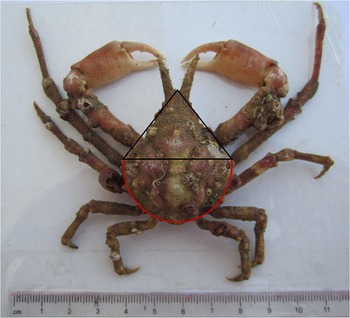
A subsample of six males and six females was randomly selected to be examined for the characterization of their diatom assemblages. Since the carapace of H. hilgendorfi was uneven, the total area was measured by marking it into the nearest geometric figure (1 triangle) and (half circle), then summing their areas (Figure 2). Quantification of diatoms was carried out by scraping the entire carapace with a brush into a known volume of filtered seawater and preserved in 4% formalin. Diatoms were examined prior to and after cleaning with hydrogen peroxide (H2O2) and potassium dichromate (K2Cr207) to remove the organic material using an inverted microscope at 100 × and 400 ×. Species identification was based on using standard taxonomic references (Hendey Reference Hendey1964; Tomas Reference Tomas1996). Representative samples of diatoms were enumerated by the sedimentation technique (Hasle Reference Hasle and Sournia1978). To account for differences in substrate size and provide standardized ecological metric, seasonal diatom abundance was expressed as the mean diatom density (number of cell dm−2) calculated from the individual carapace counts of the sampled crabs within each sex and seasonal category.
Sketch showing the area of H. Hilgendorfi carapace.

To compare the abundance of diatoms among seasons and sexes, their presence/absence data, their diversity (Shannon–Wiener diversity, H′) and evenness (J′) indices were calculated. Generic diatom abundance data (i.e. quantitative measurement of diatoms counted and identified only at the taxonomic level of genus within the samples) were log (x + 1) transformed to reduce the influence of dominant taxa and improve normality. Their dissimilarity levels were measured through squared Euclidean distance and group average method as described by Pielou EC (1984) using R Statistical Software.
We analysed diatom assemblage data on males and females in R v4.2.2 using the vegan package (Oksanen et al., Reference Oksanen, Simpson, Blanchet, Kindt, Legendre, Minchin, O’Hara, Solymos, Stevens, Szoecs, Wagner, Barbour, Bedward, Bolker, Borcard, Carvalho, Chirico, De Caceres, Durand, Evangelista, FitzJohn, Friendly, Furneaux, Hannigan, Hill, Lahti, McGlinn, Ouellette, Ribeiro Cunha, Smith, Stier, Ter Braak and Weedon2022) Community dissimilarities were computed with Bray–Curtis dissimilarities on the filtered count matrix. We inspected the eigenvalue spectrum from a preliminary Principal Coordinates Analysis (PCoA) and observed a small fraction of negative eigenvalues (∼0.7%); we therefore employed Lingoes correction (Legendre and Anderson Reference Legendre and Anderson1999), and visualized site scores by sex, adding 95% ellipses. To test differences in composition between sexes while controlling for temporal structure, we used PERMANOVA with 9,999 permutations restricted within month, after confirming homogeneity of multivariate dispersion between sexes with beta dispersion and permutational tests. As a descriptive follow-up to identify taxa contributing to sex differences, we ran SIMPER (Clarke Reference Clarke1993) on square-root–transformed abundances with 9,999 permutations and summarized the top contributors by their average contribution to between-group Bray–Curtis dissimilarity, consistency, group-wise mean abundances, and cumulative contribution.
Results
A total of 616 individuals were collected during the sampling period, they were all in the intermoult stage. They comprised 346 males (56.2%), 196 non-ovigerous females (31.8%) and 74 ovigerous females (12.0%) with a sex ratio of 1.46:1 male to female. The size range of the population varied between 9- and 36-mm CW for males and between 9- and 33-mm CW for females. The average size of males, 22.17 mm CW (n = 750, SD = 5.1) was larger than that of females, 18.9 mm CW (n = 578, SD = 4.2). Females did not exceed 33 mm CW while a very few males ranged from 33 to 36 mm CW. A male of 34.48 mm was the largest collected specimen.
Species composition of diatom community
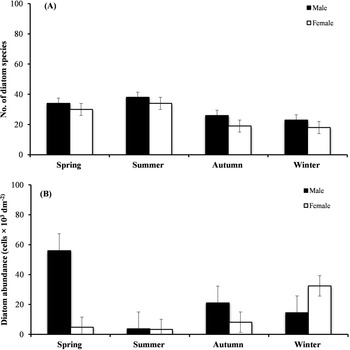
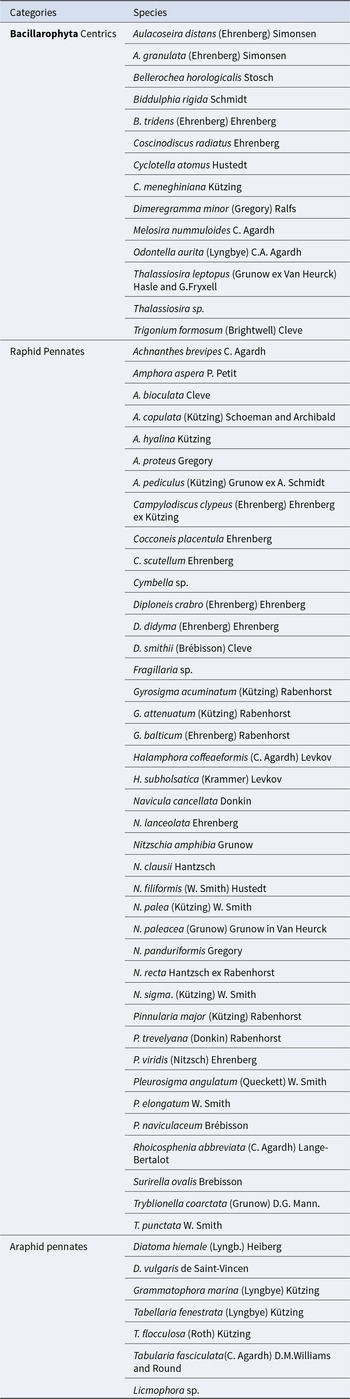
Sixty-one diatom taxa were recorded (39 raphid, 8 araphid pennate diatoms and 14 centrics) belonging to 31 genera (15 raphid, 6 araphid pennate, and 10 centrics). The dominant genera in terms of the number of species were Nitzschia (8 species) and Amphora (6 species) whereas Pinnularia, Diploneis, Pleurosigma, and Gyrosigma were represented by 3 species each (Table 1). Males had a higher number of diatom species than females throughout the whole year with a higher percentage in summer (38 and 34 species for males and females, respectively; Figure 3A). Fewer species were recorded in winter (23 and 18 species for males and females, respectively). The density of the epizoic diatoms was higher in males than in females during all seasons except winter when the opposite was observed (Figure 3B). The maximum total number of cells was recorded during spring with the highest value of 56 × 103 cells dm−2 for males while the minimums were observed during summer (4 and 3 × 10³ cells dm−2) for males and females, respectively.
H. Hilgendorfi De Man, 1887: (A) species number and (B) density of diatom (cells × 103 dm−2) in males and females during the different seasons. Error bars indicate standard errors. N = 12. N = number of individuals examined.

H. Hilgendorfi: categories of masking materials

Richness, evenness, and diversity of the diatom community
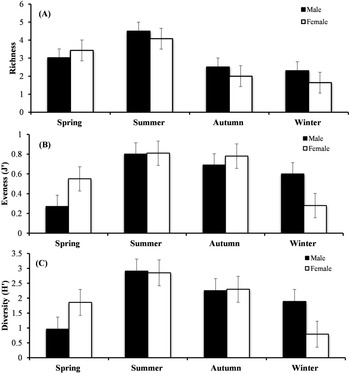
Figure (4A) shows the seasonal richness of the diatom species. Summer was the richest season (4.5 and 4.1) for males and females, respectively. The lowest value was recorded in winter (2.3 and 1.6) for both sexes, respectively. On the other hand, females showed higher values of evenness (J′) than males during all seasons except in winter (0.6 and 0.3 respectively; Figure 4B). In spring, the diversity index (H′) of diatom assemblages displayed considerably higher values for females than for males (1.86 and 0.96, respectively). However, both sexes exhibited relatively similar values in the summer and winter months. On the other hand, males had higher values of diversity index than females in winter (1.89 and 0.79, respectively). Diatoms were more diverse in summer (average H′ = 2.9) and less in winter (average H′ = 1.3; Figure 4C).
H. Hilgendorfi De Man, 1887: (A) richness; (B) evenness (J′) and (C) Shannon-Wiener diversity index (H′) of diatom in males and females during the different seasons. N = 12. N = number of individuals examined.

Dissimilarity levels of the diatom’s communities
The PERMANOVA on Bray–Curtis distances, with permutations restricted within month, indicates that community composition differs between male and female samples (Figure 5). The explained variance is small (R 2 = 0.026, i.e. sex explains about 2.6% of the variation), but the difference is statistically significant (F 1,53 = 1.418, p = 0.0016; 9,999 permutations). The beta dispersion test showed no evidence of unequal dispersion between sexes (F 1,53 = 1.905, p = 0.179), so the PERMANOVA result reflects differences in group centroids rather than differences in spread.
Principal coordinates analysis (PCoA) of Bray–Curtis dissimilarities among diatom assemblages, computed with Lingoes correction. Points represent individual samples, coloured by sex; ellipses show 95% confidence intervals (standard-error ellipses) around group centroids. Axis 1 and Axis 2 explain 11.4% and 8.3% of the variation, respectively (n = 55 samples). Statistical differences between sexes were assessed by PERMANOVA with permutations restricted within month.

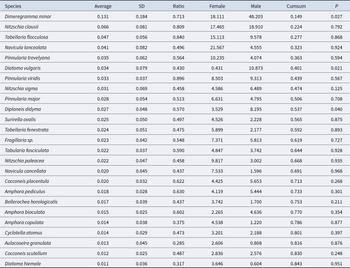
SIMPER indicated that the male–female difference was driven primarily by Dimeregramma minor (average contribution 0.131; p = 0.027), Diatoma vulgaris (0.034; p = 0.021), and Diploneis didyma (0.027; p = 0.040) (Table 2). Taxa with higher mean abundance in females included N. lanceolata and Tabellaria flocculosa, whereas D. minor and D. vulgaris were more abundant in males. The top 25 taxa together accounted for ∼84% of the average Bray–Curtis dissimilarity between sexes.
SIMPER results for differences in diatom assemblage composition between sexes based on Bray–Curtis dissimilarity (9,999 permutations). Columns show each taxon’s average contribution to the between-group dissimilarity (‘average’), its standard deviation across permutations (‘SD’), a consistency index (‘ratio’ = average/sd), mean abundances in the two groups (‘female’ and ‘male’, the cumulative proportion of dissimilarity explained (‘cumsum’), and the permutation p-value (‘P’). The top 25 taxa ranked by average contribution are shown

Discussion
In this study, 61 diatom taxa were recorded on the carapace of H. hilgendorfi, with benthic pennate forms being the most frequent. Madkour et al. (Reference Madkour, Dorgham, Hanafi and Holligan2007) reported the dominance of pennate diatoms in the middle Suez Canal, where shallow depth, weak currents and stable benthic conditions favour their attachment and growth. Similar observations have been reported in other in other sheltered coastal areas, such as the Atlantic coast of Patagonia where reduced water movement and consistent environmental conditions allow pennate diatoms to effectively colonize available surfaces (Cibic et al., Reference Cibic, Pino, Liendo, Rojo and Almandoz2024).
Most of the identified pennate diatoms were raphid types (64%), while araphid pennates were less frequent (13%). Forms that lack specialized attachment structures (centrics) were moderately represented in the assemblage (23%). The presence of these centrics is perhaps due to passive entrapment within the grooves, protrubances on the crab’s carapace, or between the setae. This suggests that diatom forms that do not have the ability to attach to any surface can become part of the biofilm associated with the carapace as a result of mechanical entrapment and not by active attachment. The high richness of 61 diatom taxa on H. hilgendorfi significantly exceeds the 29 taxa reported on the swimming crab Callinectes bellicosus (Lopez-Fuerte et al., Reference Lopez-Fuerte, Fernández-García, Del Castillo Me and Figueroa-Castro2024). This suggests that the stable, setose carapace of spider crabs provides a superior substrate for colonization compared to the smoother shells of portunids. Furthermore, the shared dominance of raphid pennate diatoms, particularly Nitzschia, reinforces their role as key pioneers in crustacean biofilms across different host families. In a previous work (Sallam et al., Reference Sallam, Madkour and Wicksten2007), only 49 diatoms species were recorded from the carapace of this species; however, Madkour et al. (Reference Madkour, Sallam and Wicksten2012) recorded 30 taxa including 22 raphid, 5 araphid, and 3 centric diatoms) for its sympatric counterpart Schizophrys dahlak. This indicates a markedly higher diversity, particularly of centric forms in H. hilgendorfi. These variations suggest that both species, although living in the same environment, differ in terms of carapace microstructure. This is supported by the study of Osman et al. (Reference Osman, Sallam and Madkour2020) who reported differences in the ultrastructure of the carapaces of the two species with that of H. hilgendorfi being more textured than that of S. dahlak.
The host carapace’s specific characteristics are essential in shaping the composition and density of its epibiotic community (Wahl et al., Reference Wahl, Goecke, Labes, Dobretsov and Weinberger2012). Dvoretsky and Dvoretsky (Reference Dvoretsky and Dvoretsky2022) in their study on the common crab species in the coastal Barents Sea found that host morphology and shell sculpture were primary initiators of biodiversity and infestation patterns. They emphasized that the stability and micro-topography of the host’s carapace enhance settlement success by offering shelter to micro-epibionts. On the other hand, Sanka et al. (Reference Sanka, Suyono, Rivero-Muller and Alam2016) explained that epibionts such as diatoms would have high chance of attaching to the carapace setae when they get trapped in areas on the carapace where the flow of water decreases such as high elevations. We reported this observation in S. dahlak, its sister species of H. hilgendorfi in Timsah Lake where carapace protrusions assisted the interlocking of diatoms (Osman et al., Reference Osman, Sallam, Madkour and Wicksten2021). In the case of H. hilgendorfi, we hypothesize that the highly stable, setose carapace functions as a critical mobile substrate, offering a foundation for colonization of diatoms.
This study showed a clear seasonal pattern in the species richness of diatoms, where the values peaked in summer and reached their lowest in winter. Diatom development and species richness have been reported to increase with temperature (Hillebrand and Sommer Reference Hillebrand and Sommer1997; Maguire et al., Reference Maguire, Yamakawa, Mixson, Lowe and Kociolek2007). This seasonal trend is consistent with the findings by Deyab (Reference Deyab2012), who reported that the temporal patterns in epiphytic diatom assemblages along the Suez Canal is influenced by fluctuations in temperature, salinity, and nutrient availability. Fernandez-Leborans (Reference Fernandez-Leborans2010) concluded that the crab’s carapace and its associated microhabitats could possibly influence diatom species richness by providing varied and complex attachment surfaces. The highest evenness (J′ = 0.81) and Shannon–Wiener index (H′ = 2.91) values recorded in summer indicate a stable and diverse diatom assemblage on H. hilgendorfi. These results are consistent with those reported by Madkour et al. (Reference Madkour, Sallam and Wicksten2012) in S. dahlak from the same study site (Sanka et al., Reference Sanka, Suyono, Rivero-Muller and Alam2016).
Figure 5 and Table 2 showed variation in the dominant diatom associations between males and females. These patterns may imply differences in carapace properties, behaviour between the two sexes, as well as interactions among epibionts (Madkour et al., Reference Madkour, Sallam and Wicksten2012). Comparable sex-specific differences in epibiotic assemblages have been linked to the variation in moulting frequency, as well as carapace morphology in other crustacean species such as the spider crab Schizophrys aspera from the southern Great Barrier Reef (Goodhill et al., Reference Goodhill, Desbiens and and Wolfe2024) and the king crab Paralithodes camtschaticus in Southern Barents Sea (Dvoretsky and Dvoretsky Reference Dvoretsky and Dvoretsky2023).
The observed seasonal variation in diatom diversity and density on the carapace of H. hilgendorfi suggests a functional link between the crab’s cryptic behaviour and microbial colonization. Diatoms are known to be among the earliest colonizers of submerged surfaces, forming biofilms that modify surface properties and release cues for the settlement of macro-epibionts (Suresh and Sureshkumar Reference Suresh and Sureshkumar2017; Qian et al., Reference Qian, Cheng, Wang and Zhang2022). These macro-epibionts such as sponges, hydroids, and algae enhance the crab’s camouflage by concealing its body outline (Wicksten Reference Wicksten1993; Berke and Woodin Reference Berke and Woodin2008). Higher diatom densities in summer and spring may reflect favourable environmental conditions (Sarthou et al., Reference Sarthou, Timmermans, Blain and Tréguer2005) which promote the development of the biofilm layer and therefore increase the recruitment of macro-epibionts. This suggests that the effectiveness of this species’ passive camouflage could be influenced by seasonal changes in biofilm structure and composition.
To the best of our knowledge, no previous studies have reported sex-specific differences in epizoic diatom assemblages on crabs, emphasizing the new insights revealed by this study. Further research is recommended in order to determine whether the relationships between microbial and macro-epibionts would vary throughout the crab’s life cycle. Considering the ongoing environmental changes in the Suez Canal continued monitoring of these epibiotic associations will be crucial to assess the responses of the host crab as well as the long-term stability of the ecosystem.
Acknowledgements
This paper is dedicated to the memory of Dr. Fedekar F. Madkour (d. 2021), whose expertise and dedication laid the foundation of this work. She examined the specimens, identified and analysed the epibiotic microalgae, and drafted the initial manuscript. Her legacy as a meticulous researcher and generous mentor lives on through this publication. We extend our thanks to Dr. Chris Butler, Biology Department, TAMU, USA for his assistance with statistics.
Author contributions
Marwa M. Osman: Assisted in designing the study, carried out the field sampling and initial data collection, and participated in data interpretation and manuscript drafting. Wafaa S. Sallam: Led the study design and coordination, contributed to the formulation of research questions, analysed and interpreted the data, revised and finalized the manuscript, and served as the corresponding author. Mary K. Wicksten: Contributed to the interpretation of findings, critically reviewed and revised the manuscript for intellectual content and clarity.
Financial support
This research received no specific grant from any funding agency, commercial or not-for- profit sectors.
Ethical standards
This study involved only epibiotic diatoms collected from the carapace of crustaceans. No procedures were conducted on live vertebrates or regulated invertebrates, and thus, ethical approval was not applicable.
Data availability
The datasets generated and/or analysed during the current study are available from the corresponding author upon reasonable request.
Conflict of interest
The authors declare none.