




No CrossRef data available.
Report of the Editor of the American Political Science Review, 2002–2003
Published online by Cambridge University Press: 26 February 2004
Abstract
An abstract is not available for this content. As you have access to this content, full HTML content is provided on this page. A PDF of this content is also available in through the ‘Save PDF’ action button.
Information
- Type
- Association News
- Information
- Copyright
- © 2004 by the American Political Science Association
I submit this report at the end of my second year as editor of the APSR. Before turning to the specific business at hand, I want to acknowledge the contributions that numerous individuals made to the operation of the APSR during 2002–2003. Conspicuous among these individuals were Assistant Editor Elizabeth Cook; APSR Editorial Interns Todd Andrews, Jason MacDonald, Allen McDuffie, Stephanie McNulty, and Misty Olsen; the 44 members of the APSR Editorial Board and especially the members of the Executive Committee (Neta Crawford, Darren Davis, Robert Goodin, Kirstie McClure, James Morrow, and Sven Steinmo); staff members too numerous to list at the APSA office, George Washington University, and Cambridge University Press; the authors who submitted their papers; and the hundreds of reviewers who donated their time, knowledge, and skill to assessing these submissions.
I also want to note briefly two events during 2002–2003 that had a major impact on the APSR. The first of these was the appearance of the APSA's new journal, Perspectives on Politics. Because Perspectives on Politics is something of a work in progress at this point, it is impossible to say exactly how the intellectual division of labor between it and the APSR will evolve in the medium to long term. What is certain as of now is that the book review section, formerly an integral component of the APSR, has moved to Perspectives on Politics, and that the APSR's former March-June-September-December publication schedule has changed to February-May-August-November.
The second event was a site visit to our editorial offices by a team consisting of the Executive Committee of the APSR Editorial Board. Following this visit, which was undertaken at my request, the team prepared and submitted to the president of the APSA an interim report in which it assessed the performance of the editor and staff, conveyed its thoughts about various APSR-related issues, and offered several specific recommendations. Subsequently, the site visit team also drafted surveys to be completed by authors, reviewers, and readers, and plans to incorporate the results of these surveys into its final report. I am pleased to acknowledge publicly my gratitude to the site visit team for the way it has approached this task and for the helpful recommendations it has provided (almost all of which were implemented as soon as they were received).
A year ago, in my first annual report as editor of the APSR, I summarized several new or revised reviewing procedures that we had established and I documented trends in manuscript submissions, processing, and outcomes (Sigelman 2003). Due to disruptions associated with the September 11 attacks and their aftermath, during 2001–2002 we faced even greater challenges than would normally beset an editorial office in its first year of operation. As we headed into our second year, it seemed likely that we would be settling into a more “normal” mode of operation. What seemed less certain was just what “normalcy” might entail. For example, during 2001–2002 we had experienced an extraordinary surge in submissions. Would that greatly enhanced manuscript flow prove to be a one-year “spike” or would it become the new norm?
Submissions and Processing
The Number of Papers Submitted
As described in my first annual report (Sigelman 2003), my hope and expectation when I was named editor was that we would quickly begin to receive more manuscripts than had previously been submitted to the APSR, especially from parts of the discipline that had not been well represented in the APSR's pages. Toward that end, the Editorial Board and I took special steps to publicize our eagerness to receive more submissions than the APSR had gotten in the past, our efforts to ensure that the review process would run as it should, and our aspiration to publish the best article-length work across the full range of the discipline. Whether as a result of these efforts or for other reasons, submissions increased dramatically during 2001–2002: depending on how submissions are counted, they rose by 44% (total submissions) or by 56% (submissions of new manuscripts) in one year—an unprecedented rate of growth!1
“Total submissions” count successive resubmissions of the “same” paper separately. For example, a paper that was submitted, revised and resubmitted, and then finally resubmitted following its conditional acceptance pending final changes would count as three submissions, not one. In terms of assessing workflow, this counting rule is not at all unreasonable, for in the example just given, several separate review processes would have been conducted. For “new” or “original” submissions, by contrast, that sequence would be counted as a single submission, not as three.
It would have been unrealistic to expect another huge increase in submissions during 2002–2003 over the recordsetting level of 2001–2002. The real question was whether what occurred in 2001–2002 was a one-time-only phenomenon, in which case submissions would revert to their status quo ante levels once the market cleared. The answer, as shown in Table 1, is that submissions showed no signs of abating during 2002–2003. Indeed, they increased again, though not by nearly as much as in the preceding year. During the 52 weeks since the end of our last reporting period (August 14, 2002), the total number of manuscripts that we handled rose from 615 to 672, a 9% increase, and the number of new manuscripts we received rose from 509 to 546, an increase of 7%.

In sum, the dramatic increase in submissions that the APSR experienced in 2001–2002 was not a one-time occurrence. Submissions continued to rise during 2002–2003, though certainly not at the same rate as they had the year before. I interpret this continuing but more moderate growth rate as a healthy sign. A reversion to lower submission levels would have been disappointing, but a continuation of the explosive growth of 2001–2002 would have been too much of a good thing; with available personnel, it would have proven very difficult for us to process that many more manuscripts in a timely and efficient manner.
Turnaround Times
Another positive development during 2001–2002 was that even though we handled a record number of manuscripts, processing times were substantially faster than had been the case in the past. By the middle of our editorial office's first year of operation, our “shake-down cruise” seemed to be over and the review process was running efficiently and predictably. That being the case, I considered any further quickening of the pace of the review process unlikely, especially if the volume of submissions continued to grow.
That expectation proved to be accurate, for, as Table 2 indicates, the median number of elapsed workdays at each step of the review process remained virtually constant from 2001–2002 to 2002–2003. For the second consecutive year, I am pleased to report that, on average, the review process lasted only two months from the day we received a manuscript until the day we mailed the decision letter to the author. Only rarely (certainly less than 5% of the time) did a review process drag on for a period that I would consider problematic.

The Mix of Papers Submitted
Arrayed across analytical approaches and fields, the distribution of papers submitted to the APSR during 2002–2003 closely resembled the 2001–2002 distribution. The overall proportion of “formal” and/or “quantitative” submissions held constant at 69%, though there were some shifts from one subcategory to another (a lower percentage of “formal” submissions and higher percentages of “quantitative” and “formal-and-quantitative” submissions). “Small-N” submissions, virtually non-existent in the recent past, accounted for a larger share of the submissions, but still constituted only 5% of the papers we received. “Interpretive/conceptual” papers fell off by a few percentage points, largely reflecting a drop of the same magnitude in the “normative theory” category. Roughly a third of the papers we received focused on American politics and a quarter fell into the comparative politics category; 15% or so represented the international relations field and a like percentage considered issues of normative theory; the rest were evenly divided between formal theory papers not elsewhere classified and papers about research methods. The latter percentages all fell close to their 2001–2002 counterparts. Because many papers were difficult to classify, I would caution against attaching much importance to minor inter-category differences or year-to-year differences in proportions.
As noted above, when I assumed the editorship, one of my major goals was to attract not only a greater number, but also a greater variety, of submissions, so that the APSR's pages would be open, in fact as well as in form, to work representing the substantive and analytical diversity of our discipline. Although the figures shown in Table 3 could certainly be interpreted as indicating that progress in that direction has been slow, I want to offer a different perspective on what has occurred. As a case in point, consider “small-N” analyses. At first glance, the difference between the 2% that such submissions constituted in the 1995–2000 period and the 5% that they constituted during 2002–2003 may not seem like much. Bear in mind, though, that the total number of submissions was much larger in 2002–2003 than it had been in earlier years, so “small-N” submissions became, in effect, a somewhat larger proportion of a much larger pie. In raw numbers, whereas during the 1995–2000 period the APSR received, on average, only about half a dozen “small-N” submissions per year, in 2002–2003 we received two dozen. In terms of the likelihood that “small-N” research would actually be published in the APSR, that is a noteworthy difference. More generally, given the very substantial increase in the number of submissions during the last two years, the figures in Table 3 actually mask considerable progress in attracting papers that represent fields and/or approaches previously under-represented in terms of submission to, and publication in, the APSR.

Outcomes
Of every 100 first-round decisions that I made during 2002–2003, 88 were rejections based on the recommendations of reviewers. Two more of every 100 first-round decisions (labeled “incorrect” submissions in Table 4) were notifications to the submitting author that I was unwilling to open the review process on their paper because the authorship of the paper had not been rendered sufficiently anonymous, or because the paper far exceeded our length limit, or because its formatting was wildly at variance with our guidelines (e.g., it was set up in a font far too small to expect reviewers to tolerate). In every such instance, this summary rejection letter invited the author to fix the problem and submit a corrected version of the paper, and without exception that invitation was accepted. One out of every 100 decision letters informed the author that in my judgment the paper was so inappropriate for the APSR that no purpose would be served by sending it out for review; I wrote only five such letters in all.

In sum, only eight of every 100 of my first-round decisions were “positive,” in the sense of holding the review process open by inviting the author to revise the paper for further consideration, accepting a paper subject to some final conditions, or accepting it unconditionally. I spent a great deal of my time conveying bad news to authors.
Rather than going into detail about the outcomes of subsequent rounds of the review process, I will note that these outcomes followed directly from the principles that I applied and the practices that I followed in the first round of the process. During 2002–2003, I continued to make very sparing use of “revise and resubmit” invitations and to resist any temptation to pile one such invitation on top of another. Thus, I invited resubmissions only when the reviewers expressed genuine enthusiasm about a paper and only when the required revisions were relatively narrow in scope; papers that were deemed competent but incremental or were seen as requiring “back to the drawing board” changes were almost invariably rejected, though on a few occasions I did bow to the reviewers' great enthusiasm for a paper that needed truly major revisions or to their judgment that an unusually well-crafted analysis deserved to be published even though it may not have been a truly major breakthrough. Reflecting these principles and practices, I either accepted, conditionally accepted, or rejected every revised resubmission; that is, I never offered a second “revise and resubmit” invitation. Nor was it at all common for me to reject a revised resubmission. Of all the revised resubmissions on which the review process was completed during 2002–2003, more than 85% were accepted. I would prefer to report that that figure was 100% rather than 85%, but on occasion the optimism that produced a “revise and resubmit” invitation turned to disappointment with the revised paper.
In almost every instance, my initial acceptance of a paper was conditional rather than final. In accepting a paper conditionally, I advise the author (1) that I will assess the new version myself rather than send it out for further review, and (2) that I will accept it as soon as I receive a version that settles any remaining issues. Most often, the point of the remaining revisions is to improve the accessibility and appeal of a paper by reworking its introductory and concluding sections and/or by editing the text to enhance readability; on some occasions, straightforward and specific substantive matters also require attention.
An obvious question is whether certain types of papers fared better than others. The key question in this respect is how many papers representing each approach and field were accepted for publication during 2002–2003. Arrayed across approaches, the 46 papers that were accepted broadly followed the distribution of the papers that were received, though with some gaps. As can be seen by comparing Tables 2 and 5, formal and/or quantitative papers constituted 63% of those accepted, close to the 69% that were submitted. Compared to submissions, purely quantitative papers were numerically underrepresented and interpretive/conceptual papers were numerically overrepresented among those accepted. The cross-field deviations were more substantial, with international relations and normative theory papers picking up the slack from American politics papers. Lest these patterns be viewed as manifestations of an editorial bias against quantitative analyses and research on American politics, I hasten to add that those are precisely the categories into which most of my own work falls. If pressed, I could provide some tentative accounts for these gaps, but rather than speculating about them at this point, I would prefer to note that (1) because no such patterns were evident during the preceding year and (2) because I am unaware of any new bias that may have intruded into our review process during 2002–2003, (3) I tend to regard these as one-time blips that are unlikely to recur in years to come. In any event, we will continue to monitor these patterns to determine whether they continue in 2003–2004.

References
Sigelman Lee.
2003
“Report of the Editor of the American Political Science Review, 2001–2002.”
PS: Political Science and Politics
36
(January):
113–
117.Google Scholar
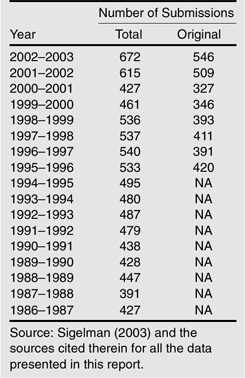
Number of Papers Submitted
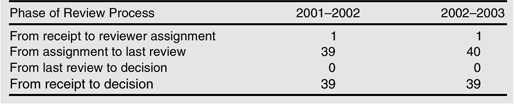
Elapsed Time (Median Number of Workdays) in the Review Process
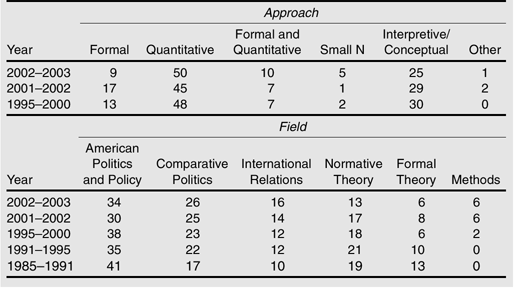
Distribution of Papers Submitted by Approach and Field (%)
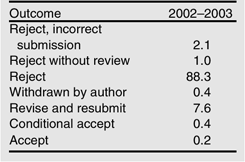
Outcomes in First Round of the Review Process (%)
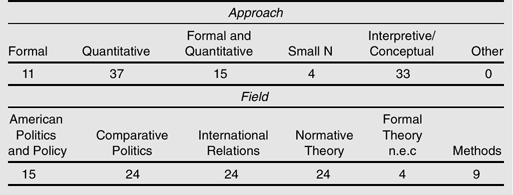
Distribution of Papers Accepted, 2002–2003 (%)
 You have Access