Introduction
Younger onset dementia (YOD) is defined as the onset of dementia symptoms before the age of 65 years. The causes of YOD are heterogeneous, more so than are observed in older people with dementia, and these include a greater proportion of rarer illnesses (Rossor et al., Reference Rossor, Fox, Mummery, Schott and Warren2010). YOD encompasses the usual suspects of Alzheimer's disease (AD) and vascular dementia (VaD) as well as disorders such as frontotemporal dementia (FTD), dementia with Lewy bodies (DLB), alcohol-related dementia (ARD), and prion diseases (Sampson et al., Reference Sampson, Warren and Rossor2004). An investigation of adults presenting with progressive cognitive decline between the age of 17 and 45 years indicated that neurodegenerative dementias (particularly FTD) were the most common cause, although AD was uncommon (Kelley et al., Reference Kelley, Boeve and Josephs2008). It was further found that autoimmune or inflammatory etiologies (most commonly multiple sclerosis (MS) but also neuropsychiatric lupus and autoimmune encephalopathy) accounted for more than one in five patients (21.3%). No cause of dementia was ascertained for 18.7% of the patients.
In addition to the causes cited above, there are a number of medical disorders where secondary, progressive cognitive impairment may occur, which can be severe enough to meet the clinical criteria of dementia; such disorders include HIV (Antinori et al., Reference Antinori2007), multiple sclerosis (Longley, Reference Longley2007), Huntington's disease (Peavy et al., Reference Peavy2010), Parkinson's disease (Emre et al., Reference EMRE2007), and Down syndrome (Lott and Dierssen, Reference Lott and Dierssen2010). Dementia plus syndromes, where there is comorbid cognitive impairment and neurological or systemic signs, such as FTD with motor neurone disease, are observed more frequently in YOD (Rossor et al., Reference Rossor, Fox, Mummery, Schott and Warren2010). Recent international trends of rapidly increasing alcohol abuse may also cause cognitive problems in middle age and later life (Gupta and Warner, Reference Gupta and Warner2008; Ridley et al., Reference Ridley, Draper and Withall2013). Although cognitive impairment has been described in these groups, relatively little is known about the proportion of dementia cases within some of these categories (Withall, Reference Withall2013).
Younger onset dementia is a serious health and social issue (McMurtray et al., Reference McMurtray, Clark, Christine and Mendez2006) and is associated with qualitatively different issues to late onset dementia (Luscombe et al., Reference Luscombe, Brodaty and Freeth1998). YOD is unexpected when a person is aged in their thirties to sixties; a time when people are actively engaged in work, family life, and have significant financial commitments. The shock of this diagnosis can have devastating effects on the person's relatively young partner or spouse, their young children, and broader support network (van Vliet et al., Reference Van Vliet, De Vugt, Bakker, Koopmans and Verhey2010; Svanberg et al., Reference Svanberg, Spector and Stott2011). Unlike persons with late onset dementia, those with YOD are generally fit and in good physical health, which, together with their marked age differences, makes their integration into mainstream dementia services difficult. People with YOD often fall outside the age limits of aged care services and are deemed as not meeting the criteria for care, thus increasing burden upon carers and other family members and the acute care system (Draper et al., Reference Draper, Karmel, Gibson, Peut and Anderson2011).
An accurate indication of prevalence is necessary to determine service requirements for this people in this group and their carers (Withall, Reference Withall2013). Younger patients with dementia have very different needs to people with late onset dementia (Williams et al., Reference Williams, Cameron and Deardon2001). Younger people with dementia tend to remain at home for longer periods (Williams et al., Reference Williams, Cameron and Deardon2001), although they struggle to find community care options and often do not fit in with mainstream dementia services that are geared toward the elderly population (Luscombe et al., Reference Luscombe, Brodaty and Freeth1998). More than one in five patients have to transition to a nursing home or a hospital ward approximately a year after diagnosis (Ferran et al., Reference Ferran, Wilson and Doran1996), where lack of residential beds for younger patients results in inappropriate placement with elderly patients (Sperlinger and Furst, Reference Sperlinger and Furst1994; Freyne et al., Reference Freyne, Kidd, Coen and Lawlor1999). Since these patients are relatively uncommon, their dementia may be due to rarer illnesses, and since they often present with non-cognitive and/or behavioral symptoms, they are often misdiagnosed and the time taken for exact diagnosis is much longer than in older patients (Luscombe et al., Reference Luscombe, Brodaty and Freeth1998; Roach et al., Reference Roach, Keady, Bee and Hope2008; van Vliet et al., Reference Van Vliet2013).
A barrier to service provision for this group is the lack of epidemiological data. Australian and international epidemiological studies of dementia usually exclude people aged under 60 or 65 years (Alzheimer's Disease International, 2009). For AD, the prevalence rates have varied from 15.2/100,000 for people aged 45–64 years (Ratnavalli et al., Reference Ratnavalli, Brayne, Dawson and Hodges2002) to 34.6/100,000 for people aged 40–64 years (Newens et al., Reference Newens1993). Both studies were conducted in the United Kingdom. The two studies on FTD have also yielded conflicting prevalence rates for people aged 45–64 years: 15.1 per 100,000 in the United Kingdom (Ratnavalli et al., Reference Ratnavalli, Brayne, Dawson and Hodges2002) versus a much lower rate of 4.0 per 100,000 in the Netherlands (Rosso et al., Reference Rosso2003). The latter study explained the lower rate as resulting from under-ascertainment due to non-referral via their yearly postal enquiry. Ratnavalli et al. (Reference Ratnavalli, Brayne, Dawson and Hodges2002), on the other hand, chose a catchment area within a well-organized, single area health authority and used a more personal approach to health specialists and clinics. The prevalence rate of VaD in people aged 45–64 years has been reported as 8.2 per 100,000 (Ratnavalli et al., Reference Ratnavalli, Brayne, Dawson and Hodges2002).
The two broad international studies that have investigated the prevalence of YOD have yielded conflicting results. An epidemiological catchment area prevalence survey was conducted in London (total population 567,500) using a three-stage process of awareness building, case-finding, and case validation (Harvey et al., Reference Harvey, Skelton-Robinson and Rossor2003). There were 185 confirmed patients and the prevalence rate in people aged 30–64 years was 54.0/100,000 (95% Confidence Interval (CI): 45.1–64.1). The main sub-types were AD (34%), VaD (18%), FTD (12%), and ARD (10%). A Japanese study revealed a prevalence rate of 51.7/100,000 in the 30–64-year age group with a very different clinical profile: VaD (42%), AD (26%), dementia following head injury (7%), and Lewy body dementia/Parkinson's disease dementia (6%) (Ikejima et al., Reference Ikejima2009).
In summary, planning in Australia as to how best to help people with YOD and their families is hampered by the lack of robust data regarding their prevalence and characteristics. The aim of the current study was therefore to establish the prevalence, etiologies, and clinical features of people with YOD in a defined catchment area of Sydney, Australia. A secondary aim was to compare secondary dementias (including ARD) with degenerative dementias according to basic demographic and clinical features. We hypothesized that there would be a higher percentage of males than females with YOD, and those with degenerative dementias would be older than the group with secondary dementias.
Methods
Catchment area
The catchment area for the study comprised four local government areas (Waverley, Woollahra, Randwick, and Botany) in Eastern Sydney, New South Wales. From the 2006 census data (Australian Bureau of Statistics, 2006), the area had a population of 129,070 people aged 30–64 years, 68,867 aged 30–44 years, and 60,203 aged between 45 and 64 years. It is estimated that in 2006, 40% of the population in this area was born overseas, 2.2% was indigenous, and the average median weekly household income of the four local areas was $1385.75 (Australian Bureau of Statistics, 2006).
Case finding
A brief, structured questionnaire was distributed to health professionals associated with the two hospitals operating in the catchment area (Prince of Wales Hospital and the War Memorial Hospital). These included psychiatrists, neurologists, geriatricians, general practitioners (GPs), allied health professionals (e.g. psychologists, social workers, occupational therapists, speech pathologists, and nurses), rehabilitation practitioners, immunologists, and addiction specialists. We also approached private specialists working in the catchment area. The questionnaire asked how many patients with YOD they had seen over the previous 12 months as of the census date (1st June 2008).
The following questions were included in the questionnaire:
-
1. Do you currently assist any patient who fulfills the criterion for younger onset cognitive impairment or younger onset dementia (i.e. persons with onset of memory, behavioral, and/or language symptoms before age 65 years)?
-
2. As of 1st June 2008, over the last 12 months, how many people with younger onset dementia have been in your care? (Note: The dementia syndrome is defined here as an acquired decline in memory and other cognitions due to brain disease that results in significant impairment of personal, social, or occupational function and persisting for at least six months).
For identified patients, practitioners assigned patients with a 14-character identification code known as a Statistical Linkage Key (SLK), based upon the initials of their name, date of birth, and gender. The SLK enables confidentiality to be maintained while providing a unique code to ensure against double counting. This code is part of the National Minimum Data Set used with community care packages and residential aged care services in Australia. This robust technique achieved a unique key rate of over 99.7% in a study involving 190,000 people in residential care (Karmel, Reference Karmel2005). For each case of YOD, practitioners were also asked to record the patient's age at the onset of dementia symptoms and at dementia diagnosis, the patient's current postcode, and the relevant diagnosis. The respondents were also asked to select the patient's diagnosis from the following list: AD, VaD, mixed dementia, FTD or Pick's disease, FTD with motor neurone disease or amyotrophic lateral sclerosis with dementia, semantic dementia, progressive non-fluent aphasia, corticobasal degeneration, progressive supranuclear palsy, DLB, dementia in Parkinson's disease, dementia in Huntington's disease, dementia in Creutzfeldt–Jakob disease, dementia in HIV or AIDS-dementia complex, dementia in multiple sclerosis, dementia in epilepsy, dementia in Down's syndrome, ARD, unspecified dementia, or others (respondents were asked to specify the type). Practitioners who did not respond for a month were sent a second questionnaire, followed by a reminder email or phone call. Respondents were encouraged to return the completed questionnaire even if they had not seen any YOD patient. Memory clinics (searched for five years prior to census, i.e. 2003–2008) and other specialist dementia services, including aged care assessment teams, neuropsychiatry services, adult mental health services, neurology services, dementia day centers and community services, residential aged care facilities, and aged care psychiatry services were also approached via their managers. To improve the participation rates of GPs, we circulated the questionnaire to practitioners via local Divisions of General Practice. Hospital medical records were also searched for potential patients with relevant ICD-10 codes for the 12 months prior to the census date (F00: Dementia in Alzheimer's disease & its subcategories; F01: Vascular dementia & its subcategories; F02: Dementia in other diseases classified elsewhere & its subcategories; F03: Unspecified dementia; F10.73: Alcohol-associated dementia; G30: Other degenerative diseases of the nervous system & relevant subcategories, and G31: Other degenerative diseases of the nervous system not elsewhere classified & relevant subcategories).
Institutional ethics approval for this study was obtained from the Ethics Committees of the University of New South Wales and the South Eastern Sydney and Illawarra Area Health Service, Eastern Sector.
Case verification
Potential patients were included if they were alive and residing within the catchment area on the census date; had a clinical diagnosis of dementia; had an onset of memory, behavioral, and/or language symptoms before the age of 65 years; and had persistent cognitive impairment for at least six months. The dementia diagnosis for 81.6% (n = 115) of the identified patients was verified against the Diagnostic and Statistical Manual of Mental Disorders, Fourth Edition (DSM-IV) criteria for dementia through a medical case note review. Data used in the medical case note review to support the diagnoses included documentation about the age of onset of dementia symptoms, the clinical history supplied by the person with dementia and their informants, their family history, and test results, including blood tests, brain scans, and neurological, functional, and cognitive assessments. All of the patients had received a cognitive assessment that indicated clinically significant impairment on Mini-Mental State Examination, Addenbrooke's Cognitive Examination – Revised, or a full neuropsychological assessment. These data were used to confirm the DSM-IV dementia diagnosis as well as the specific clinical diagnosis provided in the survey. We used established clinical criteria consistent with Harvey's UK study, for example, NINCDS-ADRDA for AD (McKhann et al., Reference McKhann1984), NINDS-AIREN for VaD (Roman et al., Reference Roman1993), the Lund and Manchester criteria for FTD (The Lund and Manchester groups, 1994), consensus criteria for DLB (McKeith et al., Reference McKeith1996), and DSM-IV criteria for alcohol-induced persisting dementia (American Psychiatric Association, 1994). Two of Oslin's criteria for ARD were additionally used to confirm that the quantity and timing of alcohol abuse was sufficient to validate this diagnosis (i.e. minimum 35 standard drinks per week for males and 28 for females) for more than five years, and significant alcohol use occurring within three years of the onset of cognitive deficits (Oslin et al., Reference Oslin, Atkinson, Smith and Hendrie1998). All validated patients were checked to verify that they met the criteria for the dementia specified in the survey results. For some patients, more than one diagnosis was specified and this was investigated during the case note review, with a decision being reached for complex patients in a consensus process with the second author (Brian Draper).
Results
Case finding
The brief, case-finding questionnaire that was sent to health practitioners and services had an overall 83% response rate (23% response rate for GPs). Regarding the patients, 26.8% were referred by a medical specialist, 20.3% by a residential aged care facility, 8.7% by a psychologist, 5.8% by a nurse, 5.1% by a social worker, 4.3% by an aged care assessment team, 3.6% by GPs, 2.2% from the hospital records’ search, and 18.8% from other sources (mostly memory clinics and dementia day services). Seventeen percent of the patients were identified by two or more clinicians/services, and 18% had received more than one dementia diagnosis.
The sample
Of the 239 potential patients, 141 patients with YOD were identified. Patients were excluded if they were not found to meet the criteria for dementia (n = 32; 8 patients reported by residential aged care facilities, 15 patients identified in the hospital search as having ARD but with insufficient supporting evidence, 4 patients due to mental illness, 2 had mild cognitive impairment, 2 had intellectual disability with insufficient evidence of dementia, and 1 patient detected in the hospital search was incorrectly coded as having dementia), had onset of symptoms after 64 years of age (n = 5), lived outside the catchment area on the census date (n = 55), or were no longer alive (n = 6).
Diagnoses were verified by the medical case notes of 115 patients. Of the remaining 26 patients, 21 came from reliable sources: the aged care assessment team (n = 4), a medical specialist (n = 12), or a community dementia service that requires a diagnosis of dementia to access the service (n = 5). The remaining five patients were from residential care facilities – the current age was under 65 years for each of these patients and a member of staff verified by phone that the person met the criteria for the diagnosis of dementia at a syndromal level. For 17 patients (12.1%), the age of onset was not specified and could not accurately be determined from medical notes. This was mostly evident in the ARD group where the data were missing for ten patients (38.5%). For each of these patients, their age at census was under 65 years, hence they were included.
All patients identified by GPs, except one, were identified by other sources. This patient had received a specialist diagnosis of dementia but had not seen the specialist in the previous 12 months. To account for the low response rate of GPs, we also chose an additional 15 non-responding GPs at random and contacted these clinicians to see if there were any missed cases. All these GPs confirmed that they did not have a YOD patient in their care in the preceding 12 months.
The mean age at the onset of symptoms for the group was 55.0 years (median = 57.00, SD = 9.52); the mean age at diagnosis was 56.6 years (median = 59.50, SD = 9.89); and the mean time from symptom onset to diagnosis was 2.5 years. However, the time from onset to diagnosis ranged from a few months to 13 years across the sample (median = 1.00, SD = 2.90), and for 10.6% of the patients this process took five years or longer. The youngest reported patient had an onset of dementia symptoms at 15 years old, with a diagnosis of Rasmussen's syndrome. Another participant had an onset of dementia symptoms at an age of 26 years, with a dementia diagnosis secondary to juvenile-onset multiple sclerosis. All other participants had an onset of cognitive symptoms over the age of 30 years, and the age range on the census date was 34 to 77 years.
There was no significant difference in the ratio of females to males in the sample (71 females, 50.4% vs. 67 males, 47.5%; missing data = 3). In addition, there was no significant difference in mean age of onset of symptoms between females and males (54.1 (females) vs. 55.9 (males), t = 0.86, p = 0.39).
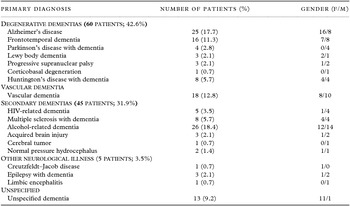
The most common clinical diagnoses were ARD (26 patients, 18.4%), AD (25 patients, 17.7%), VaD (18 patients, 12.8%), and FTD (including semantic dementia and progressive non-fluent aphasia; 16 patients, 11.3%) (see Table 1 for all diagnoses).
The proportion of YOD clinical diagnoses in the sample and their associated disorders

Prevalence rates of YOD and major clinical subtypes
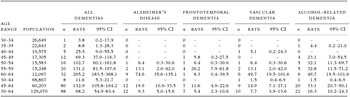
Eighty-eight patients with YOD were aged between 30–64 years on census date and comprised the sample for prevalence calculations. The overall prevalence rate of YOD in the 30–64-year age group was therefore 68.2/100,000 (95% CI: 54.9–83.4; see Table 2). The prevalence rates for the 30–44- and 45–64-year age groups were 11.6/100,000 (95% CI: 5.3–21.7) and 132.9/100,000 (95% CI: 105.8–164.2) respectively. Prevalence rates for major diagnostic groups are also provided in Table 2. There were no patients with either AD or FTD under the age of 45 years.
Age-specific prevalence rates for all dementias and for the most common diagnoses of YOD

Comparison between secondary dementia and degenerative dementia groups
When degenerative and secondary dementia groups were compared, the degenerative dementia group was significantly older at symptom onset (58.4 (degenerative) vs. 49.8 (secondary) years, t = 3.50, p = 0.002), although the groups did not differ regarding the time to diagnosis (2.9 (degenerative) vs. 2.7 (secondary) years, t = 0.17, p = 0.87).
Due to the higher than expected number of patients with ARD (26 patients; age range at census, 38 to 75 years), we examined further the sources of referral and diagnostic verification undertaken. The ARD patients were referred from different sources within the health system and no patient was reported more than once. Ten patients were detected in the hospital search (38.5%), seven were referred from hospital neuropsychologists (26.9%), three from residential care facilities (11.5%), two from occupational therapists (7.7%), and one each from a social worker (3.8%), aged care psychiatry ward nurse (3.8%), aged care assessment team (3.8%), and a medical specialist (psychogeriatrician; 3.8%). For the majority of patients, the ARD diagnosis was made following an acute hospital admission, usually for a fall, fracture, or hepatic illness. All had received either a full neuropsychological assessment or a cognitive screen following a period of abstinence. On the medical case note review, it was evident that this group had complex medical histories and comorbidities (92.3% had two or more vascular risk factors) and they often had estranged relationships with family members. Five resided in residential care and two were homeless. Only a minority of the patients had received repeat, follow-up cognitive testing after discharge in spite of file note recommendations that all patients should receive this.
In addition to the above cases, alcohol abuse was also noted to be a contributing factor to the onset of dementia for four patients in the total sample (two with a diagnosis of VaD, and one each with a diagnosis of HIV and epilepsy).
Discussion
This was the first epidemiological study on YOD in Australia. The design incorporated case finding and verification methods that have proven successful elsewhere (Harvey et al., Reference Harvey, Skelton-Robinson and Rossor2003). Of the 141 patients with YOD identified in total, 88 were in the 30–64-year age group on census date, which yielded a prevalence rate of 68.2 per 100,000 persons at risk. The prevalence of YOD in the 45–64-year age group was, as expected, much greater at 132.9 per 100,000 persons at risk. Some patients were very young at the onset of their dementia symptoms; five aged less than 40 years. This study found that there was significant clinical heterogeneity across the group, with approximately 35 different causes of dementia identified. The major clinical subtypes were ARD (18.4%), AD (17.7%), VaD (12.8%), and FTD (11.3%). The cases were complex and it was at times difficult to ascertain the primary dementia diagnosis.
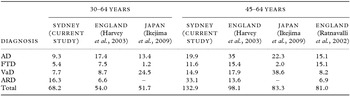
Our study found a higher prevalence of YOD than Harvey's study using a similar methodology and set of diagnostic criteria (Harvey et al., Reference Harvey, Skelton-Robinson and Rossor2003). Our prevalence rates were also higher than those reported by Ikejima et al. (Reference Ikejima2009) for both 30–64- and 45–64-year age groups, and Ratnavalli et al. (Reference Ratnavalli, Brayne, Dawson and Hodges2002) for the 45–64-year age group. Our prevalence rates for AD were lesser than the studies conducted in the United Kingdom (Harvey et al., Reference Harvey, Skelton-Robinson and Rossor2003) and Japan (17.7% vs. 34% and 26% respectively; see Table 3). McMurtray et al. (Reference McMurtray, Clark, Christine and Mendez2006), however, reported a similar proportion of AD patients in an analysis of memory clinic data; 52% for late onset dementia presentations compared with 17% for YOD patients. Our rates for VaD were equivalent to Ratnavalli et al.'s (Reference Ratnavalli, Brayne, Dawson and Hodges2002) study (8.3/100,000 and 8.2/100,000 respectively), however smaller than Harvey et al.'s (Reference Harvey, Skelton-Robinson and Rossor2003) and Ikejima et al.'s (Reference Ikejima2009) studies (17.9/100,000 and 38.6/100,000 respectively). Our rates for FTD were more similar to Harvey et al.'s (Reference Harvey, Skelton-Robinson and Rossor2003) and Ratnavalli et al.'s (Reference Ratnavalli, Brayne, Dawson and Hodges2002) studies, which are higher than the rates in Ikejima et al.'s (Reference Ikejima2009) study. No patients with AD were identified in the 30–44-year age group, which is consistent with Kelley et al.'s (Reference Kelley, Boeve and Josephs2008) findings that AD is uncommon in younger age groups. Consistent with Harvey et al. (Reference Harvey, Skelton-Robinson and Rossor2003) and McMurtray et al. (Reference McMurtray, Clark, Christine and Mendez2006), our group showed considerable clinical heterogeneity with a number of patients due to preventable causes of dementia, such as ARD and HIV-related dementia (McMurtray et al., Reference McMurtray, Clark, Christine and Mendez2006).
Comparison of prevalence data with Harvey et al. (Reference Harvey, Skelton-Robinson and Rossor2003), Ikejima et al. (Reference Ikejima2009), and Ratnavalli et al. (Reference Ratnavalli, Brayne, Dawson and Hodges2002) per 100,000 persons at risk for primary clinical subtypes. Total number represents all patients included in prevalence calculation

The diagnosis of YOD is distressing for the person, their family, and support network. Delays in diagnosis are common in YOD, especially since changes in behavior can be the presenting symptom (Luscombe et al., Reference Luscombe, Brodaty and Freeth1998). It took an average of 2.5 years from onset of symptoms to dementia diagnosis for these participants, although this ranged from a few months to 13 years. Van Vliet et al. (Reference Van Vliet2013) also reported a significant longer time for YOD diagnosis versus late onset dementia. Furthermore, the group with FTD was a key contributor for this delay and this was mainly due to the preponderance of behavioral symptoms at presentation, which often led to an initial diagnosis of stress or depression (van Vliet et al., Reference Van Vliet2013). This delay in diagnosis has a serious impact on the person with dementia and their relations with their partner, family members, and broader support network. A UK study reported that carers described the process of diagnosis as being passed from pillar to post, from one consultant to another (Williams et al., Reference Williams, Cameron and Deardon2001). They also expressed a need for additional information, practical help, support, and counseling. Diagnostic delay can also have serious implications on the person's work and career. Better awareness among medical specialists and health professionals, particularly GPs, about the prevalence and characteristics of YOD is needed.
We found no gender differences in rates overall. We did find that those with degenerative dementias were older at symptom onset although there were no differences between this group and those with secondary dementias regarding time to diagnosis. Of note was the much higher than expected occurrence of ARD, accounting for 18.4% of the total sample, and which was often complicated by other substance abuse. Our rates of ARD are significantly higher than those reported elsewhere (33.1 per 100,000 for the 45–64-year age group vs. 13.6 and 6.9 in Harvey et al.'s (Reference Harvey, Skelton-Robinson and Rossor2003) and Ratnavalli et al.'s (Reference Ratnavalli, Brayne, Dawson and Hodges2002) studies respectively) and may account for the overall higher prevalence of YOD in this study. This high rate of ARD may be due to changing cohorts in the decade since these previous studies. Our study would have detected the start of the baby boomer generation, having more permissive attitudes toward alcohol and other substance use (Härkönen and Mäkelä, Reference Härkönen and Mäkelä2010). This trend is expected to become more pronounced in the coming years (Colliver et al., Reference Colliver, Comptom, Gfroerer and Condon2006). A recent study of all public hospitals in New South Wales, Australia, examined admissions of people aged between 50 and 64 years over a 12-month period (Draper et al., Reference Draper, Karmel, Gibson, Peut and Anderson2011). Dementia was diagnosed in 0.9% of patients (n = 759) overall and the rate of ARD was very close to this study at 20.8%. However, many were identified in acute hospital admissions and few cases were verified post-discharge after a longer period of abstinence. The possibility of over-diagnosis of ARD by clinicians who are not dementia specialists, as found in Denmark (Salem et al., Reference Salem2012), must be considered. We did use a more robust combination of DSM-IV and Oslin's criteria and accordingly we further excluded 15 patients with ARD where the diagnosis could not be supported during the medical case note review. This should be monitored in future epidemiological studies and more research is needed to verify this prevalence and examine whether rates are increasing in younger persons. This has important public health implications since ARD is preventable, in some cases “reversible” and better awareness is needed. Patients in this study with ARD presented as complex clinical cases and had multiple access points to the health system. It is still unclear whether people with ARD (or alcohol-related brain damage) should be eligible for dementia services. People with this diagnosis need better cognitive screening, more vigorous follow-up instigated by a health professional, and defined care pathways to ensure that they receive adequate care and do not fall between the gaps that exist between aged care and drug and alcohol services, particularly in light of their social isolation.
The health system access points for the patients identified in this study were diverse. Consistent with the fact that this is a relatively rare, specialist diagnosis, the most common single route was referral by a geriatrician, old age psychiatrist, or neurologist. However, this only accounted for just over one-quarter of patients, with the remainder coming from a nursing home, allied health professional, or aged care assessment team. These numbers are consistent with the disagreement that exists as to whether these clients should be managed within dementia services. One-quarter of persons identified with YOD were currently residing in a nursing home, with the youngest such resident being 39 years of age. How best to manage and meet the needs of younger people in residential care is a critical issue in service provision for YOD. Existing dementia service plans are designed for older and more frail patients, often using an “Alzheimer's” model of care, which does not cater for younger, more physically able patients with dementia, whose diagnoses predispose them to increased levels of behavioral and psychological symptoms of dementia (BPSD). There are additional challenges for those with diagnoses of ARD or head injury and dementia due to their differing clinical course, whereby they may remain relatively stable in care for years and even decades.
Of note was the absence of some diagnostic groups. We did not detect any patient with intellectual disability with dementia and only low rates of head injury with dementia. Since these participants usually come to the attention of services for their other difficulties at a relatively young age, they may not receive consistent monitoring for cognitive and/or behavioral changes over time, particularly as they become older and at risk of cognitive decline. In addition, these groups usually receive services via the disability sector in Australia, as opposed to aged care, and better detection methods may be needed to identify individuals via this service pathway. The proportion of dementia in older people with intellectual disability is significant and warrants consideration. For example, a representative study of dementia in Down syndrome found that the prevalence rate was 9% up to the age of 49 years, 17.7% from 50 to 54 years, and 32.1% from 55 to 59 years (Coppus et al., Reference Coppus2006). Due to increased attention, it is expected that the group with head injury with dementia will increase in numbers in the years to come. This is particularly true for groups with cognitive impairment due to sporting concussions (dementia pugilistica or chronic traumatic encephalopathy) and war veterans returning with traumatic brain injuries (Stein et al., Reference Stein, Alvarez and McKee2014). However, the clinical phenotype of the “dementia” syndrome in these groups remains to be identified (Gardner et al., Reference Gardner, Iverson and McCrory2014).
This was a pilot study and as such it was limited in its relatively small, urban population size. Further validation in a larger sample is therefore required. The response rate to the survey from GPs was, as expected, low, although it must be recognized that the sample size for this clinician group was substantially larger than any other. We tried to mitigate this by contacting a random sample of non-responding GPs to check for missed cases; we did not detect any. In addition YOD is a specialist diagnosis, so while we do not expect that this has greatly impacted upon the rates we do acknowledge that this may render them conservative. Likewise, we acknowledge the possibility of referral bias; however, again the specialist nature of YOD means that this is unlikely to greatly affect our findings. To clarify concerns regarding the accuracy of diagnoses for some of the secondary dementias, we also recommend that further research be directed toward clarifying the validity of diagnostic criteria for dementia subsequent to alcohol abuse and head injury. We expect that there are additional cases currently undetected that are secondary to other substance abuse and this should also be the subject of further study.
In conclusion, dementia is often perceived as an illness of aging but can present in people younger than 65 years, particularly in the 45–64 year age range. There are many causes of YOD and the access points of these patients to the health system are diverse. Our study indicated a higher prevalence of YOD than reported formerly, which may indicate an increasing number of patients over the last decade or so and/or greater awareness of dementia in younger people. As such, previous calculations may underestimate the current need for services for this group. Diagnostic delays were often significant, and better care pathways and signposting to services would be beneficial. ARD was the most common form of YOD in this study, closely followed by AD. Further international epidemiological studies are warranted and more attention should be focused upon investigating the rates of cognitive impairment and dementia associated with alcohol and other substance abuse. In this study, preventable dementias accounted for over one-third of patients of YOD and, with validation, this is an important public health message. If we can address these cases, then this would help to avert some of the future burden of dementia.
Conflict of interest declaration
None.
Description of authors’ roles
A. Withall designed the study, collected and analyzed the data, and wrote the paper. B. Draper designed the study, assisted with data interpretation, and assisted with writing the paper. K. Seeher collected, entered, and analyzed the data and assisted with writing the paper. H. Brodaty assisted with study design, data interpretation, and assisted with writing the paper.
Acknowledgments
The project was funded by grants from Alzheimer's Australia Research and the Dementia Collaborative Research Centre Assessment and Better Care, University of New South Wales. It was conducted in cooperation with the Prince of Wales Hospital, Randwick, and the University of New South Wales. The authors would also like to acknowledge the assistance of Natalie Chilko with the preparation of this manuscript and Richard Harvey in providing assistance regarding study design.