Despite its potential importance, the role of typographic factors has usually been disregarded in the literature on visual-word recognition and reading (see Tinker, Reference Tinker1963, for a review of early research on typography and reading, and Sanocki & Dyson, Reference Sanocki and Dyson2012, for a recent review). Indeed, most current computational models of visual-word recognition (e.g., DRC model: Coltheart, Rastle, Perry, Ziegler, & Langdon, Reference Coltheart, Rastle, Perry, Ziegler and Langdon2001; spatial coding model: Davis, Reference Davis2010; multiple read-out model: Grainger & Jacobs, Reference Grainger and Jacobs1996; interactive activation model: McClelland & Rumelhart, Reference McClelland and Rumelhart1981) still employ the uppercase font designed by Rumelhart and Siple (Reference Rumelhart and Siple1974), in which each letter is formed by fourteen straight segments, as in

In the present experiment, we examined whether bold emphasis (i.e., actor vs. actor) affects the processing of visually presented words. When reading a text, a word can be written in boldface to attract attention to that word. Thus, a potential advantage in the recognition of a single word written in boldface embedded in a sentence could simply be due to the fact that this word is visually different from the rest –e.g., one could use italics for the same goal (see Perea & Acha, Reference Perea and Acha2009, for an alternating bold manipulation during sentence reading). The critical issue in the present experiment is whether there is a genuine advantage for the words presented in boldface during lexical processing. There is some evidence in the literature on letter recognition that suggests that this may be the case. In an experiment in which isolated letters were embedded in visual noise, Pelli, Burns, Farell, and Moore-Page (Reference Pelli, Burns, Farell and Moore-Page2006) reported that the efficiency (i.e., the ratio of thresholds of an ideal observer versus a human observer) for the letters in Bookman boldface was higher than for the letters in Bookman regular font. Pelli et al. acknowledged that the effects of bold emphasis during visual-word recognition could be limited to those reading conditions in which there is a low signal-to-noise ratio such as reading at distance (e.g., reading traffic signs while driving) because “reading books neither demands nor encourages more than moderate efficiency” (Pelli et al., Reference Pelli, Burns, Farell and Moore-Page2006, p. 4664). Furthermore, one must be cautious at generalizing the findings obtained with isolated letters to visual-word recognition because there may be some differences in the brain representations of isolated letters and of letters embedded in words (see Blais et al., Reference Blais, Fiset, Jolicoeur, Arguin, Bub and Gosselin2009, for discussion).
To examine whether or not bold emphasis facilitates the recognition of visually presented words, words were presented under normal viewing conditions (i.e., until the participant’s response) in boldface or in regular format (e.g., actor vs. actor). To that end, we employed the most common visual-word recognition task, namely, the lexical decision task (i.e., a word/nonword discrimination task; see Balota et al., Reference Balota, Yap, Cortese, Hutchison, Kessler, Loftis and Treiman2007). While Pelli et al. (Reference Pelli, Burns, Farell and Moore-Page2006) only used Bookman in their bold emphasis manipulation, we employed two typefaces: Bookman and Arial (i.e., a serif font and a sans serif font; see Perea, Reference Perea2013). This was done to test whether the effects of bold emphasis on lexical access could be generalized across different typefaces. It is important to stress here that we are not interested in the direct comparison of the Bookman vs. Arial typefaces per se because these two fonts differ in a number of potentially relevant elements (e.g., presence/absence of serifs, x-height, among others; see Perea, Reference Perea2013; Sanocki & Dyson, Reference Sanocki and Dyson2012).
At what processing stage would the effect of bold emphasis occur? To help determine the locus of this effect, we also manipulated word-frequency (i.e., the most well-known lexical effect): half of the words were of low-frequency (mean = 4 per million words) and the other half were of high-frequency (mean = 81 per million words). An effect of bold emphasis during visual-word recognition should presumably occur at an early letter encoding stage, as it occurs with isolated letters (Pelli et al., Reference Pelli, Burns, Farell and Moore-Page2006). If one applies the additive-factor logic (Sternberg, Reference Sternberg and Koster1969), one might argue that the effect of bold emphasis should affect equally frequent and infrequent words –i.e., the two manipulations would affect different processing stages (i.e., the letter level in the case of bold emphasis and the word level in the case of word-frequency). Nonetheless, it is important to note that the effect of bold emphasis may carry over further down along the word-processing stream, so that it may affect frequent and infrequent words in a different way. In this light, Perea and Rosa (Reference Perea and Rosa2002) reported that low-frequency words were responded to faster when presented in lowercase than when presented in UPPERCASE, while there were no signs of a lowercase/UPPERCASE difference with high-frequency words (see also Perea, Comesaña, & Soares, Reference Perea, Comesaña and Soares2012, for a parallel finding). Perea and Rosa (Reference Perea and Rosa2002) argued that familiar words accelerate toward resonance (i.e., perceptual identification) quickly in a resonance model (see Van Orden & Goldinger, 1994), and hence they would be less affected by the format of bottom-up information than unfamiliar words. If this reasoning applies to the bold emphasis manipulation, then its effect may be greater on low-frequency words than on high-frequency words.
Because of expected magnitude of an effect of bold emphasis in visual-word recognition is presumably quite small, we employed a large number of words per condition (120 words in boldface, 120 words in regular format). Finally, it may be important to indicate that presence of an effect of bold emphasis in visual-word recognition would be beyond the scope of the letter coding schemes of models of visual-word recognition –which do not predict such an effect. This implies that an effect of bold emphasis would have theoretical implications for the choice of an appropriate coding scheme at the letter feature level in future implementations of these models.
Method
Subjects
Twenty-eight undergraduate students from the University of Valencia participated voluntarily in the experiment. All of them had normal (corrected-to-normal) vision and were native speakers of Spanish.
Materials
A set of 240 two-syllable Spanish words of five letters was selected from the B-Pal lexical database (Davis & Perea, Reference Davis and Perea2005). Half of the words were of high-frequency (M = 81.4 occurrences per million words; mean number of substitution-letter neighbors = 1.03) whereas the other half was of low-frequency (M = 4.52 occurrences per million words, mean number of substitution-letter neighbors = 0.83). For the purposes of the lexical decision task, 240 orthographically legal nonwords of five letters were created. Four lists of stimuli were formed to counterbalance the materials across Typeface (Arial vs. Bookman) and Bold emphasis (regular vs. bold), so that each target appeared only once in each list, but always in a different condition (e.g., actor in List 1, actor in List 2, actor in List 3, and actor in List 4). Participants were randomly assigned to each list (7 participants in each list).
Procedure
Participants were tested in groups of up to four in a quiet room. DMDX software (Forster & Forster, Reference Forster and Forster2003) was employed to present the stimuli and record the responses. On each trial, a fixation point (+) was presented for 500 ms in the center of the computer monitor. Then, the stimulus item, in lowercase, was presented until the participant response. The letter strings were presented centered in black, on a white background on a 14-point font (Arial or Bookman). Participants were instructed to press a button labeled “sí” [yes] if the letter string formed a real Spanish word and a button labeled “no” if the letter string was not a word. This decision had to be made as fast as possible while keeping a reasonable level of accuracy. Each participant received a different order of trials. The experimental session lasted for about 15-17 min.
Results
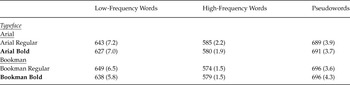
Incorrect responses (4.1% of the data) and response times (RTs) less than 250 ms or greater than 1,500 ms (less than 1% of the data) were excluded from the RT analyses. ANOVAs based on the participant (F1) and item (F2) mean correct RTs were conducted based on a 2 (Word-frequency: low, high) x 2 (Typeface: Arial, Bookman) x 2 (Emphasis: boldface, regular) x 4 (List: list 1, list 2, list 3, list 4) design. List was included as a dummy factor in the ANOVAs to remove the error variance due to the counterbalancing lists (see Pollatsek & Well, Reference Pollatsek and Well1995). The mean RTs and error percentages in each condition are displayed in Table 1.
Mean lexical decision times (in ms) and percentage of errors (in parentheses) for words and pseudowords

Word data
The ANOVA on the RT data showed that, on average, high-frequency words were responded to 60 ms more rapidly than low-frequency words, F1(1, 24) = 191.06, MSE = 10358.9, p < .001; F2(1, 232) = 153.48, MSE = 6412.1, p < .001, and that words presented in boldface were responded to 7 ms more rapidly than the words presented in regular format, F1(1, 24) = 8.38, MSE = 305.6, p = .008; F2(1, 232) = 3.05, MSE = 1840.3, p = .082. More important, the interaction between these two factors was significant, F1(1, 24) = 4.92, MSE = 471.4, p = .036; F2(1, 232) = 6.40, MSE = 1840.3, p = .012. This interaction reflected that, for low-frequency words, there was an advantage of 13.5 ms of the words presented in boldface compared with the words presented in regular format, F1(1, 24) = 11.12, MSE = 438.5, p = .003; F2(1, 232) = 9.28, MSE = 1814.4, p = .003, in contrast, there were no signs (less than 1 ms) of an effect of bold emphasis for high-frequency words, both Fs < 1.
The interaction between typeface and word-frequency was also significant, F1(1, 24) = 11.12, MSE = 438.5, p = .003; F2(1, 232) = 5.92, MSE = 2197.2, p = .015. This interaction reflected that, for low-frequency words, words presented in Arial were responded to 8 ms more rapidly than the words presented in Bookman, F1(1, 24) = 4.93, MSE = 410.0, p = .036; F2(1, 116) = 3.05, MSE = 2635.5, p = .083, whereas the reverse trend was observed for high-frequency words (6 ms faster for the words presented in Bookman), F1(1, 24) = 3.33, MSE = 296.2, p = .080; F2(1, 116) = 2.91, MSE = 1758.9, p = .091. None of the other effects/interactions was significant.
The ANOVA on the error data only revealed a significant effect of word-frequency in the analyses by subjects, F1(1, 24) = 42.90, MSE = 30.73, p < .001; F2(1, 232) = 3.01, MSE = 44.1, p = .085: participants committed more errors on low-frequency words than on high-frequency words.
Nonword data
The ANOVA on the latency/error data did not reveal any significant effects.
Discussion
Bold emphasis in the Bookman font produces a better efficiency in the recognition of isolated letters embedded in visual noise (Pelli et al., Reference Pelli, Burns, Farell and Moore-Page2006). Here we examined whether this finding can be generalized to a standard visual-word recognition task under normal viewing conditions. Results revealed that low-frequency words presented in boldface were responded to more rapidly (around 13.5 ms) than the words with no emphasis, whereas there were no signs of a parallel effect for high-frequency words. Furthermore, this advantage occurred to a similar degree in Bookman and Arial typefaces (i.e., it was not restricted to a specific typeface).
Therefore, the present experiment has revealed that the effect of bold emphasis reported by Pelli et al. (Reference Pelli, Burns, Farell and Moore-Page2006) is not an experimental curiosity that merely benefits letter recognition under visual noise conditions. Bold emphasis influences the speed of lexical access in normal viewing conditions (i.e., in absence of visual noise). Importantly, the interaction between word-frequency and bold emphasis reflects that even though the effect of bold emphasis may initially occur at an early letter encoding stage, its impact carries over further down the word processing stream: it affects to a larger degree low-frequency than high-frequency words (e.g., see Perea & Rosa, Reference Perea and Rosa2002; Perea et al., Reference Perea, Comesaña and Soares2012, for a similar pattern with other perceptual factors). It is important to note here that the effect of bold emphasis did not affect the response times for the pseudowords. This may seem at odds with the assumption that the effect of bold emphasis originates in the letter level. However, we must bear in mind that responses to pseudowords may be made via different response criteria (e.g., a flexible deadline for “no” responses, active evidence for “no” responses, among others; see Perea, Rosa, & Gómez, Reference Perea, Rosa and Gómez2005). For instance, using a flexible deadline for “no” responses on the basis of lexical activity may lead to a null effect of bold emphasis.
What are the implications of these findings for models of visual-word recognition? At present, the most influential computational models of visual-word recognition employ the simplified uppercase font designed by Rumelhart and Siple (Reference Rumelhart and Siple1974). This font is insensitive to the effects of bold emphasis so that the present data cannot be successfully simulated in these models. The present data strongly suggests that the weight of component segments for each letter (as in the case of words presented in boldface) influences the easy of lexical access –in particular for infrequent words (i.e., this reflects an interaction between letter and lexical representations). Clearly, the new generation of implemented models of visual-word recognition should pay greater attention to the perceptive and typographical features in their coding schemes at their feature/letter level, going beyond the typography created by Rumelhart and Siple (Reference Rumelhart and Siple1974) to more realistic ones (see Hannagan, Ktori, Chanceaux, & Grainger, Reference Hannagan, Ktori, Chanceaux and Grainger2012, for similar evidence using degraded words).
Although the present findings are relevant from a theoretical perspective, their practical implications are also worth noticing. One may take for granted the “regular” format of the fonts as the optimal settings in print, in the same way as assuming that the standard inter-letter spacing is optimal (but see Perea & Gomez, 2012). However, the present experiment suggests that some extra bold weighting in a word’s component letters may favor the process of lexical access even under standard viewing conditions; note that bold emphasis may play an even larger role in scenarios in which there is suboptimal viewing conditions (e.g., while reading traffic signs at a distance; see Pelli et al., Reference Pelli, Burns, Farell and Moore-Page2006). In the past, design guidelines and publication standards have been under the control of publishing companies rather than based on empirical data. We believe that well-controlled empirical research is necessary to determine the optimal parameters and conditions for the presentation of written information in computer technology, tablets, TV screens, etc. –i.e., there is a growing need to create the most appropriate and optimal reading environment that optimizes and reduces reading speed. The present experiment represents a small step in this direction.
In sum, the present experiment has demonstrated that a typographical element such as bold emphasis facilitates the process of visual-word recognition with adult skilled readers under normal viewing conditions –at least for infrequent words. Further research is necessary to examine whether the effect of bold emphasis on lexical access is magnified in other populations (e.g., individuals with dyslexia, low-vision readers, older adults) and whether this effect also influences sentence reading (see Rayner, Reference Rayner2009, for a review of the literature of eye movements in reading).