Apprenticeship was one of the most important means by which occupational training was supplied in premodern Europe. In England, nonagricultural apprentices made up between 7.5 and 10 percent of the labor force, even in the eighteenth century.Footnote 1 Elsewhere in Europe, apprenticeship had a comparable level of importance as the main route into skilled manufacturing, service, and mercantile occupations. However, there is little consensus among historians about the structure and effects of premodern apprenticeship. Recently, S. R. Epstein suggested that what he saw as the success of apprenticeship in supplying technical training across Europe depended on craft guilds' ability to enforce the contracts between masters and their apprentices.Footnote 2 Jane Humphries has a similarly positive understanding of apprenticeship, suggesting that it “contributed to the premature exodus of labor out of agriculture that is the hallmark of English exceptionalism.” She emphasizes the effectiveness of several self-enforcing aspects of the apprenticeship contract (including, but not limited to the activities of guilds in policing them) in buttressing this process at least into the eighteenth century.Footnote 3 By contrast, Sheilagh Ogilvie argues that apprenticeship was mainly a device to exclude competition. Guilds, she suggests, were “neither necessary nor sufficient for ensuring craft skills.” Her position extends a critique of both apprenticeship and guilds that goes back to Adam Smith and beyond.Footnote 4
In this article, I reexamine the economics of premodern apprenticeship, focusing on England between the sixteenth and mid-eighteenth centuries.Footnote 5 The standard account of apprenticeship describes apprentices spending the early part of their time in service receiving training before repaying their masters' investment by working at below-market (or no) wages for the remainder of their contractual terms. While this two-stage model is a useful simplification for some purposes, and may even come close to the reality of training in the late nineteenth and twentieth centuries, it is seriously flawed as an account of premodern apprenticeship. The problems with the standard account are both conceptual and empirical. The account bears little resemblance to our understanding of how occupational skills are acquired in practice, and it is inherently unsustainable if apprentices fail to serve their full terms. Mortality and morbidity rates among apprentices present a significant challenge to this system on their own. Even more significant, given the emphasis on contract enforcement in the literature, is the evidence I present here that apprentices in premodern England quit in large numbers, as I show for London in the 1690s in the first part of the article.
I therefore suggest an alternative model of apprenticeship that could be sustainable in these circumstances. I argue that training was less intensive and more fragmented than in the standard account. Instead of preceding useful work, apprentices' training occurred in parallel with their engagement in profitable labor for their masters. This made for a closer matching between the timing of the master's expenditure on training and the apprentice's repayment of these costs. Both parties were thus less vulnerable to loss in cases of default. In this form, apprenticeship can survive in an environment in which quits are commonplace. Lastly, I briefly sketch the consequences this has for our understanding of the effects guilds had on apprenticeship.
One finding that should be emphasized is the significant divergence that apparently existed between premodern and modern apprenticeship structures. The standard account of the economics of apprenticeship does seem to fit the evidence we have about nineteenth- and twentieth-century training patterns. Perhaps shifts in employment structures (possibly the growth of large firms with its attendant shift in expectations among skilled workers about their likely contract duration) allowed employers to move to a more efficient training schedule after 1800.
APPRENTICESHIP AND ITS DIFFICULTIES
Early modern apprenticeship was a system of training in which young men, and much less often young women, entered contracts to work for established craftsmen and merchants for a lengthy period, generally of some years, in exchange for instruction in a craft or trade. Beyond this common core, the terms of service and the manner of its arrangement differed across Europe, governed by a mix of law, custom, and individual inclination. The key piece of legislation in early modern England was the Statute of Artificers (1562).Footnote 6 This set out basic national rules for apprenticeship, which were largely based around London's existing practices—all householders over 24 years of age could take apprentices, the term of service should be at least seven years, apprentices should be 24 years old or older when they finished, and so on. The Statute also limited the practice of most nonagricultural occupations to those who had served an apprenticeship within that trade.
Although the arrangement of an apprenticeship contract was a matter of private negotiation, the incorporated towns and cities in England, and the guilds within them, generally established further requirements that helped them to record and govern apprenticeship. These practices were often direct imitations of London's well-known customs. Masters in such towns were thus normally required to register (“enroll”) apprenticeship contracts with their guild and the urban authorities. This record would then provide the basis for an apprentice to become a freeman or citizen of the town after completing his term—apprenticeship being the most common means by which citizenship was obtained in this period.Footnote 7 Other criteria about the health, literacy, or social origins of apprentices, and their expected level of skill at the end of their terms were sometimes added by guilds. Outside the corporate towns, where the issue of citizenship did not apply, no system for registering apprentices' indentures existed, despite occasional proposals to establish one. This was a serious obstacle to the enforcement of laws limiting crafts and trades to those who had served apprenticeships within them, even though, during the seventeenth century at least, all of the major English urban centers were still incorporated boroughs. Indeed, the constellation of rules around English apprenticeship never stopped a number of artisans from ignoring them in practice, although the frequency with which regulations were breached is impossible to assess.Footnote 8 Elsewhere in Europe, the regulation of apprenticeship varied. In some areas, particularly many German regions, it was more tightly controlled by guilds; in others, such as parts of France and Spain, it largely remained a private contract between apprentice and master.Footnote 9
By the seventeenth century in England, apprentices' families often paid a fee or “premium” to the master at the time of binding and gave bonds for their behavior and honesty; apprentices' clothing and sometimes even their board might also be subsidized by their parents.Footnote 10 Most apprentices, however, still lived as part of their masters' households and were given their board and lodging. They were rarely paid wages, although some did get gifts on completing their terms, and they might receive tips or pocket money during their service.Footnote 11 Wages were even illegal in some cities; in 1527 London's Common Council banned the city's freemen from paying apprentices wages, a policy restated as late as 1744.Footnote 12 The length of apprenticeships also varied. In England, seven years was set as the legal minimum in 1563; shorter terms of three to five years seem to have been more common elsewhere in Europe.Footnote 13 When the terms of indentures were broken, guild, civic, and other legal bodies could intervene to resolve disputes, punish offenders, and discharge apprentices, if necessary. Some impression of the significance of apprenticeship can be gained from the numbers involved. Steve Rappaport has estimated that roughly 10 percent of London's population in 1550 was apprentices, and two-thirds of all adult male Londoners at that time had served apprenticeships; by 1700, despite the city's rapid growth and the expansion of its more weakly regulated suburbs, apprentices still made up around 10 percent of the population.Footnote 14
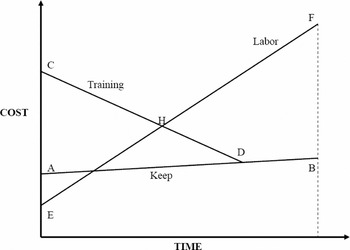
Compared to the debate over the economic consequences and institutions of apprenticeship, the internal economics of the system have been surprisingly uncontroversial. All modern commentators who explicitly consider the question of how apprenticeship training was paid for have subscribed to the same account.Footnote 15 In this formulation, apprenticeship is an example of workers willingly funding their acquisition of general skills, as standard human capital theory would predict. Rather than taking payment upfront, the length of the contract allows masters to recoup the costs of the training they supply retrospectively, by having the skilled apprentice work at below-market wages for a sufficient period to equal the expense of their training—these are the opportunity costs of time spent on instruction rather than work, the costs of materials and space used, and the apprentices' board and keep. An early version of this analysis was given basic graphical form in the 1930s (Figure 1).Footnote 16 By the early twentieth century, apprenticeship did seem to take this form.Footnote 17 As the figure shows, in the early years of the contract the master's investment in the apprentice is greater than the value of labor they receive. The value of the apprentice increases with training until, at point H, he becomes an asset. As R. B. McKerrow, the author of the diagram noted, his “initial value is the area FHDB minus the area CHE. (This ignores risk of death, & c).”
THE STANDARD ACCOUNT OF APPRENTICESHIP

The sequential distribution of training costs and repayment envisaged in this account of apprenticeship presents obvious risks for both masters and apprentices. Early on, apprentices were vulnerable to exploitation by masters who could fail to provide sufficient or appropriate training. Conversely, once trained, apprentices who quit could capture the returns on their skill themselves, rather than repaying their masters' investment. This balance of tensions explains why recent studies of apprenticeship focus on how apprenticeship contracts could be written and enforced in such a way that the system would not collapse under the weight of opportunistic behavior. Epstein has suggested that guilds acted to prevent opportunism, while Humphries has identified various bulwarks for indentures, particularly the reputational and institutional enforcement mechanisms of family, guild, and law, and the potential advantages of completion in future earnings and settlement rights.Footnote 18 As she comments, “perhaps most important of all the completion of an apprenticeship marked a man out as trustworthy and dutiful.”Footnote 19 Both suggest that apprenticeship contracts worked, at least in the sense that opportunism was restrained and training was provided effectively. Yet while these analyses are plausible at first sight, there is remarkably little empirical evidence that apprenticeship contracts were, in fact, enforced.
In practice, early modern apprenticeship contracts do seem frequently to have ended early. One reason for this is the “death & c,” which McKerrow glossed over, for premodern apprenticeship inevitably coexisted with a significant risk of death and disability. Modern estimates suggest around 10 percent of apprentices died.Footnote 20 Even more must have experienced serious sickness or disability.
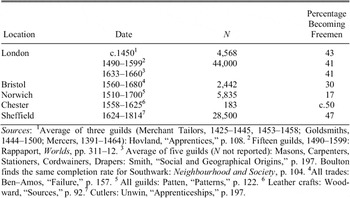
More surprising are the high levels of early departure by apprentices. The first evidence that many apprentices did not complete their terms of service comes from the large numbers who failed to become freemen or citizens in the town or city where they had trained (Table 1). Apprenticeship was the main mechanism through which the freedom of towns was obtained, and becoming a freeman brought significant benefits—settlement and its associated right to poor relief, and the right to work at a trade in the town or city.Footnote 21 Yet studies of a wide variety of guilds and towns across England have repeatedly found that fewer than half of apprentices became freemen. The contrast with completion rates of over 90 percent in England in the 1920s is dramatic.Footnote 22
PERCENTAGE OF APPRENTICES WHO BECAME FREEMEN IN ENGLAND

Sources:
1 Average of three guilds (Merchant Tailors, 1425–1445, 1453–1458; Goldsmiths, 1444–1500; Mercers, 1391–1464): Hovland, “Apprentices,” p. 108.
2 Fifteen guilds, 1490–1599: Rappaport, Worlds, pp. 311–12.
3 Average of five guilds (N not reported): Masons, Carpenters, Stationers, Cordwainers, Drapers: Smith, “Social and Geographical Origins,” p. 197. Boulton finds the same completion rate for Southwark: Neighbourhood and Society, p. 104.
4 All trades: Ben—Amos, “Failure,” p. 157.
5 All guilds: Patten, “Patterns,” p. 122.
6 Leather crafts: Woodward, “Sources,” p. 92.
7 Cutlers: Unwin, “Apprenticeships,” p. 197.
These data are very far from perfect. They only capture apprentices who entered the freedom of their guild or town, rather than directly measuring completion rates. The process of becoming a freeman involved various costs—fees, gifts, or other payments to guilds and urban authorities. While not always large, these served as a disincentive. The benefits it brought were most important to independent artisans and traders; even if they completed their apprenticeships, many aspirant freemen would then have to struggle to gather the resources to establish their own business. Obtaining the freedom normally occurred several years after the end of apprenticeship. Most former apprentices presumably filled the gap by working legally as a journeyman while they saved, and many may never have worked in a more independent position that would have made the freedom worthwhile. Hence, freedom rates do not distinguish between apprentices who quit, those who completed apprenticeships but remained journeymen, and those who completed and then migrated. Nonetheless, these low rates do at least raise the question of whether a significant proportion of apprentices might have left before the end of their term.Footnote 23
We have limited amounts of more precise information about how many apprentices left their masters early and when they did so. The only published work on the timing of departure explores early-seventeenth-century Bristol, where Ilana Ben-Amos found that most of the apprentices for whom a time of departure was recorded left in the first two years of their term (59 of 99). Unfortunately, the sample is small and possibly unrepresentative; departure dates were recorded for only 5 percent of Bristol apprentices, whereas roughly 60 percent of them failed to become freemen.Footnote 24 For London carpenters' apprentices between 1540 and 1590, the guild recorded their fate, but not the point at which it occurred; only 39.7 percent were freed. Of the rest, 14.6 percent died and 1.1 percent wed, thus voiding their indenture. The remaining 44.6 percent were simply described as “gone,” leaving the timing and manner of their departure unknown.Footnote 25
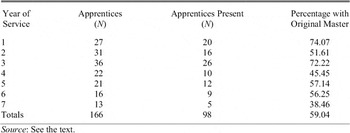
For London apprentices in the 1690s, it is possible to get a better sense of when apprentices left. By linking tax and guild records, I identified a sample of freemen whose households were recorded in detail in a 1695 tax assessment.Footnote 26 The apprentices these freemen had taken in the years before 1695 were obtained from guild records.Footnote 27 I then examined the listings in the assessment to identify which of those apprentices, whose contracted terms of service overlapped with the 1695 tax date, were actually in residence with their masters at that time. This produced a sample of 166 apprentices bound to 97 masters in a range of London guilds.
Table 2 shows the percentage of apprentices still resident in their original master's household, broken down by the time elapsed since their apprenticeship began. Overall, only 59 percent of apprentices were resident with their masters at the time of the tax. The decline over time in the percentage of apprentices who were still in service with their original master is clear and significant at the 10 percent level.Footnote 28 It is also noticeable that even in the first year of their service, a quarter of apprentices were missing. By the seventh year of their term, only 38 percent of apprentices were resident. The scale and timing of their departure suggests that apprentices quit throughout their term. It is not the case that apprentices were simply not taking the freedom. Nor is there an obvious cusp, which we might expect if they were leaving after a definable early training period had passed. Freedom records confirm the significance of the pattern of absences in the assessment listings, 40 percent of apprentices in the sample were later freed; this rises to 51 percent among apprentices who were resident. Only 25 percent of the missing apprentices later became freemen.Footnote 29
PERCENTAGE OF APPRENTICES WITH ORIGINAL MASTER BY YEAR

Source:
See the text.
These data present a fundamental problem for the standard account of apprenticeship. They suggest that indentures did not stop many apprentices from leaving before the end of their terms, despite the available informal or formal enforcement mechanisms (given that indentures continued to be used, they did presumably serve some useful functions, plausibly in legitimating and defining the conditions of service).Footnote 30 Similarly, other elements of apprenticeship contracts that have sometimes been interpreted as incentives for completion—payoffs at the end of terms, for example—were not enough to keep apprentices at work.Footnote 31 These are, perhaps inevitably, data for a later period than one might hope for, particularly given the long-running debate over when the guilds lost their authority in England. Nonetheless, it seems that by most indications, the 1690s safely pre-dates the period when the guild system in London weakened seriously.Footnote 32
The levels of absence in Table 2 are, it should be emphasized, an upper bound estimate. As we have seen, some of those who were absent did later become freemen. Some of these apprentices may have been away temporarily when the tax assessment was taken, or deliberately concealed to reduce the tax payable; some may simply have been missed by the assessors. Others would have been working on their masters' behalf elsewhere—a normal occurrence for many merchants' apprentices who often went abroad to act as factors for their masters and common in some trades connected to shipping. A few may have lodged elsewhere, although in this period apprentices still usually lived in their masters' households, and there is no reason to suspect lodging habits varied over apprentices' terms in a way that might explain the pattern in Table 2.Footnote 33 The status and role of male servants present in the household listings is another obvious gray area. In addition, there were also a further ten people described as “apprentices” by the tax assessors who could not be identified in guild records. These may have been apprentices who were present “on liking”—the trial period of between a month and a year that was common before formally contracting an apprenticeship—or simply cases missed in the guild records. More definite evidence of this practice is apparent in the five apprentices who were present in their masters' households before they were officially bound, one nearly four years in advance of his enrollment. Indeed, they might have been illegally-kept apprentices, although if so it is somewhat surprising that they were described as apprentices to tax assessors.
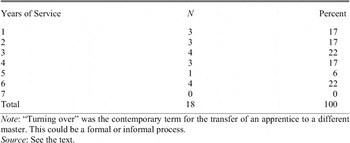
Apprentices could also be “turned over” to new masters during their term, raising the possibility that some absent apprentices had moved rather than quit. Turning over was only occasionally recorded in guild apprenticeship registers. To obtain some sense of the scale of this, all nonfamily members listed as resident in masters' households were compared with lists of apprentices. This identified 18 individuals who had been indentured to different masters, but who had since moved.Footnote 34 As Table 3 shows, these apprentices could have been turned over at any stage in their terms. This suggests that roughly 10 percent of all apprentices, or 22 percent of absent apprentices, had left by moving to another master rather than quitting, which fits with the freedom rates of missing apprentices discussed previously.Footnote 35 Unfortunately, given the limitations of the evidence, it would be no more than guesswork to estimate the actual rate of departure. Nonetheless, the data do indicate that departures were likely to be significant in number and begin early.
YEARS OF SERVICE OF TURNED-OVER APPRENTICES RESIDENT WITH NEW MASTERS

Note:
“Turning over” was the contemporary term for the transfer of an apprentice to a different master. This could be a formal or informal process.
Source:
See the text.
It is hard to establish why these apprentices departed early.Footnote 36 We know that some apprentices slipped into vagrancy or a marginal existence while others departed when their masters' businesses could no longer support them. A number left after a breakdown in relations with their masters.Footnote 37 Urban courts frequently heard cases in which apprentices and masters sought to be released from their indentures. Apprentices cited a range of failings among masters, including excessive correction, abuse, lack of training, and failing to supply food or clothing. Conversely, masters complained about apprentices running away and refusing to return to their service, being drunkards, attacking them or their family, or embezzling money from the shop.Footnote 38 Some masters pursued runaway apprentices and succeeded in forcing them to return or else had them punished.Footnote 39 Such formal, and relatively costly, interventions are rare and even then many ended with an attempt at reconciliation. Unsurprisingly, a number of them clearly relate to attempts to recover a portion of the premium paid on binding. These cases, while striking, are likely to have been a small proportion of the total of departures. Court cases only occurred when apprentice or master resisted the ending of the contract. No trace would be left when master and apprentice jointly agreed to end their contract, which was probably the most common way terms ended early. In such situations, legal intervention was unnecessary; “the agreement of the master and apprentice” recorded under his master's hand was enough, as guides for Justices of the Peace made clear.Footnote 40 For many masters and apprentices, it must have made sense to end contracts consensually rather than struggle to enforce the original terms.
Leaving a master could be a positive decision for apprentices. The chance to learn a more suitable or advantageous trade, opportunities elsewhere, inheritances, marriage; all could draw an apprentice onto a different path. In larger cities, in particular, it seems likely that many apprentices always intended to curtail their term after acquiring skills. A few descriptions of their decisions survive. As Ben-Amos describes, one London shoemaker's apprentice, Benjamin Bangs, quit after three years because he “understood [his] business pretty well”; similarly a Bristol weaver's apprentice, John Mayes, left after three years to work in the countryside.Footnote 41 As centers of skilled production, training in a large city offered a good basis on which to establish a business elsewhere. The apprentice could then move to another location where he might have useful connections, or perhaps simply face less competition.Footnote 42 When the places where a craft could be practiced were legally constrained, as was the case for printing in England, which was restricted to London, and Oxford and Cambridge Universities, apprentices were significantly more likely to become freemen. Among stationers' apprentices, 60 percent took the freedom, compared to an average of 45 percent for London apprentices at that time.Footnote 43 Laws in England to prevent people practicing most other trades without serving an apprenticeship were enforced patchily, particularly outside corporate towns with strong guilds, and might be circumvented through inherited rights or purchase, or by working as a journeyman.Footnote 44
High levels of mortality, morbidity, and departure had obvious implications for the standard account of costs and repayment across apprenticeship terms. If apprentices did not finish their terms, then they did not pay off the costs of their training; there was no transfer mechanism so that the loss suffered by one master might be offset from the benefits provided by those apprentices who did finish their terms, nor did most masters take enough apprentices over their careers that they could offset the losses from one against gains from another. In short, if apprenticeship worked as the standard account suggests, premodern master artisans were making a loss on many apprentices. The outcome surely should have been a breakdown in the system of training. Yet apprenticeship persisted.
Reinterpreting Apprenticeship
How did apprenticeship survive in the face of death and opportunistic departure? To construct an alternative analysis of apprenticeship that can fit these facts we need to consider both the nature of occupational skills and the organization of premodern employment and production. In the standard model, it was assumed that training was general, and that it was therefore paid for by apprentices because they would capture the returns through their later earnings, as suggested by standard human capital theory. This is plausible.Footnote 45 Production in most crafts was highly fragmented, giving a wide range of possible employers, and many apprentices would later establish independent businesses. There was little likelihood that apprentices would remain in long-term employment with their master after completion, except in a handful of larger enterprises. Artisans were generally training future rivals, not employees—and at the same time were revealing their client, credit, and supplier networks to them. In these circumstances, few of the advantages identified to explain modern firms' investments in apprenticeship apply.Footnote 46
As this might suggest, a significant proportion of master craftsmen in some crafts and trades did not take apprentices. Many more took only one or two over their careers. Apprentices could have their uses, but they were not essential to many businesses, even as a source of cheap labor. Small workshops had limited resources for training at the best of times—and apprentices added a further risk in bad times, for masters remained responsible for apprentices' upkeep even during business slumps or sickness. Clearly, apprentices had good reason to invest in their training; masters much less so. To be fair, apprentices could offer some long-run advantages to their masters. As natural additions to their social, economic, and political networks, they might become creditors, collaborators, successors, and supporters.Footnote 47 However, the luster of these possibilities was dimmed by the limited proportion of apprentices who remained in the location where they were trained. This balance of costs and benefits helps explain the size and variation of premiums paid by apprentices, the price of access to the best masters implies that masters demanded significant inducements before agreeing to take apprentices on.Footnote 48
As the indirect and direct benefits from the training received during apprenticeship largely accrued to apprentices, not masters, how did masters recover the costs of the instruction they supplied when they could not be sure of doing so retrospectively? To answer this, we must reconsider three of the key assumptions about the timing and allocation of costs and benefits in the standard model. These are that, firstly, apprentices need training before their labor is valuable; secondly, training is concentrated at the start of an apprenticeship; and, thirdly, training costs are high relative to the value of a new apprentice's labor, and that they must therefore be born, at least initially, by masters. Each of these assumptions is suspect.
First, it is clear that regarding apprentices as callow youths, of little worth to a business until instructed, is misguided for most of our period.Footnote 49 In early modern England, apprentices were generally bound in their mid-to-late teens.Footnote 50 From the outset, they could be set to a variety of unskilled yet necessary tasks, such as cleaning, carrying, deliveries, shop watching, and simple preparatory or processing jobs. They might also have some useful skills. Most would have been engaged in productive work in the household or their parents' workshop, farm, or shop for years prior to entering service, giving them the chance to acquire skills that would later be useful to their new master.Footnote 51 The most extreme example of this was youths from families involved in the same trade who might well have already obtained craft-specific skills before entering service. Contemporaries' recognition of the value of new apprentices' labor is apparent in official wage assessments from the sixteenth and seventeenth centuries, which often included wages for apprentices in the building trades. Although paid to their masters, they underline the point that apprentices' work was worthwhile throughout their term. For example, London tilers' apprentices earned 11 pence a day without food in 1589, well above the 2.56 pence necessary to provide a basic diet at that time.Footnote 52 Apprentices' status should not be confused with their ability.Footnote 53
The second and third assumptions of the standard account, about the early concentration of training and its high costs, are best addressed together. Underlying discussions of apprenticeship are differing views of the expense and difficulty of training in preindustrial crafts and trades. Epstein, for example, maintains that craft skills were complex and hard to learn. By contrast, many others have shared Adam Smith's position that training was quick and simple.Footnote 54 Given what we know of the theory of skill acquisition, it is likely that both views are partially correct, training could be quick and easy for masters, but learning might be hard and long for apprentices. Practicing early modern crafts and trades required a blend of tacit and propositional knowledge. Tacit knowledge is acquired through modeling, imitation, observation, and experience. Didactic instruction is insufficient and sometimes ineffective in situations where skilled practitioners find it difficult to articulate how they perform some complex operations; instead, immersion in practice is crucial.Footnote 55 Instructing apprentices might thus demand very little time-consuming direct instruction from masters. Instead, the burden of acquiring a craft was put on the apprentice's diligence in observing and particularly practicing skills. Of course, this process varied between crafts and individuals, but the speed of learning should not be exaggerated, and it should not be forgotten that apprentices needed to learn commercial as well as craft skills. Some element of instruction was, it seems, expected by apprentices who did complain about masters who failed to provide training. But it seems unlikely they envisaged intensive guidance that would substantially distract the master from more immediately productive work. This account of how skills are acquired has a further obvious implication, the distinction between periods of learning and periods of production largely dissolves. There are few points at which apprentices were not learning, even if they were not conscious of it themselves.Footnote 56 Lest this seem too optimistic, it should be remembered that given the lengthy fixed minimum term of seven years for an apprenticeship in England, the period of contracted service—if completed—might long outrun the period of training within which this balance of training and labor was necessary. In such cases, the profit from the apprentices' remaining time was simply a benefit to the master.
Evidence on modes of training in the past is unfortunately so limited that it is hard to establish firm conclusions in this area. Few accounts of apprenticeship survive, transmitting tacit knowledge is, almost by definition, a nonverbal process, and it was sufficiently universal as to attract little comment. However, those accounts we have—mostly from the eighteenth and nineteenth centuries—suggest that apprentices gradually acquired skills in their trade over a period of several years, often beginning with a period of relatively unskilled labor. Using diaries, court records, and other sources, Peter Earle and Joan Lane have each revealed apprentices spending years opening shops, making deliveries or drinks, and cleaning, followed by similarly long stretches assisting skilled workers—shoemakers' apprentices “closing” boots, for example, or ribbon weavers' apprentices helping to change patterns—before finally moving on to more skilled tasks.Footnote 57 The array of menial tasks that apprentices undertook would have extended the time it took them to learn the more skilled parts of a trade, but in the short term this must have significantly increased their immediate value to their master. Throughout their term, apprentices combined useful work with learning, and only gradually moved from unskilled to skilled work.
It is at least suggestive that this analysis has parallels with the findings of modern anthropologists studying apprentice-type learning in traditionally organized crafts today.Footnote 58 They have generally found that apprentices are heavily engaged in productive work from the beginning, with little time dedicated specifically to training. Knowledge gained by apprentices might even be seen as “stolen.” When learning pottery in Japan in the 1980s, one apprentice found herself spending hours cleaning the workshop and preparing clay, literally “earning the right to observe and learn by doing the menial scutwork of the master and the workplace”; direct tuition was almost nonexistent, instead she was allowed to observe, practice on a very small scale, and only attempt more complex techniques after a long time in the workshop.Footnote 59 This reliance on a “benign community of neglect” to supply instruction is a common experience.Footnote 60 Among apprentice minaret builders in Yemen, for example, “much of learning process involves little or no verbal communication, the apprentice must rely on his or her eyes, ears, and sense of touch to incorporate their Master's skill into the reproduction of bodily representations of knowledge.”Footnote 61 Instruction is implicit and fragmented. Questions are rarely posed, and reprimands, rather than correction, form the majority of feedback to apprentices.
If we take the potential value of apprentices' labor and the nature of their learning together, we find a quite different structure for premodern apprenticeships—one that could thrive amidst high levels of contractual default. Apprenticeship had four characteristics not recognized in the standard account. First, apprentices provided valuable labor services throughout their term, rather than repaying their masters' investment just in the later years of service. Second, any explicit instruction was likely to be delivered in fragments over a long duration. Third, most training was through observation, imitation, and practice by apprentices that occurred while they were engaged in useful work—thus even apprentices' learning could even be productive. And fourth, the costs of supplying this training were low enough that they could be met by the value of less skilled apprentices' work (at times in combination with a premium), even after the costs of their keep. In short, an apprentice's training occurred in parallel with their engagement in work that offset the costs of their keep and instruction. Premodern apprenticeship was not a two-stage process of costly training followed by repayment, but a time when work and training were often indistinguishable.Footnote 62
With work and training intermingled, neither apprentice nor master was likely to lose out substantially when their relationship ended. Apprentices' value to their masters certainly fluctuated, depending on the level of training they received at any point and the value of their labor. They might also be able to advance the training curve through additional payments. As Daniel Defoe explained in the early eighteenth century, premiums exempted apprentices from “menial offices, which were wont to be required of younger apprentices.”Footnote 63 Nonetheless, neither master nor apprentice was ever likely to be at risk of a large loss through opportunism. Inevitably, each did still face risks. For masters, there was the chance of theft, misbehavior, or future competition inherent in any employee. For apprentices, the potential losses from mistreatment or exclusion from the workshop were higher, particularly when a substantial premium had been paid. This yields a further reason to expect that large premiums were accompanied by a quickening of the training schedule. Similar trade-offs were also implicit in agreements to repay all or part of the premium if an apprentice or master died or moved; these generally indicated that repayment was only normally expected if this occurred during the early years of the term.Footnote 64
Clearly, this slow training schedule does come at a cost to masters. By putting little effort into apprentices' training and obliging them to do useful but not instructive tasks, such as deliveries, cleaning, watching shops, and the like, the time in which apprentices were most skillful and are thus most productive is reduced. As Epstein predicted, “in the absence of credible bans against apprentice opportunism which took the shape of early departure … training would have been less then optimal and would have constrained output.”Footnote 65 This loss of productivity was the price of the systematic failure to prevent opportunistic departure (although it would be, to some extent, offset by the supply of very cheap labor for unskilled or semiskilled tasks). One consequence of this was that when masters could enforce apprenticeship contracts then they should, in theory, advance the training schedule by offering more instruction, advice, time to practice, and so on. This seems to have occurred in nineteenth-century Britain, in parallel with the growth of employment by large firms who could collectively police contracts through their hiring policies.Footnote 66
This analysis obviously deals only with the basic costs of apprenticeship. Apprenticeship served a social as well as a training function. It was a period of socialization, of transition from youth to adulthood, and often from country or small town to city. Apprenticeship regulations served to reinforce the status and authority of masters, while formal apprenticeships underlined the importance of skill as the central aspect of the artisan's identity.Footnote 67 Often, apprentice terms were in practice or theory determined by the age of majority, rather than the training needs of the individual.Footnote 68 Similarly, a concern with controlling potentially disorderly youths seems also to have encouraged state sanction for long terms. These factors will cloud any attempt to calculate training values and labor costs.
Institutions and Apprentices
I have suggested that premodern apprenticeship operated in a way that would allow it to survive despite high levels of opportunistic early departure among apprentices. What, then, explains the institutional framework, particularly the guilds, that surrounded, and in some interpretations sustained, the system? Together with the evidence of low rates of completion discussed earlier, this analysis suggests that London guilds did not monitor or enforce apprenticeship contracts with any degree of success, at least by the late seventeenth century, and that apprenticeship thrived nevertheless. It is thus hard to accept that guilds primarily existed in order to provide enforcement for apprenticeship contracts. London may perhaps have been exceptional. However, the durability of apprenticeship as a system of training irrespective of the guilds is also apparent from the many examples of apprenticeship existing where guilds did not.Footnote 69 It is hard to avoid the conclusion that guilds were not necessary for apprenticeship to work; coexistence did not imply dependence in this case. As Sylvia Thrupp noted, “medieval artisan apprenticeship was a product not of gild monopoly, but of the family workshop.”Footnote 70
Of course, guilds did attempt to enforce apprenticeship contracts and influence the terms they contained. These measures were limited, however, to the area over which a guild had authority. This raises the question of why they sought to become involved with apprenticeship when it could survive without them—and what effect they had on its operation. The answer, as Smith and others have recognized, is that guilds' collective concerns with apprentices largely centered on restricting the numbers of people being trained in order to limit the workforce available to each master and control present and future competition.Footnote 71 It was this anxiety about competition which meant apprenticeship was a concern of all masters, and by extension the guild. Apprentice taking was not ubiquitous or smoothly distributed in guilds, but all masters were affected by decisions about labor concentrations in a craft. One other consequence of guilds' efforts to limit numbers was the incentive it gave masters to default and take additional apprentices in secret.Footnote 72
Guilds' impact on apprenticeship did go beyond policing numbers. They generally reserved the right to arbitrate disputes between masters and apprentices, which probably produced a persistent structural inequality in guild arbitration in favor of masters.Footnote 73 They attempted to limit departed apprentices' opportunity for alternative employment, through rules against poaching. Perhaps most importantly, they also imposed arbitrary minimum terms on apprentices. Despite the varying needs of different crafts or different apprentices, even outside England terms seldom varied substantially between crafts with similar political clout in a region; variation across regions was, by contrast, more pronounced and underlines the rent-seeking aspect of guilds' involvement.Footnote 74
Locked into terms set without regard for ability or achievement, at least some of those apprentices who did serve out their contracts must have spent their later years working without compensatory training. Without these regulations, it seems likely that negotiation of terms to match the age and prior skills of apprentices would have produced a more equitable system. In early-nineteenth-century Paris, for example, Michael Sonenscher found that “the length of an apprenticeship could vary from six months to six years in exactly the same trade.”Footnote 75 Similarly, as guilds weakened in England in the later eighteenth century, terms declined from an average of six or seven years to four years across a large range of trades.Footnote 76
The attractions of these guild regulations to masters are obvious, and apprentices had little ability to resist such rules. As guilds existed in most major towns, there were few alternative centers of production where high quality skills could be learned. One implication of the findings here is that the full burden of the arbitrary term of service was only born by a limited number of apprentices, although this included all those who hoped to later work legitimately in the area controlled by the guild; others could and did avoid these costs by departing early. The nature of these concerns also imply that guilds' involvement in apprenticeship might diminish or change in nature in several situations, where their ability to impose limits on apprentice numbers broke down; if the scale of trade was no longer seen as fundamentally constrained; or if the occupational range of members of a guild became so diverse that members worried more about external than internal competitors. These may suggest further reasons for the relationship between the decline of guilds and apprenticeship in England.Footnote 77
CONCLUSION
This essay has sought to further the discussion Epstein opened by pointing out that “the economics of preindustrial apprenticeship has been virtually ignored” since Adam Smith. Having shown that levels of early departure among apprentices were almost as high as freedom statistics suggest, I have suggested a revised account of apprenticeship in which the delivery of training is kept in balance with payments in the form of labor or money from apprentices. Both were distributed across apprentices' terms so that high rates of early departure did not impose heavy penalties on masters. The effect of guilds on this was to extend the terms of service of those who did complete and restrict the numbers becoming apprentices in the first place. Guilds in England did not succeed in enforcing what were, in practice, unenforceable contracts. Like many other areas of premodern regulation, the tidy hierarchy of the seven-year apprenticeship leading to mastery was more ideal than reality.
This analysis suggests the need to modify the terms of the recent debate over guilds and apprenticeship. It is hard to reconcile very low completion rates and extensive use of apprenticeship outside guilds with Epstein's view that guilds were necessary to prevent opportunistic behavior from destroying the apprenticeship system.Footnote 78 As Ogilvie has suggested for different reasons, the enforcement of apprenticeship is not a reason to rehabilitate the guilds.Footnote 79 However, the high rates of noncompletion suggest that apprenticeship was undertaken as a more flexible period than the formalities of contracts and the simplifications of the traditional two-stage model of training would suggest. Guilds might seek to use apprenticeship as a “means for excluding outsiders.”Footnote 80 But for many apprentices, and their parents and friends, guilds' opportunistic rent-seeking did not outweigh the advantages of using this institution as a means of obtaining training and experience, even if the formal contract was never completed.Footnote 81
Seemingly, apprenticeship thrived despite, not because of, the guilds, and we should therefore be more aware of the distinction between the two institutions. In this regard, apprenticeship, even when not completed, could have still provided a key mechanism for the skill transfer and labor mobility that Epstein and Humphries have highlighted—at least so long as masters were still willing to provide training. Indeed, their interpretations of the economic effects of apprenticeship in Europe may actually be bolstered to the extent that noncompletion was the result of apprentices actively seeking skills and engaging in ongoing migration in search of opportunities, as in part seems likely.
I have focused here on premodern England. However, much of the argument about the economics of apprenticeship is likely to be generally applicable across Europe, even though the particular forms of apprenticeship and its relationship to family, trade, corporate law and custom, and guild varied. Apprenticeship persisted in continental towns and regions with weak or no guild infrastructure to sustain indentures; continental masters faced the same general issues of how to instruct apprentices that English masters did; and mortality and morbidity rates alone meant that heavy early investment in training carried significant risks wherever one was based. Unfortunately, quit rates and evidence about the training and working patterns of apprentices are, it seems, as elusive for continental apprentices as they are for their peers in England.Footnote 82
Preindustrial apprenticeship of the kind analyzed here did not seem to survive the economic transitions of the eighteenth and nineteenth centuries. One factor in this in England was the extension of systems of parish apprenticeship, which placed pauper apprentices in a far more dependent and, obviously, exploited position. But informally structured apprenticeship, without employers concerning themselves greatly in training, will also tend to fail in larger organizations, where the scale of operation is greater, specialization is more extensive, and the distance between master and apprentice extends. This is apparent in some of the ways apprenticeship developed in the later part of the nineteenth century.Footnote 83 Apprenticeships in large firms took on quite different characteristics.Footnote 84 These later changes in the context, form, and structure of apprenticeship are perhaps also the explanation of why preindustrial apprenticeship has—with the exception of a few contrary voices—received such bad press.