With a prevalence of almost 1%, CHD is the most frequent congenital disease in humans.Reference Schumacher, Hess and Bühlmeyer 1 Approximately 6000 children are born with CHD each year in Germany.Reference Bauer and Lange 2 , Reference Schwedler, Lindinger and Lange 3
In the past few decades, methods of corrective surgery have been developed for almost all kinds of CHD. Thanks to this continuous advancement, over 90% of all CHD patients nowadays reach adulthood.Reference Diller, Breithardt and Baumgartner 4 , Reference Moons, Bovijin and Budts 5 The increasing number of adolescent and adult patients with CHD can be attributed mainly to this constant improvement in diagnostic and treatment methods.Reference Marelli, Mackie and Ionescu-Ittu 6 – Reference Sable, Foster and Uzark 8
Although medical care for adult patients with CHD in Germany has been established and refined, knowledge concerning their life situation and state of treatment as assessed by these patients themselves is scarce.Reference Hess, Bauer and de Haan 9 , Reference Kaemmerer, Bauer and de Haan 10 The term “life situation” should be understood as a collective term for the individual private and environment circumstances of the individual CHD patients – for example, employment status, state of health, and disease-specific knowledge.
In the current era with increasing focus on patient-centred care and the need to avoid lapses and discontinuation – that is, loss to follow-up – in medical care, understanding patients’ specific life situation and individual circumstances is gaining importance. In this context, the treatment plan for chronically ill patients must ensure patient involvement and take into account both their life situation and their quality of life.Reference Hager and Hess 11 – Reference Vigl, Niggemeyer and Hager 13 Beyond informing patients about medical conditions/risks and the probable further course of their disease, context-specific counselling on the impact of CHD on other aspects of life, including closing relevant health-related knowledge gaps, is essential.Reference Lesch, Specht and Lux 14 This process requires understanding of the typical general life situation of adults with CHD, especially of life factors of particular subjective importance to patients.
The present study was performed to gain insights into the life situation and state of medical care of adults with CHD in Germany. To this end, an online survey was performed in close collaboration with patient organisations, physicians, and scientists investigating potential relationships between patient response behaviour and their occupational situation.
Materials and methods
Individuals aged 18 years or older at the time of the survey were informed about the survey and invited to take part via e-mail, websites, and social media. For identifying potential participants, the database of the National Register for Congenital Heart Defects was systematically scanned for suitable patients with an available active e-mail address. At the same time, the patient organisations “Bundesverband Herzkranke Kinder e. V.” and “Bundesvereinigung Jugendliche und Erwachsene mit angeborenem Herzfehler e. V.” both invited their full age members to participate. Details on the National Register and its representativeness have been reported previously.Reference Helm, Koerten and Abdul-Khaliq 15 The survey was open for 31 days (1–31 March 2015). In total, 1828 individuals (777 males, 1051 females) took part.
Participants were asked to answer the following questions, among others, by means of a six-tier scale (1=lowest/worst specification in each case):
-
∙ Do you understand the explanations given by your physician concerning your heart defect?
-
∙ Do you feel well informed about your heart defect by your treating physician?
-
∙ How well would you rate your knowledge regarding your heart defect?
-
∙ How much do you trust your treating physician?
-
∙ How would you rate your current state of health?
-
∙ How much do you feel limited by your heart defect in everyday life?
The participants’ response behaviour was analysed against the background of their respective occupational details. The different fields of activity were merged, resulting in the following groups of occupation:
-
Group A: In training – school, job training, or studies
-
Group B: Employed – part time, full time, or self-employed
-
Group C: Seeking work
-
Group D: Reduced earning capacity – pension for reduced earning capacity
For creating and conducting the online survey, the survey tool EFS-Survey was used. Data were analysed using the software SPSS, version 22. To compare mean values, the Mann–Whitney U-test was used. The results of the Mann–Whitney U-test are reported in the text as follows: U – the empirical U value – Z – U converted into the standardised Z-value – and p – the level of significance. The abbreviations M and SD represent mean value (M) and standard deviation (SD).
Results
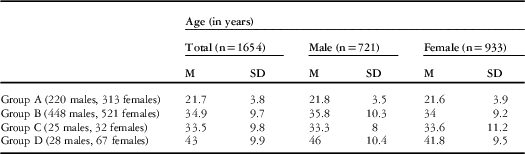
The mean age of the 1828 participants was 31.7 years (male=32.7; female=31). The age and sex distribution of the single groups of occupation can be viewed in Table 1.
Sample composition (n=1654).

Group A=in training; Group B=employed; Group C=seeking work; Group D=reduced earning capacity; N=sample size; M=mean value; SD=standard deviation
Individuals who refrained from providing information regarding their current occupation (n=143) – as well as those already receiving retirement pension (n=31) – were excluded from the subsequent analyses, leading to an accordingly reduced sample size of n=1654.
Understanding the physician’s explanations
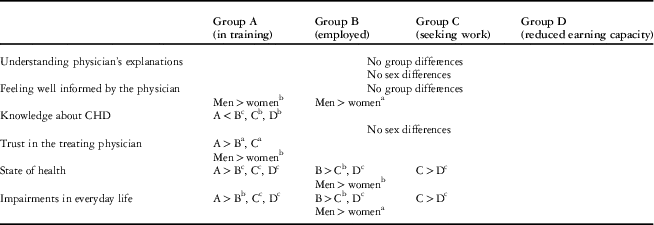
No significant differences were found between the four groups’ response behaviour regarding the question “Do you understand the explanations given by your physician concerning your heart defect?” (Tables 2 and 3). In addition, within the groups, no significant sex differences were found.
Descriptive statistics.

Group A=in training; Group B=employed; Group C=seeking work; Group D=reduced earning capacity
Overview of significant group and gender differences.

“X>Y”=Group “X” rating significantly more positively than Group “Y”; “X<Y”=Group “X” rating significantly more negatively than Group “Y”; Group A=in training; Group B=employed; Group C=seeking work; Group D=reduced earning capacity
ap<0.05; bp<0.01; cp<0.001
Being informed by the physician
Similar findings were obtained regarding the question whether participants felt to be well informed about their heart defect by their treating physician; no significant differences were found between the groups regarding response behaviour (Tables 2 and 3).
Within group A (in training), male participants’ response behaviour (n=220, M=5.3, SD=1.0) differed significantly from that of female participants (n=313, M=4.9, SD=1.2). Accordingly, male participants felt well informed about their heart defect by their treating physician to a higher degree compared with female participants (U=29,392.5, Z=−3.1, p<0.01).
In addition, within group B (employed), the response behaviour of men (n=448, M=5.2, SD=1.0) and women (n=521, M=5.0, SD=1.2) differed significantly (U=10,7279, Z=−2.3, p<0.05), with men feeling better informed by their physician compared with women.
Knowledge about the heart defect
Regarding knowledge about their heart defect, group A (“in training”: n=533, M=4.2, SD=1.3) differed significantly from the other three groups (“employed”: n=969, M=4.6, SD=1.2, “seeking work”: n=57, M=4.6, SD=1.3; and “reduced earning capacity”: n=95, M=4.7, SD=1.2). Trainees rated their knowledge about their heart defect to be significantly lower compared with participants assigned to the remaining three groups of occupation (comparison with B – “employed”: U=221,436.5, Z=−4.7, p<0.001; C – “seeking work”: U=12,639.5, Z=−2.1, p<0.05; and D – “reduced earning capacity”: U=20,174.5, Z=−3.2, p<0.01) (Tables 2 and 3).
No sex differences were found within the three groups of occupation regarding response behaviour.
Trust in the treating physician
Those who were in training at the time of the survey (school, job training, study) (n=533, M=5.3, SD=1.0) reported a significantly higher degree of trust in their treating physician (U=241,833, Z=−2.2, p<0.05) as compared with the employed participants (n=969, M=5.2, SD=1.0).
Significant differences in response behaviour (U=12,391, Z=−2.5, p<0.05) were also found when comparing those in training with group C (“seeking work”: n=57, M=4.9, SD=1.2) (Tables 2 and 3).
Within the group “in training”, male participants’ response behaviour (n=220, M=5.4, SD=0.8) differed significantly from that of female participants (n=313, M=5.1, SD=1.0). Accordingly, male participants stated that they trusted their treating physician to a higher degree compared with female participants (U=28,993, Z=−3.4, p<0.01).
State of health
In assessing their current state of health, all groups differed significantly from each other. Individuals who were in training at the time of the survey rated their state of health as the highest (Tables 2 and 3).
Within group B (employed), male participants’ response behaviour (n=448, M=4.9, SD=1.0) differed significantly from that of female participants (n=521, M=4.8, SD=1.0): Male respondents assessed their state of health more positively than did female respondents (U=106,494.5, Z=−2.5, p<0.05).
Impairments in everyday life
All groups differed significantly regarding assessment of impairments they faced in everyday life due to the heart defect. Those who were in training at the time of the survey (n=533, M=5.0, SD=1.2) rated the impairments they faced in everyday life due to their heart defect as the lowest (Tables 2 and 3).
Within group B (employed) male respondents’ response behaviour (n=448, M=5.0, SD=1.1) differed significantly from that of female respondents (n=521, M=4.8, SD=1.2). Male participants felt less limited by their heart defect in everyday life than did female participants (U=108,179.5, Z=−2.1, p<0.05).
Association with age
To assess the potential impact of age on the various aspects of life studied here, correlational analysis with age as an independent predictor was performed. This showed that employment status (r=0.58, p<0.01) was correlated with patient age. A trend was found for “Understanding the physician’s explanations” (r=0.09, p<0.01), “Knowledge about the heart defect” (r=0.2, p<0.01), “State of health” (r=−0.26, p<0.01), and “Impairments in everyday life” (r=−0.22, p<0.01). “Being informed by the physician” (r=0.13) and “Trust in the treating physician” (r=−0.04) were not significantly correlated to patient age.
Discussion
The present study highlights the importance of training for or pursuing a profession on participant ratings of the aspects of life and medical care studied here. In addition, the impact of sex in this context is illustrated by the current study. Employed patients were specifically found to report a better understanding of their heart defect, have greater trust in their treating physician, have a more positive perception of their current health state, and report less impairment in daily life compared with the remaining patients. In addition, a general trend towards a more optimistic self-assessment was found in men in the current study.
Understanding the physician’s explanations
The participants’ understanding of the explanations given by the treating physician seems to depend neither on their occupational status nor on their sex.
Being informed by the physician
Male respondents from the groups “in training” and “employed” felt to be well informed about their heart defect by their treating physician to a higher degree than did female respondents. Whether these male participants’ subjective feeling really corresponds to actual knowledge that has been imparted through the physician in an objectively better way remains unclear. In the search for possible explanations, the question arises whether the duration of consultations between physicians and patients might be sex dependent. This would result in more or less time being available to impart CHD-specific knowledge, depending on the patient’s sex. BärReference Bär 16 could show that, at least in the case of spontaneous talks between physicians and patients, there is no correlation to the patient’s sex; furthermore, the physician’s sex was also found to have no influence on the consultation’s duration. A study by Deveugele et alReference Deveugele, Derese and van den Brink-Muinen 17 yielded similar results, whereas another study by Britt et alReference Britt, Valenti and Miller 18 reports on a considerably longer duration of consultations with female physicians as compared with male physicians.
Female patients seem to be more prone to carrying a mental or physical burden. We can assume that this burden entails a lower quality of life. Just as in women after myocardial infarction,Reference Grande 19 it remains unclear whether this sex-specific phenomenon is connected to differences in emotional regulation, different strategies of self-expression, or coping. This issue should thus be primarily addressed by future research.
Another explanation for the sex differences found here could be that the response behaviour is influenced by social desirability.Reference Esser 20 Thus, it seems quite plausible that men might be less inclined to admit their inability to understand everything about their heart defect as explained by their treating physician because of internalised general role expectations – for example, traditional gender roles.
Whether female and male participants’ subjective feeling of being informed is also reflected by actual knowledge that could be verified by objective measurements remains to be investigated by future studies. Answers to this question will help ensure the best possible medical education – regardless of the patient’s and physician’s sex. This also applies to a thorough investigation of the causality regarding patients’ assessment of their being well informed and the patient’s as well as the treating physician’s sex.
Knowledge about the heart defect
The present study revealed that individuals who are still training for a job – at least according to their subjective statement – have rather less knowledge about their heart defect. As stated earlier, the question whether this subjective assessment could be verified by objective measurements cannot be answered here. A possible explanation for this rather poor rating of knowledge about their CHD could be the relatively young age of the surveyed persons in training. Viewing these participants’ stage of life in the context of transition – a phase during which many are lost to follow-up – their assessment seems to be quite realistic. It is a well-known fact that younger patients tend to see their physician rather infrequently for their CHD or, sometimes, not at all for a longer period of time.Reference Lesch, Specht and Lux 14 , Reference Mackie, Ionescu-Ittu and Therrien 21 It seems plausible that this has a negative effect on their rating of their own knowledge regarding their heart defect, or these two factors might also interact: patients knowing only little about their condition might be reluctant to schedule an appointment with their physicians because of this; however, a way should be found to provide patients with chronic illnesses with the necessary knowledge about their disease before their 18th year of life. This might be achieved by, for example, training programmes or age-specific information material taking into account the new media used by young individuals. By doing this, the rate of loss to follow-up could be reduced.Reference Moons, Hilderson and Van Deyk 22
Trust in the treating physician
Having a permanent job is associated with a greater trust in the treating physician. The lack of such regular occupation seems to negatively influence the confidence in the treating physician. Whether or to what extent being unemployed is associated with mutual trust with the treating physician cannot be concluded clearly from the performed analyses. The same applies to the question regarding whether physicians might unknowingly treat unemployed patients in a different way, for example, less empathically or taking less time for counselling. According to a meta-analysis by McKee-Ryan et al,Reference McKee-Ryan, Song and Wanberg 23 unemployed individuals’ mental and physical well-being is lower as compared with employed individuals. Against this background, the assumption that lower mental and physical well-being can also be found in unemployed CHD patients seems plausible. This might also be the reason for a lower confidence on the part of these patients.
Men who are in training for or have a job trust their treating physician to a higher degree than women of the same groups. This, too, might be attributed to socially desirable responding.Reference Esser 20 It is a well-known fact that different sexes correspond to different role models. In this sense, males are expected to be strong and knowledgeable. It thus seems to be logical and consistent with patients’ sense of self that male patients stating to feel well informed by their physician inevitably also report a high degree of trust.
State of health
The assessment of the current state of health seems to be subject to individuals being employed to a considerable degree. Unemployment seems to be associated with low rating of the current state of health, whether a causal association exists and the direction of such a possible association remains speculative. It remains to be clarified, however, to what extent other (medical) reasons influence the assessment of their own state of health by patients assigned to the group “seeking work”. Against the background of the results of the meta-analysis by McKee-Ryan et al,Reference McKee-Ryan, Song and Wanberg 23 the present results seem to be plausible.
Regarding the group of those being reduced in earning capacity, including individuals receiving pension for reduced earning capacity, respective participants’ negative rating of their own state of health seems to be quite realistic, as this is a group that is severely restricted in terms of health, receiving pension for exactly that reason. Employed men rated their current state of health better as did employed women. This might be explained by men not differentiating as much as women when assessing their state of health. The surveyed women’s rating might thus be closer to reality than that of male participants. It is also quite possible that women draw upon their social network for receiving help less adequately, as can be observed in women after myocardial infarction.Reference Grande 19 This can also be attributed to socially desirable responding.Reference Esser 20 The actual reasons for this different rating should be the focus of future studies based on the question “which tailored sex-specific measures of support can be developed and provided?”.
Impairments in everyday life
Having a job was also found to have an impact on participants’ responses to the question concerning impairments in everyday life due to the heart defect. Especially unemployment was associated with a negative assessment of this aspect. Having a permanent job might possibly have a protective influence on patients’ rating of the impairments they face in everyday life; however, it is equally possible that the causality is reverse. Accordingly, another possible explanation would be that increased (subjective) impairments in everyday life might increase the probability of being unemployed. The present study’s results are also in accordance with the results of the meta-analysis by McKee-Ryan et al.Reference McKee-Ryan, Song and Wanberg 23
Regarding the group with “reduced earning capacity”, the negative assessment can be explained, above all, by the severe health restrictions – as is the case with the assessment of the current state of health.
Similar to the assessment of the current state of health, employed men also generally rated the impairments in everyday life as lower than did employed women. Even in this case, socially desirable responding connected to a strong male role stereotypeReference Esser 20 that leaves no room for impairments in everyday life due to the CHD might be a possible explanation, as was the case with the assessment of own state of health, trust in the physician, and level of information. The causes for the demonstrated deviations should be further investigated in the future.
Limitations
The present study is a cross-sectional study. This means that we can state no cause–effect relations; furthermore, the information given by the patients are not objective, but rather subjective, as assessments by those surveyed present the reality of the surveyed individuals. In addition, correction for multiple testing was not applied because of the study being exploratory and primarily descriptive and because of our endeavour to not miss any influences on the outcomes. Finally, it remains unclear how or to what extent socially desirable responding has influenced the results. The current study was performed in the context of a National Register, possibly limiting the generalisability of the results to patients outside of Germany. We also acknowledge the limited psychometric properties of the survey questions used and a possible selection bias due to the survey methods used, as well as the fact that patients had to be registered with the National Register of CHD or affiliated with patients’ organisations.
Conclusions
The current study sheds light on the association between various life factors and aspects of care in patients with CHD. Specifically, a relationship between employment status and factors related to patient care could be established. Employed patients were found to report a better understanding of their heart defect, have greater trust in their treating physician, have a more positive perception of their current health state, and report less impairment in daily life compared with the remaining patients. Furthermore, sex had impact on the rating in the current survey, with a general trend towards a more optimistic self-assessment in male participants. It is hoped that the results presented here will facilitate comprehensive, open, and trusting communication between physicians and patients, taking into account the patients’ life circumstances. Special attention should be paid to patients’ employment status. In this regard, medical professionals should be particularly sensitive to patients’ problems, fears, and worries connected to unemployment and reduced earning capacity in order to be able to consider resulting, subjective or objective, limitations and to jointly develop solution strategies. Future studies are required to further investigate factors related to the physician–patient relationship, patients’ disease-specific knowledge, and impairments in everyday life.
It should also be kept in mind that having a paid job is not the only means of enjoying a good life.Reference Becker 24 For many individuals, regular paid work is associated with excessive demands and stress. The active decision to not take part in the “normal” working environment might be a reasonable strategy.
Acknowledgements
Our sincere thanks go to all patients and parents who so willingly answered our questions. Furthermore, we extend our thanks to Eva Niggemeyer, Berlin, for editorial support.
Financial Support
This work was supported by the Competence Network for Congenital Heart Defects, which received funding from the German Federal Ministry of Education and Research, grant number 01GI0601 (until 2014), and the DZHK (German Centre for Cardiovascular Research; as of 2015).
Conflicts of Interest
None.