Saudi Arabia reported the first worldwide case of Middle East Respiratory Syndrome Coronavirus (MERS-CoV, MERS) officially in September 2012. Since then, a total of 2266 MERS cases worldwide have been reported in 27 countries, with a total of 804 fatalities,1 in which the case fatality rate reached 35.5%,1 and the number of confirmed cases continues to increase.2 The largest outbreak outside the Arabian peninsula began in South Korea on May 20, 2015, when the first MERS-CoV case was confirmed in a man who had visited Saudi Arabia. During the epidemic, a total of 16,693 people were isolated for close monitoring, and 38 died from the virus.3 The epidemic ended officially on December 23, 2015.4
Key events during the MERS outbreak period are as follows: May 20, First imported case of MERS confirmed; June 1, The first death attributable to MERS occurred; June 3, The number of patients surpassed 30; more than 1,000 quarantined; June 9, Korea-WHO set up a joint mission to address the MERS outbreak; July 2, The number of patients reached 183; 16,005 quarantined; November 25, The last patient died; 38 total deaths; number of infected, 0; December 23, The Korean government declared the end of MERS transmission.
Health authorities alone cannot address high consequence infectious diseases (HCIDs) effectively by performing emergent response activities because necessary knowledge, specialties, and resources often are distributed across individuals and organizations in (or beyond) a society or community.Reference Lai5 The response to HCIDs involves individuals and organizations at multiple levels and in multiple sectors, such as local, state, and federal public health authorities, health care, law enforcement, local and state emergency management, academia, and local and national media.Reference Sell, Shearer and Meyer6 Nontraditional emergency response organizations, such as medical waste treatment organizations, also can be critical in epidemic responses.Reference Sell, Shearer and Meyer6 Domestic and international collaboration’s importance has been emphasized,Reference Williams, Dunville and Gerber7 and jurisdictions’ governance structure and the way authority and responsibility is shared can influence the response to HCIDs greatly.Reference Sell, Shearer and Meyer6 The public and private sectors’ involvement also influences the response outcome, but their roles often are defined poorly.Reference Hodge, Gostin and Vernick8 In brief, effective coordination and collaboration across a range of stakeholder organizations at the vertical (eg, interjurisdictional) as well as the horizontal (eg, cross-sectoral) levels are pivotal in the response to HCIDs.Reference Sell, Shearer and Meyer6,Reference Hodge, Gostin and Vernick8
This study analyzed interorganizational working relationships in crucial epidemic response activities in the context of the 2015 MERS-CoV outbreak in South Korea. We used a content and social network analysis by focusing on which organizations played key roles in 3 response networks (epidemiological investigation, laboratory testing, and patient management networks) and the way such organizations worked with others in the networks.
METHODS
Three Response Networks
We relied on the South Korea’s MERS Response Manuals to define the boundaries of the 3 interorganizational response networks.9,10 The epidemiological investigation network includes interorganizational coordination and collaboration to perform epidemiological investigation, report the results to stakeholders, acquire flight passengers’ information, and contact and monitor close contacts. The laboratory testing network performs activities through coordination and collaboration among organizations to collect and transport samples/specimens and suspected cases for testing, confirm MERS cases, transmit the results to hospitals, and distribute protective testing equipment. The patient management network includes coordination and collaboration among organizations to transport MERS patients, request and provide isolated beds, share MERS patient information, manage close contacts and suspected cases while the test results are confirmed, and manage MERS hospitals as well.
Data Sources
We used 2 sources of data: online news articles published between May 20, 2015, and December 31, 2015, in 4 major newspapers in the country (the Kyunghyang Shinmun, the Hankyoreh, Dong-a Ilbo, and Hankook Ilbo) and the government’s MERS white paper.Reference Kim, Kim and Oh11,Reference Kim, Ku and Oh12 Other disaster studies have used news articles as a source to study disaster responses,Reference Comfort and Haase13,Reference Topper and Carley14 although we are unaware of any study on interorganizational coordination and collaboration in the context of HCIDs. The Ministry of Health and Welfare (MOHW) published the MERS white paper in December 2016, which is a comprehensive document that includes after-event research by a group in the Korea Institute for Health and Social Affairs (KIHASA). The KIHASA researchers conducted multiple investigations to understand the response process by collecting data from in-depth interviews with key personnel and stakeholders, surveys of government officials, and archival materials.4 These text materials supplement each other by providing data at the time of, or after, the event, as well as from the government and media’s different perspectives.
Social Network Analysis
We analyzed the response networks visually using GephiFootnote * and by calculating network structure measures, such as density and average degree. Density is the number of ties in the network, expressed as a proportion of the ties to the number of ties possible. Average degree centrality literally is the mean of each node’s ties in the network. In addition, we calculated the networks’ centralization, which is a measure of the extent to which a network resembles a star.
MERS-CoV RESPONSE NETWORKS
A total of 215 organizations participated in the response networks. Approximately 50% were government organizations at multiple levels, and the other half were nongovernmental or international organizations. Specifically, central government organizations constituted less than 5%, approximately 17% were at the provincial or metropolitan level, and approximately 28% were local. HospitalsFootnote ** constituted 47%, clinical laboratories approximately 2%, and transportation companies and international organizations less than 1%. This provides 4 important pieces of information about the epidemic response, particularly with respect to the key response activities: (1) government agencies at all levels, not predominantly local agencies, participated in the response; (2) traditional emergency organizations, such as fire and police, also participated in the response; (3) hospitals constituted a large proportion of response organizations, and (4) international agencies or organizations were involved in the critical response activities.
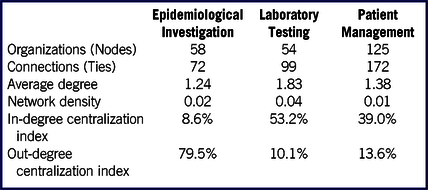
In Table 1, the scale of the network analyzed in this study was the largest for patient management, which consisted of 125 organizations with 172 links among them. The epidemiological investigation network included 58 organizations and 72 links. The laboratory testing network consisted of 54 organizations and 99 links. On average, organizations in each network were connected to approximately fewer than 2 other organizations (1.24 in the epidemiological investigation network, 1.83 in the laboratory testing network, and 1.38 in the patient management network). Network density also was low in all 3 response networks (0.02 in the epidemiological investigation network, 0.04 in the laboratory testing network, and 0.01 in the patient management network). The in-degree centralization index was highest in the laboratory testing network (53.2%). This tendency was less marked in the other networks: 39.0% in the patient management network and 8.6% in the epidemiological investigation network. The out-degree centralization index was the highest in the epidemiological investigation network (79.5%), as 1 organization dominated in sending out information and human resources to other organizations to perform the epidemiological investigation tasks. The other networks exhibited much less out-degree centralization: 10.1% in the laboratory testing network and 13.6% in the patient management network.
MERS Response Networksa

a small fraction of isolated relationships in each network (2 or 3) was eliminated to focus on core relationships. The isolated relationship was captured when organizations in a specific location were formed, but not linked to other organizations in that location. For example, in the patient management network, 3 isolated relationships were removed: the link from Gyeongsan Police Station to Gyeongsan Local Health Clinics in Gyeongsang North Province, the link from Mediheal Hospital to Ewha Woman’s University Medical Center, and also an isolated network between the Seoul Metropolitan Fire and Disaster Headquarters and 23 Local Fire Stations in Seoul.
Epidemiological Investigation Network
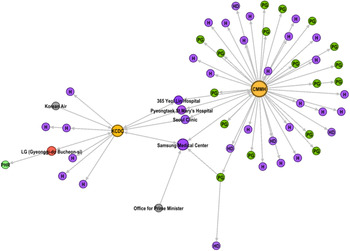
In the epidemiological investigation network (Figure 1), the CMMH appeared to work with several hospitals (H) and provincial/metropolitan governments (PG) because the organization dispatched a response team to hospitals and also deployed epidemiological investigation teams that consisted of private preventive medicine doctors and nurses in each PG.Reference Sell, Shearer and Meyer6 The CMMH coordinated the effort largely through unidirectional relationships with other organizations. Korea Centers for Disease Control (KCDC) was another organization that bridged others in the network. KCDC’s relationships with other organizations in this network tended to be more bidirectional than were those of the CMMH. The CMMH had the highest normalized out-degree centrality (0.79), showing that the organization directed, guided, or supported other organizations in the task. KCDC had the highest normalized in-degree centrality (0.11), which suggests that other organizations sought them for the task.
Epidemiological Investigation Network

During the MERS-CoV outbreak, all response efforts were performed at the YellowFootnote *** level. The health alert level returned to Blue on December 1, 2015,4 and never increased to Orange or Red. According to the MERS Response Manuals,9,10 at the Yellow level, KCDC is supposed to establish a Central Quarantine Headquarters, and as planned, did so after the health alert level increased from Blue to Yellow on May 20, 2015. However, on May 28, MOHW decided to: (1) establish the CMMH; (2) direct the response overall; and (3) reassign KCDC’s role to quarantine, epidemiological investigation, and laboratory testing.4,Footnote † Nonetheless, the epidemiological investigation team within the CMMH later formed private epidemiological investigation support teams at the provincial/metropolitan government levels.
Laboratory Testing Network
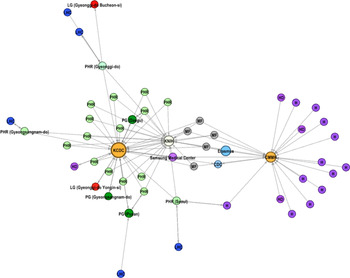
Figure 2 maps the coordination and collaboration among organizations that participated in laboratory testing. Again, KCDC and the CMMH were found to bridge other organizations. KCDC’s role was more crucial in coordinating and bridging several different types of organizations, such as the Health and Environment Research Institutes (PHR), Clinical Laboratories (MF), and several provincial (PG) and local governments (LG). KCDC had both the highest normalized in- (0.55) and out-degree (0.13) centrality in the network, suggesting that it was a prominent and dominant actor in the network.
Laboratory Testing Network

KCDC and the CMMH coordinated and collaborated with different types of organizations (eg, hospitals for the CMMH, government organizations for KCDC). While the arrows from hospitals were directed to the CMMH, KCDC coordinated primarily with the PHR, the Korea National Institute of Health (KNIH), and other organizations. However, substantively, KCDC allowed the PHR to perform screening tests 10 days after the outbreak (on May 30, 2015), and MF to do so after June 3, 2015.4 To confirm a MERS case, screening tests require a confirmatory test that only KNIH, which is under the KCDC’s supervision, can perform. Therefore, KCDC did not transfer the responsibility for the confirmatory test to PHR or MF, which delayed reporting confirmed MERS cases.4 PHR, MF, and designated hospitals (HD) were allowed to perform both screening and confirmatory tests only after June 7, 2015. Positive cases these organizations confirmed also were required to be transferred to the CMMH and reported to KCDC and KNIH.4
Patient Management Network
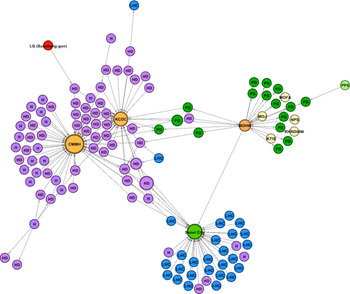
Figure 3 presents the patient management network. Like the previous figures, this network also was highly centralized around the key health authorities. The CMMH had the highest normalized in-degree centrality (0.42), while MOHW had the highest normalized out-degree centrality (0.15). Unlike the previous 2 epidemic response networks, KCDC’s role in this network was relatively limited. Hospitals (H or HD) in this network worked with KCDC and the CMMH. KCDC designated some hospitals for infectious diseases before the outbreak, which provided patient-related services, particularly in the outbreak’s early stage.4 However, after its establishment, the CMMH expanded and designated other hospitals specifically for MERS patient treatment.4 In Figure 3, MOHW appeared because the organization coordinated with PG and other central government departments, such as the Ministry of Foreign Affairs, in other supporting activities related to patient management. Seoul Metropolitan City, which was where the second infection hospital (Samsung Seoul Medical Center) was located, also appeared as an important organization that coordinated with local health clinics (LHC) and hospitals (H) in the metropolitan area.
Patient Management Network

Patient management requires close coordination and collaboration among national and local health authorities and hospitals, as well as national health authorities and provincial/local authorities. The number of MERS patients increased drastically on approximately May 30, 2018, to such an extent that KCDC could not accommodate the number of isolated beds needed at designated hospitals. Thus, the CMMH assumed the task and communicated with PG to secure isolated beds and collaborated with private hospitals in areas other than Seoul and Gyeonggi-do, where the MERS epidemic began and had spread most severely. However, this endeavor confronted challenges in transferring MERS patients to hospitals in other jurisdictions, and conflicts between the national health authority and provincial/local governments that are in charge of designated hospitals and other hospitals in their areas.4 Thus, collaboration between the CMMH and provincial/metropolitan governments or local medical associations was identified as a critical, but challenging, issue in the response.
DISCUSSION
An issue identified clearly in the analysis of document contents and extracted networks is governance. The event was addressed officially at the Yellow level during the outbreak period, but the responses performed corresponded to a greater extent to those at the Orange level or above.4,Reference Park15 The CMMH’s establishment illustrates the situation well. According to the national plans, KCDC is expected to lead response efforts at the Yellow level, but Figure 1 showed that the ad-hoc CMMH played significant roles and had significant responsibilities in all 3 response networks. The unforeseen consequence of this organizational design is the concern about the accountability in decisions made by an ad-hoc organization and those decisions’ aftermath. Ad-hoc organizations are disbanded after the mission is completed, but the consequences of their decisions can reverberate even after the event ends. If forming ad-hoc organizations is a viable option to respond to HCIDs effectively, their roles, responsibilities, and accountability, as well as their relationship with formal organizations, must be delineated properly and discussed during the planning and preparedness stage.
Health-care organizations play a crucial role during public health emergencies.Reference Son, Lee and Kim16,Reference Johnson, Sullivan and Piquette17 Over 46% of the organizations that participated in the key response activities were hospitals. In the literature, hospital capacity, such as surge,Reference Hodge, Gostin and Vernick8 hospital workers’ emotion,Reference Son, Lee and Kim16 and health-care facilities’ distribution,Reference King, Tiwari and Mikler18 have been identified as crucial and found to be an issue that requires further attention in preparations for HCID events. According to the WHO, health-care workers reported approximately 19% of the MERS-CoV cases identified.2 South Korea also suffered from a shortage of health-care workers because many were exposed to MERS, became patients themselves, and had to be treated in isolation.4 As a result, the response required military and private hospital workers’ involvement and assistance. There has been a lack of scholarly attention to the subject of providing risk advice to health-care workers during infectious disease outbreaks.Reference Potter, Sweeney and Iuliano19 In HCID contexts, informing and helping them protect themselves from the risk needs to be a priority in public health emergency preparedness.
Previous studies have emphasized the importance of cross-sector coordination in public health emergencies.Reference Sell, Shearer and Meyer6,Reference Hossain, Bdeir and Crawford20 Our analysis suggested that close coordination among health-care organizations and government agencies, not only at the local and state level, but also at the national level, is critical, particularly when an emergency reaches a serious level. However, in doing so, the national health authorities may need to coordinate with provincial/metropolitan and local government authorities first to facilitate such collaboration with hospitals and health-care organizations within each jurisdiction. Strategies to facilitate collaboration with private organizations, particularly those in different jurisdictions, need to be discussed seriously, such as establishing a way that health-care organizations can be compensated after the event for their time and efforts.
Finally, it is worthwhile to note the limitations that are associated inherently with our data collection approach, which used archival materials. We learned that extracting network data from a large volume of texts requires coders to have significant contextual knowledge and the ability to interpret information, which are error-prone. While the government document and news articles can complement each’s strengths and weaknesses by providing quite an exhaustive number of organizations and response relationships, this does not necessarily suggest that we captured the complexity of the response network fully and did not miss relevant information. Although our findings emphasized broad important themes in public health emergency preparedness and response, such as organizational leadership and governance and cross-sector coordination, they need to be understood within the unique context of South Korea’s culture.
Funding Statement
This work was supported by the research fund of Hanyang University (HY-2017).