INTRODUCTION
The Black Sea is an almost enclosed sea, and is therefore very sensitive to threats such as pollution and deterioration of marine habitats. Three cetacean species live in the Black Sea: the harbour porpoise (Phocoena phocoena), bottlenose dolphin (Tursiops truncatus) and common dolphin (Delphinus delphis). Cetaceans in the Black Sea are facing several threats, including accidental catch in fishing gear (by-catch), habitat degradation, overfishing, marine pollution and epizootics resulting in mass mortality events (Birkun, Reference Birkun and Oğuz2008). As a result of incidental catch during the sole, turbot and sturgeon fishing seasons (between early April and June), a large number of harbour porpoises and bottlenose dolphins are drowned in bottom gill nets and some of them strand ashore dead. It has been assumed by Öztürk (Reference Öztürk1996) that at least 2000–3000 individuals of these two species are killed as by-catch in the Turkish Black Sea each year. Previous cetacean by-catch studies in the Turkish Black Sea, such as Öztürk et al. (Reference Öztürk, Öztürk, Dede, Evans, Cruz and Raga1999), Tonay & Öz (Reference Tonay and Öz1999), Tonay & Öztürk (Reference Tonay, Öztürk, Oray, Çelikkale and Özdemir2003), Gönener & Bilgin (Reference Gönener and Bilgin2009), have not estimated total cetacean by-catch in turbot fishery. Obtaining demographic data of by-caught animals, including age and sex, is a key to understanding the effects of the turbot fishery on the harbour porpoise population. Few studies include such demographic information on harbour porpoise by-catch in the Black Sea (Karaçam et al., Reference Karaçam, Düzgüneş and Durukanoğlu1990; Tanabe et al., Reference Tanabe, Murdhusree, Öztürk, Tatsukawa, Miyazaki, Özdamar, Aral, Samsun and Öztürk1997; Gol'din, Reference Gol'din2004).
The aim of this study is to gather information on cetacean by-catch resulting from the turbot fishery in the Turkish western Black Sea to estimate the total number of by-catch and determine the age of by-caught harbour porpoises. This research is the first study regarding the estimation of cetacean by-catch in the turbot fishery in the Turkish coast of the Black Sea.
MATERIALS AND METHODS
In this study, the operation of a turbot fishing boat was observed in the Turkish western Black Sea coast during two fishing seasons, 2007 and 2008, and cetacean by-catch in turbot trammel nets was examined. Fishing with trammel nets, which is forbidden year-round to protect juvenile turbots, is still widely conducted illegally in the study area.
The fishing operations were carried out with a team of 5–7 fishermen on a 12 m long boat. Only a single boat at the fishing port (Rumeli Feneri) accepted an observer during the turbot seasons, because there is no legislation requiring fishing boats to have onboard observers in Turkey. It was a typical turbot fishing boat, representing the turbot fishing fleet in the Turkish western Black Sea coast. The fishing operations were observed from the beginning of April through the end of July in 2007 and from the beginning of April through the middle of September in 2008. At the time of this study, turbot fishing was prohibited from 1 May to 30 June (the closed season was changed to 15 April to 15 June in 2012). A unit of turbot bottom-set trammel net is 60 fathoms in length (=108 m) and 2.20–2.40 m in depth. Nets were set in strings of variable length, typically 1.7–3.5 km, consisting of 16–32 nets. A total of 115 nets (about 12.4 km in total length) were used with the inner panel of 165 mm nominal mesh size and the outer panels of 500 mm nominal mesh size. The webbing of the net was a nylon multifilament (i.e. PA-210 D/9-12 for the inner net and PA-210 D/15 for the outer nets).
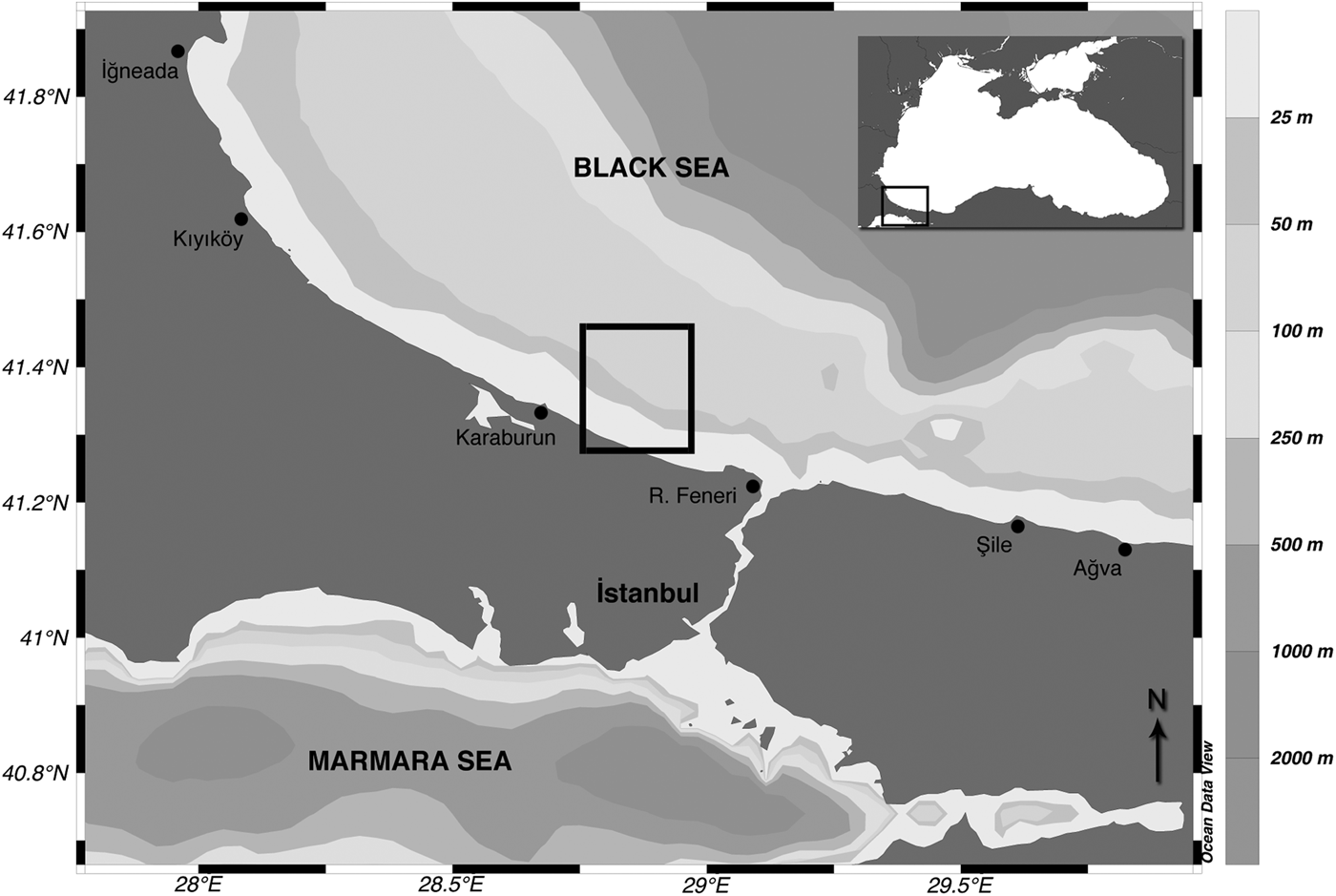
The closest set of the net was 0.4 NM from the shore and 10 m deep. The furthest set of net was 10 NM from shore and 90 m deep. The observed fishery was conducted in general 2–9 NM from the shore and 50–85 m deep in an area of ~250 km2 (Figure 1). All by-caught cetaceans were photographed and measured, and their sexes were determined.
Study area. Box shows the area where the fishing operations were observed.

By-catch rates (number of specimens per km of net) (number of specimens × 100 (km of net × day)−1 of by-caught cetaceans were calculated. The total numbers of by-caught cetaceans during turbot fishing seasons were estimated using the formulae in Northridge & Fortuna (Reference Northridge and Fortuna2008). According to the formulae, an estimate of the population average number of animals taken per haul in a given year is the average by-catch per observed haul in that year:
 $$\hat T = \displaystyle{{\sum {t_h}} \over H}$$
The sample variance of the t h is
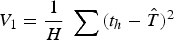 $${V_1} = \displaystyle{1 \over H}\; \sum {({t_h} - \hat T)^2}$$
And an estimate of the variance of  $\hat T$ due to sampling error is:
 $${V_2} = \displaystyle{{{V_1}} \over H}$$
With standard error
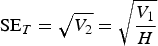 $${\rm S}{{\rm E}_T} = \sqrt {{V_2}} = \sqrt {\displaystyle{{{V_1}} \over H}} $$
The estimate of total by-catch in a given year is:
 $${\rm \;} \hat K = \sum {t_h} + U.\hat T$$
with estimated standard error SEK = U.SET and coefficient of variation  $CV = U.{\rm S}{{\rm E}_T}/\hat K$ where H is the number of hauls or operations observed in a given year, U is the number of unobserved hauls or operations in the same year, t h is the number of animals taken (by-caught) in the h th haul, and T is the overall by-catch rate (as animals per haul or animals per operation). Assuming that the calculated by-catch rate, the net specifications and fishing characteristics (e.g. recirculating time of the nets: 2.3 times in 2007, 2.7 in 2008 legal periods, and 5.5 times in 2007, 5.1 in 2008 legal and illegal periods) of all turbot nets in the area were similar to that of the observed boat, two estimations of total cetacean by-catch for each year were made: the legal and illegal period of turbot fishing.
Teeth were collected from the middle part of the mandible of by-caught harbour porpoises for age determination. The age was determined by counting growth layer groups (GLGs) in dentine according to the standard techniques (Perrin & Myrick, Reference Perrin and Myrick1980; Bjørge et al., Reference Bjørge, Hohn and Kvam1995), with the use of thin (18–25 µm) longitudinal sections of decalcified (Dekalsifier2-Surgipath) teeth by Cryostat (SLEE MTC) in −10 and −20°C and stained by Mayer's haematoxylin.
RESULTS
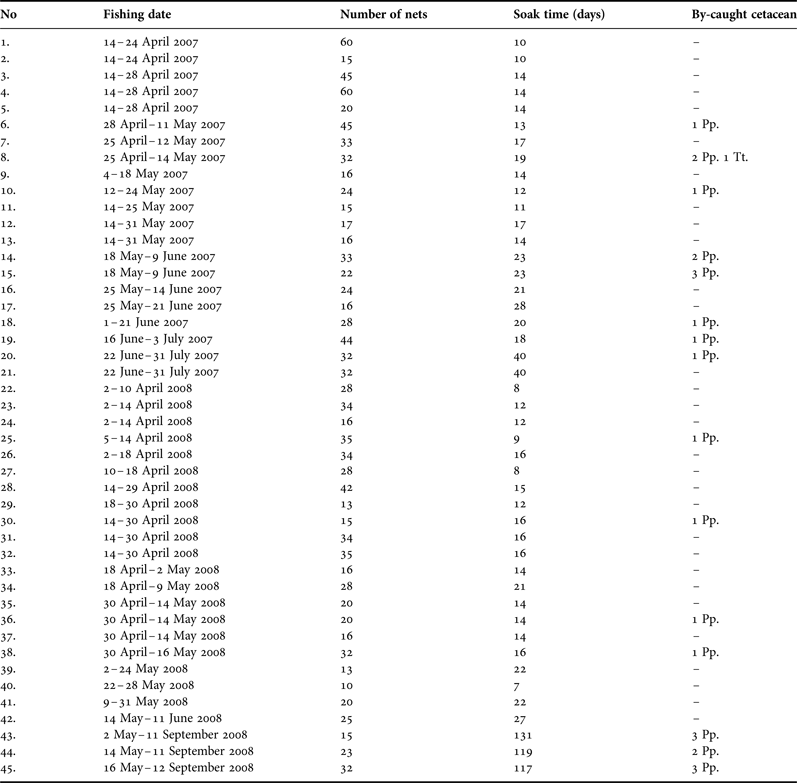
The observed boat hauled a total of 629 bottom trammel nets with a soaking time of 10–40 days (mean 18.7 ± 8.45) in 2007 and 584 bottom trammel nets with a soaking time of 7–131 days (mean 28.25 ± 36.70) in 2008 (Table 1). In 2008, when the September hauls (three sets of nets were set in May but left abandoned until September) were excluded, total nets were 514 with 7–27 days of soaking time (mean 14.8 ± 5.06). A total of 25 cetaceans were recorded as by-catch (13 in 2007, 12 in 2008). One individual was a male bottlenose dolphin, the rest (96%) were harbour porpoises (13 males, 8 females, 3 unidentified sex). No common dolphin was observed. In the observed turbot fishery, the by-catch rate (number of specimens per km of fishing gear) was found to be 0.18 for harbour porpoise and 0.01 for bottlenose dolphin in 2007 and 0.19 for harbour porpoise in 2008. Among the harbour porpoises the most frequently observed body length interval was 111–120 cm (mean 112.7 ± 8.87) in males and 121–130 cm (mean 117.9 ± 9.15) in females.
Details of fishing operations and by-caught cetaceans in two turbot fishing seasons 2007 and 2008.
Pp., Harbour porpoise; Tt., Bottlenose dolphin.
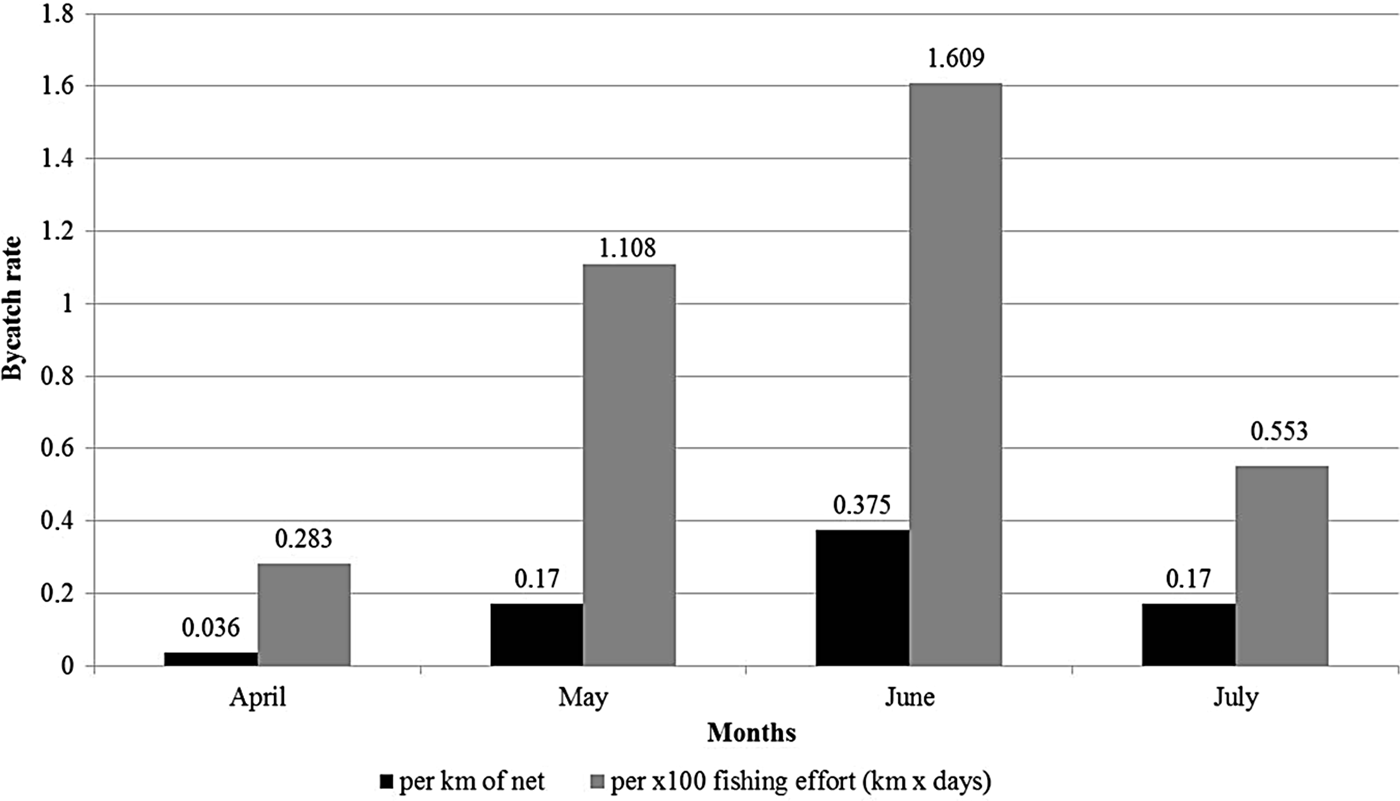
The highest by-catch rate was observed in June and 76% of the by-catch occurred during May and June (N = 13) (Figure 2), when turbot fishing was banned. The eight harbour porpoises found in the nets hauled in September 2008 were not taken into account in this figure but were included in by-catch estimations below. Because these harbour porpoises were at an advanced stage of decomposition we suspect that they were by-caught in June or July.
Cetacean by-catch rates (individuals per kilometre/fishing effort) by hauling months.
By-catch estimation
During the study period, the recirculating times of the nets were as follows: all nets of the observed boat (115 pieces) were set and hauled 2.3 times in 2007, 2.7 in 2008 legal periods, and 5.5 times in 2007 and 5.1 in 2008 legal and illegal periods. In six fishing ports (İğneada, Kıyıköy, Karaburun, Rumeli Feneri, Şile and Ağva) on the Turkish western Black Sea coast, approximately 19,000 pieces of turbot bottom nets (185 boats) were reported in total (Tonay & Öztürk, Reference Tonay, Öztürk, Oray, Çelikkale and Özdemir2003). If we assume that the by-catch rate, the net specifications and fishing characteristics (e.g. recirculating time of the nets) of the turbot nets in six fishing ports were similar to that of the observed boat, it can be estimated that the number of harbour porpoises caught during the turbot fishing seasons (both legal and illegal) was 2011 ± 742 (SE) (CV: 0.37) in 2007 and 2294 ± 806 (SE) (CV: 0.35) in 2008. The estimated number of bottlenose dolphins killed through by-catch was 168 ± 156 (SE) (CV: 0.93) in 2007. During the legal period (April and July) of turbot fishing season, it is estimated that the number of harbour porpoises caught was 167 ± 153 (SE) (CV: 0.92) in 2007 and 329 ± 220 (SE) (CV: 0.67) in 2008. No bottlenose dolphins were entangled during this period.
Age determination
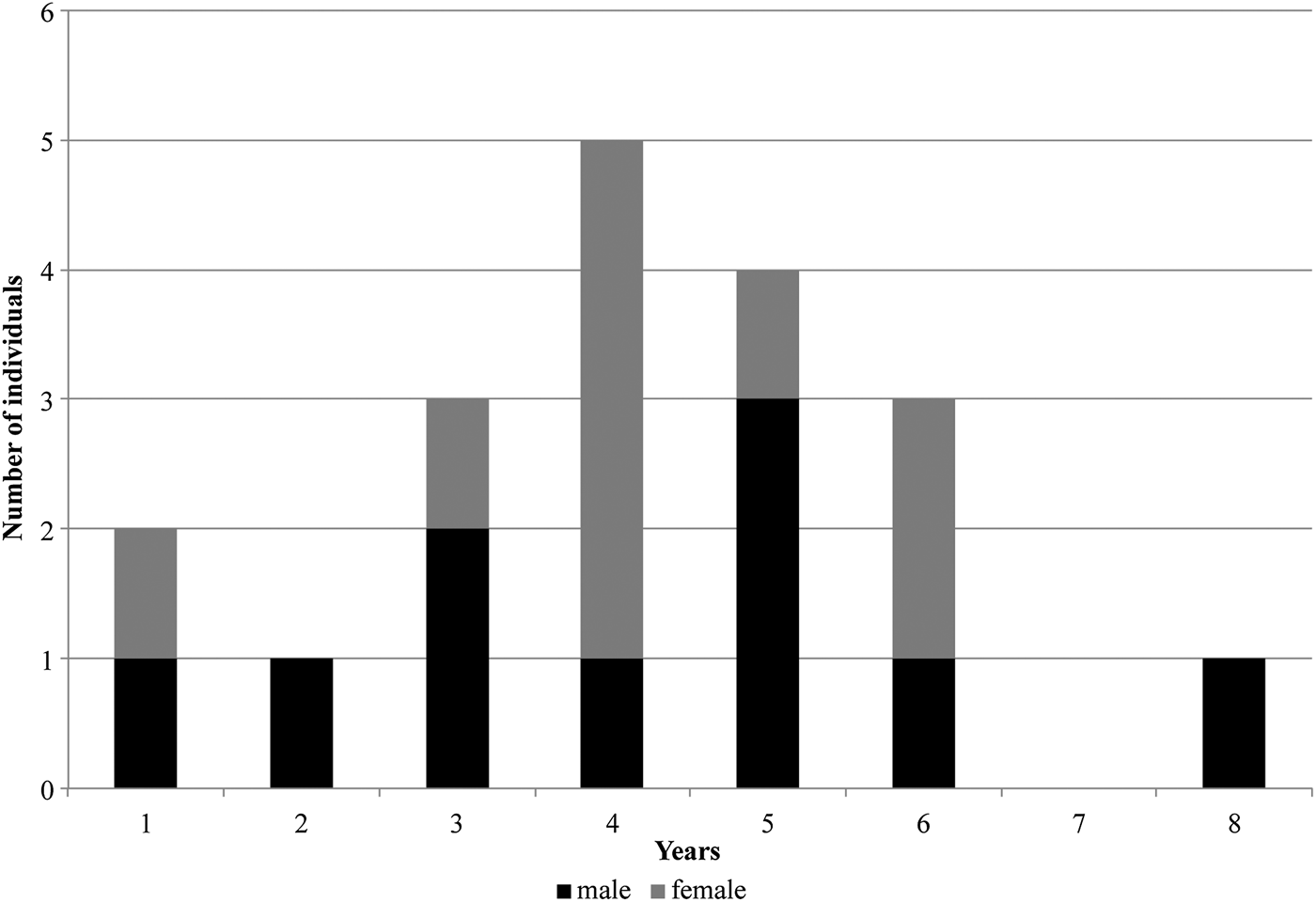
According to the age determination, all by-caught harbour porpoises were between 1–8 years of age. About half of them were within the age range of 4 (26%) and 5 (21%) years old (Figure 3). Four of five individuals at the age of 4, the most common age of death in by-caught harbour porpoises, were female.
Distribution of by-caught (N = 19) harbour porpoises by age and sex.
DISCUSSION
This study, together with Tonay & Öz (Reference Tonay and Öz1999) and Tonay & Öztürk (Reference Tonay, Öztürk, Oray, Çelikkale and Özdemir2003), reported a total of 92 by-caught harbour porpoises (61% female) and two bottlenose dolphins between 1999 and 2008 on the Turkish western Black Sea coast. Among three cetacean species living in the study area, the turbot fishery primarily impacts harbour porpoises (98%).
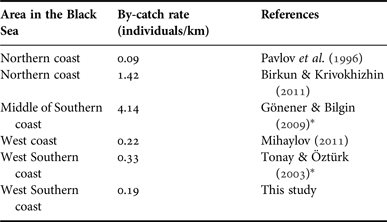
The by-catch rate was found to be 0.19 for cetacean individuals per kilometre both in 2007 and 2008. These are low values when compared with other studies in the whole Black Sea region (Table 2).
Harbour porpoise by-catch rates in turbot fishery in the Black Sea.
* The figure was recalculated based on the data.
There are two possible explanations for these low rates. One of them is that there may be fewer cetaceans living in the western and south-western Black Sea compared with the other parts of the Black Sea in spring and early summer. The fact that the values in Mihaylov (Reference Mihaylov2011) were also low supports this possibility for Bulgaria. The other explanation is that the nets observed in Tonay & Öztürk (Reference Tonay, Öztürk, Oray, Çelikkale and Özdemir2003) and this study were trammel nets, while gillnets were observed in other studies. According to Kastelein et al. (Reference Kastelein, Au and de Haan2000), the 90% detection range by echolocating harbour porpoises approaching the nets at perpendicular angles, under low noise level conditions, varies between 3 and 6 m, while for bottlenose dolphins, under high noise conditions, this value is between 25 and 55 m depending on the type of gillnets. Because the three-layer turbot trammel nets are thicker than one-layer gillnets which are used in the other parts of the Black Sea, harbour porpoises might be able to recognize the trammel nets more easily and hence face less accidental entanglement. If trammel nets reduce the cetacean by-catch significantly, they can be designed and tested in such a way (e.g. with larger mesh size) that entanglement of juvenile turbot and harbour porpoises could be reduced.
During the legal period of turbot fishing season (April and July), it was estimated that the numbers of harbour porpoises caught was 167 ± 153 in 2007 and 329 ± 220 in 2008 for the western Black Sea coast of Turkey. In that case, these numbers would be the lowest estimation on the Turkish western Black Sea coast. The estimated total number of by-caught porpoises (both in legal and illegal periods) was 2011 ± 742 in 2007 and 2294 ± 806 in 2008. These estimates were based on the assumption that every bottom turbot net in the study area was a trammel net and was used in the same way as this study, which covered both legal and illegal periods. Therefore, these numbers represent the maximum estimate because not all fishermen fish during the illegal fishing period. The observed boat and nets were typical for the turbot fishery in the western Black Sea coast, which includes a fleet of 185 vessels (Tonay & Öztürk, Reference Tonay, Öztürk, Oray, Çelikkale and Özdemir2003). The number of nets and boats of turbot fishery used during the illegal period is unknown. In conclusion, the estimated range of by-caught harbour porpoises resulting from the turbot fishery on the Turkish western Black Sea coast is 167 ± 153–2010 ± 742 in 2007 and 329 ± 220–2294 ± 806 in 2008. The lower end of the range is the minimum estimation based only on fishing conducted during the legal fishing season; the higher end of the range is the maximum estimation including both legal and illegal fishing periods.
Because the population size of the Black Sea cetaceans is unknown, it is both difficult and important to assess the effects of anthropogenic mortality on the cetacean population. Although Birkun (Reference Birkun and Oğuz2008) suggested that the present population size of the Black Sea harbour porpoise consists of several thousand to tens of thousands of individuals, the total population size and the extent of human-caused mortality of Black Sea cetaceans are unknown. Woodley & Read (Reference Woodley and Read1991) found that the harbour porpoise population in the Bay of Fundy and Gulf of Maine are unlikely to sustain even moderate levels of incidental mortality, which was estimated at 4% of the population per year. In the region regulated by ASCOBANS (Agreement on the Conservation of Small Cetaceans of the Baltic, North East Atlantic, Irish and North Seas), the maximum annual by-catch (anthropogenic removal) must be less than 1.7% of the population size (MOP 3, 2000). However, according to the Scientific Committee of ACCOBAMS (Agreement on the Conservation of Cetaceans of the Black Sea, Mediterranean Sea and Contiguous Atlantic Area) the only acceptable limit of cetacean accidental captures is zero (ACCOBAMS-SC7, 2011). Therefore, these by-catch rates still remain unacceptable especially as by-catches are known to occur possibly at higher rates throughout much of the Black Sea, while observed fishery in this study only covers less than 1% of the sea area.
It is known that Black Sea harbour porpoises reach sexual maturity at the age of 3–4 and physical maturity at the age of 6–12 (Gol'din, Reference Gol'din2004). Therefore, most of the by-caught harbour porpoises in this study (78%) were physically immature individuals. Additionally, in this study, together with Tonay & Öz (Reference Tonay and Öz1999) and Tonay & Öztürk (Reference Tonay, Öztürk, Oray, Çelikkale and Özdemir2003), five of the 92 by-caught harbour porpoises were pregnant females; one of which was sampled in April and the others in May. According to Birkun (Reference Birkun and Notarbartolo di Sciara2002), fishing in the Black Sea impacts mainly this species and the intensity of this impact is probably 30–40 times higher compared with the other two species because every 20 by-caught cetaceans consist of 19 harbour porpoises and one bottlenose or common dolphin. Since the turbot fishing season coincides with the gestation and nursing period of harbour porpoises (Birkun, Reference Birkun and Notarbartolo di Sciara2002), turbot fishing using bottom nets, especially in May and June when turbot fishing is banned, is a threat to the sustainability of the harbour porpoise population. Mortality of pregnant and nursing females, as well as immature individuals at this scale can pose a large threat to the population. Proper implementation of the ban on turbot fishing will result in a decrease in the Black Sea cetacean mortality.
During this study, the turbot fishing nets remained in the water for several months. The recovery of nets by fishermen in September 2008 was intended only to save the nets, not to collect the fish caught in the nets. However, this type of ‘ghost fishing’ is unacceptable for sustainable use of natural resources. According to the questionnaire survey conducted with fishermen in Rumeli Feneri during 2008 a total of 1279 turbot nets were lost, and 1200 of them were lost in the Romanian-Ukrainian Exclusive Economic Zone (Taner, Reference Taner2010). The conversations with the fishermen during the 2008 field study revealed that there could be 10,000–15,000 turbot nets lost during previous years in the same region. In order to decrease the pressure of ghost nets on natural resources, it is necessary to have regulations to prevent nets from being left in the sea for such long periods of time, and to carry out activities aimed at increasing the sensitivity and awareness of fishermen about ghost fishing.
Research should be carried out in the Black Sea on reducing cetacean entanglement by adopting the cetacean-safe fishing methods and using the fishing gear and technology (i.e. pingers and acoustically reflective nets) recommended in the ‘Conservation Plan for Black Sea Cetaceans’ in 2006 and ‘Strategic Action Plan for the Environmental Protection and Rehabilitation of the Black Sea’ in 2009. The results presented by this first study can be used to implement the actions in the conservation plan for the cetacean populations in the Turkish western Black Sea coast.
ACKNOWLEDGEMENTS
I would like to thank Drs Bayram Öztürk, Ayaka A. Öztürk and Ayhan Dede for their encouragement and assistance; the turbot fishermen for allowing this study to be conducted on their boat and for assistance in the field; and Elizabeth Hemond and Öykü Yağcı for polishing the English of the manuscript.
FINANCIAL SUPPORT
This study was supported by the Scientific Research Projects Coordination Unit of the Istanbul University (Project number T-924/06102006); and the Turkish Marine Research Foundation (TUDAV).