Introduction
Relatively little work among the extensive recent empirical literature examining the impact of institutions on economic development has focused on the role played by civil liberties. Recent attention has instead been concentrated on other measures intended to represent governance and the rule of law. Those empirical investigations that have incorporated civil liberties – most often measured by the Freedom House aggregate Civil Liberties Index – have found mixed evidence of their influence on economic growth. For example, while Isham et al. (Reference Isham, Kaufmann and Pritchett1997) present robust evidence of the impact of the aggregate Civil Liberties Index on the performance of World Bank projects, Levine and Renelt (Reference Levine and Renelt1992) find that the significance of the index is quite sensitive to changes in the conditioning set. King and Levine (Reference King and Levine1993) include the index as a covariate in their analysis of the relationship between financial development and growth, finding no evidence of civil liberties’ role in shaping economic growth.
We return attention to the role of civil liberties in the context of the ongoing discussion about which institutions matter for long-term economic growth. Betancourt (Reference Betancourt2004) suggests that these rights may be better indicators of a government's long-term commitment to the rule of law than other proxies examined in the literature. Building on conceptual work by North (Reference North1990) and Olson (Reference Olson2000), we identify the prevalence of the rule of law, indicated by the extent of civil liberties, as a plausible mechanism acting as a crucial determinant of long-term economic growth or development.
Given the mixed and limited empirical evidence supporting these propositions, we offer striking results on the impact of civil liberties on income levels. These new empirical findings became feasible as a result of Freedom's House decision to make publicly available the four main components of its aggregate civil liberties indicators at the end of 2006. Freedom House (2006) also disaggregated its index of political rights into its three main components. Thus, we are also able to compare the empirical impact of these governance indicators on income levels.
In explaining differences in income levels across countries, our work is most closely related to that of Acemoglu and Johnson (Reference Acemoglu and Johnson2005) [AJ] on unbundling institutions. Their work focused on differentiating between contracting institutions and property rights institutions; our work focuses on differentiating among different concepts and measures of property rights institutions. Our most intriguing result shows that, using the same methodology as these authors, one of Freedom House's recently disaggregated components of civil liberties ‘explains’ income differences better than any of the alternative property rights indicators available, including the best indicator Acemoglu and Johnson identify. This component, entitled ‘Personal Autonomy and Individual Rights’, evaluates the extent of personal economic freedoms such as the choice of ownership form, employment, residence and education, as well as social freedoms such as choice of marriage partners and family size.
We further find that this fundamental result remains remarkably robust as we address a variety of well-cited criticisms of cross-country studies and some not so well-cited ones. These include reverse causation, important omitted variables such as geography and human capital, and a battery of sensitivity tests. Throughout, we find that Personal Autonomy and Individual Rights remains more important than any of the other institutional variables considered in terms of both the magnitude of its effect and its statistical significance.
This paper also contributes to the institutions literature in more subtle forms. First, it shows that the rule of law is a broader concept than the formal or informal protection against government and elite predation or expropriation, as characterized by AJ and Olson (Reference Olson2000). Our results highlight the importance of protection of individual economic rights and personal social freedoms from government activities as well as from social norms and non-governmental collective infringement. Second, it encourages further research on why economies in East Asia are able to grow rapidly under non-democratic regimes. Is their experience a manifestation of the effects of different civil liberties on long-term economic growth? Or, is it evidence that different human and property rights may matter more at different points on an economic development path?
The rest of this paper is organized as follows: In Section 1, we lay out a conceptual framework that relates civil liberties and the rule of law to the operation of certain types of markets and economic development. Measurement issues are discussed in Section 2, emphasizing the newly disaggregated Freedom House civil liberties measures. We examine the empirical evidence on the role of civil liberties in determining long-term economic growth in an ordinary least squares setting (Section 3). Issues of reverse causation are addressed in Section 4, while omitted variables such as human capital and geography are incorporated in Section 5. We perform a variety of robustness checks on the sensitivity of the above results to a variety of other issues, including features of the data, in Section 6. By way of a conclusion, we offer a perspective in Section 7 on our main contributions.
1. Conceptual framework: why civil liberties matter
Succinctly put, the logic of our analysis is based on two main propositions and three subsidiary ones. The two main ones are: First, the prevalence of the rule of law is a key factor determining the rate of economic growth in the long term. Second, the protection of human rights through the provision of civil liberties is one of the most – if not the most – fundamental indicators of the prevalence of the rule of law in a society. The three subsidiary propositions suggest potential causal mechanisms for the operation of the first two. First, modern economies consist of two types of markets, spontaneous (and irrepressible) markets and socially contrived markets, and it is the latter that underlie modern economic growth. Second, a critical distinction between these two types of markets is the role that the state performs in supporting these markets. More precisely, the prevalence of the rule of law is an essential determinant of the level of operations in socially contrived markets. Third, financial markets and tangible capital markets are important examples of socially contrived markets. The rest of this section discusses the basis for these propositions and their implications in some detail.
What does one mean by the prevalence of the rule of law in economics? It certainly encompasses the protection of property rights. This is a widely accepted view in discussions of institutions. Property rights are usually defined at the most elementary level as the right to consume services of, the right to generate income from and the right to alienate an asset, e.g., Barzel (Reference Barzel1989). What seems to have been relatively ignored in recent literature is that the protection of human rights as part of the rule of law follows from the same logic. Violations of human rights (through loss of life, imprisonment, or other less dramatic restrictions on the capabilities to make choices and enjoy their consequences) deprive individuals of property rights that emanate from every human being's most fundamental asset: her own person. These violations are inconsistent with the prevalence of the rule of law in a society.
Part of the reason for this lack of recognition in viewing human rights as a separate but equally important dimension of property rights is an understandable but misplaced reluctance to place something as precious as life under the same general label as a physical asset, such as a house. We merely note that the logic is the same without making any assertion as to the intrinsic valuations of these different rights. Furthermore, distinctions are made between traditional human rights, such as life and liberty, and more modern ones, such as economic and social freedoms. The former are frequently described as ‘first generation’ human rights and the latter are frequently described as ‘second generation’ human rights, e.g. Kaufmann (Reference Kaufmann2004). Civil liberties usually encompass both sets of human rights.
Olson (Reference Olson2000: Chapter 10) distinguishes between an active role for the state and a passive role. The former entails the provision of various types of public goods; the latter consists of constraining itself from abusing its monopoly of power and engaging in predatory behavior on its own behalf or that of a few small groups. Betancourt (Reference Betancourt2004) argues that the best indicator of a state's intentions to perform this passive role (and thus of its intentions to abide by the rule of law) is the state's explicit commitment to the protection of human rights. In their essay on institutions as a fundamental cause of economic growth, Acemoglu et al. (Reference Acemoglu, Johnson, Robinson, Aghion and Durlauf2005: 390) explain why commitment problems inherent in the use of political power can lead ‘to economic inefficiencies and even poverty’. One way of addressing some of these commitment issues on the part of governments is through a credible pledge to the protection of human rights.
In their work on unbundling institutions, AJ distinguish between institutions supporting private contracts (‘contracting institutions’) and institutions constraining government and elite expropriation (‘property rights institutions’). These authors put forth specific measures of each type of institution. Legal Formalism and Constraints on the Executive are the ones that perform best empirically in their respective categories. Based on these two measures, they show the unimportance of contracting institutions and the importance of property rights institutions in explaining differences in the level of income across countries and, thus, their relative importance in explaining long-term economic growth. We view these results as an illustration of our first proposition, since property rights institutions and the principal measure used by Acemoglu and Johnson can be viewed as one manifestation of what one means by the prevalence of the rule of law.
While Constraints on the Executive emphasizes the balance of powers aspect of the rule of law, civil liberties emphasize the protection of individual liberties aspect. Since the prevalence of the rule of law is a complex phenomenon, difficult to capture both conceptually and empirically, we view our emphasis on civil liberties as a complementary step to AJ's work unbundling institutions. Specifically, we claim that we have a conceptually better measure of the provision of the rule of law (and thus of property rights institutions) than the measure relied upon most heavily by Acemoglu and Johnson. The arguments above suggest that it encompasses an additional dimension of the prevalence of the rule of law and, thus, of property rights institutions.Footnote 1
Our subsidiary propositions are based on an earlier literature that can be used to provide suggestive causal mechanisms for the empirical results that support the first proposition. The distinction between markets with transactions that are self-enforcing and markets with transactions that are not self-enforcing can be traced back at least to North (Reference North1990). He labels these two types of markets as traditional and modern, respectively, and identifies three conditions that lead to self-enforcing transactions: small numbers of market participants, repeated interactions among them, and plentiful information on their characteristics. North (Reference North1990) also emphasized the importance of an impartial judiciary and its role as a third-party enforcement mechanism in determining economic performance in modern economies, where markets with transactions that are not self-enforcing predominate.
The idea that there are two types of markets relevant for understanding economic growth was also put forth forcefully by Clague, Keefer, Knack and Olson (Reference Clague, Keefer, Knack and Olson1999) [CKKO]. They point out the differential role of government in these two types of markets. In markets where transactions are not self-enforcing, which they label as socially contrived, they argue that one needs contract enforcement mechanisms or else these markets will not exist or will operate at low levels of transactions. Exceptions to the need for these mechanisms in socially contrived markets arise when the gains from exchange appear so large to participants on both sides of the market that they are willing to incur the risk of non-fulfillment, as for example in some illegal markets. CKKO label these markets as irrepressible. Just as in markets where transactions are self-enforcing, which CKKO label spontaneous, explicit contract enforcement mechanisms are unnecessary for these markets to thrive. These authors acknowledge the possibilities of non-governmental mechanisms that provide enforcement services, but they stress the importance of governments in providing contract enforcement mechanisms in socially contrived markets and suggest contract-intensive money (CIM) as a measure of these institutions. CKKO stress that socially contrived markets are the most important for modern growth.
Further insight into the role of government in different types of markets arises from papers in a conference to honor Mancur Olson published under the title Market Augmenting Government (Azfar and Cadwell, Reference Azfar and Cadwell2003). In self-enforcing and irrepressible markets, the main role of the state is to provide ‘market augmenting services’ such as law and order (the ability of governments to protect citizens from predation by other citizens, that is to prevent crime against property and persons by other individuals) and a medium of exchange. In socially contrived markets, however, the state needs also to provide contract enforcement services, for example through an independent judiciary. This is the essential market augmenting service in socially contrived markets identified by CKKO. It is also consistent with North's view of the difference between traditional and modern markets.
Betancourt (Reference Betancourt2004) argues that a commitment to the rule of law is another public good or ‘market augmenting service’ that the state must provide for socially contrived markets to function at a high level. This commitment entails constraining government and elite expropriation, as argued by AJ, or preventing predation by government over citizens, as argued by Olson (Reference Olson2000). It differs from the public good ‘law and order’ in that the latter focuses on predation by other citizens or non-government groups. It also differs from the public good ‘contract enforcement services’ in that it is a much broader concept.Footnote 2 Furthermore, while there are private substitutes for the role of government in the provision of contract enforcement services (or of law and order), there are no private substitutes for the role of government in the provision of rule of law. Thus, we believe that the essential role of government in these two types of markets lies in the provision of the ‘rule of law’ in socially contrived markets, rather than the contract enforcement mechanisms emphasized by CKKO and North.
Both financial markets and tangible capital markets imply transactions with strong inter-temporal dimensions. For participants on one side of these markets, many of the benefits from transactions take place in the future, while many of the costs of these transactions take place up-front. Thus, these markets are socially contrived, because transactions in them are unlikely to be self-enforcing. Both of these markets are usually viewed as important for economic development. We believe that civil liberties are important for these markets to function at a high level due to their socially contrived nature, suggesting possible causal mechanisms between civil liberties and long-term growth or development.
2. Measurement issues: civil liberties and the unbundling of institutions
We follow AJ and differentiate between contracting institutions and property rights institutions. We differ from them in that we focus on identifying measures which capture our broader emphasis on the role of human rights as an indicator of the prevalence of the rule of law. Throughout, we compare these measures to the one highlighted by AJ, namely the Polity IV Constraints on the Executive variable. This variable, produced by the Polity IV Project, captures the degree of constraints on politicians and politically connected elites. It ranges from one to seven, where a higher score indicates greater constraints. We also compare these measures to the one emphasized by CKKO, namely CIM, which is defined as the contract-based share of the money supply or CIM = (M – C)/M, where C is currency and M is the money supply, including currency, demand deposits, and time deposits.
In 2006, Freedom House agreed for the first time ever to release the data for every country on each of the four subcategory scores making up the organization's aggregate Civil Liberties Index. These scores cover the period 1 December 2004, to 30 November 2005. Scores on the aggregate index have been available for many years. Table 1 presents the 15 overarching questions representing different dimensions of civil liberties on which each country is rated. Each question is rated on a score of 0 (worst) to 4 (best). These questions are then aggregated into four subcategories by adding the score on each of the questions making up the subcategory. Subcategories (D), (F), and (G) are composed of four dimensions each, whereas subcategory (E) is composed of three. Thus, the subcategory indexes for the former range from 0–16 and the one for the latter ranges from 0–12. The scoring for the aggregate Civil Liberties Index is slightly different.Footnote 3
Freedom House civil liberties categories

A more detailed look at subcategory (F), which is mislabeled ‘Rule of Law’ from our point of view, suffices to establish the lack of correspondence between the conceptual measure described in the previous section and what this empirical measure represents. This subcategory combines four dimensions that capture very different phenomena. The first one (Is there an independent judiciary?) reflects the existence of a mechanism that is important for the rule of law as well as for the provision of contract enforcement services and/or law and order. The second one reflects the rule of law with respect to procedural issues and the third one reflects the prevalence of law and order. The fourth one reflects the prevalence of non-discrimination against population segments by the government.
The other three subcategories are more homogeneous in what they capture. ‘Freedom of Expression and Belief’ (D) captures the ability of media (first question), religious institutions (second question), educational institutions (third question), and private individuals and organizations (fourth question) to express their views. This measure corresponds to one dimension of first generation human rights. The subcategory ‘Association and Organizational Rights’ (E) captures the ability of individuals and organizations, including trade unions and peasant organizations, to pursue their interests collectively. This measure also corresponds to a (different) dimension of first generation human rights. Finally, ‘Personal Autonomy and Individual Rights’ (G) captures the ability of individuals to exercise their economic rights with respect to employment, location, and ownership of property without severe infringements from the state or other individuals or groups (questions 1, 2, and 4), as well as their personal social freedoms with respect to marriage partners and family size regardless of gender (question 3). This measure corresponds to second generation human rights, as stressed by Kaufmann (Reference Kaufmann2004).Footnote 4 Subcategory G also reflects more intensely than the other categories interactions of individuals within a society as opposed to interactions with the state or its organizations.
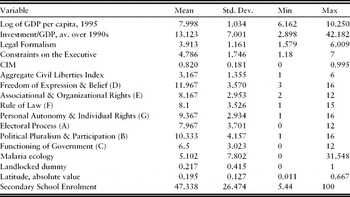
Our dataset consists of the original data for 60 countries used by AJ supplemented in several ways. First and foremost, we merged this dataset with the Freedom House data on civil liberties and its subcategories, as well as with the organization's Political Rights Index and its three subcategories.Footnote 5 We also incorporated the data on CIM from International Financial Statistics and added two other datasets that are important for our robustness tests. The first one simply extends the sample by including all the OECD countries that are not ex-colonies and thus excluded from the original 60 countries; the second one consists of data we gathered on gross secondary school enrollments and ‘geographic’ variables for the original set of 60 countries. Table 2 offers summary statistics on the dataset used for the sample of 60 countries.
Summary statistics for sample of 60 former colonies

Finally, it is worth noting that the primary outcome variable of interest in our dataset is GDP per capita in 1995. The differences in income levels across countries in 1995 are the result of the differences in the actual evolution of economic activity and population in these countries up to this date. We thus consider these income levels as the result of long-term economic growth or development, and we use these terms interchangeably.
3. Civil liberties and economic development: a simple OLS comparison
One of our arguments is that the prevalence of the rule of law as indicated by the provision of civil liberties is a better measure of the institutions needed for growth than the alternative measures used in the literature. In this section, we examine the empirical power of these new measures of property rights institutions by comparing them to the main alternative used in the literature to explain long-term growth. We start our analysis by incorporating these measures as substitutes for Constraints on the Executive in the main empirical specification employed by AJ.
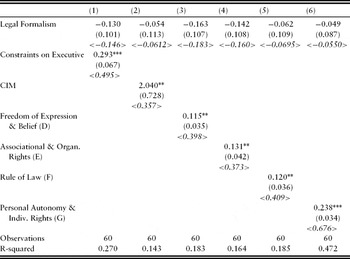
In the first panel of Table 3, we present the results of OLS regressions of the log of GDP per capita in 1995 on two institutional variables: Legal Formalism, intended to capture contracting institutions; and one of a set of different measures intended to capture property rights institutions. For comparison with existing literature, we include the variable most often used by AJ to represent property rights institutions, namely Constraints on the Executive, in the first column, and CIM in the second column. The remaining columns consider subcategories of civil liberties. The results are unambiguous. Legal Formalism is statistically insignificant at the 5% level in all specifications. All measures of property rights are positive and statistically significant at the 1% level. The main difference among these variables is in their explanatory power. It is especially striking that the civil liberties subcategory Personal Autonomy and Individual Rights explains about 75% more of the variation in GDP per capita than the second best measure, namely Constraints on the Executive. Not surprisingly, a non-nested J-test (not shown) favors the former over the latter.
OLS, dependent variable is log GDP per capita in 1995

Notes: Standard errors in parentheses and beta coefficients in brackets. * significant at 5%, ** significant at 1%, *** significant at 0.1%.
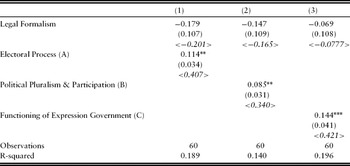
OLS, dependent variable is log GDP per capita in 1995

Notes: Standard errors in parentheses and beta coefficients in brackets. *significant at 5%, **significant at 1%, ***significant at 0.1%.
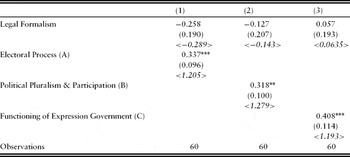
Freedom House's Political Rights Index is made up of three subcategories: Electoral Process (A) capturing the existence and degree of freedom, fairness and honesty in elections; Political Pluralism and Participation (B), capturing the nature of participation in the political process by individuals and groups; and Functioning of Government (C), capturing the effectiveness of governance. In the second part of Table 3, we repeat the exercise in the previous table using political rights measures as the institutional variable capturing the prevalence of the rule of law in our regressions explaining long-term growth.
One measure of civil liberties, Personal Autonomy and Individual Rights, outperforms each of the political rights variables by a wide margin in terms of explanatory power. Indeed, none of the political rights variables performs as well as the Constraints on the Executive, which is the second best-performing variable by this simple criterion. Of course, there are other relevant criteria that one can use for these comparisons, particularly statistical and economic significance, as well as criticisms that one can make of these OLS regressions, such as the need to correct for reverse causation and omitted variables.
We address the two main criticisms in the next two sections. Here, we note that all these ‘property rights’ variables are statistically significant at the 1% level. If one were to use the magnitude of the t-ratio as a criterion, Personal Autonomy and Individual Rights would perform best. With respect to economic significance, we have included the beta coefficients in the table, but we note that they can be sensitive to the inclusion of covariates. Hence, the main point to be made here is that all the property rights variables reflect substantial economic significance in terms of their impact on the level of per capita income. Comparisons between the beta coefficients of explanatory variables are best made after we include additional covariates.
Summing up the main result from this section, the Personal Autonomy and Individual Rights subcategory of civil liberties performs best in a simple comparison with any of the institutional variables that can be sensibly chosen as alternatives to capture property rights institutions or the prevalence of the rule of law. Despite the well-known biases in this simple approach, especially when using cross-country data, it would seem unlikely that they would always work out in favor of this particular measure by sheer accident. After all, the other alternatives considered here are subject to the same type of biases in exactly the same setting.
4. Civil liberties and economic development: reverse causation
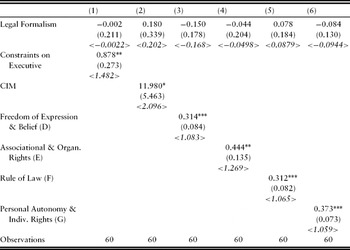
Since the possibility of reverse causation between the institutional variables and GDP per capita is well-established, we re-estimate the simple specification of the previous section using 2SLS. As instruments for the institutional variables, we follow AJ and use the log of population density in 1500 and a dummy for British legal origin. The results, which are presented in the two panels of Table 4, are similar in terms of signs to the previous section. Nevertheless, while all coefficients in the top panel increase in magnitude, they decrease in statistical significance compared to the OLS estimation. The end result, however, is that all civil liberties indicators continue to be statistically significant at the same levels as with OLS, but Constraints on the Executive and CIM are now statistically significant at lower levels than with OLS.
2SLS, dependent variable is log GDP per capita in 1995

Notes: The instruments used in the 2SLS specifications are the log of population density in 1500 and a dummy for British legal origin. Standard errors in parentheses and beta coefficients in brackets. *significant at 5%, **significant at 1%, ***significant at 0.1%.
Interestingly, the bottom panel of Table 4 reveals that the political rights indices experience an increase in statistical significance compared to the OLS results. Nonetheless, the Personal Autonomy and Individual Rights subcategory continues to have the highest t-ratio of any of the institutional variables in this setting. Thus, correcting for reverse causation preserves the basic results of the OLS specification. Namely, contracting institutions do not seem to matter in explaining the level of per capita income across these 60 countries, but property rights institutions do matter regardless of how they are measured.
Our analysis, thus far, confirms the basic results of AJ by showing that they hold for a variety of other measures of property rights institutions not considered by these authors. It also extends their analysis by showing that one of these alternative measures performs empirically better than theirs with respect to explanatory power and statistical significance in exactly the same setting. From the substantive point of view, however, this is a somewhat surprising result. The measure that performs better corresponds most closely to second generation human rights and not to first generation human rights.Footnote 6 Nonetheless, the result becomes less surprising when one realizes that this measure captures economic dimensions expected to impact growth directly, such as economic mobility and the ability to exercise ownership rights.
5. Civil liberties and economic development: omitted variables
We now consider how the previous results are affected by the introduction of additional variables identified as important in previous literature. In particular, we consider geography and human capital. With only 60 observations and the multicollinearity and endogeneity issues that affect cross-country data, however, there is always a trade-off between the need for parsimony to preserve degrees of freedom and economize on instruments and the dangers of omitted variable bias in doing so. Hence, we drop the Legal Formalism variable from all subsequent analysis in the interest of parsimony. Its lack of impact in any of the earlier results suggests little danger of omitted variable bias.
There are a number of dimensions of a country's geography that have been viewed as important in determining long-run growth. For instance, latitude has been used by Hall and Jones (Reference Hall and Jones1999) and others as an indicator of tropical climate. Thus, we consider the absolute value of a country's latitude as an explanatory variable. Similarly, whether or not a country is landlocked has been used by Faye et al. (Reference Faye, MacArthur, Sachs and Snow2004) to capture access to markets and infrastructure costs. Therefore, we also consider their indicator of whether or not a country is landlocked as an explanatory variable. Jeffrey Sachs has publicized the role of malaria in affecting developing countries well being. Kiszewski et al. (Reference Kiszewski, Mellinger, Spielman, Malaney, Sachs and Sachs2004) have developed an indicator of a country's exogenous malaria ecology. We also consider their malaria ecology index as an explanatory variable.
Glaeser et al. (Reference Glaeser, La Porta, Lopez-de-Silanes and Shleifer2004) argue that settlers brought to the colonies at least one other characteristic known to be useful for growth besides institutions, namely human capital. Thus, we investigate the effect of human capital on our results. For this purpose, we need a human capital measure that is available for our sample of 60 countries. We follow Mankiw et al. (Reference Mankiw, Romer and Weil1992) in using the secondary school gross enrollment ratio as our measure of human capital.Footnote 7
Human capital introduces another issue of reverse causation since economic growth generates resources that can be used for educational purposes. Having dropped Legal Formalism from the analysis, we could use British legal origins as an instrument for the human capital variable. One argument for this use of British legal origins is that these supported unconditioned private contracting as opposed to socially conditioned private contracting, La Porta et al. (Reference La Porta, de Silanes and Shleifer2008). Thus, the British legal tradition allowed agents finding some form of education useful to develop it, as opposed to waiting for a socially approved authority to recognize the need.
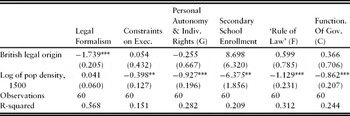
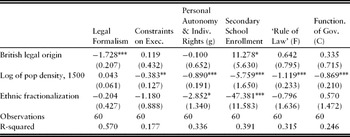
Since this use of British legal origins as an instrument for education is not an established practice in the literature, we checked the first stage regressions and found that these legal origins are a strong instrument for Legal Formalism but a much weaker instrument for secondary school enrollment. These results are presented in panel A of Table 7. It can also be seen in this panel that the log of population density in 1500 is a strong instrument for both the institutional variable and the human capital variable. In the empirical growth literature, ethnic fractionalization has been identified as an instrument for human capital, for example in Durlauf et al. (Reference Durlauf, Johnson, Temple, Aghion and Durlauf2005). The rationale is that the higher the level of ethnic fractionalization in a society, the lower is the level of human capital, since education is normally publicly provided and any groups controlling the state would be disinclined to empower other groups through education. We adopt the measure of ethnic fractionalization employed by Alesina et al. (Reference Alesina, Devleeschauwer, Easterly, Kurlat and Wacziarg2003). It can be seen from panel B of Table 7 that this measure is a better instrument for secondary school enrollment than British legal origin in terms of both statistical significance and explanatory power.
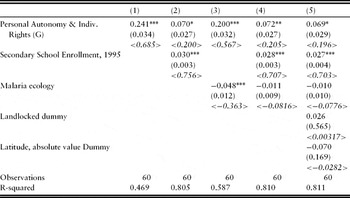
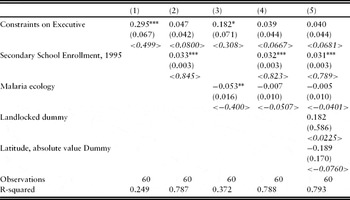
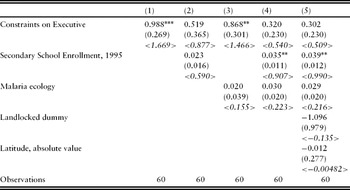
We limit the presentation of results to two property rights variables, namely Constraints on the Executive, which best captures aspects of balance of power, and Personal Autonomy and Individual Rights, which best captures second generation human rights and performs best among the civil liberties variables. Table 5 presents the OLS results. It can be seen that the civil liberties variable dominates the Constraints on the Executive variable in every possible comparison in terms of predictive performance and statistical significance. Indeed, the addition of the human capital variable renders Constraints on the Executive statistically insignificant regardless of whether or not the geography variables are included. It can also be seen that the institutional variables have significant explanatory power by themselves and that human capital adds substantially to explanatory power, despite the inclusion of the institutional variables. On the other hand, the geography variables add to explanatory power given the institutional variables, but their contribution disappears once both institutions and human capital variables are included.
OLS, dependent variable is log GDP per capita in 1995

Notes: Standard errors in parentheses and beta coefficients in brackets. *significant at 5%, **significant at 1%, ***significant at 0.1%.
OLS, dependent variable is log GDP per capita in 1995

Notes: Standard errors in parentheses and beta coefficients in brackets. *significant at 5%, **significant at 1%, ***significant at 0.1%.
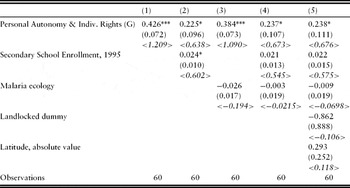
Both the institutional variables and the human capital variables are subject to reverse causation biases. Thus, we present 2SLS results in Table 6 using population density, ethnic fractionalization and British legal origins as instruments in the first stage.Footnote 8 The 2SLS results continue to favor the civil liberties variable relative to the Constraints on the Executive one. In particular, the inclusion of human capital continues to render Constraints on the Executive statistically insignificant.
2SLS, dependent variable is log GDP per capita in 1995

Notes: The instruments used in the 2SLS specifications are the log of population density in 1500, a dummy for British legal origin, and ethnic fractionalization. Standard errors in parentheses and beta coefficients in brackets. *significant at 5%, **significant at 1%, ***significant at 0.1%.
First stages (dependent variable in column heading)

Notes: Standard errors in parenthesis; *significant at 5%, **significant at 1%, ***significant at 0.1%.
First stages with ethnic fractionalization

Notes: Standard errors in parenthesis; *significant at 5%, **significant at 1%, ***significant at 0.1%.
With respect to the geography and human capital variables, the results differ dramatically between OLS and 2SLS. The malaria ecology variable is not statistically significant at the 5% level with just the institutional variable included in the 2SLS setting. Just as noted above, the human capital variable renders Constraints on the Executive statistically insignificant. In contrast, both the human capital variable and the civil liberties variable are statistically significant at the 5% level when included without the geography variables. Inclusion of the latter, however, renders the human capital variable statistically insignificant when Personal Autonomy and Individual Rights is the institutional variable. While initially surprising, this result may also reflect the effect of second generation human rights on the level of human capital.
Summing up, the prevalence of the rule of law through the provision of civil liberties, measured in terms of Personal Autonomy and Individual Rights, remains an important determinant of long-term growth and, thus, of economic development when geography and human capital are included in the analysis. It does so with and without correction for reverse causation. Finally, the beta coefficients imply economic significance in terms of impact on the dependent variable. While magnitudes change substantially depending on the particular specification, economic significance does not disappear in any specification.
6. Sensitivity analysis
In view of the broad skepticism concerning the use of cross-country data, we performed a variety of sensitivity analyses on our basic results to enhance confidence in their reliability. In explaining long-term growth, for instance, we have posited as a dependent variable the level of GDP per capita achieved in 1995. Our preferred measure of institutions rates the level of Personal Autonomy and Individual Rights in 2005. One rationale for the use of a variable in 2005 to explain one in 1995 is that fundamental institutional variables change very slowly. Thus, the 2005 value is a very good proxy for the 1995 value. Nevertheless, to explore the sensitivity to these differences in dates, we constructed an estimate of the latter variable for 1995.Footnote 9 The results of using the estimated 1995 indicator of Personal Autonomy and Individual Rights are very similar to the results for the 2005 indicator used in Tables 3 and 4. For example, the explanatory power of this 1995 estimated variable (R2 = 0.4585) is far closer to the 2005 indicator (R2 = 0.4717) than to that of any of the other indicators in Table 3, and the coefficient of the estimated variable (0.214) and its standard deviation (0.03) are quite close to the corresponding coefficient estimates in Table 3 (0.238 and 0.03, respectively). We also obtained GDP per capita data for 2003. Re-doing our original analysis led to the same conclusion.
One way to test for the sensitivity of our analysis to outliers is to exclude one country at a time from the sample and observe the impact on the results. This exercise makes no difference to the results in Tables 3 and 4. A more systematic approach is to use the criteria for dropping outliers noted in Kennedy's Guide to Econometrics (Reference Kennedy2003: Chapter 20). Using these criteria, we identified 18 observations that could be candidates for exclusion. Dropping all of these observations at the same time leaves us with 42 countries. In a regression comparable to those in Table 3, the explanatory power of the Personal Autonomy and Individual Rights variable was 0.46, and its coefficient was 0.243 with a standard error of 0.05. The results for the other measures of institutions were similar and the basic conclusion of superior performance for this variable remained unaltered.
Next, we extended the sample by incorporating all OECD countries not previously included in the dataset because they are not former colonies (Australia, Canada, Mexico, New Zealand, and the US were already included). This procedure increases the sample size from 60 to 83. Personal Autonomy and Individual Rights continues to have the greatest explanatory power (R2 = .684) by a wide margin over Constraints on the Executive ((R2 = .469) in explaining long-term growth.
As a final check on the results in Sections 3 and 4, we used the settler mortality index used by AJ rather than population density in 1500 as the instrument for property rights institutions in the 2SLS regressions. This mortality index has proven to be somewhat controversial; see Albouy (Reference Albouy2008). In our context, use of this index as an instrument reduces sample size to 51 observations. In this sample, the results are more favorable to the Personal Autonomy and Individual Rights subcategory than in Table 4. For, it is the only property rights institutional variable that remains statistically significant at the 0.1% level in explaining long-term growth.
In addressing the omitted variables problem in the previous section, we faced the problems of multicollinearity and endogeneity. In doing sensitivity analysis of these results, the same two problems arise in a more powerful form. For instance, the lowest correlation between the Personal Autonomy and Individual Rights variable and any of the other three civil liberties subcategories is 0.747. Its correlation with Constraints on the Executive is 0.686. Regional dummies for Sub-Saharan Africa are highly correlated with the geography variables. Thus, we dropped the geography variables to ameliorate the multicollinearity problem. Furthermore, the property rights variables are all endogenous. Hence, their introduction would require an instrument other than British legal origin, because we showed that the latter is not a good instrument for property rights institutions. Following Mobarak (Reference Mobarak2005), we used the proportion of Muslims in the population as an instrument to deal with this issue.
Briefly put, if we add one institutional variable at a time to the specification in Table 6 while dropping the geography variables, none of the added variables is statistically significant at even the 10% level in any of the specifications. Meanwhile, Secondary School Enrollment and Personal Autonomy and Individual Rights remain statistically significant at the 5% level in at least two of the five different specifications. A similar experiment with a Sub-Saharan African dummy or a Latin American dummy yields t-ratios less than one for the coefficients of the dummies. Meanwhile, the two included variables from Table 6 remain statistically significant at the 10% level in both specifications.
Finally, we considered the five subcategories of the Economic Freedom Index (EFI) developed by Gwartney and Lawson (Reference Gwartney and Lawson2008): size of government (EFI1), legal structure and security of property rights (EFI2), access to sound money (EFI3), freedom to trade internationally (EFI4), regulation of credit, labor, and business (EFI5). Adding each of these five EFI variables for 1995 one at a time to the specification in Table 6, while dropping the geography variables, results in each one of them having a coefficient with a t-ratio less than unity. Moreover, the coefficients for four of the five EFI components have the wrong sign, that is a higher value of the EFI variable lowers the level of income. Incidentally, the EFI index has no data for five of the countries in our sample so these results are based on 55 observations rather than 60.
7. Implications
One contribution of our empirical analysis is to show that the dominance of property rights institutions over contracting institutions in explaining long-term growth is not limited to the measures considered by AJ. On the contrary, using exactly the same methodology and sample, this dominance extends to a wide range of other variables. Prominent among these other variables are four dimensions of civil liberties recently provided at a disaggregated level by Freedom House.
It would be foolish to conclude from this finding that contracting institutions are irrelevant for development. Our conceptual framework suggests reasons why this might be the case without implying the irrelevance of these institutions for development. Namely, the prevalence of the rule of law provided by property rights institutions is an essential public input for the operation of socially contrived markets at a high level, while contract enforcement institutions are not an essential public input. While there are private substitutes for the lack of contract enforcement institutions, there are no private substitutes for the rule of law.
If the operation of socially contrived markets at a high level is an important component that generates sustained economic growth, private substitutes for contract enforcement institutions, such as corruption, may arise and operate in some countries. These private substitutes can allow economic activities to take place at a high level, even though the public provision of contract enforcement institutions through mechanisms such as Legal Formalism is awfully inefficient. Thus, the result we established empirically does not necessarily imply that contract enforcement institutions are irrelevant for development. What it does suggest is that public provision of these institutions is not an essential public input for economic development.
A second contribution of this paper is the unbundling of property rights institutions. Civil liberties matter in determining the level of long-term economic growth as indicators of the prevalence of the rule of law in general and of property rights institutions in particular. The civil liberties that matter most in this setting, however, are those associated with second generation human rights. The salience and robustness of this empirical finding is very unusual for analyses of cross-country data. We view this result as an unusually strong and auspicious step in the process of unbundling property rights institutions and in understanding their role in the economy. Thus, it is desirable to highlight the implications of our results for a couple of fundamental issues in the institutions and economic development literature.
It is difficult to believe that one can maintain high levels of second generation rights without having some minimal levels of first generation rights. Nonetheless, the well-documented and exceptional sustained economic growth of the East Asian economies since World War II is consistent with this possibility. Vietnam and China are two recent and dramatic examples of countries with sustained growth despite divergence between second generation human rights and other property rights institutions. Their scores on second generation human rights are 7 and 8, respectively, out of a possible 16. The next highest score for either country in any of the disaggregated civil liberties subcategories is 4 out of 16. These correspond to Freedom of Expression for China and Rule of Law for Vietnam. Indeed, one can plausibly argue that these ‘high’ scores on second generation human rights are the result of improvements concurrent with sustained economic growth. Understanding the nature of the relationships between different civil liberties subcategories in affecting long-term growth is a potentially fruitful area of future research.
One might also expect some relationship between a minimal level of political rights and these second generation human rights. Using China and Vietnam as illustrations again, one finds that neither country scores higher than a 1 out of a possible 12 or 16 in any of the three political rights subcategories. Thus, future research should examine the interactions between political and economic institutions in the context of economic development. One contribution that has looked at this issue in the context of short-term economic growth is Vega-Gordillo and Álvarez-Arce (Reference Vega-Gordillo and Álvarez-Arce2003), who rely on five year averages of growth rates to generate short panels. Using Granger causality tests, they find strong evidence that the aggregate EFI index Granger causes the average five year economic growth rate, as well as far less robust evidence that the FH political rights index Granger causes the average five year economic growth rate. Using a similar methodology, Justesen (Reference Justesen2008) finds that the only component of the EFI index that has a robust effect Granger causing the average five year economic growth rate is EFI5, regulation of credit, labor, and business. Much closer to our work in raising this question from a long-term economic growth perspective, at least in principle, is North et al. (Reference North, Wallis and Weingast2009).
A third contribution of this paper lies in the conceptual framework, which helped us interpret our first empirical result and also helps us interpret the unusual implications of our second empirical result noted above. That is, one possible reason for the exceptional growth performance of China and Vietnam, despite their low scores on most civil liberties and political rights, is that at low levels of development, growth can be based on activities in markets that are not socially contrived, for example agricultural markets. Yet as one attains higher levels of development, it becomes impossible to sustain growth without socially contrived markets and it is at this point that most civil liberties and perhaps political rights begin to matter. In early stages of the development process, however, the civil liberties that matter most are the ones associated with second generation human rights. For, they have more direct effects on economic activities through improving labor mobility and the full exercise of ownership rights.