1. Introduction
The crucial role of science and technology for the development of countries and for increasing their welfare is evident throughout history. In this process, science and technology have grown increasingly closer, with mutual interaction. With the impact of global capital, a rise in welfare has brought along increasing profits. Hence, concepts such as innovation, technology transfer, technology commercialisation, and research and development (R&D), have gained importance, and several sectors underlining these concepts have begun to emerge.
The restructuring of countries with an eye to science and technology occurs as a result of the policies and practices that evolve in parallel with the permanent competition in the world. With the aim of making progress in science and technology, countries have devised restructuring policies, and these have been implemented in public institutions as well as the private sector, universities and civil society, all of these mutually interacting. In the various stages of this process both internal and external dynamics have played a role.
2. Brief History of Restructuring in Science and Technology in Turkey
2.1. 1923–1960
The Republic of Turkey was established right after the country had come out its War of Independence. The establishment of the Turkish national industry was initiated with the decisions taken in the first meeting of the Izmir Economic Congress on 4 March 1923. At this Congress it was also decided to provide support for entrepreneurs and to establish investment banks to furnish credit to investors. In the following years, an industry-oriented development was targeted in accordance with the existing needs of Turkey.
The state-supported policies entered into effect under the leadership of Mustafa Kemal Atatürk after the 1923 İzmir Economic Congress with the aim of rapid industrialisation and increasing the welfare of the nation. During this time there was an urgent need for the reconstruction of the national industry. However, there was not enough private sector accumulation to realise this aim, therefore state leadership and involvement were a necessity. All national resources, including all available manpower, were aligned and utilised to the maximum extent in addition to obtaining foreign support and making technology transfers. In this way, many industrial plants were installed.
İş Bankası (1924) and Sümerbank (1933) played important roles in the industrial investments of the period (Oğuztürk Reference Oğuztürk2004, 100–105). The paper and cement industries were also established and the iron and steel industry was introduced with the foundation of Karabuk Iron and Steel Factories. This period also witnessed the introduction of the first development plans. The first five-year development plan was put into practice in 1934 and covered the period between 1934 and 1938, while the second five-year development plan could not be implemented because of the Second World War (1939–1945).
Darulfunun (University) in Istanbul, dating from late Ottoman times, and the Engineering School were transformed into Istanbul University in 1933 and to Istanbul Technical University in 1940, respectively (Acun Reference Acun and Kılınçkaya2005, 352–370). During this period, many students were sent abroad for higher education. Foreign scientists also gave lectures and taught in Turkish universities in the same period (Yıldız et al. Reference Yıldız, Ilgaz and Seferoğlu2010, 1–5).
During the Second World War, Turkey went through a period of stagnation in science and technology. The post-1945 period was a time of competition, with large-scale restructuring of science and technology all over the world. Computers made their entry and a brain-drain from developing to developed countries gained speed. Hence, the divergence between developed and developing countries in terms of science and technology severely widened.
While the Turkish state gave special weight to infrastructure investments such as roads, dams and harbours in the 1950s and 1960s, the private sector was also encouraged to achieve technology transfer and to make the appropriate investments. However, it seemed impossible to come up with advanced and planned science and technology policies.
2.2. 1960–1983
The State Planning Organisation was established in 1960 to accelerate social development and to guide the government in preparing development plans.
2.2.1. First Development Plan Period (1963–1967)
In the first five-year development plan, research was emphasised as one of the most important factors to encourage industrial, technological, economic and social progress. Priority was given to basic research that might eventually lead to applied research effects (Birinci Kalkınma Planı 1963–1967, 463). The Scientific and Technical Research Council (TÜBİTAK), established in 1963, was meant to play an important role in the design of scientific activities. However, there occurred no major change in science policy, and scientific research remained limited to basic research.
2.2.2. Second Development Plan Period (1968–1972)
The second five-year development plan designated scientific studies and researches as the basis of technological development. The importance of qualified labour was also emphasised (İkinci Kalkınma Planı 1968–1972, 197). While R&D activities ran to 3% of GNP in various countries, this share was only 0.4% in Turkey. This ratio was predicted to increase to 0.6% between 1968 and 1972 (İkinci Kalkınma Planı 1968–1972, 199).
2.2.3. Third Development Plan Period (1973–1977)
In the third five-year development plan, emphasis was on the application of modern technologies for rapid development (Üçüncü Kalkınma Planı 1973–1977, 898). These technologies should meet the demands of the country and complement existing technologies. Subsidies would be given to facilitate the necessary adaptation to contemporary technologies and to produce domestic technology. However, in the end, these goals could not be achieved because of lack of resources.
2.2.4. Fourth Development Plan Period (1979–1983)
The fourth five-year development plan foresaw that the objectives of the technology policy should proceed in accordance with industrial, employment and investment policies and that more resources should be allocated to R&D activities (Dördüncü Kalkınma Planı 1979–1983, 275). Coordinated, efficient and deliberate regulation of the relevant institutions would allow for planning and programming to participate in, and contribute to, international cooperation (Dördüncü Kalkınma Planı 1979–1983, 277). Export subsidies were increased. Labour intensive and low-technology products continued to occupy a large share of Turkish exports, although structural transformation based on science and technology – which already had started in a number of developing countries and especially in Korea – could not be put into practice in Turkey.
2.3. 1983–2000 PeriodFootnote 1
The beginning of the 1980s witnessed rapid investment in industrial infrastructure and the promotion of the industrial sectors in Turkey. This pattern shifted towards the services sector closer to the 1990s. Especially in the 1990s, sectors such as communication and housing gained importance. In this period, investments in agriculture and industry declined.
Turkey was influenced by the neoliberal policies of the West and the state started to distance itself from the purchase of goods and services. The state gave R&D subsidies to the private sector to increase technology transfer activity; still, the results were unsatisfactory. The private sector could not allocate the necessary share to R&D due to lack of capital accumulation. In addition, the private sector did not attach the necessary importance to R&D activities.
A 1997 report of TÜBİTAK drafted proposals for the ‘Law of Technoparks and Technology Development Zones’, the ‘Legislation of University Industry Collaboration’ and ‘the Legislation of Research Personnel’. With this report, TÜBİTAK redefined its mission as well as the mission of affiliated R&D units, and initiated the restructuring of the public research institutions (TÜBİTAK 1997, 3–110).
2.4. 2000–2011 Period
Between 2001 and 2005, structuring towards the formation of a national innovation system was started in accordance with the Eighth Development Plan. This system comprises all institutional mechanisms for the production of science and technology and ensures that these mechanisms are transformed for social benefit.
On 26 June 2001, the law on the establishment of technology development zones was introduced, with Law no. 4691. The establishment of technoparks in collaboration with the universities was promoted within the framework of the legislation. The process of restructuring the universities in science and technology had started.
The Supreme Council for Science and Technology (BTYK) in December 2001 issued a report entitled ‘Vision 2023: Strategies of Science and Technology’. The aim for the one-hundredth anniversary of the Republic was determined as the creation of a ‘welfare society’ that masters technology, uses it consciously, can produce new technologies, and is able to transform technological progress into social and economic benefit (Kayalıdere Reference Kayalıdere2014, 75–96).
The name of TÜBİTAK was changed to the ‘Scientific Research and Technological Research Council of Turkey’ in accordance with Law no. 5376, which was enacted on 7 July 2005. The law of establishment and the subsequent regulations of TÜBİTAK, which gave the impression that its scope of activity was limited to the natural sciences, were extended in the new law so as to include the social sciences and the humanities.
Within the framework of the Ninth Development Plan (2007–2013) the process of harmonisation with the EU was completed and the long-term strategy (2001–2023) was formulated as ‘creating a competitive technology and science infrastructure’.
3. Restructuring Institutions of Science and Technology
3.1. Public Institutions before the 24 June 2018 Elections
3.1.1. The Supreme Council for Science and Technology (BTYK)
The BTYK was established in 1983. It was restructured with the decree law issued in the Official Gazette on 8 June 2011 and on 4 July 2011.
The BTYK holds highest authority in the determination of science and technology policies. The first meeting of the BTYK was held on 9 October 1989 and its secretariat activities have been carried out by TÜBİTAK since then.
The National Science, Technology and Innovation Strategy (2011–2016) was approved in the 22nd meeting of the BTYK. This fundamental document encapsulates the vision, the priorities, and the main targets of science, technology and innovation (STI). The aim of this document was to ensure the sustainability of the acceleration of science and technology gained by the ‘Science and Technology Policies Implementation Plan 2005–2010’ that constituted the basis of the STI progress.
3.1.2. The Ministry of Science, Industry and Technology
According to the Decree Law no. 635 of 3 June 2011, the name of the ‘Ministry of Industry and Trade’ was changed to ‘Ministry of Science, Industry and Technology’. In addition, the following were added to the Ministry’s mission statement; (i) determination and implementation of science, technology, innovation and efficiency policies and strategies in accordance with Turkey’s targets in economic development, social progress and national security; (ii) promotion and encouragement of industry-oriented R&D and innovative programmes and projects; (iii) increasing productivity in industrial production; (iv) supporting clean production projects, which would ensure environment-friendly production (Bilim, Sanayi ve Teknoloji Bakanlığı 2011a).
Appropriate institutional restructuring followed. TÜBİTAK and the Turkish Academy of Sciences (TÜBA) became institutions of the Ministry with regard to their duties in science and technology. The Ministry’s organisation was also restructured, with general directorates reflecting the Ministry’s new missions (Bilim, Sanayi ve Teknoloji Bakanlığı 2011b).
3.1.3. Related Institutions of the Ministry of Science, Industry and Technology
The Scientific and Technological Research Council of Turkey (TÜBİTAK)
The basic duty of TÜBİTAK at its establishment was to promote basic and applied academic research, particularly so in the natural sciences, and to promote and encourage young researchers.
The secretariat duty of BTYK was delegated to TÜBİTAK. Hence, it was TÜBİTAK that prepared ‘Turkish Science Policy: 1983–2003’ as well as ‘Vision 2023’.
The main duties of TÜBİTAK are as follows:
-
Supporting the government in preparation of the STI policies of Turkey.
-
Supporting and promoting STI research.
-
Carrying out STI research.
-
Supporting the formation and advancement of human resources required by STI.
-
Ensuring the development of international STI collaborations and guiding them.
-
Supporting the formation and development of STI culture in Turkey.
-
Making a contribution to the development of STI infrastructure in Turkey.
-
Ensuring easy access to the knowledge on STI and making it systematic.
TÜBİTAK currently runs national and international support programmes under the main headings of academia, industry, public, entrepreneurship, scientific activity and science and society. In 2016, 4.6 billion Turkish Lira was allocated to R&D projects.
Small and Medium-sized Enterprises Promotion and Support Agency (KOSGEB)
KOSGEB was established on 12 April 1990 to support small and medium-sized enterprises (SMEs). KOSGEB has contributed to compensating a certain amount of costs of SMEs in their fields of activities and their services as well as providing direct credits and grants to them. KOSGEB currently provides financial support to firms within the scope of the ‘R&D, Innovation and Industrial Implementation Support Program’ in accordance with national technology policy, in addition to the other support programmes.
Turkish Standards Institution (TSE)
The TSE was established in 1960. It aims to ensure the formation of national standards in every field in Turkey. Right from its establishment, it has especially worked in collaboration with universities and other scientific and technical organisations and institutions to establish and implement new standards, and has founded the archive of national standards in accordance with international standards. TSE works with affiliated institutions on science and technology under the coordination of the Ministry to form compatible standards for goods and services produced by the newly-developed technologies.
3.1.4. Affiliated Institutions of the Ministry of Science, Industry and Technology
Turkish Patent Institute (TPE)
The TPE was established on 24 June 1994 with a decree law as affiliated to the Ministry of Industry and Trade, with administrative and financial autonomy. Then, on 19 November 2003, upon the enactment of ‘Law No. 5000 on the Establishment and Duties of the Turkish Patent Institute’, it was reorganised and restructured. TPE carries out its activities in close collaboration with R&D institutions and universities in Turkey. Through the support provided by TÜBİTAK, universities finance patent application fees of faculty members and assist them in the application process.
Turkish Academy of Sciences (TÜBA)
TÜBA was established on 2 September 1993 and started its operations on 7 January 1994. TÜBA has a legal entity, is affiliated to the Ministry of Science, Industry and Technology and has scientific, administrative and financial autonomy. TÜBA aims to become a science academy that shapes all science policies of Turkey, to encourage research, honour researchers, direct youth towards science and research, raise and protect the societal status of scientists and researchers, raise science and research standards to international levels, make inquiries and provide consultancy in scientific issues and determine scientific priorities, ensure the dissemination of scientific approaches and ideas in society, and recommend changes in regulations regarding the societal status and living standards of Turkish scientists and researchers.
3.1.5. Defence Industries
In 2015, the share of R&D expenditures in GDP was 0.88%, which equals US$7.58 billion,Footnote 2 while the R&D expenditures in the defence industry amounted to US$890 million for the same year.
Undersecretariat for Defence Industries (SSM), Military Electronic Industries (ASELSAN), Rocket Industry and Trade Inc. (ROKETSAN), Air Electronics and Industry Inc. (HAVELSAN), FNNS Defence Systems Inc., Otokar Automotive and Defence Industry Inc. (OTOKAR), Turkish Aerospace Industries, Inc. (TAI) and TÜBİTAK Defence Industries Research and Development Institute (TÜBİTAK SAGE) are among the institutions that develop defence industry technologies and conduct R&D activities. They collaborate with both national and international institutions.
In particular, the Ministry of Science, Industry and Technology, TÜBİTAK, and SSM run many joint projects within the context of increasing cooperation between industry and universities through R&D support. Domestic defence industry products accounted for approximately 42% in 2007. Recently this increased to 55%. In developed countries this share is around 85–95%. Hence, Turkey is dependent on external sources in this field (Savunma Sanayii Müsteşarlığı 2015, 24).
3.2. Public Institutions after the 24 June 2018 Elections
Turkey adopted a new presidential system after the 24 June 2018 elections. With a decree law issued in the Official Gazette on 9 July 2018, the ‘Ministry of Science, Industry and Technology’ and the ‘Ministry of Development’ were united and renamed as the ‘Ministry of Industry and Technology’.Footnote 3
3.3. Restructuring in Science and Technology in Universities
Restructuring in science and technology in universities has gained momentum, especially with Law no. 4691 on the establishment of technology development zones in 2001, which resulted in the proliferation of technoparks in universities. With the 2005–2010 Science and Technology Implementation Plan the involvement of academics in R&D activities has increased considerably with the financial support of the Ministry of Science, Industry and Technology and TÜBİTAK to the R&D activities of the universities and university–industry collaboration.
Universities have an important role in the development of university–industry collaboration. In order for universities to fulfil such a role: (1) research centres need to be activated; (2) the concept of the researcher needs to be embedded in the academic staff system; (3) mechanisms that ensure the transformation of knowledge produced in universities to new products and technologies need to be activated; (4) research project production and support processes need to be started; (5) universitysociety relations need to be revitalised and universities should be made a part of social life (Erdil et al. Reference Erdil, Pamukçu, Akçomak and Erden2013, 95–127).
In recent years, there has been a considerable increase in the number of research and application centres in universities. Thus, universities have become institutions that coordinate research, development and application activities in science and technology in addition to education.
3.3.1. Technoparks
Technoparks are structures in which technology-oriented firms operate and which provide these firms with the opportunity to produce technological products or software by benefiting from universities, high technology institutes or R&D centres. Even before the legislative regulations of 2001, which paved the way for the establishment of technoparks in Turkey, some universities, such as Istanbul Technical University (İTÜ) and Middle East Technical University (METU), had structured themselves in accordance with the same aim. The main objectives of technoparks are to ensure technology transfer, encourage the production of technological knowledge and products with high value-added, and hence to transform R&D studies into economic value.
In 2011, Law no. 4691 on the technology development zones was amended. With this amendment, the tax incentives were extended until 2023 and the firms were allowed to make mass production in technoparks. In 2016, a new reform package was introduced. In the same year, further amendments were made to Law no. 4691 on the technology development zones with the aim of bringing new incentives and increasing the influence of technoparks in the technology transfer and innovation ecosystem.
3.3.2. Technology Transfer Offices (TTOs)
TTOs are ‘interface’ organisations operating in the universities, established to help academics improve their inventions, commercialise them, and apply for patents, to assist the academics in the selection of appropriate support programmes for their inventions, and provide and coordinate technology transfer and university–industry cooperation. The main objective of TTOs is to transform the potential of human resources in universities and their scientific output into value-added products and commercialise their inventions in the market within an ecosystem in which both universities and inventors can provide income. Commercialisation can be realised either through the establishment of start-up/spin-off companies by the inventors or through the capital contribution of external investors or transfer of licences.
In 2017, a new patent law came into effect in Turkey that defines the invention made at the university as the property of that university and mandates that the income to be generated from the commercialisation of this invention be split between the university and the academic, with the allocation decided according to the university management. It is expected that this law will have a positive impact on the commercialisation of research and innovation outcomes that stem from universities.
The ‘Technology Transfer Offices (TTO) Support Programme’, with code number 1513, was initiated by TÜBİTAK in order to encourage the establishment and strengthening of TTOs within the universities. Within the scope of this programme, it was decided to support several universities. It was predicted that around 1 million Turkish Lira per year would be provided to these selected TTOs for ten years.Footnote 4 In 2013, ten more universities were supported through this programme. Finally, more universities were supported by a new protocol signed in February 2015.Footnote 5 It is observed that the performance of the TTOs was boosted as a result of the aforementioned practices of TÜBİTAK. It was also decided to evaluate the performance of the TTOs by TÜBİTAK. Currently, the performance of the TTOs is monitored and evaluated by TÜBİTAK on a regular basis.
3.3.3. Research and Application Centres
Research and application centres are established solely for the purpose of conducting research or submitting applications in order to carry out activities that cannot be accomplished within the existing structure of the universities. Apart from the research institutes within TÜBİTAK, under the restructuring of the universities, research centres have been established which operate in many fields of the natural, engineering and social sciences. There are centres with independent protocols as well as centres directly affiliated with the university.
3.4. Restructuring in Science and Technology in the Private Sector
In recent years, together with the increasing support programmes of the Ministry of Science, Industry and Technology, and TÜBİTAK, private sector organisations, especially those operating in the field of industry, have accelerated their R&D-based activities. At the same time, the number of companies willing to establish R&D centres has increased. Both the tax incentives provided and the premium supports have played a very important role in this increase.
In the sectoral distribution of the private sector R&D centres, the automotive supply industry is at the forefront. The fields of activity of the first five of the 453 centres are distributed as follows: 66 centres in automotive supply industry, 55 in machine manufacturing, 38 in software, 31 in Information Communication Technology (ICT), and 26 in electrics and electronics. The first five cities in the geographical distribution of these centres are as follows; 157 centres in Istanbul, 52 in Ankara, 52 in Bursa, 48 in Kocaeli, and 40 in İzmir.
4. The Situation of Turkey in Science and Technology
The share of R&D expenditures in Gross Domestic Product (GDP), the number of patent applications by residents per year, the share of high technology exports in total manufactures exports, and the number of R&D researchers are among the accepted criteria in measuring the level of a country in science and technology.
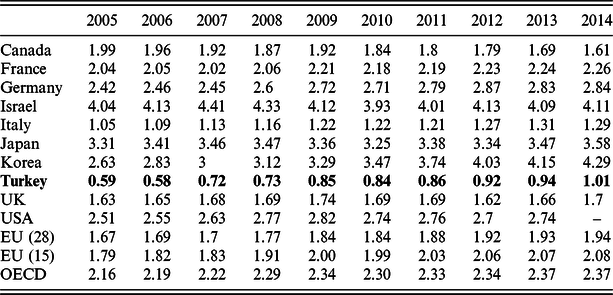
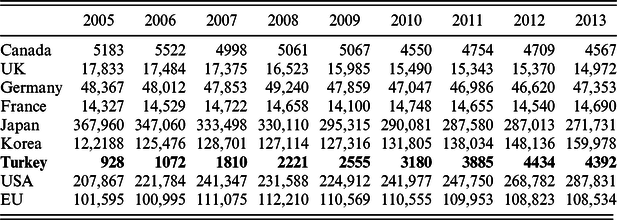
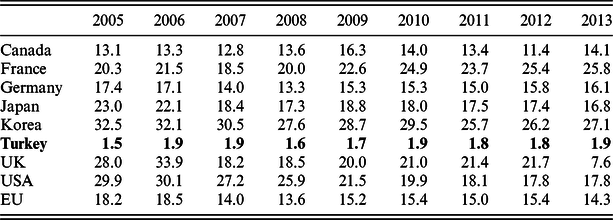
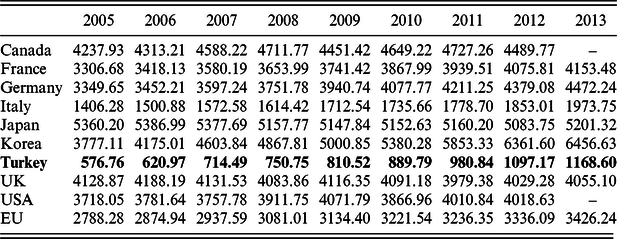
The data on these indicators for various countries and Turkey are given in Tables 1–4.
The share of R&D expenditures in GDP.

Source: OECD, Main Science and Technology Indicators Database, July 2018.
The share of R&D expenditures in GDP in Turkey increased from 0.59% in 2005 to 1.01% in 2014. As can be seen in Table 1, this share is rather low compared with countries such as Germany, the EU, the UK, Japan, USA, Korea and Israel.
In terms of the national and international patent registrations given out by the Turkish Patent Institution, Turkey achieved an eight-fold increase between 1998 and 2009, and reached 5.610 in 2009 (Yalçıntaş Gülbaş Reference Yalçıntaş Gülbaş2011, 139–145). However, as can be seen in Table 2, the difference between Turkey and other countries widens with respect to the number of patent applications, excluding Canada. Yet, the patent criterion should be evaluated not only in terms of quantity but also in terms of quality.
The number of patent applications by residents within the Patent Cooperation Treaty (PCT).

Source: World Bank, World Development Indicators, July 2018.
The share of high technology exports in total manufacturing exports in Turkey increased from 1.5% in 2005 to 1.9% in 2013. However, as can be seen in Table 3, as of 2013 the share of high technology exports in total manufacturing exports in Turkey is quite low compared with developed countries.
The share of high technology exports in total manufacturing exports (%).

Source: World Bank, World Development Indicators, July 2018.
The number of R&D researchers per million people.

Source: World Bank, World Development Indicators, July 2018.
Similar to the other criteria mentioned above, the number of R&D researchers in Turkey lags behind developed countries. Hence, despite all the restructuring and the steps taken in the public and private sectors and by the universities, it seems that Turkey needs to achieve more in science and technology.
5. Conclusion
Investments and structuring in the industrial sector in Turkey have been realised rapidly in the early years of the Turkish Republic. The planned development process, which was begun in the 1930s and interrupted by the Second World War, was restored in the 1960s, but the incentive policies were not implemented selectively. In the 1960s and 1970s no priority was given to economic and social benefit in science and technology policies (Göker Reference Göker2002, 1–24). While open market policies were implemented and some industrial investment was made in the 1980s, the services sector gained importance in the 1990s. In this period, the ‘science and technology’ policy, which was regarded as the key to development, was emphasised and a fast restructuring process started in this field. However, the existence of technology-related institutions and the design of science and technology policies alone are not enough. The main shortcoming of science and technology policies in Turkey is that there is a lack of implementation or full implementation of policy designs rather than their absence (Göker Reference Göker2002, 11).
The policies and restructuring that are designed to meet the needs of the industry and to increase collaboration between universities and industry can be described as the ‘industry-oriented approach’ to science and technology. It would surely be very useful and necessary that universities participate in and contribute to technology production oriented towards the needs of industry. However, it is also indisputable that the focus of research in universities should also be on science and on the production of new knowledge for the advancement of science.
Science should not be limited only to solving instant problems and producing technology, and human potential should be developed for science as well. In this sense, an ‘industry-oriented approach’ to science and technology in Turkey is necessary but not sufficient. Science and education infrastructures should be developed and qualified human resources required for industry should be formed. That is, both ‘science-for-science’ and an ‘industry-oriented approach’ should be followed in parallel.
Turkey’s medium- and long-term goal and strategy is to increase the domestic industrial production contribution through the development of technology, and at the same time produce high value-added products. In this way it is aimed at increasing the national income, decreasing the current account deficit, and escaping the middle income trap.
The development of basic industrial production sectors is needed in Turkey. This is necessary for industrialisation to continue. In this sense, it is not enough to focus only on the technology production required to produce products with high value-added. It is also necessary to develop new technologies for basic industries. It is clear that it is essential to find practical and quick solutions to the problems that arise in industry and to have a certain knowledge and experience in order to develop the technology that industry needs. It is seen from the example of other countries that success in high technology production will emerge within a basic and sound industrial and scientific infrastructure and as a result of a specific process. It would be useful to set such a vision for Turkey as well.
About the Authors
Itir Ozer-Imer holds a PhD degree in Economics from Hacettepe University, Ankara, Turkey and has conducted postdoctoral research at George Mason University’s School of Public Policy. She is currently working as an Associate Professor in the Department of International Relations of Hacettepe University. Her research interests include International Political Economy, Economic Development, International Trade and Finance, Economic Integration.
S. Tugrul İmer received an MA in Metallurgical and Materials Engineering from Middle East Technical University, Ankara, Turkey and holds a PhD degree in Political Science and Public Administration from Ankara Hacı Bayram Veli University. He is also the general manager of Gazi University Technopark, Ankara, Turkey. His expertise and research interests include technology commercialisation, technology transfer, university-industry collaboration and entrepreneurship.