Defeat in 1945 marked an exceptionally politicized moment of renegotiation within Japanese society, not least because Japan's conflict, like all wars, involved suppression of domestic dissent (Dower Reference Dower1999; Stone Reference Stone2004). Thus, it is not surprising that after the Asia-Pacific War was lost, many Japanese wanted to reform society by taming the belligerence of the state and by carving out a respected space for dissent. One such individual, Wakimura Yoshitarō (Reference Yoshitarō, Tai, Jurō, Masaya and Yoshitarō1900–1997), is the focus of this essay. Revealing a sophisticated understanding of how both explicit and implicit expressions of power operate culturally, Wakimura sought to make the implicit statements visible to others and then reshape Japanese cultural institutions along more inclusive lines.
During the war, Japanese national cohesion had been achieved through state-centered nationalism and mobilization for war, a combination that Wakimura, like many other Japanese of his generation, thought of as fascism. Wakimura's main focus, as discussed later, was to make Japan's economic institutions more egalitarian, but he also devoted a surprisingly large portion of his energies to establishing art museums and creating other opportunities for public art appreciation. Wakimura's actions, which went far beyond enthusiastic participation in a private hobby, show that he thought of art museums as both literal and figurative spaces in which Japanese could learn to communicate directly with each other in productive and respectful ways and thereby reshape political culture.
Wakimura thought of museum-going as one way to develop aesthetic and therefore political subjectivity. He championed the rights to free expression, assembly, publication, and “cultured living” established in the new Constitution while he was on the editorial board of Sekai magazine, where he edited a column on global politics from 1946 to 1959, frequently writing the entries himself (Yoshino Reference Genzaburō1989, 76–77). Such freedoms were not an abstract issue for Wakimura, as he had spent nineteen months in prison during the war for violating the harsh Peace Preservation Laws. Wakimura also was contributing to the postwar debates on why Japanese had allowed their government to drag them into a conflict that informed individuals already knew was unwinnable in 1941. Like such famous scholars as Wakimura's mentor, Ōuchi Hyōe, and his colleague Maruyama Masao, both of whom served on Sekai's editorial board, Wakimura thought that wartime Japanese had lacked sufficient political self-confidence, or political subjectivity, to resist the blandishments of the state (Karube Reference Karube2008; Koschmann Reference Koschmann1996). For Wakimura, an economist by training, the solution to this problem was, first, to provide more political rights, and, second, to encourage Japanese to be more rational, more universalistic, and more cosmopolitan in their thinking. As I have argued elsewhere, he worked hard to popularize empiricism, social scientific thought, and statistical literacy among the general population, so that Japanese could reject the faulty reasoning of a state that had justified its authority on the basis of uniqueness (Hein Reference Hein2004). Instilling habits of informed, systematic, logical thought—whether the topic was returns to capital or the merits of Cezanne—was a crucial way for citizens to safeguard their rights, he believed.
The habits that Wakimura wanted to encourage included respect for the views of others, which is where art seemed particularly important to him. Wakimura wanted to create new practices of art appreciation that could mediate relations between potentially antagonistic groups of Japanese, especially between capitalists and workers, but also between bourgeois businessmen and presumably bohemian artists. He also thought that the enjoyment of art was an important strategy for repairing the rift between political right-wingers who had controlled the state during the war and the newly legalized left-wingers (such as himself) whom they had persecuted. Communicating about art, he hoped, could teach Japanese to differ among themselves in ways that led neither to state repression nor to class conflict. He not only preached democracy, he also tried to shape postwar institutions so that newly empowered Japanese citizens could develop the tools to actually exercise that democracy.
Much recent scholarship on museums has emphasized the ways in which they extend the authority of the state—or the empire—and assert a unified national cultural tradition (Davis Reference Davis and Gillis1994; Dubin Reference Dubin1999; Duncan Reference Duncan1995). Other studies have explored the ways in which cultural capital operates as a hidden but powerful enforcer of social class barriers (Bourdieu Reference Bourdieu and Nice1984). Wakimura anticipated and shared both Pierre Bourdieu's assumption that individual taste is socially constructed and his insight that cultural capital operates as an invisible form of power (Bourdieu Reference Bourdieu and Nice1984). Yet rather than merely analyzing this phenomenon, Wakimura wanted to change it. The astonishing optimism and boldness of Japanese reformers in the early postwar years comes through in Wakimura's assumption that by democratizing access to aesthetic experience, wise social planners could diminish the distance between classes, particularly when they combined such efforts with national policies—such as a minimum wage and unemployment insurance—that eliminated economic insecurity.
Tony Bennett has pushed Bourdieu's insight further by observing that public museums ostensibly welcome all comers while still enforcing class distinctions. As he put it, the true “political rationality of the museum” comes from the inherent contradiction “between on the one hand, the democratic rhetoric governing the conception of public museums as vehicles for popular education and, on the other, their actual functioning as instruments for the reform of public manners” (Bennett Reference Bennett1995, 90). Bennett's point is that this contradiction is built into the museum because it valorizes bourgeois behavior. Yet Wakimura was not just trying to expose “the working classes to the improving mental influence of middle-class culture,” although that was one of his goals (Bennett Reference Bennett1995, 100). He also wanted to push middle-class culture into developing a sense of engagement with and obligation to all Japanese.
In other words, Wakimura not only understood what was at stake, but also treated arts institutions as just one element of a much larger project to transform bourgeois institutions. In myriad ways, he acted as a cultural broker, bringing together people in all areas of the art world and personally involving himself as a collector, exhibitor, scholar, and institution builder. His actions help explain the fact that Japan today has well over 200 art museums, in striking contrast to the pre-surrender years, when there were precisely two permanent venues for viewing modern art, although from the 1920s a dedicated art lover could see a variety of privately held or temporarily exhibited art objects (Guth, Volk, and Yamanashi Reference Guth, Volk and Yamanashi2004). Postwar Japanese art collectors now regularly lend their art both for special exhibits and long-term display at these museums, in another contrast with the past. To an extent not generally recognized, this flurry of postwar museum construction and new norms of art exhibition represent a concerted postwar effort not only to deepen democracy, but also, in some cases, to tame capitalism and constrain the nation-state. Moreover, most Japanese soon thought of themselves as middle class for the first time, just as Wakimura had hoped, a status that included the freedom to appreciate art as they pleased, a crucial step toward the cultural transformation he desired.
Yet Wakimura did not explicitly argue that these new museum visitors would or should transform the museum's contents, something that museum scholars such as Bennett argue must happen in order for museums to be truly open to all. Instead—and less attractively—Wakimura clearly saw himself as a good model for those who desired to enhance their cultural capital and political subjectivity.
Developing a Politics of Culture
Wakimura participated in Japan's newly developing social infrastructure from the beginning. Born as the century opened, he came of age at an important moment in Japanese cultural history, just when mass media and access to higher education were expanding enormously, creating a vibrant modern culture, particularly in Japan's cities (Harootunian Reference Harootunian2000; Tipton and Clark Reference Tipton and Clark2000). Wakimura's postwar assumption that he could be a model for other Japanese who desired cultural capital was both presumptuous and snobbish, but it was not wrong. He really was a part of the new cosmopolitan elite. As a middle school student, he discovered the premier site of literary and artistic modernism, Shirakaba magazine, soon after it appeared in 1910. Other important Japanese institutions for appreciating and exhibiting modern art were just then developing. In 1921, Wakimura visited an exhibition of French paintings in Osaka sponsored by Asahi News. At that time, the paintings were simply hung at the newspaper office, because neither news organizations nor department stores had yet established dedicated spaces for exhibits, although they would soon become two of the major venues for viewing art, as detailed by Julia Sapin (Reference Sapin2003). The paintings belonged to Ōhara Magosaburō, who later built Japan's first museum of European art, including modern art, which opened in 1930.
Ōhara was a crucial figure in introducing both modern art and civic-minded collecting and display to other Japanese. Japan had a long tradition of artistic expression in private settings, one that businessmen such as Masuda Takashi updated and appropriated for their own purposes, as Christine M. E. Guth (Reference Guth1993) has pointed out. Yet, as both Guth and Umesao Tadao have noted, Meiji-era individuals such as Masuda were not interested in promoting public access to art, and Ōhara stood essentially alone in this regard in prewar Japan (see Guth, Volk, and Yamanashi Reference Guth, Volk and Yamanashi2004, 82–84; Umesao Reference Tadao, Tadao, Lockyer and Kenji2001, 3).
Wakimura not only admired Ōhara for these efforts, he did so at close range. Ōhara's son Sōichirō and Wakimura were lifelong friends who frequently shared evenings at theaters and concert halls. Wakimura was connected to Ōhara Magosaburō in other ways as well; the older man had founded several other philanthropic institutions, such as a social science research institute best known for its efforts to improve wages and working conditions, that employed many of Wakimura's economist friends.
Wakimura was also influenced by John Ruskin's work, which he encountered very early. Economist Kawakami Hajime, who also introduced Marxism to Japan, was a friend of Wakimura's father, and the younger man almost certainly read Kawakami's 1917 translation of John Ruskin's “Unto This Last” when it first appeared. Ruskin's quirky blend of left-leaning economic ideas and celebration of art as the key to empowering individuals quickly attracted Wakimura's attention, as did Ruskin's belief that aesthetic judgment was fundamental to both human happiness and a just society (Sakai Tadayasu, interview, May 19, 2006; Sugihara Reference Shirō1994).
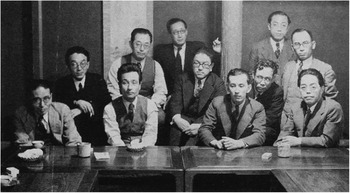
Another model for combining left-wing economic analysis and public forms of art criticism was closer to home. Ōmori Yoshitarō was two years ahead of Wakimura in graduate school, and also preceded him as a young economics professor at Tokyo Imperial University. Ōmori, who was a member of the semilegal Marxist group that published the journal Rōnō, was also one of the first people in Japan to earn significant income as a film critic. He wrote in Kaizō magazine about the relationship between movies and other cultural and economic developments, commenting, for example, on fashions seen on the street that were inspired by films, and on cinema as an industry. As Carole Cavanaugh and Dennis Washburn have argued, cinema seemed to many Japanese in the 1920s “the medium with the greatest potential to express the experiences of modern society” (2001, xxii). This was certainly one of the main attractions for Ōmori, who also enjoyed the opportunity to shape public opinion. From 1923 to 1928, when Ōmori was forced to resign his job because of his politics, Wakimura saw him every day (Arisawa, Miyazaki, and Wakimura Reference Hiromi, Toshiyoshi and Yoshitarō1953). After 1928, the two friends continued to see each other regularly—for example, visiting the Shōchiku studio together to see films before their official release. In a photograph from 1935 (figure 1), taken at a farewell party for Wakimura, Ōmori is seated next to him, suggesting that he hosted the event. By the mid-1930s, then, Wakimura had amassed considerable knowledge about modern art, was already a participant in exhibition practices and the art market, and had a close friend who was a pioneer in the new field of arts criticism.
Farewell party for Wakimura before he left for London in 1935. Front row, from left, are Sakisaka Itsurō, Ōmori Yoshitarō, Wakimura Yoshitarō, and Arisawa Hiromi. The second row shows Tsuchiya Takao, Abe Isamu, Maede Chōgorō, an unidentified man, and Serizawa Hyōe, while Minobe Ryōshin and his cousin Minami Kinji are in the back row.

Like many young Japanese and their peers around the world, one of the attractions of Marxism for Wakimura and Ōmori was that they saw socialism as likely to liberate human potential of all kinds. These young people in the 1920s looked to socialism not only to free “the masses” from drudgery in the workplace, but also to free individuals to transform their environments. Although, under Joseph Stalin's rule, Marxism later became associated with heavy-handed state supervision that crushed individual expression, in the 1920s, it seemed highly compatible with diverse forms of individual creativity. By the same token, Wakimura (and to a lesser extent, Ōmori) shared the usually implicit Marxist assumption that individuals should exercise self-control for the sake of the collective good. Thus, he was not attracted to the wilder avant-garde explorations of anarchical and sexual self-expression epitomized by the MAVO movement (Weisenfeld Reference Weisenfeld2002).
Wakimura's priorities were based on his understanding of the tandem historical development of capitalism and bourgeois culture. Like many scholars of his generation, Wakimura thought in terms of Marxist stages of historical development, in which cultural changes were the by-products of new economic actors, although he was unusually attuned to the precise ways in which specific capitalists created bourgeois culture, as this was his own research subject. In the mid-1930s, he spent two years in Great Britain, studying how Lloyds of London managers had taught their values—not just their activities—to new employees and how they managed financial risk in the volatile international shipping industry.
The central debate among people interested in these issues during late 1920s Japan was whether their compatriots were already modern enough to handle bourgeois—that is, democratic—politics, or whether they were mired in feudal structures and attitudes. Ōmori and Wakimura clearly belonged to the former camp. One of the important implications of their branch of Marxist thought was that working-class empowerment could evolve out of capitalism rather than requiring a class revolution, meaning that the line between that stance and one that espoused capitalist reform was always blurry. This meant that Wakimura's analysis would change very little over the decades.
Indeed, although Wakimura remained concerned about class conflict throughout his life, fundamentally, he thought that bourgeois culture was a good thing that should be made more democratic. His allegiance to the cultural pastimes of his own class was built on theoretical and strategic reasons as well as his own personal inclinations. Following not only Marx but also Maruyama and Ōuchi, Wakimura thought that democratic liberties and the public sphere in which they were valued, while originally the creation of European middle-class urbanites in the seventeenth and eighteenth centuries, were completely appropriate and necessary to modern Japan. As he reminded his readers, early modern European cities were the first places “where the air was free” from feudal overlords (Wakimura Reference Yoshitarō1975b). Thus, ensuring such bourgeois freedoms and making bourgeois culture more welcoming to all Japanese was a crucial missing element for postwar Japan's evolution into a fairer system. Even though Wakimura never used this term, the concept of a “postcapitalist society” captures his thinking.
Wakimura's own aesthetic preferences were for representational art, particularly oil painting, but he also thought that in a truly modern society, everyone should have the opportunity to develop their aesthetic tastes. Indeed, his brother Reijirō, with whom he enjoyed a close relationship, also collected art, but he preferred Edo-period literati painting and modern abstract American and Japanese art. The Wakimura brothers' belief in providing art to all without trying to define “better” kinds of art for other people was similar to that expressed by other elite, left-wing, twentieth-century cosmopolitans around the globe. As Raymond Williams (Reference Williams, Crabtree and Thirwall1978) has argued for the Bloomsbury group, which included the eminent economist John Maynard Keynes, the crucial issue for the Wakimura brothers was the freedom to choose a favorite style and thereby develop one's own aesthetic judgment. And, like the Bloomsbury group, Wakimura not only thought that providing such opportunities would help democratize the political as well as the cultural sphere, but also was similarly vague as to the precise point at which capitalism would end and postcapitalism would set in. Wakimura admired Ōhara Magosaburō precisely because he had made such opportunities possible for others in a systematic way.
The freedom to choose one's own style was, of course, a distant fantasy in wartime Japan. After two years in Europe, Wakimura was shocked when he returned home in October 1937 at how repressive Japan had become in his absence, feeling like Urashima Tarō, the Rip van Winkle of Japanese folklore. Shortly afterward, he refused to lead his students to Meiji Shrine to pray for victory over China, saying, “I've gone to all this effort to study abroad and bring back knowledge to Japan. I want to go on studying, not get involved in politics. Precisely because war has begun, I cannot participate in this renovationist movement in the nation or the university,” a protest strong enough that Wakimura's department chair demanded his resignation (Tokyo Daigaku Reference Tokyo Daigaku Keizai Gakubu1976, 690, 696). Wakimura was, in this seemingly mild way, trying to resist the government's campaign of spiritual mobilization. Yet because Japan's leaders viewed the war as a catalyst for domestic cultural renewal, they directed the full panoply of state power against cultural heterodoxy as well as explicit critics of their military policies. Visual art was only one of many arenas for this home front assault, as Wakimura understood better than most (Earhart Reference Earhart2007).
Soon things grew worse. Wakimura was imprisoned on February 1, 1938, on charges of violating the Peace Preservation Laws. He ran into trouble for essays he had published between 1930 and 1932 that had criticized Japanese capitalism and suggested that invading China was a doomed project. Even though the essays had passed the censors at the time, the authorities now argued that they showed that Wakimura was dangerous to public order. Ōmori Yoshitarō was arrested on related charges in December 1937 and died in July 1940 shortly after emergency surgery, paid for by Wakimura. Far luckier, Wakimura was released on bail in August 1939 and, after two trials, was acquitted in August 1944 (Wakimura Reference Yoshitarō1991, 202–11).
Wakimura's personal wartime experiences explain the intensity of his desire to create institutions that would both strengthen society at the expense of the state and ameliorate capitalism. He also had extraordinary opportunities to effect such change. On August 15, 1945, Wakimura was already working in the economic division of the Ministry of Foreign Affairs, where he and a few others had quietly begun planning what to do after the impending defeat. Beginning on August 16, these men organized a famous and enormously influential project to rebuild the Japanese economy in ways that encouraged higher industrial wages and lower rural rents (Special Survey Committee Reference Ōkita1992). It is hard to overemphasize the importance of this policy, which fundamentally reoriented the economy away from a development strategy based on cheap labor to one designed to raise standards of living. It was, in short, a blueprint for new economic ground rules for Japanese society.
Wakimura was particularly involved in efforts to prune back the power of big businesses, which he thought were partly responsible for the war in China as well as for poverty at home. One of his first postwar tasks, as an official liaison between the Ministry of Foreign Affairs and the occupation government, was to explain to Japanese officials and business leaders the American antitrust rationale for breaking up large corporations. As he put it in 1968, “SCAP [Supreme Commander of the Allied Powers] analysis of Japan's pre-surrender political economy was that Japanese aggression derived in part from the excessive economic control by a few huge corporations and their ability to keep wages low and rural rents high, constricting the Japanese consumer market.” He continued, “when we look at the postwar twenty years, my conclusion is that they were exactly right” (Wakimura and Masaki Reference Yoshitarō and Chifuyu1968, 124). Wakimura enforced this stance when he served on the six-man Holding Company Liquidation Commission (Kabushiki Kaisha Seiri Iinkai), appointed by the Japanese government to break up the giant zaibatsu corporations. He also defended occupation purges of business leaders because they cleared the way for younger men who were more willing to radically change the economy, and who could be taught how to treat workers as cultural equals (Wakimura Reference Yoshitarō and Yoshio1966, 184).
In later years, Wakimura continued to push government officials and business leaders to fully commit to a socially responsible vision of enlightened capitalism and to guarantee more equitable distribution of economic resources through a national minimum wage, a progressive tax structure, universal health care, and retirement pensions. He increased the power of labor unions at the Maritime Industry Labor Arbitration Board, for example, where he helped establish an industry-wide retirement plan so that sailors could change jobs without losing their pensions, a settlement that was used as a model by other industries. In his main career as an economist, then, Wakimura spent his time developing both a strong regulatory structure to control capitalism and new spaces in which workers and managers could work out their differences directly with each other on an equal footing.
Using Art Appreciation to Build Democratic Community
Wakimura also used art appreciation to establish alliances with conservative elites in order to pass social reform legislation and so repair the social damage inflicted by the government before 1945. Wakimura frequently mediated between activists in the Socialist and Liberal Democratic parties, and art appreciation was a key tool in that effort. Two Liberal Democratic Party stalwarts, Takemi Tarō and Ishida Hirohide, provide instructive examples. Both shared Wakimura's art interests and lent paintings for exhibitions that he helped organize, giving them a safe topic of conversation where they could develop some trust in each other. Takemi, a medical doctor as well as a politician, served from 1949 for a decade under Ōuchi Hyōe on the Social Insurance Commission (Shakai Hoshō Seido Shingikai), which built Japan's postwar national health insurance system. His cooperation made it possible to pass crucial legislation in the Diet that expanded the social welfare system. The cooperation between Wakimura and Ōuchi, on one hand, and Takemi, on the other, represented a repudiation of the politics of the past, when men such as Takemi had stood by when Ōuchi and Wakimura were thrown in prison.
Wakimura's involvement with Ishida shows even more clearly that his model for cooperating with conservative elites was predicated on their willingness to tame capitalism. Ishida served as minister of labor in both the short-lived Ishibashi Tanzan cabinet in 1957 and the Ikeda Hayato cabinet in 1960–64. He emphasized the importance of a cultural life for all Japanese when he enforced the right to one day off per week as the most important goal of his first stint as labor minister. Without free time, workers could not possibly engage in cultural activities such as visiting art museums, after all. Despite his Liberal Democratic Party credentials, Ishida agreed with Wakimura that firms had had far too much power over workers in the past and that Japanese social institutions should better meet workers' needs. Under Ishida, the Ministry of Labor agreed to work within the framework of the “spring wage offensive,” a tactic employed by labor unions in 1955 to maximize their bargaining power. When Ishida reassumed responsibility for labor in 1960, Japan was in the midst of the Miike coal mine strike, the single most important battle for control of Japan's workplaces in the postwar era. Rebuffing the confrontational tactics of the intervening Kishi Nobusuke administration, Ishida forced both sides to accept binding arbitration (administered by a six-man board that included Wakimura's closest friend) and then provided substantial social welfare benefits to miners as the industry declined (Ishida Reference Hirohide1960, Reference Hirohide1986). This was precisely the approach recommended by Wakimura and his friends, and neither Takemi nor Ikeda is likely to have followed their advice without these direct personal interactions.
Beginning in the 1950s, Wakimura focused on a new research area in which to encourage political subjectivity and cross-class dialogue: paintings, art markets, and art museums. In his writing, Wakimura set out to demystify the global historical development of bourgeois taste-making institutions, particularly the art market and art collecting practices, in a book that he first planned in 1950 but only published in 1967. His approach, which combined business history and art history in a portable, easy-to-read paperback, was imaginative and unusual, explaining why The Value of Taste (Shumi no kachi) became a long-term bestseller. That volume analyzed the history of the global art market in terms that anticipated art historical analysis today, emphasizing both the intertwined global circuits of aesthetic and economic exchange and the interplay between elite and mass culture. Other chapters did the same for wine, whiskey, diamonds, tea, and Persian rugs.
In the chapter on the global art market, Wakimura explained that, in both Europe and Japan, ordinary people only began buying art when mechanisms were established that assured them of a fair market with the same price for all purchasers (1967, 119–20). Drawing on company histories of the Sotheby's and Christie's firms, he explained that the first crucial step was the development of the auction system at the end of the sixteenth century. The auction houses accidentally became the main route by which ordinary people could view art in the early eighteenth century. “At that time, there were very few museums (the British Museum opened in 1759) and almost no opportunity for the general public to get close to the art amassed by the royal family. Auction houses had public viewings of their goods the day before the auction and that became one of the few chances for people to look at them. This was a big reason that people went to the auctions” (Wakimura Reference Yoshitarō1967, 128). His point was that this quintessentially capitalist institution directly contributed to expanding the cultural opportunities for ordinary citizens and also diminished the power of the aristocracy. Moreover, the auctioneers, while pursuing a different agenda, discovered that people wanted more art than they were being offered, showing the democratic origin of this development.
Wakimura went on to explain that, on a smaller scale, art appreciation spread to the middle class when some Britons served as tutors to young aristocrats making a grand tour of the Continent. One such individual was Adam Smith, the author of The Wealth of Nations, generally considered the first book to express modern—that is, capitalist—economic thought. At the same time that Smith was disseminating a new model of how markets worked, he was also articulating an expanded place for art appreciation within middle class culture (Wakimura Reference Yoshitarō1967, 129). Wakimura's audience would have understood that he was explaining precisely how the demand for art and its supply were being transformed from a feudal relationship between patron and client to a market relationship among modern institutions and bourgeois individuals.
Despite his substantial publication record on both economics and art, Wakimura rarely made the next piece of his argument explicit—that the arts played an important role in overcoming the contradictions of capitalism. Perhaps because of his wartime experience of having his words retroactively declared dangerous to public order even though they had passed the censors when they were published, Wakimura typically built his essays out of a dense stack of facts with little interpretive framing. (This strategy, of course, is itself an argument for the value of empirical information.) Nonetheless, his choices of topics and facts, the consistent way in which he staged opportunities for others to express similar views, and his actions on behalf of public and private museums reveal his underlying assumptions.
So how could Japanese develop better relations across social classes through art appreciation? Drawing on the central assumption of modern economic thought, that people respond to incentives, Wakimura located the answers to this question in specific economic and political institutions. He frequently argued that the government should use the tax system more aggressively to encourage collectors to deposit their artworks in public museums, as in the United States. In several essays, he mentioned that both the National Gallery of Art and the museum-friendly tax code of the United States were the personal creations of Andrew W. Mellon, who moved to Washington, D.C., to become secretary of the treasury in 1921 but was dissatisfied about living in a city that he considered a “cultural desert” (Wakimura et al. Reference Yoshitarō, Tai, Jurō, Masaya and Yoshitarō1990, 289). Mellon responded not only by donating his collection to the nation, but also by paying for the building to house it. More importantly, Wakimura thought, he also altered the federal inheritance tax by exempting donations to cultural institutions, giving wealthy individuals a huge incentive to donate their most valuable possessions outside the family. In a 1982 conversation with like-minded industrialist and “Sunday painter” Suzuki Haruo, after Wakimura explained this system, Suzuki responded that “rather than thinking of donations as spontaneous acts by individuals, they should be seen as a system of estate management influenced by public policy” (Wakimura and Suzuki Reference Yoshitarō, Haruo, Yoshitarō and Yoshitarō1990, 348–50). Both men agreed that governments not only could but should shape art production and consumption through such policies.
Wakimura thought that providing public spaces for various kinds of modern art offered symbolic value as a peaceful, forward-looking activity that could reconnect Japan to the international community of nations and redeem Japan's international image. While this attitude can be construed as nationalistic, although not state centered, Wakimura never argued for a distinctive Japanese aesthetic sense, unlike essentially all public discussion of Japanese art during the war, as well as much prewar discourse (Thomas Reference Thomas2002). Rather, he consistently argued that variations in the European, American, and Japanese social contexts for art production and consumption could all be explained by specific political and economic institutions, such as anti-Semitism, the tax code, or export laws, rather than by timeless cultural differences (Wakimura Reference Yoshitarō1967).
Wakimura gave much thought to specific business practices that would encourage nonelite Japanese to spend more time and energy on arts appreciation, too. In a 1965 discussion with Hasegawa Jin and Kuwahara Mikine, he complimented Hasegawa for keeping his Nichidō gallery open on Sundays. Doing so meant that students and working Japanese could “enjoy viewing art from a young age and learn about it. I believe that really is a major service.” Wakimura also approved of Hasegawa's practice of putting the best paintings on the walls, where anyone could walk in to look at them, rather than the traditional practice of bringing them out only for viewing by clients who were seriously interested in purchasing them. In the same spirit, Wakimura urged Hasegawa to hire staff to explain the finer points of each painting to visitors on Saturday mornings, as was common at Roman art galleries (Kuwahara, Hasegawa, and Wakimura Reference Mikine, Jin and Yoshitarō1965, 4–5). He was, of course, snobbishly showing off his international sophistication, but his political point was that widening access to good art was a democratizing act that benefited everyone involved.
In other words, Wakimura advocated a range of new activities for government officials and businessmen that would establish new norms for bourgeois culture. As he put it, “of course we collectors have an obligation to both society and the artist to publicly display art objects” (Wakimura Reference Yoshitarō1976a, 23). In particular, he wanted large corporations and individual businessmen to take responsibility for bridging social tensions among Japanese. First and foremost, this meant class tensions. As he made clear in his business histories, he thought that capitalists had too often viewed workers with mistrust and did little to make them feel as if they were valued members of the national community. On the other side of the class divide, many poorer Japanese thought of their rich compatriots as rapacious and evil men. While supporting workers' rights to better wages and working conditions was the most important step toward a good society, Japanese also needed to engage in egalitarian human contact to transform their class prejudices, Wakimura believed, and he hoped that mutual enjoyment of art could be an important vehicle for that process.
At the same time, Wakimura appreciated the fact that philanthropy was compatible with profit. In his discussion with Kuwahara and Hasegawa, he half-joked that making art accessible to young people was fundamentally self-interested because, after gradually developing their tastes, several were likely to return to the gallery to buy something. Wakimura not only understood that exhibition and scholarship enhanced the value of an artist's works, he also used this insight to develop his own financially as well as artistically significant collection, and to help his friends (Yonekura Mamoru, interview, May 24, 2006). Wakimura helped organize at least four exhibits on Saeki Yūzō and two on Kishida Ryūsei, the two main artists he collected, and also conducted scholarship on them himself, such as at the “Ryūsei no Kai” study group. Art dealer Hasegawa Jin started this organization in 1963 because he correctly anticipated that some of Kishida's paintings would soon be designated important cultural properties by the national government and wanted a good record of Kishida's output in order to identify fakes (Wakimura et al. Reference Yoshitarō, Riichirō, Akira, Nobuo, Hideo, Tadao and Ichirō1979). As the value of his collection grew, Wakimura used it as a fund to help his friends' civic activities. For example, in 1973, he put up a painting as collateral to back a bridge loan for Tsuru Shigeto, then president of Hitotsubashi University. Tsuru wanted to purchase a $10 million book collection in the United States for the public university's library and needed to secure it while he arranged permanent financing (Tsuru Reference Shigeto1991, 4).
In a 1991 discussion with Suzuki Haruo, Wakimura and Suzuki thought that society would benefit from more direct dialogue between “business leaders and creative artists, including musicians, poets, and novelists,” who “need to learn to understand and appreciate each other, or there can be no trust” across that cultural divide. Wakimura himself had many friends who were artists, novelists, and poets. Suzuki spoke for both men when he said, “Businessmen must get to know artists. If that happens, they will appreciate how artists feel about things…. But, from the artists' perspective, somehow when they look at executives, they don't say it straight out, but they are suspicious. Firms are profit-seeking organizations so how can they understand art?…. It's an uncomfortable fact but to a certain extent the attitude of the general public in the past was that business executives who made cultural contributions were just trying to make themselves less dirty.” Another way of putting the same problem, they agreed, is that people too often assume that others are motivated solely by a desire for financial self-interest or for self-expression, and should recognize that people blend those motivations. Greater mutual understanding of each other's perspectives, along the lines pioneered by Ōhara Magosaburō, would lead to more long-term financial support of the arts by businessmen, a higher level of cultural knowledge among the entire population, and a more tolerant society (Wakimura, Suzuki, and Yui Reference Yoshitarō, Haruo and Tsunehiko1991, 17).
Museum Building for Democracy
While Wakimura explored a variety of ways that private activities and public policy could be braided together to promote the right to cultural life for all citizens, he clearly thought the best social practice was to house art in public museums. Wakimura wrote about this topic on many occasions, suggesting that art should be publicly funded and available to all, like education. In a 1965 essay, he noted approvingly that Europeans considered it “good etiquette” for every municipality to include in its basic plans a public art museum to serve as the city's central “ornamental space.” Interestingly, he used the Japanese term tokonoma to make this point, subtly reinforcing his position that modernity and urbanity were both universal qualities (Kuwahara, Hasegawa, and Wakimura Reference Mikine, Jin and Yoshitarō1965, 7). Elsewhere, he wrote approvingly of efforts by provincial elites in such places as Detroit, Osaka, rural Holland, and Edinburgh to establish municipal or regional museums that would counterbalance the dominance of the capital city (Wakimura, Suzuki, and Yui Reference Yoshitarō, Haruo and Tsunehiko1991).
Wakimura personally left his mark on at least four public museums. He had the greatest impact on a new municipal museum that he and his brother Reijirō established in their home town in Wakayama Prefecture in 1996, capping decades of efforts to bring high-quality art to the area. Reijirō, who died in 1988, made the first and largest commitment, in a bequest to Tanabe City of stocks worth 302 million yen (approximately $2.3 million at 1988 exchange rates) earmarked for building a museum. He also promised the new museum the right to display all his 112 Tokugawa-era paintings, and ensured free admission to the permanent collection. Wakimura Yoshitarō added to the museum's modern art holdings when he bequeathed to it Saeki Yūzō's painting Luxembourg Gardens, and allowed it to hold twenty-seven other paintings on long-term loan, including Saeki's Door and Nakamura Tsune's Girl with a Hat. While Yoshitarō donated his most valuable paintings to public museums, he and his brother left most of them to a nonprofit foundation that their family had established several decades earlier, which, in turn, lent the art to the Tanabe City Museum. A big reason for this double-barreled arrangement was to avoid inheritance taxes but, as explained earlier, Wakimura approved of such taxes (Ueyama Reference Shunpei and Bijutsukan2000; Mitani Wataru, interview, March 10, 2009).
Wakimura actually began his museum activities much earlier. His first major relationship with a museum was with the pioneering and dynamic Museum of Modern Art in Kamakura (Kanagawa Kenritsu Kindai Bijutsukan), where he served on the advisory board from its inception in November 1951, and chaired its management committee from 1969 until his death in 1997. The Kamakura museum is justly famous for creating exhibits that explore important themes in art history, such as how paintings and prints have contributed to modern understandings of the city, or how premodern art was reassessed in the twentieth century. The museum also has advised small cities throughout Japan on how to expand local cultural opportunities. Wakimura helped in a variety of ways. In the early years, when such information was scarce in Japan, he clipped the art reviews from his expensive air mail subscriptions to the New York Times and London Times for the curators (Wakimura Reference Yoshitarō1993, 303). He arranged for publication of a museum catalog on at least one occasion, and in 1984, when the museum was planning a major show on Kishida Ryūsei, Wakimura convinced Iwanami Press to publish Kishida's multivolume diary at the same time (Hosoya, Sugimoto, and Kikukawa Reference Chihiro, Toshirō and Hideo1991–92, 34–35, 59). He also sometimes paid for opening night receptions. Before he died, Wakimura bequeathed the museum his most valuable painting, a 1923 portrait by Kishida Ryūsei of Kishida's daughter Reiko that Wakimura had purchased in late 1937 for 2,000 yen (Sakai Reference Tadayasu and Tadayasu2004, 39–41).
Wakimura influenced Tokyo museums as well. Minobe Ryōkichi, who had been Wakimura's close friend since graduate school and had been arrested with him in 1938, was governor of Tokyo from 1967 to 1979. He recruited Wakimura for two major projects to develop Tokyo's cultural institutions. In August 1971, he appointed Wakimura as head of the committee to rebuild the Tokyo Metropolitan Art Museum in Ueno Park. The municipal museum, founded in 1926, needed to be completely rebuilt. Wakimura hired the architect and commissioned him to design spaces for classrooms, a lecture hall, workshops, a library, and several new exhibition rooms, including one dedicated to contemporary Japanese art (Wakimura Tomō, interview, April 13, 2005). His goal was to make the museum more multifunctional, more welcoming to Tokyo residents, and more receptive to postwar art. The structure in existence today is the result. Wakimura also arranged a job there for Asahi Akira, one of the assistant curators at the Kamakura museum. Minobe had offered the directorship of the museum to Wakimura, but he thought the museum should be run by someone young, smart, and professionally trained, the strategy for building a strong organization that Wakimura had first identified at Lloyds of London thirty years earlier (Hosoya, Sugimoto, and Kikukawa Reference Chihiro, Toshirō and Hideo1991–92, 100). At about the same time, Wakimura joined the board of trustees of the National Western Art Museum (Kokuritsu Seiyō Bijutsukan) in Ueno Park, which had opened in June 1959. He helped plan and organize a Saeki Yūzō exhibit there in 1978 (Yonekura Reference Mamoru2000, 74–77).
From December 1972 until May 1977, Wakimura served as chair of the Tokyo municipal planning committee for arts and performance spaces throughout the city. The committee's single largest project was the design for an eleven-story Ikebukuro arts complex that was to include an opera house, performance spaces for dance and music, and an art gallery. Wakimura drew on his personal experience of evenings spent at opera houses in Sydney, New York, London, Paris, and Vienna in choosing the architectural design. The committee completed its work but, after Minobe stepped down in 1979, leaving a substantial municipal debt, the plan was shelved, although it was dusted off much later and became the basis for the 1990 Tokyo Metropolitan Art Space (Minobe Oyako Archive; Minobe Reference Ryōkichi1979, 130–34).
While Wakimura firmly believed in public museums, he also helped establish several private ones. Wakimura had met the heads of every major zaibatsu corporation when he served on the occupation-era Holding Company Liquidation Commission (Wakimura Reference Yoshitarō1975b, 239). Because of this contact, the Mitsui family hired him in the early 1960s to organize the records of the then-disbanded core firm. When he inventoried Mitsui's holdings, Wakimura realized that the Mitsui family owned substantial art collections, including the tea-related collection established by Masuda Takashi in the Meiji era. He advised the family to donate its art to a cultural foundation, advice that led to the creation of the museum at the Mitsui Bunko. Wakimura then served on its board of directors and advised the museum on its acquisition strategy, urging the curators to develop a distinctive and coherent collection. (Wakimura Reference Yoshitarō1995, 168; Yui Tsunehiko, interview, May 26, 2009).
Wakimura also helped Kaga Tani, the president of Tokyo Denki Corporation (later Tōshiba), establish the Central Museum in downtown Tokyo because he “agreed with Kaga that well-planned exhibits in places like Ginza and Sukiyabashi can attract busy working people from as far away as Ueno even on weekdays,” and wanted to support such an endeavor. Wakimura helped Kaga set up the exhibit space and hire a qualified manager. The Central Museum opened with a show on Maurice Utrillo and then one on Fujita Tsuguharu. The third exhibit, yet another on Saeki Yūzō, was a joint venture between Asahi News, which offered publicity, the Central Museum, which provided the hall, and Nichidō Garō, which supplied a full-time staff member to organize the exhibit, all brokered by Wakimura.
The Tōshiba Corporation eventually closed the gallery so that it could use the high-rent space for other purposes. Wakimura called this decision “retrograde” and “reversing progress,” and complained in print that “if Tōshiba had only held out a little longer, changing market conditions would have meant that it could have taken advantage of the new Odakyū Department Store building that went up shortly afterward and so participated in making Tokyo the third best museum city in the world after London and New York.” As far as he was concerned, Tōshiba was shirking its responsibility to the public as well as missing out on a business opportunity (Wakimura Reference Yoshitarō1976b, 340).
Wakimura also served on the boards of directors of the Yamatane Art Museum in Tokyo's Nihonbashi district and the Kasama Nichidō Art Museum in Ibaragi. Wakimura was particularly proud that he had convinced a private seller to let the founder of the Yamatane Museum, Yamazaki Tomiji, buy a painting that several people were trying to acquire by arguing that Yamazaki should have it because he planned to display it publicly. The painting, a nude by Murakami Kagaku, then became the centerpiece of the museum's collection (Wakimura Tomō, interview, May 17, 2006). Finally, Wakimura helped petroleum magnate Idemitsu Sazō set up the Idemitsu Museum, joined its board of trustees in October 1972, and then its managing board in March 1985. In a book written while the museum was still in the planning stages, Wakimura stressed that “it is many times more difficult to build a museum that the public can enter” than to just privately enjoy a valuable art collection, praising the strong sense of public service implied by its creation (Wakimura Reference Yoshitarō1967, 204).
In addition to working directly with these public and private museums, Wakimura also poured energy into convincing Japanese businessmen and corporations to democratize access to their art. Indeed, his main contribution to the museums mentioned earlier was to convince reluctant owners to lend their art for temporary exhibits. Wakimura frequently praised private collectors who did so in print, such as his comments about Yamamoto Sumio, who “freely sends” his paintings to exhibits “whenever he is asked.” Later, after Wakimura negotiated with the mayor of Osaka, Yamamoto eventually donated his collection to the Osaka Municipal Museum of Art, raising him even higher in Wakimura's estimation (Wakimura Reference Yoshitarō1993, 305–11). By contrast, Wakimura was very critical of businessmen who kept their art inaccessible to the public, a practice that he, Suzuki Haruo, and Yui Tsunehiko derided as “hoarding” in their conversation (Wakimura, Suzuki, and Yui Reference Yoshitarō, Haruo and Tsunehiko1991, 11). In 1993—at the age of ninety-three—Wakimura lamented that he could no longer play his favorite role of kagemusha, or power broker, because the new younger company presidents no longer knew his face or his reputation (Wakimura Reference Yoshitarō1993, 313–15).
Wakimura expanded his focus on art as a tool of reconciliation to include international war reparations on at least one occasion. After discussing the Italian government's attempt to reclaim a painting that had been stolen by the Nazis and then acquired by the Boston Museum of Fine Arts, Wakimura added that “[i]n Japan's case too, it is proper that after the war Japanese should decide to return art to Korea to restore international relations.” Wakimura went on to explain that, while the National Art Museum and other public bodies had repatriated some important art works to Korea, very few individual owners had. “In fact … probably there are still some important collectors in Osaka who are keeping quiet” (Wakimura Reference Yoshitarō1972, 4). Given Wakimura's extensive knowledge about the Kansai business elite, it is likely that he spoke from certain knowledge. His point was that, although such behavior is characteristic of collectors everywhere, it is not civic minded. Internationally as well as at home, art was most valuable when it broadened rather than constricted the public sphere.
Contrary to Wakimura's hopes, modern art has not, nor is it likely to ever fully support the political weight of institutionalizing democracy. Indeed, Wakimura's clear understanding that capitalist markets shape tastes already called into question his imagined community of aesthetically empowered individuals. Nor do art museums attract all citizens equally, as Bourdieu has convincingly argued. In Japan, as elsewhere, they are mainly visited by older and wealthier individuals (and mostly women). Yet Japanese in every prefecture now can enjoy beautifully hung visual images in elegant buildings. The overwhelming majority of Japanese today think of themselves as both middle class and cosmopolitan, which they define specifically in terms of such leisure pursuits as visiting art museums. In a 1998 government survey, 40 percent of respondents, or 53.4 million Japanese, had visited an art museum in the previous year. Museum-going was the most common cultural pursuit reported, surpassing visits to theater performances, cinema screenings, or any other cultural pastime (Japanese Government 2000, 1–2). Public and private art museums function as centers of local community and are among the best developed areas of philanthropy in Japan. Most host a busy schedule of public lectures, art appreciation classes, and other cultural events.
Meanwhile, at a more important level, Wakimura's goal is realized even when young people direct their aesthetic attention to other art forms, such as manga and pop-rock. Rather than seeking dialogue, these teens and twenty-somethings make their choices partly in order to evade explicit dialogue with older people, whose cluelessness is a significant part of such media's appeal for them. While their interest in creating a subculture accessible only to young people may seem at first glance to reject Wakimura's goals, their easy assumption that they have the right to choose their own cultural politics, unconstrained by outside forces, is a luxury built on the efforts of men such as Wakimura. The much larger and far more tolerant intellectual space for cultural expression than was available before 1945 is the product of new postwar norms, deliberately created by men such as Wakimura Yoshitarō in order to reshape Japanese society.
Acknowledgements
Many thanks to Kendall H. Brown, S. Hollis Clayson, Christopher Gerteis, Shuji Otsuka, Christopher Reed, Jordan Sand, Yū Sakai, Gennifer Weisenfeld, and Yui Tsunehiko for wise advice on earlier drafts of this essay.