During the past few decades research in the area of cognitive development of bilinguals has made tremendous progress and there is evidence supporting the notion that speaking two languages extends rather than diminishes the bilingual individual's cognitive capacities (e.g., Hakuta and Diaz, Reference Hakuta, Diaz and Nelson1985; Ricciardelli, Reference Ricciardelli1992a; Bialystok, Reference Bialystok, Kroll and De Groot2005). A significant contribution to research in this area has been made by Ellen Bialystok and her colleagues, who were able to demonstrate that bilingual children have an advantage over their monolingual counterparts when it comes to cognitive tasks employing certain executive processes (e.g., Bialystok, Reference Bialystok1988, Reference Bialystok2001; Bialystok, Craik, Grady, Chau, Ishii, Gunji and Pantev, Reference Bialystok, Craik, Grady, Chau, Ishii, Gunji and Pantev2005). Moreover, Bialystok, Craik, Klein and Viswanathan (Reference Bialystok, Craik, Klein and Viswanathan2004) have shown that this cognitive advantage persists into adulthood, assisting bilingual adults to offset age-related losses in executive processes. Specifically, bilinguals were found to benefit from control processes including selective attention to relevant aspects of a problem, inhibition of attention to misleading information, and switching between competing alternatives. These benefits were explained by bilinguals' extensive practice with two active language systems during which they constantly have to focus on one language, inhibit another language, or switch between the languages (Bialystok et al., Reference Bialystok, Craik, Grady, Chau, Ishii, Gunji and Pantev2005). It was argued that due to such cross-linguistic practice, bilinguals exercise crucial cognitive skills that enhance the problem-solving abilities that require attentional control in order to ignore or inhibit misleading cues (Bialystok, Reference Bialystok2001).
These studies show that bilingualism may have a constructive influence on conscious processing, which requires both a focus of attention and an inhibition of misleading cues. However, the positive influence of bilingualism on human cognition seems to extend beyond conscious functioning. A number of studies investigating the relationship between bilingualism and creativity (see Ricciardelli, Reference Ricciardelli1992b, for an overview) provide indirect evidence that bilingualism may also have an influence on unconscious automatic cognitive processing that requires no attentional control, such as divergent thinking. This study reports bilinguals' advantages on a number of supposed creativity tasks. However, these creativity assessments specifically measure divergent thinking rather than creativity as a whole.
Following Guilford (Reference Guilford1967), divergent thinking is defined as a process which involves a broad search for information and the generation of numerous novel alternative answers to problems. Divergent thinking occurs in a mental state where attention is defocused (e.g., Mendelsohn, Reference Mendelsohn1976; Kasof, Reference Kasof1997) and thought is associative (e.g., Koestler, Reference Koestler1964; Mednick and Mednick, Reference Mednick and Mednick1967; Ward, Smith and Vaid, Reference Ward, Smith and Vaid1997). Therefore, an automatic spreading activation mechanism triggers a large number of simultaneous mental representations. This spreading activation mechanism establishes associations that link concepts from distant categories. Thus, divergent thinking can be assumed to be an unconscious ability to simultaneously activate and process a large number of often unrelated concepts from distant categories. Guilford associated the properties of divergent thinking with four main characteristics: fluency (the ability to rapidly produce a large number of ideas or solutions to a problem); flexibility (the capacity to consider a variety of approaches to a problem simultaneously); elaboration (the ability to think through the details of an idea and carry it out); and originality (the tendency to produce ideas different from those of most other people).
Although divergent thinking appears to be an important component of creative behavior (Lubart, Reference Lubart2000), many creativity researchers refrain from perceiving this process as identical to creativity (e.g., Hocevar, Reference Hocevar1981; Amabile, Reference Amabile1996; Sternberg and O'Hara, Reference Sternberg, O'Hara and Sternberg1999). It is generally assumed that divergent thinking creates a new plane of thought on which original and novel ideas might be generated (e.g., Mednick, Reference Mednick1962; Koestler, Reference Koestler1968; Rothenberg, Reference Rothenberg1996), but creative performance itself depends on the contribution of other processes as well (Guilford and Christensen, Reference Guilford and Christensen1973). Despite the ongoing question over the validity of equating divergent thinking with creative thought, most studies of bilinguals have used divergent thinking (DT) tests (e.g., Remote Associates Test, Mednick and Mednick, Reference Mednick and Mednick1967; Torrance Test of Creative Thinking, TTCT, Torrance, Reference Torrance1966) as a measure of creative performance. Specifically, the TTCT was the standard assessment of creative thinking in the studies that reported bilinguals' advantages on a variety of creativity traits such as fluency (e.g., Carringer, Reference Carringer1974; Ricciardelli, Reference Ricciardelli1992a), flexibility (e.g., Carringer, Reference Carringer1974; Konaka, Reference Konaka1997), elaboration (e.g., Srivastava and Khatoon, Reference Srivastava, Khatoon and Annamalai1980), and originality (e.g., Okoh, Reference Okoh1980; Konaka, Reference Konaka1997). Clearly, these assessment criteria have addressed the main characteristics of divergent thinking as defined by Guilford (Reference Guilford1967). Therefore, the first goal of the present study is to assess the hypothesis that bilingualism has an effect on unconscious divergent thinking.
The second goal of the study is to examine the factors in bilingual development that may facilitate divergent thinking. One of the key problems in bilingualism research is to provide a reliable assessment of bilingualism. Many studies suffer from a lack of control over participants' degree of language proficiency, their age of second language acquisition, and the circumstances under which this language was acquired (Lemmon and Goggin, Reference Lemmon and Goggin1989). It is entirely possible that the inconsistency in the findings in this area of research can be attributed to a failure to control for these factors. The research in bilingualism and first (L1) and second (L2) language acquisition indicates the importance of at least three major factors in bilingual development relating to bilinguals' cross-linguistic and cross-cultural experiences: bilinguals' proficiency in two languages, age of acquisition of these languages, and extent of exposure to the cultural settings in which these languages were acquired.
Bilinguals' language proficiency
The first bilingualism factor implicated in the divergent thinking abilities of bilinguals is the level of their proficiency in the languages they speak. Lambert (Reference Lambert1955) drew a distinction between two types of bilinguals based on their degrees of relative proficiency. Balanced bilinguals, he argued, are equally competent in both languages, whereas dominant bilinguals speak one language better than the other. The hypothetical relationship between the level of language proficiency in both languages and divergent thinking is based on a number of empirical studies reporting the former as a reliable predictor of bilinguals' cognitive abilities (e.g., Cummins, Reference Cummins1976; Bialystok, Reference Bialystok1988; Lemmon and Goggin, Reference Lemmon and Goggin1989). For example, Bialystok reported two studies in which children differing in their level of bilingualism were given metalinguistic problems that made demands on either analysis of knowledge (i.e., the way in which the language is represented in the mind) or control of processing (i.e., the selection of information for use). She found that fully bilingual children performed better than partially bilingual children on tasks requiring high levels of analysis of knowledge.
These studies suggest that the language proficiency of bilinguals is an important contributor to their cognitive development. The present study hypothesizes that if bilinguals with different levels of language proficiency show varying performance on cognitive tasks they might also show differing patterns of performance on the DT tasks. Similar to the studies reported above and following Lambert's (Reference Lambert1955) distinction, the present study differentiates between balanced bilinguals who are highly proficient in both languages, unbalanced bilinguals with one language dominating over the other, and bilinguals with relatively poor command of both languages.
Bilinguals' age of L2 acquisition
There is indirect evidence suggesting that the age of L2 acquisition might also be an essential contributor to bilinguals' divergent thinking abilities. The important role of this factor can be logically inferred from studies demonstrating that certain cognitive capacities decrease with age. These findings reveal an age-related decrease in the ability to learn paired associates (Salthouse, Reference Salthouse1992), increased difficulty encoding new information (Rabinowitz, Craik and Ackerman, Reference Rabinowitz, Craik and Ackerman1982; Craik and Jennings, Reference Craik, Jennings, Craik and Salthouse1992), reduced accuracy in recalling detail as opposed to the broader picture (Hultsch and Dixon, Reference Hultsch, Dixon, Birren and Schaie1990), and changes in working memory capacity, cognitive processing speed, and attention (Kemper, Reference Kemper, Craik and Salthouse1992; Kharkhurin, Kempe and Brooks, Reference Kharkhurin, Kempe and Brooks2001). Age-related deficiencies were also reported for implicit learning abilities (e.g., Curran, Reference Curran1997; Howard and Howard, Reference Howard and Howard2001; Fischman, Reference Fischman2005). The decline in cognitive functioning can be explained to some extent by age-related changes in cognitive structures and/or processing that occur as the person matures. Studies with connectionist networks provide evidence for this phenomenon (e.g., Elman, Reference Elman1993; Marchman, Reference Marchman1993).
If the acquisition of a new language results in certain changes in bilingual memory (e.g., De Groot, Reference De Groot2000; Pavlenko, Reference Pavlenko, Kroll and De Groot2005), then the age of this acquisition may determine the specificity of these changes (e.g., Kroll and De Groot, Reference Kroll, De Groot, Groot and Kroll1997; Brysbaert, Wijnendaele and Deyne, Reference Brysbaert, Wijnendaele and Deyne2000; Silverberg and Samuel, Reference Silverberg and Samuel2004). In other words, individuals who learn both languages early in life might have different cognitive systems than individuals who acquire their L2 later. For example, Kroll and De Groot propose that late bilinguals may develop asymmetry in lexical access, which may result in more lexical–conceptual connections from L1 than from L2, and in varying strengths of these links. The present study hypothesizes that the cognitive processes accompanying early L2 acquisition establish a particular architecture in the bilingual mind that results in cognitive advantages later in life. One of the possible advantages is that the acquisition of both languages at an early age may lead to a greater sensitivity to underlying concepts and more refined connections between linguistic and conceptual representations. In turn, greater sensitivity may result in establishing more elaborate associations and therefore greater divergent thinking.
Bilinguals' exposure to new cultural environment
The previous sections proposed that the age of L2 acquisition and proficiency in both languages were possible contributors to bilinguals' divergent thinking abilities. These two factors are likely to be complemented by a third factor – the degree of the bilinguals' exposure to the cultural settings of the languages they have learned.
This study, as well as many other studies in bilingualism research, is conducted with immigrants. These individuals have acquired each of their languages in the respective cultural environment where different cultural cues were available (Pavlenko, Reference Pavlenko2000). For example, most of the Russian–English bilingual participants in the present study have acquired their L1 (Russian) while living in Russia, and their L2 (English) after immigrating to the USA. Their L2 acquisition, as suggested by acculturation research, is often accompanied by the adoption of new cultural values (Gordon, Reference Gordon1964; Birman, Trickett and Vinokurov, Reference Birman, Trickett and Vinokurov2002). In turn, contemporary research on conceptual representations in bilingual memory shows that bilinguals may undergo conceptual changes due to their experiences within different cultural settings (e.g., De Groot, Reference De Groot2000; Paradis, Reference Paradis2000; Pavlenko, Reference Pavlenko, Kroll and De Groot2005). These researchers argue that the conceptual system of individuals who acquire more than one language inevitably undergoes adaptations that are influenced by the cultural and social contexts in which these languages were learned. Cultural knowledge (in the form of schemas and frames) modifies conceptual representations and organizations in the memories of bilingual speakers (Vaid, Reference Vaid2000). New connotations, even entirely new meanings, may develop through acculturation. In turn, newly developed conceptual representations may promote cognitive flexibility, and novel and creative ways of encoding experience. The present study takes these considerations into account and introduces exposure to new cultural environments as another factor that can potentially influence bilinguals' divergent thinking.
Unfortunately, studies that examine the cultural effects on individuals' creative potential are few in number and highly inconsistent (Niu and Sternberg, Reference Niu and Sternberg2001). Exposure to cultural settings, although recognized as an important factor in bilingual development (e.g., Cummins and Gulutsan, Reference Cummins, Gulutsan and Carey1974; Okoh, Reference Okoh1980; Lopez, Reference Lopez and Houtz2003), has been virtually ignored in empirical studies, possibly due to the fact that it is difficult to measure and relate to the individuals' cognitive functioning (Francis, Reference Francis2000). The present study makes an attempt to overcome this problem by introducing two quantitative measures of bilinguals' cultural experience.
Research in cultural adaptation emphasizes that the rate of exposure to new cultural settings should be assessed by the participants' age of arrival to a new country and their length of residence in that country. These two factors are argued to be conceptually different and to have different implications for immigrants of different ages (e.g., Marin, Sabogal, Marin and Otero-Sabogal, Reference Marin, Sabogal, Marin and Otero-Sabogal1987; Tsai, Ying and Lee, Reference Tsai, Ying and Lee2000; Birman and Trickett, Reference Birman and Trickett2001). In particular, Tsai and her colleagues claim that individuals who were exposed to both cultures early or late in life would exhibit variations in cognitive functioning, which might result in a different perception of the L1 and L2 cultural values. The present study adopts this viewpoint and takes the age of arrival to a new country and the length of residence in it as the measures of bilinguals' exposure to a new cultural environment.
The present study objective
The studies reviewed above show that bilinguals' extensive cross-linguistic and cross-cultural experiences may enhance their performance on various cognitive tasks. The facilitatory effect is explained by specific processing in the bilingual mind: experiences with different linguistic and cultural settings may result in certain modifications of bilingual memory, which in turn may improve cognitive abilities. By analogy, the present study hypothesizes that cross-linguistic and cross-cultural experiences may have an influence on bilinguals' divergent thinking. The specific architecture of bilingual memory may account for bilinguals' greater range of associations to a concept compared to non-bilingual speakers because it is situated in two different linguistic conceptual networks (Lubart, Reference Lubart and Sternberg1999). It is this diversity of associations that is considered to be a key property of divergent thinking.
Thus, the present study pursues two major goals. First, it explores the hypothesis that bilingualism has an effect on unconscious divergent thinking. To test this hypothesis, the performance of bilinguals and monolinguals was compared on DT tasks, which, as per Guilford (Reference Guilford1967), assess fluency, flexibility, elaboration, and originality in divergent thinking. The superior performance by bilinguals on these measures could be regarded as supportive of the hypothesis, whereas equivalent or inferior performance would contradict the hypothesis.
The second goal of the study is to examine the factors in bilingual development that may facilitate divergent thinking. The performance of different types of bilinguals was compared on the aforementioned DT tasks. Three factors in bilingual cross-linguistic and cross-cultural experiences were explored as potential determinants of bilingualism type: proficiency in the two languages, age of acquisition of L2, and exposure to the cultural environment of L2. The significant performance differences in different types of bilinguals could be regarded as supportive to the hypothesis that bilinguals' experience with different linguistic and cultural settings has an impact on their divergent thinking. No performance differences would suggest that other factors in individual development might influence divergent thinking.
In contrast to most previous studies, college students were enlisted as participants in order to determine whether the benefits of bilingualism previously detected in childhood persist into adulthood when a cognitive system is well established. To minimize the methodological problems with assessment of language skills, a screening procedure was administered in which various measures were used to provide a careful control of the degree of language proficiency.
The screening test
Participants
Participants were Brooklyn College (BC) psychology students who participated for course credit. Participants were recruited from an on-campus subject pool through posters that advertised the need for bilinguals who were native Russian speakers, and monolinguals who were native English speakers with no skills in any other language.
Due to the fact that monolingual participants in this study went through a secondary and higher education system in the USA where foreign language education is required, they cannot be considered as entirely monolingual; rather, they are considered as speakers with minimal degrees of foreign language proficiency. Self-report measures of participants' proficiency in languages other than English and their country of origin were included on a monolingual version of a biographical questionnaire, and this data was then used to ensure that monolingual participants satisfy the selection criteria. Twenty monolingual participants whose self-rating proficiency score in languages other than English exceeded 4 out of 14 points were eliminated. In addition, 13 monolingual participants who were born and lived in other countries were also eliminated from the study.
Another constraint on participants' selection was the levels of language proficiency in the bilingual group. Participants whose score on an English or Russian objective picture naming test did not reach 30 out of 120 items were eliminated. In addition, five potential participants who did not complete this test were eliminated from the study.
A total of 103 immigrants from the former Soviet Union who speak both Russian and English (25 male and 78 female) aged between 16 and 39 (M = 21.57, SD = 4.63) were selected for the experiment. Of these, 101 born in the former Soviet Union had immigrated to the USA at different ages (M = 13.57, SD = 6.86), and had resided in the USA for different time intervals (M = 8.08, SD = 4.93); two participants were born in the USA. However, all bilingual participants indicated that they had acquired Russian as their L1 and English as their L2 at different ages (M = 9.27, SD = 3.96). In addition, 47 native monolingual English speakers (18 male and 29 female) aged between 16 and 51 (M = 23.45, SD = 8.96) were selected for the study.
Among the bilingual participants, 15 reported enrollment in higher education programs in Russia for one to four years (M = 1.97, SD = .97, indicating an incomplete degree assuming a standard five year program) and six participants indicated that they had attended higher education for five to seven and a half years (M = 5.92, SD = 1.11). Participants who were enrolled in higher education programs in Russia showed no significant performance differences on any of the divergent thinking tasks compared to all other bilingual and monolingual participants (all ps>.72). An additional 31 bilingual participants indicated that they had not attended secondary education in the USA, while 15 bilingual participants had attended secondary school in the USA for fewer than four years (M = 2.37, SD = 1.00) and 57 bilingual participants had attended secondary school in the USA for four or more years (M = 4.25, SD = 1.21). A participant's history of secondary schooling in the USA was found to have no significant effect on their performance on any of the divergent thinking tasks (all ps>.55). The fact that at the time of data collection all participants were enrolled in an undergraduate program at BC and that no significant effect of prior schooling was found on their divergent thinking performance suggests that the different bilingual and monolingual groups were comparable with respect to level and quality of education.
Biographical questionnaire
A biographical questionnaire (BQ, developed by Kharkhurin, Reference Kharkhurin2005; see Appendix A) was administered to determine participants' linguistic, cultural, and educational backgrounds. Bilinguals received a questionnaire used to obtain data on each participant's place of origin, age of immigration to the USA, length of residence in the USA, age of acquisition of English and Russian, and the level of education obtained in Russia and the USA.
The BQ also included Likert-type 4-point scales on which participants rated their abilities in reading, writing, speaking, and listening in English and Russian, and a Likert-type 3-point scale on which participants rated their ability to speak without an accent in these languages. The perceived accent rating was added because it has been an important topic in L2 acquisition research (see Major, Reference Major2001, for a review). The total subject self-rating score (SSR) ranged from 0 to 14 for each language. In the monolingual version of the BQ, the self-rating scales for Russian were substituted by the ones for the language other than English that the participants spoke best. This rating was used to ensure that monolingual participants satisfy the selection criteria.
The purpose of the various measures of language proficiency used in the present study was to justify assigning participants to balanced and dominant groups. Therefore, in addition to traditional self-ratings in major linguistic skills that assess individuals' language proficiency, a Bilingual Balance Scale (BBS, developed by Kharkhurin, Reference Kharkhurin2005; see Appendix A) was introduced as a more direct measure of linguistic dominance. Participants were asked to rate their degree of bilingualism on a Likert-type 11-point scale. Greater positive BBS scores indicate English linguistic dominance, with 5 representing English monolingual speakers, while greater negative BBS scores indicate Russian linguistic dominance with −5 representing Russian monolinguals. A zero score indicates bilingual balance.
Picture naming test
In addition to the self-report measures of language proficiency, participants were tested on a standard test of productive vocabulary, the Picture Naming Test (PNT). Language proficiency was assessed by the accuracy of the participants' responses to 120 pictures of simple objects, a technique similar to the Boston Naming Test (Kaplan, Goodglass and Weintraub, Reference Kaplan, Goodglass and Weintraub1983) and the one used by Lemmon and Goggin (Reference Lemmon and Goggin1989). The pictures, randomly selected from those scaled by Rossion and Pourtois (Reference Rossion and Pourtois2001), an improved version of Snodgrass and Vanderwart (Reference Snodgrass and Vanderwart1980), were arranged on four pages. The pages were then duplicated to make an eight-page booklet, with each picture appearing twice. Responses were recorded in booklets with numbered lines corresponding to the pictures. Each participant was given four minutes to label in one language as many as possible of the 60 pictures on the first two pages and was given an additional four minutes to do the same task in the other language for the 60 pictures on the second two pages. The procedure was then repeated with the language order reversed. To prevent the emergence of a language priming effect, the order of languages was counter-balanced across participants. Each response was scored either 1 or 0, so that the maximum number of points for picture naming in either language was 120. A list of appropriate labels in English and Russian was generated for each picture by two independent native speakers for each language. If the participant's label matched the corresponding item on the list, they scored 1 point; otherwise, 0 points. Spelling errors in the participants' responses were disregarded.
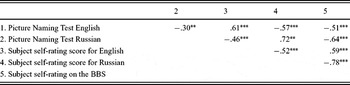
An obvious limitation of this test, as well as many other language proficiency tests in the field, is that it does not assess all four major language skills: speaking, writing, listening, and reading (cf. Padilla and Ruiz, Reference Padilla and Ruiz1973). However, the use of this test can be justified by the prior use of similar tests in a number of studies on bilinguals' cognitive abilities (e.g., Lemmon and Goggin, Reference Lemmon and Goggin1989; Bialystok et al., Reference Bialystok, Craik, Klein and Viswanathan2004), as well as by one finding of the present study, which is that the PNT is highly correlated with the self-rating scores (see Table 1) and the scores in the Cloze procedure (Taylor, Reference Taylor1953) used in the pilot study (r = .769, p < .01 for English; and r = .834, p < .01 for Russian).
Pearson Correlations for the Language Proficiency Measures (N = 103).

**p < .01, ***p < .001
Language proficiency grouping criteria
The major purpose of the various measures of linguistic skills was to provide a basis for discriminating between participants who make up the different language proficiency groups. The usefulness of the self-ratings and the picture-naming test as assessment tools of language proficiency in bilinguals was also considered. Table 1 gives the inter-correlations between the objective and subjective language proficiency scores. All correlations were significantly high (all p s< .01) suggesting that the participants were able to provide a good estimate of their linguistic proficiency by evaluating their abilities in four major language skills (reading, writing, speaking, and listening) and in speaking without an accent in English and Russian, as well as by estimating the degree of their bilingual dominance. The strong correlations between various measures of language proficiency suggest that the English and Russian PNT scores could be safely used for the language proficiency groupings.
A median split was performed on the bilingual participants' PNT scores. The 24 fluent bilinguals who scored above the median on both English and Russian tests comprised the High Proficiency group. The 31 bilinguals scoring above the median on the English PNT and below the median on the Russian PNT made up the English Dominant bilingual group. Those 28 bilinguals who scored below the median on English PNT and above the median on the Russian PNT were included in the Russian Dominant bilingual group. The other 20 with PNT scores below the median on both tests formed the Low Proficiency group. The mean English and Russian PNT scores for the four language proficiency types are reported in the first two columns of Table 2. ANOVA performed on the means of English and Russian PNTs as a function of language proficiency type provided support for the median split: all four groups scored significantly differently from each other (F(3,99) = 72.82, p < .001 and F(3,99) = 110.05, p < .001, for English and Russian PNTs, respectively).
Mean Scores (with Standard Deviations in parentheses) on the Picture Naming and Self-Rating Tests for Four Bilingual Language Proficiency Types (N = 103).

The data from the self-report ratings (summarized in the last three columns of Table 2) also converges well with the groupings based on the objective PNT. The main effect of the language proficiency group was found for bilinguals' self-ratings in English (F(3,99) = 32.08, p < .001) and Russian (F(3,102) = 52.33, p < .001). Bilinguals in the High Proficiency group rated themselves equally high on both English and Russian (t(23) = −.62, p = .54), those in the Low Proficiency group rated themselves low on both languages (t(19) = −.71, p = .49), whereas the Dominant groups rated themselves higher on their dominant language (t(23) = 13.86, p < .001 and t(27) = 15.83, p < .001, for the English and Russian Dominant groups, respectively).
A similar pattern was found for bilinguals' estimation of their degree of bilingualism, which significantly related to language proficiency type (F(3,99) = 36.71, p < .001). Bilinguals in the Dominant groups reported themselves biased toward their dominant language with a highly significant difference between the BBS scores in the English and Russian Dominant groups (t(57) = 10.51, p < .001). Bilinguals in the High and Low Proficiency groups reported significantly greater bilingual balance (BBS score closer to 0) than their counterparts in the Dominant groups (t(53) = −6.90, p < .001 and t(50) = 3.38, p < .01, for the High Proficiency, and English and Russian Dominant groups respectively, and t(49) = −4.55, p < .001 and t(46) = 4.18, p < .001, for the Low Proficiency, and English and Russian Dominant groups respectively). No significant difference in the BBS scores was found between the High and Low Proficiency groups. These findings suggest that dominant bilinguals estimated themselves as more biased toward their dominant language, whereas those with comparable mastery in both languages tended to consider themselves as more balanced bilinguals regardless of their absolute skills in both languages.
The divergent thinking test
Procedure
After administering the BQ and the PNT, participants were given the DT test, which was introduced as a test of thinking up new ideas and solving problems. Divergent thinking abilities were assessed using the Abbreviated Torrance Test for Adults (ATTA; Goff and Torrance, Reference Goff and Torrance2002). The ATTA has been developed on the basis of the Torrance Tests of Creative Thinking (TTCT; Torrance, Reference Torrance1966). The TTCT has been the standard for assessment of divergent thinking abilities since it was first published in the mid-1960s, and it has been used in about three-quarters of all recently published studies of creativity involving elementary and secondary school children (Baer, Reference Baer1993) in the USA (Davis, Reference Davis1989; Runco, Reference Runco1993) and across the globe (Niaz and Saud de Nunez, Reference Niaz and De Nunez1991; Kim and Michael, Reference Kim and Michael1995). In addition, a number of studies using this test have been conducted with bilinguals speaking different languages (e.g., Chinese–English and Malayan–English in Torrance, Gowan, Wu and Aliotti, Reference Torrance, Gowan, Wu and Aliotti1970; French–English in the St. Lambert Project (see Lambert, Reference Lambert and Wolfgang1975, for a review); Japanese–English in Konaka, Reference Konaka1997). The ATTA consists of activities utilizing the same rationale as activities in the original TTCT, but in abbreviated form, and requires considerably less testing time, which is particularly beneficial when administering it to adults.
The standard ATTA has three paper and pencil activities preceded by a written instruction that explains general guidelines and encourages participants to use their imagination and thinking abilities. At the beginning of the test participants were asked what language they preferred to take the test. In response to their preference, instructions were given either in English or in Russian. The English version of the instructions was taken directly from the original ATTA, whereas the Russian translation was produced by the author, a native speaker of Russian. Participants were encouraged to give verbal answers in the language in which they felt more comfortable.
In the problem identification task (Activity 1) participants were asked to suppose that they could walk on air or fly without being in an airplane or a similar vehicle, and then to identify the troubles they might encounter. This activity provided verbal fluency and originality scores. In the picture completion task (Activity 2) participants were presented with two incomplete figures (Appendix B(a)) and were asked to draw as many pictures as possible with these figures. This activity provided figural fluency, originality, and elaboration scores. In the picture construction task (Activity 3) participants were presented with a group of nine triangles arranged in a 3×3 matrix (Appendix B(b)) and were asked to draw as many pictures or objects as they could using the triangles. Again, they were encouraged to make these pictures as unusual as possible. This activity provided figural fluency, originality, elaboration and flexibility scores.
Two independent raters bilingual in Russian and English then assessed the participants' divergent thinking abilities using the standard ATTA assessment procedure (Goff and Torrance, Reference Goff and Torrance2002). Both raters were shown to be highly consistent in their rationales and ratings, as indicated by significantly high correlations in their results (r = .77, p < .01, for fluency; r = .96, p < .001, for flexibility; r = .90, p < .001, for elaboration; and r = .65, p < .01, for originality). A standard ATTA assessment consists of four divergent thinking traits, fluency, originality, elaboration, and flexibility. Fluency measures the ability to produce quantities of ideas. A fluency raw score is derived from the sum of fluency scores in all three activities. Originality measures the ability to produce uncommon ideas or ideas that are totally new or unique. The sum of originality scores in all three activities provides an originality raw score. Elaboration measures the ability to embellish ideas with details. The sum of elaboration scores in Activities 2 and 3 provides an elaboration raw score. Finally, flexibility measures the ability to process information or objects in different ways, given the same stimulus. A flexibility raw score is obtained from Activity 3. The raw scores for fluency, originality, elaboration, and flexibility obtained in the test were subsequently transformed into scaled norm-referenced scores by the recommended procedure (Goff and Torrance, Reference Goff and Torrance2002), which took age-related norms into account. The ATTA manual reports the Kuder-Richardson (KR21) reliability coefficient for the total raw score for the four traits measured by the ATTA as .84.
ATTA measures of divergent thinking traits
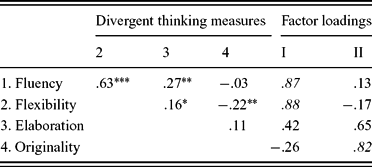
The first three columns of Table 3 present the inter-correlations among the norm-referenced ATTA scores. The correlations between the ATTA measures were factor analyzed using the principal component method with varimax rotation. SPSS FACTOR extracted two factors, which accounted for 72.83% of the variance. Loadings of the measures on these factors appear in the last two columns of Table 3, with the highest loading italicized. Factor I is determined primarily by the ATTA measures of fluency and flexibility. This factor thus appears to represent the ability to generate various solutions to a problem. The second factor seems to represent innovative thinking with the highest loading on originality. Therefore, the four ATTA measures seem to represent two types of creative behavior. The first type addresses ability to simultaneously generate and process various, often unrelated, ideas from different categories, and the second type of creative behavior addresses the ability to generate novel and unique ideas.
Pearson Correlations and Factor Loadings for the Norm-Referenced ATTA Scores (N = 150).
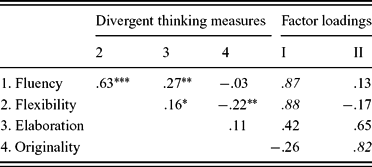
*p < .05, **p < .01, ***p < .001
Results and discussion
Bilinguals vs. monolinguals
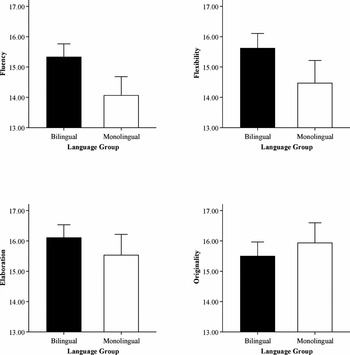
Figure 1 presents the average scores of bilingual and monolingual participants on four norm-referenced ATTA measures (fluency, flexibility, elaboration, and originality). An ANOVA revealed that bilingual participants outperformed their monolingual counterparts on three out of four ATTA measures. They scored significantly higher on fluency (ΔM = 1.27, F(1,148) = 10.98, p < .01) and flexibility (ΔM = 1.15, F(1,148) = 6.85, p < .05). They also scored higher on elaboration (ΔM = .58, F(1,148) = 2.19, p = .14), but this effect did not reach significance. No significant difference was found for bilinguals' and monolinguals' performance on the ATTA measures of originality. These findings indicate that bilingualism might have an impact on the ability to rapidly produce a large number of ideas or solutions to a problem (fluency), the capacity to consider a variety of approaches to a problem simultaneously (flexibility), and have a tendency to encourage the process of thinking through the details of an idea (elaboration). However, it does not have an effect on the tendency to produce ideas different from those of most other people (originality). Based on the assumptions made from the factor analysis reported above, these findings suggest that bilinguals show greater abilities to simultaneously generate and process various, often unrelated, ideas from different categories, but have no advantages in the generation of novel and unique ideas.
The average scores of bilingual and monolingual groups on four norm-referenced ATTA measures (N = 150).

Bilingual developmental factors influencing divergent thinking
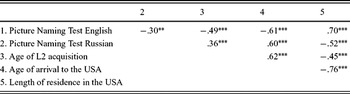
The second goal of this study was to determine what factors in the bilinguals' development may influence their divergent thinking abilities. Three major factors were proposed: language proficiency measured by the PNT in English (PNTE) and Russian (PNTR), age of L2 acquisition (AoE), and exposure to the new cultural settings measured by the age of arrival to the USA (AoA) and the length of residence in the USA (LoR). The correlational analysis reported in Table 4 shows a highly significant relationship between all five variables. The negative correlation between the PNTE and the AoE suggests that an earlier onset of English learning is related to greater linguistic skills in this language. The analysis also points out that an earlier arrival to the USA and the longer residence in the country are related to better acquisition of English, as indicated by the correlation between the PNTE and the AoA and the LoR.
Pearson Correlations for Five Bilingual Developmental Variables (N = 103).

**p < .01, ***p < .001
These findings hint to the possible interplay of language proficiency, age of L2 acquisition, and the rate of exposure to the new cultural settings. Thus, to study the independent effect of each of these factors on divergent thinking abilities, three partial correlational analyses were carried out.
The first analysis explored whether the participants' age of L2 acquisition is related to divergent thinking performance when the effect of their proficiencies in English and Russian and the rate of exposure to the new cultural settings are controlled for. This partial correlational analysis compared the AoE and four norm-referenced ATTA measures, controlling for the PNTE, the PNTR, the AoA, and the LoR. The analysis revealed significant negative correlations between the AoE and the ATTA measures of fluency (r = −.24, p < .05) and flexibility (r = −.28, p < .01). These negative correlations suggest that when the effects of language proficiency and exposure to the new cultural settings were partialed out, earlier L2 learners tended to have greater abilities to rapidly produce a large number of ideas or solutions to a problem (fluency), and to consider a variety of approaches to a problem simultaneously (flexibility).Footnote 1
Second, a partial correlational analysis with the LoR and four norm-referenced ATTA measures controlling for the PNTE, the PNTR, the AoE, and the AoA revealed significant correlations between the LoR and the ATTA measures of fluency (r = .21, p < .05), flexibility (r = .23, p < .05), and elaboration (r = −.20, p < .05). These findings suggest that when other effects are partialed out, the length of exposure to new cultural settings might have an effect on bilinguals' ability to simultaneously generate and process various, often unrelated, ideas from different categories. A partial correlational analysis with the AoA and four norm-referenced ATTA measures controlling for the PNTE, the PNTR, the AoE, and the LoR provided no significant results.
Third, to explore whether the participants' proficiencies in English and Russian are related to divergent thinking performance when the effect of their age of L2 acquisition and the rate of exposure to the new cultural settings are controlled for, a partial correlational analysis was performed with the PNTE, the PNTR and four norm-referenced ATTA measures controlling for the AoE, the AoA, and the LoR. The analysis revealed a significant positive correlation between the PNTE and the PNTR and the ATTA measures of elaboration (r = .26 and r = .25 for English and Russian PNT respectively, both p s< .05). These positive correlations suggest that when the effects of age of L2 acquisition and exposure to the new cultural settings were partialed out, the participants with greater proficiency in both English and Russian tended to have greater abilities to think through the details of an idea and carry it out (elaboration).
This finding suggests a potential difference in divergent thinking performance across language proficiency groups. To explore this effect, four norm-referenced ATTA measures were transformed into residuals by systematically excluding the effects of the AoE, the LoR, and the AoA. Subsequently, an ANOVA was performed with the residuals of four ATTA measures as dependent variables and the language proficiency group (high, unbalanced,Footnote 2 low) as the independent variable. The analysis revealed a marginally significant effect of the language proficiency group on the ATTA measure of elaboration (F(2,100) = 2.74, p = .07). A subsequent LSD post-hoc analysis revealed that the High Proficiency group significantly outperformed the Unbalanced and the Low Proficiency groups on the ATTA measure of elaboration (ΔM = 1.04, p < .05 and ΔM = 1.34, p < .05, respectively). Moreover, only the High Proficiency group significantly outperformed the monolingual group on this measure (t(69) = 2.28, p < .05). However, the significant effect disappeared when a stricter Bonferroni post-hoc analysis was applied. These findings show that when the effects of other factors are controlled for, bilinguals with high proficiency in both languages tended to outperform their less proficient counterparts on the measure that taps into the ability to think through the details of an idea and carry it out (elaboration).
General discussion
This study explores several research questions pertinent to the influence of bilingualism on individuals' divergent thinking abilities. Bilingualism is found to have an effect on fluency, flexibility, and elaboration in divergent thinking. These traits respectively address the ability to rapidly produce a large number of ideas or solutions to a problem, the capacity to consider a variety of approaches to a problem simultaneously, and the ability to think through the details of an idea and carry it out. Three factors in bilinguals' development (age of L2 acquisition, proficiency in both languages, and rate of exposure to new cultural settings) were proposed as potential contributors to their superior divergent thinking. The findings indicate that all three factors may have an impact on individuals' divergent thinking performance. Bilinguals who acquired their L2 earlier tended to outperform their counterparts who acquired L2 later in life on the measures of fluency and flexibility in divergent thinking, which require simultaneous activation of a large number of concepts from different categories. At the same time, bilinguals with high proficiency in both languages tended to score higher on the measure of elaboration, which taps into the ability to keep concepts active during the thought process. Finally, those bilinguals with longer exposure to the new cultural settings tended to show greater abilities on all of the above listed divergent thinking traits.
Bilinguals' superior divergent thinking
The finding of advanced divergent thinking abilities in bilinguals raises the question of the nature of the traits that are facilitated by bilingualism. The factor analysis performed on four divergent thinking measures revealed that fluency, flexibility, and elaboration can be grouped together as representative of the capacity to simultaneously generate and elaborate on various, often unrelated, ideas and strategies. This ability could result from the simultaneous activation and processing of a multitude of unrelated concepts from different categories. The simultaneous engagement of distant concepts is likely to be encouraged by the unconscious automatic spreading activation (Meyer and Schvaneveldt, Reference Meyer and Schvaneveldt1971) that results in more mental representations to be activated and brought to conscious awareness (Yaniv and Meyer, Reference Yaniv and Meyer1987). This notion suggests that in addition to their superior conscious processes of attentional focus and inhibition, as shown by Bialystok and her colleagues (see Bialystok, Reference Bialystok2001, for an overview), bilinguals might have an advantage on unconscious automatic processing.
Kharkhurin (Reference Kharkhurin, Kecskes and Albertazzi2007) proposes that the specific architecture of bilingual memory may facilitate the greater spreading activation between concepts. The functioning of this mechanism is stimulated by the lemma and word form-mediated concept activation. The idea of a language mediated concept activation (LMCA)Footnote 3 is based on the assumption that translation equivalents automatically activate each other through shared conceptual representations (e.g., concept mediated translation in Kroll and De Groot, Reference Kroll, De Groot, Groot and Kroll1997). Although translation equivalents share most of the conceptual features, these representations are not identical (e.g., Paradis, Reference Paradis, De Groot and Kroll1997). Variations in the conceptual representations of translation equivalents may result in the simultaneous activation of additional concepts, which eventually may produce a large pattern of activation over unrelated concepts from different categories. The activation of these concepts is assumed to take place through the lemmas representing the translation equivalents in two languages and/or through the word forms (e.g., phonetic, orthographic) shared by these languages. The evidence for the LMCA is provided by the between-language studies using semantic (see Kroll and Tokowicz, Reference Kroll, Tokowicz, Kroll and De Groot2005, for a review) and translation (see Altarriba and Basnight-Brown, Reference Altarriba and Basnight-Brown2007, for a review) priming paradigms. These studies reveal that automatic spreading activation takes place not only between translation equivalents in different languages, but between semantically related words in different languages as well. The elaborative LMCA may allow bilinguals to process a large number of unrelated concepts from different categories simultaneously, i.e., it may increase bilinguals' divergent thinking abilities. However, the question of whether bilinguals who show greater translation and semantic priming effects also demonstrate greater divergent thinking performance needs to be addressed in future studies.
Although this study has found that bilingualism has an impact on creative behavior, this effect seems to be limited to the basic cognitive functioning underlying divergent thinking. The findings show that bilinguals outperform their monolingual counterparts only on the measures of fluency, flexibility, and elaboration, but not on the measure of originality, with the latter representing innovative thinking. This finding may suggest that bilinguals have no advantage over their monolingual counterparts on more sophisticated processing that results in ability to generate novel and unique ideas. Thereby, the findings of the present study indirectly contribute to the argument that divergent thinking is a necessary, but not a sufficient component of creative thought (Guilford, Reference Guilford1967, Reference Guilford, Taylor and Getzels1975). Although bilinguals in this study show superior performance on the tasks that require the ability to simultaneously activate different concepts or categories, they fail to outperform their monolingual counterparts on the task requiring production of novel and original ideas and solutions to a problem. Other factors unrelated to a specifically bilingual experience such as intelligence, education, expertise, motivation, personality traits, and personal experience may play a more dominant role in overall creative ability. This idea overlaps with the argument in creativity literature that divergent thinking should be considered as one among many factors contributing to creative achievement (e.g., Amabile, Reference Amabile1983; Eysenck, Reference Eysenck and Boden1994). For example, Eysenck's model considers divergent thinking (defined as a creativity trait) as one component of “a possible set of cognitive, personality, and environmental variables that are likely to interact in a multiplicative fashion to produce creative product and achievements” (p. 208). Similarly, Guilford (Reference Guilford1967) contrasted divergent thinking with convergent thinking – the ability to narrow all possible alternatives down to a single solution. The product of the interplay of convergent and divergent thinking was assumed to satisfy the requirements of creativity.
Finally, the findings of the study contribute to an important debate in creativity literature regarding whether the capacity for creative thought is limited to a certain class of gifted or specially talented people, or whether the creative faculty is an essential property of normative human cognition. The former view considers creative people as a minority capable of genuine creative thinking, and thus creativity has little bearing on the everyday cognitive activities of the general population (e.g., Hershman and Lieb, Reference Hershman and Lieb1988). In this view, eminently creative people employ cognitive processes that are radically different from those used by most individuals in everyday problem solving. In contrast, the creative cognition approach argues that the former use the same processes of normative human cognition as the latter (Ward, Smith and Finke, Reference Ward, Smith, Finke and Sternberg1999). This “mundane” cognitive functioning, which may go beyond everyday human capacities, satisfies the criteria of creative products: novelty and utility. In this theoretical framework, creativity can be explained by enhanced normative cognition. Specifically, the differences in individuals' creative performance can be understood in terms of variations in the use of specifiable processes and the richness and flexibility of stored cognitive structures to which the processes are applied (Ward et al., Reference Ward, Smith and Vaid1997). The present research shows that by de facto exposure to various linguistic and sociocultural environments, bilinguals seem to benefit from the LMCA, and this may facilitate their spreading activation mechanism. The larger span of spreading activation may potentially result in greater divergent thinking, which is considered an important component of creative thought. By showing this, the present study argues that the “mundane” cognitive functioning enhanced in the process of bilingual development may increase individuals' creative capacities.
The logical continuation on the finding that bilingualism may contribute to superior divergent thinking would focus on the specific factors in bilingual development that may facilitate this trait. The present study demonstrates that three aspects of bilinguals' cross-linguistic and cross-cultural experiences exhibit some influence on divergent thinking. The following sections present a discussion of these developmental factors.
Language proficiency
Multidimensional assessment of linguistic skills
Three measures for each language were used in this study: the picture naming test, the self-rating scales, and the bilingual balance scale. The findings of significant correlations among all three measures lend support to the notion that self-ratings adequately reflect language abilities (e.g., Macnamara, Reference Macnamara1967; Albert and Obler, Reference Albert and Obler1978). The traditional self-rating scales of four major language skills (speaking, writing, listening, and reading) complemented by the self-rating of the strength of the accent in both languages provided a good prediction of the participants' PNT scores. In addition, participants were found to give a good estimation of their relative linguistic abilities by indicating their degree of bilingual dominance on the BBS. These findings have at least one practical application for the assessment of bilingualism; they suggest that the degree of language proficiency can be measured with a limited number of tests rather than by a direct assessment of the 16 skills in both languages as was recommended by Padilla (Reference Padilla and Martinez1977).
The study reveals a tendency for the proficiency of bilinguals in both English and Russian to have an effect on elaboration in divergent thinking. Specifically, it shows that bilinguals with a high proficiency in both languages are more successful in elaboration than their less proficient counterparts. This finding is in line with a number of studies on children showing greater divergent thinking performance of bilinguals highly proficient in both languages compared with their linguistically unbalanced counterparts (e.g., Carringer, Reference Carringer1974; Konaka, Reference Konaka1997).
Further, the finding that only bilinguals from the High Proficiency group outperformed the monolingual participants overlaps with the threshold theory (Cummins, Reference Cummins1976), arguing that bilinguals need to achieve high levels of proficiency in both of their languages before bilingualism can promote cognitive advantages. Ricciardelli (Reference Ricciardelli1992a) tested this theory with Italian–English bilingual and English monolingual children. She found that only bilingual children with high proficiency in both Italian and English showed superior divergent thinking abilities. Those bilinguals who had low proficiency in either one or both languages did not show any significant difference from the monolinguals.
The greater performance on elaboration in divergent thinking of the bilinguals from the High Proficiency group could be explained by their advanced LMCA (Kharkhurin, Reference Kharkhurin, Kecskes and Albertazzi2007). This divergent thinking trait addresses the ability to think through the details of an idea and carry it out, which presumably results from a capability to establish more links in a conceptual system. The proficiency in L1 and L2 determines the strength of the connections between the lexical and conceptual systems in bilingual memory. The degree of linguistic skills may influence the intensity of the lexical access: greater language proficiency may result in establishing stronger and more elaborate links to the conceptual system. As a result, more concepts become readily available for the LMCA. Therefore, bilinguals who attained a high expertise in both languages would have stronger and more efficient links between lexical and conceptual levels than those who were not able to develop any of their languages to a high degree. Thus, bilinguals highly proficient in both languages would employ the LMCA mechanism more effectively and therefore show greater elaboration in divergent thinking compared with their less proficient counterparts.
Age of L2 acquisition
The study also provides evidence that the age at which L2 was acquired relates to fluency and flexibility in divergent thinking. The individuals who acquired L2 at a younger age showed greater abilities in these traits. To the author's knowledge, no study examining the relationship between bilingualism and creativity has reported the effect of the age of L2 acquisition on bilinguals' performance.
These findings can be explained by a possible effect of the age of L2 acquisition on the structure and/or functioning in the bilingual system as suggested by a number of studies examining the neural underpinnings of bilingual representations (e.g., Dehaene, Dupoux, Mehler, Cohen, Paulesu, Perani, van de Moortele, Lehericy and Le Bihan, Reference Dehaene, Dupoux, Mehler, Cohen, Paulesu, Perani, van de Moortele, Lehericy and Le Bihan1997; Kim, Relkin, Lee and Hirsch, Reference Kim, Relkin, Lee and Hirsch1997). Kharkhurin (Reference Kharkhurin, Kecskes and Albertazzi2007) interprets the modifications of the bilingual system as facilitatory to the LMCA. Individuals who acquired both of their languages early in life may develop a greater sensitivity to underlying concepts and more refined connections between lexical and conceptual representations for both languages. The memory system in early bilinguals might foster the LMCA by providing fast routing of information exchange between both lexicons and concepts. On the other hand, late bilinguals may develop an asymmetry in lexical access (see Kroll and De Groot, Reference Kroll, De Groot, Groot and Kroll1997, for detailed discussion), with fewer shared conceptual features having direct links from both lexicons. The asymmetrical routing in the lexical–conceptual network may result in a less efficient LMCA. Cross-language priming studies support this notion (e.g., Izura and Ellis, Reference Izura and Ellis2004; Silverberg and Samuel, Reference Silverberg and Samuel2004). For example, Silverberg and Samuel demonstrated that early and late bilinguals showed different patterns of performance in the bilingual lexical decision priming study. In this study, semantic and mediated form primes produced priming effects for bilinguals who acquired their L2 early, but not for those who acquired L2 late.
Thus, the present study proposes that the age of L2 acquisition might have an influence on bilinguals' LMCA. Specifically, due to a more symmetrical distribution of lexical–conceptual routes, more conceptual representations become readily available for the LMCA in early bilinguals. Note that both traits, facilitated by the age of L2 acquisition, address the capacity to rapidly produce a large number of ideas and strategies to solve a problem. This ability, similar to elaboration in divergent thinking, may be facilitated by establishing multiple links between unrelated concepts from distant categories. Therefore, early bilinguals with a larger span of available conceptual representations may show greater fluency and flexibility in divergent thinking compared with bilinguals who acquired L2 later in life.
Length of exposure to the new cultural environment
In addition to the developmental factors resulting from the cross-linguistic experience, the present study examines the possible effects on bilinguals' divergent thinking of their exposure to a new cultural environment. A well-known problem in the psychological research on biculturalism is that cultural experience is not only extremely difficult to define, but even more difficult to measure and relate to the individual's cognitive functioning (Francis, Reference Francis2000). As mentioned earlier, research on acculturation extracts at least two indicators of exposure to a new cultural environment: the age of arrival to and the length of residence in a new country. Kharkhurin (in press) combined both factors into one variable, the cultural exposure coefficient (similar to Marin et al., Reference Marin, Sabogal, Marin and Otero-Sabogal1987; and Tropp, Erkut, Coll, Alarcon and Garcia, Reference Tropp, Erkut, Coll, Alarcon and Garcia1999), which was computed by dividing the absolute value of the difference between the number of years a participant lived in Russia (obtained from the age of immigration) and the number of years they lived in the USA (obtained from the length of residence in the USA) by the participant's age. That study revealed that the cultural exposure coefficient had no significant effect on divergent thinking performance. The present study considers these factors separately and reveals that the length of residence in a new cultural environment relates to bilinguals' performance on fluency, flexibility, and elaboration in divergent thinking.
Needless to say, using these factors degrades the psychological effects of acculturation as they cannot and should not be reduced to measures of the exposure to a cultural environment. As Tropp and her colleagues (Reference Tropp, Erkut, Coll, Alarcon and Garcia1999) argue, mere cultural exposure does not necessarily reflect the psychological ramifications of that experience. For example, some individuals may live in the USA throughout their lives without feeling a strong connection to it and may, in turn, be less likely to embrace North American cultural norms and expectations. Conversely, some recent immigrants may identify strongly with prevailing American norms and standards and may therefore attempt to integrate aspects of North American culture into their daily lives. Although the present study acknowledges these limitations, it makes an attempt to relate the experience with a new cultural environment to individuals' cognitive functioning. Certainly, further research is needed to investigate the possible interactions of these two phenomena.
The finding of the positive correlation between the length of exposure to a new culture and bilinguals' divergent thinking performance hints to the possibility that this exposure may result in modifications in the bilingual conceptual system that reflects cross-cultural diversity in conceptual representations. In this respect, Pavlenko (Reference Pavlenko, Kroll and De Groot2005) suggests that the conceptual systems of two individuals who speak different languages and participate in different cultures may differ in particular domains where concepts are encoded – lexically or morphosyntactically – in different ways. Russians in Russia, for example, will interpret an event in light of conceptual representations developed in Russian “ways of thinking”, while North Americans will have another interpretation of the same event in accordance with American ways of thinking. At the same time, Russian immigrants in North America may establish different interpretations depending on the degree of acculturation into the new culture, i.e., the extent to which they have been exposed to the new culture and have adopted new values relative to old ones. Similarly, Ervin-Tripp (Reference Ervin-Tripp2000) argues that the experience of bilinguals varies depending on their isolation or participation in the new culture as well as in a bilingual community. The structure of bilinguals' cognitive system is modified as a result of this experience and cannot be simply matched to the monolingual one. De Groot (Reference De Groot2000) illustrates this with the example of a turkey. The conceptual features of a “turkey” in non-North American culture-specific conceptual system may have no associations with great festivities taking place only in North America. For newcomers to North America the concept of “thanksgiving” develops over a series of Thanksgiving experiences which include turkey as a key attribute of the feast. As a result, the conceptual representation of a turkey may change over time as a function of the experience with the L2 culture. In particular, the conceptual representation of a turkey may become extended once it includes additional celebration-related features. The extended conceptual system in turn may result in a larger span of concepts simultaneously activated, because the new conceptual representation may establish new links to the concepts that were previously unrelated. For example, the conceptual representation of a turkey in a Russian–English bilingual may activate festivity-related conceptual features in addition to the typical Russian poultry-related ones. The ability to establish links between different, often unrelated concepts is considered a key attribute of divergent thinking. Thus, experience with new cultural settings may have an impact on bilinguals' divergent thinking. Indeed, as a number of scholars suggest, bilingual individuals who experience and participate in two cultures may well perceive the world through the amalgam of two different conceptual prisms and view events with a wider range of enriched experiences (e.g., Cummins and Gulutsan, Reference Cummins, Gulutsan and Carey1974; Okoh, Reference Okoh1980). Alternatively, non-standard perspectives may promote novel and creative ways of encoding experience.
The confounding nature of bilingual developmental factors
This study provides evidence that it is methodologically essential to recognize the confounding nature of various factors in individuals' cross-linguistic and cross-cultural development. The study demonstrates the close relationship between participants' age of acquisition of a new language, the rate of exposure to the cultural environment of that language, and success in the acquisition of this language. First, the participants' age of learning English was found to relate to their mastery of linguistic skills in this language. Bilinguals who learned English earlier in life seem to develop greater English proficiency. This finding lends support to the discussion in the language acquisition literature that language learning abilities decline with age (e.g., Lenneberg, Reference Lenneberg1967; Krashen, Reference Krashen1973; Pinker, Reference Pinker1994). Most of these studies converge on the prediction of Lenneberg's critical period hypothesis that L2 acquisition will be relatively fast, successful, and qualitatively similar to L1 only if it occurs before the age of puberty. This prediction is still debatable since there is no agreement about whether there is a cut-off point at which language-learning performance decreases dramatically. However, the investigation of the specific critical period for language acquisition is beyond the scope of the present research.
Second, the participants' age of arrival in the USA and the length of their residence in this country were also found to relate to their mastery of English. Individuals who were exposed to the American cultural environment earlier and for a longer time tended to show greater linguistic skills in English. This finding overlaps with the prediction of the acculturation studies that show that successful language acquisition goes hand in hand with cultural adaptation (e.g., Gordon, Reference Gordon1964; Birman et al., Reference Birman, Trickett and Vinokurov2002). More extensive exposure to the L2 cultural environment is likely to result in a greater rate of acculturation, which may indirectly facilitate L2 acquisition. Johnson and Newport (Reference Johnson and Newport1989) provide evidence supporting the indirect influence of exposure to new cultural settings on linguistic skills. They tested native Korean and Chinese speakers who had arrived in the USA between ages 3 and 39 years old, and who had lived in the USA between 3 and 26 years at the time of testing. The results indicated that early arrivals performed significantly better on an English grammaticality judgment task than late arrivals. Moreover, the test performance of early arrivals was linearly related to their age of arrival whereas late arrivals' performance was highly variable and unrelated to their age of arrival.
The above discussion illustrates that the various factors of bilingual cross-linguistic and cross-cultural practices are intimately intertwined. An important conclusion that can be advanced from this discussion is that in addition to assessment of linguistic aptitude, bilingualism research should systematically control for the age of initial exposure to a new language, duration and circumstances of that exposure, and the sociocultural experience of participants. Without providing a careful assessment of these parameters, researchers are likely to overlook important aspects of bilingual development, aspects that may potentially have an important influence on individuals' linguistic and cognitive performance.
Conclusion
This study explored several research questions pertinent to the influence of bilingual development on individuals' divergent thinking. First, while bilinguals show superiority on those divergent thinking tasks that refer to the capacity to rapidly produce a large number of ideas and to think through the details of an idea and carry it out, they did not demonstrate that superiority on the test where the ability to produce unique and original ideas was measured. This finding indicates that being bilingual does not necessary imply being creative, but rather that the positive effect of bilingualism on creative abilities is likely to be limited to unconscious automatic cognitive processing, which lays the foundation of more sophisticated processing during which truly creative ideas may be generated. The effectiveness of the latter cognitive processes, however, might be influenced by various developmental and personality factors not accounted for by bilingualism.
Second, depending on their history of bilingual development, different types of bilinguals show different patterns of divergent thinking performance. These differences could be explained by the facilitatory effect of cross-linguistic and cross-cultural factors in bilingual development. Bilinguals' age of L2 acquisition, linguistic fluency, and length of exposure to L2 cultural environments are suggested to influence the communication links in bilingual memory, which in turn may enhance the effectiveness of language mediated concept activation. However, further research is required to examine the hypothesis that due to variations in the rate of language mediated concept activation different types of bilinguals exhibit different patterns of divergent thinking.
Third, the study provides evidence of the interlacing nature of the various factors in bilingual development. This finding lends support to the appealing argument in the literature that bilingualism should be studied not only in the context of individuals' linguistic abilities, but also in a sociocultural context. In studying the psychological effects of bilingualism, the time and circumstances of individuals' experiences with different languages and sociocultural settings should be carefully examined. In particular, the peculiarities of the cultural environments to which an individual is exposed should be taken into account. In this regard, a question that needs to be answered is what sociocultural cues might have an effect on the conceptual changes that presumably influence individual's cognitive capacities. The psychological ramifications of experience with two sets of cultural settings on individuals' behavior and the impact of cross-cultural experiences on their conceptual system opens a new line of research on biculturalism that should bring together the joint efforts of cognitive and social psychologists. Moreover, to ignore this combination of linguistic and sociocultural factors would degrade psychological research. In this respect, it is important to develop a solid methodology assessing the cognitive implications of biculturalism. There is a need for a reliable measure of cognitive processes that are influenced by cross-cultural experiences and which accounts for variations in individuals' cognitive capacities.
Finally, this study also lends indirect support to the creative cognition approach. On the one hand, bilinguals seem to utilize the same cognitive mechanisms of concept formation and lexical access that are used by all people. On the other, they tend to show greater divergent thinking abilities. Thus, the “mundane” cognitive functioning enhanced in the process of bilingual development may contribute positively to individuals' creativity.
Appendix A. Biographical Questionnaire and Bilingual Balance Scale
Name
Subject number
Phone
Age
Gender
Date of birth
Place of birth
How old were you when you came to the USA?
How many years have you lived in the USA?
Education
Russia
Secondary school (put N/A if you didn't attend it)
How many years?
What other language(s) did you learn there? (check appropriate)
English
German
French
Spanish
Other (specify)
Was it a special language school? (circle one)Yes | No
University (put N/A if you didn't attend it)
What was the name of the University?
How many years?
What other language(s) did you learn there? (check appropriate)
English
German
French
Spanish
Other (specify)
Did you take an advanced language class? (circle one) Yes | No
USA
High school (put N/A if you didn't attend it)
What was the name of the school?
How many years?
What other language(s) did you learn there? (check appropriate)
English
German
French
Spanish
Other (specify)
What language(s) did you speak at school (outside the classroom, with your classmates)? (circle one)

College (put N/A if you didn't attend it)
What is (was) the name of the college?
How many years?
What other language(s) did you learn there? (check appropriate)
English
German
French
Spanish
Other (specify)
What language(s) do you speak in college (outside the classroom, with your classmates)? (circle one)
Language proficiency
How old were you when you began to learn Russian?
In what country did you begin to learn Russian?
Where did you learn Russian? (circle one) Home | School both
How old were you when you began to learn English?
In what country did you begin to learn English?
Where did you learn English? (circle one) Home | School both
At what age did your usage of English begin to exceed the usage of Russian (i.e., age at which you started to use English more than 50% of the time)?
Are you right- or left-handed? (circle one) Right | Left both
If you are right-handed, were you forced to use the right hand? (circle one) Yes | No
Standard scores
Did you take the TOEFL? (circle one) Yes | No
if YES, what was your score (computer/paper based)?
Did you take the SAT? (circle one) Yes | No
if YES, what was your verbal English score?
Self-rating
In the questions 1 through 10, circle the word or a phrase that applies to you.
English
Russian
What other language(s) do you speak?
Rate your language command from 0 (not at all) to 3 (very well) for each language in the table below.
How would you estimate your ability to learn foreign languages? (circle one)
Home and friends
What language(s) do you speak at home?
What percent of each language do you use at home? English Russian Other
What language(s) do you speak with your friends?
What percent of each language do you use with your friends? English Russian Other
Bilingual Balance Scale
Check the box that reflects your degree of Russian–English bilingualism. Ignore any other language you may speak.
Appendix B. Abbreviated Torrance Test for Adults
(a) Stimuli for Activity 2
(b) Stimuli for Activity 3