Introduction
The taxonomic diversity of invasive species (from viruses to hippos), multiple pathways of introduction, including both intentional (e.g., horticulture) and accidental (e.g., ship ballast), and accelerated pace of migration due to trade, changing climate, and other factors have left virtually every landscape and ecosystem around the world at risk of being invaded. We not only continue to pay historical invasion debts (Essl et al. Reference Essl, Dullinger, Rabitsch, Hulme, Hülber, Jarošík, Kleinbauer, Krausmann, Kühn, Nentwig, Vilà, Genovesi, Gherardi, Desprez-Loustau, Roques and Pyšek2011), but the rate of new species introductions continues to rise across all taxonomic groups (Seebens et al. Reference Seebens, Blackburn, Dyer, Genovesi, Hulme, Jeschke, Pagad, Pyšek, Winter, Arianoutsou, Bacher, Blasius, Brundu, Capinha, Celesti-Grapow, Dawson, Dullinger, Fuentes, Jäger, Kartesz, Kenis, Kreft, Kühn, Lenzner, Liebhold, Mosena, Moser, Nishino, Pearman, Pergl, Rabitsch, Rojas-Sandoval, Roques, Rorke, Rossinelli, Roy, Scalera, Schindler, Štajerová, Tokarska-Guzik, van Kleunen, Walker, Weigelt, Yamanaka and Essl2017). Importantly, the near-ubiquity of invasive species across all ecosystems and their concomitant impacts mean that innumerable stakeholders—including private firms in many industries, government agencies at all levels, private landowners, advocacy organizations, and scientists—with a wide range of interests, motivations, and resources are directly or indirectly engaged in some aspect of biological invasions. The matter of how to “confront the crisis” is thus complex and filled with uncertainty. Competing interests and priorities, incomplete biological, sociological, and economic understanding, and fragmented or weak governance are just some of the barriers to action. Making meaningful progress on complex issues with scientific, policy, and management dimensions, like those around invasive species (Lodge et al. Reference Lodge, Williams, MacIsaac, Hayes, Leung, Reichard, Mack, Moyle, Smith, Andow, Carlton and McMichael2006), requires multistakeholder transdisciplinary efforts (Kueffer Reference Kueffer2010; Mehring et al. Reference Mehring, Bernard, Hummel, Liehr and Lux2017; Mitchell et al. Reference Mitchell, Moore, Clement, Lockwood, Anderson, Gaynor, Gilfedder, Rowe, Norman and Lefroy2017; N’Guyen et al. Reference N’Guyen, Hirsch, Adrian-Kalchhauser and Burkhardt-Holm2016).
To this end, a subgroup of faculty members from the Global Change Center at Virginia Tech organized the Biological Invasions: Confronting a Crisis workshop on April 23, 2018, to bring together representatives of diverse stakeholder groups in the Commonwealth of Virginia, USA, to create connections, foster collaboration, and facilitate a solutions-focused discussion of the pressing invasive species challenges. The 62 participants reflected the broad reach of invasive species and included representatives from research (primarily academic faculty and students), Cooperative Extension, federal, state, and local agencies, nongovernmental organizations (NGOs), land managers, and private landowners. The format was designed to facilitate dialogue across the research, management, and policy perspectives and was not focused on any single taxonomic group or ecosystem. The idiosyncrasies of particular invasive species or habitats was beyond our scope, as we were not seeking solutions to specific situations. Rather, the focus was on coordination, communication, and barriers to success. Success is in fact quantified through management and prevention, but our goal was not to find solutions per se for management and prevention, but instead to determine the extent to which limitations to that success exist among groups working in that space.
There exists a well-known “knowing–doing” gap in the management of invasive species (Esler et al. Reference Esler, Prozesky, Sharma and McGeoch2010; Lavoie and Brisson Reference Lavoie and Brisson2015), with land managers wanting more scientific information from researchers, particularly information on management and ecological impacts (Kuebbing and Simberloff Reference Kuebbing and Simberloff2015). Similarly, others have sought to identify key gaps in executing effective conservation and invasive species management (Arlettaz et al. Reference Arlettaz, Schaub, Fournier, Reichlin, Sierro, Watson and Braunisch2010; Lavoie and Brisson Reference Lavoie and Brisson2015; Matzek et al. Reference Matzek, Pujalet and Cresci2015; N’Guyen et al. Reference N’Guyen, Hirsch, Adrian-Kalchhauser and Burkhardt-Holm2016). Our Biological Invasions workshop brought a broad range of stakeholders together to collectively identify barriers and opportunities in tackling invasive species, considering not just management but all “stages”—from research through policy to management—of invasive species in aquatic and terrestrial landscapes.
Two guests recognized across the United States—Heather Reynolds, associate professor of biology at Indiana University, and Jamie Reaser, executive director of the United States National Invasive Species Council—set the tone with keynotes highlighting the depth and breadth of the biological invasions crisis. A series of active-engagement sessions featuring work in small groups, think–pair–share, and community reporting followed. The activities were designed to give participants the opportunity to reflect on how their individual roles contribute to providing solutions, how others use their work to inform solutions, how they depend on others, and the barriers across roles that limit solutions. The overarching meeting goal was to create connections and foster collaboration among those working on invasives issues. In the following sections we summarize the broadly relevant driving questions, topics, and discussions from the day. While this workshop focused on Virginia, many of these themes likely reflect similar issues faced by stakeholders dealing with invasive species in all corners of the globe as they search for solutions.
Recognizing Barriers to Engagement and Communication
The scales at which invasive species impact the environment and society span from hyperlocal to international, involving a variety of stakeholders and policies across that continuum. Stakeholders vary widely in their levels of participation, education, and training, the nature of their respective interests and priorities, and their available resources. Parties in any given situation can even be at cross-purposes (García-Llorente et al. Reference García-Llorente, Martín-López, González, Alcorlo and Montes2008). For example, a local landowner, nearby national park, and state agency may all be engaged in mitigating current invasions and preventing future ones; however, their goals, resources, and constraints may or may not align. They may be framing and addressing “the problem” in very different ways. Important questions are thus: To what degree are actions communicated and coordinated within and among stakeholder groups? Are there shared barriers and solutions across stakeholder groups? What roles do researchers and policy makers play across this spectrum of scales and stakeholders? Given that the invasive species problem is vast, complex, and slated to worsen, are our “business as usual” practices efficacious? These were some of the broad questions workshop participants grappled with.
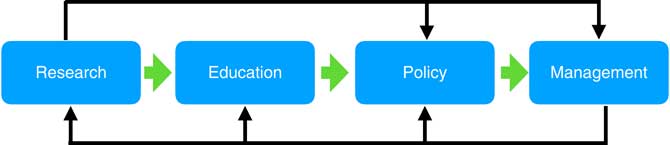
To address these questions, we conceptualized the invasive species problem as one that spans a research–education–policy–management continuum (Figure 1), similar to many other natural resource issues. This characterization was not meant to represent the “stages of invasion” or necessarily reflect a linear flow of knowledge to action; rather it was a starting point for discussing the broad categories of activities and stakeholders and how they interact. Participants started the day by identifying where they fit within the continuum, the relationships that work well, the relationships and connections that do not work well (and why), and gaps (and how they might be filled). There are certainly situations in which individuals may engage in multiple roles, but attendees were asked to assume the role that represented how they spend the majority of their efforts on invasive species. This was an individual exercise that participants completed on their own by placing Post-it notes on a printed banner of the continuum. Perhaps unsurprisingly, the importance of good research, education, policy development, and management were common themes. The need for more funding was also a common theme. These priorities largely reflect those of invasive species management plans (e.g., National Invasive Species Council 2016). The importance of better communication among stakeholders emerged and was increasingly recognized throughout the day as a key and often lacking element.
Diagram used to identify stakeholders, connections, tensions, and gaps. This schema was revisited throughout the day.

Participants reflected that the degree of stakeholder engagement across domains remains relatively low, yet potentially very important. Researchers regularly engage with other researchers at scientific conferences and through scholarly publications. Similarly, members of groups like the Virginia Native Plant Society regularly engage with one another and with the public to educate citizens and “pull weeds.” However, it is less common for stakeholders to interact outside their own groups; solutions may exist through identifying and addressing communication and coordination gaps (Larson Reference Larson2007). Participants overwhelmingly focused on problems at the interfaces between groups. Common mismatches and gaps identified included: lack of public education (e.g., “the public has no idea”); insufficient funding for research, management, education, and implementation of policy mandates; limited distribution of relevant research findings that are accessible to other stakeholder groups; lack of public–private partnerships; and the absence of an effective multistakeholder coalition. Coalition building was a consistent theme throughout the workshop, and one that had strong support from members of all groups. Participants were very vocal in their belief that, whether formal or informal, stronger “advocacy coalitions” composed of academic scientists, sympathetic officials, nonprofit organizations, and other concerned stakeholders could be very effective in raising the profile of invasive species issues and lobbying for informed action. Most participants felt this increased level of cooperation was the only pathway to developing effective invasive species solutions. Policy theory suggests that this approach may be viable for getting invasives on policy agendas (see, e.g., Sabatier Reference Sabatier1988).
Knowing Your Role—Self-Reflection across Diverse Participant Groups
Confronting the invasives crisis will require a concerted effort involving multiple stakeholders. Other workshops have successfully coalesced diverse perspectives from those working on weedy and invasive species to encourage self-reflection and identify paths forward for forging success (Murray et al. Reference Murray, Lehnhoff, Neve, Poggio and Webber2012). Despite the success of these workshops, the breadth of participants has been restricted largely to researchers (Ward et al. Reference Ward, Cousens, Bagavathiannan, Barney, Beckie, Busi, Davis, Dukes, Forcella, Freckleton, Gallandt, Hall, Jasieniuk, Lawton-Rauh, Lehnhoff, Liebman, Maxwell, Mesgaran, Murray, Neve, Nuñez, Pauchard, Queenborough and Webber2014), though in some cases a focus on transdisciplinarity involved input from social scientists (e.g., M. Bagavathiannan, personal communication). We were fortunate to have academics from a wide variety of disciplines, ranging from science, technology, and society to weed science, in addition to broad stakeholder representation. Such broad transdisciplinary engagement is an important step in advancing to address complex challenges at the science–policy interface when the stakes are high, there is uncertainty, and information is contested and/or poorly understood (Maasen and Lieven Reference Maasen and Lieven2006). This workshop exposed the need for, and offered an opportunity to initiate, a transdisciplinary, multistakeholder effort. Future work can draw from best practices in collaborative governance, including the application of joint fact-finding methodologies to advance more effective boundary work at the science–policy interface (Bodin Reference Bodin2017; Matsuura and Schenk Reference Matsuura and Schenk2016).
The discussions and outcomes from such gatherings will, necessarily, be limited to the perspectives and biases of the stakeholder groups attending. Thus, we were interested in having members from each group self-reflect on the role they play in “confronting the crisis,” how the information they generate is used by other groups, and subsequently, how they expect others to use that information. Participants worked in like groups—researchers, educators, agency personnel/policy makers, NGO workers/managers—to assess where they fit among other stakeholders, the relationships that work well, the relationships and connections that do not work well (and why), and relationship gaps (and how they might be filled). This forced members of each group to reflect on: the role(s) they play and what they bring to the table, understanding and solutions-wise; how that work contributes to other groups’ progress; and what they need from other groups to be more effective in their own roles. Following this activity, it became clear that a wide diversity of barriers to success are perceived within groups, and those barriers were not always shared across groups. For example, members of the NGO workers/managers group identified their strengths as enthusiasm, organization, a knowledge of what works, and a deep sense of place. They felt largely marginalized from the other groups and considered themselves merely as consumers of information produced by others, despite being the group that has the most direct contact with invasive species. In contrast, researchers acknowledged the complexity of invasive species, recognized that much of their more fundamental work does not directly contribute to management or policy, and felt hamstrung by inadequate funding. Even many who self-identify as applied researchers, whose findings often more directly contribute toward management solutions, were still uncertain as to the most effective format(s) for communicating their findings with other stakeholders, and subsequently, whether those methods actually worked in the field at management scales. This finding underscores not only the need for stronger transdisciplinary collaboration previously discussed, but also for increased emphasis on effective science communication. Initiatives like Virginia Tech’s new Center for Communicating Science can help academic scientists and students translate their findings in ways that are more “salient, credible, and legitimate” for other stakeholders.
Following the within-group activity, new integrative groups were formed with at least one member from a group who self-identified as a “researcher,” “government agency personnel,” “NGO worker,” or “Extension specialist or educator.” The goal of this phase was to foster cross-sectorial dialogue, discuss how each group’s work and knowledge can be better integrated with others, and identify and break down barriers to action. This was a venue for very engaged and fruitful cross-stakeholder discussion, which is rarely available. In fact, the dominant feedback from participants was how useful it was to simply get this diversity of stakeholders in the same room and to communicate in small groups. Common outputs from the integrative groups included: admission that most groups do not expressly consider the needs of other groups when conducting their business; acknowledgment that groups differentially consider themselves producers (researchers) or consumers (managers, educators) of information; and widespread lack of engagement across groups.
In some cases, it was observed that the information is siloed, existing in one group but not being communicated effectively or at all. For example, managers want up-to-date invasive management information, which in many cases is published in peer-reviewed journals behind paywalls. This problem has improved recently with the development of multistakeholder information websites (e.g., invasive.org); the rise of open-access scientific journals (e.g., NeoBiota); user-contributed mass databases, including one devoted to species occurrences (e.g., eddmaps.com); and management-focused scientific publications (e.g., Invasive Plant Science and Management). However, Matzek et al. (Reference Matzek, Pujalet and Cresci2015) found that much of the invasion research is not meeting practitioner demands, despite being more easily accessible. Thus, stressing more bidirectional communication between researchers and practitioners to inform research questions and disseminate results is a critical next step in advancing more collaborative approaches to addressing the invasives crisis.
Participants identified one important potential solution to multidirectional communication gaps that could transform management: a database of management actions and their contexts and goals and outcomes. Land managers and NGO personnel described their roles as consuming and implementing information from researchers, which is often poorly communicated to them. However, many managers acknowledged that they rarely then communicate the results of their work back to researchers. Thus, researchers’ perception of management solutions is generally limited to their experimental systems and lacks information on the successes and failures across systems. As stated earlier, land managers possess knowledge about what works in practice, which could serve as an untapped resource for the refinement of future experimental designs, ultimately leading to effective solution development not to mention a valuable data cache ripe for mining.
Researchers can be key “linchpins” in conservation and management. Arlettaz et al. (Reference Arlettaz, Schaub, Fournier, Reichlin, Sierro, Watson and Braunisch2010) argue that researchers need a paradigm shift from simply working on ecological problems as purely academic endeavors to aiding in implementation of their findings—citing a successful example of bird conservation. Similarly, Lavoie and Brisson (Reference Lavoie and Brisson2015) argue that researchers should be directly educating land managers. This brings the latest information to practitioners, who urgently want this often “hidden” information, and closes a common communication gap that likely benefits the researchers as well. This is in fact the Extension model used at U.S. Land Grant Intuitions with over 150 years of success—direct connection between researchers and practitioners.
Conclusions
Bringing together a diverse group of stakeholders fostered an active and productive discussion on the successes and barriers to developing solutions to tackle the global invasive species problem. Though this group was limited in membership to one U.S. state, it not only provided the necessary grounding and diversity, but also reflected the scale at which effective coalitions can be built, and likely also reflected the general concerns of stakeholders irrespective of geography. It also lacked representation from some important groups, including industry and elected officials, largely due to limited knowledge of who should be invited, how to best engage them, and their availability. However, the outcomes of the discussion do reflect common themes shared by many working on these and other similar issues, and the experience was overwhelmingly viewed as a productive step by participants. The complexity of the invasive species problem is such that the development of solutions will require integrated participation of all parties. Many research programs and graduate degrees are now focused on transdisciplinarity, and in particular on integrating the biophysical and social sciences (Nicolescu Reference Nicolescu2005). This trend follows a long-standing recognition that most large-scale problems—from climate change to freshwater shortages—simply cannot be solved with siloed, discipline-specific approaches (Brown et al. Reference Brown, Harris and Russell2010; Klenk and Meehan Reference Klenk and Meehan2015). Truly transdisciplinary work will need to go beyond academia though, engaging the full suite of stakeholders in productive, collaborative work at the science–policy interface. This workshop underscored that need and established a foundation for fostering effective communication across diverse stakeholder groups.
When the participants were asked what they would do as next steps following the workshop, two major themes emerged: communication and collaboration. These simple, but powerfully important elements were shared outcomes from this gathering of stakeholders. Forming solutions at all scales of the invasive species problem is best achieved with communication and collaboration among those involved. Much can be learned from existing models (e.g., Cooperative Extension Service) and scholarly work in areas including collaborative governance and science communication, but advancing truly transdisciplinary “post-normal science” is a persistently difficult task, and who should take responsibility for the critical convening and coordinating work, and how, remains an open question. Moving forward, our challenge as a community is to identify collaborative spaces that allow us to flatten existing silos, thereby broadening the capacity for confronting the crisis of biological invasions.
Acknowledgments
We thank the Global Systems Science Destination Area at Virginia Tech, Fralin Life Science Institute, and the Global Change Center for generously funding this effort. Thanks as well to the Global Change Center Coordinator Jess Zielske for her help in organizing the workshop. A special thanks to Heather Reynolds and Jamie Reaser for their excellent keynote talks that framed the discussion and to all stakeholder attendees for their commitment to working together to address the biological invasions crisis. We also thank the reviewers for feedback that improved the article. The authors declare no conflicts of interest.