Patients with complex CHD in whom a biventricular repair cannot be achieved undergo staged palliation finally culminating in all systemic venous blood being routed to the pulmonary circulation directly.Reference McGuirk, Griselli and Stumper1 This is normally a three-staged process beginning with either a high-pressure systemic to pulmonary shunt or a band to secure pulmonary blood flow in early infancy followed by a superior caval vein to pulmonary artery anastomosis (Glenn) and finally inferior caval vein to pulmonary artery connection.Reference Bando, Turrentine and Sun2 The last of these stages is generically called a Fontan operation, a term used to encompass multiple different operations to connect the lower body systemic venous blood to the pulmonary artery.Reference McGuirk, Griselli and Stumper1, Reference Pundi, Johnson and Dearani3, Reference Pigott and Norwood4 It was first performed in 1968 as an atrio-pulmonary connection but more recently as a lateral tunnel or extracardiac conduit connection with different advantages and disadvantages to each approach.Reference Pigott and Norwood4–Reference Anderson, Sleeper and Mahony6 Over the decades, timing of the operation has changed but in general it is performed in mid-childhood (3–8 years).Reference Pundi, Johnson and Dearani3, Reference Anderson, Sleeper and Mahony6 Complications related to this form of circulation are common and medium and long-term survival remains a significant concern (5-, 10-, 20-, and 30-year survival 85, 74, 61, and 43% respectively).Reference Pundi, Johnson and Dearani3 A common complication of the Fontan procedure is arrhythmia and this may occasionally require a permanent pacemaker.Reference Anderson, Sleeper and Mahony6 This is largely considered to be a poor prognostic indicator but there is very little evidence to support this conclusion.Reference Anderson, Sleeper and Mahony6 This study sought to evaluate the longer term implications of pacing in this complex patient group.
Methods
This was a single-centre retrospective cohort study involving a review of the electronic records of all patients who have undergone a Fontan operation at the Leeds Congenital Heart Unit and received regular follow-up in the Yorkshire, Humber, and Lincolnshire regions of the United Kingdom between 1990 and 2015. Patients with a pacemaker prior to surgery (2) were excluded. Groups were assigned according to whether the patient required a pacemaker either at the time of the Fontan operation or at a later point and those that did not.
The primary outcomes were 7 day, 30 day, 1 year, and 5-year survival. Secondary outcomes included incidence of acute complications: cerebral, renal, or thrombotic events; incidence of chronic complications: protein losing enteropathy, pulmonary hypertension, and plastic bronchitis; oxygen saturation level at long-term follow-up and the requirement for further intervention (both surgery and cardiac catheterisation).
Baseline patient demographics including diagnosis and type of Fontan procedure were analysed to identify any differences between the two cohorts. Information about the patient’s survival, complications, further procedures, and saturations as documented in clinic were collected from the electronic record.
For statistical analysis, median values are given with interquartile ranges. Fisher exact test for small numbers and Chi square tests were used to compare categorical outcomes between the two groups of patients. A paired t-test was used to analyse patients’ saturation levels. Kaplan–Meier plots were constructed for survival analysis.
Results
A total of 167 patients underwent a Fontan procedure. Two of these patients were excluded from the study for having pacemakers prior to their initial Fontan procedure.
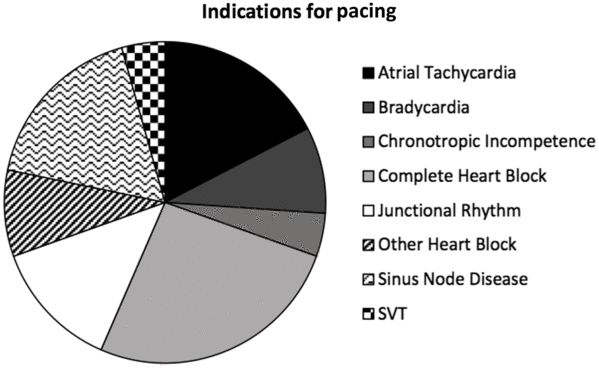
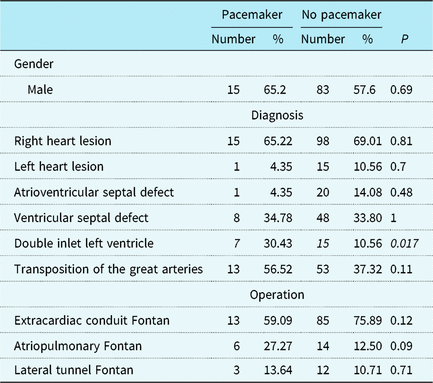
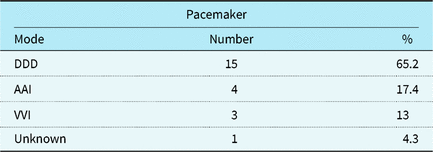
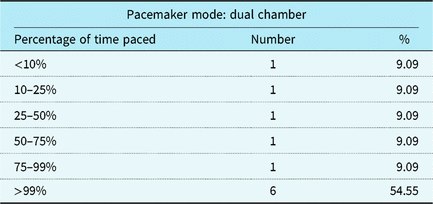
Of the remaining 165 patients, 23 patients required a pacemaker either during or following their Fontan operation (13.9%). There was a wide range of pacemaker indications (Fig 1). There were no differences in age or gender of the paced and non-paced patient groups, and no difference in the type of Fontan procedure performed (atrio-pulmonary, lateral tunnel, or extra-cardiac conduit). In terms of underlying diagnosis, double inlet left ventricle was more frequent in the paced Fontan group (7 of 23, 30.4% permanent pacemaker, 15 of 142, 10.6% sinus rhythm; p = 0.017, Table 1). In the paced group, the most commonly used setting was DDD (65%) (Table 2). Patients with dual-chamber pacemakers spent 0.4–99.6% of time paced (Table 3).
Implications for pacemaker implantation. SVT = supraventricular tachycardia.

Comparison of demographics of patients undergoing the Fontan Procedure at Leeds General Infirmary 1987–2015.

Note: The values in italics indicate statistical significance.
Mode of pacing used.

Time spent paced for patients with dual-chamber pacemakers.

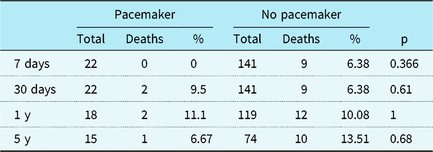
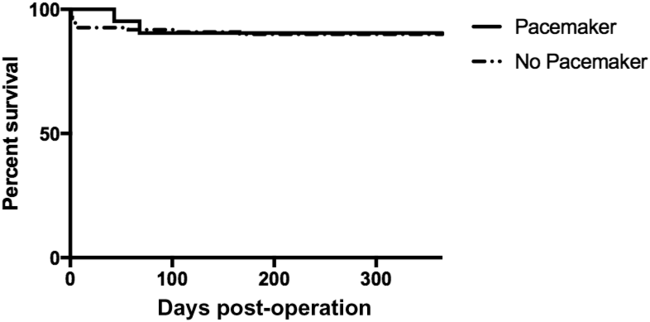
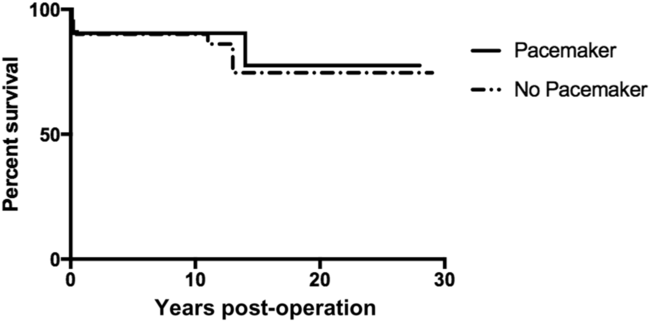
There was no significant difference between the groups in terms of survival at any stage post-Fontan procedure with up to 23 years of patient follow-up (Table 4, Figs 2 and 3).
Incidence of death following the Fontan procedure at Leeds General Infirmary.

y = years post-Fontan procedure
A Kaplan–Meier plot demonstrating survival rates throughout the first-year post-Fontan procedure comparing patients with a pacemaker to those without.

A Kaplan–Meier plot demonstrating survival rates post-Fontan procedure comparing patients with a pacemaker to those without.

Acute complications were significantly more likely to affect patients who required a pacemaker (8 of 23, 34.8% permanent pacemaker versus 4 of 142, 2.8% sinus rhythm, p < 0.001), including greater likelihood of acute kidney injury (4 of 23, 17.4% permanent pacemaker versus 1 of 142, 0.7% sinus rhythm, p = 0.0013). There was no difference in the incidence of chronic complications, including symptoms indicative of Fontan failure (1 of 23, 4.7% permanent pacemaker versus 11 of 142, 7.4% sinus rhythm, p = 1). Patients in the pacemaker group were far more likely to require further bypass procedures (8 of 23, 35% permanent pacemaker versus 9 of 142, 6.3% sinus rhythm, p < 0.001), although there was no difference in the incidence of interventional catheter procedures (4 of 23, 17.4% permanent pacemaker versus 37 of 142, 26% sinus rhythm, p = 0.45). Interventions related directly to the pacemaker were excluded (Table 3).
There were no differences between groups in oxygen saturation level as recorded in clinic at any stage post-Fontan procedure (Table 4).
Discussion
This study analyses the requirement for a post-operative pacemaker and its effects on the mortality and morbidity of patients who have undergone the Fontan operation for palliation of a single-ventricle circulation. The data provides some reassurance that pacemaker requirement does not, in the long term, appear to impact negatively on survival. However, this study does demonstrate that this group is at risk of early complications that are likely to relate to a propensity for lower cardiac output in this group (acute kidney and cerebral injury).
Pacemaker requirement had no effect on the incidence of protein losing enteropathy or other chronic complications. This suggests that pacemaker requirement in the long term is not associated strongly with symptoms suggestive of Fontan failure.Reference John, Johnson and Khan 7
A significantly higher proportion of patients in the pacemaker group had double inlet left ventricle amongst their initial diagnoses, and further analysis reveals a cohort of patients with double inlet left ventricle and transposition of the great arteries. Ventricular septal defect enlargement will have been necessary for these patients; this is often performed at the time of Fontan operation, with potential for disruption of the septal conduction pathway, increasing the likelihood of pacemaker requirement. In current practice, this patient group would have a Damus–Kaye Stansel anastomosis performed at first palliation, obviating the need for subsequent ventricular septal defect enlargement.Reference Franken, Admiraal and Verrall 8
The main limitations of this study are the retrospective design and the small number of patients requiring a pacemaker, which in turn limits the power to detect any association of pacemaker requirement with symptoms suggestive of Fontan failure in this series. A national multi-centre study would provide more evidence on the importance of pacemaker requirement and outcome post-Fontan.
Conclusions
Pacemaker requirement post-Fontan is associated with more complex surgery performed during the same procedure. This is associated with an increase in short-term morbidity. However, despite this, there appears to be no long-term propensity to Fontan failure or adverse effect on longer term survival.
Acknowledgements
None.
Financial Support
This research received no specific grant from any funding agency, commercial or not-for-profit sectors.
Conflicts of Interest
None.