Introduction
Family caregiving is the oldest form of care system. Nevertheless, relatives who assume the role of primary caregiver are exposed to a stressful situation that increases their risk of developing important emotional problems, especially anxiety and depression (Pagel et al., Reference Pagel, Becker and Coppel1985; Schulz and Williamson, Reference Schulz and Williamson1991; Crespo et al., Reference Crespo, López and Zarit2005; Cooper et al., Reference Cooper, Balamurali and Livingston2007). Dementia caregiving has been considered as a prototypical chronic stressful situation, and most of the research in this field has been carried out from the stress and coping theoretical model (e.g. Pearlin et al., Reference Pearlin, Mullan, Semple and Skaff1990; Lawton et al., Reference Lawton, Moos, Kleban, Glicksman and Rovine1991). According to this model of stress, the degree to which the difficult situations faced by caregivers over long periods of time (stressors such as the care recipient's behavioral problems or dependence) influence their own mental health (e.g. depression or anxiety) will vary depending on their personal resources (e.g. coping or social support). This model highlights the importance of analyzing the influence of personal resources on caregiving distress. While the number of studies analyzing caregivers’ stress process has grown exponentially over the last three decades, there are some relevant personal resources (which may attenuate or reinforce the impact of stressors on caregivers’ mental health) that deserve more attention than they have received so far. This is the case of spirituality and self-efficacy, which are analyzed in the following sections.
Spirituality
Spirituality refers to the individualized and personal response to matters such as the meaning of life, death, illness, and existential concerns; it is the personal quest to understand the ultimate questions about life, meaning, and our relationship to the sacred or transcendent. It can be seen as comprising elements of meaning and connection to a higher power or something greater than the self (Fetzer Institute and National Institute on Aging Working Group, 1999).
The influence of spirituality on caregiver stress process is under-explored, even though it has been considered to be an important coping resource for caregivers (Marquez-González et al., Reference Marquez-González, Lopez, Romero-Moreno and Losada2012). A review of studies analyzing the role of spirituality in caregivers’ well-being showed that most of them reported either no association between spirituality and well-being (e.g. depression) or a mixed association (combination of positive, negative, and non-significant results) (Hebert et al., Reference Hebert, Weinstein, Martire and Schulz2006). It is likely that the heterogeneity of the measures used for assessing spirituality partially explains the inconsistency of the findings in this research field. Even though spirituality is a multidimensional construct (meaning, forgiveness, spiritual coping, spiritual history, commitment, and so on; Fetzer Institute and National Institute on Aging Working Group, 1999), it is usually operationalized with broad measures, a fact that may contribute to the finding of “cloudy” results (Hebert et al., Reference Hebert, Weinstein, Martire and Schulz2006).
In order to avoid ambiguous research results, it is necessary to be specific about the dimension of spirituality measured with caregivers. Spiritual meaning is a specific spiritual dimension related to the existentialism perspective. Spiritual meaning in the context of caregiving refers to the spiritual attributions associated with the experience of caregiving (Farran et al., Reference Farran, Miller, Kaufman, Donner and Fogg1999). Spiritual or ultimate meaning relates to caregivers deriving a sense of purpose from beliefs in a greater spiritual power. A central element of spirituality is the provision of ultimate meaning. Spirituality allows people to interpret events and experiences as ultimately meaningful by linking them to a broader sense of order (Farran et al., Reference Farran, Miller, Kaufman, Donner and Fogg1999; Quinn et al., Reference Quinn, Clare and Woods2010).
Self-Efficacy
A non-avoidant belief is the construct of perceived self-efficacy. It is described as the subjective belief that one can organize and execute courses of action in order to manage given situations (Bandura, Reference Ai, Peterson, Rodgers and Tice1997). It refers to individuals’ judgment of their ability to perform a behavior successfully. In the caregiving area, these efficacy beliefs represent the caregiver's assessment of his/her ability to successfully master relevant caregiving tasks. Rather than viewing the demands of caregiving as tasks to be avoided, those with a high sense of caregiving self-efficacy may view them as challenges to be overcome (Gilliam and Steffen, Reference Gilliam and Steffen2006). When individuals face caregiving demands, those with low self-efficacy beliefs focus on negative aspects of the situation, including their personal deficiencies and the difficulties of the task. Focus on negative cognitions reduces motivation to initiate an activity, impacts task persistence, and leads to negative affective states, which then perpetuate the cycle (Bandura, Reference Bandura1997). Optimal performance involves both skills and the efficacy beliefs to use the skills.
The role of self-efficacy in the stress process, although indicated as one of the variables that may contribute to a reduction of the impact of caregiving demands on health, has been under-studied. It is especially important to consider caregiver self-efficacy in cases in which care recipients have dementia, given that, as this illness progresses, the caregiving role increasingly includes responsibility for carrying out specific care and care management behaviors. In fact, higher caregiver self-efficacy expectations regarding their own ability to handle caregiving challenges has been significantly related to lower scores on burden, anger, anxiety, and depression, even after controlling for objective stressors (Marquez-González et al., Reference Marquez-González, Losada, Lopez and Peñacoba2009).
Relationships between spirituality and self-efficacy
It seems plausible to consider different combinations (or profiles) of spirituality and self-efficacy beliefs with a view to making better predictions about caregivers’ well-being. In many respects, spirituality empowers the individual. Being connected to an all-powerful and sympathetic Supreme Being gives spiritual people a tool that can be used to change their situation or acquire the strength to endure it. This may strengthen feelings of self-efficacy and increases beliefs in one's capability to organize and execute the courses of action required to manage prospective situations. In this sense, Lim et al. (Reference Lim, Griva, Goh, Chionh and Yap2011) found that spirituality is associated with caregivers’ gain through the use of the encouragement strategy to manage dementia-related problems, suggesting that spiritual beliefs could have provided caregivers with a framework to positively reframe the situation and enabled them to be more empathetic, which, in turn, promoted efforts at encouraging the relative.
Nevertheless, one might also expect spirituality to be positively related to control or influence by powerful others. Spiritual persons believe that a higher power possesses and exerts control over the affairs of the world. Indeed, one could predict that spiritual involvement is related to a lower sense of self-efficacy. Such people place all responsibility for problem-solving on God, while passively waiting to receive solutions (Holland et al., Reference Holland1999; Kinney et al., Reference Kinney, Ishler, Pargament and Cavanaugh2003).
Kinney et al. (Reference Kinney, Ishler, Pargament and Cavanaugh2003) identified three styles of selecting solutions to problems guided by spiritual beliefs in dementia caregivers. A “collaborative style” consists of involving active personal exchange with God. In this style, caregiver and God are viewed as active contributors working together to solve problems (high spirituality and high self-efficacy). A “deferring style,” in which the caregiver waits for solutions from God, seems to be part of an externally oriented spirituality providing answers to questions that the caregiver is not able to resolve by him/herself. This style was associated with lower levels of competence (high spirituality). A “self-directing style” emphasizes the power of the caregiver to direct his own life. This style appeared to be an active coping orientation that stressed personal agency (high self-efficacy). Spirituality may increase external control, but at the same time a reliance on God may actually improve one's sense of internal control and thereby improve self-efficacy.
In our opinion, Kinney et al. (Reference Kinney, Ishler, Pargament and Cavanaugh2003) skip a style of selecting solutions to problems – a “lack of expectations style” – in which the caregiver does not wait for solutions from God, but does not believe that he can organize and execute courses of action in order to manage given situations (low spirituality and low self-efficacy). Consistently with this perspective, the caregiver does not expect that the solution comes from God but he does not have a sense of internal control either.
The dementia literature findings on the effect of spirituality and self-efficacy, considered simultaneously, on the stress process are not robust. It is possible to consider the global combined effect of spirituality and self-efficacy. Nevertheless, this research is interested in the four possible profiles of combination between spirituality and self-efficacy: collaborative, deferring, self-directing, and lack of expectations. The aim of this paper is to analyze, drawing on the stress and coping model framework, the combined role of spiritual meaning and self-efficacy in dementia caregivers’ well-being (depression and anxiety). We hypothesized that caregivers with high levels of spiritual meaning and high self-efficacy would also demonstrate fewer levels of anxiety and depression.
Methods
Sample
Face-to-face interviews were carried out with 122 dementia caregivers. To be eligible for the study, caregivers had to meet the following criteria: (1) the caregiver was providing care for a community-dwelling dementia relative diagnosed with dementia; (2) the caregiver identified him/herself as the family member primarily responsible for the patient's care; (3) the caregiver devoted at least one hour per day to caregiving tasks; (4) the caregiver had been caring for the patient for at least three consecutive months; and (5) the caregiver was 18 years old or over.
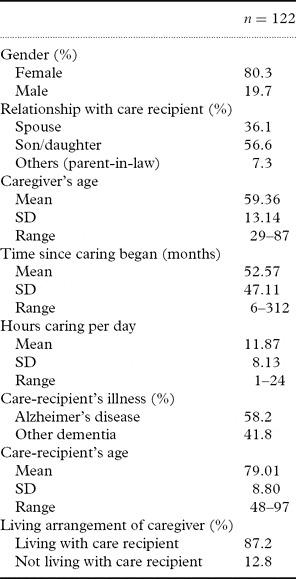
Sociodemographic characteristics of the sample (caregivers’ age, gender, and relationship with care recipient; care recipients’ age; time since caring began; hours spent caring per day; and care recipients’ illnesses and living arrangement of caregiver) are shown in Table 1.
Sociodemographic characteristics of the sample

SD = Standard deviation.
The majority of caregivers were Christian (83.6%). About one-sixth identified themselves as non-religious persons (16.4%). The average spiritual mean score was 12.39 (range 0–28).
Measures
In addition to the sociodemographic variables, and based on the stress and coping model (Pearlin et al., Reference Pearlin, Mullan, Semple and Skaff1990; Lawton et al., Reference Lawton, Moos, Kleban, Glicksman and Rovine1991), the following variables were assessed.
Stressors
Frequency of behavioral problems:
This variable was assessed with the Frequency subscale from the Revised Memory and Behavior Problems Checklist (RMBPC; Teri et al., Reference Teri, Truax, Logsdon, Uomoto and Zarit1992), which consists of a 24-item scale measuring the frequency of observable behavioral problems (e.g. “Waking you or other family members up at night”). Scores range from 0 (“not at all”) to 4 (“extremely”). In this study, the internal consistency was 0.83 (Cronbach's α).
Functional status:
Patients’ functional status was measured using the Barthel Index (Mahoney and Barthel, Reference Mahoney and Barthel1965). Caregivers respond to a ten-item scale assessing the relative's level of independence for activities of daily living (ADL; e.g. “To what extent is your relative able to feed her/himself?”). Total score ranges from 0 to 100. Higher scores are indicative of higher level of independence in the patient. Cronbach's α was 0.94 in the present study.
Daily hours devoted to caregiving and time since caregiving began were also considered as stressors.
Appraisal
Caregiver's appraisal of behavioral problems:
This was assessed using the Appraisal subscale from the RMBPC (Teri et al., Reference Teri, Truax, Logsdon, Uomoto and Zarit1992). The 24-item scale provided a score for the amount of distress caused by the problem behavior (e.g. “How much has it bothered or upset you when you or other family members have been woken up at night?”). Scores range from 0 (“not at all”) to 4 (“extremely bothered or upset”). Cronbach's α was 0.89.
Personal resources
Social support:
The Psychosocial Support Questionnaire (Reig et al., Reference Reig, Ribera and Miquel1991) was used. This questionnaire has six items (e.g. “When I need it, there is always someone to encourage me and show affection”) for assessing caregivers’ perceptions of the frequency of social, emotional, and instrumental support they receive. Participants were instructed to answer these items regarding their lives in general. The answers range from 0 (“never”) to 3 (“very often”). Cronbach's α was 0.81.
Spiritual meaning:
This was measured through the Spanish version of the Ultimate Meaning Scale (Farran et al., Reference Farran, Miller, Kaufman, Donner and Fogg1999; Fernández-Capo et al., Reference Fernández-Capo, Roque, Gual and Cruz2002). This scale is made up of seven items (e.g. “The Lord won't give you more than you can handle,” “I believe in the power of prayer; without it I couldn't do this,” “I believe that the Lord will provide”), with responses ranging from 0 (“strongly disagree”) to 4 (“strongly agree”), that were used to assess spiritual attributions associated with the experience of caregiving. Participants were instructed to answer these items regarding their lives in general. Cronbach's α was 0.89.
Perceived self-efficacy:
This was measured using the Spanish version of the Revised Scale for Caregiving Self-efficacy (Steffen et al., Reference Steffen, McKibbin, Zeiss, Gallagher-Thompson and Bandura2002; Marquez-González et al., Reference Marquez-González, Losada, Lopez and Peñacoba2009). This scale is made up of 15 items (e.g. “How confident are you that, when [. . .] asks you four times in the first hour after lunch when lunch is, you can answer without raising your voice”) that were used to assess caregivers’ perceived self-efficacy for obtaining respite, responding to disruptive patient behaviors, and controlling upsetting thoughts. The answers range from 0 (“cannot do at all”) to 100 (“certainly can do”). Cronbach's α was 0.84.
Outcome variables
Depression:
Depressive symptomatology was assessed with the Center for Epidemiological Studies Depression Scale (CES-D; Radloff, Reference Radloff1977). It consists of 20 items that assess how much the person experienced depressive symptoms during the last week (e.g. “I felt that everything I did was an effort”). Answers range from 0 (“hardly ever or never”) to 3 (“all the time”). Cronbach's α was 0.90.
Anxiety:
Anxiety was assessed using the Tension subscale of the Profile of Mood States (POMS; McNair et al., Reference McNair, Lorr and Droppleman1971), which consists of nine items that measure caregivers’ levels of anxiety (e.g. “During last week, how often did you feel nervous?”), with answers ranging from 1 (“not at all”) to 5 (“very much”). Cronbach's α was 0.91.
Data analysis
Participants were coded as high or low in spirituality and perceived self-efficacy, respectively, based on median splits for each variable (Md = 12 on the “spirituality” and Md = 79 on the “self-efficacy” scale). Four groups, corresponding to four different profiles, were formed: HEHS = High in self-efficacy and high in spirituality; LELS = Low in self-efficacy and low in spirituality; HELS = High in self-efficacy and low in spirituality; and LEHS = Low in self-efficacy and high in spirituality. With a view to analyzing differences between types of profiles in spirituality and self-efficacy for caregiving, ANOVAs were carried out to permit the analysis of differences between these groups in the following variables: (1) stressors (hours caring per day, time since caregiving began, level of dependency, and frequency of behavioral problems); (2) appraisal (caregiver's appraisal of behavioral problems); (3) caregiver's resources (social support); and (4) outcome variables (depression and anxiety). In order to test the effect size of between-group differences in the assessed variables, partial eta-square (ηp 2) was used with the usual interpretation (small effect = 0.01–0.06; medium effect = 0.06–0.14; large effect = ≥ 0.14).
Stressor-related variables (hours caring per day, time since caregiving began, level of dependency, and frequency of behavioral problems), appraisal (caregiver's appraisal of behavioral problems), and caregiver's resources variables (social support, and – as dummy variables – the four groups corresponding to the different spirituality and self-efficacy profiles) were introduced in a stepwise regression analysis in order to determine how much weight these variables had in the explanation of caregivers’ anxiety and depression and how they were related to it.
Results
No univariate (z scores in excess of 3.29; p < 0.001) or multivariate (Mahalanobis distance at p < 0.001) outliers were found following the Tabachnick and Fidell (Reference Tabachnick and Fidell2001) criteria. Also, non-significant departures from normality (skewness and kurtosis) were found for the assessed variables.
Caregivers were distributed in the four groups: 18.1% HEHS; 23.8% LELS; 31.1% HELS; and 27% LEHS.
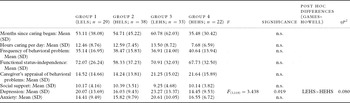
ANOVA analyses revealed main group effects only for depression (Table 2). Specifically, the LEHS caregiver group showed significantly higher levels of depression than the HEHS group. The effect size was medium. There were no group differences related to stressor variables (months since caregiving began, hours caring per day, frequency of behavioral problem, functional status), appraisal (caregiver's appraisal of behavioral problems), caregiver's resources variables (social support), or anxiety. The following trends, while not statistically significant, were noted: the HEHS group reported less hours of care per day and had been caregivers for fewer years than the LEHS group; nevertheless, the HEHS care recipient group reported more frequency of behavioral problems and less functional independence of the care recipient than the LEHS group. Therefore, caregiving is more time consuming in the LEHS group but it implies less amount of stressors than the HEHS. Nonetheless, there were no statistically significant differences among all groups.
Differences between groups in the assessed variables

LELS = Low self-efficacy and low spirituality; HELS = High self-efficacy and low spirituality; LEHS = Low self-efficacy and high spirituality; HEHS = High self-efficacy and high spirituality; n.s = Not significant; SD = Standard deviation.
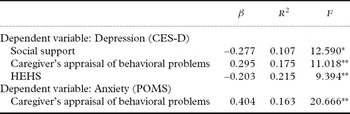
Stepwise regression analysis showed that three variables were significantly associated with depression outcome (Table 3): social support, caregiver's appraisal of behavioral problems, and the HEHS group. The total percentage of explained variance of the depression outcome measure accounted for by these three variables was 21.5%. On the other hand, lower caregiver's appraisal of behavioral problems was correlated with lower anxiety. This factor explained 16.3% of variance in caregivers’ anxiety.
Stepwise multiple regression equations to predict depression and anxiety scores

*p < 0.01; **p < 0.001.
CES-D = Center for Epidemiological Studies Depression scale; HEHS = High self-efficacy and high spirituality; POMS = Profile of Mood States.
Discussion
The present study extends the data on the relationship between self-efficacy, spirituality, and caregiver depression, providing evidence in support of the association between these two under-explored aspects of caregiver's personal resources (spiritual meaning and self-efficacy), considered simultaneously, and caregivers’ well-being. This study highlights the importance of specifying the caregiver's profile defined by the combination of the two variables: self-efficacy and spirituality (high or low levels in each one). Taken together, these results suggest that considering together the role of spirituality and self-efficacy as a personal resource is complex and warrants further study.
ANOVA analysis showed that caregivers with a strong sense of HEHS feel less depressed than caregivers who have a strong sense of LEHS. A combination of these two personal resources (spirituality and self-efficacy) may better explain caregivers’ depressive symptomatology than spirituality alone. Depressive symptoms can perhaps be better changed with the help of both personal resources (beliefs in one's ability to successfully execute courses of action and influence the choices of activity one undertakes) and a search for an ultimate truth or higher value, than through spirituality alone. A strong sense of spirituality in addition to a high sense of self-efficacy may counteract feelings of helplessness and loss of control.
The finding suggests that HEHS is associated with a lower level of depression and that both intrinsic or faith-related elements (spiritual meaning) and pragmatic ones (self-efficacy) are relevant aspects for enhancing caregivers’ ability to cope with depression. Dementia caregivers are engaged in a challenging and important role that often consumes their health. Caregivers with a high sense of spirituality and self-efficacy may be protected from the negative consequences of caregiving through the experience of a spiritual and transcendent dimension that protects their focus on what they are capable of accomplishing, rather than on their past failures. Spirituality might protect against depression because feelings of divine protection can encourage feelings of security and friendliness, and when a stressor is a life-threatening disease or disability, the person's perceived support from God may reduce reaction to the stressor (Fetzer Institute and National Institute on Aging Working Group, 1999). Self-efficacy beliefs can influence depression outcomes by determining individuals’ coping responses, degree of effort, and persistence in the face of obstacles and aversive experiences in caregiving (Gilliam and Steffen, Reference Gilliam and Steffen2006). It appears from this research that caregivers may benefit from their spiritual meaning when it is connected to self-efficacy. Thus, in exploring spiritual beliefs with caregivers who are so inclined, health professionals might include the exploration of how those beliefs foster a greater sense of self-efficacy, which may include a sense of being loved by God, and also a belief that they possess the coping resources necessary to deal with certain situations (Kinney et al., Reference Kinney, Ishler, Pargament and Cavanaugh2003). It may also be possible that spiritual coping strategies such as praying or meditating, or spiritual attitudes such as self-compassion or self-kindness, may help people maintain or increase their self-efficacy and feelings of internal control, as it has been suggested in previous studies (Ai et al., Reference Ai, Peterson, Rodgers and Tice2005; Iskender, Reference Iskender2009).
Depressed individuals who have low levels of caregiving self-efficacy may then experience their spirituality in a very passive way (“It is all up to God,” “God controls all the events and outcomes of my life”). Nevertheless, both resources (spirituality and self-efficacy) are compatible: one can act jointly with a Powerful Other – God – as a partner to cope with stressors, and thus maintain a sense of control and efficacy over life events. Although most religions, if not all, affirm that the fundamental features of life are beyond our control and a Powerful Other controls the events of our lives, some studies have documented that many people (specially older adults) report working with a Higher Being as partners in the effort to cope with major problems in their own life (Schieman, Reference Schieman, Zarit, Pearlin and Schaie2003). Empirical evidence has also been found suggesting that greater internal control is positively related to spiritual coping strategies such as private prayer (Ai et al., Reference Ai, Peterson, Rodgers and Tice2005). These findings provided evidence that a combination of HEHS may be wellbeing-enhancing. Spiritual caregivers are not passive in nature. The study supports the view that our relationship to the sacred or transcendent may imply an active exchange or interaction with a higher power or something greater than the self.
When all variables examined in this research are taken into account in an additive way to explain caregiver depression (regression analysis), both spiritual meaning and self-efficacy have been found to play an important role in caregivers’ well-being. Again, caregivers who have a strong sense of spirituality and who report HEHS showed fewer depressive symptoms, suggesting that these caregivers may cope better with stressors than caregivers who have neither a strong sense of spirituality or self-efficacy. In sum, this study supports the hypothesis that self-efficacy and spirituality may be related to depression outcome because, together, they provide better coping strategies in caregiving situations.
Surprisingly, stronger objective stressors of caregiving (e.g. longer period since caregiving began, caring longer hours per day, poorer functional status, or higher frequency of observable behavioral problems) were not associated with caregiver depression and anxiety. A possible explanation for this is that the actual demands of caregiving may not be directly related to caregivers’ well-being. Instead, other personal factors (such as caregiver's appraisal of behavioral problems, social support, and higher sense of self-efficacy and spirituality) may be more strongly related to caregiving outcomes, providing support for the stress and coping model (Lawton et al., Reference Lawton, Moos, Kleban, Glicksman and Rovine1991; Quinn et al., Reference Quinn, Clare and Woods2010).
Social support is also related to depression, suggesting that support from the community might function as a buffering factor, providing a way to channel or relieve depressive feelings. Caregivers of relatives with dementia often live an isolated existence, breaking up their relation with family members and former friends. Stressors can proliferate when the caregiver has difficulty meeting ongoing demands without any functional or emotional support. Furthermore, the perception that one is accepted and valued in one's interpersonal environment bolsters esteem, confidence, and efficacy, which guard against depression. Feelings of hopelessness, sorrow, or being alone are emotions commonly associated with depression; individuals with a healthy social support network can more easily handle such feelings. Close relationships increase happiness in individuals, because they know that they are not alone in the world. Confidence boosts from others help decrease sorrow and states of sadness in individuals (Pearlin et al., Reference Pearlin, Mullan, Semple and Skaff1990; Schulz and Williamson, Reference Schulz and Williamson1991).
Caregiver's appraisal of behavioral problems is the only variable related to both depression and anxiety. The stress and coping theoretical model adapted to caregiving affirms the central role played by caregivers’ appraisals in the understanding and explanation of psychological outcomes. Although behaviors identified as problematic in dementia have negative effects on caregiver health, they may not be experienced in the same way by different caregivers. Caregivers might appraise a potentially problematic situation as upsetting – that is, as a situation that could bring distress to oneself or to a relationship; but they might also appraise a potentially problematic situation as challenging, rather than distressing: as a situation to be overcome. The amount of distress caused by problem behaviors – caregivers’ appraisal of behavioral problems in persons with dementia – may influence their interactions with that person in ways that reduce the incidence of behavioral problems (i.e. by helping caregivers modulate thoughts and feelings that influence their modes of interaction). Therefore, it is the perception of a caregiving situation as stressful, not the mere presence of a potentially stressful situation, that determines whether the event is interpreted as manageable. In other words, how caregivers think about the situation influences the way they act and emotionally respond, suggesting that appraisal plays a mediating role between a potential stressor and coping actions (Lawton et al., Reference Lawton, Moos, Kleban, Glicksman and Rovine1991).
The results of this study are consistent with previous findings regarding significant associations between caregivers’ well-being (depression and anxiety) and their appraisals (Crespo et al., Reference Crespo, López and Zarit2005). Furthermore, other studies have found moderator or mediator effects of social support (Pearlin et al., Reference Pearlin, Mullan, Semple and Skaff1990; Schulz and Williamson, Reference Schulz and Williamson1991), self-efficacy (Gilliam and Steffen, Reference Gilliam and Steffen2006; Romero-Moreno et al., Reference Romero-Moreno, Losada, Mausbach, Marquez-González, Patterson and Lopez2011), and spirituality (Thompson et al., Reference Thompson, Solano, Kinoshita, Coon, Mausbach and Gallagher-Thompson2002; Marquez-González et al., Reference Marquez-González, Lopez, Romero-Moreno and Losada2012) on caregiver depression. Nevertheless, Thompson et al. (Reference Thompson, Solano, Kinoshita, Coon, Mausbach and Gallagher-Thompson2002) found that spirituality was associated with less depression in Latina caregivers but not in Caucasians, suggesting the importance of considering the influence of cultural factors on analyzing the association between this construct and depression. In fact, according to a review by Hebert et al. (Reference Hebert, Weinstein, Martire and Schulz2006), the effects of spirituality on depression are unclear. However, the findings of the present study, in which the combination of HEHS was significantly related to caregivers’ depression, suggest that what is important in relation to depression outcomes is precisely their combined effect.
Contrary to our hypotheses, caregivers with high spiritual meaning and high self-efficacy did not report less anxiety. There is considerable literature on burden and depression in caregivers of people with dementia. Anxiety has been a relatively neglected outcome measure. Anxiety among dementia caregivers has received far less attention in the literature than depression, and may require specific research. Cooper et al. (Reference Cooper, Balamurali and Livingston2007) found that there is a considerable comorbidity between anxiety and depression, and most caregivers with depressive symptomatology also reported symptoms of anxiety, although the converse is not clear. Factors associated with depression may not bear the same relationship to anxiety (Cooper et al., Reference Cooper, Balamurali and Livingston2007) and control or efficacy variables would be more highly related to caregivers’ depression than to anxiety (Pagel et al., Reference Pagel, Becker and Coppel1985; Cooper et al., Reference Cooper, Balamurali and Livingston2007). Nevertheless, a systematic review found a lack of evidence regarding determinants of anxiety caseness or levels in caregivers of people with dementia (Cooper et al., Reference Cooper, Balamurali and Livingston2007).
This study has interesting implications for the design of interventions with caregivers. High or negative appraisal of behavioral problems is theoretically and empirically associated with perceptions of low self-efficacy in coping with such behaviors (Haley et al., Reference Haley1996), which, over time, may contribute along with other factors (e.g. absence of spiritual meaning, absence of social support) to the development of helplessness and depression. Increasing self-efficacy in caregivers by training them to cope better with problem behaviors (so that they appraise them as less stressful), reinforcing the social support network, and finding spiritual meaning within the caregiving experience may help alleviate their depression level.
There were several limitations to this study that make it necessary to interpret the study findings with caution. It should be acknowledged that the convenience-based nature of the sample (made up of voluntary caregivers recruited through health and social centers) limits the generalization of these findings. Nevertheless, the sample looked similar to other national samples of dementia caregivers. Furthermore, the cross-sectional design of the study precludes any kind of causal inferences about the directionality of the influences of the relationships between spirituality, self-efficacy, and caregivers’ well-being. It would be interesting to analyze the directions of the relationships between these variables with a view to explaining caregiver depression and identifying the potential action mechanisms of interventions. In this sense, there is a need for longitudinal and experimental studies. Including qualitative inquiry may also help to further clarify the relationship among these variables. Further, self-report bias may have been introduced by participants in responding to sensitive personal information such as spiritual meaning. A limitation of the Ultimate Meaning Scale is that it was grounded in qualitative comments made by caregivers who reflected a primarily Judeo-Christian perspective; terms such as “Lord” and “God” may not be appropriate for all caregivers (Farran et al., Reference Farran, Miller, Kaufman, Donner and Fogg1999). Moreover, the present study involves primarily Christian caregivers. It would be useful to compare Christian beliefs with other belief systems that are somewhat different in focus (e.g. Buddhism). In spite of these limitations, this study provides some useful insights about the role of spirituality and self-efficacy in caregiver depression, and particularly about the relevance of considering these two variables jointly in caregiving research.
The current study is an important first step in understanding the combined effect of spirituality and self-efficacy and its relationship to the emotional functioning of dementia caregivers. However, there is still much to be studied in the area of spirituality and self-efficacy in families of relatives with dementia. For example, future research might examine whether men and women, or parents and siblings, share similar spiritual and self-efficacy beliefs, and how this congruence or lack thereof influences family functioning. Also, different spiritual orientations could be studied, to determine how they influence self-efficacy. The impact of self-efficacy and spirituality in dementia caregiver emotional well-being may be generalized to other situations during which other chronic role strains arise. Developing a more comprehensive theory of stress and coping in caregiving contexts (including relationships with others in the family or on the job) may be an additional fruitful line of research. Future research might also examine more systematically how emotional states, such as the two assessed in the present study, depression and anxiety, engender or are engendered by specific patterns of spiritual and self-efficacy beliefs. It would also be very interesting to analyze the moderator role of self-efficacy in the relationship between spirituality and depression. Once these relationships are better understood, intervention programs could be specifically tailored to better support dementia caregivers including, if appropriate, spiritual and self-efficacy, in combination, elements.
Conflict of interest
None.
Description of authors’ roles
Javier López worked on the data analysis and the writing of the paper; Rosa Romero-Moreno worked on the study implementation and helped write the paper; and María Márquez-González and Andrés Losada designed and carried out the study, and helped write the paper.
Acknowledgments
This work was funded by the Spanish Ministry of Education (grant number SEJ2006-02489/PSIC) and the Spanish Ministry of Science and Innovation (PSI 2009-081327PSIC).