Introduction
Shortly before their second birthdays, children begin to acquire in earnest a sizable verb vocabulary. Acquisition of verbs presents a distinct challenge for the language learner, and verbs may in fact be more difficult to acquire than nouns (e.g., Gentner, Reference Gentner1978; Gleitman, Reference Gleitman1990; Gleitman, Cassidy, Nappa, Papafragou, & Trueswell, Reference Gleitman, Cassidy, Nappa, Papafragou and Trueswell2005). Through age three, verbs constitute a smaller portion of early vocabularies than nouns, both receptively and expressively (e.g., Bornstein et al., Reference Bornstein, Cote, Maital, Painter, Park, Pascual and Vyt2004; Fenson, Marchman, Thal, Dale, Reznick, & Bates, Reference Fenson, Marchman, Thal, Dale, Reznick and Bates2007; Gentner, Reference Gentner and Kuczaj1982), and the gap between receptive and expressive knowledge is greater for verbs than for nouns (Casasola & Cohen, Reference Casasola and Cohen2000). These findings are robust for English learners, and there is some evidence that the same is true cross-linguistically, although the cross-linguistic aspects have mixed findings in the literature (see, e.g., Waxman, Fu, Arunachalam, Leddon, Geraghty, & Song, Reference Waxman, Fu, Arunachalam, Leddon, Geraghty and Song2013, for review).
Some two-year-olds may struggle even more than others. Late talkers, who are defined by atypically small expressive vocabularies given otherwise typical development (Desmarais, Sylvestre, Meyer, Bairati, & Rouleau, Reference Desmarais, Sylvestre, Meyer, Bairati and Rouleau2008; Rescorla, Reference Rescorla1989), appear to have particular difficulties in adding verbs to their vocabularies, as evidenced by their limited verb lexicons and limited use of verbs in spontaneous speech when compared to typically developing peers (Hadley, Reference Hadley2006; Olswang, Long, & Fletcher, Reference Olswang, Long and Fletcher1997). Late talkers are an important pre-clinical group: they are at greater risk for later diagnoses of language disorder than their typically developing peers (Rescorla & Dale, Reference Rescorla and Dale2013), and status as a late talker is considered a risk factor for Developmental Language Disorder (DLD, previously Specific Language Impairment or SLI)Footnote 1 (Leonard, Reference Leonard2014). Late talkers who do not ultimately have a diagnosed language disorder still have poorer language outcomes as compared to their typically developing counterparts, including poorer performance on a variety of language measures throughout childhood (Girolametto, Wiigs, Smyth, Weitzman, & Pearce, Reference Girolametto, Wiigs, Smyth, Weitzman and Pearce2001; Rescorla Reference Rescorla2005, Reference Rescorla2009; Rice, Taylor, & Zubrick, Reference Rice, Taylor and Zubrick2008), and atypical neural activation on language tasks at age eight (Preston et al., Reference Preston, Frost, Mencl, Fulbright, Landi, Grigorenko, Jacobsen and Pugh2010).
It is worrisome that late talkers may have particular deficits in verb knowledge. Verbs are particularly important to language development; because of the role that verbs play in syntactic structure, verb acquisition has cascading effects on the development of grammar. Children's verb vocabularies at age two, as they are beginning to acquire robust verb lexicons, have garnered particular attention in the literature. Perhaps unsurprisingly, two-year-olds’ verb use is a better predictor of grammatical abilities at age three than their noun use (Hadley, Rispoli, & Hsu, Reference Hadley, Rispoli and Hsu2016). Gaps in verb vocabularies at age two, then, may partially explain discrepancies in outcomes between late talkers and their typically developing peers. It is also important to consider the types of verbs that children acquire, not just the overall number. For example, Olswang et al. (Reference Olswang, Long and Fletcher1997) document that certain syntactic properties of the verbs in late talkers’ vocabularies are more predictive of grammatical outcomes than others – specifically, knowledge of intransitive and ditransitive verbs best predicts the transition to multiword phrases.
While it is well established that late talkers produce fewer verbs than typically developing children at age two (Hadley, Reference Hadley2006; Olswang et al., Reference Olswang, Long and Fletcher1997), what remains unclear is whether late talkers and typically developing children produce the same types of verbs at this age. At a group level, differences in the types of verbs that compose late talkers’ and typically developing children's verb vocabularies may indicate group differences in learning abilities or learning strategies. Understanding such differences may also be a key step in identifying which late talkers are most at risk for continued delay.
Prior research on late talkers is mixed with respect to whether there are group differences in vocabulary as compared to typically developing children, both when matching by age and when matching by number of words. In one study examining parent-reported vocabulary from Rescorla's (Reference Rescorla1989) Language Development Survey (LDS), Rescorla, Alley, and Christine (Reference Rescorla, Alley and Christine2001) found that late talkers aged 2;0 to 3;0 have similar vocabulary compositions to their age-matched typically developing peers overall, sharing the same most common vocabulary items; however, as children approached age three, the groups diverged, indicating that the words the older late talkers added to their vocabularies did not consistently overlap with the already existing vocabularies of their typically developing peers. Importantly for the current investigation, both groups’ early vocabularies were dominated by nouns, and the bulk of the items that they shared were nouns. It may be that when we focus specifically on verbs, which are relatively low frequency, group differences will emerge even earlier.
By contrast, a recent study by MacRoy-Higgins, Shafer, Fahey, and Kaden (Reference MacRoy-Higgins, Shafer, Fahey and Kaden2016) found that late talkers’ vocabularies had notable differences in composition as compared to typically developing children – both those matched by age and those matched by overall vocabulary size. Although both groups produced nouns more than any other word class, nouns made up a smaller proportion of late talkers’ vocabularies, even as compared to vocabulary-matched peers. Late talkers also had smaller proportions of verbs in their vocabularies as compared to age-matched (but not vocabulary-matched) peers; as compared to both age-matched and vocabulary-matched peers, late talkers’ vocabularies were made up of a greater proportion of ‘other’ words (e.g., animal sounds).
Beckage, Smith, and Hills (Reference Beckage, Smith and Hills2011) found using network analysis that, controlling for the number of words, typically developing children's vocabularies show greater connectivity and structure as compared to late talkers'. While typically developing children group words into semantic networks, even at young ages, late talkers acquire individual words in a more piecemeal fashion. These results hold for the entire lexicon as well as for nouns alone or verbs alone. Colunga and Sims (Reference Colunga and Sims2017) similarly found using computational modeling that typically developing children and late talkers have different structures to their vocabularies, and that this may be indicative of different word-learning biases. School-aged children with SLI have also been observed to have atypical semantic network structure as compared to their typically developing peers (Brooks, Maouene, Sailor, & Seiger-Gardner, Reference Brooks, Maouene, Sailor, Seiger-Gardner, LaMendola and Scott2017; Sheng & McGregor, Reference Sheng and McGregor2010). Taken together, these studies indicate that the developmental trajectories of late talkers are likely atypical rather than just delayed.
Considering the mechanisms underlying verb learning specifically, it is plausible that late talkers may differ from typically developing children in the process of verb acquisition. Verb acquisition in typical development is aided by attention to the linguistic contexts in which verbs appear, an ability known as ‘syntactic bootstrapping’ (e.g., Gleitman, Reference Gleitman1990; Landau & Gleitman, Reference Landau and Gleitman1985). Linguistic context is useful for acquiring verb meanings because there are relatively systematic relationships between what verbs mean and what kinds of contexts they appear in. For example, agent thematic roles are typically realized as grammatical subjects, and verbs denoting relations between two event participants often appear in transitive syntactic frames. Beginning in the second year of life, typically developing children can use such relationships to identify the meaning of new verbs (e.g., Arunachalam, Escovar, Hansen, & Waxman, Reference Arunachalam, Escovar, Hansen and Waxman2013; Fisher, Reference Fisher1996, Reference Fisher2002; Gropen, Pinker, Hollander, & Goldberg, Reference Gropen, Pinker, Hollander and Goldberg1991; Jin & Fisher, Reference Jin, Fisher, Orman and Valleau2014; Naigles, Reference Naigles1990; Naigles & Kako, Reference Naigles and Kako1993; Pinker, Reference Pinker1984; Slobin, Reference Slobin and Deutsch1981; Yuan, Fisher, & Snedeker, Reference Yuan, Fisher and Snedeker2012). Morphosyntactic cues such as verb inflection can be helpful as well; typically developing English learners use –ing and –ed morphemes to infer whether an unfamiliar verb denotes an ongoing manner of motion or a completed change of state, respectively (Behrend, Harris, & Cartwright, Reference Behrend, Harris and Cartwright1995; Carr & Johnston, Reference Carr and Johnston2001; Wagner, Reference Wagner2006; Wagner, Swensen, & Naigles, Reference Wagner, Swensen and Naigles2009).
Late talkers may have difficulty using these cues in the service of verb acquisition, because syntactic bootstrapping requires children to have substantial prerequisite linguistic knowledge and skills, including basic knowledge of the syntactic properties of their language and how thematic roles are realized in syntactic arguments. Children must also have efficient language-processing skills to quickly segment the unfamiliar verb from the ongoing speech stream, identify its morphosyntactic properties, and build a structure for the utterance in which it occurs. Conversely, when the processing demands of the utterance are high, children have difficulty using linguistic context to acquire verb meanings (He & Arunachalam, Reference He and Arunachalam2017; He, Kon, & Arunachalam, unpublished observations).
These prerequisite abilities may be particularly difficult for late talkers. Late talkers are slower to process language than typically developing children (Ellis Weismer & Evans, Reference Ellis Weismer and Evans2002; Fernald & Marchman, Reference Fernald and Marchman2012), suggesting that they will have more difficulty with the rapid parsing and assignment of syntactic structure necessary for verb acquisition. Although syntactic bootstrapping abilities have not explicitly been studied in late talkers, older children with SLI do show differences in their understanding of the relationships between meaning and argument structure (e.g., Ebbels, Dockrell, & van der Lely, Reference Ebbels, Dockrell and van der Lely2012; Ingham, Fletcher, Schelletter, & Sinka, Reference Ingham, Fletcher, Schelletter and Sinka1998; van der Lely, Reference van der Lely1994; but see Oetting, Reference Oetting1999). We expect then that late talkers have difficulty with verb acquisition overall, but that they might be disadvantaged in acquisition when processing demands are high. For example, ditransitive verbs, whose linguistic contexts are necessarily longer and more complex, may pose a particular challenge to late talkers.
Another domain in which verb vocabularies have been shown to differ in typically developing children and older children with SLI is in the semantic distinction between manner and result verbs. Manner verbs describe the way in which an action occurs, and include verbs like run and kick. Result verbs encode changes of state, and include verbs like break and open. This is an important distinction both in theoretical linguistics (e.g., Levin & Rappaport Hovav, Reference Levin and Rappaport Hovav1991, among others) and in the study of language acquisition. In typical development, evidence about the acquisition of manner and result meanings is mixed. Among children's earliest words are those that express changes of state, like “all gone”, “done”, or “up”; it has been suggested that these changes of state are particularly salient to young learners (e.g., Behrend, Reference Behrend1990; Clark, Reference Clark1995; Clark, Carpenter, & Deutsch, Reference Clark, Carpenter and Deutsch1995; Greenfield & Smith, Reference Greenfield and Smith1976; Gopnik & Meltzoff, Reference Gopnik and Meltzoff1986; de Lemos, Reference de Lemos and Deutsch1981; Penner, Schulz, & Wymann, Reference Penner, Schulz and Wymann2003). Critically, however, these particles are not verbs, and the composition of early verb vocabularies is less clear. Huttenlocher, Smiley, and Charney (Reference Huttenlocher, Smiley and Charney1983), for example, found that a majority of the verbs used by two-year-olds were result verbs. However, Gentner (Reference Gentner1978) found that five-year-old children were more accurate in ascribing verbs to actions when the verbs encoded manner (e.g., stir) as opposed to change of state (e.g., mix). Similarly, Gropen et al. (Reference Gropen, Pinker, Hollander and Goldberg1991) found that, in experiments using both familiar and novel verbs, children demonstrated a bias toward verbs that encoded manner over those that encoded an end-state. In contrast, Behrend (Reference Behrend1990) found evidence that children show a manner bias for familiar verbs but a result bias for novel verbs. In our own cross-linguistic investigation, which like the present study used vocabulary checklist data, we found no evidence of either a manner or result bias in typically developing two-year-old children's verb vocabularies (Horvath, Rescorla, & Arunachalam, Reference Horvath, Rescorla, Arunachalam, Syrett and Arunachalam2018).
Older children with SLI also appear sensitive to the distinction between manner and result verbs, but show different learning biases as compared to typically developing children. Ebbels et al. (Reference Ebbels, Dockrell and van der Lely2012), for example, found that thirteen-year-old children with SLI have more difficulty with result or change-of-state verbs than their language-matched peers. Similarly, Penner et al. (Reference Penner, Schulz and Wymann2003) have proposed that while typically developing German-acquiring children show a bias toward change-of-state meanings over manner meanings, language-impaired children do not (see also Schulz, Reference Schulz, Syrett and Arunachalam2018; Schulz, Wymann, & Penner, Reference Schulz, Wymann and Penner2001). Kelly and Rice (Reference Kelly and Rice1994), however, found that five-year-olds with SLI, like younger MLU-matched children but not like age-matched children, had no preference for assigning a change-of-state or manner meaning to novel verbs.
To date, however, no studies have examined whether late talkers also demonstrate differences as compared to typically developing peers. Given our finding with cross-linguistic data that typically developing children show no bias for either manner or result verbs, we predict the same will be true in the current study. However, late talkers’ vocabularies may be dominated by the result verbs, given hypotheses that changes of state are particularly salient to young learners (e.g., Gopnik & Meltzoff, Reference Gopnik and Meltzoff1986).
A similar distinction to that of manner or result is whether verbs denote durative or punctual events. Durative events may be protracted over an extended period of time (e.g., run, walk), whereas punctual events are not (e.g., kick, clap). Although manner verbs tend to denote durative events, and result verbs tend to denote punctual events, these are not identical distinctions: semelfactive verbs like clap encode manner but their referent events are punctual (Comrie, Reference Comrie1976; Smith, Reference Smith1991). Despite its importance for linguistic aspect (Vendler, Reference Vendler1957), this distinction is far less studied in early vocabulary; we are aware of only two studies that have examined this distinction (Abbot-Smith, Imai, Durrant, & Nurmsoo, Reference Abbot-Smith, Imai, Durrant and Nurmsoo2017; Horvath et al., Reference Horvath, Rescorla, Arunachalam, Syrett and Arunachalam2018). Both studies suggest that verbs denoting durative actions are easier to acquire, at least for typically developing children, than verbs denoting punctual actions; this is likely because punctual events are ephemeral and require children to attend to the action quickly if they are to observe it. Given that late talkers are slower language processors than typically developing children (Ellis Weismer & Evans, Reference Ellis Weismer and Evans2002; Fernald & Marchman, Reference Fernald and Marchman2012), we hypothesize that they are particularly slow to identify the referents of events that are being talked about; they would therefore be especially hindered in their efforts to acquire verbs denoting punctual events.
Taken together, prior research has shown that for typically developing children a verb's syntactic and semantic properties may impact its learnability. Given the documented difficulties with meaning–grammar relationships in older children with DLD/SLI, and given the difficulties with language processing in young late talkers, we predict that they, too, should be impacted by the syntactic and semantic properties of verbs and perhaps be particularly hindered in acquiring certain types of verbs (e.g., ditranstive verbs, punctual verbs).
In the current study, we examine vocabulary checklist data to offer a new perspective on this question, in contrast to much of the literature that has used experimental tasks. In our recent cross-linguistic study, we took this approach to examine the semantic properties of typically developing children's verb vocabularies, coding each verb for several features and asking whether those features affected children's verb knowledge (Horvath et al., Reference Horvath, Rescorla, Arunachalam, Syrett and Arunachalam2018). Here we aim to understand the similarities and differences between English-acquiring typically developing children and late talkers. We focus on both syntactic and semantic properties because although there are relationships between a verb's meaning and its syntactic properties, these relationships are not one-to-one; for example, both manner and result verbs can appear in intransitive as well as transitive frames. We categorized the verbs on the LDS according to their syntactic and semantic features using established diagnostics from theoretical linguistics and analyzed whether some features are more prevalent than others across the verb lexicons of typically developing children and late talkers.
The advantages of the checklist approach are three-fold. First, it allows us to study a relatively larger sample of children than most experimental studies include. Second, the parent-checklist format allows us to study what children produce in the home environment, rather than how they perform in constructed laboratory environments. Third, we go beyond existing checklist studies in not only tallying the number of verbs children produce, but also what syntactic and semantic types they produce.
Using this checklist data, we compared the expressive verb vocabularies of two-year-olds who were categorized either as typically developing or as late talkers. We chose to focus on chronologically age-matched groups rather than groups matched on vocabulary size for several reasons. One was a practical reason: this was the data we had access to. Rescorla and colleagues had insufficient data from younger typically developing children to allow us to compare them to two-year-old late talkers. Second, the prior work by Rescorla et al. (Reference Rescorla, Alley and Christine2001), Beckage et al. (Reference Beckage, Smith and Hills2011), and Colunga and Sims (Reference Colunga and Sims2017), examining the lexicon as a whole, compared late talkers with chronological age-matched typically developing peers. Therefore, this same group comparison is the appropriate one to make to see if the composition of the verb vocabulary specifically differs. Third, although late talkers are defined by their expressive language, some late talkers also show below-age receptive language skills, while others do not (e.g., Paul, Reference Paul1991). Therefore, we expect that many of the late talkers included in the sample have age-appropriate receptive language abilities. For these children, it would be surprising if their expressive vocabularies were identical to those of chronologically much younger children – their cognitive ability, conceptual understanding, and experience might make them more likely to produce a different subset of verbs.
Methods
In this secondary data analysis, the dataset comes from two studies that used the Language Development Survey (LDS; Rescorla, Reference Rescorla1989): Rescorla and Achenbach (Reference Rescorla and Achenbach2002) and Rescorla and Alley (Reference Rescorla and Alley2001). The LDS requires parents to complete a 310-word checklist of expressive vocabulary to indicate which words the child uses spontaneously; parents also provide basic demographic information and examples of a child's ‘best sentences’. The word list is divided into 14 categories, including foods, toys, actions, clothes, people, and places. The LDS has been shown to be a reliable and valid tool for studying child vocabulary, with a test–retest reliability of .99 at one week and .97 at 23 days for the vocabulary checklist section (Rescorla, Reference Rescorla1989). Rescorla, Bernstein Ratner, Jusczyk, and Jusczyk (Reference Rescorla, Bernstein Ratner, Jusczyk and Jusczyk2005) also report that the LDS also has a .95 correlation with the MacArthur-Bates Communicative Development Inventory: Words and Sentences (MCDI-WS: Fenson et al., Reference Fenson, Marchman, Thal, Dale, Reznick and Bates2007).
Participants
From the data collected by Rescorla and Achenbach (Reference Rescorla and Achenbach2002) and Rescorla and Alley (Reference Rescorla and Alley2001), we selected a subset of children to study, including only children above the age of 24 months. In total, we had 564 participants, including 173 participants (of the original 274) from the Rescorla and Achenbach (Reference Rescorla and Achenbach2002) study and 391 participants (of the original 422) from the Rescorla and Alley (Reference Rescorla and Alley2001) study. The final sample had a mean age of 2;2 (SD = 0;3, range 2;0–2;11); 49.5% of the sample was male, the rest female. See Rescorla and Achenbach (Reference Rescorla and Achenbach2002) and Rescorla and Alley (Reference Rescorla and Alley2001) for information about how the samples were recruited.
We divided this sample into two groups: typically developing children and late talkers. To define the late talker group, we used the well-established criteria of fewer than 50 words in total on the checklist and/or no two-word combinations (Rescorla, Reference Rescorla1989). Although the former is more commonly used, both metrics taken together may better predict a later diagnosis of DLD than the former alone (Rice et al., Reference Rice, Taylor and Zubrick2008). In total, 62 children in the sample (11.0%) were identified as late talkers. Of those, 20 had fewer than 50 words but were combining words; 12 had greater than 50 words but lacked two-word combinations; and 30 had both fewer than 50 words and no word combinations.
There was no difference between the groups in terms of age (M(late talkers) = 2;1, SD(late talkers) = 0;3; M(typically developing) = 2;2, SD(typically developing) = 0;3; t(562) = –0.59, p = .55). However, more late talkers were male (69.4% versus typically developing children = 47.0%, z = 3.32, p < .001). This difference is unsurprising, as males are typically slower to acquire vocabulary than females (e.g., Fenson et al., Reference Fenson, Marchman, Thal, Dale, Reznick and Bates2007); large-scale survey studies have found similar discrepancies in the proportion of males who are late talkers (e.g., Bavin & Bretherton, Reference Bavin, Bretherton, Rescorla and Dale2013). Because of this difference, we also created a matched subsample of typically developing children for confirmatory analysis (N = 124; N(typically developing-matched) = 62; N(late talkers) = 62). In this subsample, children were matched based on gender (percent male = 69.4% for both) and age (M = 2;1, SD = 0;3 for both).
Coding
The LDS has 56 words listed under the ‘Actions’ subcategory of the checklist. From this, we identified 45 verbs (e.g., bring, give). The remaining 11 of the words in the ‘Actions’ subcategory are often used to request actions in early child speech but are not grammatically verbs and were therefore excluded from analysis (e.g., outside, up). Additionally, we identified five words from other parts of the checklist that children may use as verbs (e.g., drink, from the ‘Foods’ subcategory), for a total of 50 verbs. We coded each of the 50 verbs as below. For a complete list of verbs and how they were coded with respect to their syntactic and semantic properties, see the online ‘Supplementary Material’ (available at < https://doi.org/10.1017/S030500091800508>).
One potential concern about our dataset is that in English, some words can occur either as nouns or as verbs (e.g., to bite, a bite). The LDS instructions for parents did not make explicit reference to categories such as ‘noun’ or ‘verb’. It is possible that in some cases parents checked a word on the list, but that the child only knew that word in its nominal and not its verbal form. Therefore, we first conducted a preliminary analysis to determine whether having an identical noun and verb form affected the likelihood of knowing the verb, which would indicate a systematic reporting bias. In total, 38 of the verbs had an equivalent nominal form (e.g., hug) and 12 did not (e.g., eat). Results of our preliminary analysis yielded no reporting bias (see below). We subsequently coded verbs based on their syntactic and semantic features.
Syntax: transitive, intransitive, and ditransitive frames
Hypothesizing that the syntactic frames in which a verb may appear would impact the likelihood that a child would produce that verb, we coded whether each verb can appear in an intransitive frame (e.g., “Jill danced”), a transitive frame (e.g., “Jill opened the box”), or a ditransitive frame (e.g., “Jill gave the box to Sandra”). Syntactic affordances were determined using VerbNet (Kipper, Korhonen, Ryant, & Palmer, Reference Kipper, Korhonen, Ryant and Palmer2006). Note that most of the verbs can appear in multiple syntactic frames; for example, the verb slide may appear in all three frames. Therefore, frames are not treated as independent of one another; instead, we considered whether a verb can or cannot appear in each type of frame. Verbs were credited for all possible frames. In total, 36 of the verbs could appear in intransitive frames, 47 of the verbs could appear in transitive frames, and 22 of the verbs could appear in ditransitive frames. We hypothesized that verbs that can appear in ditransitive frames appear less frequently in children's vocabularies, whereas verbs that can appear in intransitive frames appear more frequently in children's vocabularies. This hypothesis is based on learnability: ditransitive frames are syntactically more complex and are thus more difficult to process. We also predicted that late talkers, who have particular difficulty with processing (Ellis Weismer & Evans, Reference Ellis Weismer and Evans2002; Fernald & Marchman, Reference Fernald and Marchman2012), would know fewer ditransitive verbs than even their typically developing peers.
Semantics: manner and result
Given the wealth of research but lack of consensus on whether young children have a preference for manner or result meanings, we asked whether our relatively large dataset could shed new light on this issue. Levin and Rappaport Hovav (e.g., Reference Levin and Rappaport Hovav1991, Reference Levin and Rappaport Hovav1995, Reference Levin, Rappaport Hovav, Arsenijević, Gehrke and Marín2013; Rappaport Hovav & Levin, Reference Rappaport Hovav, Levin, Rappaport Hovav, Doron and Sichel2010) have devoted significant attention to manner and result verbs, and have argued that they appear in strict complementarity; that is, a verb may encode manner or result, but not both (but see Beavers & Koontz-Garboden, Reference Beavers and Koontz-Garboden2012; Husband, Reference Husband2011; Rissman, Reference Rissman2015). We coded verbs for whether they encode manner (e.g., walk) or result (e.g., open) using a well-established diagnostic from Beavers and Koontz-Garboden (Reference Beavers and Koontz-Garboden2012): each verb was placed in a sentence followed by “but nothing changed”. If we judged the resulting sentence to be infelicitous, we inferred that the verb entailed a change and therefore classified it as a result verb (e.g., “#I closed the window but nothing changed”). If the sentence was felicitous, we classified it as a manner verb (e.g., “I clapped but nothing changed”). Three stative verbs (love, want, have), diagnosed by whether they can occur in the progressive (e.g., “#I am wanting the cookie”) or with “what happened was” (e.g., “#What happened was I wanted the cookie”) (Jackendoff, Reference Jackendoff1983), were not coded in either category and were excluded from analysis for both features. Coding was done by the first author and checked by the third author. Disagreements were rare (one or two in the dataset) and were resolved by discussion. In total, 24 verbs were classified as encoding manner, and 23 verbs were classified as coding result.
Semantics: durative and punctual
The distinction between verbs denoting punctual and durative events has received little attention in the literature, but we hypothesized that this distinction would affect acquisition; some research has suggested that verbs denoting typically durative events are easier to acquire (Abbot-Smith et al., Reference Abbot-Smith, Imai, Durrant and Nurmsoo2017; Horvath et al., Reference Horvath, Rescorla, Arunachalam, Syrett and Arunachalam2018). We coded whether each verb refers to a punctual event (e.g., hit), or to a durative event (e.g., dance) using a diagnostic of whether the referent event could occur multiple times in rapid succession, occurring with the phrase “twice in two minutes”. Verbs that could take this phrase were coded as punctual (e.g., “I coughed twice in two minutes”) and those that were infelicitous with this phrase were coded as durative (e.g., “#I danced twice in two minutes”).
As with manner and result, we excluded the three stative verbs as they belong to neither category. We also excluded verbs like sit (sometimes known as interval statives) that refer to events whose temporal characteristics vary depending on usage (e.g., “I sat down” vs. “The book sat on the table all week”). Disagreements were rare (one or two in the dataset) and were resolved by discussion. In total, our sample included 18 durative verbs and 21 punctual verbs.
Frequency
Given that the frequency with which a word is heard in child-directed speech correlates with children's expressive use of that word (e.g., Goodman, Dale, & Li, Reference Goodman, Dale and Li2008), we controlled for frequency so that we could look for effects of syntactic and semantic features over and above frequency. We obtained estimates of frequency in child-directed speech using the CHILDES Parental Corpus (Li, Reference Li2001; Li & Shirai, Reference Li and Shirai2000), which consists of adults’ spoken utterances from a large subset of the CHILDES corpora (MacWhinney, Reference MacWhinney2000). The corpus lists each word type along with its frequency in adult speech, with all inflected forms of a word listed separately; for our frequency count, we tallied all inflected forms for each verb. Note that the corpus does not allow for the distinction between unmarked verb forms and nominal forms (e.g., bite). Input frequencies ranged from 64 (clap) to 36,581 (go) occurrences across the corpus. The extremely large range resulted in convergence errors in our models; we therefore rescaled the frequency variable using the square root of each verb's input frequency in our analyses.
We additionally compared the means of the square root of input frequency to determine whether certain syntactic or semantic features are privileged in child-directed speech. In comparing the means of intransitive verbs (M(intransitive) = 38.44, SD = 34.1), transitive verbs (M(transitive) = 43.85, SD = 37.7), and ditransitive verbs (M(ditransitive) = 46.40, SD = 36.5), no significant differences emerged (intransitive–transitive: t = 0.67, p = .50, n.s.; intransitive–ditransitive: t = 0.84, p = .40, n.s.; transitive–ditransitive: t = 0.26, p = .79, n.s.). Similarly, there were no significant differences in the average input frequency between durative verbs (M(durative) = 40.53, SD = 33.4) and punctual verbs (M(punctual) = 42.09, SD = 36.9; t = 0.14, p = .89). However, there was a significant difference between manner verbs (M(manner) = 28.26, SD = 20.6) and result verbs (M(intransitive) = 61.40, SD = 46.8), with children hearing more result verbs (t = 3.16, p = .003).
Analytic approach
Given that late talkers are defined by small vocabularies, we would not expect that the variance within the late talker group is as large as it is within the typically developing group; consequently, any analysis that we run comparing the two groups faces problems of heteroskedasticity. Given limitations of current statistical modeling, we were unable to design a single analysis that accounted for both random effects – both at the participant level and at the verb level – and a dispersion correction. We therefore chose to conduct multiple analyses: an opportunity score calculation to characterize the data; a Z-score analysis to examine within-group patterns; and a regression analysis to compare late talkers and typically developing children directly. Each of these approaches is imperfect individually, but collectively provide a robust understanding of the impact of verb feature on early verb vocabularies.
Opportunity scores
First, to understand the data descriptively, we calculated opportunity scores by feature individually for each participant. We define opportunity score as the proportion of verbs that a child knew containing a particular feature over the number of total verbs on the checklist that had that feature. For example, 36 of the verbs on the checklist can take an intransitive frame. A child who knew 20 of these verbs would have an opportunity score of 0.56 (20/36) for intransitive verbs, whereas a child who knew 34 of these verbs would have an opportunity score of 0.94 (34/36) for intransitive verbs. Scores were calculated as opportunity scores rather than raw scores because the number of possible verbs with each particular feature varied (e.g., 36 of the verbs can take an intransitive frame, while only 22 can take a ditransitive frame). Opportunity scores allow us to compare features directly by accounting for the variable number of verbs with each feature.
We then averaged together all participants’ opportunity scores for each feature to get the mean opportunity score by feature (e.g., the average of all participants’ opportunity scores for intransitive verbs was 0.61). We also averaged late talkers’ scores and typically developing children's scores separately (e.g., the intransitive verb opportunity score for late talkers was 0.12 and for typically developing children it was 0.67).
Z-scores
Next, we calculated Z-scores within each group to determine whether certain features appeared more or less frequently. Each group's opportunity score for each feature was compared to the group proportion of total number of verbs. For example, to determine whether late talkers had a higher proportion of intransitive verbs in their vocabularies, we compared their opportunity score (0.12) with their average group proportion (P = 0.11). This analysis allowed us to examine within-group patterns of verb vocabularies.
Although this analysis provided an overall picture of how well or poorly each feature was represented in children's vocabularies, it did not account for the sizable differences in exposure to our target verbs. We therefore also included regression analyses, which allowed us to control for input frequency.
Regressions: syntactic and semantic features
The final analysis was a series of binomial mixed effects regressions to determine whether the presence of a particular feature was related to the likelihood that children produced the verb, and whether typically developing children and late talkers showed differences. We included each verb (50 verbs) for each child (564 participants) as a separate datapoint (for a total of 28,200 datapoints); each datapoint is a unique combination of child and verb. The dependent variable, coded as a binary measure, was whether the child was reported to produce the verb (1) or not (0). We included child and verb as random effects, and to control for input frequency, we included the square root of each verb's input frequency as a fixed effect. Critically, we also included fixed effects of syntactic or semantic feature, group classification as typically developing or late talking, and their interaction. The feature variable was coded for whether the verb had (+1) or lacked (–1) the feature of interest (e.g., ‘dance’ was coded as (+1) for the intransitive feature and (–1) for the result feature across all participants, irrespective of whether or not the child knew the verb). Given that we were studying distinctions that did not fully overlap, each feature was examined separately, for a total of seven regression analyses (three syntactic: intransitive, transitive, ditransitive; four semantic: manner, result, durative, punctual).
We interpreted the models as follows. A significant main effect of the target feature indicated that, across the sample, the likelihood of producing a verb was affected by the presence of the target feature. A significant main effect of group indicated that verb knowledge differed between typically developing children and late talkers; this was true across the board, and is not surprising given late talkers’ smaller vocabularies, so we do not report on this parameter further. A significant interaction between feature and group indicated that typically developing children and late talkers were differentially impacted by whether a verb had or lacked the target feature.
We accounted for the possibility of Type I error for Z-scores and regressions separately by controlling for familywise error rate (FWE), which is a more appropriate method than Bonferroni corrections given the non-independence of our predictor variables (Shaffer, Reference Shaffer1995). To control for FWE at a level of .95, we established a p value of .0073 for each analysis across the seven features.
Results
On average, children were reported to produce 29.7 verbs from the checklist (SD = 16.7), or 59.4% of the total number of verbs. For typically developing children, the mean was 32.7 verbs (SD = 14.7, range = 0–50), or 65.4%, while for late talkers it was just 5.4 verbs (SD = 10.6, range 0–50), or 10.8%.
Overview
To begin, we were interested in the most common verbs appearing in typically developing children's and late talkers’ vocabularies, and whether there were notable differences between the two groups. Although our overall question is about verb features, this characterization of each group's verb knowledge also provides insight into whether there are systematic, early-acquired verbs across groups. We identified the 10 most common verbs in each group, calculated as the proportion of children, by group, who were reported to produce each verb.
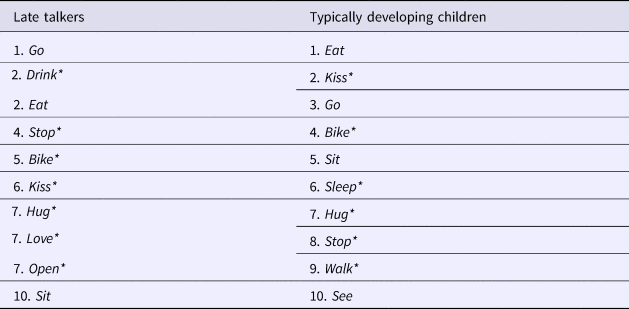
As seen in Table 1, typically developing children and late talkers share the majority of their most common verbs. Seven of the ten most common verbs in late talkers’ vocabularies are also among the ten most common verbs for typically developing children.
The Ten Most Frequently Occurring Verbs in Typically Developing Children's Vocabularies and Late Talkers’ Vocabularies

Note. Asterisks indicate words that can also occur in a nominal form. Note the similarities in the two lists, with seven verbs present in both groups' lists.
We also conducted a regression to determine whether input frequency impacted the likelihood of producing each verb. Our model included random effects of participant and verb and a fixed effect of input frequency. The results indicated that frequency significantly impacted verb knowledge, irrespective of feature (p = .004); this significance is unsurprising given the importance of frequency in language acquisition (e.g., Goodman et al., Reference Goodman, Dale and Li2008). We therefore kept frequency as a fixed effect in the subsequent regressions.
Nominal form bias
Before conducting additional analyses, we checked to ensure that our results were not influenced by the fact that some English verbs can occur either as nouns or as verbs. This model included random effects of participant and verb, and fixed effect of input frequency and whether the verb had (+1) or lacked (–1) an equivalent unmarked noun form. We found no effect of nominal form; we conclude that this factor need not affect interpretation of subsequent analyses.
Opportunity scores
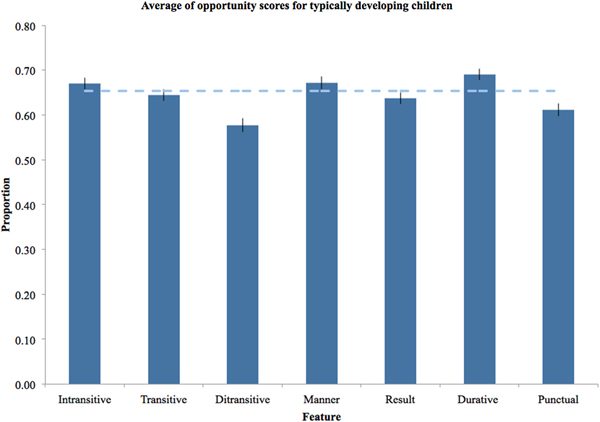
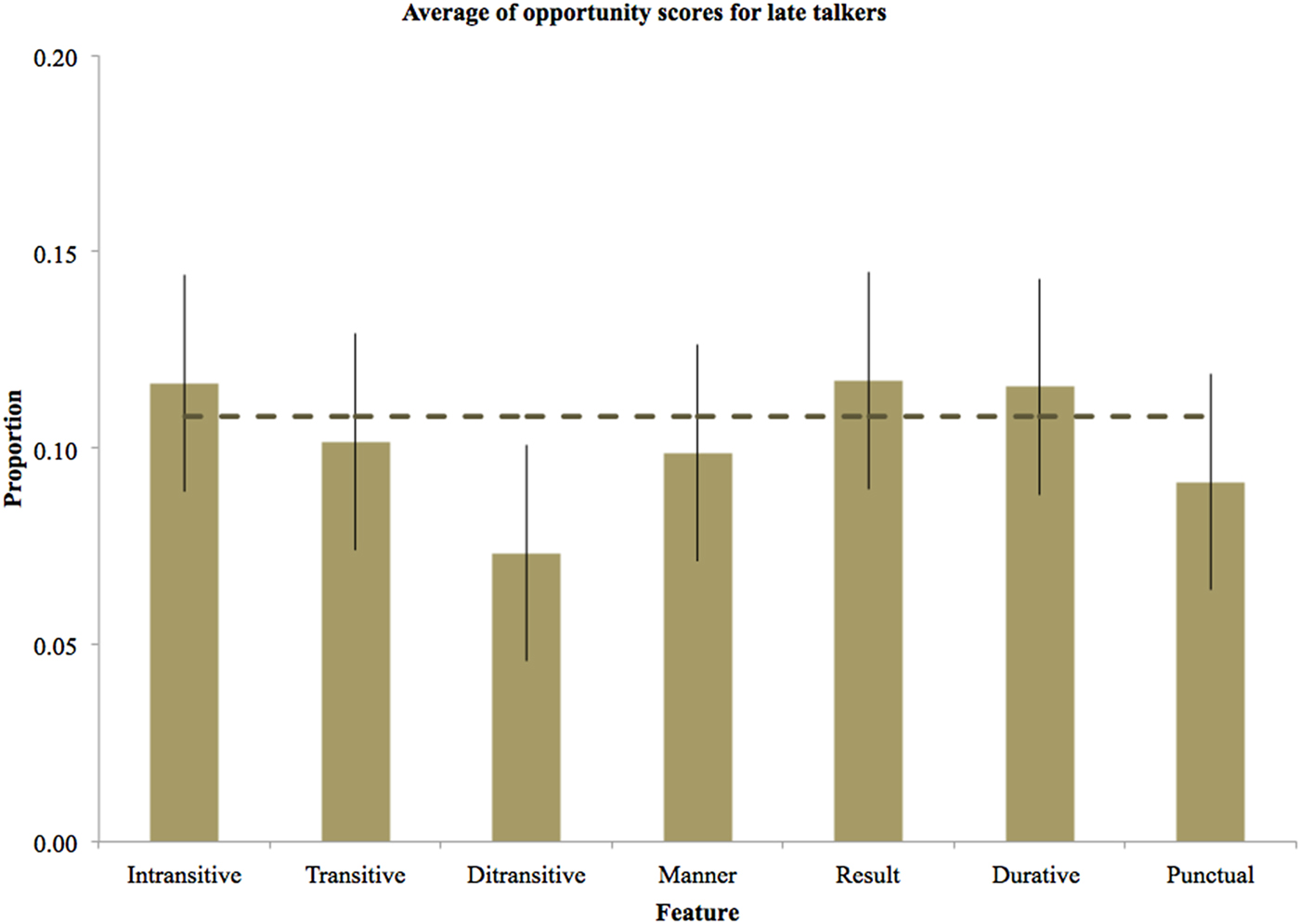
Figure 1 depicts the average of opportunity scores for typically developing children for each feature, and Figure 2 depicts the average of opportunity scores for late talkers. The horizontal lines represent the mean proportion of verbs produced by that group. An examination of Figures 1 and 2 reveals first, and not surprisingly, that late talkers produce fewer verbs overall, as evident by the difference in y-axes. Second, and more importantly for the current study, both groups appear to privilege the same features in their verb lexicons: verb features that were more frequently represented in typically developing children's vocabularies were also present more frequently in late talkers’ vocabularies, and features that were less frequently represented in typically developing children's vocabularies were also less frequently represented in late talkers’ vocabularies. The notable exceptions to this are the manner and result verbs, for which the two groups showed different patterns; we test this directly below.
The average proportion of verbs that typically developing children knew. The group average proportion of verbs known (0.654) is indicated by a horizontal line; proportions range from 0.577 (ditransitive verbs) to 0.691 (durative verbs). Error bars indicate standard errors of child means.

The average proportion of verbs that late talkers knew. The group average proportion of verbs known (0.108) is indicated by a horizontal line; proportions range from 0.073 (ditransitive verbs) to 0.117 (result verbs). Given that late talkers know fewer verbs than typically developing children, the y-axis differs from that in Figure 1. Error bars indicate standard errors of child means.

Z-score analyses
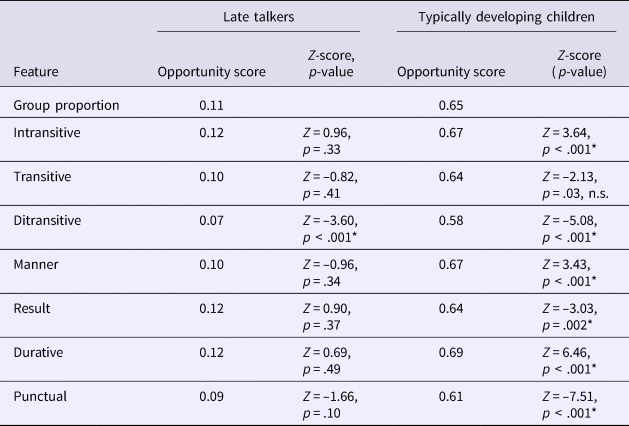
The results of the Z-score analysis are listed in Table 2. The only feature that significantly impacted late talkers was whether a verb can occur in a ditransitive syntactic frame; late talkers produced significantly fewer of these verbs (p < .001). Typically developing children similarly had fewer ditransitive verbs in their vocabularies (p < .001), but also had fewer result verbs (p = .002) and punctual verbs (p < .001). Typically developing children had significantly more intransitive verbs (p < .001), manner verbs (p < .001) and durative verbs (p < .001) in their vocabularies; the feature of transitive syntax was not significant after correction (p = .03, n.s.).
Z-scores and p-values, by Feature by Group

Note. We compared each group’s average proportion of verbs (P(late talkers) = 0.11; P(typically developing children) = 0.65) with the group’s opportunity score by feature. Significance Is marked with an asterisk; n.s. indicates significance at an alpha level of 0.05 but not after controlling for Type I Error.
This initial Z-Score analysis indicates that children's expressive verb vocabularies are impacted by syntactic and semantic properties. However, to further control for input frequency and to incorporate random effects of participant and verb, we next conducted regression analyses.
Regression analyses
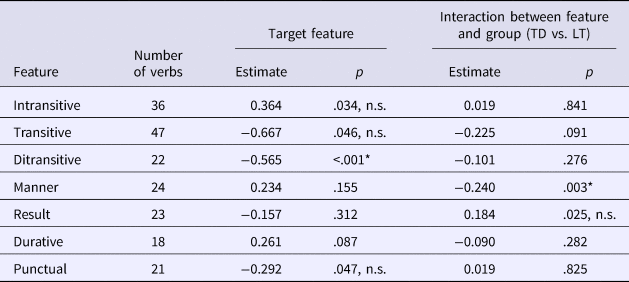
The critical parameter estimates from the regression models are in Table 3. Given the modified p value to control for Type I error, only two of the syntactic and semantic features we examined yielded either a significant main effect or a significant feature by group interaction. This suggests that many of the observed differences from the Z-score analysis may have been driven by input frequency rather than by feature. First, we found a significant main effect of ditransitive frame, but no interaction with group, indicating that both typically developing children and late talkers produced fewer verbs that take ditransitive frames as compared to those that do not (p < .001). Second, we found a significant interaction for the semantic feature of manner without a significant main effect (p = .003), indicating a cross-over; this indicates that typically developing children and late talkers were differentially impacted by the feature of manner. This result supports the patterns in Figures 1 and 2, and also the Z-score analyses in Table 2: typically developing children have a relative manner bias, while late talkers have a relative bias against manner verbs. The related feature of result also yielded no significant main effect. When uncorrected, result was the only other feature to have a significant interaction variable (p = .025); however, this was not significant after correction.
The Main Effect and Interaction Variable Estimates for Each Mixed Effect Regression

Note. Significance is marked with an asterisk; n.s. indicates significance at an alpha level of 0.05 but not after controlling for Type I Error. The direction of the estimates indicates whether a feature privileges (positive) or biases (negative) the likelihood of knowing a verb that has that feature.
Matched subsample analysis
Recall that the typically developing group was both bigger and more female-dominated than the late talker group. We therefore repeated the same analyses with a matched subset, including all of the 62 late talkers and a subset of 62 typically developing children. Results of the matched subset regressions were identical to the full sample analysis; both groups produced fewer ditransitives (p < .001) and were differentially impacted by the feature of manner (feature by group interaction p = .004). As with the full sample analysis, the interaction variable for result (p = .018) was significant before but not after correction.
Post-hoc analysis using data from Wordbank (Frank et al., Reference Frank, Braginsky, Yurovsky and Marchman2016)
The analyses reported above indicate one substantive difference between typically developing children and late talkers: late talkers appear to have a bias against manner verbs. We identified two possible explanations for this difference: first, it may be that late talker status itself is not to blame; instead, children with small vocabularies may simply know primarily result verbs (and, consequently, few manner verbs). Late talkers continue to show this pattern at two years of age only because their vocabularies are limited. The second hypothesis, not incompatible with the first, is that late talkers differ in the mechanisms they use to acquire verbs, resulting in specific difficulty learning the meanings of manner verbs.
Examination of the first hypothesis would require LDS data from younger typically developing children, which we did not have access to. However, Wordbank (Frank, Braginsky, Yurovsky, & Marchman, Reference Frank, Braginsky, Yurovsky and Marchman2016) is a large repository of MCDI-WS (Fenson et al., Reference Fenson, Marchman, Thal, Dale, Reznick and Bates2007) data, including children ages 16 to 30 months. We selected the subset of all children learning American English for our secondary analyses.
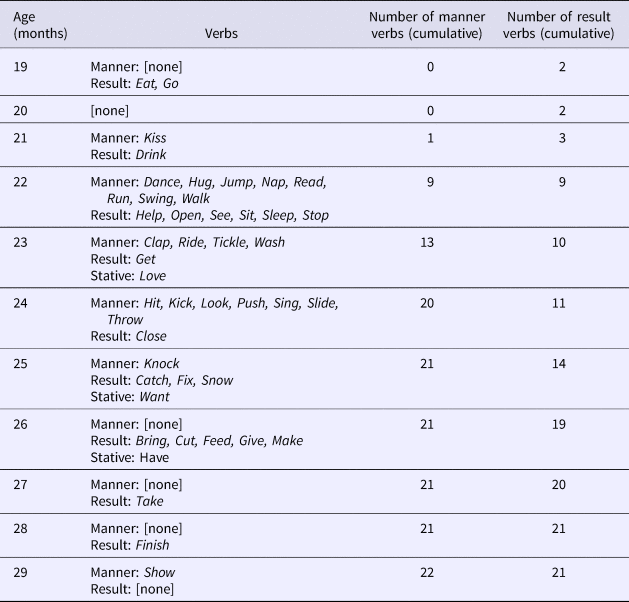
The full MCDI-WS includes 680 words, including 103 ‘Action words’. From the MCDI-WS, we selected only the words that were already included in the LDS verb vocabulary analysis. Four verbs (bike, come, cough, shut) are on the LDS but not the MCDI-WS. We then identified each verb's average age of acquisition, defined as the age (in months) at which at least 50% of the children in the sample were reported to produce the verb. Average age of acquisition ranged from 19 to 29 months. Table 4 lists the verbs produced, and the number of manner and result verbs, by age in months.
The Average Age of Acquisition of Each Verb, Based on Wordbank Data (Frank et al., Reference Frank, Braginsky, Yurovsky and Marchman2016)

Note. While very young children may exhibit a slight result bias, at 24 months there is a spurt in the acquisition of manner verbs. Late talkers, who do not have as many verbs, may demonstrate a lack of a manner bias due to their small vocabularies.
As shown in Table 4, children may preferentially acquire result verbs in the very earliest stages of verb learning, but demonstrate no strong bias for either manner or result meanings before 24 months of age. This pattern is consistent with our late talker data, wherein late talkers do not appear to privilege manner verbs over result verbs. Beginning at 24 months of age, acquisition of the manner verbs on the MCDI-WS appears to take off. At about 26 months this manner spurt appears to level off (recall, also, that our typically developing children's average age was 26 months).
Discussion
This study was designed to reveal whether the syntactic and semantic features of verbs affect the prevalence of those verbs in two-year-old children's expressive vocabularies, and whether these effects differ between children who are typically developing and children who are late talkers. Our findings indicate that, indeed, syntactic and semantic features of the verbs on the LDS do predict whether children produce them. Prior work on this issue has used experimental paradigms to probe either a very small number of familiar verbs (e.g., mix vs. stir in Gentner, Reference Gentner1978), or novel verbs in order to determine which syntactic or semantic features are easiest for young learners to encode in a new verb representation (e.g., Behrend, Reference Behrend1990; Gropen et al., Reference Gropen, Pinker, Hollander and Goldberg1991). The present study indicates that the influence of syntactic and semantic properties of verbs exists in not only experimental paradigms but also the composition of naturally developing early childhood vocabulary.
That is not to say, however, that all syntactic and semantic features were important. Although our initial Z-score analysis suggested that many of the features we examined significantly impacted children's vocabularies – either positively or negatively – when we controlled for children's frequency of exposure to verbs on an individual level we saw that most features were not, in fact, significant. This difference in results from the two analyses is not surprising given the strong relationship between frequency and expressive vocabulary use (e.g., Goodman et al., Reference Goodman, Dale and Li2008), but it highlights the importance of considering input frequency in vocabulary studies.
With this in mind, most of the syntactic and semantic features we examined did not significantly impact children's vocabulary. With respect to syntactic features, whether the verb could occur in intransitive or transitive frames was not related, suggesting that typically developing children and late talkers may have similar abilities to use simple syntactic frames to acquire verbs. With respect to semantic features, whether the verb denoted punctual or durative events was unrelated, contra our hypothesis that children's vocabularies would be biased against verbs denoting punctual events due to their ephemeral nature. As seen in our Z-score analyses, both typically developing children and late talkers do trend in this direction.
However, some features we examined were significant even when controlling for frequency: we identified one syntactic feature that was related to poor verb knowledge, and one semantic feature that differentiated typically developing children and late talkers. With respect to syntax, children were less likely to know verbs that can occur in the more structurally complex ditransitive frame than those that cannot. Of course, many of the verbs on the checklist can occur in multiple syntactic frames (like feed, which can occur in either transitive or ditransitive frames). Still, this analysis indicates the syntactic frames in which children may produce, or, more critically, hear a verb used, are important for their vocabulary acquisition. A wealth of research indicates that not all word learning contexts are equal (see, e.g., He & Arunachalam, Reference He and Arunachalam2017, for review), and we hypothesize that ditransitive contexts are particularly challenging because of their syntactic complexity.
The effect of ditransitive syntax surfaced as a main effect, but with no interaction with group, indicating that late talkers were not more affected by this feature than typically developing children. This is interesting given that older children with a diagnosis of DLD/SLI have continued deficits with complex syntax (e.g., O'Hara & Johnston, Reference O'Hara and Johnston1997; van der Lely, Reference van der Lely1996; van der Lely & Harris, Reference van der Lely and Harris1990). Our results suggest, somewhat surprisingly, that, with respect to syntactic features, late talkers follow the same developmental trajectory as typically developing children; although they do not produce as many verbs overall, they do not differ in the relative prevalence of these syntactic features in the verbs they do produce. An intriguing hypothesis for future work is that the special difficulties that older children with DLD have with syntax and verb argument structure may only surface later in development.
Only one feature distinguished children who are late talkers from those who are typically developing: the semantic feature of manner. Neither manner nor the related feature of result showed a significant main effect; however, the manner feature significantly interacted with group classification, both within the full sample and within the matched subset. Specifically, late talkers showed a bias against manner meanings in their vocabularies.
We have proposed two possible explanations for this difference, which are not mutually exclusive. First, it may be that children with small vocabularies, irrespective of group, may simply know primarily result verbs (and, consequently, few manner verbs), and that late talkers show this pattern at age two simply as a reflection of their small vocabulary size. Our secondary analysis with data from Wordbank (Frank et al., Reference Frank, Braginsky, Yurovsky and Marchman2016) lends support for this interpretation. We see that younger children's verb vocabularies do not show a clear manner preference, and that the youngest children may in fact show a slight preference for result verbs. This aligns with several studies noting that changes of state may be particularly salient to young children (e.g., Clark, Reference Clark1995; Clark et al., Reference Clark, Carpenter and Deutsch1995; Gopnik & Meltzoff, Reference Gopnik and Meltzoff1986; Greenfield & Smith, Reference Greenfield and Smith1976). Future work should test this proposed hypothesis directly, including longitudinal data from a sufficiently large sample of both late talkers and typically developing children. This might also indicate whether, as observed with the 24-month-old children from Wordbank (Frank et al., Reference Frank, Braginsky, Yurovsky and Marchman2016), late talkers show a manner bias when their vocabularies are sufficiently large. If late talkers do in fact show only delay in their patterns of expressive vocabulary acquisition, matching chronologically younger children closely, this would perhaps be surprising given that late talkers may have age-appropriate non-verbal and receptive language skills. Therefore, such an outcome would lend insight into the relationships between expressive language development and the development of other language and cognitive systems.
Our other hypothesis is that late talkers differ in the mechanisms they use to acquire verbs, resulting in specific difficulty learning the meanings of manner verbs. Perhaps, for example, late talkers have increased difficulty in encoding the sometimes subtle differences that exist between manner verbs (e.g., walk and run are distinguished by speed) rather than the more salient differences that are often encoded in change-of-state verbs. Additionally or alternatively, late talkers may struggle to use information from the linguistic context that typically developing children may use to identify a verb's meaning as either manner or result. For example, Syrett, Arunachalam, and Waxman (Reference Syrett, Arunachalam and Waxman2014) found that typically developing children can use the presence of a manner-of-motion adverb to determine that a novel verb lexicalizes manner; such cues may require a level of linguistic sophistication that late talkers do not have. This might mean that even as late talkers’ verb vocabularies increase in size, they will not develop the same abilities to acquire manner meanings that typically developing children do. Here, we would see a protracted group difference, based on conceptual or linguistic abilities rather than sheer vocabulary size. Given the importance of verbs for language development, if there is a learning difference in how late talkers acquire verbs, it is expected to have strong cascading effects on subsequent language development, impacting not only the size and composition of the lexicon but also grammatical development.
Taken together, our results indicate that children's verb vocabularies are sensitive to the syntactic and semantic properties of verbs, and that late talkers and typically developing children show overwhelming similarities in the features that compose their vocabularies. Given the similarities, we do not believe it is warranted to consider late talkers’ verb vocabulary development ‘deviant’. This is particularly interesting in the context of prior work; for example, Beckage et al. (Reference Beckage, Smith and Hills2011) found that that late talkers had less semantic organization to their vocabularies than typically developing children, even when controlling for vocabulary size. Our results, by contrast, suggest that, for verbs at least, late talkers follow a remarkably similar trajectory to typically developing children. Critically, Beckage et al. examined co-occurrence in child-directed speech as a measure of semantic relatedness, while we used only broad semantic features related to the type of event.
We also found one difference, however; the difference in manner verb knowledge between typically developing children and late talkers may be an indicator that there are differences in the processes or mechanisms by which they acquire the semantic features of verbs, and this may in turn contribute to our understanding of verb deficits in older children with language impairment.
Limitations
There are a few notable limitations to this study. First, it is important to acknowledge that the LDS was not originally designed for the purposes we used it for in this study. Although secondary analyses of checklist data have been used in prior research, using collected data for a purpose other than for which it was intended has ramifications both on the analyses and interpretation of a study. With respect to this study particularly, we have no information about children's receptive knowledge of these verbs, which is critical given that comprehension precedes production, and the relationship between these two skills may be especially complicated for late talkers. Our data also do not indicate how frequently children use each of these verbs in daily life. It may be that, although children know something of many different types of verbs, their robustness of understanding of different types of verb meanings is variable across categories and possibly also variable by group. Further, we do not have evidence about the linguistic contexts in which children produce these verbs. Although many verbs can occur in multiple syntactic frames, it may be that children initially encode only one frame (e.g., Tomasello, Reference Tomasello2003).
Additionally, we had limited demographic information for our sample. For the majority, we had no information beyond age and gender. At a minimum, information regarding such features as family socioeconomic status, ethnicity, and birth order may have characterized our population more robustly. Other information about the children, like their receptive vocabulary knowledge, or whether they ultimately received a diagnosis of DLD, would have provided additional insight into patterns of acquisition. However, receptive vocabulary is difficult to measure at this age group (e.g., Valleau, Konishi, Golinkoff, Hirsh-Pasek, & Arunachalam, Reference Valleau, Konishi, Golinkoff, Hirsh-Pasek and Arunachalam2018), and given the relatively large size of our sample and the fact that even late talkers who appear to ‘catch up’ still have below-average language outcomes, the sample we studied here still has an important role to play in increasing our understanding of who late talkers are and how they differ from typically developing children.
Another limitation of this study is in how we categorized the verbs. We determined their syntactic features using a well-documented resource (VerbNet; Kipper et al., Reference Kipper, Korhonen, Ryant and Palmer2006), and we determined their semantic features using diagnostic tests from the lexical semantics literature. Nevertheless, verbs can be coerced into unattested syntactic frames, and diagnostic tests are limited. Without a comprehensive view of each child's exposure to each verb, we can only assume that these classifications are reasonable. The same concern applies to input frequency, for which we had data from the CHILDES Parental Corpus (Li, Reference Li and Shirai2001; Li & Shirai, Reference Li and Shirai2000), rather than the specific children in the study. However, an advantage of using a large corpus is that it is a much larger dataset than we could reasonably obtain from individual children, and because of the diversity of the corpora from which the Parental Corpus was derived, it is representative of children's exposure to words at many different times of day in many situations. Input frequency, though, may be particularly important for our late talker sample: older children with DLD/SLI typically require more exposures to learn the meaning of a new word than do typically developing children (e.g., Gray, Reference Gray2003), and the same may also be true of late talkers.
Finally, the sample for this study, and its participants, were all English language learners. While these findings contribute to our understanding of late talkers learning English, they have limited generalizability to other languages. We have examined the semantic features of verb-vocabularies cross-linguistically (see Horvath et al., Reference Horvath, Rescorla, Arunachalam, Syrett and Arunachalam2018), and found broad similarities among the composition of typically developing children's vocabularies in the languages examined. However, languages of the world demonstrate significant variability in their morphosyntax, and we are particularly hesitant to extend our findings on the role of syntactic features into other languages. We might generally hypothesize that, consistent with English, children struggle with syntactic constructions that are particularly complex, but that complexity is language-specific. We see this as an area of future investigation.
Given the findings, but also acknowledging the limitations of this study, we believe further research is warranted on the subject of verb development in late talkers. Our findings about manner verbs raise the possibility that late talkers do systematically differ in the types of verbs that they know at two years of age. What is not yet clear is whether there are true learning differences that drive this, or whether or how this difference impacts later language development. In ongoing work, we are more closely examining the learning mechanisms that late talkers and typically developing children use to acquire new verbs to determine the extent to which they are the same or different. Given the findings we have outlined, we expect that they will largely use the same mechanisms, but that late talkers may be less adept overall in deploying these learning mechanisms in verb learning tasks. We also hope that insight into such mechanisms can ultimately provide further insight into the tenuous relationship between late talkers and children with DLD. By understanding these mechanisms better, we may be able to more clearly distinguish delay from disorder at two years of age, and to predict which children will need support at earlier ages.
Supplementary materials
For supplementary material for this paper, please visit <https://doi.org/10.1017/S0305000918000508>.
Acknowledgments
This research was supported by NIH K01DC013306 to the final author. The content is solely the responsibility of the authors and does not necessarily represent the official views of the National Institutes of Health. Leslie Rescorla receives royalties from the sale of the Language Development Survey. Thank you to Howard Cabral, PhD, and Timothy Heeren, PhD, for statistical consultation.