Congenital heart disease includes a heterogeneous group of conditions, which vary greatly in complexity, severity, and the type of symptoms. Treatment also varies ranging from no intervention to medication, and/or surgical interventions. Patients with congenital heart disease often require ongoing care throughout their lives, with the majority of repaired lesions remaining at risk and the possibility of re-intervention.Reference Warnes 1 , Reference Kenny and Stuart 2
Over the last six decades, outcomes for children with congenital heart disease have improved, leading to a new adult cohort, often referred to as grown-up congenital heart disease patients. There are ∼250,000 adults with congenital heart disease in the United Kingdom.Reference Bedard, Shore and Gatzoulis 3 With the improved survival rates, there has been a shift of focus from mortality rates to the assessment of patient-centred outcomes, such as functional status and quality of life. Cognitive function is an umbrella term covering domains of intelligence, language, learning, memory, attention, executive functioning, and motor ability.Reference Daliento, Mapelli and Volpe 4 Any limitation in cognitive functioning has the potential to affect a patient's quality of life and limit life chances.
Research on children with congenital heart disease suggests that they have intelligence quotient scores that are within the normal range.Reference Bellinger and Newburger 5 – Reference Miatton, De Wolf, Francois, Thiery and Vingerhoets 7 Intelligence quotient has several sub-scales including verbal comprehension, perceptual reasoning, working memory indices, and processing speed, among others, that assess more specific cognitive abilities, but these details are not frequently reported.
More specific and detailed cognitive – neuropsychological – evaluations in child cohorts, however, have highlighted deficits in language, including speech production and pragmatic language skills, as well as poor psychomotor functioning in terms of gross, fine and visual motor integration.Reference Bellinger and Newburger 5 , Reference Miatton, De Wolf, Francois, Thiery and Vingerhoets 7 There is little evidence of memory deficits. Assessments of attention and research on executive functioning among children have been limited such that it is not possible to draw clear conclusions.Reference Bellinger and Newburger 5 , Reference Miatton, De Wolf, Francois, Thiery and Vingerhoets 7
The research on child cohorts has suggested a multifactorial aetiology for neuropsychological impairments in congenital heart disease patients. Pre-operative risk factors include the level of pre-operative neurological injury and the presence of comorbid genetic syndromes, such as Down's syndrome.Reference Massaro, El-dib and Aly 6 , Reference Mahle 8 The severity of the disease, the age of repair, the use of hypothermia and cardiopulmonary bypass, and episodes of circulatory arrest during surgery have also been implicated in cognitive dysfunction.Reference Massaro, El-dib and Aly 6 , Reference Miatton, De Wolf, Francois, Thiery and Vingerhoets 7 , Reference Karsdorp, Everaerd and Kindt 9
Other factors linked to cognitive functioning in children include the length of hospital stay, post-operative haemodynamic stability, and the presence of seizures.Reference Massaro, El-dib and Aly 6 , Reference Miatton, De Wolf, Francois, Thiery and Vingerhoets 7 In addition to these clinical variables, it has also been suggested that social factors, such as absence from school and poor peer interaction, may also have an effect on cognition.Reference Horner, Liberthson and Jellinek 10
Given the low survival rates in the past, the research on cognition has tended to focus on childhood and infancy, and hence there is little understanding of the long-term cognitive functioning in adults with congenital heart disease. The relationship between childhood performance and adult cognitive performance is limited, with early child assessments demonstrating low predictive power of later child outcomes.Reference Mcgrath, Wypij and Rappaport 11 Cardiac functioning is likely to vary throughout adulthood, and as such adult congenital heart disease patients face new and additional complications such as heart failure, arrhythmias, pulmonary hypertension, and problems pertaining to infection or coagulation.Reference Kenny and Stuart 2 These issues, in conjunction with the cognitive risk factors associated with re-intervention, make it important to explore cognition in congenital heart disease adults separately from the work conducted with children.
The aim of this review was to examine the evidence on the extent and nature of adult cognitive functioning in congenital heart conditions, and if present to explore the possible factors associated with cognitive deficits in this group.
Materials and methods
Owing to the paucity of research in this field, the inclusion criteria for the studies included in the review were kept broad. Articles were included if the study sample involved adults with any form of congenital heart disease and with objective cognitive assessment. Studies that only assessed subjective or observed ratings of cognitive functioning were excluded, as the evidence suggests that these measures correlate poorly with objective cognitive assessments and have a stronger association with mood.Reference Vingerhoets, De Soete and Jannes 12 Articles were limited to the English language in peer-reviewed publications.
A broad search of the literature was conducted, without time limits. Electronic databases, including MEDLINE, AMED, OVID, PsychINFO, EMBASE, and the Web of Science, were systematically searched. Keywords included “cogniti*” “neuropsychologi*”, “neurocogniti*” “intelligence” AND “Adults” OR “grown up” AND “congenital heart disease” OR “congenital heart defect”. A further bibliographic search of reviews assessing outcomes in adult congenital heart disease was also conducted.
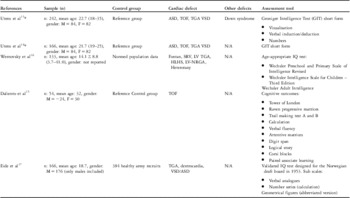
The titles of the 344 papers generated from the searches were reviewed and relevant abstracts were examined. Only five papers were found to be meeting the inclusion criteria, two of which were taken from the same sample.Reference Utens, Verhulst and Erdman 13 , Reference Utens, Versluis and Verhulst 14 The selected papers are summarised in Table 1.
Summary of the studies included.

ASD = atrial septal defect; HLHS = hypoplastic left heart syndrome; IQ = intelligence quotient; LV-NRGA = left ventricle with normally related great arteries; LV TGA = left ventricle with transposition of the great arteries; SRV = single right ventricle; TGA = transposition of the great artery; TOF = tetralogy of Fallot; VSD = ventricular septal defect
*Studies with a common study sample
Results
Results are discussed under two main headings: cognitive outcomes and factors associated with cognitive impairment in adult congenital heart disease.
Table 1 summarises the main characteristics of the studies reviewed. Most of the studies included patients with a range of congenital heart diseases: transposition of the great arteries, atrial septal defect, ventricular septal defect, hypoplastic left heart syndrome. The only study that included a sample with a single diagnostic category (tetralogy of Fallot) was by Daliento et al.Reference Daliento, Mapelli and Russo 15 All the studies had a control group for the purpose of assessment, three studies had a reference control group,Reference Utens, Verhulst and Erdman 13 – Reference Daliento, Mapelli and Russo 15 one study utilised national normative data,Reference Wernovsky, Stiles and Gauvreau 16 and one study employed healthy army recruits as a control group.Reference Eide, Skjaerven and Irgens 17
Measures of neuropsychological assessment
Many of the studies examined the intelligence quotient scores of adult congenital heart disease patients. The intelligence quotient tests used varied across studies with two studies utilising the Groniger intelligence test that has three subscales: visualisation, verbal induction/deduction, and numbers.Reference Utens, Verhulst and Erdman 13 , Reference Utens, Versluis and Verhulst 14 There was one study that included both children and adults, and utilised age-appropriate intelligence quotient tests including the Wechsler Preschool and Primary Scale of Intelligence Revised, the Wechsler Intelligence scale for children (3rd edition), and Wechsler Adult Intelligence Scale-Revised.Reference Wernovsky, Stiles and Gauvreau 16 Another study utilised a validated intelligence quotient measure that was designed for the Norwegian Army draft board, which assesses all Norwegian men at the age of 18 years.Reference Eide, Skjaerven and Irgens 17 Only one study used neuropsychological tests to examine specific cognitive functions along with intelligence quotient.Reference Daliento, Mapelli and Russo 15
Cognitive outcomes in congenital heart disease
Composite intelligence quotient scores represent a gross measure of global cognition and is the most widely used form of assessment in both the child and adult literature.Reference Mcgrath, Wypij and Rappaport 11 A finding in the adult congenital heart disease population regarding intelligence quotient scores paints an equivocal picture.
All reviewed studies (5/5) assessed intelligence quotient. Wernovsky et alReference Wernovsky, Stiles and Gauvreau 16 assessed intelligence quotient in a sample of 133 patients of mixed ages including children and adults (range 3.7–41.0 years; mean 14.1) who were to receive the Fontan operation – that is, patients with, for example, single ventricle or hypoplastic left heart syndrome – using age-appropriate intelligence quotient measures. The adults (>17 years) scored full-scale (96.3 ± 15.2), verbal (94.3 ± 14.2), and performance (99.7 ± 16.0) on the intelligence quotient test. No significant differences in the mean intelligence quotient scores were found across age groups, and the modalities were combined by the authors of the study for the purpose of further analysis.
The mean full-scale intelligence quotient score of the group was significantly lower than that of the general population (95.7 ± 17.4, compared with 100, p = 0.006). Although most participants scored within normal range on full-scale intelligence quotient, 10 participants (7.8%) scored over two standard deviations below the expected population norm. Separating the adult patients’ data from the children was not possible because of combined modalities and restricts any conclusions being drawn specifically regarding adult congenital heart disease from this study.
Eide et alReference Eide, Skjaerven and Irgens 17 examined 166 adults with congenital heart disease (mean age 18.7, standard deviation 0.7) in a retrospective cohort study. Intelligence quotient scores were compared with 311,738 healthy controls (mean age 18.7, standard deviation 1.0) upon entry into the Norwegian army. Men with a congenital heart condition were found to have significantly lower intelligence quotient scores than the control group (p = 0.007). The Norwegian study excluded Down syndrome participants. A large proportion of participants were classified as being “unspecified blue babies”.
In contrast to these findings, a Dutch study that included Down syndrome participants reported intelligence quotient scores to be higher among adult congenital heart disease compared with a reference group.Reference Utens, Verhulst and Erdman 13 Employing a cross-sectional design, 288 participants from five different diagnostic categories of congenital heart disease were recruited. Intelligence quotient scores for 46 participants were missing and a total of 242 patients completed the assessment for intelligence quotient using the standardised Gronigen Intelligence Test. Compared with the reference group, the total patient sample showed significantly higher intelligence quotient scores (mean intelligence quotient = 105.5 compared with 100). Of the total sample, 17% showed borderline mental functioning classified by a score lower than 86. The interpretation of the findings is complicated by the fact that 15 participants were unable to complete the test because of reduced mental functioning. The inclusion of these participants may have depressed the mean intelligence quotient score of the congenital heart disease participants. In a second study, the authors utilised the same sample but only included 166 participants aged 19–25 years. The mean intelligence quotient of 105 was similar to the previous report, with 12.7% of participants experiencing borderline intellectual functioning.Reference Utens, Versluis and Verhulst 14
Little research has been conducted to assess specific areas of cognition in the adult congenital heart disease population. Intelligence quotient scores are gross measures of overall cognitive functioning and could mask a wide range of specific and subtle impairments. The child literature has demonstrated the importance of examining impairments in more specific cognitive domains, as these may demonstrate deficits despite intelligence quotient scores falling within the normal range.Reference Massaro, El-dib and Aly 6
The one adult congenital heart disease study that has investigated cognitive performance by examining cognitive domain and intelligence quotient score was performed by Daliento et al.Reference Daliento, Mapelli and Russo 15 They conducted a detailed assessment of cognitive performance on 54 tetralogy of Fallot patients, with a mean age of 32 years. Participants with Down syndrome and also those with delayed psychomotor development were excluded from their study. Intelligence quotient was measured with the Progressive Matrices (non-verbal), and 11 standardised neuropsychological tests were administered to examine verbal fluency, learning, memory, psychomotor speed, attention, concentration, reasoning, calculation, and executive functioning. Intelligence quotient scores were reported to be within the normal range for over two-thirds of the sample population. The group exhibited impairments in executive functioning tasks requiring planning strategies and problem solving, with 53% of participants showing poor performance. Very few participants exhibited problems with memory, learning, or attention, although the exact number of participants affected is not reported.
Factors associated with cognitive impairment in congenital heart disease
(a) Clinical factors
Pre-operative variables have been widely studied in the Adult congenital heart disease. This has included assessing complexity, with cyanosis frequently used as a proxy measure of disease complexity. The findings suggest that cyanotic patients have a lower mean intelligence quotient full-scale score compared with participants with an acyanotic heart condition.Reference Utens, Versluis and Verhulst 14 These findings, however, need to be interpreted with caution, as this variable is difficult to capture accurately, and in this study there was a significant amount of missing data. The presence of cyanosis has also been implicated in specific cognitive problems. A significant relationship has also been reported between tetralogy of Fallot participants with a clinical history of blue spells and poor performance on the Trail Making A & B and Tower of London tasks.Reference Daliento, Mapelli and Russo 15 These tests are considered to assess attention and concentration and executive function, respectively.
Disease complexity as determined by diagnosis has also been found to be related to intelligence quotient differences. Wernovsky et alReference Wernovsky, Stiles and Gauvreau 16 assessed a mixed age group, and reported that from a sample 133 Fontan patients, those diagnosed with more complex conditions (n = 10), including hypoplastic left heart syndrome, had lower full-scale intelligence quotient scores than the remaining participants.Reference Wernovsky, Stiles and Gauvreau 16
The use of Deep Hypothermic Circulatory Arrest before the Fontan procedure accounted for 6.1% of the lower than normal intelligence quotient score obtained by the group of single ventricle patients. However, this was only significant when the diagnosis was not included in the regression model.Reference Wernovsky, Stiles and Gauvreau 16
(b) Concurrent factors
Daliento et alReference Daliento, Mapelli and Russo 15 also reported an association of psychosocial and demographic variables such as low self-esteem and low education with the performance on the Trail Making Test (p < 0.05) in their study of adult congenital heart disease.
Discussion
Cognitive functioning in congenital heart disease
Given that few patients survived into adulthood until the advent of modern surgical treatments, the lack of research in cognition of adult congenital heart disease patients is not surprising. Owing to this, the research on cognition in congenital heart disease is primarily focused on children.
Within the available literature on adult congenital heart disease, intelligence quotient is the most widely utilised instrument. Studies report mixed results, with one study surprisingly reporting higher intelligence quotient scores in congenital heart disease patients.Reference Utens, Verhulst and Erdman 13 Only one study explored cognitive functioning in detail, assessing several cognitive domains, such as memory, attention, executive functioning. The findings suggested specific impairments in executive functioning tasks when participants with tetralogy of Fallot were compared with normative data. This study is an important first step in assessing detailed cognitive functioning in adult congenital heart disease patients.Reference Daliento, Mapelli and Russo 15
When interpreting the mixed findings regarding intelligence quotient, it is difficult to draw comparisons across studies owing to the variability in the choice of instruments used. A second potential challenge, given the impact of different diagnostic categories, is the representativeness of different groups studied in the samples. Few studies have systematically examined disease and treatment complexity. There are two studiesReference Utens, Verhulst and Erdman 13 , Reference Eide, Skjaerven and Irgens 17 that have used heterogeneous samples; one examined diagnostic differences.Reference Utens, Verhulst and Erdman 13 There are two studies that have focused on only one diagnostic category: tetralogy of Fallot and single ventricle, respectively.Reference Daliento, Mapelli and Russo 15 , Reference Wernovsky, Stiles and Gauvreau 16
The different approaches to selecting a sample raises an interesting question regarding the value in assessing a range of adult congenital heart disease versus a single diagnostic group, for example tetralogy of Fallot. Although the single-group strategy allows for a larger sample size to represent the findings of the group in question, it may restrict the generalizability of findings to adult congenital heart disease population as a whole. The heterogeneity of the population as a whole may lead to a dilution of any specific effects if the total adult congenital heart disease population is sampled. The latter problem suggests that to understand the mechanisms of possible adult congenital heart disease it is preferable to select clear diagnostic groups. This point is reinforced when looking at factors associated with cognition in adult congenital heart disease.
Factors associated with cognitive functioning in congenital heart disease
Another aim of the review was identifying factors associated with cognitive functioning in adult congenital heart disease. Condition complexity emerged as the most widely assessed factor, with cyanotic participants reporting lower mean intelligence quotient scoresReference Utens, Verhulst and Erdman 13 , Reference Utens, Versluis and Verhulst 14 and poor performance on executive functioning tasks.Reference Daliento, Mapelli and Russo 15
An important question raised by the available evidence is whether to include or exclude from analysis those patients with comorbid disorders, such as Down's syndrome or DiGeorge syndrome. This revolves around the issue of the heterogeneity of any sample and the possibility of specific groups biasing the findings. If included, the presence of Down's syndrome will suppress the intelligence quotient and cognitive test performance. The issue of inclusion is further complicated, as epidemiological studies have reported a prevalence of extracardiac anomalies, including syndromes, chromosomal defects, and extracardiac malformations, to be present in about one-fifth of individuals diagnosed with congenital heart disease.Reference Grech and Gatt 18 A Norwegian epidemiological study also reported that 22% of their adult congenital heart disease sample (n = 662) had a comorbid chromosomal anomaly, syndrome, or extracardiac malformation.Reference Meberg, Hals and Thaulow 19 Treatment, independent of the cardiac lesionReference Meberg, Hals and Thaulow 19 and an altered cognitive profile, often occurs as a result of chromosomal defects,Reference Mahle 8 making this subset of congenital heart disease participants potentially different from those experiencing isolated adult congenital heart disease. By excluding participants with extracardiac anomalies, generalisation to the adult congenital heart disease population is difficult.
Differences in treatment require careful identification and analysis. The one specific operative technique that has been assessed in congenital heart disease patients was the use of Deep Hypothermic Cardiac Arrest. The child literature supports the presence of cognitive impairment post deep hypothermic circulatory arrest.Reference Bellinger, Wypij and Duplessis 20 , Reference Wypij, Newburger and Rappaport 21 In adults, Wernovsky and colleagues suggest this could account for up to 6.1% of the variance in lower intelligence quotient scores found among Fontan patients. Other treatment factors, for example age at repair, cardio pulmonary bypass, hypothermia and post-operative factors, for example length of stay in hospital, have been found to have an impact on child cognition, but remain to be studied in the adult congenital heart disease population.Reference Mahle 8 , Reference Newburger, Silbert and Buckley 22 – Reference Sahu, Chauhan and Kiran 24 Owing to the fact that many adult congenital heart disease patients require repeated surgical intervention throughout their lives, the ability to delineate the impact of different surgical techniques will pose a challenge.Reference Kenny and Stuart 2 In addition, the advent of new treatments and models of care in child congenital heart disease creates a generational effect where factors associated with adult congenital heart disease differ from those in children.
Finally, most of this work relies on retrospective collection of data, and as such is dependent upon the accuracy of data recorded from clinical records.
Several methodological issues could be addressed. Increasing the sample size would enable adequate power to assess different surgical factors. The reliance on intelligence quotient to assess cognitive functioning should be reduced and cognition could be approached through a wider spectrum of domains, by utilising appropriate neuropsychological instruments. This would enable the possibility of identifying specific areas of cognitive defect and possibly associate these with different adult congenital heart disease conditions. Given the impact of the condition and its related treatments on cognitive functioningReference Bellinger, Wypij and Duplessis 20 , Reference Wypij, Newburger and Rappaport 21 adopting a longitudinal design would allow an insight into the stability of cognitive function along with identifying any factors – medical/psychosocial – that may have an influence on changes over time.
Regardless of the methodological difficulties surrounding research in congenital heart disease patients, an understanding of cognitive functioning and factors related to possible impairments has been and will be useful in informing strategies for optimising patient outcomes. It will also provide a broader view, beyond mortality rates and disease measures, of how people have responded to congenital heart disease and its treatment.
Acknowledgement
This work was supported by the UCLH/UCL National Institute for Health Research, Comprehensive Biomedical Research Centre.