


Introduction
Ghana’s local property tax regime presents a difficult institutional puzzle. Metropolitan, Municipal, and District Assemblies (MMDAs) have statutory authority to raise local revenue through property rates, yet property taxation remains a weak source of local government finance. Local governments continue to rely heavily on central government transfers. Between 2010 and 2016, property taxes averaged less than a fifth of internally generated funds and only 3.5% of total local government revenue and have been estimated at approximately 0.02% of GDP (Bahl, Reference Bahl2009; Oppong, Reference Oppong2021). These figures also connect the Ghanaian case to a longer West African concern identified by Lewis (Reference Lewis1965): governments need revenue to provide public services, but taxation is often politically difficult. Ghana’s property rating system remains largely focused on buildings, structures, and other improvements, leaving land value outside the main local property tax base. This creates a tension between the formal powers given to local governments and the limited fiscal reach of the property rating system they administer.
The exclusion of land value is significant in a context where urban growth, infrastructure provision, planning decisions, and local development activity are often reflected in rising land values. Existing studies on Ghana have highlighted the weak performance of property rating, the limited capture of land value, the problem of undeveloped urban land, and the fiscal constraints facing local governments (Alhassan et al., Reference Alhassan, Biitir and Derbile2022; Asiama, Reference Asiama2006; Biitir, Reference Biitir2019; McCluskey and Franzsen, Reference McCluskey and Franzsen2017). These concerns have generated arguments for stronger attention to land-based revenue instruments, including the taxation of undeveloped urban land, land value capture, and, more broadly, land-based property tax reform. Ghana’s property tax administration is weak, but its fiscal reach is also limited by the design of the tax base. The main local property tax instrument is structured around buildings and improvements, while much of the value generated through urban development is reflected in land (Local Governance Act, 2016).
The puzzle examined in this article is therefore why Ghana’s weak, building-focused property rating regime has persisted despite the fiscal case for bringing land value more directly into local revenue systems. The puzzle is especially important in Ghana, where land value is embedded not only in markets and urban development but also in longer-standing authority relations over land. Thus, the difficulty of land-based reform cannot be explained only by the familiar administrative weaknesses of property taxation. Outdated valuation rolls, incomplete land records, weak collection systems, limited enforcement, political interference, and low taxpayer compliance all matter (Bahl, Reference Bahl2009; Fjeldstad et al., Reference Fjeldstad, Ali and Katera2017). However, these explanations do not fully account for why reform remains difficult where the value to be taxed is tied to land relations shaped by customary authority.
The article develops the concept of tax authority/land authority divergence to explain this problem. The concept refers to situations in which public institutions possess formal authority to tax property, while the authority to define, allocate, legitimate, or disclose land rights remains partly located in customary or informal institutions. In such contexts, the problem is not simply weak administrative capacity. It is that the institutional foundations needed for land-based taxation are divided across different authority systems.
The argument speaks to debates in institutional economics on property rights, fiscal capacity, formal and informal institutions, legal pluralism, and institutional persistence. Institutional economics is concerned with how formal rules, informal norms, enforcement arrangements, and organisational practices shape economic behaviour and policy outcomes (Hodgson, Reference Hodgson2006; North, Reference North1990). Recent work has examined how property rights affect taxation in sub-Saharan Africa, how political institutions shape fiscal capacity, how customary organisations may supply property rights, and how legal pluralism affects institutional change (Banikoi, Reference Banikoi2024; Murtazashvili and Murtazashvili, Reference Murtazashvili and Murtazashvili2016; Nistotskaya and D’Arcy, Reference Nistotskaya and D’Arcy2023; Ricciuti et al., Reference Ricciuti, Savoia and Sen2019). This article builds on these debates by using historical institutionalism to explain how earlier conflicts over land, customary authority, and local taxation became embedded in Ghana’s property rating regime.
The central argument is that the politically manageable position of Ghana’s current property rating regime within a plural authority system helps explain its persistence. It gives MMDAs a formal property tax instrument but avoids direct recurring fiscal claims over land value, customary allocation systems, undisclosed land transactions, and customary revenue expectations. The article consequently asks: How does the interaction between formal tax authority and customary land authority help explain the persistence of Ghana’s building-focused property tax regime and the difficulty of land-based property tax reform? Answering this question contributes to debates on fiscal capacity, formal and informal institutions, and institutional persistence by showing how local revenue mobilisation depends on the institutional arrangements that define and legitimate the tax base.
The article draws on qualitative case study evidence from Ghana, including documentary analysis, legal and policy materials, field observations, and 32 semi-structured interviews with actors involved in land administration, planning, local government finance, customary land governance, and tax policy. The empirical analysis examines how taxation powers and land governance powers are divided across state and customary institutions and how this division helps explain why Ghana’s property tax system continues to focus on buildings rather than land value despite its weak revenue performance.
The paper proceeds as follows. Section Institutional economics, fiscal capacity and land-based property tax reform develops the conceptual framework. Section Methodology and case selection explains the case selection and methodology. Section Findings presents the empirical findings. Section Discussion discusses the institutional and reform implications. Section Conclusion concludes.
Institutional economics, fiscal capacity, and land-based property tax reform
Property rights, tax bases, and fiscal capacity
A property tax system depends on more than the legal power to levy taxes. It also requires institutions that can define what is taxable, identify who is liable, assess value, enforce payment, and make the tax claim appear legitimate. Property taxation is therefore closely connected to institutional economics because it rests on rules and authority relations that shape property, ownership, obligation, enforcement, and compliance (Hodgson, Reference Hodgson2006; North, Reference North1990). In this paper, institutions are understood as durable systems of formal rules, informal norms, enforcement arrangements, and organisational practices that shape behaviour and structure authority. This positioning allows customary authority, socially recognised practices, and informal expectations to be treated as institutional forces rather than background cultural conditions.
This is especially important where the authority to tax property does not fully overlap with the authority through which land rights are created, recognised, or legitimated. Nistotskaya and D’Arcy (Reference Nistotskaya and D’Arcy2023) argue that taxation in sub-Saharan Africa is linked to whether the state assigns land rights, since taxpayers may be less willing to accept taxation from a state that is not perceived as the source or guarantor of those rights. Murtazashvili and Murtazashvili (Reference Murtazashvili and Murtazashvili2016) similarly show that property rights may be provided by customary organisations rather than solely by the state. These arguments suggest that property taxation cannot be understood only through tax law or revenue administration. It also requires attention to the institutions that produce, recognise, and legitimate property rights.
This point connects directly to fiscal capacity. Fiscal capacity refers to the ability of public authorities to raise revenue, enforce obligations, and fund public goods. Ricciuti et al. (Reference Ricciuti, Savoia and Sen2019) show that political institutions shape taxation capacity in developing economies, while Besley and Persson (Reference Besley and Persson2009) link fiscal capacity to legal capacity, property rights, and enforcement. For property taxation, this means that formal taxing powers must be supported by reliable property information, recognised liability, valuation evidence, and taxpayer acceptance. Where these foundations are weak or institutionally divided, formal tax authority may exist without producing strong fiscal capacity.
Existing studies often explain weak property taxation through administrative constraints, including outdated valuation rolls, weak cadastres, poor registers, inefficient collection, limited coordination, political interference, and low taxpayer understanding (Acquah-Ababio, Reference Acquah-Ababio2015; Ayitey et al., Reference Ayitey, Kuusaana and Kidido2013; Bahl, Reference Bahl2009; Boamah, Reference Boamah2013; Boamah and Okrah, Reference Boamah and Okrah2016; Fjeldstad et al., Reference Fjeldstad, Ali and Katera2017; Kuusaana, Reference Kuusaana2015; Mabe and Kuusaana, Reference Mabe and Kuusaana2016; Mohammed, Reference Mohammed2020). While these factors certainly play a role, they do not fully explain why the tax base itself may avoid land value. In Ghana, the main local property tax instrument is built around buildings and improvements, while land value remains difficult to incorporate into the tax base. In a plural land tenure context, this difficulty is both institutional and technical.
Legal pluralism, customary authority, and land governance
The institutional challenge becomes sharper in plural land tenure systems. In many African countries, statutory law, customary rules, and informal practices coexist in land governance (Amanor and Ubink, Reference Amanor, Ubink, Ubink and Amanor2008; Chimhowu, Reference Chimhowu2019; Kasanga and Kotey, Reference Kasanga and Kotey2001). Land is therefore not only a market asset but also a source of social identity, political authority, lineage, trusteeship, and local belonging. Customary authorities may continue to shape land allocation, local recognition of rights, land transactions, and landholding arrangements, even where formal state institutions are responsible for registration, valuation, planning, and public administration.
Critical accounts of land reform in Ghana also caution against treating land policy as a purely technical problem of registration, administration, or market efficiency. Obeng-Odoom (Reference Obeng-Odoom2016), for example, shows that land reform is embedded in postcolonial institutional relations, including questions of power, authority, and historical continuity. This reinforces the need to examine land-based property tax reform as an institutional problem, rather than only as a matter of fiscal design.
Legal pluralism helps explain the coexistence of statutory and customary systems. Banikoi’s (Reference Banikoi2024) analysis of legal pluralism and institutional change in Ghana is useful for the broader point that plural authority arrangements can shape reform trajectories. Hodgson (Reference Hodgson2025) discussion of formal and informal institutions is also relevant because it cautions against treating formal law and informal practice as separate worlds. In practice, they interact. Customary authority may operate through social recognition, local legitimacy, land allocation practices, and expectations about who has authority over land, even where statutory institutions hold formal administrative responsibility.
This interaction between statutory and customary authority matters for land-based taxation because no single institution holds authority over the tax base. In Ghana, MMDAs may hold formal tax powers, but land-sector agencies, planning institutions, and customary authorities control or influence various aspects of the information, valuation, planning, and legitimacy required to make land value taxable. The construction of a workable tax base therefore depends on coordination across institutions that are not always aligned.
Land value taxation (LVT) illustrates why this institutional alignment matters. The idea has a longer intellectual history in the Georgist tradition, which treats land value as a socially created source of economic rent and therefore a distinctive object of taxation (George, Reference George1879). In this article, LVT is used more narrowly to refer to a recurrent tax on the unimproved value of land, excluding buildings and improvements. Such a tax would require reliable land information, clarity over liability, defensible valuation evidence, enforceable collection, and legitimacy among landholders and taxpayers (Connellan, Reference Connellan2004; Dye and England, Reference Dye and England2010; Lichfield and Connellan, Reference Lichfield and Connellan1997). These requirements are demanding in any context, but they become especially difficult when authority over land information, land allocation, planning, and local legitimacy is divided between formal and customary institutions.
Political economy, compliance, and institutional persistence
Taxation also has a political economy dimension because tax systems distribute burdens, create winners and losers, and affect existing arrangements of wealth and authority. Public choice approaches, including Brennan and Buchanan’s (Reference Brennan and Buchanan1980) work on the revenue-seeking state, are useful because they show that governments may have incentives to expand taxation. However, governments do not expand tax systems in a political vacuum. They face resistance, compliance problems, electoral pressures, and institutional constraints. These limits are key to land-based taxation, where reform may affect not only taxpayers but also landowners, customary authorities, and actors who benefit from existing land revenue arrangements. Land is visible, immovable, and potentially attractive as a tax base, but it is also politically sensitive. Taxing land value may affect landowners, customary authorities, developers, households, local governments, and central government institutions in different ways. It may also bring into the fiscal system information that some actors prefer to keep private, including transaction prices, land allocations, and revenue streams linked to land. Land-based taxation is therefore not only a revenue question. It is also a question of authority, information, and distribution.
Distributional theories of institutional persistence help explain why inefficient institutions may endure. Acemoglu et al. (Reference Acemoglu, Johnson, Robinson, Aghion and Durlauf2005) argue that inefficient institutions may persist where they protect existing distributions of resources and authority. This insight is relevant to Ghana’s building-focused property rating regime. The regime may be fiscally weak, but it is less disruptive than reforms that would make land value a recurring object of local taxation. It allows MMDAs to maintain a formal property tax instrument while avoiding direct confrontation with customary land authority and land revenue expectations.
Compliance adds another dimension. Levi’s (Reference Levi1988) work on quasi-voluntary compliance highlights the role of legitimacy, trust, and expectations of reciprocity in taxation. In Ghana’s property tax context, land-based taxation may face an additional legitimacy problem, as landholders do not view MMDAs as institutions that define or legitimate land rights. Customary authority therefore affects not only land ownership or allocation but also the perceived legitimacy of land-based fiscal claims.
Historical institutionalism and the reproduction of tax authority/land authority relations
Historical institutionalism helps explain why institutional arrangements persist even when they produce weak outcomes. In this paper, it is used as a temporal approach within institutional economics. Institutional economics explains why rules, property rights, enforcement, information, and legitimacy matter for taxation. Historical institutionalism explains how these arrangements develop over time, become self-reinforcing, and constrain later reform possibilities.
Three concepts are particularly important: path dependence, positive feedback, and critical junctures. Path dependence refers to the way earlier institutional choices or conflicts shape later policy trajectories. Positive feedback describes how existing institutions become easier to maintain as actors adapt to, benefit from, or organise around them. Critical junctures refer to moments when institutional paths may be redirected, though they do not automatically produce deep change (Capoccia and Kelemen, Reference Capoccia and Kelemen2007; Mahoney, Reference Mahoney2000; Pierson, Reference Pierson2000, Reference Pierson2004; Thelen, Reference Thelen, Mahoney and Rueschemeyer2003).
These concepts help explain the persistence of Ghana’s property rating regime. Over time, rating buildings and improvements became a legally familiar, administratively routine, and politically safer way of maintaining property taxation without making land value the recurring object of local taxation. This embeddedness helps explain why the regime has persisted within a wider institutional settlement involving local governments, central state institutions, customary authorities, landholders and taxpayers. Earlier struggles over land authority and land taxation created lasting political caution about direct state claims over land, making a building-focused rating system a less disruptive way to maintain local property taxation. Later property rating arrangements developed within this context, producing a relationship in which formal tax authority and customary land authority remain only partially aligned.
Tax authority/land authority divergence: definition, dimensions, and scope conditions
The preceding literature points to a specific institutional problem: what happens when the authority to tax property is not aligned with the authority that defines, allocates, legitimates, and discloses land rights? Tax authority/land authority divergence refers to situations in which public institutions possess formal legal and administrative powers to tax property, while the authority to define, allocate, legitimate, or disclose land rights remains partly located in customary or informal institutions. The tax authority includes the power to define the tax base, assess liability, bill taxpayers, collect revenue, and enforce payment. Land authority includes the recognised power to allocate land, validate land rights, shape local recognition, control or disclose land information, influence land transactions, and make claims over land-based revenue.
The concept relates to legal pluralism but with a narrower focus. Legal pluralism explains the coexistence of statutory and customary orders. Tax authority/land authority divergence focuses on the fiscal consequences of that coexistence for land-based property taxation. The concern is how plural authority affects the construction of a workable tax base, including the identification of taxable land interests, the recognition of liability, the production of valuation evidence, and the legitimacy of recurrent fiscal claims over land value. The concept also differs from general accounts of state capacity. Weak state capacity is important, but the problem examined here is more specific. State institutions may possess legal authority over taxation, while customary institutions retain authority over land relations that make land value identifiable, taxable, and legitimate as a fiscal object. Formal tax powers may therefore exist alongside limited authority over the land information, allocation practices, transaction evidence, and legitimacy relations needed for land-based taxation.
Tax authority/land authority divergence also differs from polycentric governance and broader accounts of overlapping institutional domains. Polycentric governance highlights the existence of multiple centres of authority and the possibility that they may operate productively through coordination, adaptation, and mutual monitoring (Ostrom, Reference Ostrom2010). Aoki’s work similarly draws attention to the interaction between institutional domains and how rules in one domain may shape outcomes in another (Aoki, Reference Aoki2001). Tax authority/land authority divergence is narrower than both. It identifies a specific form of misalignment in which the division of authority between tax institutions and land institutions weakens the construction of a recurrent land-based fiscal instrument.
The concept is most useful for explaining land-based tax reform where land value is a significant potential revenue source but remains weakly incorporated into the local tax base, where land governance is plural, where local governments possess formal tax powers without equivalent authority over land relations, and where reform would require disclosure, valuation, or enforcement arrangements that unsettle existing authority or revenue expectations. Applied to Ghana, the argument is that formal tax authority does not automatically produce land-based fiscal capacity where authority over land remains plural and partly customary. This divergence operates through information, legitimacy, liability, revenue competition, and political caution. A building-focused property rating regime may therefore persist where it provides a familiar and less disruptive settlement than reforms that would bring land value directly into the local tax base.
Methodology and case selection
Case selection: Ghana as an institutional case
Ghana provides a useful analytical case for examining how formal tax authority and customary land authority interact in the persistence of a weak, building-focused property rating regime. It brings together three conditions central to the article’s argument.
First, MMDAs have statutory authority to raise local revenue through property rates, yet property taxation remains a limited source of local government finance, with local authorities continuing to rely heavily on central government transfers (Local Governance Act, 2016; Oppong, Reference Oppong2021). Second, Ghana’s property rating system is largely anchored to buildings, structures, and other improvements, while land value remains outside the main local property tax base. Third, customary authority remains important in land governance, with stools, skins, families, and other customary groups retaining influence over land allocation, local recognition of rights, and the legitimacy of land transactions (Amanor, Reference Amanor, Ubink, Ubink and Amanor2008; Chimhowu, Reference Chimhowu2019; Kasanga and Kotey, Reference Kasanga and Kotey2001). The aim is not statistical representativeness but analytical explanation: Ghana provides a context for examining how fiscal institutions persist alongside plural, partly customary authority over land. Together, these conditions make Ghana a useful case for examining why land-based property tax reform may remain difficult even where fiscal and administrative arguments for reform appear strong.
Research design and data sources
The article draws on qualitative case study research conducted in Ghana on property tax reform, customary land tenure and land-based taxation. This design is appropriate because the article examines institutional meanings, authority relations, actor perceptions, and historical processes, rather than tax performance alone (Yin, Reference Yin2018). The study relied primarily on semi-structured interviews and documentary analysis, supported by field observations. Interviews were conducted in Ghana between May and September 2022, lasted 40–60 minutes, and were conducted in English. Documents reviewed included legislation, policy documents, institutional reports, historical materials and academic sources on land administration, property taxation, local government finance, and land-based fiscal reform.
Participants and sampling
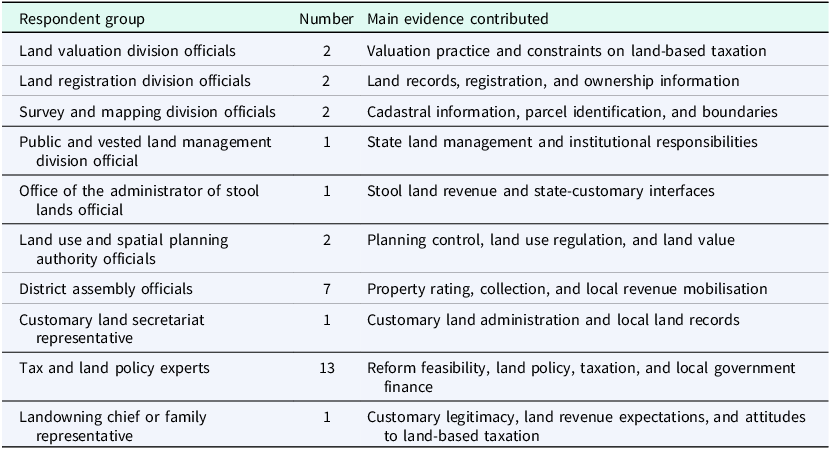
In total, 32 formal interviews were conducted. Participants were selected for their direct involvement in the institutions and policy areas through which property taxation, land administration, valuation, planning, local government finance, and customary land governance are organised in Ghana. Table 1 summarises the respondent groups, the number of participants in each group, and the type of evidence they contributed.
Respondent groups and evidence contributed

Table 1. Long description
A table comparing respondent groups, the number of participants, and the main evidence contributed. The table has three columns: Respondent group, Number, and Main evidence contributed. It has 12 rows. Row 1: Land valuation division officials, 2, Valuation practice and constraints on land-based taxation. Row 2: Land registration division officials, 2, Land records, registration, and ownership information. Row 3: Survey and mapping division officials, 2, Cadastral information, parcel identification, and boundaries. Row 4: Public and vested land management division official, 1, State land management and institutional responsibilities. Row 5: Office of the administrator of stool lands official, 1, Stool land revenue and state-customary interfaces. Row 6: Land use and spatial planning authority officials, 2, Planning control, land use regulation, and land value. Row 7: District assembly officials, 7, Property rating, collection, and local revenue mobilisation. Row 8: Customary land secretariat representative, 1, Customary land administration and local land records. Row 9: Tax and land policy experts, 13, Reform feasibility, land policy, taxation, and local government finance. Row 10: Landowning chief or family representative, 1, Customary legitimacy, land revenue expectations, and attitudes to land-based taxation.
Participants were recruited through purposive and snowball sampling. Purposive sampling identified actors with direct knowledge of property taxation, land governance, valuation, planning, and reform feasibility. Snowball sampling was used to reach additional tax and land policy experts whose knowledge was relevant but not easily captured through formal institutional categories.
Analytical approach
The analysis was guided by the institutional economics framework developed in Section Institutional Economics, Fiscal Capacity and Land-Based Property Tax Reform, with historical institutionalism used to examine how tax authority/land authority relations became durable over time. Documentary and legal materials established the formal structure of property rating and the responsibilities of MMDAs, land administration bodies, and planning authorities. Interview and documentary evidence were then used to examine how customary land authority shapes land allocation, local recognition of rights, land revenue expectations, transaction information, and perceptions of legitimacy.
The material was coded around the dimensions of tax authority/land authority divergence identified in the framework: tax-base definition, land information, legitimacy and liability, and revenue and political settlement. The analysis combined deductive codes from the theoretical framework with inductive refinement through repeated reading of transcripts, recordings, and interview notes. Quotes were selected to show how respondent groups understood the problem of land-based taxation and how those understandings related to the mechanisms identified in the framework.
Limitations
The study has limitations. Only a small number of customary land actors were interviewed directly: one Customary Land Secretariat representative and one landowning chief or family representative. The article therefore does not claim to provide a comprehensive account of all customary authorities’ views across Ghana.
This limitation is partly mitigated by interviews with actors who work directly with customary land institutions, including land registration officials, planning officials, land valuation division officials, district assembly officials, Office of the Administrator of Stool Lands (OASL)-related actors, and land policy experts. The study distinguishes between direct customary perspectives, formal institutional perspectives, and expert interpretation. Its purpose is analytical explanation rather than statistical generalisation.
Findings
The findings are organised around the mechanisms identified in the analytical framework: tax-base definition, land information, valuation and liability, planning control, legitimacy, and political feasibility. The aim is to explain how the building-focused regime is reproduced through the interaction among the formal tax authority, the customary land authority, and historically embedded institutional constraints.
Formal tax authority, the property rating base, and weak fiscal reach
Ghana’s property tax regime begins with a clear formal allocation of tax authority. Under the Local Governance Act 2016, MMDAs have authority to mobilise local revenue through rates, rents, fees, fines, and licences, including property rates (Anaafo, Reference Anaafo2018; Local Governance Act, 2016). In institutional terms, this gives MMDAs formal tax authority: they can identify rateable property, assess liability, demand payment, and use property rates as part of internally generated funds.
That formal authority operates through a specific statutory tax base. Under the Local Governance Act 2016, general rates on premises are payable by the owner of the premises and are levied by reference to the rateable value of those premises. For property rating purposes, rateable premises comprise buildings, structures, or similar developments. The rateable value is defined by reference to the replacement cost of the buildings, structures, and other structural developments that make up the premises, after the relevant deduction for depreciation or restoration. The main recurrent local property rating base is therefore anchored to buildings, structures, and structural development rather than the unimproved value of land itself. Land may enter other fiscal or administrative arrangements, but it is not directly and systematically incorporated into the main recurrent local property rating base in the way required by a full land value tax.
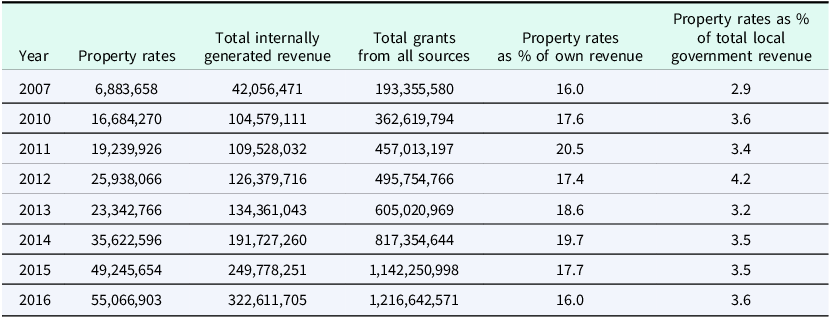
The existence of formal tax authority has not translated into a strong local property tax regime. Available revenue data show that property rates have remained a small part of local government finance. Between 2010 and 2016, property taxes averaged less than a fifth of internally generated funds and only 3.5% of total local government revenue (Oppong, Reference Oppong2021). They have also been estimated at approximately 0.02% of GDP, leaving MMDAs heavily reliant on central government transfers (Bahl, Reference Bahl2009; Oppong, Reference Oppong2021). Table 2 presents available data on property rate revenue in Ghana between 2007 and 2016.
Property rate revenue in Ghana, 2007–2016. Source: Oppong (Reference Oppong2021)

Table 2. Long description
The table presents data on property rate revenue in Ghana from 2007 to 2016. It includes six columns: Year, Property rates, Total internally generated revenue, Total grants from all sources, Property rates as % of own revenue, and Property rates as % of total local government revenue. The table has ten rows, each representing a different year. Row 1: 2007, 6,883,658, 42,056,471, 193,355,580, 16.0, 2.9. Row 2: 2010, 16,684,270, 104,579,111, 362,619,794, 17.6, 3.6. Row 3: 2011, 19,239,926, 109,528,032, 457,013,197, 20.5, 3.4. Row 4: 2012, 25,938,066, 126,379,716, 495,754,766, 17.4, 4.2. Row 5: 2013, 23,342,766, 134,361,043, 605,020,969, 18.6, 3.2. Row 6: 2014, 35,622,596, 191,727,260, 817,354,644, 19.7, 3.5. Row 7: 2015, 49,245,654, 249,778,251, 1,142,250,998, 17.7, 3.5. Row 8: 2016, 55,066,903, 322,611,705, 1,216,642,571, 16.0, 3.6.
The figures show that property rate revenue increased in nominal terms, but its relative fiscal contribution remained modest. Property rates accounted for between 2.9% and 4.2% of total local government revenue over the period shown. The problem, therefore, is not that MMDAs lack formal revenue powers. Rather, those powers operate through a narrow property rating base that generates limited local fiscal reach.
Existing studies identify familiar administrative problems, including outdated property registers, high revaluation costs, weak cadastre and registry systems, poor collection, limited coordination, political interference, and low public understanding of the tax (Acquah-Ababio, Reference Acquah-Ababio2015; Ayitey et al., Reference Ayitey, Kuusaana and Kidido2013; Boamah, Reference Boamah2013; Boamah and Okrah, Reference Boamah and Okrah2016; Kuusaana, Reference Kuusaana2015; Mabe and Kuusaana, Reference Mabe and Kuusaana2016; Mohammed, Reference Mohammed2020). The interviews support these concerns, but they also show that weak administration operates within a rating system whose main recurrent local tax base remains anchored to buildings, structures, and other structural developments rather than land value. Increasing building rates would leave this basic structure intact. It may raise additional revenue from existing rateable premises, but it would still focus the recurrent local tax on structures and improvements rather than on the site value created through urban growth, infrastructure provision, planning decisions, and surrounding development. It would also leave undeveloped or underdeveloped land, speculative landholding and increases in location value only weakly captured by the local property rating system.
This creates the first dimension of tax authority/land authority divergence. MMDAs possess formal authority to tax property, but the taxable object available to them avoids the more institutionally contentious issue of land value. Formal tax authority is therefore exercised through a rating base that gives local governments a property tax instrument while keeping much of the land value associated with urban development outside the recurrent local tax system.
Historical reproduction of land sensitivity and the rating settlement
The limits of Ghana’s property rating regime cannot be understood without examining the authority relations surrounding land. Land in Ghana is not only an economic asset or potential tax base. In many customary systems, it is tied to social identity, political authority, lineage, trusteeship, and local belonging. Land is often held through stools, skins, families, and other landholding groups, with chiefs and customary leaders exercising authority as custodians or trustees rather than as private owners in a narrow individual sense (Amanor, Reference Amanor, Ubink, Ubink and Amanor2008; Chimhowu, Reference Chimhowu2019; Kasanga and Kotey, Reference Kasanga and Kotey2001). Land value is therefore shaped not only by market conditions but also by local legitimacy, customary authority, and control over allocation.
This authority has deep historical roots. Ghana’s land reform history has repeatedly turned on the relationship among state authority, customary control, and indigenous landholding, from the Crown Lands Bill to subsequent land administration reforms (Aryeetey, Reference Aryeetey, Ayee, Ninsin and Tsikata2007). Colonial attempts to control or regulate land often generated organised resistance because they were seen as threats to indigenous land rights and customary authority. The Crown Lands Bill of 1894 and the Lands Bill of 1897, for example, sought to treat unoccupied lands as Crown lands, effectively transferring rights in so-called vacant lands to the colonial government. Chiefs and leading citizens in southern Ghana opposed these proposals through the Aborigines’ Rights Protection Society. Their resistance reflected the view that land described by colonial officials as vacant was often fallow land within customary systems and that the proposed legislation would dispossess indigenous communities (Amanor, Reference Amanor, Ubink, Ubink and Amanor2008; Bennion, Reference Bennion1962; Howard-Hassmann, Reference Howard-Hassmann1978; Kimble, Reference Kimble1963).
Land taxation also entered this historical pattern of sensitivity. Early municipal reforms in the Gold Coast faced resistance partly because local populations objected to direct taxation for a system of local government they did not understand or desire. In Cape Coast, opposition to the Municipalities Ordinance of 1889 included a petition that challenged the imported principle of direct taxation (Pachai, Reference Pachai1965). By 1912, proposals for a land tax intended to encourage productive land use generated renewed opposition from chiefs, who rejected them because the colonial authorities misunderstood customary land ownership and threatened indigenous landholding (Aryeetey, Reference Aryeetey, Ayee, Ninsin and Tsikata2007; Kimble, Reference Kimble1963; Pachai, Reference Pachai1965;).
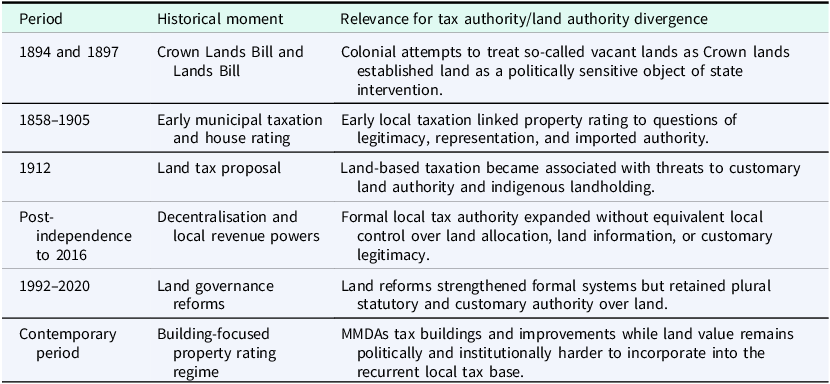
This history shows that fiscal claims over land have never been only a matter of revenue design; they have also been tied to political authority, institutional legitimacy, and control over land. In Ghana, attempts to make land an object of state authority have often intersected with questions of customary control, indigenous landholding, and local legitimacy. Later property rating arrangements developed against this background. By focusing on buildings and improvements, the rating system allowed local governments to maintain a property tax without making land value itself the recurring object of taxation. Table 3 summarises the historical sequence through which land became a politically sensitive object of state intervention and how this shaped the contemporary rating settlement.
Historical sequence of land sensitivity and the rating settlement

Table 3. Long description
A table summarizing historical moments related to land sensitivity and rating settlement. The table has 7 rows and 3 columns. Column headers are Period, Historical moment, and Relevance for tax authority/land authority divergence. Row 1: Period, 1894 and 1897; Historical moment, Crown Lands Bill and Lands Bill; Relevance for tax authority/land authority divergence, Colonial attempts to treat so-called vacant lands as Crown lands established land as a politically sensitive object of state intervention. Row 2: Period, 1858-1905; Historical moment, Early municipal taxation and house rating; Relevance for tax authority/land authority divergence, Early local taxation linked property rating to questions of legitimacy, representation, and imported authority. Row 3: Period, 1912; Historical moment, Land tax proposal; Relevance for tax authority/land authority divergence, Land-based taxation became associated with threats to customary land authority and indigenous landholding. Row 4: Period, Post-independence to 2016; Historical moment, Formal local tax authority expanded without equivalent local control over land allocation, land information, or customary legitimacy; Relevance for tax authority/land authority divergence, Decentralisation and local revenue powers. Row 5: Period, 1992-2020; Historical moment, Land governance reforms; Relevance for tax authority/land authority divergence, Land reforms strengthened formal systems but retained plural statutory and customary authority over land. Row 6: Period, Contemporary period; Historical moment, Building-focused property rating regime; Relevance for tax authority/land authority divergence, MMDAs tax buildings and improvements while land value remains politically and institutionally harder to incorporate into the recurrent local tax base.
This sequence shows how historical institutionalism helps explain persistence. The present regime is not simply a technical failure waiting to be corrected. It is the product of earlier conflicts, institutional adaptations, and political lessons about the sensitivity of land. Positive feedback may have reinforced the building-focused regime because it is legally established, administratively familiar, and politically less disruptive than reforms that would make land value a direct and recurring object of local taxation.
Land information and the limits of formal tax authority
The first contemporary mechanism of divergence concerns land information. Land-based property taxation requires reliable information about land parcels, land interests, land transactions, and liable parties. Ghana has formal land registration institutions, including the Land Registration Division and other divisions of the Lands Commission. However, the information held by formal institutions does not always meet the requirements of a land-based property tax.
One land registration official explained that the register contains useful information but lacks important data on land use and land prices:
The land title register includes certain pertinent details, but it notably lacks information regarding land use, permitted land use rights, and the classification of land uses. Additionally, crucial data on land prices is absent, with only stamp duty assessment information provided, which is typically a fraction of the actual land price. (Land Registration Official 1)
Formal institutions therefore exist, but they do not always possess the information required for land-based property taxation. Formal tax authorities depend on information systems that can identify the tax base and link it to liability. Where land allocation occurs through customary processes and only enters formal systems when individuals pursue registration, the state’s information base remains incomplete. One land policy expert explained this in relation to customary land allocation:
I think it [information sharing] is not conscious from the side of the chiefs. There is no conscious effort to give information to the land sector. So, you can see that they do a lot of allocations, they give out parcels of land. And if the person does not take steps to come to the institutions to do registration, the institution will never know about it. (Land Policy Expert 3)
This evidence shows the informational dimension of the divergence between tax and land authorities. Customary authority may allocate land, but formal tax and land institutions may not be aware of the allocation unless the recipient enters the statutory registration process. The production of land rights and the recording of land information are therefore not fully located in the same institutional system. This creates a practical problem for taxation, but the source of the problem is institutional rather than purely technical.
Valuation evidence, liability, and transaction transparency
The second mechanism concerns valuation evidence and liability. A land-based tax base depends on a defensible method for valuing land, identifying who is liable, and linking assessed value to that liable party. While land is valued in Ghana for purposes such as compulsory acquisition, mortgage applications, estate administration, and stamp duty assessment, participants identified several limitations that would affect a recurrent tax on land value.
One valuation official explained that indeterminate boundaries make valuation difficult, especially where land interests emerge from family or customary allocations without clear individual title:
It is difficult to value land for certain structures because of indeterminate boundaries. For instance, we have boundary issues with communities and assemblies. With our landowning setup, people are given land that may belong to their grandfather. Once they are from the same roots, each is assigned a place to build, but they do not have the title to it, so they cannot hold or dispose of that land because it’s from the family to which part has been granted. And once you do not have something, you cannot dispose of it. (Land Valuation Official 2)
The difficulty lies in how customary land relations affect the identification of ownership, alienability, and liability. A land-based property tax requires a relationship among the parcel, the value, the interest holder, and the taxpayer. Customary landholding may produce socially recognised rights that are meaningful locally, but not always easily translated into the individualised, parcel-based categories required for recurrent land taxation.
The problem is intensified by limited transparency in land transactions. A landowning group representative confirmed that price information is not routinely disclosed:
No, we do not disclose information on the prices during our transactions. When you go to the customary land secretariat, you can find details of whom we sold lands to, but we do not disclose prices. (Landowning Group Representative)
These accounts suggest that transaction evidence is limited not only by technical valuation constraints but also by the way land price information is controlled. Where customary landholders disclose the identity of purchasers but not transaction prices, formal valuation and tax institutions receive only a partial view of the land market. A land-based tax would therefore require greater disclosure of information currently treated as sensitive under customary landholding arrangements.
Planning control and the production of land value
The third mechanism concerns planning control. Land-based taxation depends not only on ownership information and valuation evidence but also on knowledge of permissible land use and development potential. Permitted use, development expectations, and infrastructure provision all influence land value. Where planning systems are weak or reactive, the institutional basis for consistent LVT becomes weaker.
Planning officials described situations in which customary landowners allocate land without following local plans. One planning official explained:
As I said, they are the owners, and there is a perception these chiefs have; they have been given a lot of authority, so they are seen as the bosses. They sell out these lands to people. And most of them do so without reference to the local plans that have been prepared. (Planning Official 2)
Another planning official described how such practices undermine planning authority:
They undermine the planning authority. When it happens, whatever plan we have gets destroyed. This makes it difficult and very expensive to correct such areas which are not well planned. (Planning Official 1)
These accounts show another dimension of divergence. The state may have planning law and tax authority, but it does not always control the land allocation processes that shape development patterns and land values on the ground. Where customary allocation can precede or bypass statutory planning, the value to be taxed is partly produced through processes that sit outside the full control of formal planning and fiscal institutions. A land-based tax would therefore require closer coordination among planning authorities, land-sector agencies, MMDAs, and customary landholders, as land value is partly shaped by planning decisions and land allocation practices.
Legitimacy, political feasibility, and variation across respondents
The fourth mechanism concerns legitimacy and political feasibility. Across respondent groups, there was broad recognition that land-based taxation could offer fiscal benefits, especially where local governments face revenue constraints. However, respondents differed in their understanding of the conditions under which such reform could proceed.
Some policy and land administration participants saw Ghana’s fiscal pressures as a potential opening for land-based reform. One land administrator framed the opportunity in revenue terms:
I think the opportunity that exists now is given the current economic environment where all revenue sources are closing up, the government is having a tight budget. So, if land tax presents such a golden opportunity that can easily be tapped into, I think it will provide the opportunity because of the current economic challenges. (Land Administrator 1)
These responses suggest that some participants saw land-based taxation as fiscally attractive, particularly amid revenue pressure and weak local government finances. However, that support was conditional. Participants who recognised the fiscal case also emphasised that reform would face institutional and political obstacles if introduced without addressing customary authority, land information, local government trust, and the distribution of benefits.
Other participants placed greater emphasis on likely resistance from chiefs and landholding groups. One land policy expert stated:
I know the chiefs will resist such a thing. They will resist it because anything that is in the form of tax, their answer is ‘not welcome’. (Land Policy Expert 2)
Another participant linked this resistance to the political importance of traditional authority:
The politicians are not able to do it because they think that it is the traditional authority that can help them in their political aspirations. (Land and Tax Policy Expert 5)
These accounts point to a political and institutional form of influence. Customary authorities may shape reform feasibility through local legitimacy, social authority, control over land allocation, capacity to mobilise opposition, and their importance to elected actors.
The landowning group representative gave a more direct account of resistance, linking it to both historical memory and distrust of local government:
I do not think a land tax will be welcome here in Ghana. If you look at our history, it is something our ancestors have always fought against. Moreover, we do not trust these local governments; they are corrupt. (Landowning Group Representative)
This account brings together two sources of legitimacy constraint. The first is historical: land taxation is associated with earlier struggles over customary landholding. The second is contemporary: local governments may lack trust among those who would be asked to pay. This suggests that land-based tax reform would require more than valuation and enforcement capacity. It would also require credibility, visible local benefits, and negotiated engagement with customary actors.
The respondent groups emphasised different aspects of the same institutional problem. Local government and land administration actors tended to emphasise revenue needs, records, valuation, and implementation constraints. Registration and valuation officials focused on gaps in land information, unclear rights and weak transaction evidence. Planning officials focused on customary allocation and the undermining of statutory planning controls. Customary and landowning perspectives foregrounded legitimacy, distrust, and historical resistance. Policy experts connected these issues to the political caution of elected officials. These perspectives converge on a central institutional point: land-based taxation requires alignment across institutions that currently control different parts of the tax base.
Synthesis: why the building-focused regime persists
Cumulatively, the findings point to a broader institutional constraint: land-based property tax reform remains difficult when the authority to make land value taxable is divided between formal and customary institutions.
The building-focused regime can therefore be understood as a manageable institutional settlement. It preserves a formal property tax for MMDAs but does so in a way that leaves the more contentious issues of land value, customary allocation, transaction-price disclosure, planning control, and customary revenue expectations largely unresolved. The regime remains fiscally weak. It generates limited revenue and constrains local governments’ ability to capture the land value created by urban growth, infrastructure provision, and planning decisions. Yet its institutional durability lies in its familiarity. It is legally established, administratively routine, and politically less disruptive than land-based reform. Over time, actors appear to have adapted to this arrangement, which allows formal institutions to administer property rates while avoiding more direct confrontation with customary land authority or the political sensitivities surrounding land value.
The findings therefore support the article’s central argument. Ghana’s property tax problem is not fully captured by administrative weakness alone. Administrative constraints are real, but they interact with deeper institutional misalignment. MMDAs possess formal tax authority, but the land relations needed to support land-based taxation are shaped by customary authority, fragmented information systems, incomplete disclosure, planning-control problems, and political caution. The persistence of the building-focused regime is therefore best understood as an institutional settlement: fiscally weak, but politically and administratively more manageable than reforms that would bring land value directly into the recurrent local tax base.
Discussion
The findings have three implications for institutional economics. First, they show that fiscal capacity depends on the institutional construction of the tax base, as well as on legal powers, administrative systems, and valuation capacity. In Ghana, MMDAs have formal authority to raise property rates, yet the land information, valuation evidence, liability relationships, and legitimacy needed for land-based taxation are partly shaped outside the formal tax system. Fiscal capacity is weakened when the institutions that tax property are not aligned with those that shape land rights, land information, and local legitimacy.
This clarifies the paper’s contribution to existing studies. The analysis moves beyond accounts that explain weak property taxation mainly through administrative capacity, valuation systems, collection problems, or taxpayer compliance. It also complements broader fiscal capacity and property rights literature by providing a mechanism-based qualitative account of why a specific tax-base settlement persists. The Ghana case shows how authority relations, information control, legitimacy concerns, and historical sensitivity around land contribute to the reproduction of the building-focused regime.
Second, the findings show how legal pluralism can affect fiscal reform. The coexistence of statutory and customary authority is not only a land governance issue. It also affects the construction of the tax base. Land-based taxation requires coordination across several institutional functions: defining taxable land interests, identifying liable parties, establishing value, enforcing payment, and legitimising the tax claim. Where these functions are distributed across different authority systems, land-based reform becomes an institutional alignment problem. Tax authority/land authority divergence identifies this fiscal consequence of plural land governance.
Third, the findings help explain the persistence of a weak fiscal institution. Ghana’s building-focused property rating regime performs poorly as a revenue instrument, but it is legally familiar, administratively routine, and politically less disruptive than reforms that would make land value the recurring object of local taxation. Distributional accounts suggest that inefficient institutions may persist where they protect existing interests and authority relations. In Ghana, the building-focused regime leaves direct recurring claims over land value, customary revenue expectations, land allocation practices, and the authority of landholding groups largely undisturbed. Historical institutionalism adds a temporal dimension to this explanation. Earlier struggles over land control and resistance to land-based taxation left political lessons about the sensitivity of state claims over land. Over time, rating buildings and improvements appears to have become a more manageable settlement than reforming the tax base around land value.
Compliance and legitimacy are central to this persistence. Land-based taxation would require taxpayers and landholders to accept that MMDAs have legitimate authority to make recurring claims over land value. That legitimacy cannot be assumed where local governments are weakly trusted, land rights are locally recognised through customary authority, and land value is associated with family interests, stool land revenue, or customary claims. The difficulty is therefore also one of institutional credibility.
The findings also clarify why administrative reforms alone may not resolve the problem. Low rates, exemptions, central-local fiscal dependence, valuation costs, and weak enforcement all affect property tax performance. Yet these factors do not fully explain why land value remains difficult to bring into the recurrent local tax base. Valuation problems, for example, are connected to land information, transaction disclosure, unclear rights, and customary allocation practices, as well as to technical capacity. Tax authority/land authority divergence shows how administrative constraints are tied to the wider authority relations surrounding land.
The reform implications are institutional as well as technical. Updated valuation rolls, digitised records, improved billing, stronger enforcement, and better collection systems would improve the administration of property rates. Recent Ghanaian reforms illustrate both the value and limits of administrative improvement. Digital revenue initiatives have sought to improve property rate collection by linking valuation rolls with street naming and property addressing data, while the Ghana Revenue Authority and MMDAs have also introduced a unified common property rate platform for collection (Ghana News Agency, 2020; Ghana Revenue Authority, 2022). These reforms may improve property identification, billing, payment, and enforcement, but they do not by themselves alter the building-focused nature of the recurrent rating base or resolve the wider question of how land information, valuation evidence, liability, and legitimacy are organised across formal and customary authority systems.
For that reason, reform would also require clearer channels for exchanging land information among MMDAs, the Lands Commission, planning authorities, and customary land institutions; credible engagement with chiefs, landholding families, and Customary Land Secretariats; and stronger links between local property tax revenue and visible public services.
Different land-based fiscal instruments would create different institutional demands. A full LVT would make unimproved land value the recurrent tax base. Split-rate taxation would tax land and buildings separately, typically applying a higher rate to land. Vacant or underdeveloped land taxation would target specific parcels rather than replacing the wider rating system. Betterment charges and land value capture instruments would recover part of the uplift in land value resulting from public investment, planning permission, or development activity. These instruments are not institutionally equivalent, but each still depends on reliable land information, defensible valuation, identifiable liability, and legitimacy.
The wider lesson is that land-based property tax reform in plural land tenure systems depends as much on institutional alignment as on fiscal design or administrative capacity.
Conclusion
This article has used Ghana to explain why a weak, building-focused property rating regime can persist despite the fiscal case for bringing land value more directly into local revenue systems. Ghana’s experience shows that the difficulty is not only about records, valuation, enforcement, compliance, or political interference. These constraints matter, but they sit within a deeper institutional problem: formal tax authority and customary land authority do not fully coincide.
The paper contributes to institutional economics by developing the concept of tax authority/land authority divergence. The concept identifies situations in which public institutions possess legal and administrative authority to tax property, while the authority to define, allocate, legitimate, or disclose land rights remains partly located in customary or informal institutions. In such contexts, fiscal capacity depends not only on legal tax powers or administrative systems but also on whether the institutions responsible for taxation are aligned with those that define and legitimate the tax base.
The reform implication is that land-based property taxation cannot be treated as a mere technical adjustment. Better valuation rolls, improved land records, clearer billing systems, digitisation, and stronger enforcement remain necessary, but they are unlikely to be sufficient where land value is embedded in plural authority relations. Reform would also require clearer information-sharing arrangements, credible engagement with customary land institutions, stronger links between local tax revenue and visible public services, and careful sequencing.
The paper is limited by its focus on a single-country case and by the small number of customary land actors directly interviewed. Future research could examine whether similar divergences between tax authority and land authority help explain weak property tax regimes elsewhere, whether different institutional arrangements make land-based taxation more feasible, and how customary authorities themselves understand land-based fiscal reform.
Acknowledgements
This article is based on doctoral research undertaken at the University of Reading.
Funding statement
This research received no specific grant from any funding agency in the public, commercial, or not-for-profit sectors.
Competing interests
The author declares that there are no known competing financial interests or personal relationships that could have influenced the work reported in this paper.

 Open access

