Introduction
In a landmark study of technology, Edgerton makes a persuasive case for focusing on the use of inventions.Footnote 1 A use-centred approach, he argues, allows for the possibility of a truly global history. As an organizing research concept, the date of inventions and their place of manufacture tends to limit study to a few countries. Shifting the focus to technology-in-use embraces small as well as big technologies, countries, and individuals everywhere, rich and poor, male and female. Invention, distribution, and uptake of nuclear power or flight (what Edgerton calls spectacular, masculine technologies) can be readily documented.Footnote 2 Mundane technologies are more elusive for historians. For example, the lead pencil and eye-glasses have transformed daily life for masses of people worldwide, but most users have left no record of why, when, and how they first took up novel and often foreign inventions, nor what these meant to them. Here the example of a commonplace invention, the sewing-machine, is followed on its journey from European household to indigenous home and workplace in the former Dutch East Indies. This trajectory appears to be typical of other colonies too, but this paper draws on a unique source, photographic archives, whose wealth in numbers and varieties of images allows indigenous tailors and seamstresses to walk onto the historical stage and stake their place in their homeland's history of global interaction.Footnote 3
Modernization and the sewing-machine
The sewing-machine that Isaac Singer perfected was superior to previous inventions because it was reliable, compact, and elegant. In 1856 he marketed his family model to women. A newspaper advertised his machine as capable of being operated ‘by any woman of common intelligence’.Footnote 4 As a mechanical tool, the Singer could fashion material into household goods and clothing much faster than hand sewing. Viewed from a social perspective, the Singer brought profound changes to women across a wide social band, for example piece-workers supplementing the family income by home sewing; regimented, waged factory employees; and thrifty housewives. Within ten years half of all US households owned a Singer.Footnote 5 But the machine's success was not just an American phenomenon. From the first, Singer aimed at a worldwide market.Footnote 6 Being powered by hand or foot, the sewing-machine was not dependent on household electrification—it could reach houses in smaller as well as large cities anywhere. Singer set up a secondary manufacturing site in Scotland in 1867, and sent his network of agents into Europe, Africa, and Asia. In its Asian odyssey, the Singer had reached Java by at least 1880.Footnote 7
If the simple definition that modernization is a process of adapting inventions to the particular demands of a given society is accepted, and that modernity is an attitude or disposition of mind, then the sewing-machine may be considered as both a functional and a social object. As a machine incorporated into the family home, the Singer exemplifies the worldwide distribution of trade goods, communication through advertising and sales, and the purchaser's recognition of the machine's utilitarian purpose. As a social object, the sewing-machine suggests that the owner values the new and that personal participation in global trends of consumption has been made possible by long-distance, mechanized transport. Pacey argues that transfer of technology is a form of dialogue that has to be understood within the process of local adaptation, especially in social practices.Footnote 8 Cooper reminds those studying modernization in former colonies to consider specific groups in specific situations.Footnote 9 In a colonial setting, therefore, those households that acquired a sewing-machine and who operated it need to be identified.
Visual evidence allows historians of colonial Indonesia to document the type of household that acquired the sewing-machine because the machine was considered worthy of being photographed. As well as being a functional object in the Dutch colony, the camera supplies evidence for the sewing-machine as a marker of gender, class, and ethnicity. Home operators were women; Eurasians sit before table models;Footnote 10 indigenous seamstresses work on the floor.Footnote 11 Having viewed the sewing-machine in its domestic setting and its links to women, the observer may move from the back veranda of the European household, follow the camera into the streets and there observe that in tailor shops the commercial operator was an indigenous or Chinese male.Footnote 12
Completing these preliminary observations leads to a consideration of the utilitarian function of machine-sewing, which is to furnish households with specific items such as curtains and bedding materials, to cover bodies, and make small accessories such as handkerchiefs. This is the realm of propriety, hygiene, fashion, and public display, and also the realm of work with its uniforms, office dress, and its hierarchy of sartorial status indicators. In this preliminary enquiry, the setting is the Dutch East Indies in the first four decades of the twentieth century. The households were European, in the special Dutch East Indies meaning of the term.Footnote 13 The tailors’ shops were enterprises owned by Eurasians and Chinese; they employed Chinese and indigenous staff, and catered to a wide mix of men caught up in the business of the colony. Primary data for this paper are photographs in the collections in the Royal Institute of Indonesian and Caribbean Studies (KITLV) and the Tropical Museum (TM) of the Royal Tropical Institute (KIT). This paper also draws on period fiction, social histories of Dutch colonialism, and on insights from historians of material culture.
The evidence of the camera
Much has been written on the subject of the colonial camera and its limitations and predispositions, and rather less that illustrates its value for social history.Footnote 14 When attention is focused on Western technology in Asian hands, the photograph fills a void. Indigenous seamstress and tailor created no discoverable personal records of their learning to work the sewing-machine, of the financial advantages of a new job, or how it might have altered their own position within their family and village, or what this foreign product of Westerners meant to them. Advertisements for tailors’ shops are to be found in the colony's Dutch- and Malay-language newspapers and magazines, but for the working woman there is little to go on without the aid of the colonial camera.
In studio portraits of the Dutch in the Indies, the assemblage of objects around individuals and groups are the photographer's own possessions, props such as the covered table, vase with flowers, and background draperies. But for photographs commissioned in the home, householders displayed themselves among their own possessions, and often their domestic staff as well. The social lives of the Dutch in the Indies took place outdoors. Husbands and wives pose with friends, children, servants, and the family dog on the front veranda or around a tea table set up in the garden. These public settings show the householders’ own possessions. Front verandas were characteristically furnished with hanging lamps, easy chairs, round tables, and potted plants. In many photographs, whether on the veranda or in the garden, servants stand or squat attentively or they hold in their arms the small children of their employers.
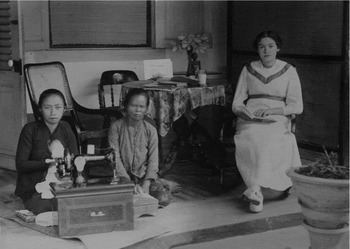
Mevr. M. van Schaafsma-van Loghem on the veranda of her house in Ambarawa, Java, with household staff and sewing-machine, 17 August 1913.

When a photographer was invited to photograph the lady of the house alone or with her servants, the site was likely to be the back veranda, and there, among the more homely objects of local provenance, such as a kitchen dresser and pot of herbs, is the imported sewing-machine. It is set on a low stool in front of an indigenous woman who is seated on the floor. The machine explains the role of the Asian woman in the household. The seamstress has not chosen to be photographed; she has not summoned the professional cameraman from his studio to record her in her workplace. So the first focus is on the female head of the house, the one who decided who and what should be included in this Indies domestic scene.
In her biography of the Singer, Brandon observes that labour saving was not perceived as a necessity by middle class housewives at the time of its launch on to the North American market. Such establishments had servants and all ladies sewed. Nevertheless, she makes a link between the sewing-machine and the early suffragette movement, and she analyses the Singer as part of a complex of small, mass manufactured appliances, such as the typewriter, that enhanced an individual's career possibilities and were part of the modern age.Footnote 15 The average Dutch household in the Indies in the early twentieth century was serviced by four to six indigenous staff whose duties were distributed between house and garden. Labour was cheap and plentiful in Java, so the Singer's labour-saving quality was perhaps of secondary importance to its European purchaser, compared to its capacity to demonstrate the modernity of the colony about which the guidebooks and travel literature boasted. Colonial families who paid for a visual record of their Indies life were self-conscious demonstrators of, and participants in, the colony's progress. One family, who assembled their domestic staff outdoors for a photograph, had the household's sewing-machine brought into the garden to distinguish the seamstress from the cook (posed with her mixing bowl), the manservant, and the gardener.Footnote 16
If we examine photographs taken of Javanese counterparts to the Indies Dutch in these same pre-war years, that is, the well-to-do who sent their children to first class European schools in the colony and held senior positions in the indigenous arm of the civil service, we find that they, too, took themselves to photographic studios and commissioned portraits of themselves at home. In the studio Java's elite sat in front of the same drapery, beside the same table and vase with flowers, and sometimes, too, with attending servants, seated on the floor. At home, this Javanese class posed in the exclusive space of their indoor apartment, rarely exposed to a passing public on the front veranda or in the garden as the Dutch were. (The Dutch and their household goods were objects of interest or curiosity to passers-by, as the camera documents.Footnote 17)
In the parlour of the Javanese well-to-do we also find this pleasure in material objects, in the novel, the modern, the exotic foreign. Families pose beside their piano; the bicycle is admitted into a living room furnished with sofas and hanging lamps; curtains cover windows; and framed photographs hang on walls.Footnote 18 The photographer was not invited to the private areas of the household, so there are no glimpses of domestic appliances that a servant might use, such as a sewing-machine. In one photograph, the family has had their modern European table with place settings carried out to the veranda to be photographed, but the table stands alone, without diners or servants.Footnote 19 Perhaps, after the Kodak camera became available in 1888 and reached Java, the middle class occupants of indigenous households took their own, more private photographs. Indonesian photograph albums from this period await location and examination, but a rare album in the KITLV collection, assembled by an Indonesian family in the 1920s, suggests that such research will indeed yield valuable information on indigenous social life in the late colonial period. Among photographs of their home and its furnishings, there is one of the family's sewing-machine [KITLV#80733].Footnote 20
In another kind of Indonesian source, the fiction that Indonesian authors wrote in this pre-Independence period, we find train travel, bicycles, and telephones supporting new middle class lifestyles. In Armijn Pane's novel, Belenggu,Footnote 21 for instance, the telephone notepad becomes the symbol for what is wrong in the relationship between Dr Sukartono and his wife Tini. She refuses to write down telephone messages from his patients. Pane describes them as two modern individuals bound up in separate careers and dilemmas. The doctor tools around Batavia, the colony's capital, in his motorcar; the wife takes the train from Batavia to Yogyakarta for her social work on behalf of orphans. Takdir Alisjahbana's female protagonists in Lajar Terkembang cycle around Batavia to nationalist rallies and to meet boyfriends, freed of the protective shepherding formerly expected for upper class women.Footnote 22
Car, train, bicycle, and telephone are part of a modern lifestyle for Pane's and Alisjahbana's Dutch school graduates, unquestioned, supporting their busy careers and personal autonomy. Turning to private correspondence written in this same period by the younger sisters of Raden Ajeng Kartini,Footnote 23 we read of trips by car and train, and visits to the cinema. The Indies Malay-language magazine, Pandji Poestaka, offered families excursion rates for holiday train travel and was clearly aimed at the growing indigenous middle class that it depicted in its advertisements as a nuclear family.Footnote 24
Servants are absent from the pre-war novels, or their modern skills are taken for granted. Dr Sukartono's manservant can drive. We discover this as an aside; it is not a focus of Pane's narrative, nor a cause for wonderment or comment. A near-contemporary photograph from Aceh makes the same point about technology transfer occurring almost unnoticed. The photographer focused on the ceremonious arrival of Governor-General Jhr. B. C. de Jonge in Tamiang, Aceh, in 1935, the guard of honour lined up to greet him as he steps from his limousine. Looking closely we can just discern that the chauffeur of the car is an Indonesian [KITLV#3830].
Photographic evidence, then, may lead in many directions. Photographs leave a record of the Indies Dutch. One part of that record is the representation of the ‘tropical’ Netherlands. There, with no apparent need to relieve the drudgery of servants, we find the sewing-machine. This particular machine was possible because no electricity was required for its operation. It says of the Dutch in the Indies and to those viewing the photograph back in Holland, that colonial life is up-to-date, with all the conveniences of the standard home in Western Europe. The Eurasian mistress of the house who wanted a permanent visual record of her sewing-machine and her sewing skill is seated on a chair; she works a machine that is placed on a table. It is the servant, not the mistress, who is shown in the humble position on the floor.
The Indies Dutch and Indies Javanese inhabited the same world. The camera was brought in to show Prince Mangkunegoro IV relaxing, around 1880, in his newly landscaped garden [KITLV#27349]. A companion stands at respectful distance, the attendant has taken his customary place on the ground, and the royal descendant of Hindu gods lounges on a garden seat for this professionally taken ‘candid camera’ scene.
The photograph of the Javanese seamstress on the floor can be read as an indicator of status relationships as well as an example of the hold and power of Javanese culture over the colonizing Dutch. However, it is worth remembering that the average Javanese house in villages and in neighbourhoods on the fringes of European suburbs did not include chairs among its furnishings. Women squatted to cook on low charcoal braziers; they sat on mats or benches to work. So the photograph perhaps records also how the Javanese integrated a foreign object into daily use without changing their personal habits. Understanding this, perhaps, the Dutch housewife economized by not purchasing a table or a treadle model sewing-machine for her domestic staff.
Manuals written for Dutch women departing for the Indies stressed the importance of being able to sew and to cut clothing patterns, and sewing was included in the curriculum of the Colonial School for Women and Girls that opened in The Hague in 1920.Footnote 25 Advice and instruction prepared the female head of the household for supervising the actual work of sewing that, in the Indies, was the job of the indigenous seamstress. The seamstress was generally not one of the live-in domestic staff in the Indies Dutch household, but came to work there for fixed hours on a daily basis.Footnote 26 Perhaps here was a reason to provide the seamstress with a sewing-machine: it would increase the productivity of a servant who was paid by the hour.
Sewing-machines were used to hem curtains and bed sheets, and embroider them. These were not items found in the bamboo houses of Javanese commoners. So, while the machine introduced new skills, such as controlling the mechanical needle, it also introduced the seamstress to new items for the house and new possibilities for home decoration when her life circumstances improved. (Sukarno's National Party of Indonesia promised followers stone houses and 1,000 guilders each if they joined the Party, according to police interviews conducted in 1930.Footnote 27)
A photograph reproduced in Nieuwenhuys's illustrated history of Indies life shows a seamstress seated on the floor before her machine sewing baby clothes.Footnote 28 Making clothes called for skills of measurement and an acquired familiarity with Dutch metric measures. Fitting entailed an intimacy of bodily contact between worker and employer. Sewing also introduced the seamstress to new styles of clothing, to Dutch concepts of what parts of the body ought to be covered and what might be exposed. In the first decades of the twentieth century Dutch women still wore a variant of the Javanese kain kebaya Footnote 29 at home. In other words, they dressed in a style similar to that of their indigenous household help, but their kebaya was distinguished by bands of machine-sewn lace embroidery. When they went out, Dutch women wore European frocks or blouses and skirts. Unlike the majority of Javanese women of the time, Dutch women covered their hair with a hat when in public. From the 1920s Western daytime clothes exposed women's legs and arms.Footnote 30
Western clothing styles incorporated pockets stitched onto shirts and blouses. In the Indies, pockets on the Western-style jackets worn by elite indigenous men contained and displayed new imported objects such as a watch with chain, a fountain pen or handkerchief.Footnote 31 Javanese women's kain kebaya had no pockets and they tended to tuck items into a length of cloth wrapped around the waist. The personal items needed by Javanese ladies were carried for them by attendants until they incorporated the Western frock and handbag into their dress style in the 1950s. By then, a train of servants had become unfashionable and out of place in modern women's lives. Pocket and handbag modified behaviour. They were status markers displaying possessions, wealth, and imported fashion, but they also detached higher status individuals from lower status personal attendants and freed (or condemned) them to be individuals.Footnote 32
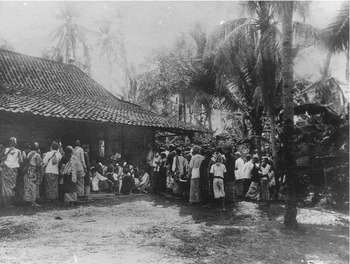
Opening of a village bank in Java, date and place unknown.
Source: TM#10001465. Reproduced with kind permission of the Royal Tropical Institute Museum, The Netherlands.

Skills acquired in the Dutch household were transferable to the urban living quarters and villages of the indigenous population. In 1930 around 350,000 Indonesians (or two per cent of the indigenous waged workforce) were household servants working for Europeans, well-to-do Chinese, and princely families.Footnote 33 Domestic service accounted for just four per cent of all female workers, as the great majority of women were employed in agriculture, cottage industry, crafts, and market trading. However, small numbers of domestic workers could channel information far beyond their immediate circle of family and friends. The sewing-machine, for instance, being portable and sturdy, could be transported home by train services that, from the last quarter of the nineteenth century, opened up the hinterlands of towns, or it could be carried across town by electric tram or dokar, a small, two-wheeled pony cart. By the end of the 1930s the becak was appearing on streets in the colony's cities as another everyday conveyance for ordinary people and their goods.Footnote 34 In 1910 in the month of December alone, 255,196 passengers travelled by third class on trams through Batavia.Footnote 35 Perhaps Singer agents were among the 72,623 people travelling second class in that same month. (A sister of the nationalist politician Sutan Syahrir was a Singer agent in her home town in Sumatra in the years before the Second World War.) Fifty-seven tailors and seamstresses were reported to be working in the Comal district of central Java in a survey of off-farm employment conducted between 1903 and 1905. It is likely that at least some of them sewed by machine.Footnote 36
The Singer entered the countryside at the same time as the Indies government was developing and extending credit services to replace the pawnshop as the source of small loans to indigenous farmers, petty traders, and manufacturers, and to reduce the role of foreign-born Chinese in the rural commercial life of the colony. Bank buildings in cities were imposing structures. They suggested financial solidity, but they were likely to have been intimidating to a domestic servant or villager wishing to acquire funds to purchase an income-producing good such as a sewing-machine. Lower socio-economic groups were able to build up savings accounts and secure small loans through their neighbourhood branch of the People's Credit Bank. Photographs show the Credit Bank's building to be a much less formidable structure than a big city bank, and its operations were conducted on the front veranda. The camera tells us that ordinary Javanese, both men and women customers, queued for its services.Footnote 37
The colony was sprouting new towns in the early twentieth century. They grew up in trade centres, around transport hubs, plantations, and mines and around holiday resorts in the hills. The foreign investment that followed on from the colonial government's easing of laws that restricted private enterprise in 1870 greatly expanded the economy and the need for personnel. New jobs were opened up in petroleum; in rubber and palm oil plantations; in rail, road, and port construction; in transport services; in banking; in education; and in the expanding departments of government. There were jobs for foremen, office clerks, and messengers, for telephonists, for schoolteachers, and journalists, for lorry drivers and lighthouse staff, for factory workers, for police and soldiers, for food suppliers and ice-makers, for tennis and swimming pool attendants. All these employees required work clothes, whether singlet and shorts, jacket and long trousers, dress uniforms, ‘safari suits’ or combinations of European and Javanese dress.
Schulte Nordholt has characterized the ‘mood’ of this era as embracing the modern. Occupants of these new jobs formed the new indigenous lower and middle classes and strove for a modern lifestyle. Too often, he observes,Footnote 38 referring to O'Malley's 1980 study, historians of modern Indonesia, knowing, as it were, the end of the story, look back to the 1920s and 1930s and characterize the mood and goals as ‘nationalist’; they focus on political institutions that were defining a new nationalist identity and demanding political independence. But, Schulte Nordholt argues, the colony rested on the ambitions of thousands of urban Indonesians who saw and wanted the modernity of the Dutch for themselves. In seeking to secure the colony, he says, the Dutch nurtured and guided these ambitions.
Schulte Nordholt draws on magazine advertisements for soap, electric light globes, wristwatches, and tobacco products. He analyses advertising text and images to show the connections made between soap, hygiene, beauty, and monogamous marital happiness; the suggested capacity of the electric light globe to promote reading in the midst of the domesticity of the nuclear family; the link between rail transport and wholesome family life enlivened by excursions at discount prices. He examines images in schoolbooks that show neatly clad Indonesians carrying letters to the post office, driving in a motorcar, and occupying well-maintained houses with neat flowerbeds and mown grass in the front garden and tidy backyards in which there is a place for everything and everything is in its place. Nationalist politics was a risky business, he argues; the new middle classes could obtain a modern lifestyle within the framework of colonial rule, they did not have to oppose Dutch authorities to attain the Dutch lifestyle and make it their own.
In 1930, there were about 500,000 middle class Indonesians in the Dutch East Indies, and the majority earned their living in jobs linked to the colonial authority.Footnote 39 Schulte Nordholt employs Stoler's memorable phrase ‘the education of desire’Footnote 40 to describe this ‘selling’ of modernity by government and private enterprise. He argues this is what kept the Dutch in power until they were swept away, not by the tiny nationalist parties of Indonesians, but by an Asian representative of modernization and modernity in the form of the Japanese. What he discusses was not just emulation—looking up to the Dutch—but also looking ahead. For in order to acquire this modern lifestyle, Indonesians had to change how they spent their time, how they earned their living, and how they selected schools for their children.
Photographic archives are rich in sources to support Schulte Nordholt's contention. Indigenous drivers line up beside their vans at the main depot of the colony's postal service [TM#10014093]; indigenous assistants staff the business office with its filing cabinets, ledgers, and electric lights [TM#60020321]; young women handle Batavia's telephone exchange [KITLV#5191]; workers operate sugar milling machinery [TM#60004334]; Javanese draftsmen make technical drawings in a machine company's blueprint office [TM#60020323]. Each person's modernity was situational. The modern Dutch lady in the colony played tennis and relaxed at the municipal swimming pool for Europeans, but modernity for a Javanese woman was working for wages as a coffee bean sorter on a factory production line [KITLV#26927], and purchasing daily necessities rather than making them. Well-off Javanese, who owned rice land and fishponds or were district traders, bought tickets on the modern Dutch steamship service to Arabia to make the traditional pilgrimage to Mecca.
Tailors’ shops dressed men for their new jobs and lifestyles; the sewing-machine and its made-to-measure work clothes launched indigenous men into new possibilities. For a small capital outlay an entrepreneur could set up with two or three machines in a storefront. Modernization was not only the product of trickle down from the top, or the monopoly of Indonesian graduates of Dutch academic and technical institutions. In the colony Indonesians engaged everywhere with new things and new careers. Tailors’ shops were open to the street for all to see. By contrast, for women seamstresses, in this era, the sewing-machine took them indoors. For women it was a rise in status to be off the streets, out of the fields, away from the skin-darkening sun, respectable in jobs that did not expose them to the public gaze. The West's technology in Asian hands opened up new lives for those willing or courageous enough to associate themselves with the Dutch as staff in public and domestic settings.
Rapid change, of course, produced social dislocations. The colony's administrators and middle classes—Indonesian and Dutch—perceived a variety of social ills, such as vagrancy and juvenile delinquency. Through colonial policing, but also through the formation of charitable societies and other volunteer organizations, they attempted to bring modern remedies to contemporary problems. Dirks devises the concept of ‘colonial civil society’ to describe the new organizations whose Indonesian and Dutch members raised funds to support orphanages and reformatories.Footnote 41 Reformatories for boys offered instruction in tailoring, using sewing-machines as a way out from delinquency into a life as a self-supporting, law-abiding member of colonial society.Footnote 42 Other options were training in carpentry and agriculture. The sewing-machine journeyed into the colony's prisons too, and here can be seen the coercive aspect of technology transfer. J. C. Lamster took the new moving picture camera into Batavia's prison yard in 1912 to film inmates at work on sewing-machines as one part of his recording of colonial life, commissioned by the Colonial Institute to encourage young Dutch professionals to consider an Indies career.Footnote 43
Hooker's study of fatwas issued between the 1920s and 1990s allows us to perceive what the new might mean for ordinary people who have left no personal record of their own.Footnote 44 Fatwas are judgements issued by a respected Islamic jurist or a body of jurists in response to questions put by individuals, and so may be considered as ‘guides for the perplexed’. Hooker examines fatwas issued by four Islamic bodies in Indonesia. He groups them under headings such as ‘Muslims and Christian ritual’, ‘Prayer while travelling’, ‘Women going out of the house’, ‘Medicine’, and ‘Money contracts’. Hooker's scholarly interest is in exposing the reasoning and principles behind the rulings, the recourse to Qur'an, Hadith and qiyas (reasoning by analogy).
Fatwas state the question posed, but not the identity of the questioner. The fatwas issued in the 1920s and 1930s tell us what pious, but nameless Muslims, caught up in the colony's proliferation of new processes and things, wanted to know. There are no fatwas considering the West's sewing-machine in Hooker's selection, but two other rulings dealing with women in public can be considered. A fatwa, issued by Nahdlatul Ulama in 1933 on the permissibility of women trading in small local markets, granted permission if the female workers covered their faces and hands (NU Fatwa No.135/1933). The second comes from 1939 when a petitioner approached the Nahdlatul Ulama to ask if it was lawful (in Islamic terms) for a girl to ride a bicycle. Clearly the bicycle offered lower class girls the same unsupervised mobility for work and leisure as it did for men; the bicycle offered the individual cyclist freedom. The Nahdlatul Ulama's answer (NU Fatwa No. 255/1939) was a qualified yes—so long as she did not use the bicycle for prostitution. In his examination of many such fatwas to do with the individual's relationship to modern things, especially those that were products of Christian Europe, Hooker makes the point that it was the use of the thing or purpose to which it might be put that was the key consideration of the jurist, rather than the physical thing itself.
Returning again to the sewing-machine, we can note its function of producing tailored clothing for covering the body. Christian and Muslim standards required a covered torso for men and women. In this sense, the machine as an object may be said to act on the user, and, at the same time, the operator uses the machine to accomplish a purpose that has a moral as well as a practical dimension. Perhaps the moral dimension was what was signified by Singer's advertising slogan for the sewing-machine as ‘the herald of civilisation’ in Africa and Asia.Footnote 45 From its earliest days as an employer, the Dutch East Indies Company (VOC, 1602–1799) had paid its Asian workers in shirts and blouses, as well as in rations and cash. The twentieth-century colonial studio produced photographs of bare breasted ‘Oriental beauties’ and titillating shots of female slaves in Balinese households, but drawings, paintings, and photographs of indigenous female staff in Dutch households consistently show covered bodies. Male servants are also fully clothed in jackets, trousers, and sometimes a batik waist wrap as well.Footnote 46
More was at stake than conforming to Dutch standards of propriety and thinking on how an employee should appear at work. The adoption of Western dress for government and business offices altered manners and relationships. A Javanese man in a Western suit did not crawl across the floor and squat in the presence of superiors, whether those superiors were Javanese or Dutch. A European official was compelled by the style of clothing worn by a Javanese to adjust his own behaviour: he expected a Javanese to squat if the man wore Javanese clothes; he had to offer a chair to the Javanese man in Western clothes. In the Dutch East Indies, where 80 per cent of the Dutch population was locally born and most were of mixed Indonesian-Dutch ancestry, Javanese who wore Western dress in public looked like the majority of the ‘Dutch’, that is, like the Eurasians.
In the eyes of Islamist rejecters of the Dutch, Western dress threatened a stable Islamic identity. Sukarno recounts in his Autobiography that the head of the mosque refused to perform his wedding ceremony with Utari Tjokroaminoto unless he removed his necktie. He remembered the exchange 40 odd years later in the following way:
He [the mosque official] said, ‘Young man, a necktie is a strictly Christian mannerism and not in keeping with our Islamic custom.’
‘Sir’, I retaliated, ‘I am aware that formerly a groom wore only our native dress, the sarong. However, that is the old-fashioned way. The law has now become modernized.’
‘Yes,’ he snapped, ‘but our modernization extends only so far as to permit the groom to wear trousers and an open collar.’Footnote 47
The humble sewing-machine, in other words, added to the complexities of colonial life and its hierarchies.
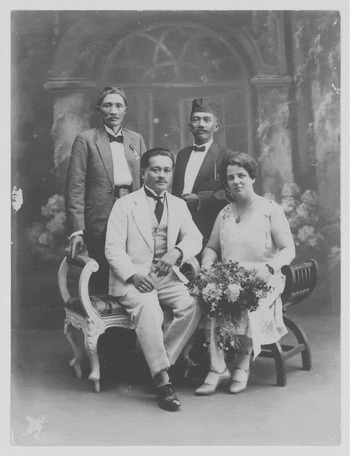
Wedding of Dr Marzoeki, head of the Public Health Service, Batavia, and N. Cornelia Spaanderman, 1927.
Source: KITLV#4783.

Western clothing seems to have been a more controversial choice for the Western educated indigenous woman and the woman going into domestic service or labouring jobs. The record of the colonial camera is that by 1920 the European frock, at least for photographs, was the dress of the immature female, the school-aged girl, and that kain kebaya was the dress of marriageable-age and married women and of working women, whether professionals or plantation workers.
Kartini and other pioneers of girls’ schooling and careers insisted they were still loyal to their own culture, not out to get Dutch husbands or behave like European women. However, school girls in kain kebaya crawled across the floor to their Indonesian lady teachers in schools founded by Raden Dewi Sartika, and in such traditional behaviours they did not model the new age that Kartini had so desired. In his Autobiography, Sukarno urged Indonesian men to adopt Western dress, calling Indonesia's sarong the dress of servants; however, he opposed women wearing Western dress and equated the kain kebaya with female allures and service.Footnote 48 The adoption of Western dress by adult Indonesian women was a phenomenon of the 1950s.Footnote 49 It has been under challenge since the 1980s by Islamists who promote (and in many circumstances stipulate) a new ‘Southeast Asian Islamic’ dress code for women consisting of tailored garments—trousers, loose tunics—and covering of hair, ears, and neck.
The sewing-machine enabled the individual to own more clothes to respond to the different needs of each aspect of personal life in the colony at home, school, work, leisure, and mosque. Mass manufacturing allowed individuals to possess many more clothes than was possible in pre-industrial societies. Of course, the labour saving that machines offered was, for many, the drudgery of long hours spent in the rapid production of ready-to-wear clothing.Footnote 50 Indies tailors’ shops trained employees in the skills of measuring and cutting to a pattern. In addition to sewing techniques, they learned how to deal with customers from many different ethnic and language groups, with the common objective of equipping them for working, social, and political lives in a country formed by a foreign colonizing power. Mrázek put it this way: the Indonesian ‘borrowed Dutch clothes to place himself in a “modern” colonial society’.Footnote 51
Singers abroad
In his study of the sewing-machine in Egypt, Kupferschmidt reminds us that labour, gender, and social conditions differ from country to country, eras, and classes.Footnote 52 The Indonesian case-study demonstrates that visual records both complement and challenge accounts of colonial technology in pointing attention towards the indigenous user who is obscured in statistics of sales and trends. It allows some tentative conclusions. It suggests that the sewing-machine was an ambiguous object of Western material culture in the Indies.Footnote 53 First, the Singer was a modern machine that reinforced conventional gender roles in Indonesian societies: women machinists worked in domestic space,Footnote 54 men in the public space of a shop open to the street. Second, it accelerated the production of traditional costume when embroidery by machine replaced hand sewing. Third, it was a modern machine purchased by European women for their Asian servants to use. Fourth, the sewing-machine was one item in a complex array of items imported into the colony from the West that became a permanent part of everyday use by indigenous men and women. For the waged poor there were imports such as the thermos flask (patented in 1904), the graphite lead pencil, and the enamel washbasin; for ‘white collar’ employees in government and business offices there were the telephone, typewriter, and ledger book; for skilled labourers, who drove cars, buses, and lorries, stoked locomotives, and milled sugar, there were tool boxes and the clock that governed their time.
All these objects and the attendant skills necessary to use them entered Indonesia as part of colonial culture, catching up with people in all social classes. Boeke argues that colonies fostered a socio-economic system in which two distinct sectors coexisted, the one characterized by imported Western capitalism, technically advanced industries, entrepreneurship, and dynamism; the other characterized by labour-intensive work practices, limited wants, and lack of a profit motive.Footnote 55 In the case of Java, in Boeke's analysis, Europeans and foreign Asians dominated the capital-rich sector, while the indigenous people were restricted to the capital-poor segment, because their social psychology inhibited their transition to the capitalist sector. But, viewed from the perspective of material culture, everyone in the colony was caught up in changes propelled by Western capitalism and colonialism. Rural labourers wore work singlets made from imported cotton because it was cheaper and of better quality than locally grown cotton; they took journeys by train and bus to towns that were further distant than their feet could conveniently transport them and their goods; they saw manufactured products, such as bottled drinks and tinned foods, in weekly village markets and in shops with their new glass windows in provincial towns. New objects connected individuals at all social levels with global trade and introduced more diversity. Imported objects made a rapid journey into domestication or assimilation. First-generation operators of the sewing-machine must have perceived it as new and of foreign provenance. Few in Indonesia today would think of the sewing-machine as novel or exotic. Dikötter calls this domestication of the foreign ‘appropriation’.Footnote 56
Human beings live with machines. Historically, with few exceptions, humans like machines. Colonial-era photographs, on which so many of the observations in this paper are based, can be read in many ways. The seamstress seated on the floor at her sewing-machine in the Dutch house can be considered a marginalized worker or one of the new lower middle classes that Schulte Nordholt says shored up colonial rule through their striving after, and embrace of, the new.Footnote 57 The seamstress was also a participant in global trends reflected, for example, in the Philippines where, Godley tells us, 16,520 households purchased a sewing-machine in 1914.Footnote 58
Some scholars of globalization see consumer culture as bringing the intrusion of the West and a loss of local identity in Asian communities. Here Asians are implicitly understood as passive recipients of global trends rather than as actors appropriating objects for their personal use and purposes. The reading in this paper is that sewing-machine operators in tailor shops dressed fellow Indonesians who could then break into occupations hitherto dominated by Europeans and Eurasians. In domestic environments, seamstresses produced hemmed doilies and other household items that reflected their upward mobility.
Writing of China and lower class purchasers and consumers of imported manufactured objects, Dikötter speaks of their ‘love of the new and enjoyment of consumption’, their pleasure in the possession of things, rather than ‘hostility toward alien things’, rejection or mass outbursts of destruction.Footnote 59 We may take as an example from the Indies the charm of electrical illumination. In 1937, the mosque authorities controlling the Bait Ur-Rahman in Banda Aceh lit up its facade as the local Muslim community's contribution to celebrating the wedding of Crown Princess Juliana of the Netherlands [KITLV#4545]. Other photographs from the colonial archive document the ready acceptance of foreign things. They tell us, for instance, that all kinds of people—young, elderly, male, and female—were willing to undergo eye tests and start wearing Dutch spectacles. Eye-glasses are a small technical invention, but one that transforms every waking minute of daily life.Footnote 60
Barbara Watson Andaya states that, ‘Southeast Asians have always operated on the assumption that what comes from the outside can be adapted to their own environment’, and stresses that, in approaching the present, tradition is reappraised but not devalued.Footnote 61 Locher-Scholten reminds us that modernity (here understood as inventions, technological processes, institutions, associations, ideas, and dispositions) came to the colonial Indies by several routes: from Europe, from North America, from Japan, and from certain Islamic circles in Egypt.Footnote 62 Harootunian stresses Japan as a source of modernity for other Asian societies;Footnote 63 Pramoedya Ananta Toer notes the special impact on Indonesians of the Philippines’ war against Spain;Footnote 64 Locher-Scholten comments that half of all publications listed in the Dutch Central Catalogue of Books for the 1990s had ‘modernity’ in their titles.Footnote 65 So it is as well to remember that the word ‘modern’ itself has an ancient history in European languages. It first appears in written English in the form ‘modernis’ in 1485.Footnote 66 From its first entry into academic discourse, modern meant now, the present, as compared to a remote past; it indicates a sensibility that places the individual firmly in time between past and future. It seems it is characteristic of the human condition always to feel modern.
The camera records technology appropriation in the Indies in the household sphere and in industrial workplaces where employees and their work machines were regularly photographed to document Dutch company successes.Footnote 67 We do not know what propelled the first indigenous users of machinery in Java, whether they found it daunting to steer a lorry, to oil equipment, or awkward to thread the Singer needle. But we do know that almost as soon as new objects reached the Indies, Indonesians became users of them, worked them into their own culture and self-perception as individual human beings. Their move into new jobs which involved operating machines had a long background in the Dutch cultivation system on Java. Its ‘spin-off’ was off-farm employment taken up by Javanese who specialized as cartwrights, buffalo breeders, bricklayers, and builders.Footnote 68 In the unseen world of women it is likely that plantations, mines, and construction projects provided openings for them to make snacks to sell to waged workers and day labourers, or respond to the increase in numbers of Europeans in the colony by seeking employment in their households. Locher-Scholten has documented that Javanese women wishing to learn how to sew by machine could take training lessons from the Association for [European] Housewives and register with it as seamstresses seeking employment in European households.Footnote 69 The Association also offered classes to indigenous women in European cookery.
Little by little Indonesia's physical, mental, and spiritual landscapes were permanently changed by men and women embracing the new, learning how things worked, and adapting them to their own situations. Imperialism and colonialism did not impose modernization and modernity on the Dutch East Indies in only one sphere of colonial life and economy, the sphere dominated by Europeans and ‘Foreign Orientals’Footnote 70, its imports opened up new possibilities to all inhabitants and social classes of the Indies.
For historians of Indonesia, this ready uptake and assimilation of foreign things, technical processes, and ideas come as no surprise. Indonesia's islands lie across international sea highways. Sea travellers opened the archipelago's coastal communities to objects, people, and ideas from external sources. Examples familiar to every Indonesia specialist must include: iron working; adapting Indic and Arabic writing systems to express indigenous languages; adopting status symbols such as parasols and Chinese silks stitched in gold thread; Indian titles and the Mughal seal for royalty. Having well-established habits of adopting, adapting, and absorbing material culture and technologies from external sources, Indonesians experienced no sharp break when it came to material objects proliferating from Western Europe's manufactories. Javanese smiths made copies of Dutch muskets in their forges, alongside kris and gongs. The lead pencil, bicycle, and sewing-machine were welcomed. The consequences attendant on their use—democratization of learning, ability to leave home, and the possibility of becoming a different person with each new suit of clothes—could be doubt, controversy, a wish to restrict—or a ready embrace and diffusion. In this large social process the humble sewing-machine and its operators played a part.