




Introduction
Poland’s political landscape in 2025 was shaped above all by the presidential election, which ended in a narrow victory for Karol Nawrocki, an independent candidate backed by the radical-right Law and Justice (Prawo i Sprawiedliwość, PiS) over Rafał Trzaskowski, candidate of the main ruling formation Civic Coalition (Koalicja Obywatelska [KO]). The result dashed the government’s hopes of breaking the institutional deadlock that had persisted since the coalition took office in December 2023. Prime Minister Donald Tusk responded with a vote of confidence and a major cabinet restructuring, streamlining government but also sharply lowering the share of women in cabinet. The first half of the year saw Poland hold the Presidency of the Council of the European Union, with a focus on security that produced tangible results, including the €150 billion Security Action for Europe (SAFE) defence instrument. On the right, the presidential election confirmed Confederation’s (Konfederacja) emergence as a serious rival to PiS, fracturing the opposition landscape and setting the stage for a more fragmented contest at the next parliamentary election. The presidential campaign and its aftermath exposed divides in the ideologically heterogeneous ruling coalition, with Trzaskowski’s defeat partly due to the withdrawal of support among the electorates of junior coalition partners.
Election report
The year 2025 saw a single major electoral event: the presidential election, held in two rounds on 18 May and 1 June.
Presidential elections
With the presidency possessing key powers of legislative veto and referral to the constitutional court, the future of the Tusk government’s judicial and institutional reform programme depended on whether it would continue to face cohabitation with an ideologically uncongenial head of state. Second-term incumbent Andrzej Duda was ineligible to stand. The ruling coalition’s candidate, Rafał Trzaskowski, the Mayor of Warsaw and runner-up to Duda in the 2020 presidential election, faced a crowded first-round field of 13 candidates, and before the onset of the campaign proper was widely expected to win. In the absence of first-rank party candidates willing to stand, PiS endorsed the independent Karol Nawrocki. Though not formally a member of the party, Nawrocki had been appointed as head of the Institute of National Remembrance (Instytut Pamięci Narodowej) by a previous PiS government and had expressed views consistent with the party’s nativist and socially conservative orientation.
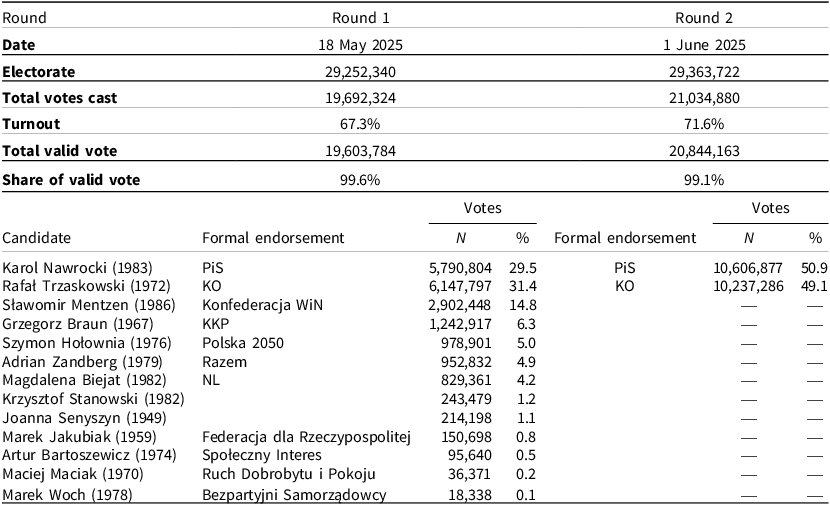
The first round, held on 18 May, saw a turnout of 67.31% – the highest ever recorded in the first round of a Polish presidential election, surpassing the previous record of 64.70% set in 1995 (Państwowa Komisja Wyborcza 2025a). Trzaskowski narrowly led with 31.4% of the vote, followed by Nawrocki with 29.5%. Sławomir Mentzen of Confederation Liberty and Independence (Konfederacja Wolność i Niepodległość) won 14.8%, and Grzegorz Braun, representing the Confederation of the Polish Crown (Konfederacja Korony Polskiej [KKP]) – a far-right vehicle expelled from Confederation in early 2025 – took 6.3%. Szymon Hołownia of the centrist Poland 2050 (Polska 2050, Pl2050) received 5%, Adrian Zandberg of the social-democratic Together (Razem) 4.9%, and Magdalena Biejat of the centre-left New Left (Nowa Lewica [NL]) 4.2%. The remaining six candidates each received less than 1.5% (Table 1).
The fact that the combined right-wing vote substantially exceeded that of the liberal-progressive camp set the tone for the second round. Mentzen’s first-round share made him the pivotal figure of the run-off, and both finalists spent much of the second-round campaign courting his electorate, although neither ultimately received Mentzen’s endorsement. The second round, held on 1 June, produced a still higher turnout of 71.63%. Nawrocki won with 50.89% of the vote to Trzaskowski’s 49.11% (Państwowa Komisja Wyborcza 2025b), and was sworn in on 6 August 2025.
The socio-demographic profiles of the candidates’ electorates ran along familiar lines. A late poll conducted by IPSOS showed Nawrocki winning among men (54.3%), rural voters (63.4%), and those with vocational or lower education (68–73%), while Trzaskowski drew majorities among women (54.2%), residents of cities above 500,000 (67.8%), and the university-educated (62.6%) (RMF24 2025). Pre-election survey data also documented a religious cleavage: among voters who reported attending services at least once a week, 68.8% intended to back Nawrocki in the run-off, against just 21.6% among those who rarely or never practise (Stanley and Żerkowska-Balas Reference Stanley and Żerkowska-Balas2025).
If the second-round campaign was driven by uncertainty around the nature of vote transfers, the post-election picture was clear. Own-party loyalty was not the issue: 94.2% of 2023 KO voters backed Trzaskowski, and 93.6% of PiS voters chose Nawrocki. For Trzaskowski, the deficit lay among supporters of the other parties of the ruling coalition. Only 67.6% of those who voted for the centre-right Third Way (Trzecia Droga [TD]) coalition in the 2023 parliamentary election voted for Trzaskowski, as did 74.7% of New Left voters. The rest either defected to Nawrocki (11.7% and 18.9%, respectively) or abstained (15.7% and 6.3%) (Kołczyńska, Cześnik, Sychowiec et al. Reference Kołczyńska, Cześnik, Sychowiec, Szczupska, Żerkowska-Balas and Stanley2025).
In spite of Mentzen’s refusal to endorse a candidate, right-wing voters largely swung behind Nawrocki, with 75.2% of 2023 Confederation voters choosing Nawrocki against only 7.1% for Trzaskowski. Among first-round voters who voted in the run-off, 75% of Mentzen and Braun supporters opted for Nawrocki. Right-wing voters who were unwilling to back Nawrocki tended to stay home rather than cross to Trzaskowski, whereas more of the centrist and left-wing first-round electorates leaked across to Nawrocki instead of abstaining, including 23% of Hołownia voters, 18% of Zandberg voters and 30% of Biejat voters (Stanley Reference Stanley2026). The scale of this cross-bloc leakage was notably larger than centre-left voters had themselves predicted: a pre-election survey fielded in May had Hołownia, Zandberg and Biejat first-round supporters reporting that around 87%, 91% and 92%, respectively, would back Trzaskowski in a run-off (Stanley and Żerkowska-Balas Reference Stanley and Żerkowska-Balas2025).
Cabinet report
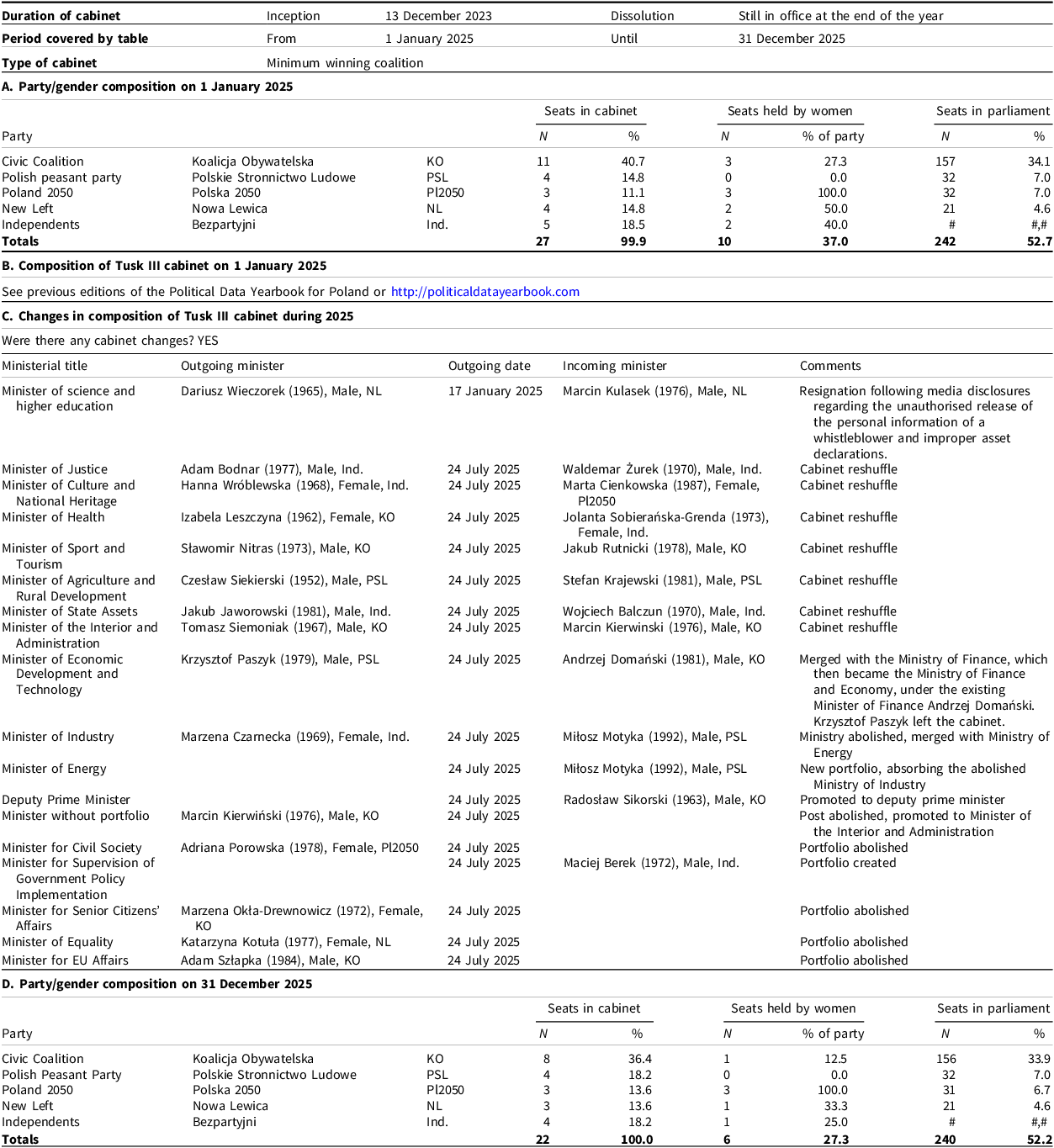
After relative stability during its first year in office, the Tusk III cabinet underwent substantial change in mid-2025 in an attempt to regroup and regain the political initiative (Table 2). Only one change preceded the presidential election: the replacement of Dariusz Wieczorek (New Left) as Minister of Science and Higher Education by his party colleague Marcin Kulasek following a series of controversies, including allegations that he had shared a whistleblower’s personal data with university authorities.
On 11 June 2025, Prime Minister Tusk delivered a policy address in the Sejm and submitted a request for a vote of confidence in his government, which the Sejm approved by 243 votes to 210. The move reaffirmed the coalition’s parliamentary majority and set the stage for a comprehensive reshuffle on 24 July. The Council of Ministers, including the Prime Minister, shrank from 27 members at the start of the year to 22 by its close. Several ministerial portfolios were absorbed within other ministries or eliminated outright: Development and Technology, Civil Society, Equality, Senior Citizens, and EU Affairs. Justice Minister Adam Bodnar, who had faced criticism over the slow pace of judicial reform, was replaced by the more hawkish Waldemar Żurek. Interior Minister Tomasz Siemoniak relinquished the Interior Ministry while retaining the special services coordination portfolio, with Marcin Kierwiński – who had briefly held the interior portfolio in late 2023 before departing for the European Parliament – returning to the role. Foreign Minister Radosław Sikorski was promoted to Deputy Prime Minister while retaining his portfolio.
A striking consequence of the reshuffle was its effect on the gender composition of the government. On 1 January 2025, the Council of Ministers included 10 women among its 27 members – a share of 37.0%, the highest of any permanent Polish government since 1989 (Skiba Reference Skiba2024), albeit with none in the ‘power ministries’ of Finance, Justice, Internal Affairs, Defence, and Foreign Affairs. By 31 December, that share had fallen to 27.3% (6 women among 22 ministers).
Parliament report
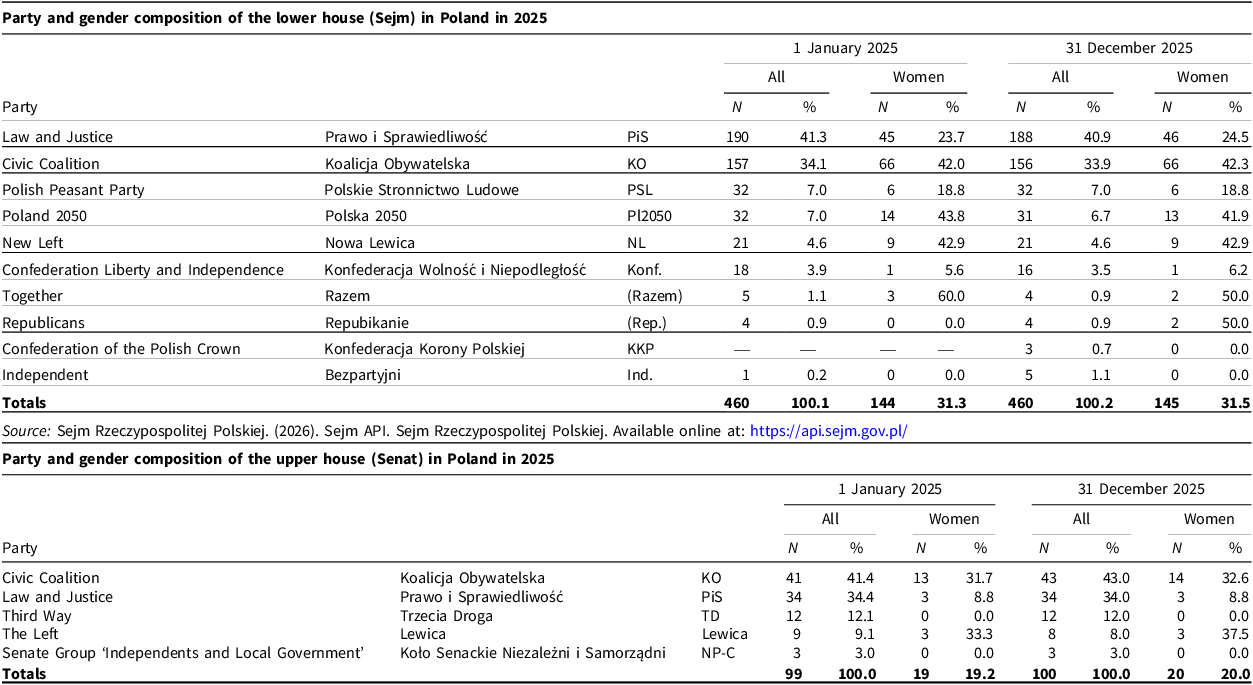
There were few noteworthy changes in the composition of the Sejm during 2025, and none affected the essential government-opposition dynamic (Table 3). The only new group to be established was the Confederation of the Polish Crown (KKP) – expelled from the Konfederacja parent alliance by its internal court in January. In March 2025, two members of parliament originally elected on the Confederation list left the parliamentary club for KKP, and in early June they were joined by a defector from PiS, enabling KKP to register its own parliamentary circle. On the government side, the Third Way alliance of Pl2050 and the Polish Peasant Party (Polskie Stronnictwo Ludowe [PSL]) was dissolved in the aftermath of the presidential elections in June, but this was essentially a formal adjustment to an established reality: both parties had maintained separate parliamentary clubs which had existed since the start of the parliamentary term, and both would remain within the Tusk coalition. The third change came on the left, with Together removing Paulina Matysiak from the party in November following her refusal to coordinate her activities with party structures (OKO.press 2025b). The composition of the Senate remained largely unchanged throughout the year, the only notable adjustment being a by-election held on 16 March 2025 to fill the seat vacated by Bogdan Klich, which was won by Monika Piątkowska (the joint candidate of KO, PSL, and NL) with 50.1% of the vote (Kancelaria Senatu 2025); the new senator took office on 26 March.
Political party report
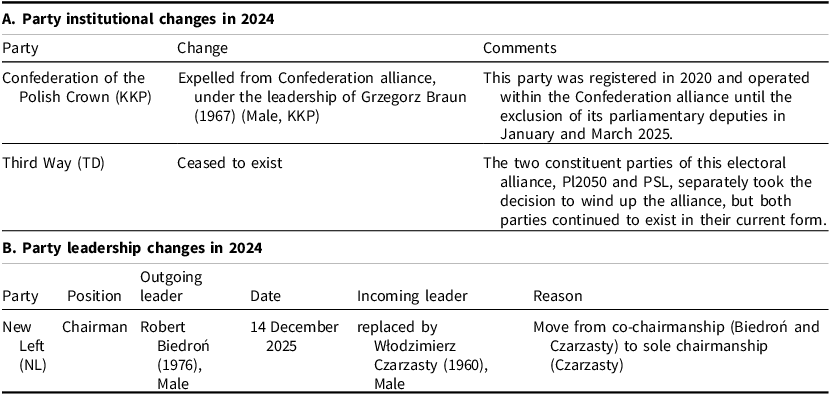
If there were few changes in personnel, the year was marked by significant shifts in the dynamics of the Polish right (Table 4). While Confederation’s expulsion of the KKP faction in January seemed to presage the decline of the non-PiS right, by the end of the year both parties had consolidated themselves at PiS’s expense. Following the presidential election, relations between Confederation and PiS deteriorated sharply, with a suspicious Mentzen rejecting overtures from PiS leader Jarosław Kaczyński for closer cooperation, and distancing his party from PiS’s social policy proposals (Bankier.pl 2025). Meanwhile, rather than benefiting from Nawrocki’s victory, PiS’s polling figures began to fall as voters defected to both wings of Confederation (Michalak Reference Michalak2025), and the party’s internal coherence was tested by the emergence of competing factions.
KO remained stable and, despite the unpopularity of the government, continued to lead in the polls, but its coalition partners experienced instability. The winding up of the Third Way coalition did not affect PSL unduly, but Pl2050’s cohesion was undermined by leader Szymon Hołownia’s poor showing in the election and his mercurial leadership style. The Left also experienced fragmentation. After months of uncertainty about the party’s leadership, NL’s co-leadership structure ended in December when Sejm speaker Włodzimierz Czarzasty was elected leader. Together, having exited the parliamentary caucus of the Left in 2024, fielded Adrian Zandberg as its own presidential candidate, while Magdalena Biejat, who had left Razem to remain in the Left – ran as the New Left candidate. The combined left-wing vote in the presidential first round was split across multiple candidates, and the fissure between the governing NL and the opposition Together continued to grow.
Elections for President in Poland in 2025

Table 1. Long description
The table presents the election results for President in Poland in 2025, detailing the votes cast in two rounds. It includes columns for candidate names, their formal endorsements, and the number and percentage of votes received in each round. The table has 14 rows and 6 columns. Row 1: Round, Round 1, Round 2. Row 2: Date, 18 May 2025, 1 June 2025. Row 3: Electorate, 29,252,340, 29,363,722. Row 4: Total votes cast, 19,692,324, 21,034,880. Row 5: Turnout, 67.3 percent, 71.6 percent. Row 6: Total valid vote, 19,603,784, 20,844,163. Row 7: Share of valid vote, 99.6 percent, 99.1 percent. Row 8: Karol Nawrocki (1983), PiS, 5,790,804, 29.5 percent, PiS, 10,606,877, 50.9 percent. Row 9: Rafal Trzaskowski (1972), KO, 6,147,797, 31.4 percent, KO, 10,237,286, 49.1 percent. Row 10: Slawomir Mentzen (1986), Konfederacja WiN, 2,902,448, 14.8 percent. Row 11: Grzegorz Braun (1967), KKP, 1,242,917, 6.3 percent. Row 12: Szymon Hołownia (1976), Polska 2050, 978,901, 5.0 percent. Row 13: Adrian Zandberg (1979), Razem, 952,832, 4.9 percent. Row 14: Magdalena Biejat (1982), NL, 829,361, 4.2 percent. Row 15: Krzysztof Stanowski (1982), 243,479, 1.2 percent. Row 16: Joanna Senyszyn (1949), 214,198, 1.1 percent. Row 17: Marek Jakubiak (1959), Federacja dla Rzeczypospolitej, 150,698, 0.8 percent. Row 18: Artur Bartoszewicz (1974), Społeczny Interes, 95,640, 0.5 percent. Row 19: Maciej Maciak (1970), Ruch Dobrobytu i Pokoju, 36,371, 0.2 percent. Row 20: Marek Woch (1978), Bezpartyjni Samorządowcy, 18,338, 0.1 percent.
Source: Państwowa Komisja Wyborcza. (2025a). Wybory Prezydenta Rzeczypospolitej Polskiej w 2025 r. —Wyniki głosowania w pierwszej turze. Available online at: https://prezydent2025.pkw.gov.pl/prezydent2025/pl/wynik/pl
Państwowa Komisja Wyborcza. (2025b). Wybory Prezydenta Rzeczypospolitej Polskiej w 2025 r. —Wyniki ponownego głosowania. Available online at: https://prezydent2025.pkw.gov.pl/prezydent2025/pl/2/wynik/pl
Cabinet composition of Tusk in Poland

Table 2. Long description
The table presents the composition of Tusk’s cabinet in Poland, detailing party and gender distribution. It includes data on the inception and dissolution of the cabinet, seats in cabinet, seats held by women, and seats in parliament. The table is divided into sections: A. Party/gender composition on 1 January 2025, B. Composition of Tusk III cabinet on 1 January 2025, C. Changes in composition of Tusk III cabinet during 2025, and D. Party/gender composition on 31 December 2025. Each section provides specific details about the cabinet’s structure and changes throughout the year.
Source: Kancelaria Prezesa Rady Ministrów. (2025). Skład Rady Ministrów. Kancelaria Prezesa Rady Ministrów. Available online at: https://web.archive.org/web/20251218031941/ https://www.gov.pl/web/premier/sklad-rady-ministrow
Parliamentary Report, significant changes

Table 3. Long description
The table presents the party and gender composition of the lower house (Sejm) and the upper house (Senat) in Poland for the year 2025. It includes data for 1 January 2025 and 31 December 2025. The lower house data is organized by party, showing the total number of members and the percentage of women for each party. The parties listed are Law and Justice, Civic Coalition, Polish Peasant Party, Poland 2050, New Left, Confederation Liberty and Independence, Together, Republicans, Confederation of the Polish Crown, and Independents. The upper house data similarly lists the parties and the total number of members and the percentage of women for each party. The parties listed are Civic Coalition, Law and Justice, Third Way, The Left, and Senate Group ‘Independents and Local Government’. The table also includes totals for both houses. The source of the data is provided as Sejm Rzeczypospolitej Polskiej and Senat Rzeczypospolitej Polskiej.
Notes: In January 2025 there were only 99 senators, as elections had not yet been held to replace Bogdan Klich (KO), who resigned his mandate in November 2024.
Source: Senat Rzeczypospolitej Polskiej. (2026). Senatorowie. Senat Rzeczypospolitej Polskiej. Available online at: https://www.senat.gov.pl/sklad/senatorowie
Changes in political parties in Poland in 2025

Table 4. Long description
A table detailing changes in political parties in Poland in 2024. The table is divided into two sections: Party institutional changes and Party leadership changes. Section A lists two parties: Confederation of the Polish Crown (KKP) and Third Way (TD). For KKP, the change is expulsion from the Confederation alliance under the leadership of Grzegorz Braun, with comments noting the party’s registration in 2020 and exclusion of its parliamentary deputies in January and March 2025. For TD, the change is ceasing to exist, with comments explaining the decision by constituent parties Pl2050 and PSL to wind up the alliance while continuing to exist separately. Section B lists one party: New Left (NL). The change is in the Chairman position, with Robert Biedron replaced by Wlodzimierz Czarzasty on 14 December 2025, moving from co-chairmanship to sole chairmanship.
Source: EURACTIV.pl. (2025, June). Koniec Trzeciej Drogi. Polska 2050 i PSL potwierdzają zakończenie współpracy. EURACTIV.pl. Available online at: https://euractiv.pl/section/demokracja/news/koniec-trzeciej-drogi-polska-2050-i-psl-potwierdzaja-zakonczenie-wspolpracy/
Konfederacja Korony Polskiej. (2025). Historia partii. Konfederacja Korony Polskiej. Available online at: https://konfederacjakoronypolskiej.pl/partia/historia-partii/
Nowa Lewica. (2025, December 14). Kongres krajowy Nowej Lewicy. Włodzimierz Czarzasty—Przewodniczącym. Nowa Lewica. Available online at: https://lewica.org.pl/aktualnosci-kujawsko-pomorskie/12204-kongres-krajowy-nowej-lewicy-wlodzimierz-czarzasty-przewodniczacym
Institutional change report
The governing coalition continued to lack the two-thirds supermajority required for constitutional amendments, and presidential vetoes ensured that attempts to restore independence to key judicial institutions were unsuccessful. The most consequential institutional development of the year took place at Poland’s eastern border. In March 2025, parliament invoked legislation suspending the right to lodge applications for international protection along the border with Belarus. Human rights organisations criticised the measure as incompatible with Poland’s obligations under the Refugee Convention, but it was upheld and renewed, with the government arguing that the inflow at the Belarusian border constituted a hybrid attack rather than ordinary migration (Chrzczonowicz Reference Chrzczonowicz2025).
Issues in national politics
The central political issue of 2025 remained the unresolved conflict over the rule of law. The government’s strategy of waiting for a congenial president to sign the judicial reform bills vetoed by Duda was rendered moot by Nawrocki’s victory. A mere five months after Nawrocki took office, he surpassed the 19 vetoes his predecessor Andrzej Duda had issued across his 10 years in office (Szadkowska Reference Szadkowska2025), raising concerns not only about the rule of law but about a de facto presidential usurpation of the government’s executive function.
A standoff in which different institutions recognised different legal realities persisted throughout the year, with no resolution in sight. The government’s reform bills concerning the National Council of the Judiciary (Krajowa Rada Sądownictwa [KRS]) and the Constitutional Tribunal (Trybunał Konstytucyjny) remained blocked throughout 2025. The government maintained its position that the Constitutional Tribunal had lost its ability to function in accordance with the constitution and continued to refuse to publish its decisions. The KRS continued to operate in its contested form, while Justice Minister Bodnar (until July) and his successor Żurek avoided announcing new judicial appointments to prevent the body from nominating judges whose appointment would thus be irregular. The European Commission’s 2025 Rule of Law Report, published in July, acknowledged the significant efforts made by the government to remedy the damage done to judicial independence under PiS but noted that the persistent institutional conflict between the government and the Constitutional Tribunal militated against substantial progress being made (European Commission 2025).
Among the government’s principal rule-of-law initiatives during the year was the preparation of legislation to separate the offices of Minister of Justice and Prosecutor General. The fusion of these offices was widely held to have facilitated the politicisation of the prosecution service under PiS. A draft law to insulate an independent Prosecutor General from political direction was advanced through 2025 and was explicitly recommended by the Commission’s Rule of Law Report. Yet this legislation had not entered into force by the end of the year, its prospects clouded by the near-certainty of a presidential veto.
A further manifestation of conflict over the legitimacy of state institutions concerned the public financing of PiS. In August 2024, the National Electoral Commission (Państwowa Komisja Wyborcza [PKW]) had rejected the party’s financial report for the 2023 parliamentary election, a decision that would have cut its state subsidy by tens of millions of złoty. PiS appealed to the Supreme Court’s Chamber of Extraordinary Review and Public Affairs – a body itself created under the previous PiS government and staffed by judges appointed through the contested KRS – which in December 2024 overturned the PKW’s decision. The dispute remained unresolved throughout 2025, with the PKW declining to recognise the Chamber as a court within the meaning of the constitution. Accordingly, the Finance Minister withheld payment of the subsidy pending further legal assessment. In September 2025, the Court of Justice of the European Union lent weight to the government’s position, ruling that decisions issued by panels containing improperly appointed judges could not constitute those of a legitimate tribunal under EU law (Notes from Poland 2025).
Poland held the Presidency of the Council of the European Union for the first six months of 2025. The Presidency was organised around seven dimensions of security: external, internal, information, economic, energy, food, and health. Its principal achievements included the negotiation of the €150 billion SAFE defence investment instrument, the recognition of the East Shield (Tarcza Wschód) and Baltic Defence Line as EU-eligible security projects, the extension of sanctions against Russia, agreement on the progressive launch of the Entry-Exit System for monitoring Schengen border crossings, and the adoption of the Cyber Blueprint for joint EU cyber-attack response (Polish Presidency of the Council of the EU 2025).
The 2025 budget allocated defence expenditure equivalent to 4.7% of GDP (PLN 186.6 billion), the highest among Nato member states and an increase of around 17.5% over the previous year (Biliński Reference Biliński2025). The East Shield project – a 700 km line of defence installations along Poland’s border with Russia and Belarus – continued to advance, with completion expected by 2028. Prime Minister Tusk announced an initiative to provide military training to every adult male in Poland, with the goal of expanding the armed forces to 500,000 personnel including reservists, which would make Poland’s land army the largest in Europe.
The failure to liberalise Poland’s near-total abortion ban – one of the most restrictive among EU member states – remained a source of frustration for progressive voters and a point of tension within the ruling coalition. In July 2024, a New Left bill to decriminalise acts associated with abortion was narrowly rejected in the Sejm on 12 July 2024 by 218 votes to 215, with some KO deputies not voting and PSL voting against (Gazeta Prawna 2024). No further progress was made on this issue in 2025, and the issue was notably absent from the presidential campaign, with neither major candidate making it a central theme. In parallel, the question of legal recognition for same-sex partnerships re-entered the legislative agenda. Attempts by the New Left to legislate for establishing civil partnerships, including for same-sex couples, with rights covering inheritance and social security, met with internal opposition from the conservative PSL (OKO.press 2025a). No substantive legislation in any of these areas reached final passage by the end of 2025, and Nawrocki’s anticipated veto presented an obstacle to any such legislation taking effect within the current parliamentary term.
Migration policy converged on a markedly more restrictive line during 2025. The Tusk government extended and intensified the policy framework it had introduced in 2024 in response to the situation at the Belarusian border. In February, parliament passed a law suspending the right to apply for international protection along the entire border with Belarus for 60 days; the suspension was extended in May and remained operative through the second half of the year. The government maintained that the inflow at the Belarusian border, orchestrated by the Lukashenko regime, constituted a hybrid attack rather than ordinary migration, and pledged to seal the border and tighten visa and asylum rules. Critics, including the Helsinki Foundation for Human Rights and the Council of Europe Commissioner for Human Rights, argued that the suspension contravened Poland’s international obligations, but the government’s stance enjoyed wide public support. On the EU pact for migration and asylum, the Tusk government insisted that Poland would not accept relocated migrants, citing the country’s role in hosting Ukrainian refugees and its security exposure on the Belarusian border. The European Commission’s solidarity pool proposal, presented in November and adopted in December, included Poland among the member states whose quotas for migrant relocation were fully or partially removed, a development the Tusk government claimed as a diplomatic success.
The presidential election that defined 2025 has bequeathed to 2026 an even sharper version of the institutional gridlock that has shaped Polish politics since the Tusk government took office. Prospects for judicial reform, abortion liberalisation, and civil partnerships look bleak before the next parliamentary election in 2027. Inside the ruling coalition, the dissolution of the Third Way electoral alliance, the sharp fall in the share of women in the post-July cabinet, and the impending departure of Hołownia from front-line politics marked a narrowing of the Tusk government’s original coalitional and demographic breadth, while on the right, Confederation’s continued rise and the bitterness of the Kaczyński–Mentzen feud pointed to a more fragmented opposition than the ruling coalition had been preparing to face. Whether Tusk can convert his government’s institutional resilience into political momentum, or whether the structural advantages secured in 2023 continue to dissipate against the resistance of the new presidency, will be the question that shapes Polish politics in the year ahead.
Data availability statement
The data for this article can be found at the PDY Interactive website: http://politicaldatayearbook.com.
Competing interests
The author declares none.

 Open access

