INTRODUCTION
The Sparidae family consists of 106 species worldwide, with a peak of diversity in the North-east Atlantic and the Mediterranean, where 24 species have been described. The striped seabream (Lithognathus mormyrus Linnaeus, 1758) is a commercially valuable sparid that is caught frequently in the Gulf of Gabes (southern coast of Tunisia). This species is widespread in the Eastern Atlantic from the Bay of Biscay off France to the Cape of Good Hope in South Africa (Bauchot & Hureau, Reference Bauchot, Hureau, Whitehead, Bauchot, Hureau, Nielsen and Tortonese1986). It is a very common species throughout the Mediterranean Sea, Black Sea and Azov Sea. It also occurs in the Red Sea and in the South Western Indian Ocean (Bauchot & Hureau, Reference Bauchot, Hureau, Whitehead, Bauchot, Hureau, Nielsen and Tortonese1986). It inhabits littoral waters over various types of bottoms (rocky, sand or sandy-muddy bottoms) from the surf zone to a maximum depth of 150 m, entering some estuaries and coastal lagoons (Bauchot & Hureau, Reference Bauchot, Hureau, Whitehead, Bauchot, Hureau, Nielsen and Tortonese1986; Pajuelo et al., Reference Pajuelo, Lorenzo, Mendez, Coca and Ramos2002; Ribeiro et al., Reference Ribeiro, Bentes, Coelho, Gonçalves, Lino and Erzini2006). Lithognathus mormyrus and other seabreams (Sparidae) are important members of the continental shelf demersal fish community (Bradai, Reference Bradai2000) and consequently of the fisheries of the Gulf of Gabes. This species has a reasonably high commercial and recreational value, with commercial landings reaching 544 tonnes in 2011, representing about 11% of total landings of sparid species from the southern Tunisian coasts (DGPA, 2011). Along the coast of the Gulf of Gabes, striped seabream is caught by a multi-gear fishing in many fisheries, mainly with trammel nets and gill nets. These two types of fishing gears accounted for ~67 and 33%, respectively, of the total catch by weight of striped seabream in the region, representing ~86% of total catch of this species from the continental shelf of Tunisia (DGPA, 2011).
Studying feeding habits of marine fish, such as predator–prey relationships is useful in order to assess the role of marine fish in the ecosystem (Bachok et al., Reference Bachok, Mansor and Noordin2004). Data on diet composition are also useful for developing trophic models as a tool of understanding the complexity of coastal ecosystems (Lopèz-Peralta & Arcila, Reference Lopèz-Peralta and Arcila2002; Stergiou & Karpouzi, Reference Stergiou and Karpouzi2002). Diet analysis is also necessary for exploring the trophic overlap within and between species and determining the intensity of the inter- and intraspecific interactions in marine fish communities (Morte et al., Reference Morte, Redon and Sanz-Brau2001).
The diet of Lithognathus mormyrus has been investigated in the Mediterranean Sea (Suau, Reference Suau1970; Badalamenti et al., Reference Badalamenti, D'Anna, Fazio, Gristina and Lipari1992; Chessa et al., Reference Chessa, Lanera, Pais, Plastina, Scardi, Serra, Valiente and Vinci2005; Harchouche et al., Reference Harchouche, Maurin and Quéro2005; Kallianiotis et al., Reference Kallianiotis, Torre and Argyra2005) and in the Adriatic Sea (Froglia, Reference Froglia1977; Fabi et al., Reference Fabi, Manoukian and Spagnolo2006; Šantić et al., Reference Šantić, Paladin and Elez2010). In Tunisian waters, data on feeding behaviour of the species are scarce and have only been investigated by Bradai et al. (Reference Bradai, Jarboui, Ghorbel, Bouaïn and El Abed1998b).
The objectives of this study were to: (1) quantify the diet composition, (2) examine potential diet differences by predator size, sex and season and (3) qualitatively assess feeding strategy. This study will strengthen our knowledge on the feeding biology of L. mormyrus in Tunisia and in the Mediterranean Sea.
MATERIALS AND METHODS
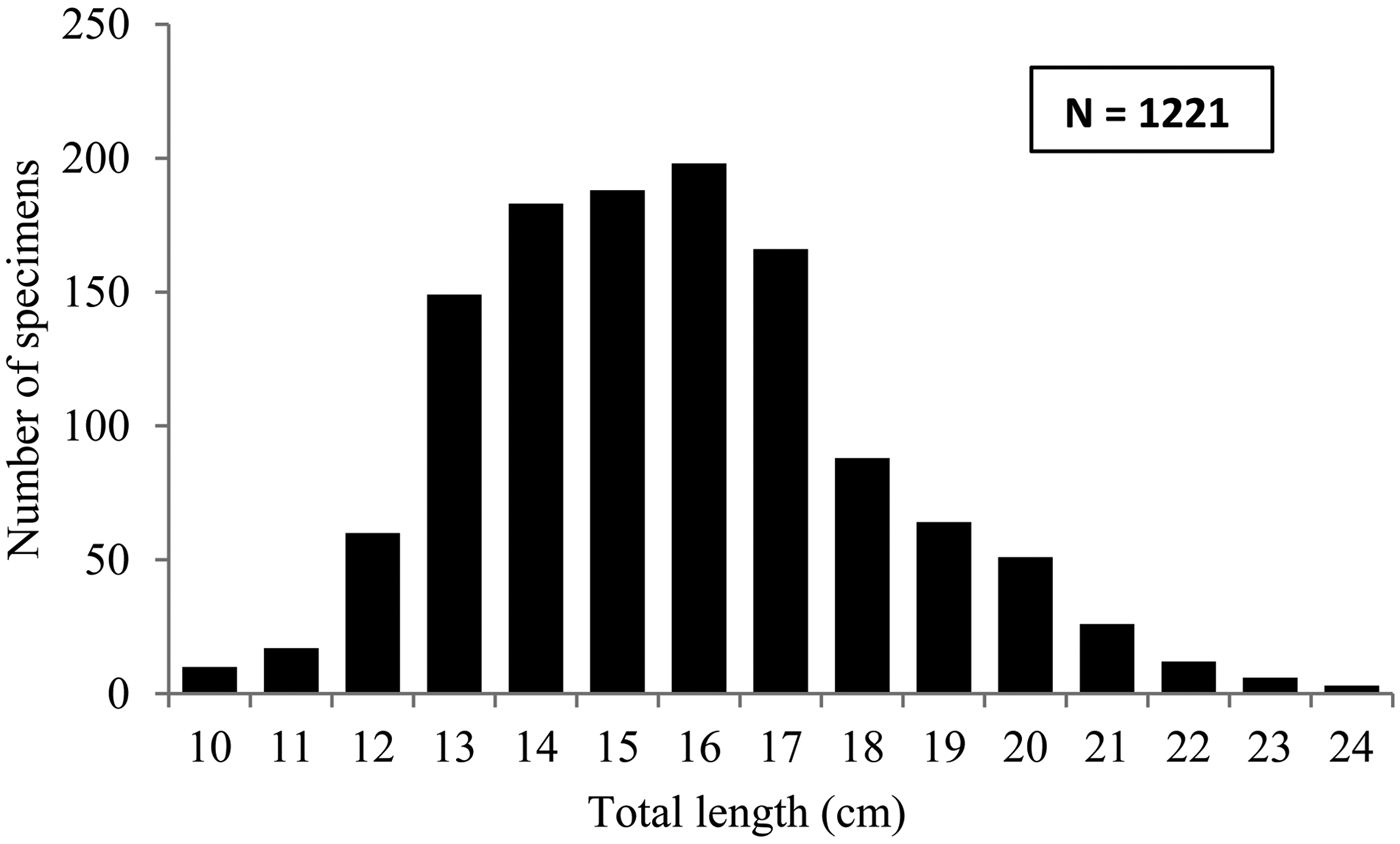
In the Gulf of Gabes, from the parallel 35°N to the Tunisian–Libyan border (33°10N), Lithognathus mormyrus is caught by different types of artisanal fishing gears (mostly gill nets and trammel nets) and also by trawl. A total of 1221 specimens were collected throughout the year from 2005 to 2007. These specimens range in size from 9.7 to 24.1 cm total length (L T; Figure 1) and from 11.2 to 158.1 g in total weight. In the laboratory the total length of each fish was measured to the nearest 0.1 cm and weighed to the nearest 0.1 g. Specimens were then dissected, the number of empty stomachs recorded and prey identified to the lowest possible taxonomic level using Riedel (Reference Riedel1963) and Fischer et al. (Reference Fischer, Bauchot and Schneider1987a, Reference Fischer, Bauchot and Schneiderb). In order to perform a qualitative and quantitative description of the diet, the following indices were used:
-
Percentage frequency of occurrence (%F): number of stomachs in which a food item was found, expressed as a percentage of the total number of full stomachs.
-
Percentage numerical abundance (%N): number of each prey item expressed as a percentage of the total number of food items in all stomachs.
-
Percentage gravimetric composition (%W): total weight of each prey item, expressed as a percentage of the total weight of stomach contents.
-
Index of relative importance (IRI) (Pinkas et al., Reference Pinkas, Oliphant and Iverson1971) as modified by Hacunda (Reference Hacunda1981), to estimate the contribution of prey items in the fish diet:
 $${\rm IRI} = {\rm \%} F \times {\rm (\%} N + {\rm \%} W{\rm )}$$

Length-frequency distribution of Lithognathus mormyrus specimens caught in the Gulf of Gabes (N = 1221); juveniles (L T ≤ 13.0 cm, N = 236), transitional or subadults (13.0 < L T ≤ 16.0 cm, N = 569) and adults (L T > 16.0 cm, N = 416).

The index was expressed in percentage as follows:
 $${\rm \% IRI} = \displaystyle{{{\rm IRI}} \over {\sum {{\rm IRI}}}} \times {\rm 100}{\rm.} $$
In order to evaluate periods of feeding activity, the index of vacuity (I V) was calculated as follows: number of empty stomachs divided by total number of stomachs multiplied by 100.
Prey species were sorted in decreasing order according to IRI. The cumulative %IRI was calculated from the main food categories and compared among different groups according to sex, size and season. To assess for possible changes in diet with respect to size, fish were divided into three size-classes: juvenile (L T ≤ 13.0 cm, N = 236), transitional or subadult (13.0 < L T ≤ 16.0 cm, N = 569) and adult (L T > 16.0 cm, N = 416).
Statistical differences (P < 0.05) in the diet composition with respect to size, season and sex were assessed by a χ2 test (Sokal & Rohlf, Reference Sokal and Rohlf1981) of the frequencies of a given prey. The variation of vacuity index was also tested by χ2 test over a contingency table of the number of empty stomachs.
The effect of size and season on the mean number (Nm ST−1) of prey items and mean weight per stomach (Wm ST−1) were tested by analysis of variance (ANOVA). Tukey's test was employed to locate the source of significant differences (Zar, Reference Zar1984).
Proportional food overlap between seasons was calculated using Schoener's (Reference Schoener1971) dietary overlap index: C xy = 1 − 0.5 ∑ |P xi − P yi |, where P xi and P yi are the proportions of prey I (based on %IRI) found in the diet of groups x and y. This index ranges from 0 (no prey overlap) to 1 (all food items in equal proportions), and values ≥0.6 are usually considered to indicate significant overlap (Wallace, Reference Wallace1981).
The trophic level (TROPH) was estimated as follows (Pauly et al., Reference Pauly, Froese, Sa-a, Palomares, Christensen and Rius2000):
 $${\rm TROPH} = 1 + \mathop \sum \limits_{\,j = 1}^G D{C_{ij}} \times {\rm TROP}{{\rm H}_j}$$
where TROPH j is the fractional trophic level of prey (j), DC ij is the fraction of j in the diet of i and G is the total number of prey species. Trophic levels express the positions of organisms within the food webs that define a large part of aquatic ecosystems (Stergiou & Polunin, Reference Stergiou and Polunin2000). The determination of different prey trophic levels was based on Froese & Pauly (Reference Froese and Pauly2000), Stergiou & Karpouzi (Reference Stergiou and Karpouzi2002) and on Fishbase.
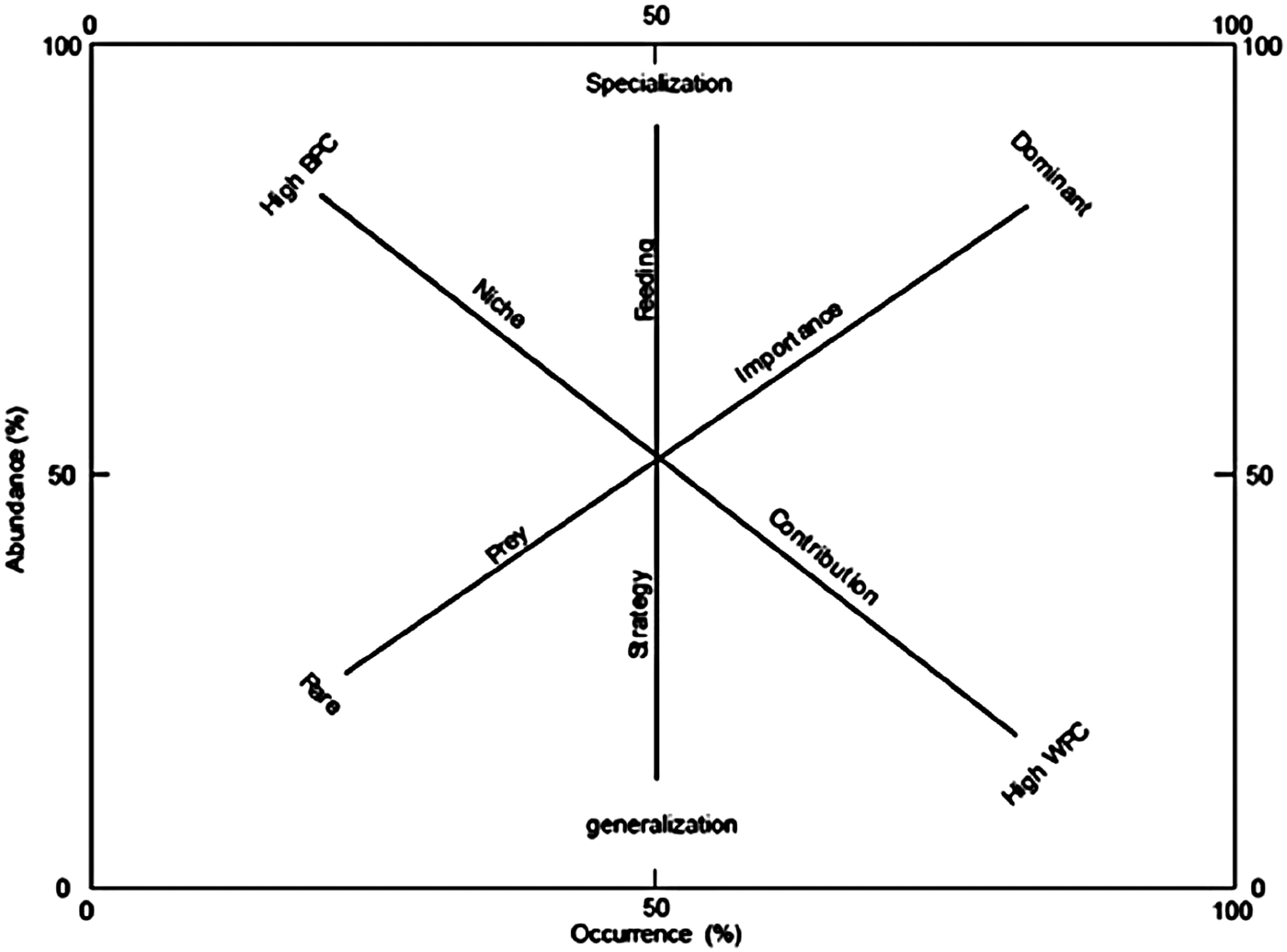
Relative importance of prey items, for interpretation of the feeding strategy, was constructed graphically using a variation of the Costello method (Costello, Reference Costello1990) proposed by Amundsen et al. (Reference Amundsen, Gabler and Staldvik1996). This analysis is based on a graphical representation (Figure 2), making it possible to explore ingested food types, data in relation to feeding strategies, as well as intra- and inter-individual shifts in niche utilization.
Schematic representation of species feeding strategies proposed by Costello (Reference Costello1990) and modified by Amundsen et al. (Reference Amundsen, Gabler and Staldvik1996). The first diagonal represents abundance increase along with prey importance. The vertical axis represents predator strategy going from generalist to specialist. The second diagonal axis represents resource use changing from BPC (between phenotype component, among individuals of population) to WPC (within phenotype component – tending towards the same resource use).

RESULTS
Feeding intensity and trophic level
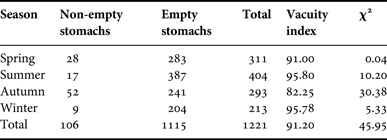
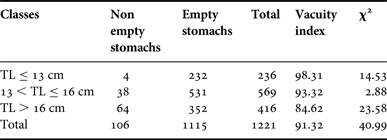
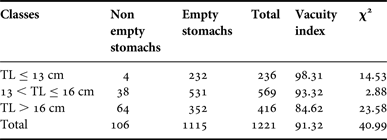
Of the 1221 stomachs examined, 1115 were empty (I V = 91.3%). This percentage varied significantly by season (χ2 = 45.95, P < 0.05), with a maximum of 95.79% during the summer and a minimum of 82.25% during the autumn (Table 1). The I V analysis shows a low significant difference between the sexes (χ2 = 4.63, P < 0.05), whilst a high significant difference among size-classes (χ2 = 40.99, P < 0.05) (Table 2).
Variation in the Index of Vacuity (I V) of Lithognathus mormyrus by season.

Variation in Index of Vacuity (I V) of Lithognathus mormyrus by size classes.
The calculation of trophic level gave an average of 3.63 ± 0.59 for the whole population of L. mormyrus in the Gulf of Gabes. According to the classification of Stergiou & Karpouzi (Reference Stergiou and Karpouzi2002), the species is an omnivore with a preference for animal material (2.9 < TROPH < 3.7). This level was 3.66 for females and 3.58 for males, and increased from 3.59 for the smallest size class to 3.7 for the largest size.
The TROPH of this species varies significantly among season. According to Stergiou & Karpouzi (Reference Stergiou and Karpouzi2002), the species seems to be omnivore with a preference for animal material during autumn (TROPH = 3.57 ± 0.57) and spring (TROPH = 3.6 ± 0.52), and carnivore with a preference for large decapods, cephalopods and fish (3.7 < TROPH < 4.5) during winter (TROPH = 3.79 ± 0.6) and summer (TROPH = 4.06 ± 0.7).
Diet composition
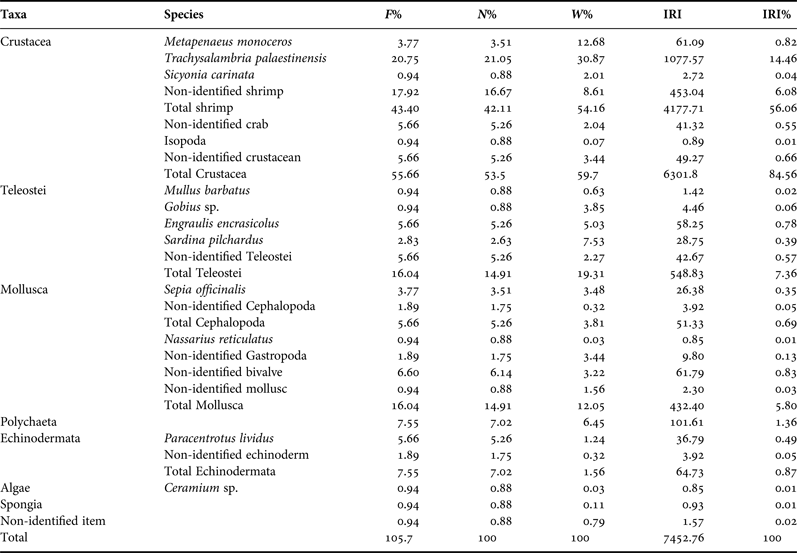
The stomach contents of the striped seabream consisted of eight major systematic groups: Red algae (Rhodophytes), sponges, echinoderms (Echinoids), crustaceans (Decapoda Macroura, Brachyura, Isopoda), annelids, molluscs (Cephalopoda and Gastropoda) and teleosts (Gobiidae, Engraulidae, Clupeidae) (Table 3). Crustaceans were the main prey, constituting 84.6% of the total IRI. Among these crustaceans, shrimps (particularly Trachysalambria palaestinensis) were the most important prey (%IRI = 56.1). Teleosts and molluscs were consumed as secondary prey (%IRI = 7.4 and 5.8 respectively). The other food items were of minor importance.
Diet composition of Lithognathus mormyrus in the Gulf of Gabes.

F, frequency of occurrence; N, numerical composition; W, biomass composition; IRI, Index of Relative Importance.
There were no dietary differences between sexes (χ2 = 0.779, P > 0.05).
Diet composition in relation to fish size
Crustaceans were the most important prey in the diet of all size-classes (94.9, 88.8 and 75.2% IRI in juveniles, subadults and adults, respectively), but their importance is reduced when fish mature. For subadults, annelids (%IRI = 5.4) and molluscs (%IRI = 4.6) were relatively important; while teleosts (%IRI = 15.2) and molluscs (%IRI = 6.9) were frequent in the diet of larger fishes. Molluscs, teleosts and annelids are only part of the food spectrum of individuals greater than 13 cm total length. A χ2 test revealed no significant differences in the diet among size-classes in any prey category (χ2 = 11.352, P < 0.05) (Figure 3A).
Diet composition of Lithognathus mormyrus among sex (A), size classes (B) and season (C) based on percentage index of relative importance (IRI) values of major prey groups in the Gulf of Gabes.

A nearly full dietary overlap was observed between juveniles, subadults and adults (0.99–1). The mean number of prey items (ANOVA, F = 2.27; P > 0.05) and the mean mass per stomach (ANOVA, F = 1.68; P > 0.05) were not significantly different between seasons (Figure 4).
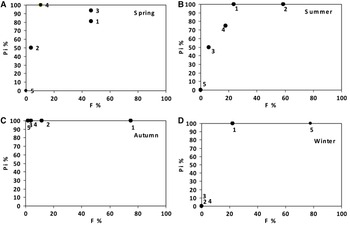
Feeding strategy plots for Lithognathus mormyrus in (A) Spring, (B) Summer, (C) Autumn and (D) Winter. Prey types are numbered as follows: 1. Crustaceans; 2. Teleosts; 3. Molluscs; 5. Annelids; 5. Echinoderms.

Diet composition in relation to season
Analysis of the stomach contents of L. mormyrus in the Gulf of Gabes evidenced significant differences in the diet composition of this species among seasons (χ2 = 112.716, P < 0.01).
Crustaceans were present in the stomachs throughout the year, with a peak recorded in autumn (%IRI = 97). However, in winter, the ingested proportion of crustaceans decreases considerably (IRI% = 6) and constitutes a secondary food item. Teleosts, molluscs and annelids were not consumed by striped seabream during winter; the species seems to prefer other items (sponges, echinoderms and algae) with 94% of total IRI (Figure 3B).
During spring, striped seabream feeds mainly on molluscs (%IRI = 51.5%) and crustaceans (%IRI = 51.5%). Annelids are secondary item prey, while teleosts are ingested occasionally. The diet of L. mormyrus during summer was dominated by teleosts (%IRI = 81); crustaceans (%IRI = 14.1%) and annelids (%IRI = 4.4) are secondary prey.
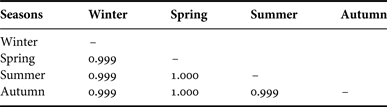
The mean weight (Wm ST−1) of prey items did not vary significantly throughout the year (ANOVA, F = 2.18, P > 0.05). The mean number (Nm ST−1) of prey items showed a tendency to increase from winter (1 prey) to summer season (1.06 prey), but not significantly (ANOVA, F = 0.74, P > 0.05). Schoener's index (0.99) indicates high degree of diet overlap between all seasons (Table 4).
Seasonal proportional food overlap coefficients (Schoener's index) of the diet of Lithognathus mormyrus.

Feeding strategy
The feeding strategy plots (Figure 4) revealed that L. mormyrus ate predominantly crustaceans. We regarded this species as specializing in this food item during all seasons. These plots also position prey types which indicate some individual specialization in some periods, e.g. molluscs, in spring; teleosts in summer, annelids in autumn and echinoderms in winter. The variability in resource breadth between individuals was high (high variation between phenotypes).
DISCUSSION
Dietary studies of Lithognathus mormyrus in the Gulf of Gabes, show a high proportion of empty stomachs. This is consistent with results of Bradai et al. (Reference Bradai, Jarboui, Ghorbel, Bouaïn and El Abed1998b) who estimated annual I V to be 94.1% in the same area. Fabi et al. (Reference Fabi, Manoukian and Spagnolo2006) and Harchouche et al. (Reference Harchouche, Maurin and Quéro2005) reported a high I V for L. mormyrus in the northern Adriatic (I V = 68.5%) and in the Bay of Algiers and Annaba (I V = 62.8% for juveniles and 64.3% for adults), respectively, while Šantić et al. (Reference Šantić, Paladin and Elez2010) found a very low I V value (17.7%) for striped seabream from eastern central Adriatic Sea. However, the proportion of empty stomachs is often variable in commercial Sparid catches.
The high %I V may also be related to the fact that captures occurred at night, which is when the fish are most active as they are generally feeding. The individuals caught were hauled on board the following morning, so some of them may have remained in the net for several hours, and their capture may have occurred after the digestion of prey. As a result, many specimens had an empty stomach at the time they were collected.
In view of the lack of evidence of stomach reversion at capture, the high percentage of empty stomachs observed in the present study may reflect short periods of feeding followed by periods of rapid digestion. Feeding intensity is negatively related to the percentage of empty stomachs (Bowman & Bowman, Reference Bowman and Bowman1980). In our study, vacuity index (%I V) values were increased in April–June which coincided with a gonad maturation period of L. mormyrus in the Gulf of Gabes (Bradai, Reference Bradai2000). Feeding intensity decreased during the winter and summer months, as can be deduced from the high number of empty stomachs (>90%). Different factors may cause a decrease in feeding activity in fish (Nikolsky, Reference Nikolsky1976). This can be explained either by the unavailability of the prey or by the temperature-dependent physiological process. According to Wassef & Eisawy (Reference Wassef and Eisawy1985), temperature has a strong effect on the feeding activity of the seabream. In fact, Tyler (Reference Tyler1971) reported that many demersal fishes show a decrease in the feeding rate as temperature drops. Surface temperatures of sea water measured in the Gulf of Gabes from July to October 2010 varied from 15.3 to 28.6 °C (Hajji, Reference Hajji2012).
However, the relatively greater feeding intensity of the species coincided with the autumn season, which may reflect the fact that the fish requires more energy to palliate the deficit due to the spawning event. Otherwise, I V of L. mormyrus of the Gulf of Gabes varies according to size. I V values decrease with fish age. In fact, juvenile fishes require much more energy for growth.
The present study revealed that the diet of L. mormyrus was diverse, and consisted mainly of crustaceans (%F = 55.66), teleosts (%F = 16.04) and molluscs (%F = 16.04), although the occurrence of annelids and echinoderms were also relatively important (%F = 7.55 each). Other prey groups, i.e. sponges and Red algae, were less important in the diet of striped seabream. In the Gulf of Gabes, Bradai et al. (Reference Bradai, Jarboui, Ghorbel, Bouaïn and El Abed1998b) found that crustaceans were preferential prey, while annelids and molluscs represented secondary food; remaining prey such as teleosts and tunicates were of minor importance and represented an accessory food.
Striped seabream is a carnivorous bottom feeder; juveniles presumably feed on copepods, small polychaetes and amphipods (Froglia, Reference Froglia1977; Jardas, Reference Jardas1985), whereas adults are more generalist feeders (Suau, Reference Suau1970; Froglia, Reference Froglia1977; Badalamenti et al., Reference Badalamenti, D'Anna, Fazio, Gristina and Lipari1992).
According to Fabi et al. (Reference Fabi, Manoukian and Spagnolo2006), striped seabream appeared to be opportunistic, capable of adapting to environmental variations and exploiting the available food resources, although with different strategies. Lithognathus mormyrus focused mainly on decapods and molluscs, turning to other prey only when the preferred ones were scarce.
In the Italian and Hellenic waters, bivalves with polychaetes constituted the main prey items in the diet of this fish (Badalamenti et al., Reference Badalamenti, D'Anna, Fazio, Gristina and Lipari1992; Kallianiotis et al., Reference Kallianiotis, Torre and Argyra2005).
Šantić et al. (Reference Šantić, Paladin and Elez2010) reported that L. mormyrus is an active seeking bottom feeder whose diet in the Adriatic Sea, as well as in Italian and Hellenic waters, consists of diverse benthic groups, with wide range of size and morphology. In the eastern central Adriatic Sea bivalves were the most important prey in all seasons as well as in large specimens, whereas copepods and amphipods constituted the main prey in stomach of smaller individuals. The present data are a step ahead to improve knowledge on the feeding ecology of striped sea bream.
Variation in the prey importance could be related to the presence/availability of different benthic assemblages among regions. In fact, Bradai (Reference Bradai2010) noted that benthic invertebrates (Crustaceans and Molluscs) and fishes constitute the main components of benthic fauna of the Gulf of Gabes.
High seasonal variation in the diet of striped seabream was noticed within the study area. Values of Schoener's index (>0.9) indicated high significant dietary overlap between all seasons.
The striped seabream diet in autumn was dominated by crustaceans, whereas in spring there was an increase in the consumption of the molluscs. The diet of the striped seabream, during summer, consists mainly of teleosts. During winter, sponges, echinoderms and algae were the most important prey of the species.
In Hellenic waters (Thracian Sea), considerable seasonal variation was observed in the diet of striped seabream (Kallianiotis et al., Reference Kallianiotis, Torre and Argyra2005). Bivalves dominated in spring, amphipods in winter, while polychaetes were more frequently preyed upon in other seasons. On the other hand, Šantić et al. (Reference Šantić, Paladin and Elez2010) found low seasonal variation in the diet of this species in the Adriatic Sea. Bivalves dominated the diet composition throughout the year, particularly in winter. Increased decapods consumption was observed during summer. These changes may be correlated to the seasonal variation in food availability (Kallianiotis et al., Reference Kallianiotis, Torre and Argyra2005).
No significant variation in the diet of L. mormyrus among size was observed within the study area. Froglia (Reference Froglia1977) reported that smaller specimens of L. mormyrus from western Adriatic coasts consume more copepods, cumaceans and juveniles of polychaetes, often switching to echinoderms, decapods, bivalves and teleosts as they increase in length. In the Thracian Sea, Kallianiotis et al. (Reference Kallianiotis, Torre and Argyra2005) indicated that while maturing L. mormyrus becomes a more generalist feeder. The food consumption and the dietary overlap revealed significant changes in the diet of striped seabream with its growth in the eastern central Adriatic sea (Šantić et al., Reference Šantić, Paladin and Elez2010), where smaller specimens (<16 cm) mainly feed on amphipods and copepods; as the fish grows up, bivalves and decapods increase in importance.
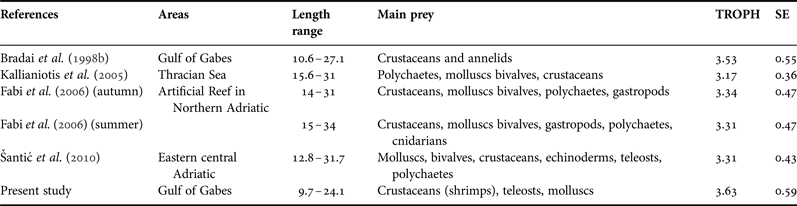
According to the classification of fishes in functional groups based on their TROPH (Stergiou & Karpouzi, Reference Stergiou and Karpouzi2002), L. mormyrus was found to be considered as an omnivorous species with a preference for animal material. In addition, we compared its TROPH in other areas of its distribution based on published diet composition data (Table 5).
Feeding habits of Lithognathus mormyrus in different areas. Length range (in total length) of specimens (in cm); TROPH: trophic level; SE: standard error of TROPH.

In our study based on the Amundsen's method, the striped seabream has a specialist feeding strategy. Crustaceans were the main diet of L. mormyrus, during all seasons. A dietary analysis is key to the assessment of feeding strategy (Amundsen et al., Reference Amundsen, Gabler and Staldvik1996) and the breadth of a predator's diet (i.e. niche width; Schoener, Reference Schoener1971), which ultimately identify the functional role of a predator in an ecosystem.
Data on feeding of striped seabream from other areas indicate that the diet of the species includes a wide range of prey. Many of the authors (Rosecchi, Reference Rosecchi1987; Rosecchi & Nouaze, Reference Rosecchi and Nouaze1987; Kara et al., Reference Kara, Derbal and Chaoui1997; Caragitsou & Papaconstantinou, Reference Caragitsou and Papaconstantinou1998; Pita et al., Reference Pita, Gamito and Erzini2002; Pallaoro et al., Reference Pallaoro, Šantić and Jardas2003) have observed generally analogous feeding habits in other species of Sparidae. Similar indications were also made by authors working on sparid species off the coasts of Tunisia (Ghorbel & Bouaïn, Reference Ghorbel and Bouaïn1991; Bradai et al., Reference Bradai, Ghorbel, Jarboui and Bouaïn1998a, Bradai, Reference Bradai2000; Chemmam-Abdelkader, Reference Chemmam-Abdelkader2004; Hadj Taieb et al., Reference Hadj Taieb, Derbali, Ghorbel, Ben Hadj Hamida and Jarboui2013; Chaouch et al., Reference Chaouch, Ben Abdallah-Ben Hadj Hamida, Ghorbel and Jarboui2014).
In conclusion, L. mormyrus is an active seeking bottom feeder whose diet in the Gulf of Gabes, as well as in the Adriatic Sea and in Italian and Hellenic waters, consists of diverse benthic groups, with a wide range of size and morphology. It is mainly a specialist feeding strategy species with a preference for animal prey. In the Tunisian south-eastern waters, crustaceans were the most important prey of all size classes, particularly in autumn and spring, whereas molluscs and teleosts constituted the main prey in the stomach contents during spring and summer.
Feeding mechanisms that lead to specialization or generalization in the diet are not yet properly defined. This question is broad and has so far barely been addressed. Furthermore, morphological and physiological specialization can also influence fish feeding behaviour and must be considered. Further research will be focused on feeding ecology of L. mormyrus in order to better understand inter- and intra-specific interactions in the study area and elucidate the impact of climate changes on these interactions.