





Introduction
The NHS constitution commits the health service to providing a ‘comprehensive service, available to all‘ (Department of Health and Social Care, 2021) and to paying particular attention to groups with health inequalities. Despite this principle, inclusion health populations, accepted widely as people experiencing homelessness, vulnerable migrants, people or individuals engaged in sex work, Gypsy, Roma and Traveller communities, and people leaving prison, continue to face the poorest health outcomes and greatest barriers to accessing care (UK Health Security Agency, 2025). Despite this principle, inclusion health populations continue to experience some of the poorest health outcomes and greatest barriers to accessing care. Addressing these inequalities requires a healthcare workforce equipped to recognize and respond to the needs of socially excluded populations, creating an important responsibility for undergraduate medical education. These disparities are most apparent within primary care settings where unmet need, fragmented care, and system-level exclusion result in poorer health outcomes (NHS England, 2023a; Lau, Reference Lau2024).
The NHS Fit for the Future 10-Year Plan outlines reforms centred on prevention, community care, digital transformation, and workforce flexibility (Department of Health and Social Care, 2025). While framed as opportunities to redesign services and training to incorporate innovation, sustainability, and workforce flexibility, these reforms risk entrenching inequalities if the needs of systemically excluded populations are overlooked. Ensuring that the future primary care workforce is equipped to provide culturally safe person-centred care, which highlights institutional bias and the need for services to be judged safe by user groups (Ramsden, Reference Ramsden2002), is a key component of service redesign. Cultural safety shifts the focus from gaining specific competencies towards recognizing systemic power imbalances, ensuring respect for lived experiences and supporting patients and communities to define whether care feels safe and respectful. These principles align closely with inclusion health priorities. Despite this principle, inclusion health populations continue to experience some of the poorest health outcomes and greatest barriers to accessing care. Addressing these inequalities requires a healthcare workforce equipped to recognize and respond to the needs of socially excluded populations, creating an important responsibility for undergraduate medical education. This is particularly relevant to newer medical schools established after 2010. Many of these schools were explicitly commissioned to address primary care workforce shortages in their local area, including Anglia Ruskin School of Medicine.
A recent national study by Ahluwalia et al., (Reference Ahluwalia, Greenfields, Coker and Church2024) reported that while many UK medical schools include some inclusion health content, teaching remains inconsistent across curricula and is rarely assessed. Reported barriers included overcrowded timetables, limited educator expertise, and uncertainty around appropriate assessment strategies. Community stakeholders were unequivocal in their expectations: students must graduate equipped not only with theoretical understanding of the social determinants of health, but also with the practical skills to deliver accessible, culturally competent care. The report highlights that it is not sufficient for students merely to understand inequality conceptually; rather, they must develop the skills and confidence to engage with inclusion health communities in practice (Ahluwalia et al., Reference Ahluwalia, Greenfields, Coker and Church2024: 14–16). Systematic and scoping reviews show persistent barriers to primary care access for people experiencing homelessness and identify outreach and integrated services as promising approaches although robust evaluation remains limited (McNeill et al., Reference McNeill, O’Donovan and Hart2022; Kopanitsa et al., Reference Kopanitsa, McWilliams, Leung, Schischa, Sarela, Perelmuter, Sheeran, d’Algue, Tan and Rosenthal2023).
Although a growing body of literature has described the importance of inclusion health teaching, there remains relatively little published guidance on how medical schools can operationalize these principles within existing curricula. Sharing local curriculum development experiences may therefore help inform implementation efforts across institutions facing similar educational and service pressures.
Newly established medical schools may be well positioned to embed inclusion health teaching, develop partnerships with underserved communities and align curricula with contemporary public health priorities (Ahluwalia et al., Reference Ahluwalia, Greenfields, Coker and Church2024). Meanwhile, the General Medical Council (GMC) released the updated Medical Licensing Assessment (MLA) content map formalizing the knowledge, skills, and behaviours required of medical students graduating in the UK (General Medical Council, 2025). While the map acknowledges the social determinants of health through domains such as social and population health and themes including delivering person-centred care and safeguarding vulnerable patients, explicit reference to inclusion health remains limited.
Recent policy developments further strengthen the case for inclusion health education. The NHS Fit for the Future 10-Year Plan emphasizes prevention, community-based care, and reducing health inequalities, while the ongoing review of the Carr-Hill funding formula reflects growing recognition that deprivation and complexity are not adequately represented within current primary care resource allocation models (Department of Health and Social Care, 2025). Together with the GMC’s emphasis on population health, safeguarding, and person-centred care, these developments reinforce the need for graduates who can work effectively with marginalized and socially excluded populations.
Within this context, Anglia Ruskin University (ARU) School of Medicine undertook a curriculum development workshop with educator stakeholders to inform the integration of inclusion health within the undergraduate medical curriculum. This paper describes the workshop process and the resulting curriculum priorities, practical recommendations, and implementation considerations identified by educators working across primary care, secondary care, community services, and medical education.
Methods
The workshop was conducted during the ARU School of Medicine Annual Educator Day in May 2025. Attendance was open to all educators participating in the event, and all attendees were invited to contribute. As the workshop was undertaken as an educational development activity to inform curriculum design and planning, rather than as a formal research study, attendance was open to all educators participating in the Annual Educator Day, and no inclusion or exclusion criteria were applied.
Seventeen educator stakeholders contributed to the workshop (N = 17). Participants represented a range of educational and clinical roles, including General Practitioner (GP) educators (n = 4), curriculum leads (n = 6), placement supervisors (n = 4), secondary-care clinicians (n = 5), and representatives from third-sector organizations (n = 2). As some participants held multiple educational roles, the sum of role categories exceeds the total number of participants. No personal demographic characteristics, such as age, gender, educational experience, or highest qualification, were collected, as these data were not required for the workshop’s curriculum development objectives.
Workshop activities and documentation
Four simultaneous small groups of 4–5 participants and 1 facilitator used verbal prompts covering:
-
1. populations affected by healthcare exclusion,
-
2. barriers to access and engagement in primary care,
-
3. challenges to student involvement in inclusion health settings, and
-
4. opportunities for curriculum development and educational reform.
Discussion prompts were developed by the curriculum development team to structure discussion while allowing educators to identify additional issues relevant to curriculum design and implementation.
Internal facilitator notes from each small-group discussion were written contemporaneously during the workshop and expanded immediately afterwards to include contextual detail and illustrative examples. The workshop lasted approximately 90 minutes and included both small-group discussions and a plenary feedback session. The workshop record comprised 13 pages of facilitator notes capturing barriers, examples of practice, and proposed curriculum strategies across the four discussion areas. Sessions were not audio recorded.
Structured review of workshop outputs for curriculum planning
Workshop outputs were reviewed using a structured thematic synthesis approach informed by the principles described by Braun and Clarke (Reference Braun and Clarke2006). The review was undertaken to identify recurring issues, curriculum priorities, and practical implementation considerations arising from workshop discussions. The analytic process combined inductive thematic analysis, in which themes were generated directly from the data, with deductive organization, whereby these emergent themes were mapped onto pre-agreed curriculum domains including placement design, assessment, and partnership development. A member of the curriculum development team conducted an initial inductive review to identify recurring issues and emerging priorities. The preliminary themes were reviewed by a second member of the curriculum development team, with differences in interpretation resolved through discussion to improve consistency and support curriculum planning. This iterative process organized educator contributions into coherent themes that informed agreed curriculum priorities and practical strategies for implementation. The analysis was guided by pragmatic and developmental considerations, particularly those relevant to curriculum planning, placement design, and assessment, while remaining open to unanticipated but significant insights. All activities were conducted within the scope of educational development and research capacity-building, in line with institutional governance procedures. A verbal summary of emerging priorities was shared with attendees at the end of the workshop to confirm resonance. This educational intervention involved educator stakeholders only; inclusion of people with lived experience and student representatives is planned for subsequent co-design and evaluation phases following integration and implementation of inclusion health within the undergraduate medical curriculum.
Results
The educator workshop generated a set of practice-informed priorities to inform the development of inclusion health teaching, assessment, and placement activity within the undergraduate curriculum. Discussions highlighted current challenges, identified opportunities for enhancement, and informed a series of recommendations for curriculum planning. This collaborative process resulted in a series of agreed priorities and practical recommendations for embedding inclusion health across learning activities, including placement design strategies, assessment approaches, and partnership development with community and third-sector organizations.
Workshop discussions identified five priority areas for curriculum development:
-
• Populations experiencing systematic exclusion
-
• Barriers to access and engagement
-
• Fragmented educational exposure
-
• Institutional and logistical constraints
-
• Priorities for curriculum reform
Together, these themes highlight the need for a more coherent, equitable, and practice-aligned approach to inclusion health education.
Educators identified a wide range of populations affected by healthcare exclusion, including people with severe mental illness, Gypsy, Roma and Traveller communities, trans and non-binary individuals, those working in sex industries, women living in refuges, refugees, asylum seekers, undocumented migrants, care leavers, and individuals involved in the criminal justice system. Educators highlighted the importance of ensuring these groups were visibly represented within teaching cases, placements, simulation activities and assessment materials. These populations were recognized not only for their poorer health outcomes but also for the intersecting structural and interpersonal barriers that limit meaningful access to care. Educators emphasized the importance of locally responsive services to support such populations that are timely, accessible, and equitable.
Barriers to engaging such populations in primary care settings included worry about exacerbating patients’ fear of stigma and mistrust, alongside communication challenges related to language barriers, low health literacy, and cultural differences. Distrust of institutions, often rooted in previous lived experience or historical harm, was seen as a significant obstacle to engagement, with concerns expressed that the presence of students might further inhibit trust in some settings. Structural factors such as unstable housing, lack of transport, and digital exclusion not only compound patients’ difficulties in accessing care but also limit opportunities for student learning. This could be due to reducing attendance at appointments, reducing continuity with patients in placements, or making report supervision inappropriate. Educators also highlighted clinician time pressure and limited training in culturally safe care as constraints on the quality of interactions with marginalized patients. Suggested approaches to addressing these challenges included engagement with faith and cultural leaders to enhance both community trust and educators’ knowledge and co-designed involvement of lived-experience partners in service and curriculum design to rebuild trust.
From an educational perspective, engagement with inclusion health was consistently described as incidental rather than intentional. Student exposure to inclusion health populations was reported as limited, sporadic, and unstructured. When encounters did occur, students were often underprepared both emotionally and practically, with educators highlighting a lack of structured preparation and debriefing. Perceived patient discomfort with student presence, student anxiety and uncertainty, and the dominance of assessment-driven learning were all identified as factors that discouraged engagement with non-traditional or equity-focused learning environments. Non-traditional or equity-focused learning environments in medical education refer to educational settings that extend beyond conventional classroom or hospital-based models, incorporating community-based, virtual, interprofessional, or simulation contexts. These environments are intentionally designed to promote inclusivity and social accountability by exposing learners to diverse populations, addressing health disparities, and integrating principles of cultural and structural competence.
Institutional and logistical barriers further restricted student involvement in inclusion health settings. These included limited placement capacity, safety and safeguarding concerns, regulatory and indemnity considerations, and ambiguity around supervision and accountability. Such constraints were viewed as disproportionately affecting inclusion health placements compared with more traditional clinical settings, reinforcing their marginal position within undergraduate curricula.
As a priority for curriculum and placement development, educators recommended a range of practical interventions to support student engagement within inclusion health settings. These included clear student identification, structured placement guidance, patient information resources co-designed with lived-experience partners, and administrative processes to facilitate supervision and access. Such interventions were considered achievable within existing placement structures and were viewed as likely to improve communication, support informed consent, enhance student preparedness, and promote safe, meaningful engagement with inclusion health populations. Educators recommended that these initiatives be developed in partnership with people with lived experience, piloted locally, and refined through ongoing evaluation and stakeholder feedback.
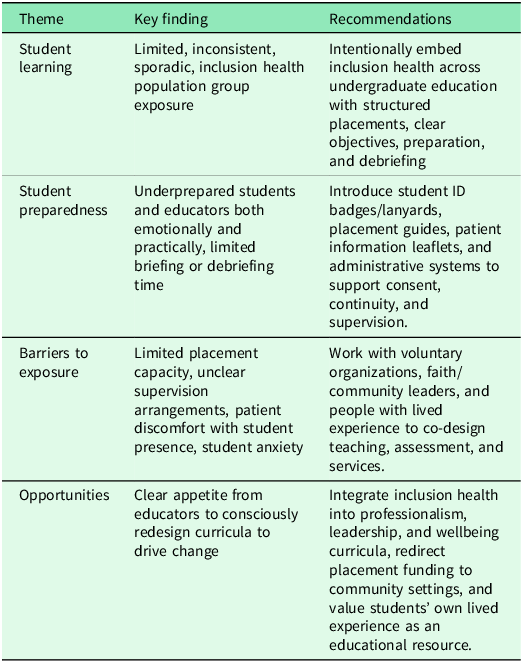
Despite these challenges, educators expressed a clear commitment to strengthening inclusion health within undergraduate medical education. Proposed curriculum development strategies included reallocating placement funding to inclusion health services, establishing formal partnerships with third-sector organizations and expert patients, and embedding inclusion health across professionalism, leadership, and wellbeing curricula. Educators also emphasized the value of recognizing students’ own lived experience as a legitimate educational resource. Practical measures, such as the introduction of clear identification tools to support student integration into inclusion health placements, were viewed as feasible steps to reduce uncertainty for both learners and patients. A summary table of key findings and recommendations is shown in Table 1.
Key findings and recommendations

Table 1. Long description
A table with four rows and three columns. The columns are labeled Theme, Key finding, and Recommendations. The table summarizes key findings and recommendations for inclusion health in undergraduate medical education. Row 1: Theme, Student learning; Key finding, Limited, inconsistent, sporadic, inclusion health population group exposure; Recommendations, Intentionally embed inclusion health across undergraduate education with structured placements, clear objectives, preparation, and debriefing. Row 2: Theme, Student preparedness; Key finding, Underprepared students and educators both emotionally and practically, limited briefing or debriefing time; Recommendations, Introduce student ID badges/lanyards, placement guides, patient information leaflets, and administrative systems to support consent, continuity, and supervision. Row 3: Theme, Barriers to exposure; Key finding, Limited placement capacity, unclear supervision arrangements, patient discomfort with student presence, student anxiety; Recommendations, Work with voluntary organizations, faith/community leaders, and people with lived experience to co-design teaching, assessment, and services. Row 4: Theme, Opportunities; Key finding, Clear appetite from educators to consciously redesign curricula to drive change; Recommendations, Integrate inclusion health into professionalism, leadership, and wellbeing curricula, redirect placement funding to community settings, and value students’ own lived experience as an educational resource.
Overall, this educational intervention highlighted that inclusion health must be understood as a foundational lens for curriculum design rather than as an optional or peripheral topic. Educators emphasized that meaningful reform requires both structural change and cultural shift, positioning equity, trust-building, and cultural safety as essential competencies for future primary care clinicians. Collectively, these priorities informed subsequent curriculum planning within the School of Medicine, including further integration of inclusion health within teaching, assessment, placement development, and partnership working.
Discussion
Interpretation of key findings
This development work reinforces a consistent message within medical education: inclusion health remains peripheral within many undergraduate curricula despite its clear relevance to primary care practice and the needs of socially excluded populations. Educator discussions during this workshop echoed concerns reported elsewhere in the literature, highlighting that student engagement with inclusion health is often sporadic, unstructured, and constrained by institutional, regulatory, and curricular factors. Similar challenges have been identified nationally and internationally, including limited curricular visibility, inconsistent learning opportunities, and structural barriers that restrict meaningful engagement with inclusion health. Taken together, these observations emphasize that equity-focused education requires intentional curriculum design, longitudinal integration, and institutional commitment rather than reliance on incidental exposure or the enthusiasm of individual educators (Bochatay et al., Reference Bochatay, Bajwa and van Schaik2021).
The barriers identified through this curriculum development activity align closely with existing national and international literature. Previous work has shown that inclusion health teaching within undergraduate medical education is often fragmented, inconsistently delivered, and rarely assessed, contributing to a gap between conceptual awareness and practical competence (Abel and McManus, Reference Abel and McManus2021; Wurie and Patel, Reference Wurie and Patel2021; Ahluwalia et al., Reference Ahluwalia, Greenfields, Coker and Church2024; Ogunyemi et al., Reference Ogunyemi, Thind, Teixeira, Sams, Ojo, Dinkins and Serseni2024). Educators contributing to this workshop echoed these concerns, highlighting how structural constraints, including limited placement availability, regulatory anxieties, and assessment-driven curricula, shape the learning opportunities available to students. Educators also highlighted that patient-level factors may further restrict learning opportunities, particularly where individuals from marginalized groups are reluctant to engage with students because of previous negative or stigmatizing experiences of healthcare. This observation is consistent with wider evidence, including recent work by Ahluwalia et al., (Reference Ahluwalia, Greenfields, Coker and Church2024), which highlights how mistrust and prior experiences of judgement can limit meaningful interaction with healthcare providers. Taken together, these educator-identified priorities reinforce arguments that inequity in healthcare is sustained not only through service-level exclusion but also through educational systems that inadequately prepare graduates for effective and compassionate work with marginalized populations.
Comparison with previous literature
International literature supports the educational value of meaningful engagement with socially excluded communities when learning is appropriately designed, supported, and contextualized (Abel and McManus, Reference Abel and McManus2021; Ogunyemi et al., Reference Ogunyemi, Thind, Teixeira, Sams, Ojo, Dinkins and Serseni2024; Ashwell et al., Reference Ashwell, Russell, Williamson and Pope2025). Such engagement has been shown to foster empathy, cultural competence, and preparedness for diverse clinical practice. However, this evidence also cautions against tokenistic or poorly supported exposure, which risks reinforcing stigma or placing undue emotional burden on learners. Educators contributing to this curriculum development activity highlighted similar concerns, particularly the absence of structured preparation and debriefing for students encountering inclusion health populations. This reinforces the need to view inclusion health learning as a curriculum responsibility rather than an informal by-product of clinical placements.
We recommend adopting an intersectionality lens (Crenshaw, Reference Crenshaw1989) to deepen curriculum reasoning. This will recognize how overlapping identities, such as race, ethnicity, migration status, and disability, produce distinct patterns of marginalization, mistrust, and access. This framing will help prioritize placements, learning outcomes, and assessments that reflect real-world complexity rather than treating inclusion health groups as homogeneous.
Strategic and regulatory alignment
Educational frameworks provide practical guidance for addressing these challenges. Universal Design for Learning emphasizes the importance of longitudinal integration, inclusive assessment, and responsiveness to learner diversity, principles directly applicable to inclusion health education (Luke, Reference Luke2021). Similarly, literature on diversity, equity, and inclusion curricula highlights that content alone is insufficient to effect meaningful change; institutional culture, role modelling, and assessment practices play a critical role in shaping professional identity and behaviour (Verbree et al., Reference Verbree, Isik, Janssen and Dilaver2023; Henry et al., Reference Henry, Rollin and Olakunle2024). These principles were reflected in educators’ priorities, particularly the emphasis on embedding inclusion health across professionalism, leadership, and wellbeing curricula rather than confining it to isolated teaching sessions.
The current policy context creates a timely opportunity to operationalize these educational principles. The ongoing review of the Carr-Hill formula acknowledges that current primary care funding models inadequately reflect deprivation and workload in marginalized communities (Department of Health and Social Care, 2025). If funding is recalibrated to better support practices serving inclusion health populations, this may enable the development of sustainable community-based placements that align educational goals with service delivery realities. At the same time, the GMC’s updated MLA content map formally embeds population health, safeguarding, and person-centred care as core outcomes for all graduates (General Medical Council, 2025). While explicit reference to inclusion health remains limited, the MLA provides curriculum leverage to integrate equity-focused competencies within mandatory teaching and assessment rather than optional content.
Aligning undergraduate curricula with both the MLA and national workforce strategies supports constructive alignment between learning outcomes, educational activities, and assessment (Biggs, Reference Biggs1996; Harden, Reference Harden2001). The NHS 10-Year Plan and Workforce Plan emphasize the need for a flexible, community-oriented workforce capable of delivering preventative and inclusive care (NHS England, 2023b). Preparing graduates to work effectively with socially excluded populations is therefore not an optional enhancement, but a workforce imperative. Curriculum development that embeds inclusion health longitudinally and assesses related competencies directly responds to these national priorities.
Educational intervention strategy at ARU
Curriculum updates have already begun within the ARU School of Medicine, with inclusion health competencies embedded across modules in reproductive and sexual health, child and family health, and psychiatry, ahead of wider curriculum roll-out. These developments include teaching on safeguarding, cultural safety, trauma-informed care, the health needs of women in prison, women living in refuges, asylum seekers, and gambling-related harm, alongside consideration of barriers to healthcare access experienced by socially excluded populations. Physical health inequalities among people with serious mental illness have also been incorporated, with an emphasis on early identification of risk factors and proactive intervention.
To support experiential learning in inclusion health, ARU is also developing innovative approaches including immersive three-dimensional patient interactions that allow students to engage with complex social and clinical scenarios within a safe and structured learning environment. Co-designed with people with lived experience and third-sector clinicians, these scenarios will reflect the complexity of real-world inclusion health contexts, including homelessness, migration, and trauma, to support the development of culturally safe communication, trauma-informed practice, systems-level thinking, and reflective skills. The learning activities will incorporate structured pre-briefing, standardized consent procedures, and facilitated debriefing to support learner wellbeing and minimize emotional burden. Accessibility features, including desktop access, captioning, and non-virtual-reality alternatives, have been incorporated to maximize inclusivity.
As part of ongoing curriculum development, we plan to undertake a curriculum audit to evaluate the extent and distribution of inclusion health content across the programme. Subsequent research and evaluation activities involving multiple stakeholder groups will explore the impact of these curriculum innovations on student learning, preparedness, and educational experience.
Strengths and weaknesses
A key strength of this development work lies in the structured dialogue between educators working across primary care, secondary care, community services, and academic medicine. This breadth of professional perspectives enhanced the relevance of the identified challenges and proposed solutions across educational and service contexts. However, several limitations should be acknowledged. The workshop was a single institutional event involving a limited number of participants; workshop outputs were captured through facilitator notes that were intended to support curriculum planning rather than generate detailed research data. Future curriculum development and evaluation activities should incorporate student and patient perspectives to broaden stakeholder input and assess the impact of inclusion health teaching on learner preparedness, confidence, and professional behaviours.
Despite these limitations, this work contributes practical, practice-informed guidance at a time when both funding reform and educational reform are underway. Embedding inclusion health within undergraduate medical education requires structural rather than symbolic change. Experiential learning in inclusion health settings must be intentionally designed, supported, and assessed, linking clinical exposure with core themes of professionalism, leadership, and wellbeing. Integration of inclusion health into assessment is particularly critical; without assessment, equity-focused competencies risk remaining marginalized within crowded curricula.
Implications for curriculum developers
This development work highlights several priorities for curriculum developers in undergraduate medical education. Inclusion health should be embedded longitudinally across curricula and explicitly mapped to national frameworks, including the MLA content map (General Medical Council, 2025) and NHS inclusion health priorities (NHS England, 2023a). Community-based placements serving inclusion health populations require formal partnerships, clear learning outcomes, and structured student preparation and debriefing to ensure safe, meaningful engagement. Inclusion health competencies should be assessed within existing professionalism, leadership, and wellbeing domains to signal their core importance and to support constructive alignment. Curriculum design should also recognize and value both educator and student lived experience as legitimate resources for learning, supporting culturally safe and reflective practice.
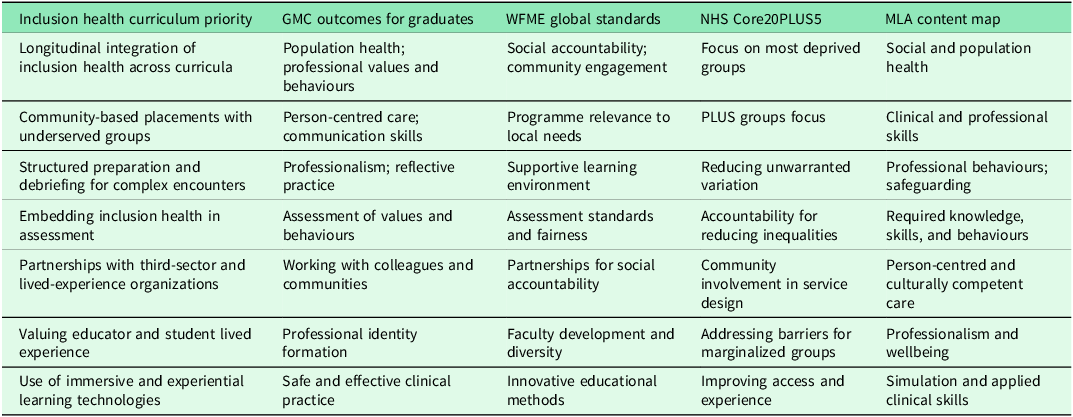
To support curriculum developers and other higher education institutions (HEIs) in operationalizing these principles, Table 2 maps key inclusion health curriculum priorities to major national and international frameworks.
Alignment of inclusion health curriculum priorities with key educational and policy frameworks

Table 2. Long description
A table with seven rows and five columns comparing inclusion health curriculum priorities with key educational and policy frameworks. The columns are labeled ‘Inclusion health curriculum priority’, ‘GMC outcomes for graduates’, ‘WFME global standards’, ‘NHS Core20PLUS5’, and ‘MLA content map’. The rows list priorities such as ‘Longitudinal integration of inclusion health across curricula’, ‘Community-based placements with underserved groups’, ‘Structured preparation and debriefing for complex encounters’, ‘Embedding inclusion health in assessment’, ‘Partnerships with third-sector and lived-experience organizations’, ‘Valuing educator and student lived experience’, and ‘Use of immersive and experiential learning technologies’. Each row details how these priorities align with the respective frameworks, focusing on aspects like population health, social accountability, and professional values.
Beyond ARU, medical schools and primary care educators can adopt similar strategies by integrating equity-focused competencies across all years of undergraduate training rather than confining them to isolated modules. Leveraging immersive technologies for experiential learning, prioritizing the early identification of health risks in marginalized populations, and embedding inclusion health within assessment frameworks are practical steps that can normalize equity-focused education. Newly established and long-standing medical schools alike have a strategic opportunity to embed equity-focused competencies and prepare graduates for the realities of contemporary primary care practice.
Importantly, these implications extend beyond a single institution and align closely with key frameworks that guide medical education nationally and internationally. The GMC Outcomes for Graduates (General Medical Council, 2018) emphasize person-centred care, safeguarding, population health, and professional values, all domains that inclusion health teaching directly strengthens. The World Federation for Medical Education (WFME) Global Standards for Quality Improvement highlight social accountability, community engagement, and responsiveness to local health needs, offering a clear rationale for embedding inclusion health within curriculum design (World Federation for Medical Education, 2020). Similarly, the NHS Long Term Workforce Plan and Core20PLUS5 prioritize the development of a workforce capable of addressing health inequalities and delivering culturally competent care in underserved communities (NHS England, 2023a; 2023b). HEIs seeking to demonstrate social accountability, meet widening participation commitments, or align with global equity agendas will find that inclusion health provides a practical, evidence-based route to operationalizing these expectations.
For institutions undergoing curriculum reform, these frameworks offer a shared language and structure through which inclusion health can be embedded systematically rather than added peripherally. For those with established programmes, they provide a mechanism to review existing provision, strengthen assessment alignment, and ensure that equity-focused competencies are recognized as core professional requirements. As such, the approaches outlined in this paper offer a transferable model for HEIs seeking to embed social justice, community responsiveness, and health equity at the heart of undergraduate medical education.
Acknowledgements
The authors would like to thank the educators and stakeholders who contributed to the workshop.
Funding statement
This work received no specific grant from any funding agency, commercial, or not-for-profit sectors.
Competing interests
All authors are employed by or affiliated with ARU School of Medicine. The authors declare no other competing interests.
Ethical standards
Formal ethical approval was not required as all activities were conducted within the scope of educational development, in line with institutional governance procedures. Contributors were informed of the purpose of the workshop and how outputs would be used, and all contributions were anonymized in reporting.

 Open access

