Introduction
“Caninioid” corals are fairly widely distributed in Upper Pennsylvanian–lower Permian rocks all over the world, and a detailed study of these might well yield valuable tools for stratigraphic correlation. A specific feature of “caninioid” corals of different ages and regions involves the homeomorphic similarity of mature growth stages; however, this cannot be considered as sufficient for taxonomy. Serial sectioning of the early evolutionary stages of corallites is required to distinguish among species and, especially, genera of caninioids. The concept of an “amplexoid” or breviseptal ontogenetic stage has been considered as one of the important and basic features. Lewis (Reference Lewis1929) established this type of analysis by intensive serial sectioning of Salée’s (Reference Salée1910) specimens, and diagnosed Caninophyllum without a breviseptal phase in contrast to the traditional Caninia Michelin in Gervais, Reference Michelin1840. His approach was followed by subsequent authors (e.g., Fedorowski, Reference Fedorowski1975; Onoprienko, Reference Onoprienko1980; Flügel, Reference Flügel1993). Later, Kossovaya (Reference Kossovaya1989) used this character at the family level for the Cyathopsidae Dybowski, Reference Dybowski1873, in contrast to the Bothrophyllidae Fomichev, Reference Fomichev1953. The amplexoid stage in caninioids refers to the shortening of the major septa during early or middle ontogeny, in comparison to rather long septa in the primary and occasionally also mature stages. As a comparison with genera included in the Cyathopsidae has shown, a single feature is not sufficient for a proper understanding of the taxonomy and cannot be separated from other features that form the definite mature stage. The combination of all ontogenetic stages, including the typical adult morphology (e.g., length and arrangement of septa and structure of dissepimentarium) is seen as important taxonomic criteria. Comparisons of selected genera related to the new taxon Preisingerella are based on their type species, but refer also to additional species that are well documented by ontogenetic studies.
In Slovenia, caninioid corals (Caninia aff. kokscharowi Stuckenberg, Reference Stuckenberg1895) were mentioned (Schellwien, Reference Schellwien1898a, p. 697; Schellwien, Reference Schellwien1898b, p. 361), but unfortunately they were not described monographically and the present whereabouts of the collection is unknown. Caninella kokscharowi is distributed in the Late Pennsylvanian and early Permian of the Urals and the East European Platform. Numerous well-preserved specimens, collected in the Stegovnik section, allow a detailed description of the ontogenetic evolution of the septal structure. Within the predominately monospecific assemblage, only a single specimen of another rugose coral of the genus Lophophyllidium Grabau, Reference Grabau1928 was recovered.
Materials and methods
A collection of about 100 specimens was recovered in the southern Karavanke Mountains (Southern Alps, Slovenis); most corallites were easily isolated from the sandy limestone matrix. Sixteen specimens were cut into serial transverse sections (between four and 12), about seven were cut into longitudinal sections and processed to thin sections.
Repository and institutional abbreviation
The collection used in this study is kept in the Museum für Naturkunde Berlin, under registration number MB.K.2422.1-n. In 2015, the sedimentary succession (86.8m in total thickness) was logged in detail and sampled for microfacies study. Three horizons with accumulations of fusulinid foraminifera have been sampled for biostratigraphic evaluation. Altogether, 52 thin sections were prepared, 37 of which with oriented fusulinid sections. This material is stored in the M. Novak Collection at the Geological Survey of Slovenia, Ljubljana.
Locality and geological setting
Locality
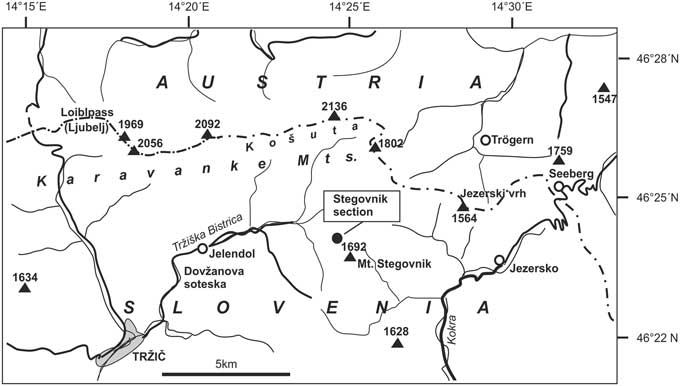
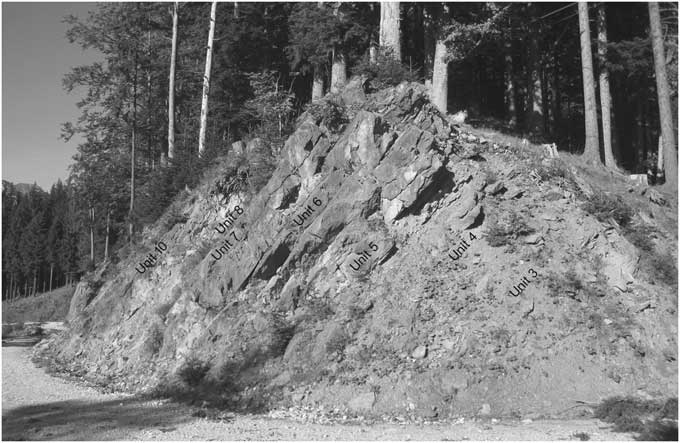
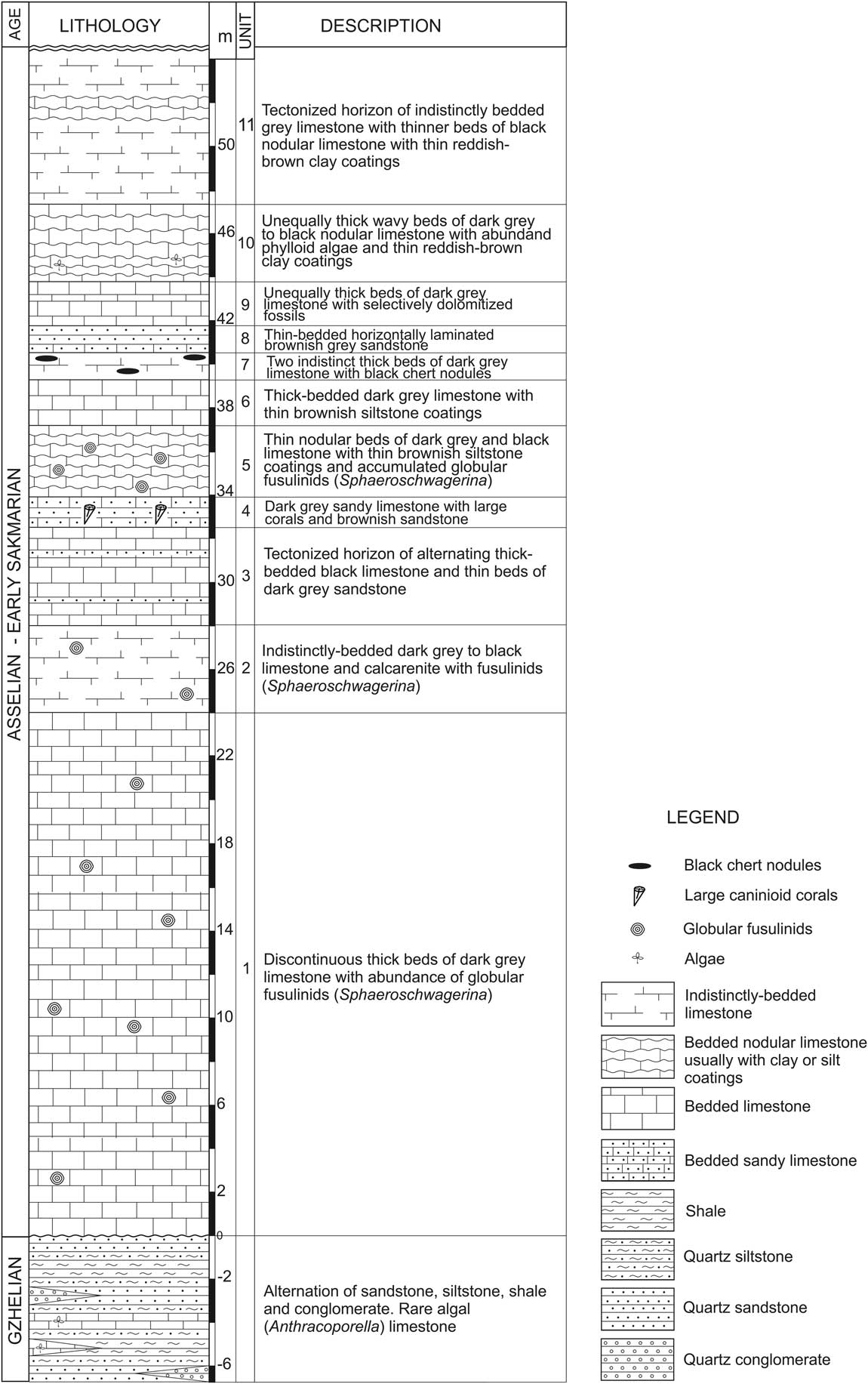
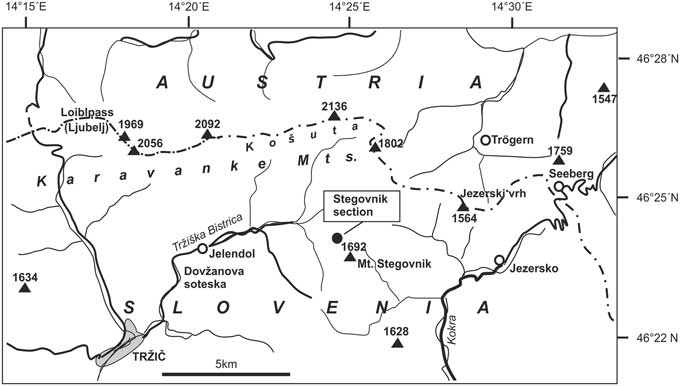
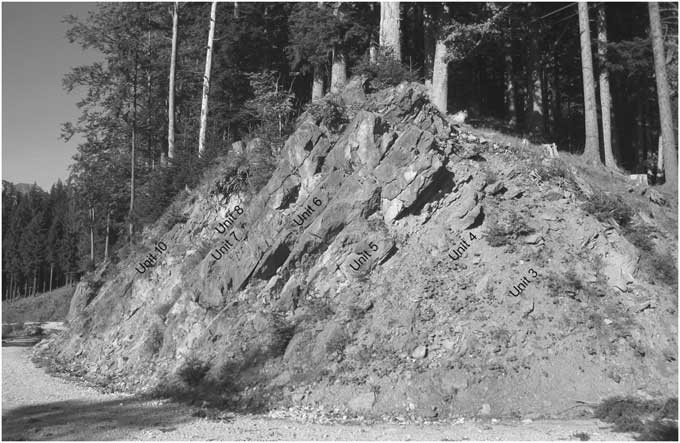
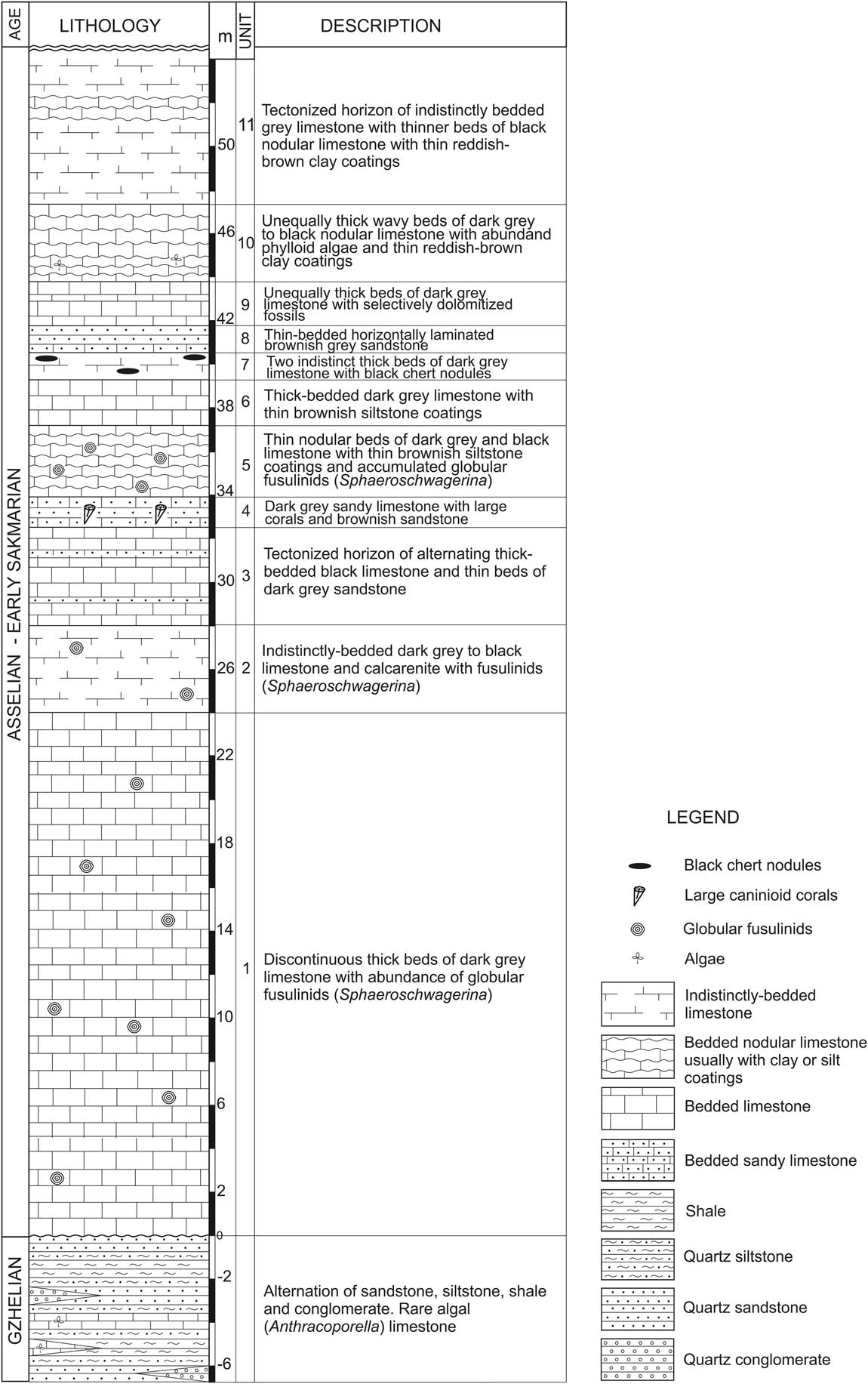
Northwestern slope of Mount Stegovnik (1692 m), east of the village of Jelendol, in the central part of the southern Karavanke Mountains (Southern Alps, Slovenia; Fig. 1). Co-ordinates are 46.399350, 14.413352 (WGS84). A forest road on the mountainside cuts through a long section of steeply inclined beds of limestones alternating with siliciclastic rocks (Figs. 2, 3). The collection comes from a single, approximately 30-cm-thick limestone bed (within Unit 4; Fig. 3), almost entirely composed of large solitary horn corals, chaotically embedded in a brownish-gray silty to sandy calcareous matrix.
Location of the Stegovnik section in the central Karavanke Mts. (Southern Alps, Slovenia).
The middle part of the Stegovnik section on the northwestern slope of Stegovnik Mountain.
Lithostratigraphic log of the Stegovnik section.
Geological setting
The section was studied in detail in January 2015. The total thickness of exposed upper Carboniferous (Gzhelian) and lower Permian beds is 86.8 m. Both the lower contact with the lower Carboniferous Hochwipfel Formation and the upper contact with the middle Permian Val Gardena Formation are tectonic in nature. In the lithostratigraphic log (Fig. 3), only the lower part of the section with abundant fusulinid foraminifera and the layer with corals is shown. The alternation of siliciclastic rocks and algal (Anthracoporella) limestone in the lowermost part is typical of the Auernig Formation of Gzhelian age in the Carnic Alps and Karavanke Mts. (Kochansky-Devidé and Ramovš, Reference Kochansky-Devidé and Ramovš1966; Krainer, Reference Krainer1992; Schönlaub and Forke, Reference Schönlaub and Forke2007). Permian strata rest unconformably, with a tectonic contact, on Gzhelian rocks. In the lower Permian succession, dark-gray to black, bedded limestones with abundant globular fusulinids, easily recognized with a hand lens as Sphaeroschwagerina, predominate. The sedimentological and microfacies characteristics, as well as macro- and microfossil assemblages, document an undoubted correlation with the Born Formation, described from the Dovžan Gorge (Forke, Reference Forke2002; Novak, Reference Novak2007), about seven kilometers to the southwest of the Stegovnik section. The thin nodular limestone beds with siltstone or claystone coatings, numerous fusulinids, large euomphalid gastropods, and siliciclastic horizons are particularly distinctive of the Born Formation (Novak, Reference Novak2007).
Fusulinid assemblage and age
Fusulinid foraminifera have been collected from Units 1 (below the coral-bearing Unit 4), 5, and 7 (the latter two above the coral-bearing Unit 4; Fig. 3). In Unit 1, Sphaeroschwagerina carniolica (Kahler and Kahler, Reference Kahler and Kahler1937) is the most common. It is accompanied by Pseudochusenella pseudopointeli (Rauzer-Chernousova in Shcherbovich, Reference Shcherbovich1969), “Pseudofusulina” sp. and Rugosofusulina sp. In Unit 5, Sphaeroschwagerina carniolica is accompanied by Paraschwagerina mukhamedjarovica Rauzer-Chernousova, Reference Rauzer-Chernousova1949, Paraschwagerina pseudomira Miklukho-Maklay, Reference Miklukho-Maklay1949, and Pseudoschwagerina aff. uddeni (Beede and Kniker, Reference Beede and Kniker1924). In Unit 7, the predominant Darvasites eocontractus Leven and Shcherbovich, Reference Leven and Shcherbovich1980 is accompanied by Rugosofusulina? minuta Forke, Reference Forke2002, Paraschwagerina mukhamedjarovica, Pseudochusenella sp., and Schubertella australis Thompson and Miller, Reference Thompson and Miller1949.
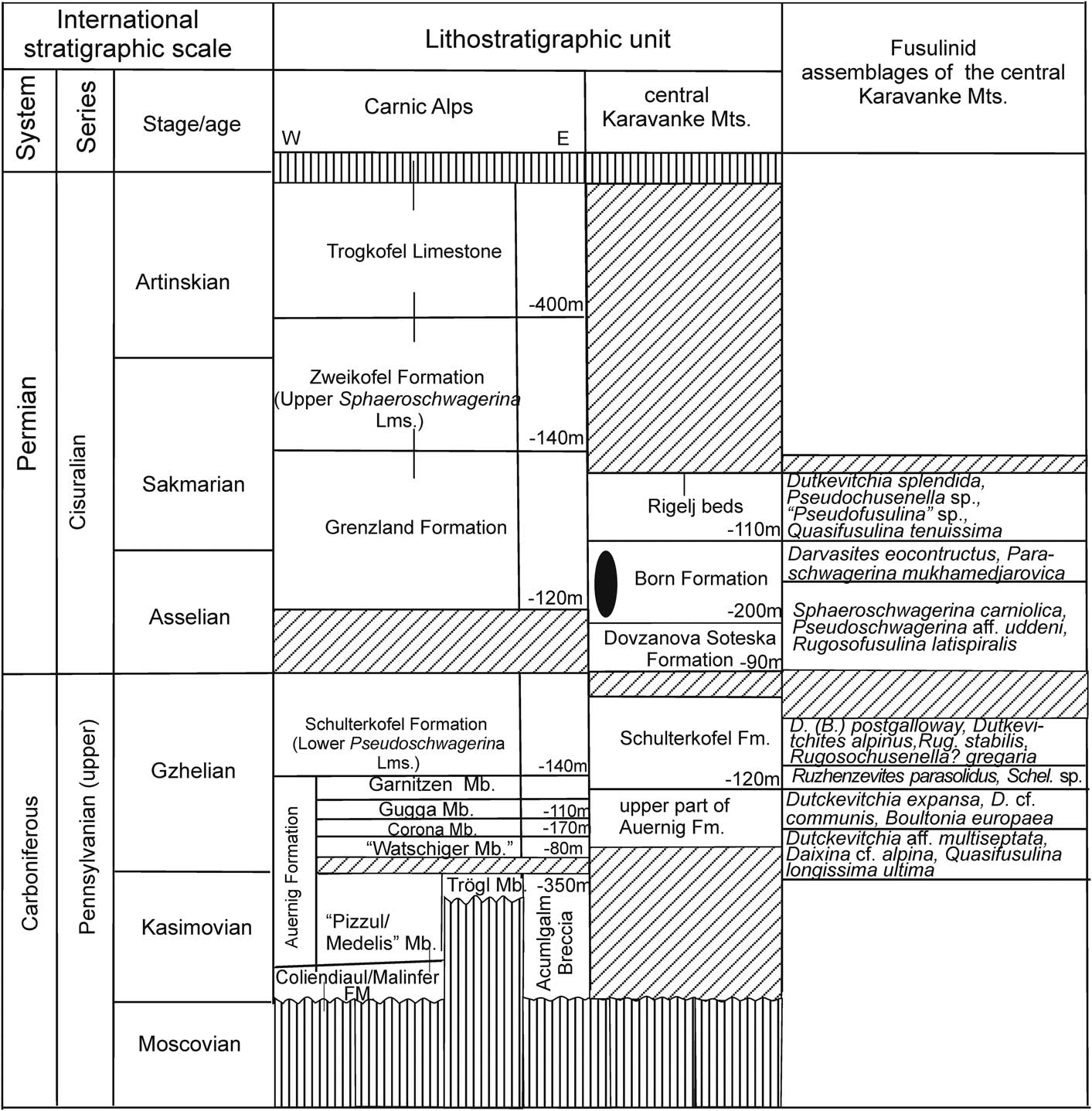
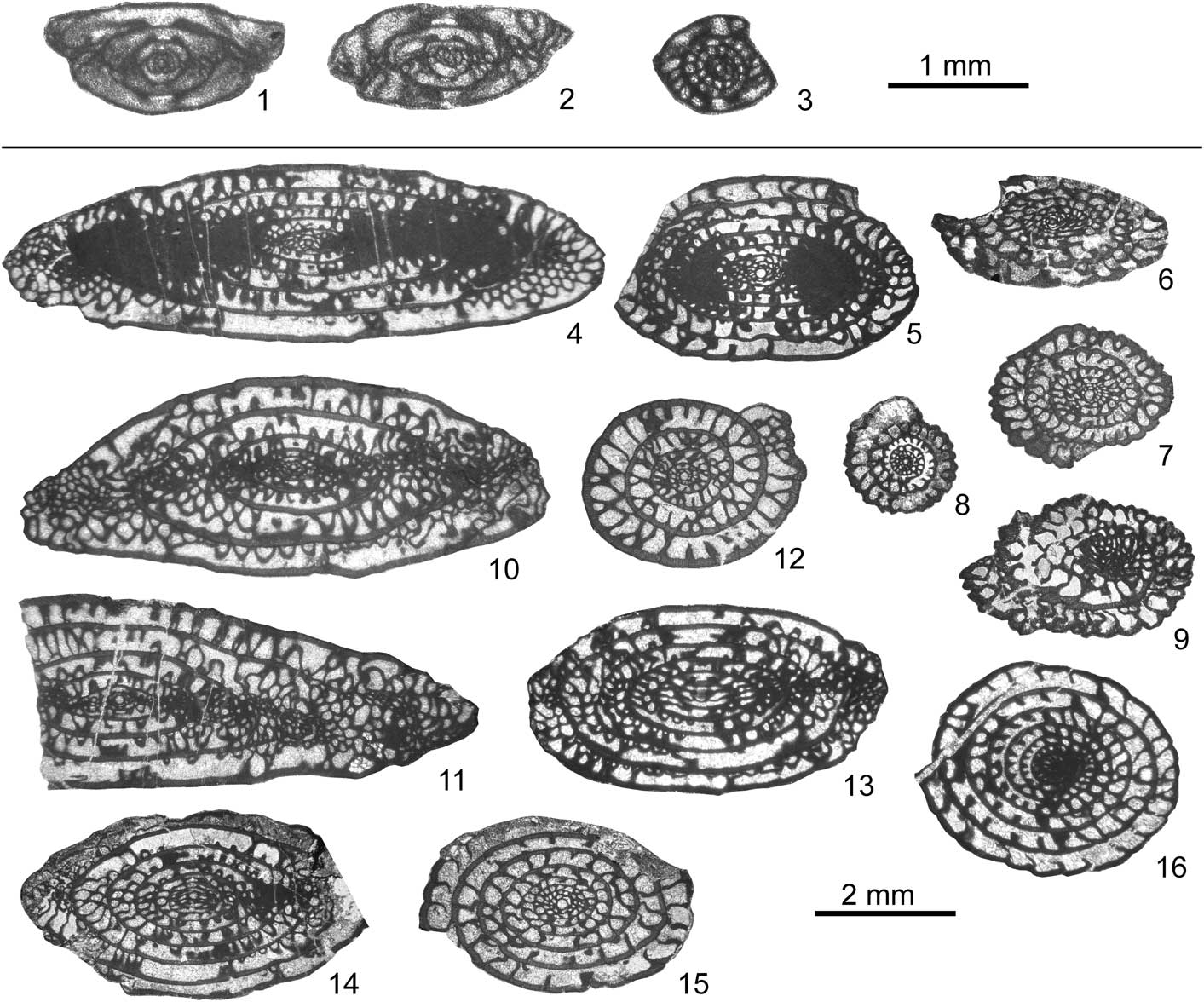
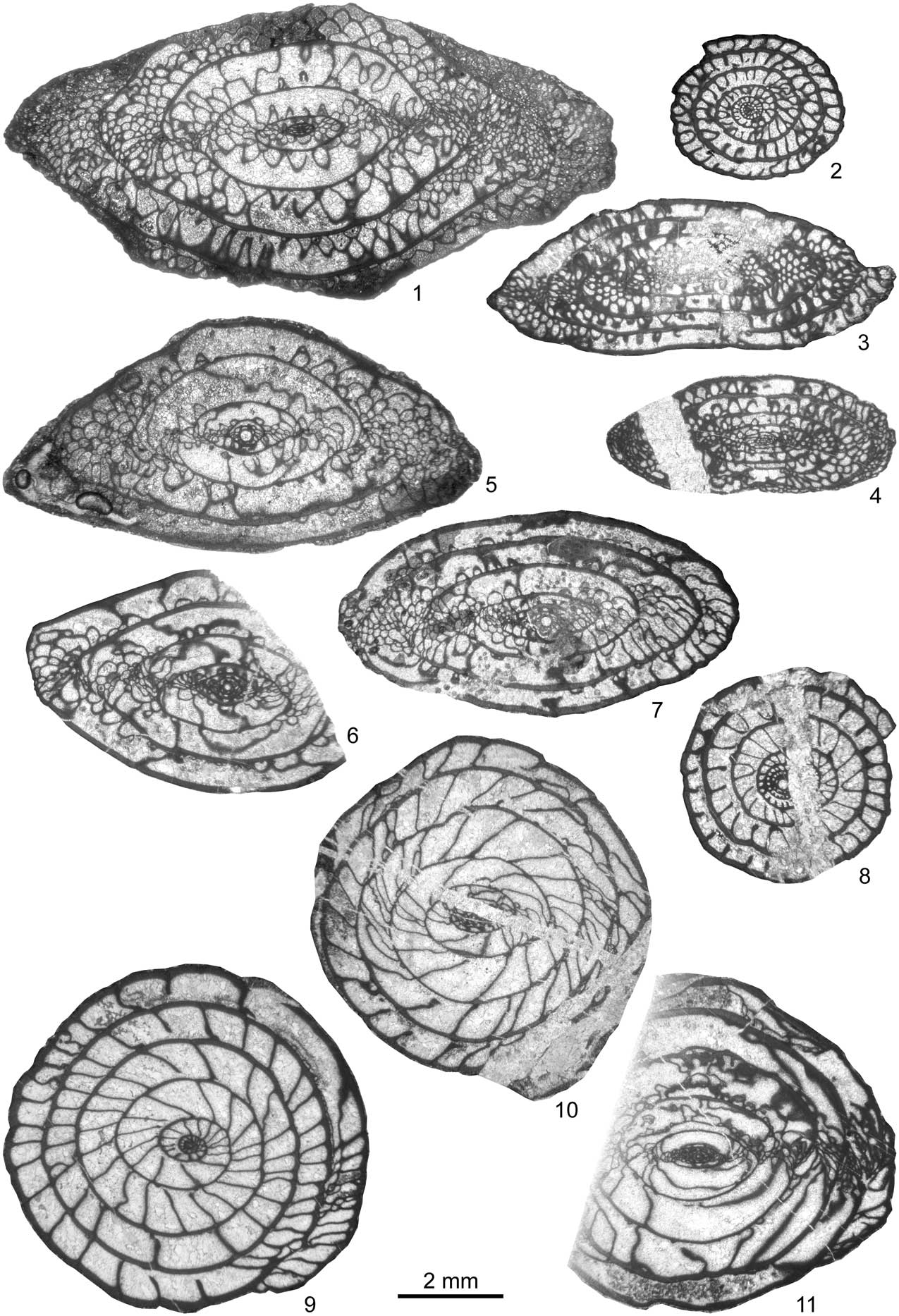
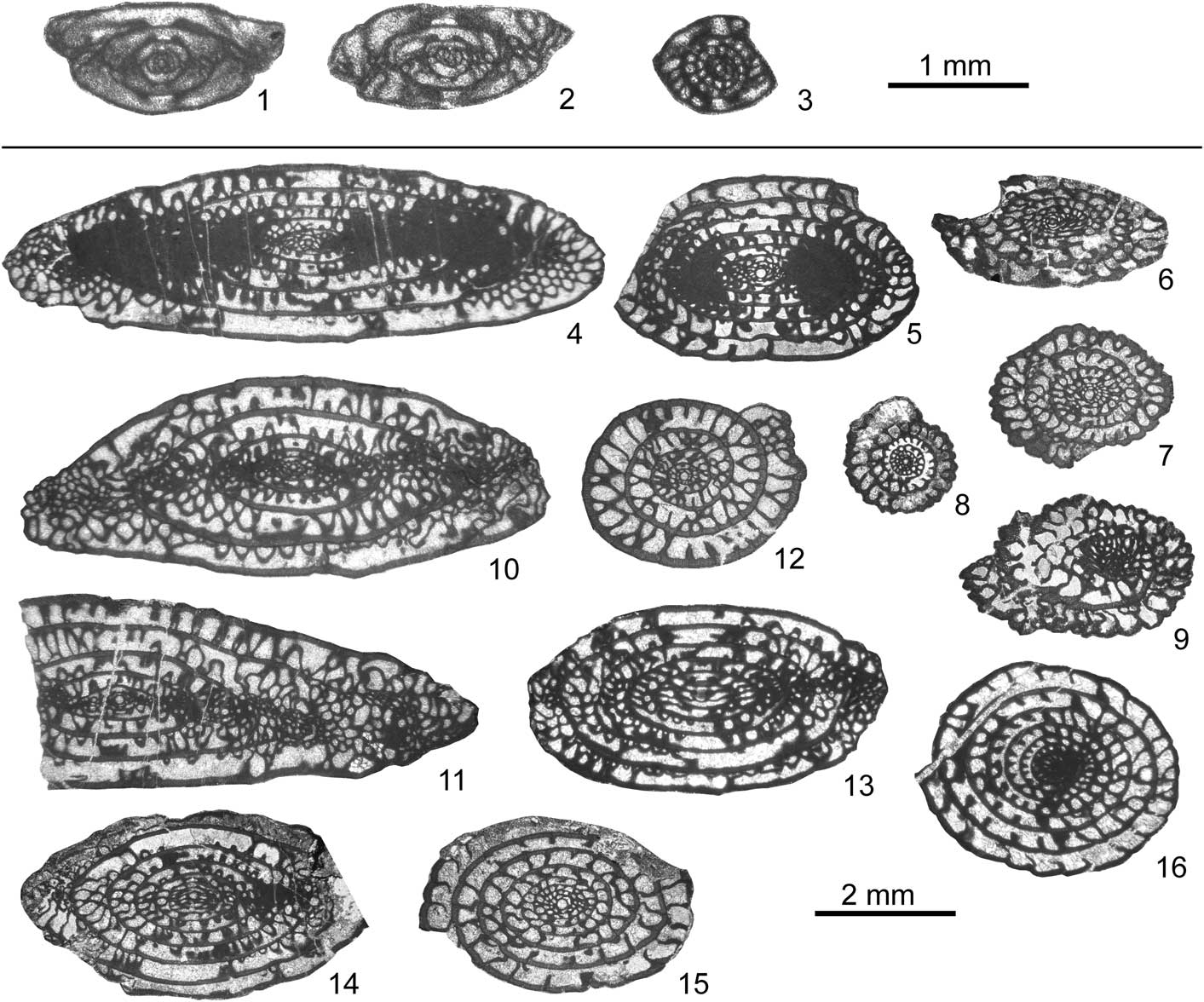
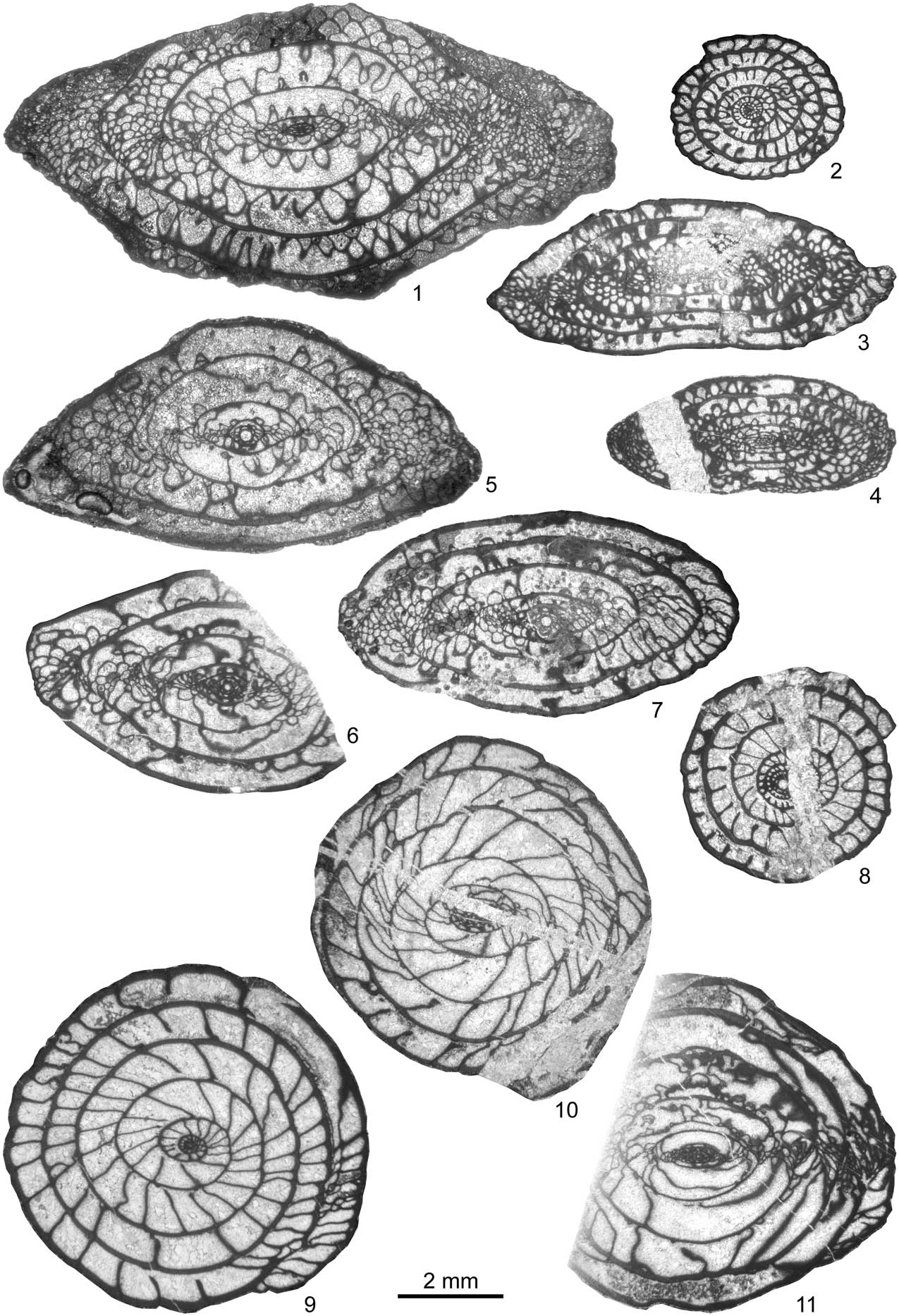
The fusulinoidean assemblage is characteristic of the Born Formation (Forke, Reference Forke2002), as represented by Sphaeroschwagerina carniolica, Rugosofusulina cf. likana Kochansky-Devidé, Reference Kochansky-Devidé1959, Paraschwagerina mukhamedjarovica, and Darvasites eocontractus in its stratotype (Forke, Reference Forke2002; Novak, Reference Novak2007; Figs. 4–6). Forke (Reference Forke2002) compared this assemblage with the fauna from the Southern Urals and pointed out the strong resemblance in both generic and specific composition. Species of the genus Sphaeroschwagerina Miklukho-Maklay, Reference Miklukho-Maklay1959 and the group of Rugosofusulina latispiralis Forke, Reference Forke2002 are present in many sections in the Southern to Northern Urals, and occur even in the Arctic realm (Vachard et al., Reference Vachard, Pille and Gaillot2010). A typical faunal element in both regions is also Pseudochusenella pseudopointeli (Forke, Reference Forke2002). Species of Pseudoschwagerina Dunbar and Skinner, Reference Dunbar and Skinner1936 from the lower part of the Born Formation are close to those of the Southern Urals (Pseudoschwagerina uddeni russiensis Rauzer-Chernousova and Shcherbovich, 1949, and Pseudoschwagerina beedei uralensis Rauzer-Chernousova and Shcherbovich, Reference Rauzer-Chernousova and Shcherbovich1949), where their first appearance defines the base of the middle Asselian. In the upper part of the Born Formation, representatives of the genus Darvasites become very abundant, especially Darvasites eocontructus and related species that constitute primitive forms of this genus. They were found in lower Sakmarian rocks in the Urals and Central Asia. However, a number of similar species have been recorded from the Asselian (Krainer and Davydov, Reference Krainer and Davydov1998; Forke, Reference Forke2002). Thus, the fusulinoidean assemblage of the Born Formation corresponds to the time interval between the Sphaeroschwagerina moelleri-Schwagerina fecunda and the Pseudofusulina moelleri zones, which indicates the late Asselian to early Sakmarian in the Southern Urals (Davydov and Popov, Reference Davydov and Popov1986; Davydov et al., Reference Davydov, Snyder and Spinosa1997; Forke, Reference Forke2002; Novak, Reference Novak2007). It is of note that the fusulinoidean fauna (and lithology) of the Kadirler section in NW Anatolia (Turkey) (Okuyucu and Göncüoglu, Reference Okuyucu and Göncüoglu2010) also are closely similar to those of the Born Formation.
Stratigraphic correlation of Upper Pennsylvanian and lower Permian units of the Karavanke Mts. and Carnic Alps, with position of the Stegovnik section (black dot).

Fusulinoidean assemblage of the Born Formation, Asselian–early Sakmarian, Stegovnik section, Karavanke Mts., Slovenia: (1–3) Schubertella australis Thompson and Miller, Reference Thompson and Miller1949, axial and oblique sagittal sections, Unit 7; (4) Pseudochusenella pseudopointeli (Rauzer-Chernousova in Shcherbovich, Reference Shcherbovich1969 ), axial section, Unit 1; (5) Pseudochusenella sp., axial section, Unit 7; (6–9) Rugosofusulina? minuta Forke, Reference Forke2002, oblique section through proloculus, two sagittal sections and oblique section, Unit 7; (10–12) “Pseudofusulina” sp., two axial sections and one sagittal section, Unit 1; (13–16) Darvasites eocontractus Leven and Shcherbovich, Reference Leven and Shcherbovich1980, two tangential sections, oblique sagittal section, and eccentric sagittal section, Unit 7.
Fusulinoidean assemblage of the Born Formation, Asselian–early Sakmarian, Stegovnik section, Karavanke Mts., Slovenia (continued): (1) Paraschwagerina pseudomira Miklukho-Maklay, Reference Miklukho-Maklay1949, eccentric axial section, Unit 5; (2, 3) Paraschwagerina mukhamedjarovica Rauzer-Chernousova, Reference Rauzer-Chernousova1949, eccentric sagittal section and poorly preserved axial section, Unit 5; (4) Paraschwagerina mukhamedjarovica Rauzer-Chernousova, Reference Rauzer-Chernousova1949, tangential section, Unit 7; (5–8) Pseudoschwagerina aff. uddeni (Beede and Kniker, Reference Beede and Kniker1924), three axial sections and sagittal section, Unit 5; (9, 10) Sphaeroschwagerina carniolica (Kahler and Kahler, Reference Kahler and Kahler1937), oblique section through proloculus and slightly oblique sagittal section, Unit 1; (11) Sphaeroschwagerina aff. carniolica (Kahler and Kahler, Reference Kahler and Kahler1937), axial section of a specimen with more irregular septal fluting in comparison with the type material, Unit 1.
Depositional environment
In its complete section in the Dovžan Gorge, the Born Formation documents a clear transgression, during which the sedimentary depocenter migrated from the shoreface toward the open-marine inner platform. The alternation of black, bedded, bioclastic grain- to packstones, biocalcarenites, oolites, sandy limestones, and quartz sandstones with shallow-water benthos in the Born Formation indicates deposition in an open lagoonal setting that was repeatedly affected by sedimentary influx from platform-margin oolitic and sand shoals. Some of the mixed carbonate-siliciclastic rocks have characters of debris-flow deposits (Novak, Reference Novak2007).
General characteristics of the coral assemblage
Schellwien (Reference Schellwien1898a, p. 697; 1898b, p. 361) mentioned Caninia aff. kokscharowi in faunal lists from the so-called “Trogkofel Limestone” (Heritsch, Reference Heritsch1938) at the Teufelsschlucht near Neumarktl (= currently Dovžanova Soteska near Tržič). This was later amended by Buser and Forke (Reference Buser and Forke1996) to the Dovžanova Soteska Limestone, as part of the Dovžanova Soteska Formation of Asselian age (Forke, Reference Forke2002). To date, this record remains dubious. Schellwien’s specimens are probably lost, and his original data were insufficient for today’s standards. The younger Born Formation (middle Asselian–lower Sakmarian) yields at least three different communities: small solitary ahermatypic Rugosa of the “Cyathaxonia facies,” a pseudocolonial Carinthiaphyllum Heritsch, Reference Heritsch1936 assemblage (already described from Slovenia by Gräf and Ramovš, Reference Gräf and Ramovš1965), and the hitherto undescribed shallow-water “caninioid” corals of the Stegovnik locality.
The nearest occurrence of a late Carboniferous–early Permian caninioid fauna is in the Carnic Alps (Austria/Italy), from where a few species (Caninophyllum gortanii Heritsch, Reference Heritsch1933; Caninia nikitini Stuckenberg, Reference Stuckenberg1905; Caninia sophiae Heritsch, Reference Heritsch1936; Caninia stuckenbergi Heritsch, Reference Heritsch1936; and Caninia fredericksi Heritsch, Reference Heritsch1936) were described by Heritsch (Reference Heritsch1936). Caninia sophiae, which was found in the Grenzlandbänke (Grenzland Formation) of Asselian–early Sakmarian age, is most similar to Preisingerella. Some features of Caninophyllum gortanii Heritsch, Reference Heritsch1933, such as lonsdaleioid dissepiments and general caninioid structure, are also developed in the new species.
Large caninioid corals are also widely distributed in the interval from the late Kasimovian up to the late Asselian or Sakmarian in the Urals (Stuckenberg, Reference Stuckenberg1895; Kossovaya, Reference Kossovaya1986), Spitsbergen (Fedorowski, Reference Fedorowski1975; Chwieduk, Reference Chwieduk2009, Reference Chwieduk2013), Central Asia (Kossovaya, Reference Kossovaya1992), and the Donets Basin (Fomichev, Reference Fomichev1953; Ogar, Reference Ogar2010). Locally, their presence is restricted to Late Pennsylvanian strata of the Samarskaya Luka at Volga River (Stuckenberg, Reference Stuckenberg1905; Kossovaya, Reference Kossovaya1986) and Novaya Zemlya (Gorskiy, Reference Gorskiy1938).
Systematic paleontology
Terminology
Lateral dissepiments (term of Hill, Reference Hill1956) are radially arranged on the flanks of septa, in contrast to the normal (peripheral) dissepiments of the marginarium (with an orientation parallel to the wall). The herringbone type of normal dissepiments was defined by Lewis (Reference Lewis1924, p. 393, fig. 1).
In the “amplexoid” phase of ontogeny, the brevisepta appear in the early or middle ontogeny of some caninioids. The number of major septa is indicated (following Faurot, Reference Faurot1909; Wright, Reference Wright1969; Weyer, Reference Weyer1972, p. 719, fig. 5a, and 1974, p. 354, fig. 4) by the last septum of every quadrant (genetically seen), which is always a major septum and never a minor septum, in spite of mostly having its morphological appearance. Thus, the traditional method of counting (by morphology) major septa and doubling this number in order to obtain the number of all septa does not work. The term archaetheca of Alloiteau (Reference Alloiteau1952, p. 591, 644) is used for the external wall of Rugosa, which appeared earlier than septa, while epitheca is a postseptal structure (Weyer, Reference Weyer1975, p. 25).
Subclass Rugosa Milne-Edwards and Haime, Reference Milne-Edwards and Haime1850
Order Stauriida Verrill, Reference Verrill1865
Suborder Caniniina Wang, Reference Wang1950
?Family Cyathopsidae Dybowski, Reference Dybowski1873
Genus Preisingerella new genus
Type species
Preisingerella stegovnikensis n. sp., upper Asselian–lower Sakmarian, Born Formation, Southern Karavanke Mts., Stegovnik Mountain, Slovenia.
Diagnosis
Large conical or cono-cylindrical solitary corals. Septa of two orders. Major septa reach the half of radius, with lateral dissepiments. Tabulae flat in the inner part, with rare tabellae on the flanks. Dissepiments interseptal (simple and herringbone), rarely lonsdaleioid. Lateral dissepiments appear in the middle ontogenetic stages and are well developed at maturity. External wall thin, without stereoplasmatic thickening. Early ontogeny of “caninioid” type with long duration of an “amplexoid” phase.
Etymology
In honor of Mr Davorin Preisinger, an amateur fossil collector who directed us to the rich type locality and presented a part of his collection to us.
Remarks
The new genus is doubtfully assigned to the family Cyathopsidae, following the systematics of Hill (Reference Hill1981). Among the taxa included in this family, genera with a “caninioid” type of ontogeny and showing some similarity to the new taxon were selected for direct comparisons. In addition, a few genera erected after 1981 were added. These comparable taxa include Caninia Michelin in Gervais, Reference Michelin1840, Arctophyllum Fedorowski, Reference Fedorowski1975, Fomichevella Fedorowski, Reference Fedorowski1975, Pseudozaphrentoides Stuckenberg, Reference Stuckenberg1904, Siphonophyllia Scouler in McCoy, Reference McCoy1844, Skolekophyllum Fomichev, Reference Fomichev1953, Conilophyllum Poty and Boland, Reference Poty and Boland1996, and Alekseeviella Kossovaya, Reference Kossovaya2001. Additional to the diagnosis given by Hill (Reference Hill1981), new morphological features have been described for some genera included in the Cyathopsidae. Interstitial tabellae were discovered in Siphonophyllia rivagensis Poty and Boland, Reference Poty and Boland1996 and some other species (Poty, Reference Poty2002).
The type genus of the family Cyathopsidae Dybowski, Reference Dybowski1873 or Caniniidae Hill, Reference Hill1939 is in need of revision. Cyathopsis d’Orbigny, 1849 (type species Caninia cornubovis Michelin, Reference Michelin1846) is generally declared to be a junior synonym of Caninia Michelin in Gervais, Reference Michelin1840, but even this remains unproven. The type species of Caninia is Caninia cornucopiae Michelin in Gervais, Reference Michelin1840, which was the base of the ontogenetic study of Carruthers (Reference Carruthers1908) and Salée (Reference Salée1910), though this is not supported by any definite choice of a holotype/lectotype/neotype. According to Vuillemin, Reference Vuillemin1990, p. 41, a “holotype” was destroyed in the town of Caen (France) during the Second World War. In contrast to Preisingerella, Caninia (sensu Carruthers, Reference Carruthers1908) bears a long counter septum in juvenile stages, but is similar in its early ontogeny with an “amplexoid” phase. Denayer et al. (Reference Denayer, Poty and Aretz2011, p. 156, pl. 3.A–D), discussing the ontogeny of Caninia cornucopiae, wrote, “counter septum often long and thickened, forming a weak columella.” Examining the topotypes of Carruthers (Reference Carruthers1908), we do not think that this is really an everted pseudocolumella. More probably, here we are dealing with different species within the famous upper Tournaisian coral fauna of the Belgian Tournai region.
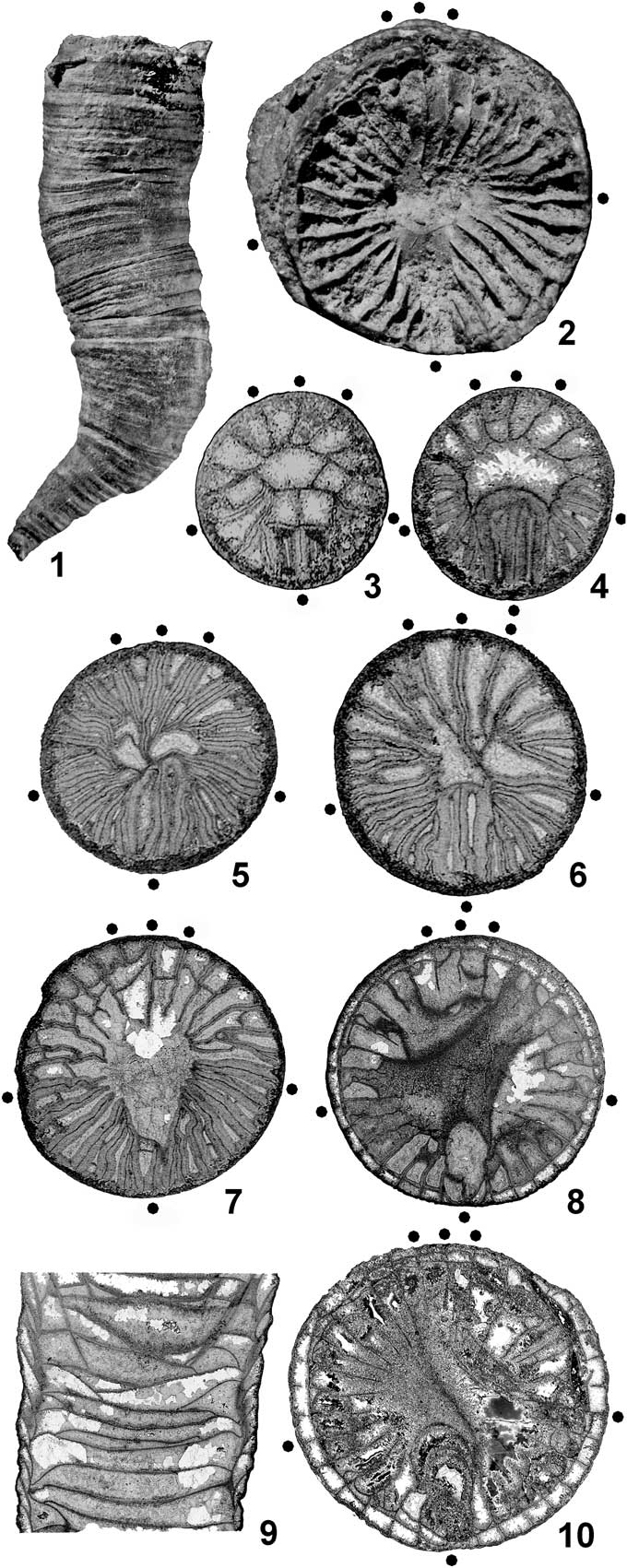
The local facies in the Tournai area indicates that Caninia is a pleonophorous ahermatypic coral of the Cyathaxonia facies (like Guerichiphyllum Różkowska, Reference Różkowska1969 in the Middle–Upper Devonian), described from such British lower Carboniferous occurrences by Hudson (Reference Hudson1943, Reference Hudson1945). One specimen housed in the Museum für Naturkunde Berlin was sectioned for comparison. It was found in the vicinity of the town of Tournai, thus being a topotype of Caninia cornucopiae. The new succession of thin sections demonstrates similarity with Carruthers’ (Reference Carruthers1908, pl. 6, fig. 1) specimen, but bearing an easily visible long cardinal septum in early stages (Fig. 7.3–7.6). The thin ring of lonsdaleioid dissepiments, absence of lateral dissepiments, and long counter septum in the immature stages are the main differences versus the new taxon.
Caninia cornucopiae Michelin in Gervais, Reference Michelin1840, topotype MB.K.2423., Museum für Naturkunde, Berlin, collection of 19th century, area around Tournai (northern flank of the Namur Synclinorium, Belgium), Late Tournaisian (Ivorian): (1) lateral view of coral, ×1,5; (2) calicular view, ×3; (3–8, 10) ontogenetic series of transverse sections, (3) ×8, (4–6) ×7, (7) ×4, (8, 10) ×3; it starts with a diameter of 3.5 mm earlier than in the comparable specimen of Carruthers (Reference Carruthers1908, pl. 6, fig. 1b: diameter 6 mm); the coral never developed a pseudocolumella as in the co-occurring Eostrotion tortuosum (Michelin, 1847) revised by Carruthers (Reference Carruthers1913); thus not identical with the so-called Caninia cornucopiae of Denayer et al. (Reference Denayer, Poty and Aretz2011, p. 156, pl. 3, figs. A–C), which seems to be nearer to Eostrotion Vaughan, Reference Vaughan1915; (9) mature longitudinal section, ×2.5.

Caninia sophiae (lower Permian, Carnic Alps) has long major and minor septa, no lateral dissepiments, with cardinal and counter septa as long as metasepta (Heritsch, Reference Heritsch1936, pl. 6, fig. 1–9). The quite different Preisingerella has a shortened cardinal septum in mature stages and well-developed lateral dissepiments. A varied assemblage of caninioid corals was recorded from the Karachatyrian Stage (Sebisurd and Khoridz formations) of the northern Pamir and northern Afghanistan (Pyzhjanov, Reference Pyzhjanov1980). These formations correspond to the Asselian and Sakmarian respectively. The assemblage includes Caninia mapingensis Lee and Yü in Yü, Reference Yü1934, Caninia fredericksi Heritsch, Reference Heritsch1936, and eight new undescribed species. Caninia hanseni Wilson and Langenheim, Reference Wilson and Langenheim1962 and two new species were assigned to Caninophyllum Lewis, Reference Lewis1929 (Pyzhjanov, Reference Pyzhjanov1980).
The mature stages of Siphonophyllia Scouler in McCoy, Reference McCoy1844 differ strongly from Preisingerella by the prominent ring of lonsdaleioid dissepiments. An ontogenetic comparison is also possible for two Belgian species: Siphonophyllia hastariensis (Salée, Reference Salée1913) and Siphonophyllia rivagensis. The first species shows a disconnection of the cardinal and counter septa during early ontogeny (Boland, Reference Boland1997, pl. 1, fig. 2). Its following section shows long septa coming to the center. Siphonophyllia rivagensis exhibits a narrow ring of lonsdaleioid dissepiments already in immature stages and a cardinal septum as long as other major septa. In the mature stage, the cardinal septum is thin and rather long, although slightly shorter than other major septa of cardinal quadrants (Boland, Reference Boland1997, pl. 2, fig. 5). Lateral dissepiments were not observed.
The ontogeny of Conilophyllum (Poty and Boland, Reference Poty and Boland1996; Boland, Reference Boland1997) reveals amplexoid immature stages and a wide tabularium without septa in the first section studied. Subsequent appearance of lonsdaleioid dissepiments and the absence of lateral dissepiments distinguish the genus from Preisingerella.
Arctophyllum Fedorowski, Reference Fedorowski1975, was based on the re-description of the type species Arctophyllum intermedium (Toula, Reference Toula1875). It shows the short counter septum in the early ontogeny, but later this septum is grown to full length as the others. According to Fedorowski (Reference Fedorowski1975, p. 43), “the neanic stage of ontogeny plerophylloid with particularly well developed alar septa and shortened counter septum.” The presence of longer alar septa and the absence of lateral dissepiments distinguish Arctophyllum from Preisingerella. A similar ontogeny was observed in Arctophyllum permicum Flügel, Reference Flügel1993 from the Sakmarian of the Kara-Dag Massif, southern-west Anatolia, Turkey. The earliest ontogeny of Arctophyllum was described in Arctophyllum lugankaense Ogar, Reference Ogar2010. Serial sections of specimens from Spitsbergen assigned to the type species and to Arctophyllum spitsbergense Chwieduk, Reference Chwieduk2013 exhibit the typical long lateral septa in immature stages (Chwieduk, Reference Chwieduk2013, figs. 9.A1, A2, 10.B, D, 11.B1). This feature was also observed in Arctophyllum minimum Kossovaya, Reference Kossovaya1986 (plate 15, fig. 1a, b, 2a), known from the uppermost Gzhelian deposits of Samarskaya Luka (Volga River), which had been considered as lower Permian before the international redefinition of the system boundary in 1996 during the 30th International Geological Congress in Beijing.
Fomichevella Fedorowski, Reference Fedorowski1975, earlier included within the Cyathopsidae (Hill, Reference Hill1981), was reassigned to the Kleopatrinidae Fedorowski, Bamber, and Stevens, Reference Fedorowski, Bamber and Stevens2007, with some doubts expressed by the authors of the family. The holotype of the type species Fomichevella hoeli (Holtedahl, Reference Holtedahl1913) from Western Spitsbergen was not located for restudy (Fedorowski et al., Reference Fedorowski, Bamber and Stevens2007, p. 81). Fedorowski et al. (Reference Fedorowski, Bamber and Stevens2007, p. 71) emended the diagnosis of Fomichevella to be, “Fasciculate Kleopatrinidae with axial structure weakly developed in immature growth stages or entirely absent; cardinal septum shortened in open cardinal fossula; lonsdaleioid dissepiments rare; tabularium biform while minor septa cross dissepimentarium.” Their diagnosis markedly differs from the previous one given by Fedorowski (Reference Fedorowski1975, p. 52), “…axial structure does not appear in any stages…”. It was also mentioned that this genus probably was in a phylogenetic relationship with “Caninia”. As indicated by Fedorowski (Reference Fedorowski1975), the type species did not show any columella and its ontogeny could not be studied. Thus, the family placement of the genus remains unsettled and the connection with other Kleopatrinidae is uncertain. The new specimens from Spitsbergen assigned to Fomichevella hoeli (Holtedahl, Reference Holtedahl1913) consisted of fasciculate colonies with incomplete corallites, but show the isolated immature stages without axial structure (Chwieduk, Reference Chwieduk2013, fig. 71, B1–2). In comparison, Preisingerella constitutes a solitary form, has no columella, a wide tabularium uncrossed by septa, and a dissepimentarium consisting of three types of dissepiments.
Skolekophyllum Fomichev, Reference Fomichev1953 is a cyathopsid with prominent lateral dissepiments and an amplexoid early stage. Originally, it was described as a subgenus of Campophyllum Milne-Edwards and Haime, Reference Milne-Edwards and Haime1850; the morphology of that genus was not well understood before the revision of Hill and Jull (Reference Hill and Jull1965). Similar features shared with Preisingerella are: occurrence in accumulations, minor septa short, well-developed lateral dissepiments. Most important is that both taxa have amplexoid early stages (e.g., Skolekophyllum tenue Fomichev, Reference Fomichev1953, pl. 17, fig. 18, 19). His description mentions that major septa are shorter and straighter in youth and become twisted in mature stages. Fomichev’s (Reference Fomichev1953, p. 299) diagnosis of Skolekophyllum noted, “Solitary strongly elongated conical corals with smooth outer surface. Major septa thin, well developed, partly do not come to the coral wall. Septa are strongly twisting and flexuous, especially in the dissepimentarium. They are partly interrupted by dissepiments. Dissepiments strongly curved and non-symmetrical. Minor septa are weakly developed; permanent stereoplasmatic thickening is absent, fossula indistinct. Tabulae flat in the center, splitting and sometimes uplifted at periphery.” A detailed investigation of the Fomichev Collection (CNIGR Museum, Saint Petersburg) shows a distinct fossula in early stages, with long septa next to the cardinal septum and reaching the center; all other major septa are also long and extend almost to the center. These features are absent in our new taxon.
Based on material from Kashirian deposits (Moscovian Stage) of the Moscow Basin, the genus Alekseeviella Kossovaya, Reference Kossovaya2001 differs in having a long counter and cardinal septa in early stages. The counter septum is longer than or equal in length to others in maturity (Kossovaya, Reference Kossovaya2001). A fossula is also well developed in Alekseeviella; there is no amplexoid phase, and the shortening of septa is characteristic of the mature stage of corals. The holotype of Alekseeviella irinae (Gorskiy in Fomichev, Reference Fomichev1939) (Gorskiy, Reference Gorskiy1978, pl. 5, fig. 11, p. 74; Fomichev, Reference Fomichev1939, p. 54, pl. 6, fig. 10) was collected from the Usva River, near the railway bridge, in the Central Urals (district of Perm), not from the Kosva River as erroneously indicated by Fedorowski (Reference Fedorowski2015, p. 25); its age could be middle Bashkirian to lower Moscovian.
The holotype of the type species Pseudozaphrentoides jerofeevi Stuckenberg, Reference Stuckenberg1904 is housed under the number 50/336, CNIGR Museum, Saint Petersburg (Stuckenberg, Reference Stuckenberg1904, p. 33, pl. 8, fig. 5, pl. 9, fig. 7). It was also illustrated by Fedorowski (Reference Fedorowski1975, p. 32, figs. 1b, 1c) and Hill, Reference Hill1981. It occured in the early Carboniferous (?Steshevian, lower Serpukhovian) in the Tula region, Podmokloe village (Ivanovskiy, Reference Ivanovskiy1987, p. 31). Despite numerous records from many countries, this is a poorly known genus. In his original diagnosis, Stuckenberg (Reference Stuckenberg1904) mentioned a shortening of the cardinal and two lateral septa—probably based on incorrectly identified protosepta. Fedorowski (Reference Fedorowski1975, p. 32, fig. 1b) illustrated the immature stages, which are, according to this author an amplexoid stage. The new, brief diagnosis (Fedorowski, Reference Fedorowski2015, p. 3) of the genus, based mostly on the holotype, is as follows, “The cardinal septum is not shortened, but is equal in length to most of the longest major septa; the cardinal fossula is narrow and open, marked by underdevelopment of the last pair of major septa in cardinal quadrants and by the curvature of sections of tabulae; the counter septum is either equal to adjacent major septa or shortened … dissepimentarium is narrow.” Until the ontogenetic development of Pseudozaphrentoides becomes better known, the well-developed lateral dissepiments and a short cardinal septum are the main distinguishing features of Preisingerella. Another genus that probably should be included in the Cyathopsidae is Ferganophyllum Kossovaya, Reference Kossovaya1992, some species of which were described from the Urals without a genus-level revision (Kossovaya, Reference Kossovaya1997). For now, Ferganophyllum should be considered as a nomen dubium, in need of redescription.
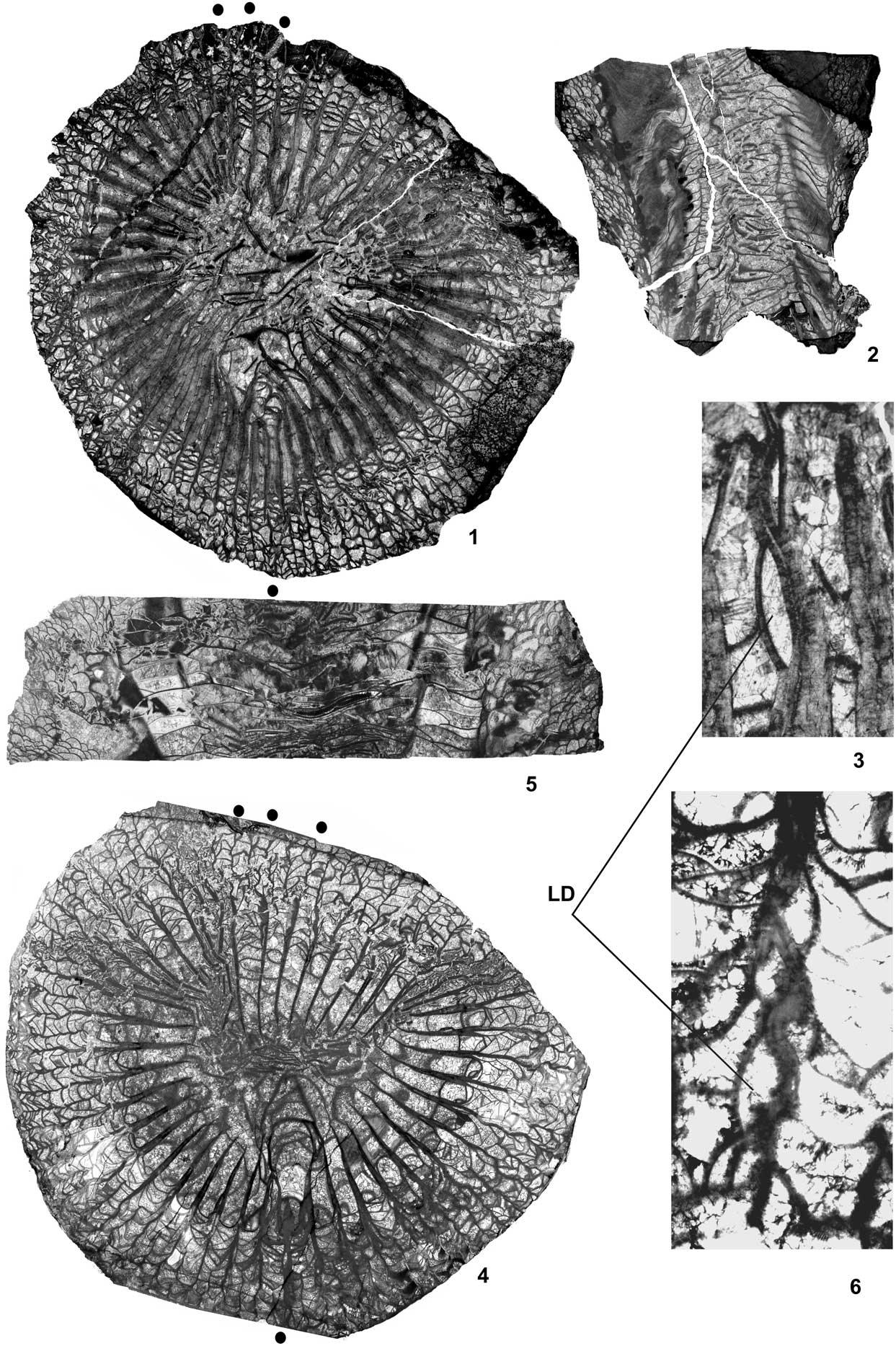
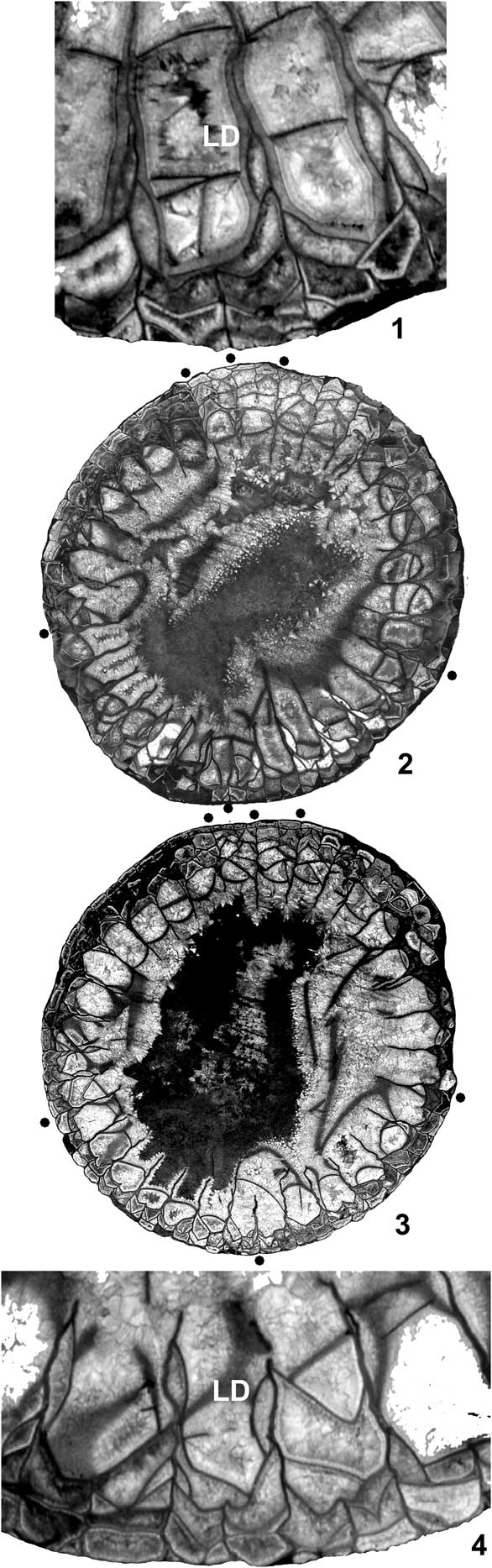
A genus that displays some similarity to specimens studied here is Caninella Gorskiy, Reference Gorskiy1938, which presently is assigned to the Bothrophyllidae Fomichev, Reference Fomichev1953 (Hill, Reference Hill1981). It has no axial structure, horizontally split tabulae, and rather long septa that do not reach the center of coral (Fig. 8). The type species, Caninella pulchra Gorskiy, Reference Gorskiy1938, is represented by a single specimen; its ontogeny was not studied. It was found in an erratic boulder of unknown precise age. According to Gorskiy, in the type species, “…the dissipiments are arranged at the different angles to septa...” (Gorskiy, Reference Gorskiy1938, p. 42). They were similar to those of Caninia juddiformis Gorskiy, Reference Gorskiy1938, bearing typical lateral dissepiments (Gorskiy, Reference Gorskiy1938, pl. 4, fig. 1). The holotype of Caninella pulchra (Gorskiy, Reference Gorskiy1938) (specimen 44a/5769, CNIGR Museum, Saint Petersburg), has rare lateral dissepiments in the tabularium. Interstitial tabellae are visible in transverse and longitudinal sections (Fig. 8.1–8.3). The dissepimentarium consists of various interseptal dissepiments, occasionally of herringbone type. Preisingerella differs by its well-developed lateral dissepiments (mostly at major septa) in the tabularium and its short major septa, which never reach the center.
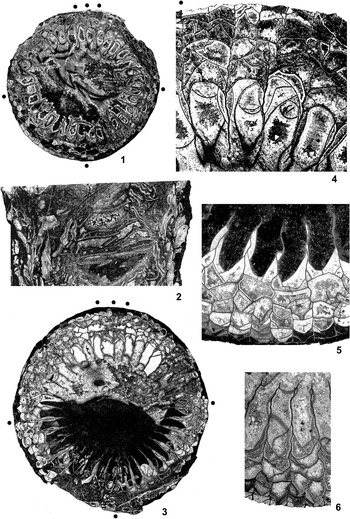
(1–3) Caninella pulchra Gorskiy, Reference Gorskiy1938, holotype 44/5769 CNIGR Museum Saint Petersburg, Novaya Zemlya (Northern Island), Russian Harbour, Carboniferous, Visean–Gzhelian, precise age unknown: (1) transverse section, with a few lateral dissepiments and long counter septum, ×2; (2) longitudinal section, ×2; (3) details of septum with lateral dissepiments (LD), ×10; (4–6) Caninella kokscharowi (Stuckenberg, Reference Stuckenberg1895), lectotype 139/305 CNIGR Museum, Saint Petersburg, selected by Ivanovskiy (Reference Ivanovskiy1987, p. 17, plate 11, fig. 1), Western Urals, Kolva River, “Kamen’ Diviy”, Pennsylvanian–lower Permian; (4) transverse section, ×2; (5) longitudinal section, ×2; (6) details of septum with lateral dissepiments (LD), ×14.
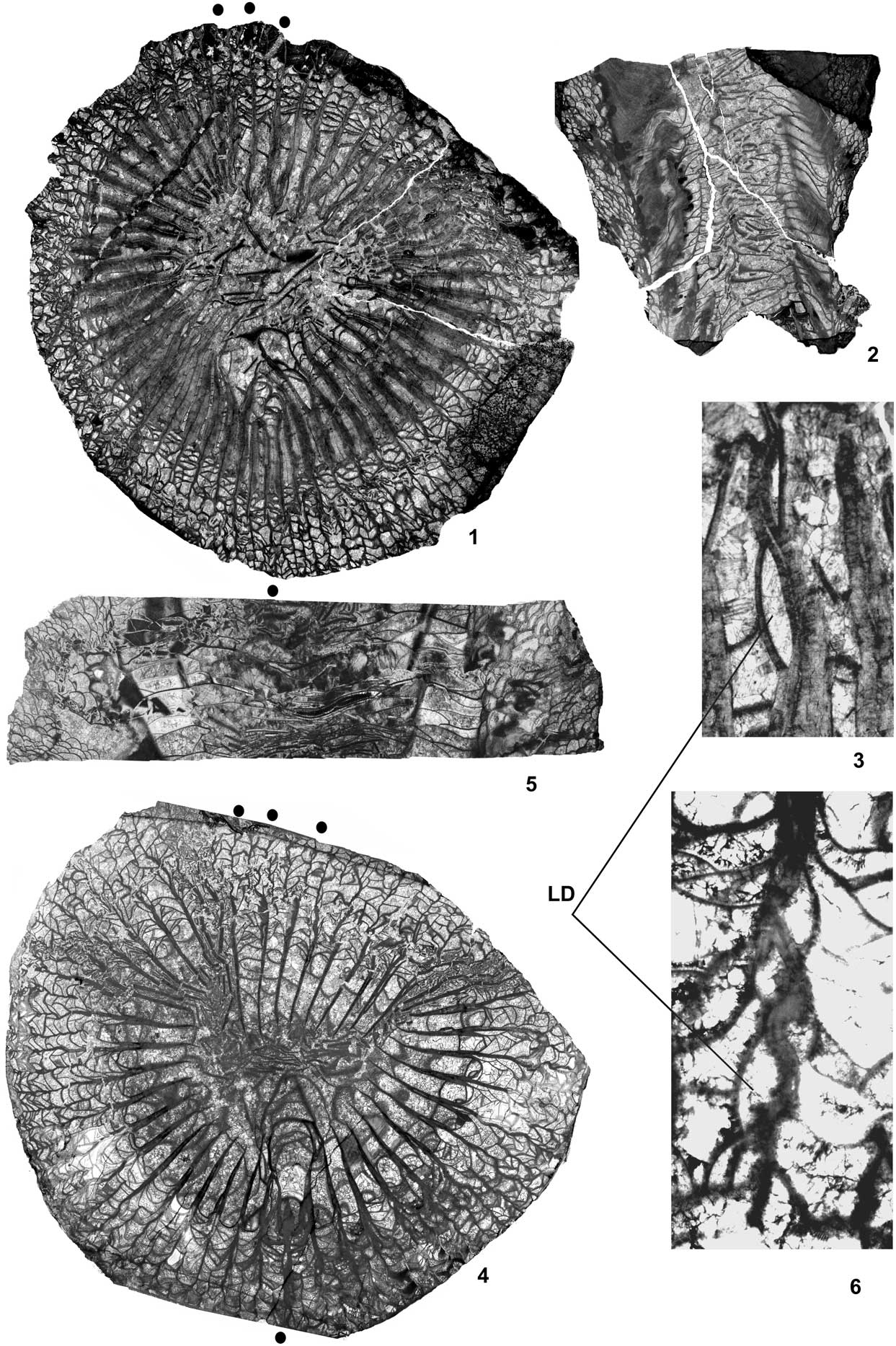
Caninella kokscharowi (Stuckenberg, Reference Stuckenberg1895), an additional species previously assigned to Caninia, also bears lateral dissepiments. Ivanovskiy (Reference Ivanovskiy1987, pl. 11, fig. 1) assigned it to Caninella and designated a lectotype without mentioning its locality (specimen 139/305, CNIGR Museum, Saint Petersburg). According to the primary label, it was found at the Kolva River, near rock “Kamen’ Divyi” in the Western Urals. The specimen demonstrates many lateral dissepiments, longer major septa, and a wider dissepimentarium in comparison with Preisingerella (Fig. 8.4–8.6). Additional material from “Kamen’ Boetz” and “Kamen’ Divyi” (Kolva River) was described and illustrated earlier, but no details of ontogeny were given (Grek, Reference Grek1936). The age of the species is not known precisely, although it could be Late Pennsylvanian–middle Artinskian. Some specimens of Caninella kokscharowi in the Stuckenberg collection (1895; no. 305, CNIGR Museum) have corroded epitheca and were probably allochtonous, transported by the river. The genus Caninella is placed in the Bothrophyllidae (Fomichev, Reference Fomichev1953; Hill, Reference Hill1981; Fedorowski, Reference Fedorowski2015), although its early ontogeny is still unknown. In addition, an axial structure, which is well developed in some representatives of the family, was not observed in the two species mentioned. In view of the fact that the ontogeny and the stratigraphic provenance of the type species Caninella pulchra are unknown, we are unable to assign the specimens described here as a new genus to Caninella with any confidence.
Preisingerella stegovnikensis new species
Figures 9.1–9.6, 10.1–10.4, 11.1–11.8, 12.1–12.4, 13.1–13.4, 14.1–14.6
Preisingerella stegovnikensis n. gen. n. sp.: (1–5) holotype, MB.K.2422.1., (1) transverse section no. 3, ×3; (2) longitudinal section no. 8, ×3; (3) calicular transverse section no. 9, ×3; (4) detail of transverse section no. 3, lateral dissepiments of major septa in peripheral tabularium, and dissepimental zone with short minor septa, ×12, right counter quadrant with marked antilateral septum; (5) the same details in calicular transverse section no. 11, ×8; (6) paratype MB.K.2422.4., detail of subtabular transverse section, lateral dissepiments at peripheral part, tabular “cysts” at axial part of major septa in tabularium, ×8.

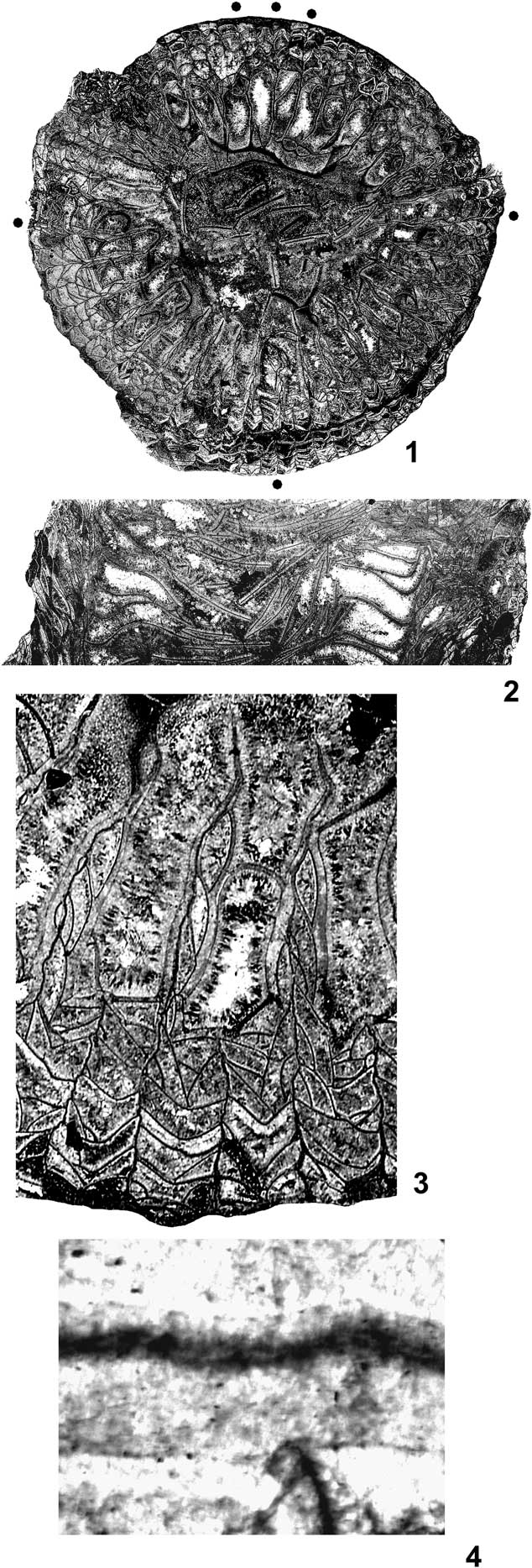
Preisingerella stegovnikensis n. gen. n. sp., paratype MB.K.2422.5.: (1) subtabular transverse section no. 1, × 2.5, (2) longitudinal section, ×2.5, (3) detail of transverse section no. 1, lateral dissepiments (often thickened by stereoplasma) at major septa in tabularium, ×10; (4) recrystallized septal microstructure, perhaps with relicts of trabiculae (?) in the dark median line, transverse section no. 1, ×50.

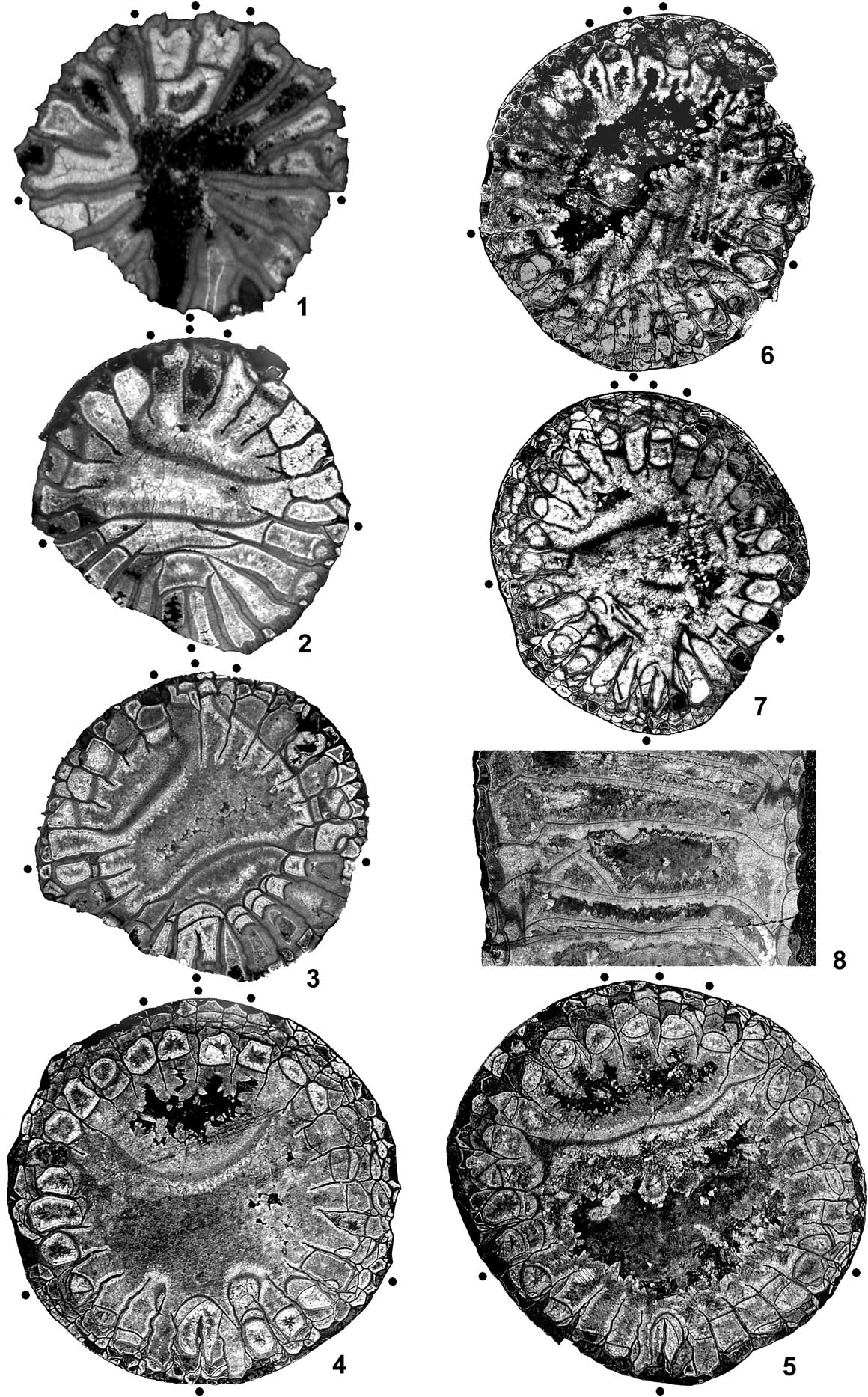
Preisingerella stegovnikensis n. gen. n. sp.: (1–3) paratype MB.K.2422.8., successive juvenile transverse sections (no. 1, 5, 9) still without lateral dissepiments, peripheral dissepimentarium just arising, (1) ×15 with almost completely corroded archaeotheca, (2) ×8, (3) ×6; (4, 5) paratype MB.K.2224.9., successive transverse sections no. 9 and no. 10, subtabular and at calicular base, ×6; (6, 7) paratype MB.K.2422.6., successive transverse sections, (6) ×4, (7) ×3.5 (further illustrations of the same specimen in Fig. 13.1–13.4); (8) paratype MB.K.2422.10., immature median longitudinal section with narrow dissepimentarium, ×5.

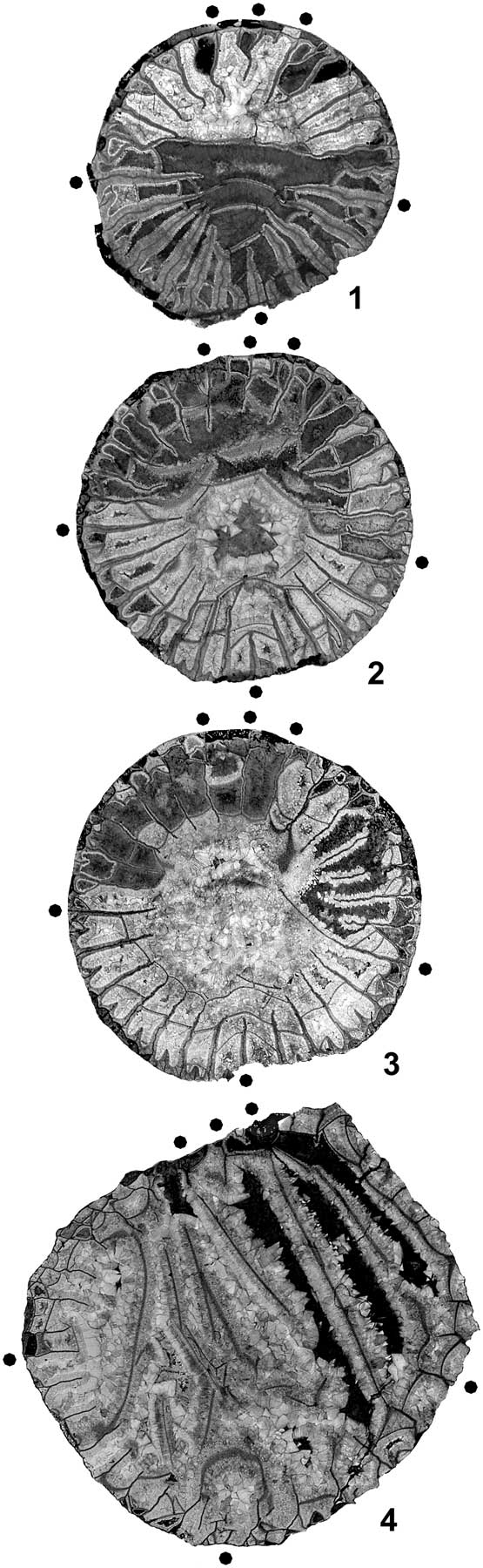
Preisingerella stegovnikensis n. gen. n. sp.: (1–4) paratype MB.K.2422.7., successive transverse sections (no.2, 4, 5, 8), (1) ×6; (2, 3, 4) ×5.

Preisingerella stegovnikensis n. gen. n. sp., paratype MB.K.2422.6.: (1) detail of transverse section no. 2, narrow herringbone dissepimentarium, minor septa very short, lateral dissepiments just appeared, ×15; (2, 3) successive transverse sections no. 4, no. 5, ×4; (4) detail of transverse section no. 5, lateral dissepiments at flanks of major septa, minor septa just entering the tabularium, ×15 (further illustrations of the same specimen in Fig. 11.6–11.7).

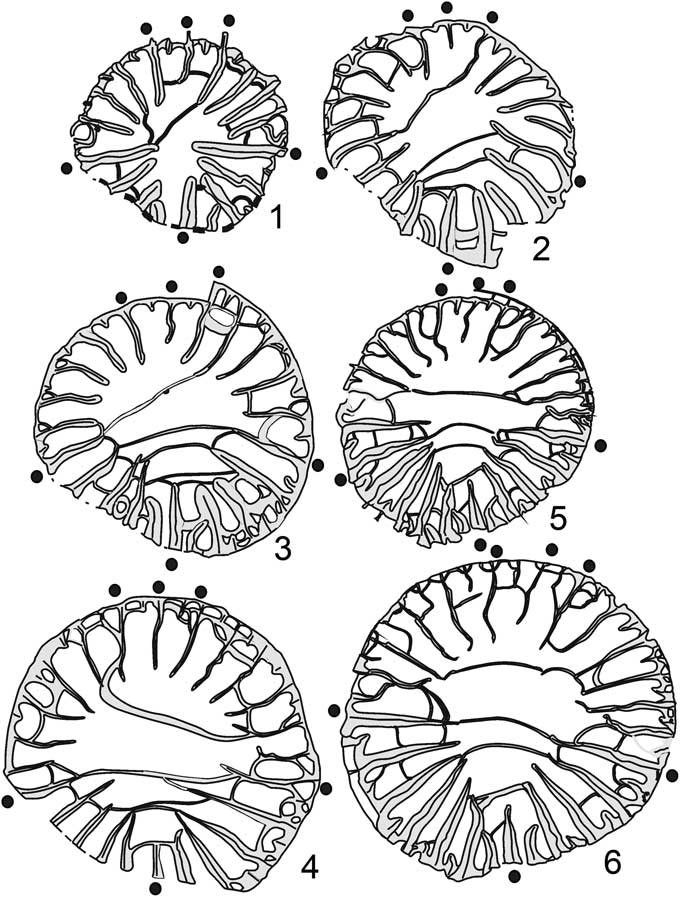
Preisingerella stegovnikensis n. gen. n. sp., line drawings of the early ontogeny: (1–4) paratype MB.K.2422.8., sections no. 1, 2, 3, 5, with first dissepiments appearing; (1–3) ×6; (4) ×5; (5–6) paratype MB.K.2422.7, typical phase with thickened septa only in cardinal quadrants, (5) section no. 2 ×3.5; (6) section no. 3 ×4.5.

Holotype
Specimen MB.K.2422.1. (11 transverse sections, 1 longitudinal section); upper Asselian–lower Sakmarian, Born Formation, southern Karavanke Mountains, Stegovnik Mountain. Co-ordinates of the locality are 46.399350, 14.413352 (WGS84).
Paratypes
Selected sectioned specimens, MB.K.2422.4.– MB.K.2422.10.
Diagnosis
Large solitary conical or cylindrical, straight or slightly cornute corals. In mature stages, major septa are short, thin, and extend across one-fourth of the tabularium. Minor septa are short and partly discontinuous in the periphery. The stereoplasma thickening of septa is nearly absent. Peripheral additional tabellae are developed rarely on the tabulae. Major septa bear lateral dissepiments, mostly in the peripheral tabularium. Dissepiments are interseptal, regular or herringbone type, rarely lonsdaleioid. An expanded and improved diagnosis could be given in future, pending assignment of additional species.
Etymology
Named after the type locality, the Stegovnik Mountain.
Occurrence
Upper Asselian–lower Sakmarian, Born Formation, southern Karavanke Mountains, Stegovnik Mountain ENE of Tržič, Slovenia.
Description
Solitary straight cylindrical, or slightly conical corals, 6–10 cm long in preserved fragments (reconstructed length about 10–15 cm); maximum diameter up to 5 cm. Archaetheca mostly corroded, extremely thin (Fig. 13.1, 13.2, 13.4), bearing only growth lines and very weak or even no longitudinal ribs. Depth of calice unknown, but estimated to be half of the diameter.
Septa of two orders (Table 1). Major septa are short and thin in the mature stages and never reach the center of the coral (Figs. 9, 10). Well-developed lateral dissepiments cover them replacing the former stereoplasma of juvenile stages (Figs. 9.3–9.5, 9.6, 10.3, 13.1, 13.4). They occur in the tabularium, either on one or on both sides of major septa, extending sometimes to their inner ends. Minor septa are very short, often discontinuous; protrude shortly in the tabularium or not extending beyond the dissepimentarium. They often appear as short pegs on the dissepiments (Fig. 9.3–9.6). The cardinal septum is short in an open fossula. The counter septum is equal in length to neighboring metasepta. Usually counter quadrants contain one to three major septa more than cardinal quadrants.
Measurements of diameter (D) and number of major septa in Preisingerella stegovnikensis n. gen. n. sp. (* holotype, ** TS = number of thin section)

The dissepimentarium consists at first of two or three rows of dissepiments (Fig. 13); later at maturity there are as many as 7–8 rows: interseptal regular or herringbone, and rarely lonsdaleioid. Inner part of the tabulae horizontal or convex-concave, occasionally with a shallow, broad axial depression. The outer part of tabulae descends towards the dissepimentarium, especially in cardinal fossula. Additional tabellae on the flanks of tabulae occur sporadically (Figs. 9.2, 11.8).
Ontogeny
Five thin sections of specimen MB.K.2422.8 were made to study early ontogeny. In the first available stage, there are 22 major septa (Fig. 11.1, 14.1). The wide free tabularium is crossed by one tabula. The cardinal septum is long and the counter septum is short. All major septa are thickened (those in the cardinal quadrant a little stronger). Minor septa protrude a very short distance into the tabularium and are always free. They never show any tendency to become contracline. This stage probably is comparable with the “vermicularis” phase (Carruthers, Reference Carruthers1908), which is distinguished by a short counter septum. The following stages have increased thickening of major septa in cardinal quadrants (Fig. 14.2, 14.3, 14.5, 14.6), which disappeared later (Fig. 14.4). The number of septa increased up to 27 or 28 (with diameter 8 or 9 mm) (Table 1). The cardinal septum is rather short in an open fossula, and the counter septum became longer (Fig. 14.4). The loss of major septal thickening in cardinal quadrants is reached at diameters of about 11 mm. Only a few first dissepiments appeared (Figs. 12.1, 12.2, 14.2).
At the next stage with breviseptal configuration (diameter 12.5–14.0 mm), septa became shorter and thinner, the tabularium is wide, and the dissepimentarium is well developed with constant two or three rows of simple or herringbone vesicles (Fig. 11.4, 11.5). One example with extremely short septa is shown in Figure 12.4. During later ontogeny (diameter 17–18 mm), septa are thin, rather short, and lateral dissepiments occur in the tabularium (Figs. 11.6, 11.7, 13.2, 13.3). Single lonsdaleioid dissepiments appear near counter septum (Fig. 13.2). They are more common in mature stages, and mostly interrupt minor septa, which reappear on the next vesicle as a short spine (Fig. 9.3).
Intraspecific variation
The minor septa have different lengths. They may be restricted to the dissepimentarium (Fig. 9.4–9.5) or they can enter the tabularium for a very short distance (Fig. 10.3). The specimen shown in Figure 10.3 differs in its adult major septa, which are more thickened both by stereoplasma and corresponding thickened lateral dissepiments. The time of appearance of lateral dissepiments varies with the diameter. At about 16–17 mm they are not yet present (Fig. 12.4) or developed (Fig. 13). They occur throughout the length of major septa in the tabularium (Fig. 9.5, 9.8) or are restricted to their peripheral part (Fig. 13.1). The full length of the counter septum is acquired earlier (Fig. 14.4) or later (Fig. 14.6).
Materials
About 100 specimens, collected in 2010, (collection number MB.K.2422). Sixty-seven serial thin sections were prepared from holotype and paratypes. An additional 59 transverse sections were prepared from eight non-illustrated specimens. The total collection includes 126 transverse sections and seven longitudinal sections; these have enabled a study of the complete sequence of ontogenetic stages. Additional unsectioned materials comprise about 85 specimens, mostly cut one or several times, and showing polished surfaces. All came from the above-mentioned type locality (Stegovnik section, bed 4).
Discussion
The restricted number of typical features in corals with “caninioid” mature stages requires a precise study of the ontogeny, which yields good results for our understanding of genera and their possible phylogeny. The importance of ontogeny for interpreting caninioid corals has been known since Carrruthers (1908), and was emphasized by Fedorowski (Reference Fedorowski1975, Reference Fedorowski2015). Other authors (Kossovaya, Reference Kossovaya1989; Poty and Boland, Reference Poty and Boland1996; Boland, Reference Boland1997) also paid special attention to such ontogenetic research. Knowledge of early and middle ontogenetic stages is indispensible for generic diagnoses of caninioids. Conventional taxonomy (Hill, Reference Hill1981) accepts a suborder Caniniina, but the majority of the many included genera are quite unrelated with the name-giving taxon.
The second most remarkable feature of the collection studied is the occurrence of lateral dissepiments, which appear at the end of the amplexoid phase. Lateral dissepiments are not a unique feature. They are well known to have arisen independently several times in genera that belong to different families. Examples include: Neokoninckophyllum Fomichev, Reference Fomichev1953 (Caniniina, Bothrophyllidae), which differs by having a long counter septum and pseudaxial structure (Fomichev, Reference Fomichev1953); Yunzhugophyllum Yu in Fan et al., Reference Fan, Yu, He, Pan, Li, Wang, Tang, Chen, Zhao and Liu2003, and a few species of Iranophyllum Douglas, Reference Douglas1936 (Wentzelellina Ding et al. in Lin et al., Reference Lin, Xu, Jia, Guo, Ouyang, Wang, Ding, Cao, Yan and Chen1995), which bear an axial structure and more than two orders of septa; Bunuophyllum Xu and Chen in Xu et al., Reference Xu, Wang, Chen and Shi1987 (Aulophyllina Hill, Reference Hill1981); and Qinglongshanophyllum Yu, 1980 (Protonaoticophyllina Xu in Lin et al., Reference Lin, Xu, Jia, Guo, Ouyang, Wang, Ding, Cao, Yan and Chen1995).
Conclusions
Preisingerella stegovnikensis n. gen. n. sp. is described on the basis of recently collected material from the lower Permian of the Karavanke Mountains, Slovenia. Taxon recognition is based on ontogeny and the structure of the dissepimentarium with interseptal, lonsdaleioid and lateral dissepiments. Consideration of similar Cyathopsidae (sensu Hill, Reference Hill1981) and some related genera described subsequently support erection of a new taxon, as does a comparison with Caninella kokscharowi (previously recorded from the region). On evidence of associated fusulinid foraminifera, the age of the assemblage is late Asselian–early Sakmarian.
Acknowledgments
We thank D. Preisinger (Kranj), an amateour fossil collector who directed us to the locality in the Karavanke Mts., which is rich in large-sized Paleozoic corals, and for donation of specimens in 2010. We also thank H. Forke for help with fusulinid identification. This work was supported by the Slovenian Research Agency (BI-RU/14-15-049 Project Biostratigraphy and correlation of late Paleozoic and Early Triassic rocks and P1-0011 Program Regional Geology), and the Russian Government Programme of Competitive Growth of Kazan Federal University. The investigations were supported by Grant RFBR 15-55-10007KO_a. We are grateful to S. Rodríguez and to I. Somerville for comments and recommendations. We are thankful to B. Pratt and R.J. Elias for their review of the manuscript. We appreciate I. Somerville and J. Yagt for editing and improving the English language. Thanks go also to N. Kadletz for many loans of coral specimens under her care in CNIGR Museum, Saint Petersburg, Russia.