I. INTRODUCTION
Magnesium has a long history of load bearing and non-load bearing application in industries spanning from automobile, aerospace, military, and electronic to biomedical. Reference Kainer, Von Buch and Kainer1–Reference Witte3 Unlimited natural existence (sixth most-abundant element in earth crust and third most-abundant element in seawater) with economic refining process Reference Kainer, Von Buch and Kainer1 guarantees possibility of limitless supply of magnesium for any industrial scale application. It is one of the lightest structural metallic materials with a density value of 1.74 g cm3, which is two-third that of aluminum, two-fifth that of titanium, and one fourth that of steel, Reference Callister4 with a potential to become substitute for existing common structural materials. It has high specific stiffness and strength, good damping capacity, excellent castability, and superior machinability. However, intrinsically poor ductility, relatively low strength coupled with poor corrosion resistance and low thermal stability became the cause of durable application of magnesium, which consequently reduced the massive application of magnesium in the middle of last century. Growing call for higher fuel efficiency, energy resources conservation, and environmental protection in last few decades has renewed the interest in magnesium based materials for structural application. Noticeably enormous research activities is underway to develop competitive magnesium based light weight structural materials mostly focusing on improvement of strength and ductility. Reinforcement with stiffer and thermally stable second phase have been considered to be one of the major initiatives in this regard, and reports Reference Lloyd5–Reference Ansell and Cahn11 suggested achievement of significant progress in improving these properties of magnesium beyond the limit dictated by traditional alloying process. Size, shape, volume fraction, distribution pattern, intrinsic properties of the reinforcement and their compatibility with the matrix dictate the resultant properties of the developed metal matrix composite. Types of reinforcement and its compatibility with the matrix during the processing are considered to be the critical aspect for metal matrix composite in achieving their end properties. Reports suggests that extremely fine reinforcements Reference Unverricht, Peitz, Riehemann and Ferkel7–Reference Ansell and Cahn11 or metastable precipitation, Reference Singh, Nakamura, Watanabe, Kato and Tsai12 and grain refinement Reference Yang and Lee13 could improve strength and ductility of reinforced magnesium materials simultaneously. It has been reported Reference Unverricht, Peitz, Riehemann and Ferkel7,Reference Hassan and Gupta10 that small volume fraction of thermally stable oxide ceramic particles reinforcement, like Al2O3, Y2O3, and ZrO2 in nano-size, were capable of strengthening as well improving the ductility of magnesium matrix when incorporated using powder processing. There are also discreet reports available on the effect of these nano-size oxide reinforcement on magnesium matrix when incorporated via solidification process, which provide relatively much higher reinforcement-matrix contact to offer better interfacial compatibility. Reference Eustathopoulos, Nicholas and Drevet14 However, no attempts has been reported in the open literature suggesting attempt to incorporate nano-size Al2O3, Y2O3, and ZrO2 particles in magnesium matrix using solidification process to study the effect of process and types of oxide ceramic on the microstructure and mechanical properties of commercially pure magnesium. Accordingly, the primary aim of this present study was to incorporate nano-size Al2O3, Y2O3, and ZrO2 particles in magnesium matrix using solidification process. The primary processed reinforced nanocomposites were hot extruded and characterized for microstructural and mechanical properties. Particular focus was the comparative study of the effect of the different types of oxide nano-particles on the microstructure and mechanical properties of solidification processed magnesium.
II. EXPERIMENTAL PROCEDURES
A. Materials
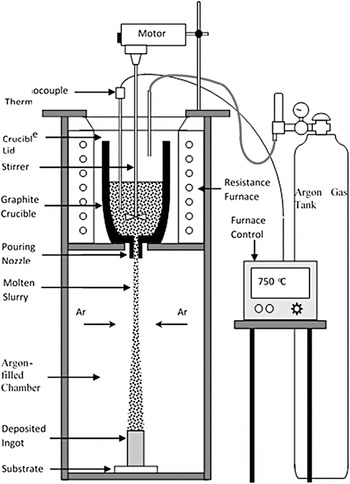
Magnesium in turning form with >99.9% purity (from ACROS Organics, Morris Plains, New Jersey) was used as matrix materials and oxide ceramic Al2O3 (average size of 50-nm, from Baikowski, Chiba, Japan), Y2O3, and ZrO2 (average size of 29-nm and 29–68-nm, respectively, from Nanostructured & Amorphous Materials Inc., Houston, Texas). The matrix was incorporated with 0.66 vol% of each of the reinforcement particle using solidification process called disintegrated melt deposition (DMD) process (see Fig. 1).
Schematic diagram of DMD technique.

B. Primary processing
DMD process of the reinforced nanocomposites involved melting and superheating the magnesium turnings with reinforcement particles to 750 °C under inert argon gas atmosphere in a graphite crucible. The superheated nanocomposite slurry was stirred at 460 rpm for 2.5 min using a coated steel twin blade (pitch 45°) stirrer to facilitate the incorporation and uniform distribution of reinforcement particles in the molten matrix. The nanocomposite slurry was then released through an orifice at the base of the graphite crucible and disintegrated by two argon gas jets, orientated normal to the slurry stream, and subsequently deposited onto a metallic substrate. The synthesis of monolithic magnesium was carried out using similar steps except that no reinforcement particles were added.
C. Secondary processing
The deposited monolithic and nanocomposites ingots were machined to 35 mm diameter and sectioned to 40 mm height billet. The machined billets were hot extruded to cylindrical rods of 8 mm diameter using an extrusion ratio of 19.1:1 at a temperature of 250 °C. Extrusion of each billet took ∼1 min and was conducted in open air on a 150 ton uniaxial hydraulic press. Colloidal graphite was used as lubricant. The machined billets were coated with colloidal graphite and held at a constant temperature furnace at 300 °C for 90 min prior to the extrusion.
D. Density measurement
Density of the extruded nanocomposites and monolithic magnesium measured in accordance with the Archimedes' principle. The samples were weighed in electronic balance, A&D ER 182-A, with an accuracy of ±0.0001 gm. Distilled water was used as immersion fluid. Theoretical densities of reinforced nanocomposites were estimated assuming fully-dense microstructure and absence of any reinforcement-matrix interfacial reaction to measure the volume percentage of porosity present in the extruded microstructure. Rule-of-Mixture was used in both of the calculations.
E. Microstructural characterization
Microstructural characteristics of the solidification processed reinforced nanocomposites and monolithic magnesium were studies on metallographically prepared extruded samples to investigate the nano-size oxide particles distribution pattern, reinforcement-magnesium matrix interfacial characteristics, and grain morphology. Hitachi S4100 field-emission scanning electron microscope (FESEM; Hitachi, Schaumburg, Illinois) and OLYMPUS optical microscope (Olympus, Tokyo, Japan) were used in this regard. Scion image analysis system was used to determine the grain morphology of the reinforced nanocomposite and monolithic magnesium.
F. Mechanical characterization
1. Hardness
Macro and microhardness of the nanocomposite and monolithic magnesium were measured on the polished extruded samples. Vickers microhardness measurement was conducted by Matsuzawa MXT50 automatic digital microhardness tester (Matsuzawa Co. Ltd., Tokyo, Japan) using an indentation load of 25 gf. Macrohardness measurements was conducted using Rockwell 15T superficial scale (Future-Tech Corporation, Kanagawa, Japan) in universal Rockwell hardness testing machine in accordance with ASTM E18-08 standard.
2. Tensile testing
Elongation-to-fracture tensile test was conducted on the extruded nanocomposites and monolithic magnesium samples in accordance with ASTM test method E8M-09. Instron 8516 machine (Instron Engineering Corporation, Norwood, Massachusetts) was used with a crosshead speed set at 0.254 mm/min on round tension test specimens of 5 mm diameter and 25 mm gauge length. Instron 2630-100 Series Clip-On type extensometer (Instron Engineering Corporation) was used for strain recording. Stress–strain curves obtained from the tensile tests were used to compute work of fractures (area under stress–strain curve) using excel software. Fracture surfaces of the tensile fractured samples were studied using JEOL JSM-5800 LV scanning electron microscope (JEOL Ltd., Tokyo, Japan) to investigate the failure mechanisms.
III. RESULTS
A. Macrostructural characteristics
Macrostructural characterization of the solidification processed nanocomposites ingots with different types of oxide reinforcement did not reveal any macrostructural defects. Surfaces of nanocomposite and monolithic magnesium rods were also smooth and free from any surface defects. Density measurement results shown in Table I reveled development of near dense nanocomposites irrespective of the type of oxide reinforcement, and also monolithic magnesium. Level of porosity was found to be highest in Al2O3 reinforced nanocomposite and lowest in Y2O3 reinforced nanocomposite.
Results of density, porosity, and grain morphology of processed nanocomposites.

B. Microstructural characteristics
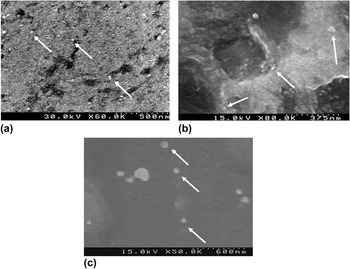
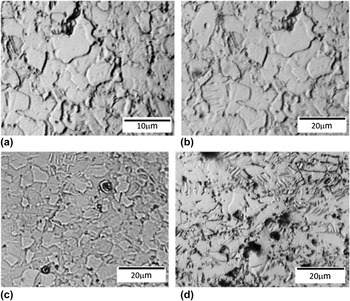
Microstructural characterization of the extruded nanocomposite matrices revealed that the process parameters used in this study was capable to reasonably distribute the nano-size oxides particles (see Fig. 2) with good interfacial integrity. Dispersed nano-size oxides has a significant grain refinement effect (see Table I and Fig. 3) on the magnesium matrix of the developed nanocomposites, indicating much better exploitation of grain refinement effect of Y2O3 and ZrO2 compared to Al2O3 particles.
FESEM micrographs showing distribution of reinforcement: (a) Al2O3, (b) Y2O3, and (c) ZrO2, respectively.

Optical micrographs showing grain morphology in: (a) monolithic, (b) Al2O3 reinforced, (c) Y2O3 reinforced, and (d) ZrO2 reinforced magnesium, respectively.

C. Mechanical characteristics
1. Hardness
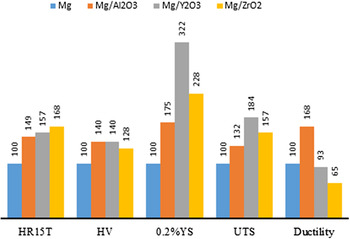
Hardness measurement on the different types of nano-size oxide reinforced nanocomposites revealed (see Table II and Fig. 4) significant improvement in hardness (both in macro and micro level) of the magnesium matrix.
Results of room temperature mechanical properties of processed nanocomposites.

Graph showing relative changes in mechanical properties of magnesium matrix in nanocomposite due to the incorporation of different types of oxide reinforcement.

2. Tensile characteristics
Room temperature elongation-to-fracture tensile tests results (see Table II and Fig. 4) revealed there was significant strengthening effect of the different types on nano-size reinforcement, used in this study, on the magnesium matrix of the processed nanocomposites. Formability of the magnesium matrix in the processed nanocomposites was experienced impressive enhancement in the presence of Al2O3, marginally reduced in the presence of Y2O3 and significantly reduced in the presence of ZrO2.
3. Fracture characteristics
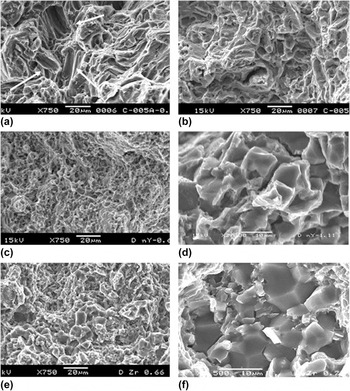
Study of tensile fracture surface revealed brittle cleavage fracture behavior of monolithic magnesium transformed to (see Fig. 5) ductile dimple type with incorporation of Al2O3, brittle intergranular type with incorporation of Y2O3 and ZrO2 reinforcement.
Fractographs showing magnesium matrix fracture mode when: monolithic (a), Al2O3 reinforced (b), Y2O3 reinforced (c, d), and ZrO2 reinforced (e, f), respectively.

IV. DISCUSSION
A. Microstructural characteristics
Microstructural characteristics of the solidification processed nanocomposites with different types of oxide reinforcement are discussed in terms of: (a) reinforcement particle distribution pattern, (b) matrix grain morphology, and (c) porosity level.
Reasonably uniform dispersion of the nano-size oxide particles (see Fig. 2) in the magnesium matrix of the developed nanocomposites can be attributed to the cumulative effect of primary solidification process and secondary thermomechanical extrusion process. Effect of solidification process in nano-size oxide particle dispersion in primary processed nanocomposite was derived from: (i) limited reinforcement agglomeration during matrix melting due to homogeneous arrangement of magnesium-oxide particle in melting crucible, (ii) minimal gravity induced reinforcement settlement due to effective stirring parameters, and (iii) reasonably good wettability of reinforcement by the matrix melt. Reference Eustathopoulos, Nicholas and Drevet14 Thermomechanical processing of primary processed nanocomposite, with a large deformation, further dispersed the reinforcement's in the magnesium matrix Reference Tan and Zhang16 in extruded microstructure. Almost zero standard deviation in experimentally measured density values (see Table I) of all the nanocomposites also reflects the uniform distribution of reinforcement particles in the magnesium matrices. Reinforcement-matrix interfacial integrity was found to be good as anticipated for oxide/metal system. Reference Eustathopoulos, Nicholas and Drevet14 Extent of reinforcement-matrix reaction was investigated by X-ray diffraction (XRD) techniques on identically processed nanocomposites with 10-vol% of reinforcement. XRD was done by exposing the samples to Cu Kα radiation (λ = 1.5418 Å) with a scan speed of 0.5°/min on an automated Shimadzu LAB-X XRD-7000 diffractometer. Obtained results revealed absence of any detectable reinforcement-magnesium reaction product when processed using the methodology used in this present work.
Extruded magnesium matrices of the nanocomposites experienced significant grain refinement due to the presence of nano-size reinforcement (see Table I and Fig. 3) irrespective of type of oxide reinforcement. Solidification process anticipated to induce grain refinement in the as cast microstructure, compared to the monolithic matrix, resulted from dispersed nano-size reinforcement particles in matrix due to vigorous stirring of reinforcement-matrix slurry prior to solidification. The dispersed enormous nano-oxide particles acted as nuclei in the solidifying melt and grain boundary pinning-site during progressive solidification. Reference Lee, Dahle and StJohn17 During thermomechanical secondary process the nano-oxide particles again acted as nucleation sites in recrystallization process and grain boundary pinning site, hence resulted in significantly refined grains in extruded matrices of nanocomposites. However, the study revealed that Y2O3 and ZrO2 particles were relatively better grain refiner compared to Al2O3 particles and the plausible reason might be higher thermal stability of the earlier two oxides in magnesium. Reference Unverricht, Peitz, Riehemann and Ferkel7,Reference Ansell and Cahn11,Reference Eustathopoulos, Nicholas and Drevet14,Reference Gilchrist18
Minimal porosity in the processed reinforced nanocomposites, corroborated by experimentally measured density values (see Table I), and attributed to the cumulative effect of process parameters used in both solidification and extrusion process.
B. Mechanical characteristics
1. Hardness
Hardness measurements of the nanocomposites (see Table II and Fig. 4) revealed that the presence of nano-size oxide reinforcement induced significant increment in the macro and microhardness of the magnesium matrix. The hardening effect of the oxide reinforcement used in this study could be attributed to the: (i) presence of harder ceramic particles, Reference Ferkel and Mordike6,Reference Unverricht, Peitz, Riehemann and Ferkel7 (ii) dispersed hard phase induced higher resistance to the localized deformation during test indentation, and (iii) reduced grain size. Reference Naser, Riehemann and Ferkel19
2. Tensile properties
Elongation-to-failure tensile test revealed significant increase in 0.2% yield strength (YS) and ultimate tensile strength (UTS) of magnesium matrices in the nanocomposites (see Table II and Fig. 4) irrespective of the types of oxide nano-size reinforcements. Cumulative effect of the following strengthening mechanisms apparently contributed to the 0.2% YS enhancement in magnesium matrices:
-
(i) Orowan Strengthening Mechanism: YS of the magnesium matrices increased due to the interaction between moving dislocations and dispersed fine hard oxide reinforcement particle, especially if the particles located within the grain.
-
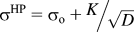
(ii) Hall–Petch Strengthening Mechanism: YS of magnesium matrices increased due to the interaction between moving dislocations and increasing grain boundary according to the relation Reference Callister4
 ${\sigma ^{{\rm{HP}}}} = {\sigma _{\rm{o}}} + {\raise0.7ex\hbox{$K$} \!\mathord{\left/ {\vphantom {K {\sqrt D }}}\right.\kern-\nulldelimiterspace}\!\lower0.7ex\hbox{${\sqrt D }$}}$
, where σo the friction stress, D the grain size, and K is a constant which depends on the stress direction. Hall–Petch strengthening effect was anticipated to be significantly higher in the cases of Y2O3 and ZrO2 particles reinforced matrices compared to Al2O3 particles reinforced matrix.
-
(iii) Increased Dislocation Density Strengthening: YS of magnesium matrices increased due to the increased dislocation density in the nanocomposite, generated due to the reinforcement-matrix elastic modulus (EM) and coefficient of thermal expansion (CTE) mismatch. YS increment can follow the relation Reference Dai, Ling and Bai20 :
 $${\sigma _{{\rm{my}}}} = {\sigma _{{\rm{mo}}}} + \Delta \sigma \quad ,$$
where σmy and σmo are YS of reinforced and monolithic matrix material, respectively, Δσ, the total increment in yield stress of the matrix due to the incorporation of thermally stable oxide particles and can be estimated by Reference Clyne and Withers21
 $$\Delta \sigma = \sqrt {{{\left( {\Delta {\sigma _{{\rm{EM}}}}} \right)}^2} + {{\left( {\Delta {\sigma _{{\rm{CTE}}}}} \right)}^2}} \quad ,$$
where ΔσEM and ΔσCTE are the strength increment due to mismatch in EM and CTE between reinforcement and matrix, which can estimated as Reference Clyne and Withers21 :
 $$\Delta {\sigma _{{\rm{EM}}}} = \sqrt 3 \alpha {\mu _{\rm{m}}}b\sqrt {\rho _{\rm{G}}^{{\rm{EM}}}} \quad ,$$
 $$\Delta {\sigma _{{\rm{CTE}}}} = \sqrt 3 \beta {\mu _{\rm{m}}}b\sqrt {\rho _{\rm{G}}^{{\rm{CTE}}}} \quad ,$$
where μm is matrix shear modulus, b is Burgers vector, and α and β are the two dislocation strengthening coefficients. The stiff and thermally stable reinforcement particles causes deformation incompatibility in matrix due to the presence of high dislocation density at their immediate vicinity. These geometrically necessary high dislocation density were evolved due to the differences in EM [390 GPa for Al2O3, Reference Callister4 (171.5 GPa), 22 205 GPa (Ref. Reference Callister4) for ZrO2 and 45 GPa for Mg (Ref. Reference Callister4)] and CTE [7.6 × 10⁻⁶/°C, Reference Callister4 7.6 × 10⁻⁶/°C, Reference Morrell23 11.0 μm/m °C (Ref. Reference Morrell23) for ZrO2 and 27.045 μm/m °C (Ref. Reference Smithells24) for Mg] of the oxide reinforcement particles and magnesium matrix. EM mismatch induced dislocation density can be estimated by Reference Fleck, Muller, Ashby and Hutchinson25 :
 $$\rho _{\rm{G}}^{{\rm{EM}}} = {{4\gamma } \over {b\lambda }}\quad ,$$
where γ is plastic shear strain and λ is local length of the deformation field. For particle reinforced nanocomposites, λ is related to the interparticle distance and considered to be approximately equal to r/f, where r is the particle radius and f is the volume fraction of the particles.
CTE mismatch induced dislocation density can be estimated by Reference Chawla and Chawla26 :
 $$\rho _{\rm{G}}^{{\rm{CTE}}} = {{A\varepsilon {V_{\rm{p}}}} \over {b(1 - {V_{\rm{p}}})d}}\quad ,$$
where A is a geometric constant, b is the Burgers vector, d is the diameter of the particle, V p is the particle volume fraction, and ε is the thermal misfit strain between the reinforcement and matrix. The equation predicts that, smaller diameter and higher volume fraction of the reinforcement yields higher dislocation density in the reinforced matrix.
The results obtained in this study indicated that Orowan strengthen mechanism and the Hall–Petch strengthening mechanism were the dominating strengthening mechanisms in all the developed nanocomposites while “increased dislocation density strengthening” mechanism played a minor role. In essence it is revealed that the Y2O3 and ZrO2 particles were relatively more effective in strengthening the magnesium matrices compared to Al2O3 particles.
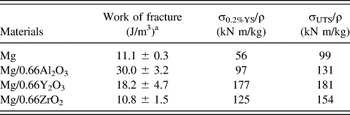
Ductility of magnesium matrices in the developed nanocomposites was differently affected (see Table II) due to the presence of nano-size oxide particles reinforcement. Presence of extremely fine oxide particles dispersion are capable in improving ductility of hexagonal close packed structured magnesium matrix due to the cumulative effects of: (i) grain refinement, Reference Yang and Lee13 (ii) uniform dispersion, Reference Ansell and Cahn11 and (iii) activation of non-basal slip system. Reference Goh, Wei, Lee and Gupta27 Al2O3 particles as reinforcement significantly improved the ductility magnesium matrix (see Table II and Fig. 4). However, despite being better grain refiner, Y2O3 and ZrO2 particles has adverse effect on the ductility of magnesium (see Table II and Fig. 4) and which could be attributed to the inability to introduce non-basal slip system in the matrix. The energy absorption capacity was calculated in terms of work of fracture using the stress–strain graphs, Reference Callister4 which revealed (see Table III) that fracture resistance of magnesium matrices in nanocomposites was impressively improved by Al2O3 and Y2O3 nano particles. However ZrO2 nano particles could not make any impression on the fracture resistance of the magnesium matrix.
Specific strength and work of fracture of processed nanocomposites.

a Determined from engineering stress–strain diagram using EXCEL software.
The result of this study revealed that all three oxide nano particles, i.e., Al2O3, Y2O3, and ZrO2, were effective in strengthening magnesium matrices. However, ductility of magnesium matrices was effectively enhanced by Al2O3 nano particles but reduced by ZrO2 nano particles. Nano-Al2O3 reinforced nanocomposite is effective for both strength based designs (higher YS when compared to monolithic magnesium) and damage tolerant designs (higher work of fracture when compared to monolithic magnesium). While nano-Y2O3 and ZrO2 reinforced nanocomposites are effective for only strength based designs (higher YS when compared to monolithic magnesium).
3. Fracture characteristics
Elongation-to-fracture tensile test fractured surfaces of the solidification processed materials revealed presence of microscopically rough small steps [see Fig. 5(a)] in monolithic magnesium indicating its relative less ductile nature. Reference Raynor28 Incorporation of nano- Al2O3 particles resize the rough small steps in to more circular shape like dimples [see Fig. 5(b)] reflecting the ductile nature of the nanocomposite. Nano-Y2O3 and ZrO2 particles, however, roughen the fracture surface [see Figs. 5(c) and 5(e)] with introduction of intergranular crack propagation mode [see Figs. 5(d) and 5(f)], which decreased the matrix ductility in the respective nanocomposite.
V. CONCLUSIONS
-
(1) Solidification process is effective in synthesize of magnesium nanocomposite with reasonably uniform dispersion of nano-size Al2O3, Y2O3, and ZrO2 particles reinforcement.
-
(2) Nano-size Y2O3 and ZrO2 particles were relatively better magnesium matrix grain refiner compared to nano-size Al2O3 particles.
-
(3) Oxides reinforcement in nano-size used in this study have strong strengthening effect on the magnesium matrix, where Y2O3 particles were most effective and Al2O3 particles were least effective.
-
(4) Ductility and resistance to fracture of magnesium was significantly improved by Al2O3 particles, unaffected by Y2O3 particles, and adversely affected by ZrO2 particles.